By
Shuvankar Madhu
Assistant Professor of Education
The University of Burdwan
PROGRAMMED INSTRUCTION
 In America it’s known as Programmed Instruction, and in
England it’s called as Programmed Learning.
 It is highly individualized and systematic instructional
strategy.
 Especially use in providing materials to the students of
Correspondence or ODL courses.
 It occupies of those subjects who requiring logical and
systematic study.
Teaching , Instruction and
Programmed Instruction
According to Edgar Dale, “Teaching is a broad, vague, ill-defined term and
Instruction is a purposeful orderly, controlled sequencing the experiences to
reach a specified goal.”
All instruction involves teaching but all teaching cannot be instruction.
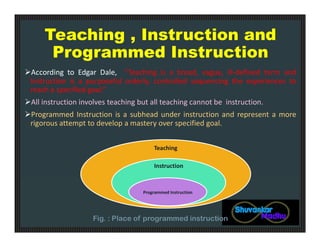
Programmed Instruction is a subhead under instruction and represent a more
rigorous attempt to develop a mastery over specified goal.
Fig. : Place of programmed instruction
Teaching
Instruction
Programmed Instruction
Definitions of Programmed
Instruction
Harold W. Bernard: “Programmed Instruction refers to the arrangement of
instructional material in progressive sequence.”
Edgar Dale : “Programmed Instruction is a systematic, step by step, self
instructional programme aimed to ensure the learning of stated behaviour.”
Espich & William : “Programmed Instruction is a planned sequence of
experience learning to proficiency in terms of stimulus response relationship that
have proven to be effective.”
Characteristics of Programmed
Instruction
Individualised instruction,
Logical sequence of material (small step),
Active response,
Immediate knowledge of the result,
Learners own speed (self-pacing),
Constant evaluation.
Principles of Programmed
Instruction
Principles of small steps,
Principles of active responding,
Principles of immediate reinforcement,
Principles of self – pacing,
Principles of students testing.
Advantages of Programmed
Instruction
Follows the maxim of Learning by doing,
No fixed time interval for learning,
Emphasis on individual differences and students involvement,
Students can learn by their own speed,
Learning becomes interesting game,
Useful – where human instructors are not available.
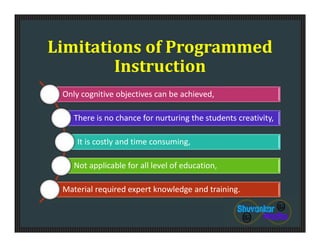
Limitations of Programmed
Instruction
Only cognitive objectives can be achieved,
There is no chance for nurturing the students creativity,
It is costly and time consuming,
Not applicable for all level of education,
Material required expert knowledge and training.
References
◦ Aggarwal, J.C. (2004). “Educational Technology- Management and
Evaluation”.vinod pustak mondir, agra-2.
◦ Kumar,K.L. (2006),Educational Technology. New Delhi: New Age
International Pvt. Ltd.
◦ Mangal, S.K. and Uma Mangal. (2010), Essentials of Educational
technology. New Delhi: PHI Learning Pvt, Ltd.
◦ Sampath,K., Panneerselvem,A .and Santhanam,S. (2004), Introduction to
Educational Technology. New Delhi: Sterling Publishers Pvt.Ltd.
◦ Srinivasan, P. and Muthumanickam, R,.(2010, August). An Innovative
computer assisted instructional programme. . Edutracks. 9(12).
Programmed Instruction: Basic concepts

Programmed Instruction: Basic concepts

  • 1.
    By Shuvankar Madhu Assistant Professorof Education The University of Burdwan
  • 2.
    PROGRAMMED INSTRUCTION  InAmerica it’s known as Programmed Instruction, and in England it’s called as Programmed Learning.  It is highly individualized and systematic instructional strategy.  Especially use in providing materials to the students of Correspondence or ODL courses.  It occupies of those subjects who requiring logical and systematic study.
  • 3.
    Teaching , Instructionand Programmed Instruction According to Edgar Dale, “Teaching is a broad, vague, ill-defined term and Instruction is a purposeful orderly, controlled sequencing the experiences to reach a specified goal.” All instruction involves teaching but all teaching cannot be instruction. Programmed Instruction is a subhead under instruction and represent a more rigorous attempt to develop a mastery over specified goal. Fig. : Place of programmed instruction Teaching Instruction Programmed Instruction
  • 4.
    Definitions of Programmed Instruction HaroldW. Bernard: “Programmed Instruction refers to the arrangement of instructional material in progressive sequence.” Edgar Dale : “Programmed Instruction is a systematic, step by step, self instructional programme aimed to ensure the learning of stated behaviour.” Espich & William : “Programmed Instruction is a planned sequence of experience learning to proficiency in terms of stimulus response relationship that have proven to be effective.”
  • 5.
    Characteristics of Programmed Instruction Individualisedinstruction, Logical sequence of material (small step), Active response, Immediate knowledge of the result, Learners own speed (self-pacing), Constant evaluation.
  • 6.
    Principles of Programmed Instruction Principlesof small steps, Principles of active responding, Principles of immediate reinforcement, Principles of self – pacing, Principles of students testing.
  • 7.
    Advantages of Programmed Instruction Followsthe maxim of Learning by doing, No fixed time interval for learning, Emphasis on individual differences and students involvement, Students can learn by their own speed, Learning becomes interesting game, Useful – where human instructors are not available.
  • 8.
    Limitations of Programmed Instruction Onlycognitive objectives can be achieved, There is no chance for nurturing the students creativity, It is costly and time consuming, Not applicable for all level of education, Material required expert knowledge and training.
  • 9.
    References ◦ Aggarwal, J.C.(2004). “Educational Technology- Management and Evaluation”.vinod pustak mondir, agra-2. ◦ Kumar,K.L. (2006),Educational Technology. New Delhi: New Age International Pvt. Ltd. ◦ Mangal, S.K. and Uma Mangal. (2010), Essentials of Educational technology. New Delhi: PHI Learning Pvt, Ltd. ◦ Sampath,K., Panneerselvem,A .and Santhanam,S. (2004), Introduction to Educational Technology. New Delhi: Sterling Publishers Pvt.Ltd. ◦ Srinivasan, P. and Muthumanickam, R,.(2010, August). An Innovative computer assisted instructional programme. . Edutracks. 9(12).