j
INTRODUCTION
The waste produced in the course of health care
activities carries a higher potential for infection
and injury than any type of waste. Therefore safe
and reliable method for its handling is essential.
Inappropriate methods in handling of health care
waste may have serious public health problems
and significant impact on health.
KEY FACTS
Of the total amount of waste generated by health-care activities,
about 85% is general, non-hazardous waste.
The remaining 15% is considered hazardous material that may be
infectious, toxic or radioactive.
Every year an estimated 16 billion injections are administered
worldwide, but not all of the needles and syringes are properly
disposed of afterwards.
Open burning and incineration of health care wastes can, under
some circumstances, result in the emission of dioxins, furans, and
particulate matter.
DEFINITION
According to bio-medical waste (management &
handling) rules, 1998 of India, “Biomedical waste is
a waste generated during the diagnosis, treatment
or immunization of human beings or animals or
research activities pertaining to or in production or
testing of biological” .
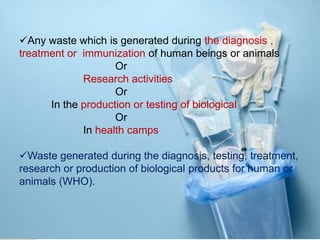
Any waste which is generated during the diagnosis ,
treatment or immunization of human beings or animals
Or
Research activities
Or
In the production or testing of biological
Or
In health camps
Waste generated during the diagnosis, testing, treatment,
research or production of biological products for human or
animals (WHO).
Types of waste
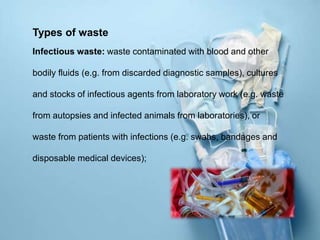
Infectious waste: waste contaminated with blood and other
bodily fluids (e.g. from discarded diagnostic samples), cultures
and stocks of infectious agents from laboratory work (e.g. waste
from autopsies and infected animals from laboratories), or
waste from patients with infections (e.g. swabs, bandages and
disposable medical devices);
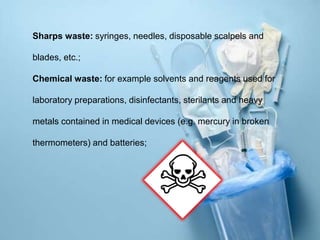
Sharps waste: syringes, needles, disposable scalpels and
blades, etc.;
Chemical waste: for example solvents and reagents used for
laboratory preparations, disinfectants, sterilants and heavy
metals contained in medical devices (e.g. mercury in broken
thermometers) and batteries;
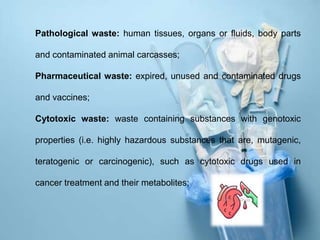
Pathological waste: human tissues, organs or fluids, body parts
and contaminated animal carcasses;
Pharmaceutical waste: expired, unused and contaminated drugs
and vaccines;
Cytotoxic waste: waste containing substances with genotoxic
properties (i.e. highly hazardous substances that are, mutagenic,
teratogenic or carcinogenic), such as cytotoxic drugs used in
cancer treatment and their metabolites;
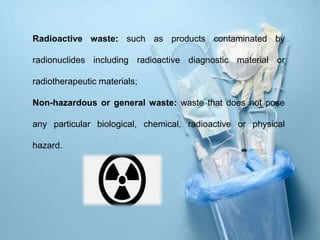
Radioactive waste: such as products contaminated by
radionuclides including radioactive diagnostic material or
radiotherapeutic materials;
Non-hazardous or general waste: waste that does not pose
any particular biological, chemical, radioactive or physical
hazard.
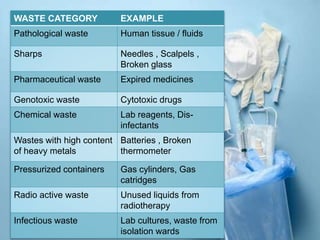
WASTE CATEGORY EXAMPLE
Pathological waste Human tissue / fluids
Sharps Needles , Scalpels ,
Broken glass
Pharmaceutical waste Expired medicines
Genotoxic waste Cytotoxic drugs
Chemical waste Lab reagents, Dis-
infectants
Wastes with high content
of heavy metals
Batteries , Broken
thermometer
Pressurized containers Gas cylinders, Gas
catridges
Radio active waste Unused liquids from
radiotherapy
Infectious waste Lab cultures, waste from
isolation wards
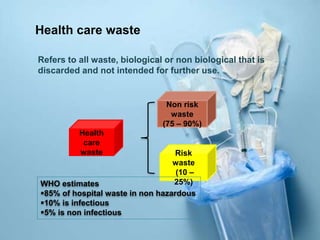
Health care waste
Refers to all waste, biological or non biological that is
discarded and not intended for further use.
Health
care
waste Risk
waste
(10 –
25%)
Non risk
waste
(75 – 90%)
WHO estimates
85% of hospital waste in non hazardous
10% is infectious
5% is non infectious
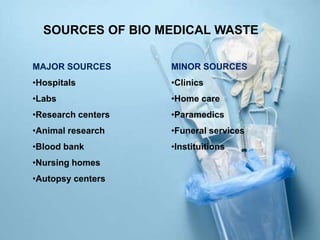
SOURCES OF BIO MEDICAL WASTE
MAJOR SOURCES
•Hospitals
•Labs
•Research centers
•Animal research
•Blood bank
•Nursing homes
•Autopsy centers
MINOR SOURCES
•Clinics
•Home care
•Paramedics
•Funeral services
•Instituitions
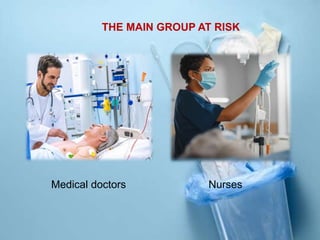
THE MAIN GROUP AT RISK
Medical doctors Nurses
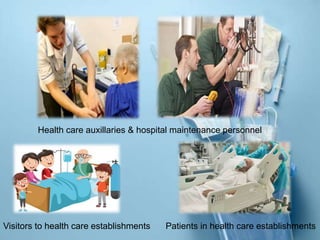
Health care auxillaries & hospital maintenance personnel
Patients in health care establishments
Visitors to health care establishments
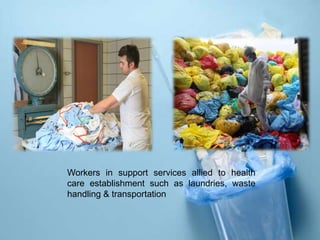
Workers in support services allied to health
care establishment such as laundries, waste
handling & transportation
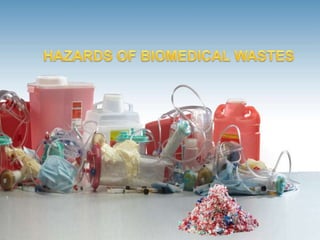
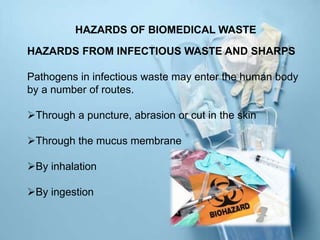
HAZARDS OF BIOMEDICAL WASTE
HAZARDS FROM INFECTIOUS WASTE AND SHARPS
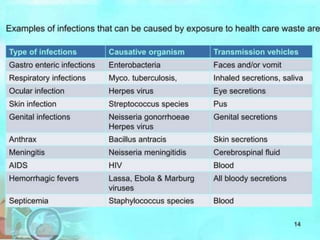
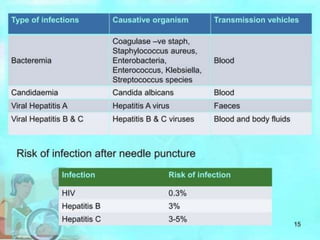
Pathogens in infectious waste may enter the human body
by a number of routes.
Through a puncture, abrasion or cut in the skin
Through the mucus membrane
By inhalation
By ingestion
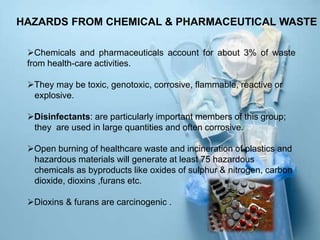
HAZARDS FROM CHEMICAL & PHARMACEUTICAL WASTE
Chemicals and pharmaceuticals account for about 3% of waste
from health-care activities.
They may be toxic, genotoxic, corrosive, flammable, reactive or
explosive.
Disinfectants: are particularly important members of this group;
they are used in large quantities and often corrosive.
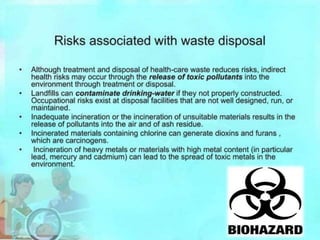
Open burning of healthcare waste and incineration of plastics and
hazardous materials will generate at least 75 hazardous
chemicals as byproducts like oxides of sulphur & nitrogen, carbon
dioxide, dioxins ,furans etc.
Dioxins & furans are carcinogenic .
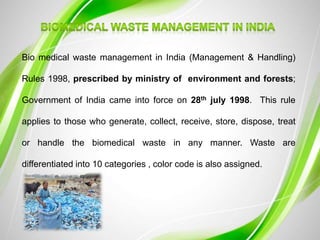
Bio medical waste management in India (Management & Handling)
Rules 1998, prescribed by ministry of environment and forests;
Government of India came into force on 28th july 1998. This rule
applies to those who generate, collect, receive, store, dispose, treat
or handle the biomedical waste in any manner. Waste are
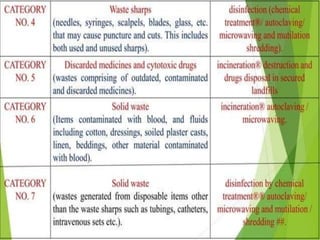
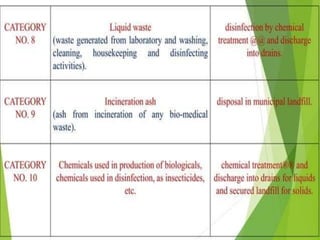
differentiated into 10 categories , color code is also assigned.
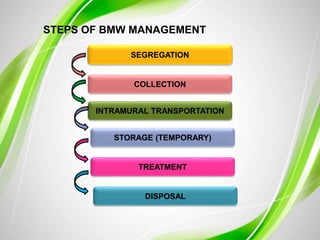
STEPS OF BMW MANAGEMENT
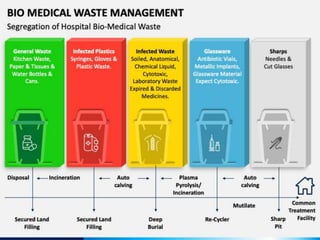
SEGREGATION
COLLECTION
INTRAMURAL TRANSPORTATION
STORAGE (TEMPORARY)
TREATMENT
DISPOSAL
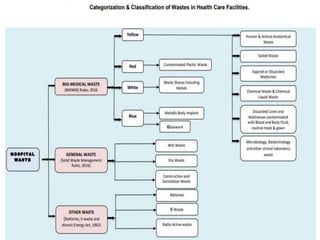
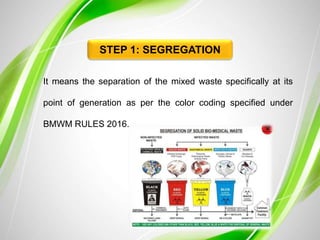
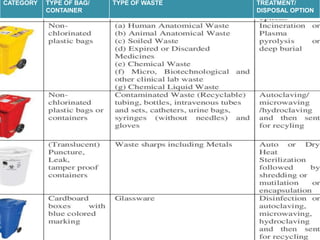
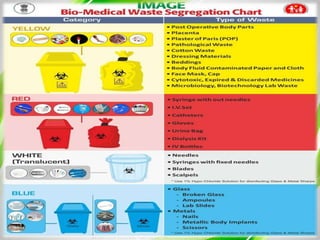
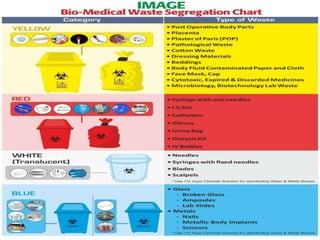
It means the separation of the mixed waste specifically at its
point of generation as per the color coding specified under
BMWM RULES 2016.
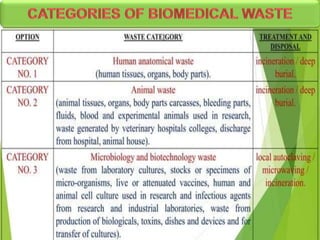
STEP 1: SEGREGATION
CATEGORY TYPE OF BAG/
CONTAINER
TYPE OF WASTE TREATMENT/
DISPOSAL OPTION
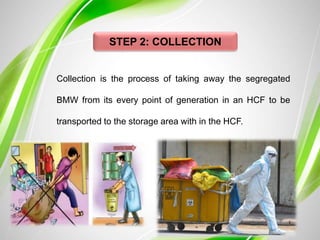
STEP 2: COLLECTION
Collection is the process of taking away the segregated
BMW from its every point of generation in an HCF to be
transported to the storage area with in the HCF.
Time of Collection
Bio-medical waste should be collected on daily basis from each ward
of the hospital at a fixed interval of time. There can be multiple
collections from wards during the day
HCF should ensure collection, transportation, treatment and disposal
of bio-medical waste as per BMWM Rules, 2016 and HCF should also
ensure disposal of human anatomical waste, animal anatomical waste,
soiled waste and biotechnology waste within 48 hours
General waste should not be collected at the same time or in the
same trolley in which bio-medical waste is collected.
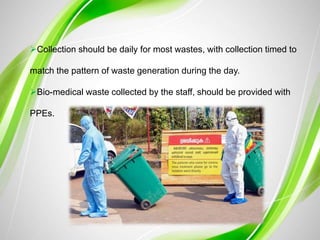
Collection should be daily for most wastes, with collection timed to
match the pattern of waste generation during the day.
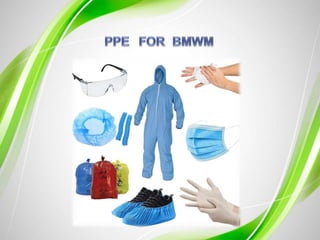
Bio-medical waste collected by the staff, should be provided with
PPEs.
PACKAGING
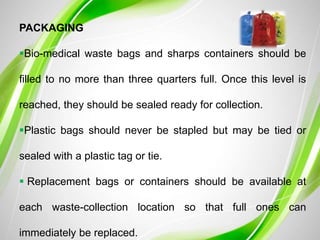
Bio-medical waste bags and sharps containers should be
filled to no more than three quarters full. Once this level is
reached, they should be sealed ready for collection.
Plastic bags should never be stapled but may be tied or
sealed with a plastic tag or tie.
 Replacement bags or containers should be available at
each waste-collection location so that full ones can
immediately be replaced.
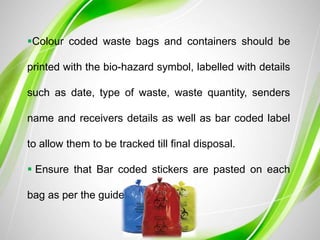
Colour coded waste bags and containers should be
printed with the bio-hazard symbol, labelled with details
such as date, type of waste, waste quantity, senders
name and receivers details as well as bar coded label
to allow them to be tracked till final disposal.
 Ensure that Bar coded stickers are pasted on each
bag as per the guidelines
LABELING
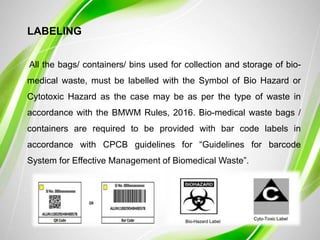
All the bags/ containers/ bins used for collection and storage of bio-
medical waste, must be labelled with the Symbol of Bio Hazard or
Cytotoxic Hazard as the case may be as per the type of waste in
accordance with the BMWM Rules, 2016. Bio-medical waste bags /
containers are required to be provided with bar code labels in
accordance with CPCB guidelines for “Guidelines for barcode
System for Effective Management of Biomedical Waste”.
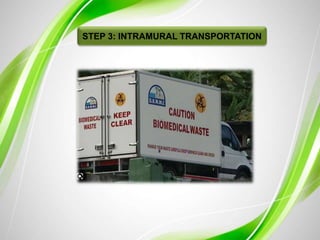
STEP 3: INTRAMURAL TRANSPORTATION
IN HOUSE TRANSPORTATION OF BIO MEDICAL
WASTE
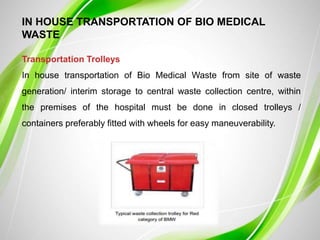
Transportation Trolleys
In house transportation of Bio Medical Waste from site of waste
generation/ interim storage to central waste collection centre, within
the premises of the hospital must be done in closed trolleys /
containers preferably fitted with wheels for easy maneuverability.
ROUTE OF INTRAMURAL TRANSPORTATION OF
BIO-MEDICAL WASTE
Route of transportation preferably be planned in such a way
that:
Transportation does not occur through high risk areas
 Supplies and waste are transported through separate routes.
 Waste is not transported through areas having high traffic of
patients and visitors
Central Waste collection area can be easy accessed through
this route
Safe transportation of waste is undertaken to avoid spillage and
scattering of waste
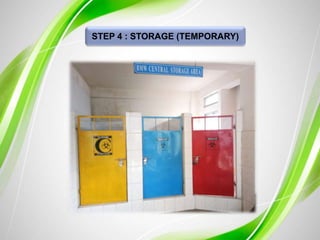
STEP 4 : STORAGE (TEMPORARY)
INTERIM STORAGE
 Interim storage of bio medical waste is discouraged in the
wards / different departments of HCF.
 If waste is needed to be stored on interim basis in the
departments it must be stored in the dirty utility/sections.
 No waste should be stored in patient care area and
procedures areas such as Operation Theatre. All infectious
waste should be immediately removed from such areas.
 In absence of dirty utilities/ sections such BMW must be stored
in designated place away from patient and visitor traffic or low
traffic area.
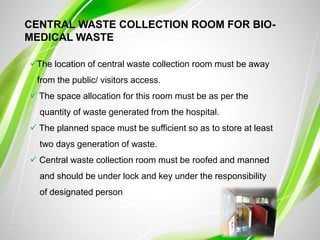
CENTRAL WASTE COLLECTION ROOM FOR BIO-
MEDICAL WASTE
The location of central waste collection room must be away
from the public/ visitors access.
 The space allocation for this room must be as per the
quantity of waste generated from the hospital.
 The planned space must be sufficient so as to store at least
two days generation of waste.
 Central waste collection room must be roofed and manned
and should be under lock and key under the responsibility
of designated person
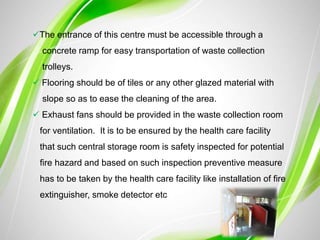
The entrance of this centre must be accessible through a
concrete ramp for easy transportation of waste collection
trolleys.
 Flooring should be of tiles or any other glazed material with
slope so as to ease the cleaning of the area.
 Exhaust fans should be provided in the waste collection room
for ventilation. It is to be ensured by the health care facility
that such central storage room is safety inspected for potential
fire hazard and based on such inspection preventive measure
has to be taken by the health care facility like installation of fire
extinguisher, smoke detector etc
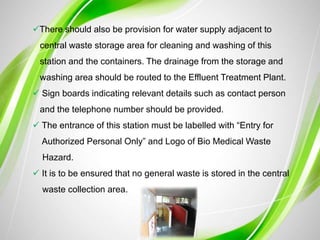
There should also be provision for water supply adjacent to
central waste storage area for cleaning and washing of this
station and the containers. The drainage from the storage and
washing area should be routed to the Effluent Treatment Plant.
 Sign boards indicating relevant details such as contact person
and the telephone number should be provided.
 The entrance of this station must be labelled with “Entry for
Authorized Personal Only” and Logo of Bio Medical Waste
Hazard.
 It is to be ensured that no general waste is stored in the central
waste collection area.
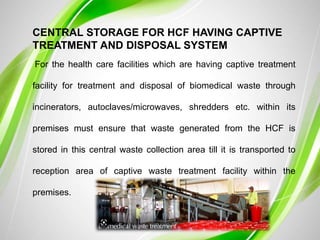
CENTRAL STORAGE FOR HCF HAVING CAPTIVE
TREATMENT AND DISPOSAL SYSTEM
For the health care facilities which are having captive treatment
facility for treatment and disposal of biomedical waste through
incinerators, autoclaves/microwaves, shredders etc. within its
premises must ensure that waste generated from the HCF is
stored in this central waste collection area till it is transported to
reception area of captive waste treatment facility within the
premises.
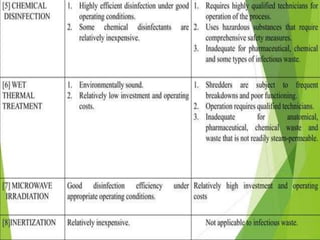
STEP 5: TREATMENT
STEP 6: DISPOSAL
RECORD KEEPING
Every healthcare facility need to maintain the records w.r.to
category wise bio-medical waste generation and its treatment
disposal on daily basis.
Category wise quantity of waste generated from the facility must
be recorded in Bio Medical Waste Register/logbook being
maintained at central waste collection area under the supervision of
one designated person.
 A weighing machine as per the specifications given in CPCB
guidelines for bar code system needs to be kept in central waste
collection centre of the HCF having 30 or more than 30 nos. of
beds for weighing the quantity of Bio Medical Waste.
HCFs having less than 30 beds shall maintain records of
receipts printed by the CBWTF.
Records on Annual Report on bio-medical waste
management submitted to SPCB.
Records shall be maintained on training on BMW
Management including both Induction and in service training
records.
Maintain record on Immunization of all the employees.
UPDATING OF INFORMATION IN WEBSITE
Contact Address and details of the Healthcare Facility .
No. of beds
Details of :
 Authorisation under BMWM Rules, 2016
 Consent under Water (Prevention and Control of Pollution)
Act, 1974 and Air (Prevention and Control of Pollution) Act,
1981
 Quantity of bio-medical waste generation (in kg/day).
 Mode of disposal of bio-medical waste (through CBWTF or
through captive treatment facility).
 Name and address of the CBWTF through which waste is
disposed off (as applicable) .
 In case, HCF is having captive treatment facility,
a) bio-medical waste treated (in kg/day)
b) Details of treatment equipment
c)Total nos. and capacity of each treatment equipment (in kg/day)
d) Operating parameters of the treatment equipment as per
BMWM Rules, 2016
 Monthly records of bio-medical waste generation (category
wise)
 No. of trainings conducted on Bio-medical Waste
Management in the current year
 Stats of immunization of Health Care Workers involved in
handling of BMW
BIOMEDICAL WASTE MANAGEMENT .pptx

BIOMEDICAL WASTE MANAGEMENT .pptx

  • 1.
  • 2.
    INTRODUCTION The waste producedin the course of health care activities carries a higher potential for infection and injury than any type of waste. Therefore safe and reliable method for its handling is essential. Inappropriate methods in handling of health care waste may have serious public health problems and significant impact on health.
  • 3.
    KEY FACTS Of thetotal amount of waste generated by health-care activities, about 85% is general, non-hazardous waste. The remaining 15% is considered hazardous material that may be infectious, toxic or radioactive. Every year an estimated 16 billion injections are administered worldwide, but not all of the needles and syringes are properly disposed of afterwards. Open burning and incineration of health care wastes can, under some circumstances, result in the emission of dioxins, furans, and particulate matter.
  • 4.
    DEFINITION According to bio-medicalwaste (management & handling) rules, 1998 of India, “Biomedical waste is a waste generated during the diagnosis, treatment or immunization of human beings or animals or research activities pertaining to or in production or testing of biological” .
  • 5.
    Any waste whichis generated during the diagnosis , treatment or immunization of human beings or animals Or Research activities Or In the production or testing of biological Or In health camps Waste generated during the diagnosis, testing, treatment, research or production of biological products for human or animals (WHO).
  • 6.
    Types of waste Infectiouswaste: waste contaminated with blood and other bodily fluids (e.g. from discarded diagnostic samples), cultures and stocks of infectious agents from laboratory work (e.g. waste from autopsies and infected animals from laboratories), or waste from patients with infections (e.g. swabs, bandages and disposable medical devices);
  • 7.
    Sharps waste: syringes,needles, disposable scalpels and blades, etc.; Chemical waste: for example solvents and reagents used for laboratory preparations, disinfectants, sterilants and heavy metals contained in medical devices (e.g. mercury in broken thermometers) and batteries;
  • 8.
    Pathological waste: humantissues, organs or fluids, body parts and contaminated animal carcasses; Pharmaceutical waste: expired, unused and contaminated drugs and vaccines; Cytotoxic waste: waste containing substances with genotoxic properties (i.e. highly hazardous substances that are, mutagenic, teratogenic or carcinogenic), such as cytotoxic drugs used in cancer treatment and their metabolites;
  • 9.
    Radioactive waste: suchas products contaminated by radionuclides including radioactive diagnostic material or radiotherapeutic materials; Non-hazardous or general waste: waste that does not pose any particular biological, chemical, radioactive or physical hazard.
  • 10.
    WASTE CATEGORY EXAMPLE Pathologicalwaste Human tissue / fluids Sharps Needles , Scalpels , Broken glass Pharmaceutical waste Expired medicines Genotoxic waste Cytotoxic drugs Chemical waste Lab reagents, Dis- infectants Wastes with high content of heavy metals Batteries , Broken thermometer Pressurized containers Gas cylinders, Gas catridges Radio active waste Unused liquids from radiotherapy Infectious waste Lab cultures, waste from isolation wards
  • 11.
    Health care waste Refersto all waste, biological or non biological that is discarded and not intended for further use. Health care waste Risk waste (10 – 25%) Non risk waste (75 – 90%) WHO estimates 85% of hospital waste in non hazardous 10% is infectious 5% is non infectious
  • 12.
    SOURCES OF BIOMEDICAL WASTE MAJOR SOURCES •Hospitals •Labs •Research centers •Animal research •Blood bank •Nursing homes •Autopsy centers MINOR SOURCES •Clinics •Home care •Paramedics •Funeral services •Instituitions
  • 14.
    THE MAIN GROUPAT RISK Medical doctors Nurses
  • 15.
    Health care auxillaries& hospital maintenance personnel Patients in health care establishments Visitors to health care establishments
  • 16.
    Workers in supportservices allied to health care establishment such as laundries, waste handling & transportation
  • 17.
    HAZARDS OF BIOMEDICALWASTE HAZARDS FROM INFECTIOUS WASTE AND SHARPS Pathogens in infectious waste may enter the human body by a number of routes. Through a puncture, abrasion or cut in the skin Through the mucus membrane By inhalation By ingestion
  • 20.
    HAZARDS FROM CHEMICAL& PHARMACEUTICAL WASTE Chemicals and pharmaceuticals account for about 3% of waste from health-care activities. They may be toxic, genotoxic, corrosive, flammable, reactive or explosive. Disinfectants: are particularly important members of this group; they are used in large quantities and often corrosive. Open burning of healthcare waste and incineration of plastics and hazardous materials will generate at least 75 hazardous chemicals as byproducts like oxides of sulphur & nitrogen, carbon dioxide, dioxins ,furans etc. Dioxins & furans are carcinogenic .
  • 44.
    Bio medical wastemanagement in India (Management & Handling) Rules 1998, prescribed by ministry of environment and forests; Government of India came into force on 28th july 1998. This rule applies to those who generate, collect, receive, store, dispose, treat or handle the biomedical waste in any manner. Waste are differentiated into 10 categories , color code is also assigned.
  • 49.
    STEPS OF BMWMANAGEMENT SEGREGATION COLLECTION INTRAMURAL TRANSPORTATION STORAGE (TEMPORARY) TREATMENT DISPOSAL
  • 50.
    It means theseparation of the mixed waste specifically at its point of generation as per the color coding specified under BMWM RULES 2016. STEP 1: SEGREGATION
  • 51.
    CATEGORY TYPE OFBAG/ CONTAINER TYPE OF WASTE TREATMENT/ DISPOSAL OPTION
  • 53.
    STEP 2: COLLECTION Collectionis the process of taking away the segregated BMW from its every point of generation in an HCF to be transported to the storage area with in the HCF.
  • 54.
    Time of Collection Bio-medicalwaste should be collected on daily basis from each ward of the hospital at a fixed interval of time. There can be multiple collections from wards during the day HCF should ensure collection, transportation, treatment and disposal of bio-medical waste as per BMWM Rules, 2016 and HCF should also ensure disposal of human anatomical waste, animal anatomical waste, soiled waste and biotechnology waste within 48 hours General waste should not be collected at the same time or in the same trolley in which bio-medical waste is collected.
  • 55.
    Collection should bedaily for most wastes, with collection timed to match the pattern of waste generation during the day. Bio-medical waste collected by the staff, should be provided with PPEs.
  • 56.
    PACKAGING Bio-medical waste bagsand sharps containers should be filled to no more than three quarters full. Once this level is reached, they should be sealed ready for collection. Plastic bags should never be stapled but may be tied or sealed with a plastic tag or tie.  Replacement bags or containers should be available at each waste-collection location so that full ones can immediately be replaced.
  • 57.
    Colour coded wastebags and containers should be printed with the bio-hazard symbol, labelled with details such as date, type of waste, waste quantity, senders name and receivers details as well as bar coded label to allow them to be tracked till final disposal.  Ensure that Bar coded stickers are pasted on each bag as per the guidelines
  • 58.
    LABELING All the bags/containers/ bins used for collection and storage of bio- medical waste, must be labelled with the Symbol of Bio Hazard or Cytotoxic Hazard as the case may be as per the type of waste in accordance with the BMWM Rules, 2016. Bio-medical waste bags / containers are required to be provided with bar code labels in accordance with CPCB guidelines for “Guidelines for barcode System for Effective Management of Biomedical Waste”.
  • 59.
    STEP 3: INTRAMURALTRANSPORTATION
  • 60.
    IN HOUSE TRANSPORTATIONOF BIO MEDICAL WASTE Transportation Trolleys In house transportation of Bio Medical Waste from site of waste generation/ interim storage to central waste collection centre, within the premises of the hospital must be done in closed trolleys / containers preferably fitted with wheels for easy maneuverability.
  • 61.
    ROUTE OF INTRAMURALTRANSPORTATION OF BIO-MEDICAL WASTE Route of transportation preferably be planned in such a way that: Transportation does not occur through high risk areas  Supplies and waste are transported through separate routes.  Waste is not transported through areas having high traffic of patients and visitors Central Waste collection area can be easy accessed through this route Safe transportation of waste is undertaken to avoid spillage and scattering of waste
  • 62.
    STEP 4 :STORAGE (TEMPORARY)
  • 63.
    INTERIM STORAGE  Interimstorage of bio medical waste is discouraged in the wards / different departments of HCF.  If waste is needed to be stored on interim basis in the departments it must be stored in the dirty utility/sections.  No waste should be stored in patient care area and procedures areas such as Operation Theatre. All infectious waste should be immediately removed from such areas.  In absence of dirty utilities/ sections such BMW must be stored in designated place away from patient and visitor traffic or low traffic area.
  • 64.
    CENTRAL WASTE COLLECTIONROOM FOR BIO- MEDICAL WASTE The location of central waste collection room must be away from the public/ visitors access.  The space allocation for this room must be as per the quantity of waste generated from the hospital.  The planned space must be sufficient so as to store at least two days generation of waste.  Central waste collection room must be roofed and manned and should be under lock and key under the responsibility of designated person
  • 65.
    The entrance ofthis centre must be accessible through a concrete ramp for easy transportation of waste collection trolleys.  Flooring should be of tiles or any other glazed material with slope so as to ease the cleaning of the area.  Exhaust fans should be provided in the waste collection room for ventilation. It is to be ensured by the health care facility that such central storage room is safety inspected for potential fire hazard and based on such inspection preventive measure has to be taken by the health care facility like installation of fire extinguisher, smoke detector etc
  • 66.
    There should alsobe provision for water supply adjacent to central waste storage area for cleaning and washing of this station and the containers. The drainage from the storage and washing area should be routed to the Effluent Treatment Plant.  Sign boards indicating relevant details such as contact person and the telephone number should be provided.  The entrance of this station must be labelled with “Entry for Authorized Personal Only” and Logo of Bio Medical Waste Hazard.  It is to be ensured that no general waste is stored in the central waste collection area.
  • 67.
    CENTRAL STORAGE FORHCF HAVING CAPTIVE TREATMENT AND DISPOSAL SYSTEM For the health care facilities which are having captive treatment facility for treatment and disposal of biomedical waste through incinerators, autoclaves/microwaves, shredders etc. within its premises must ensure that waste generated from the HCF is stored in this central waste collection area till it is transported to reception area of captive waste treatment facility within the premises.
  • 68.
  • 69.
    RECORD KEEPING Every healthcarefacility need to maintain the records w.r.to category wise bio-medical waste generation and its treatment disposal on daily basis. Category wise quantity of waste generated from the facility must be recorded in Bio Medical Waste Register/logbook being maintained at central waste collection area under the supervision of one designated person.  A weighing machine as per the specifications given in CPCB guidelines for bar code system needs to be kept in central waste collection centre of the HCF having 30 or more than 30 nos. of beds for weighing the quantity of Bio Medical Waste.
  • 70.
    HCFs having lessthan 30 beds shall maintain records of receipts printed by the CBWTF. Records on Annual Report on bio-medical waste management submitted to SPCB. Records shall be maintained on training on BMW Management including both Induction and in service training records. Maintain record on Immunization of all the employees.
  • 71.
    UPDATING OF INFORMATIONIN WEBSITE Contact Address and details of the Healthcare Facility . No. of beds Details of :  Authorisation under BMWM Rules, 2016  Consent under Water (Prevention and Control of Pollution) Act, 1974 and Air (Prevention and Control of Pollution) Act, 1981  Quantity of bio-medical waste generation (in kg/day).  Mode of disposal of bio-medical waste (through CBWTF or through captive treatment facility).  Name and address of the CBWTF through which waste is disposed off (as applicable) .
  • 72.
     In case,HCF is having captive treatment facility, a) bio-medical waste treated (in kg/day) b) Details of treatment equipment c)Total nos. and capacity of each treatment equipment (in kg/day) d) Operating parameters of the treatment equipment as per BMWM Rules, 2016  Monthly records of bio-medical waste generation (category wise)  No. of trainings conducted on Bio-medical Waste Management in the current year  Stats of immunization of Health Care Workers involved in handling of BMW