SUBJECT
MBA303: OPERATION MANAGEMENT
LECTURE NO.-3
Dr. Moiz Akhtar
Faculty of Commerce & Management
Integral University, Lucknow
CENTRE FOR DISTANCE AND ONLINE EDUCATION
INTEGRAL UNIVERSITY, LUCKNOW
Topics Covered
The Design of product and Services
Supply Network Design
Topic 1
The Design of product and Services
The strategic importance of product and service
design
 The essence of a business organization is the products
and services it offers, and every aspect of the
organization and its supply chain are structured around
those products and services.
 organizations have a strategic interest in product and
service design because organizations that have well-
designed products or services are more likely to realize
their goals than those with poorly designed products or
services.
Factors influence the strategy of design
• Cost
• Quality
• Time-to-market
• Customer satisfaction
• Competitive advantage
As a result marketing, finance, operations,
accounting, IT, and HR need to be involved in
design.
What Does Product and Service Design Do?
The various activities and responsibilities (functional interactions)
1. Translate customer wants and needs into product and service
requirements. (marketing, operations)
2. Refine existing products and services. (marketing)
3. Develop new products and/or services. (marketing, operations)
4. Formulate quality goals. (marketing, operations)
5. Formulate cost targets. (accounting, finance, operations)
6. Construct and test prototypes. (operations, marketing, engineering)
7. Document specifications.
8. Translate product and service specifications into process
specifications. (engineering, operations)
The key questions of product and service design
 Is there demand for it?
 Can we do it ? Known as Manufacturability,
serviceability
 What level of quality is appropriate?
 Does it make sense from an economic
standpoint?
Reasons for Product and Service Design or Redesign
The main forces that initiate design or redesign are
market opportunities and threats.
The factors that give rise to market opportunities and threats can
be one or more changes:
 Economic.
 Social and demographic.
 Political, liability, or legal.
 Competitive.
 Cost or availability.
 Technological.
Some of the main sources of design ideas
(IDEA GENERATION)
 Reverse engineering : Dismantling and inspecting a competitor’s product to discover
product improvements.
 Research and development (R&D) Organized efforts to
increase scientific knowledge or product innovation.
R&D efforts may involve basic research, applied research, or development.
Other sources :
Customers , employees , distributors and suppliers .
customer input can come from surveys, focus groups, complaints, and unsolicited
suggestions for improvement.
Input from suppliers, distributors, and employees can be obtained from interviews, direct
or indirect suggestions, and complaints.
LEGAL AND ETHICAL CONSIDERATIONS
Legal : Most organizations are subject to numerous
government agencies that regulate them such as Food and Drug
Administration, the Occupational Health and Safety Administration, the
Environmental Protection Agency.
Product liability is the responsibility of a manufacturer for any injuries
or damages caused by a faulty product because of poor workmanship or
design.
Uniform Commercial Code : A product must be suitable for
its intended purpose.
LEGAL AND ETHICAL CONSIDERATIONS
Ethical “Releasing products with defects “
• Or “vaporware,” when a company doesn’t issue a release of a
software or hardware as scheduled as it struggles with production
problems or bugs in the software.
Organizations generally want designers to adhere to guidelines
such as the following:
i. • Produce designs that are consistent with the goals of the
organization
ii. • Give customers the value they expect.
iii. • Make health and safety a primary concern.
HUMAN AND CULTURAL FACTORS
o Human consideration :
- Safety and liability.
- Adding new features to their products or services (CS).
o Cultural consideration :
Product designers in companies that operate globally also must
take into account any cultural differences of different countries or
regions related to the product .
GLOBAL PRODUCT AND SERVICE DESIGN
o Advantages:
 Engaging the best human resources from around the world
without the need to assemble them all in one place, and
operating on a 24-hour basis
 Global product design can provide design outcomes that
increase the marketability and utility of a product
o Disadvantages:
 If it is mismanaged, that can lead to conflicts and
miscommunications.
ENVIRONMENTAL FACTORS: SUSTAINABILITY
Key aspects include :
 Cradle-to-grave assessment” life cycle analysis”.
 End-of-life programs (EOL).
 The Three Rs: Reduce, Reuse, and Recycle.
ENVIRONMENTAL FACTORS: SUSTAINABILITY
Key aspects include :
 Cradle-to-grave assessment” life cycle analysis”
is the assessment of the environmental impact of a product or
service throughout its useful life, focusing on such factors as
global warming ,smog formation and oxygen depletion.
The goal of cradle-to-grave assessment is to choose products
and services that have the least environmental impact while
still taking into account economic considerations.
cradle-to-grave assessment are part of the ISO 14000
environmental management standards.
ENVIRONMENTAL FACTORS: SUSTAINABILITY
Key aspects include :
 End-of-life programs (EOL) programs deal with
products that have reached the end of their useful lives.
The purpose of these programs is to reduce the dumping of
products, particularly electronic equipment in landfills or
third-world countries.
Example : IBM provides a good example of the potential of
EOL programs. Over the last 15 years, it has collected about
2 billion pounds of product and product waste .
ENVIRONMENTAL FACTORS: SUSTAINABILITY
Key aspects include :
 The Three Rs: Reduce, Reuse, and Recycle.
Reduce: Value Analysis refers to an examination of the function of parts
and materials in an effort to reduce the cost and/or improve the
performance of a product.
Reuse: Remanufacturing refers to refurbishing used products by
replacing worn-out or defective components, and reselling the products .
Designing products so that they can be more easily taken apart has given
rise to yet another design consideration: Design for disassembly (DFD)
Recycling means recovering materials for future use . Companies
recycle for a variety of reasons, including Cost savings, Environment
concerns, Environmental regulations.
OTHER DESIGN CONSIDERATIONS
 Strategies for Product or Service Life Stages.
 Degree of Standardization.
 Designing for Mass Customization.
 Reliability.
 Robust Design.
 Degree of Newness.
 Quality Function Deployment.
 The Kano Model.
Strategies for Product or Service Life Stages
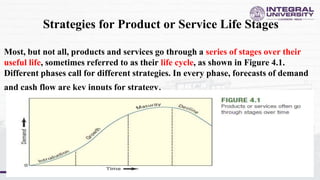
Most, but not all, products and services go through a series of stages over their
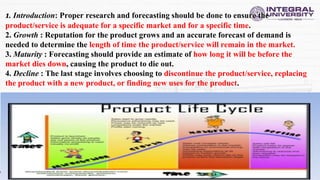
useful life, sometimes referred to as their life cycle, as shown in Figure 4.1.
Different phases call for different strategies. In every phase, forecasts of demand
and cash flow are key inputs for strategy.
1. Introduction: Proper research and forecasting should be done to ensure the
product/service is adequate for a specific market and for a specific time.
2. Growth : Reputation for the product grows and an accurate forecast of demand is
needed to determine the length of time the product/service will remain in the market.
3. Maturity : Forecasting should provide an estimate of how long it will be before the
market dies down, causing the product to die out.
4. Decline : The last stage involves choosing to discontinue the product/service, replacing
the product with a new product, or finding new uses for the product.
Degree of Standardization
 Standardization refers to the extent to which there is
absence of variety in a product, service, or process.
 Standardized service implies that every customer or item
processed receives essentially the same service ,ex : An
automatic car wash.
Benefits and Advantages of Standardization
 Standardized products are immediately available to customers.
 Fewer interchangeable parts to deal with in inventory and in
manufacturing.
 Design costs are generally lower.
 Save time and money while increasing quality and reliability.
 Reduced time and cost to train employees and reduced time to design
jobs, scheduling of work, inventory handling, and purchasing and
accounting activities become much more routine.
 Quality is more consistent.
Disadvantages of Standardization
 1. Designs may be frozen with too many imperfections
remaining.
 2. High cost of design changes increases resistance to
improvements.
 3. Decreased variety results in less consumer appeal.
Designing for Mass Customization
“A strategy of producing basically standardized goods, but
incorporating some degree of customization”
TOW Tactics can make this possible :
1. Delayed differentiation
2. Modular design.
Delayed differentiation
IS a postponement tactic: the process of producing, but not
quite completing, a product or service, postponing completion until
customer preferences or specifications are known.
The result of delayed differentiation is a product or service with
customized features that can be quickly produced, appealing to the
customers’ desire for variety and speed of
delivery, and yet one that for the most part is standardized.
Delayed differentiation
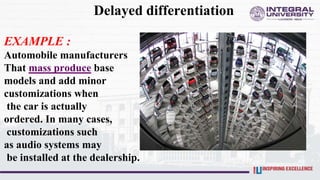
EXAMPLE :
Automobile manufacturers
That mass produce base
models and add minor
customizations when
the car is actually
ordered. In many cases,
customizations such
as audio systems may
be installed at the dealership.
Modular design
Modular design A form of standardization in which component parts
are grouped into modules that are easily replaced or interchanged.
One familiar example of modular design is computers, which have
modular parts that can be replaced if they become defective.
Example:“ Dell Computers has successfully used this concept to
become a dominant force in the PC industry by offering
consumers the opportunity to configure modules according to
their own specifications”.
Reliability
Reliability : Is a measure of the ability of a product, a part,
a service, or an entire system to perform its intended function under
a prescribed set of conditions.
Failure : Situation in which a product, part, or system does not
perform as intended.
Normal operating conditions : The set of conditions under
which an item’s reliability is specified, Such as: load, temperature,
and humidity ranges as well as operating procedures and
maintenance schedules.
Normal operating conditions example
o Using a passenger car for too heavy loads will cause excess wear and tear on
the car engine.
Improving Reliability
Reliability can be improved in a number of ways such as :
1. Improve component design.
2. Improve production and/or assembly techniques.
3. Improve testing.
4. Use backups.
5. Improve preventive maintenance procedures.
6. Improve user education.
7. Improve system design.
Robust Design
“Design that results in products or services that can function over a
broad range of conditions”.
Other def.
It is defined as reducing variation in a product without eliminating the
causes of the variation.
In other words, making the product or process insensitive to variation.
Robust Design
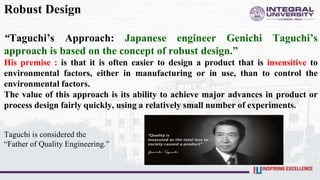
“Taguchi’s Approach: Japanese engineer Genichi Taguchi’s
approach is based on the concept of robust design.”
His premise : is that it is often easier to design a product that is insensitive to
environmental factors, either in manufacturing or in use, than to control the
environmental factors.
The value of this approach is its ability to achieve major advances in product or
process design fairly quickly, using a relatively small number of experiments.
Taguchi is considered the
“Father of Quality Engineering.”
Degree of Newness
Product or service design change can range from the
modification of an existing product or service to an entirely
new product or service:
1. Modification of an existing product or service.
2. Expansion of an existing product line or service offering.
3. Clone of a competitor’s product or service.
4. New product or service.
For example : mobile phones products, transportation services.
Quality function deployment(QFD)
“(QFD) An approach that integrates the “voice of the customer” into
both product and service development”.
The structure of QFD is based on a set of matrices. The main matrix
relates customer requirements (what) and their corresponding
technical requirements (how). This matrix is illustrated in Figure 4.2
. The matrix provides a structure for data collection.
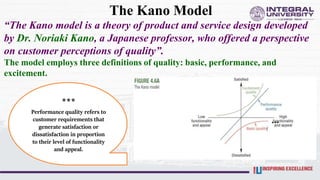
The Kano Model
“The Kano model is a theory of product and service design developed
by Dr. Noriaki Kano, a Japanese professor, who offered a perspective
on customer perceptions of quality”.
The model employs three definitions of quality: basic, performance, and
excitement.
***
Performance quality refers to
customer requirements that
generate satisfaction or
dissatisfaction in proportion
to their level of functionality
and appeal.
***
PHASES IN PRODUCT DESIGN
AND DEVELOPMENT
1. Feasibility analysis : Market analysis (demand) Economic analysis (development
cost and production cost, profit potential) Technical analysis (capacity requirements
and availability, and the skills needed).
2. Product specifications : what is needed to meet (or exceed) customer wants.
3. Process specifications : specifications for the process that will be needed to produce
the product. Alternatives must be weighed in terms of cost, availability of resources,
profit potential, and quality.
4. Prototype development: one (or a few) units are made to see if there are any
problems with the product or process specifications.
PHASES IN PRODUCT DESIGN
AND DEVELOPMENT
5. Design review : At this stage, any necessary changes are made or
the project is abandoned.
6. Market test : A market test is used to determine the extent of
consumer acceptance. If unsuccessful, the product returns to the
design review phase.
7. Product introduction : The new product is promoted.
8. Follow-up evaluation : Based on user feedback, changes may be
made or forecasts refined.
DESIGNING FOR PRODUCTION
Design techniques that have greater applicability for the design of
products than the design of services this include the following
techniques :
 Concurrent Engineering
 Computer-Aided Design (CAD)
 Production Requirements
 Component Commonality
DESIGNING FOR PRODUCTION
Concurrent Engineering
“Concurrent engineering or simultaneous engineering means bringing
design and manufacturing engineering people together early in the design
phase to simultaneously develop the product and the processes for
creating the product”.
The purpose of Concurrent Engineering is :
 To achieve product designs that reflect customer wants as well as manufacturing capabilities .
 To achieve a smoother transition from product design to production, and to decrease product development time.
DESIGNING FOR PRODUCTION
Concurrent Engineering
Advantages of Concurrent Engineering :
1. Manufacturing personnel are able to identify production
capabilities and capacities
2. Design or procurement of critical tooling, that might have long
lead times ,can occur early in the process.(shortening of the product
development process)
3. The technical feasibility of a particular design or a portion of a
design can be assessed.
4.The emphasis can be on problem resolution instead of conflict
resolution.
DESIGNING FOR PRODUCTION
Concurrent Engineering
Disadvantages of Concurrent Engineering :
1. Long-standing boundaries between design and manufacturing can
be difficult to overcome.
2. There must be extra communication and flexibility if the process
is to work, and these can be difficult to achieve.
DESIGNING FOR PRODUCTION
Computer-Aided Design (CAD)
Definition :“CAD A Product design using computer
graphics”.
A growing number of products are being designed in this way, including
transformers, automobile parts, aircraft parts, integrated circuits, and electric
motors.
DESIGNING FOR PRODUCTION
Computer-Aided Design (CAD)
Computer-Aided Design major benefits :
 CAD increases the productivity of designers from 3 to 10 times.
 Creation of a database for manufacturing that can supply needed
information on product.
 Some CAD systems allow the designer to perform engineering
and cost analyses on proposed designs.
DESIGNING FOR PRODUCTION
Production Requirements
Designers must take into account the following aspects :
 Production capabilities : e.g., equipment, skills, types of materials,
schedules, technologies, special abilities), This helps in choosing designs that
match capabilities.
 Forecasts of future demand can be very useful.
 Manufacturability :The ease of fabrication and/or assembly, (DFM
AND DFA)
DESIGNING FOR PRODUCTION
Production Requirements
Manufacturability : IS important for cost, productivity,
and quality.
Design for manufacturing (DFM) : The designing of products
that are compatible with an organization’s capabilities.
Design for assembly (DFA) : Design that focuses on reducing
the number of parts in a product and on assembly methods and
sequence.
DESIGNING FOR PRODUCTION
Component Commonality
Products or services that have a high degree of similarity
of features and components such as product families or
when a part can be used in multiple products (share parts).
Significant Benefits from Commonality :
 Savings in design time and cost
 Reduced training for assemble and installation
 Saving in repair time and cost.
Service design
Service refers to an act, something that is done to or for a customer
(client, patient, etc.), It is provided by a service delivery system
There are many similarities between product and service design.

However, there are some important differences as well
One major difference is that services are usually
Created and delivered simultaneously.
Service design
 Service delivery system :The facilities, processes, and skills needed
to provide a service.
 Product bundle : The combination of goods and services provided to
a customer.
 Service package that include :
 The physical resources needed.
 The accompanying goods that are purchased or consumed by the customer, or
provided
with the service.
 Explicit services (the essential/core features of a service, such as tax preparation).
 Implicit services (ancillary/extra features, such as friendliness, courtesy).
Over view of Service design
Two key issues in service design are :
o The degree of variation in service requirements
o The degree of customer contact and customer involvement in the
delivery system.
These have an impact on the degree to which service can
be standardized or must be customized.
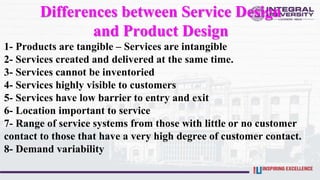
Differences between Service Design
and Product Design
1- Products are tangible – Services are intangible
2- Services created and delivered at the same time.
3- Services cannot be inventoried
4- Services highly visible to customers
5- Services have low barrier to entry and exit
6- Location important to service
7- Range of service systems from those with little or no customer
contact to those that have a very high degree of customer contact.
8- Demand variability
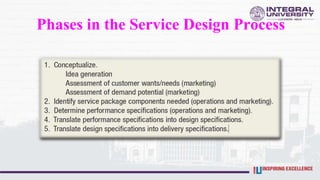
Phases in the Service Design Process
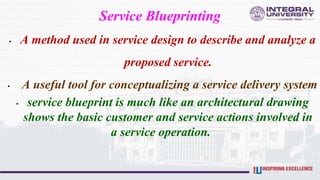
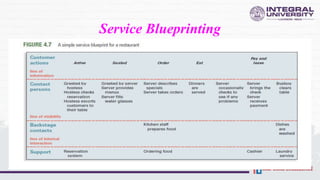
Service Blueprinting
• A method used in service design to describe and analyze a
proposed service.
• A useful tool for conceptualizing a service delivery system
• service blueprint is much like an architectural drawing
shows the basic customer and service actions involved in
a service operation.
Service Blueprinting
Major Steps in Service Blueprinting :
1. Establish boundaries for the service and decide on the level of
detail needed.
2. Identify and determine the sequence of customer and service
actions and interactions. A flowchart can be a useful tool for this.
3. Develop time estimates for each phase of the process.
4. Identify potential failure points and develop a plan to prevent or
minimize them.
Characteristics of Well-Designed Service Systems
1. Consistent with the organization’s mission.
2. User friendly.
3. Robust.
4. Easy to sustain.
5. Cost effective.
6. Value to customers.
7. Effective linkages between back operations.
8. Having a Single unifying theme.
9. Ensure reliability and high quality.
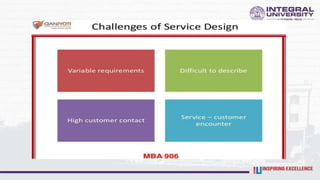
What Are The Challenges of Service Design?
 Requirements tend to be variable, both in terms
of differences in what customers want or need,
and in terms of the timing of customer requests.
 Balancing supply and demand.
 Services can be difficult to describe precisely and
are dynamic in nature.
OPERATIONS STRATEGY
Product and service design is a fertile area for achieving competitive
advantage and/or increasing customer satisfaction.
Potential sources of such benefits include the following :
 Packaging products and ancillary services to increase sales. "component
commonality” .
 Using multiple-use platforms.
 Implementing tactics that will achieve the benefits of high volume while
satisfying customer needs for variety, such as mass customization.
 Continually monitoring products and services for small improvements
OPERATIONS STRATEGY
 Shortening the time it takes to get new or redesigned goods and services
to market, by using the approach “first-to-market” approach
companies are able to enter markets ahead of their competitors.
THIS APPROACH INCLUDE :
• Using standardized components to create new but reliable products.
• Using technology such as computer-aided design (CAD) equipment to
rapidly design new or modified products.
• Concurrent engineering to shorten engineering time
Topic 2
Supply Network Design
Role of Distribution in Supply Chain
• Distribution refers to the steps taken to move and store a
product from the supplier stage to a customer stage in the
supply chain. Distribution is a key driver of the overall
profitability of a firm because it affects both the supply
chain cost and the customer experience directly.
• The appropriate distribution network can be used to
achieve a variety of supply chain objectives ranging from
low cost to high responsiveness. As a result, companies in
the same industry often select very different distribution
networks.
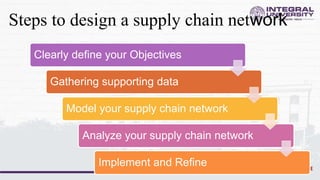
Steps to design a supply chain network
Clearly define your Objectives
Gathering supporting data
Model your supply chain network
Analyze your supply chain network
Implement and Refine
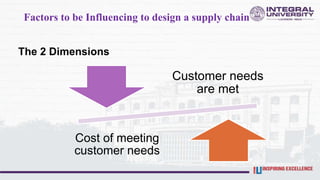
Factors to be Influencing to design a supply chain
Customer needs
are met
Cost of meeting
customer needs
The 2 Dimensions
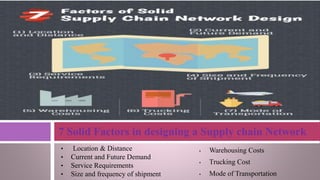
• Location & Distance
• Current and Future Demand
• Service Requirements
• Size and frequency of shipment
7 Solid Factors in designing a Supply chain Network
• Warehousing Costs
• Trucking Cost
• Mode of Transportation
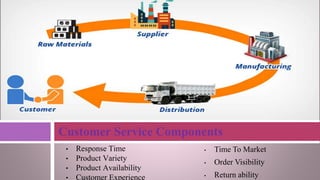
• Response Time
• Product Variety
• Product Availability
• Customer Experience
Customer Service Components
• Time To Market
• Order Visibility
• Return ability
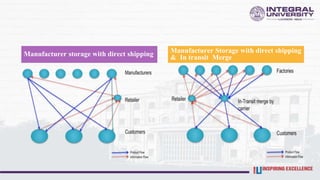
Manufacturer storage with direct shipping Manufacturer Storage with direct shipping
& In transit Merge
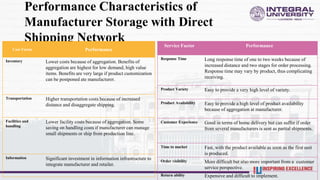
Performance Characteristics of
Manufacturer Storage with Direct
Shipping Network
Cost Factor Performance
Inventory Lower costs because of aggregation. Benefits of
aggregation are highest for low demand, high value
items. Benefits are very large if product customization
can be postponed ate manufacturer.
Transportation Higher transportation costs because of increased
distance and disaggregate shipping.
Facilities and
handling
Lower facility costs because of aggregation. Some
saving on handling costs if manufacturer can manage
small shipments or ship from production line.
Information Significant investment in information infrastructure to
integrate manufacturer and retailer.
Service Factor Performance
Response Time Long response time of one to two weeks because of
increased distance and two stages for order processing.
Response time may vary by product, thus complicating
receiving.
Product Variety Easy to provide a very high level of variety.
Product Availability Easy to provide a high level of product availability
because of aggregation at manufacturer.
Customer Experience Good in terms of home delivery but can suffer if order
from several manufacturers is sent as partial shipments.
Time to market Fast, with the product available as soon as the first unit
is produced.
Order visibility More difficult but also more important from a customer
service perspective.
Return ability Expensive and difficult to implement.
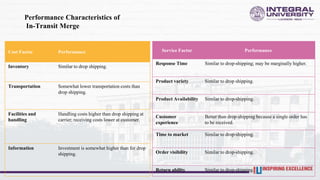
Performance Characteristics of
In-Transit Merge
Cost Factor Performance
Inventory Similar to drop shipping.
Transportation Somewhat lower transportation costs than
drop shipping.
Facilities and
handling
Handling costs higher than drop shipping at
carrier; receiving costs lower at customer.
Information Investment is somewhat higher than for drop
shipping.
Service Factor Performance
Response Time Similar to drop-shipping; may be marginally higher.
Product variety Similar to drop shipping.
Product Availability Similar to drop-shipping.
Customer
experience
Better than drop-shipping because a single order has
to be received.
Time to market Similar to drop-shipping.
Order visibility Similar to drop-shipping.
Return ability Similar to drop-shipping.
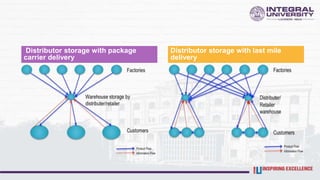
Distributor storage with package
carrier delivery
Distributor storage with last mile
delivery
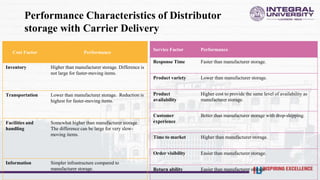
Performance Characteristics of Distributor
storage with Carrier Delivery
Cost Factor Performance
Inventory Higher than manufacturer storage. Difference is
not large for faster-moving items.
Transportation Lower than manufacturer storage. Reduction is
highest for faster-moving items.
Facilities and
handling
Somewhat higher than manufacturer storage.
The difference can be large for very slow-
moving items.
Information Simpler infrastructure compared to
manufacturer storage.
Service Factor Performance
Response Time Faster than manufacturer storage.
Product variety Lower than manufacturer storage.
Product
availability
Higher cost to provide the same level of availability as
manufacturer storage.
Customer
experience
Better than manufacturer storage with drop-shipping.
Time to market Higher than manufacturer storage.
Order visibility Easier than manufacturer storage.
Return ability Easier than manufacturer storage
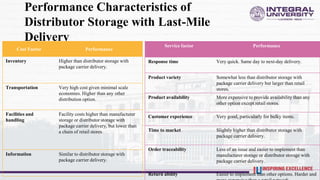
Performance Characteristics of
Distributor Storage with Last-Mile
Delivery
Cost Factor Performance
Inventory Higher than distributor storage with
package carrier delivery.
Transportation Very high cost given minimal scale
economies. Higher than any other
distribution option.
Facilities and
handling
Facility costs higher than manufacturer
storage or distributor storage with
package carrier delivery, but lower than
a chain of retail stores.
Information Similar to distributor storage with
package carrier delivery.
Service factor Performance
Response time Very quick. Same day to next-day delivery.
Product variety Somewhat less than distributor storage with
package carrier delivery but larger than retail
stores.
Product availability More expensive to provide availability than any
other option except retail stores.
Customer experience Very good, particularly for bulky items.
Time to market Slightly higher than distributor storage with
package carrier delivery.
Order traceability Less of an issue and easier to implement than
manufacturer storage or distributor storage with
package carrier delivery.
Return ability Easier to implement than other options. Harder and
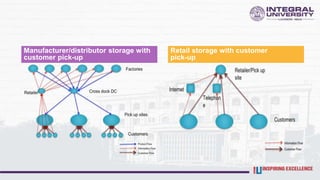
Manufacturer/distributor storage with
customer pick-up
Retail storage with customer
pick-up
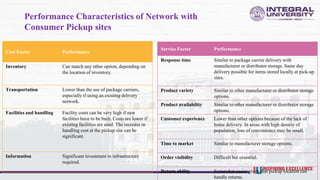
Performance Characteristics of Network with
Consumer Pickup sites
Cost Factor Performance
Inventory Can match any other option, depending on
the location of inventory.
Transportation Lower than the use of package carriers,
especially if using an existing delivery
network.
Facilities and handling Facility costs can be very high if new
facilities have to be built. Costs are lower if
existing facilities are used. The increase in
handling cost at the pickup site can be
significant.
Information Significant investment in infrastructure
required.
Service Factor Performance
Response time Similar to package carrier delivery with
manufacturer or distributor storage. Same day
delivery possible for items stored locally at pick-up
sites.
Product variety Similar to other manufacturer or distributor storage
options.
Product availability Similar to other manufacturer or distributor storage
options.
Customer experience Lower than other options because of the lack of
home delivery. In areas with high density of
population, loss of convenience may be small.
Time to market Similar to manufacturer storage options.
Order visibility Difficult but essential.
Return ability Somewhat easier given that pickup location can
handle returns.
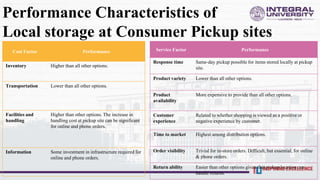
Performance Characteristics of
Local storage at Consumer Pickup sites
Cost Factor Performance
Inventory Higher than all other options.
Transportation Lower than all other options.
Facilities and
handling
Higher than other options. The increase in
handling cost at pickup site can be significant
for online and phone orders.
Information Some investment in infrastructure required for
online and phone orders.
Service Factor Performance
Response time Same-day pickup possible for items stored locally at pickup
site.
Product variety Lower than all other options.
Product
availability
More expensive to provide than all other options.
Customer
experience
Related to whether shopping is viewed as a positive or
negative experience by customer.
Time to market Highest among distribution options.
Order visibility Trivial for in-store orders. Difficult, but essential, for online
& phone orders.
Return ability Easier than other options given that pickup location can
handle returns.
Thank You

Lecture 13Operation Management MBA303.pptx

  • 1.
    SUBJECT MBA303: OPERATION MANAGEMENT LECTURENO.-3 Dr. Moiz Akhtar Faculty of Commerce & Management Integral University, Lucknow CENTRE FOR DISTANCE AND ONLINE EDUCATION INTEGRAL UNIVERSITY, LUCKNOW
  • 2.
    Topics Covered The Designof product and Services Supply Network Design
  • 3.
    Topic 1 The Designof product and Services
  • 4.
    The strategic importanceof product and service design  The essence of a business organization is the products and services it offers, and every aspect of the organization and its supply chain are structured around those products and services.  organizations have a strategic interest in product and service design because organizations that have well- designed products or services are more likely to realize their goals than those with poorly designed products or services.
  • 5.
    Factors influence thestrategy of design • Cost • Quality • Time-to-market • Customer satisfaction • Competitive advantage As a result marketing, finance, operations, accounting, IT, and HR need to be involved in design.
  • 6.
    What Does Productand Service Design Do? The various activities and responsibilities (functional interactions) 1. Translate customer wants and needs into product and service requirements. (marketing, operations) 2. Refine existing products and services. (marketing) 3. Develop new products and/or services. (marketing, operations) 4. Formulate quality goals. (marketing, operations) 5. Formulate cost targets. (accounting, finance, operations) 6. Construct and test prototypes. (operations, marketing, engineering) 7. Document specifications. 8. Translate product and service specifications into process specifications. (engineering, operations)
  • 7.
    The key questionsof product and service design  Is there demand for it?  Can we do it ? Known as Manufacturability, serviceability  What level of quality is appropriate?  Does it make sense from an economic standpoint?
  • 8.
    Reasons for Productand Service Design or Redesign The main forces that initiate design or redesign are market opportunities and threats. The factors that give rise to market opportunities and threats can be one or more changes:  Economic.  Social and demographic.  Political, liability, or legal.  Competitive.  Cost or availability.  Technological.
  • 9.
    Some of themain sources of design ideas (IDEA GENERATION)  Reverse engineering : Dismantling and inspecting a competitor’s product to discover product improvements.  Research and development (R&D) Organized efforts to increase scientific knowledge or product innovation. R&D efforts may involve basic research, applied research, or development. Other sources : Customers , employees , distributors and suppliers . customer input can come from surveys, focus groups, complaints, and unsolicited suggestions for improvement. Input from suppliers, distributors, and employees can be obtained from interviews, direct or indirect suggestions, and complaints.
  • 10.
    LEGAL AND ETHICALCONSIDERATIONS Legal : Most organizations are subject to numerous government agencies that regulate them such as Food and Drug Administration, the Occupational Health and Safety Administration, the Environmental Protection Agency. Product liability is the responsibility of a manufacturer for any injuries or damages caused by a faulty product because of poor workmanship or design. Uniform Commercial Code : A product must be suitable for its intended purpose.
  • 11.
    LEGAL AND ETHICALCONSIDERATIONS Ethical “Releasing products with defects “ • Or “vaporware,” when a company doesn’t issue a release of a software or hardware as scheduled as it struggles with production problems or bugs in the software. Organizations generally want designers to adhere to guidelines such as the following: i. • Produce designs that are consistent with the goals of the organization ii. • Give customers the value they expect. iii. • Make health and safety a primary concern.
  • 12.
    HUMAN AND CULTURALFACTORS o Human consideration : - Safety and liability. - Adding new features to their products or services (CS). o Cultural consideration : Product designers in companies that operate globally also must take into account any cultural differences of different countries or regions related to the product .
  • 13.
    GLOBAL PRODUCT ANDSERVICE DESIGN o Advantages:  Engaging the best human resources from around the world without the need to assemble them all in one place, and operating on a 24-hour basis  Global product design can provide design outcomes that increase the marketability and utility of a product o Disadvantages:  If it is mismanaged, that can lead to conflicts and miscommunications.
  • 14.
    ENVIRONMENTAL FACTORS: SUSTAINABILITY Keyaspects include :  Cradle-to-grave assessment” life cycle analysis”.  End-of-life programs (EOL).  The Three Rs: Reduce, Reuse, and Recycle.
  • 15.
    ENVIRONMENTAL FACTORS: SUSTAINABILITY Keyaspects include :  Cradle-to-grave assessment” life cycle analysis” is the assessment of the environmental impact of a product or service throughout its useful life, focusing on such factors as global warming ,smog formation and oxygen depletion. The goal of cradle-to-grave assessment is to choose products and services that have the least environmental impact while still taking into account economic considerations. cradle-to-grave assessment are part of the ISO 14000 environmental management standards.
  • 16.
    ENVIRONMENTAL FACTORS: SUSTAINABILITY Keyaspects include :  End-of-life programs (EOL) programs deal with products that have reached the end of their useful lives. The purpose of these programs is to reduce the dumping of products, particularly electronic equipment in landfills or third-world countries. Example : IBM provides a good example of the potential of EOL programs. Over the last 15 years, it has collected about 2 billion pounds of product and product waste .
  • 17.
    ENVIRONMENTAL FACTORS: SUSTAINABILITY Keyaspects include :  The Three Rs: Reduce, Reuse, and Recycle. Reduce: Value Analysis refers to an examination of the function of parts and materials in an effort to reduce the cost and/or improve the performance of a product. Reuse: Remanufacturing refers to refurbishing used products by replacing worn-out or defective components, and reselling the products . Designing products so that they can be more easily taken apart has given rise to yet another design consideration: Design for disassembly (DFD) Recycling means recovering materials for future use . Companies recycle for a variety of reasons, including Cost savings, Environment concerns, Environmental regulations.
  • 18.
    OTHER DESIGN CONSIDERATIONS Strategies for Product or Service Life Stages.  Degree of Standardization.  Designing for Mass Customization.  Reliability.  Robust Design.  Degree of Newness.  Quality Function Deployment.  The Kano Model.
  • 19.
    Strategies for Productor Service Life Stages Most, but not all, products and services go through a series of stages over their useful life, sometimes referred to as their life cycle, as shown in Figure 4.1. Different phases call for different strategies. In every phase, forecasts of demand and cash flow are key inputs for strategy.
  • 20.
    1. Introduction: Properresearch and forecasting should be done to ensure the product/service is adequate for a specific market and for a specific time. 2. Growth : Reputation for the product grows and an accurate forecast of demand is needed to determine the length of time the product/service will remain in the market. 3. Maturity : Forecasting should provide an estimate of how long it will be before the market dies down, causing the product to die out. 4. Decline : The last stage involves choosing to discontinue the product/service, replacing the product with a new product, or finding new uses for the product.
  • 21.
    Degree of Standardization Standardization refers to the extent to which there is absence of variety in a product, service, or process.  Standardized service implies that every customer or item processed receives essentially the same service ,ex : An automatic car wash.
  • 22.
    Benefits and Advantagesof Standardization  Standardized products are immediately available to customers.  Fewer interchangeable parts to deal with in inventory and in manufacturing.  Design costs are generally lower.  Save time and money while increasing quality and reliability.  Reduced time and cost to train employees and reduced time to design jobs, scheduling of work, inventory handling, and purchasing and accounting activities become much more routine.  Quality is more consistent.
  • 23.
    Disadvantages of Standardization 1. Designs may be frozen with too many imperfections remaining.  2. High cost of design changes increases resistance to improvements.  3. Decreased variety results in less consumer appeal.
  • 24.
    Designing for MassCustomization “A strategy of producing basically standardized goods, but incorporating some degree of customization” TOW Tactics can make this possible : 1. Delayed differentiation 2. Modular design.
  • 25.
    Delayed differentiation IS apostponement tactic: the process of producing, but not quite completing, a product or service, postponing completion until customer preferences or specifications are known. The result of delayed differentiation is a product or service with customized features that can be quickly produced, appealing to the customers’ desire for variety and speed of delivery, and yet one that for the most part is standardized.
  • 26.
    Delayed differentiation EXAMPLE : Automobilemanufacturers That mass produce base models and add minor customizations when the car is actually ordered. In many cases, customizations such as audio systems may be installed at the dealership.
  • 27.
    Modular design Modular designA form of standardization in which component parts are grouped into modules that are easily replaced or interchanged. One familiar example of modular design is computers, which have modular parts that can be replaced if they become defective. Example:“ Dell Computers has successfully used this concept to become a dominant force in the PC industry by offering consumers the opportunity to configure modules according to their own specifications”.
  • 28.
    Reliability Reliability : Isa measure of the ability of a product, a part, a service, or an entire system to perform its intended function under a prescribed set of conditions. Failure : Situation in which a product, part, or system does not perform as intended. Normal operating conditions : The set of conditions under which an item’s reliability is specified, Such as: load, temperature, and humidity ranges as well as operating procedures and maintenance schedules.
  • 29.
    Normal operating conditionsexample o Using a passenger car for too heavy loads will cause excess wear and tear on the car engine.
  • 30.
    Improving Reliability Reliability canbe improved in a number of ways such as : 1. Improve component design. 2. Improve production and/or assembly techniques. 3. Improve testing. 4. Use backups. 5. Improve preventive maintenance procedures. 6. Improve user education. 7. Improve system design.
  • 31.
    Robust Design “Design thatresults in products or services that can function over a broad range of conditions”. Other def. It is defined as reducing variation in a product without eliminating the causes of the variation. In other words, making the product or process insensitive to variation.
  • 32.
    Robust Design “Taguchi’s Approach:Japanese engineer Genichi Taguchi’s approach is based on the concept of robust design.” His premise : is that it is often easier to design a product that is insensitive to environmental factors, either in manufacturing or in use, than to control the environmental factors. The value of this approach is its ability to achieve major advances in product or process design fairly quickly, using a relatively small number of experiments. Taguchi is considered the “Father of Quality Engineering.”
  • 33.
    Degree of Newness Productor service design change can range from the modification of an existing product or service to an entirely new product or service: 1. Modification of an existing product or service. 2. Expansion of an existing product line or service offering. 3. Clone of a competitor’s product or service. 4. New product or service. For example : mobile phones products, transportation services.
  • 34.
    Quality function deployment(QFD) “(QFD)An approach that integrates the “voice of the customer” into both product and service development”. The structure of QFD is based on a set of matrices. The main matrix relates customer requirements (what) and their corresponding technical requirements (how). This matrix is illustrated in Figure 4.2 . The matrix provides a structure for data collection.
  • 35.
    The Kano Model “TheKano model is a theory of product and service design developed by Dr. Noriaki Kano, a Japanese professor, who offered a perspective on customer perceptions of quality”. The model employs three definitions of quality: basic, performance, and excitement. *** Performance quality refers to customer requirements that generate satisfaction or dissatisfaction in proportion to their level of functionality and appeal. ***
  • 36.
    PHASES IN PRODUCTDESIGN AND DEVELOPMENT 1. Feasibility analysis : Market analysis (demand) Economic analysis (development cost and production cost, profit potential) Technical analysis (capacity requirements and availability, and the skills needed). 2. Product specifications : what is needed to meet (or exceed) customer wants. 3. Process specifications : specifications for the process that will be needed to produce the product. Alternatives must be weighed in terms of cost, availability of resources, profit potential, and quality. 4. Prototype development: one (or a few) units are made to see if there are any problems with the product or process specifications.
  • 37.
    PHASES IN PRODUCTDESIGN AND DEVELOPMENT 5. Design review : At this stage, any necessary changes are made or the project is abandoned. 6. Market test : A market test is used to determine the extent of consumer acceptance. If unsuccessful, the product returns to the design review phase. 7. Product introduction : The new product is promoted. 8. Follow-up evaluation : Based on user feedback, changes may be made or forecasts refined.
  • 38.
    DESIGNING FOR PRODUCTION Designtechniques that have greater applicability for the design of products than the design of services this include the following techniques :  Concurrent Engineering  Computer-Aided Design (CAD)  Production Requirements  Component Commonality
  • 39.
    DESIGNING FOR PRODUCTION ConcurrentEngineering “Concurrent engineering or simultaneous engineering means bringing design and manufacturing engineering people together early in the design phase to simultaneously develop the product and the processes for creating the product”. The purpose of Concurrent Engineering is :  To achieve product designs that reflect customer wants as well as manufacturing capabilities .  To achieve a smoother transition from product design to production, and to decrease product development time.
  • 40.
    DESIGNING FOR PRODUCTION ConcurrentEngineering Advantages of Concurrent Engineering : 1. Manufacturing personnel are able to identify production capabilities and capacities 2. Design or procurement of critical tooling, that might have long lead times ,can occur early in the process.(shortening of the product development process) 3. The technical feasibility of a particular design or a portion of a design can be assessed. 4.The emphasis can be on problem resolution instead of conflict resolution.
  • 41.
    DESIGNING FOR PRODUCTION ConcurrentEngineering Disadvantages of Concurrent Engineering : 1. Long-standing boundaries between design and manufacturing can be difficult to overcome. 2. There must be extra communication and flexibility if the process is to work, and these can be difficult to achieve.
  • 42.
    DESIGNING FOR PRODUCTION Computer-AidedDesign (CAD) Definition :“CAD A Product design using computer graphics”. A growing number of products are being designed in this way, including transformers, automobile parts, aircraft parts, integrated circuits, and electric motors.
  • 43.
    DESIGNING FOR PRODUCTION Computer-AidedDesign (CAD) Computer-Aided Design major benefits :  CAD increases the productivity of designers from 3 to 10 times.  Creation of a database for manufacturing that can supply needed information on product.  Some CAD systems allow the designer to perform engineering and cost analyses on proposed designs.
  • 44.
    DESIGNING FOR PRODUCTION ProductionRequirements Designers must take into account the following aspects :  Production capabilities : e.g., equipment, skills, types of materials, schedules, technologies, special abilities), This helps in choosing designs that match capabilities.  Forecasts of future demand can be very useful.  Manufacturability :The ease of fabrication and/or assembly, (DFM AND DFA)
  • 45.
    DESIGNING FOR PRODUCTION ProductionRequirements Manufacturability : IS important for cost, productivity, and quality. Design for manufacturing (DFM) : The designing of products that are compatible with an organization’s capabilities. Design for assembly (DFA) : Design that focuses on reducing the number of parts in a product and on assembly methods and sequence.
  • 46.
    DESIGNING FOR PRODUCTION ComponentCommonality Products or services that have a high degree of similarity of features and components such as product families or when a part can be used in multiple products (share parts). Significant Benefits from Commonality :  Savings in design time and cost  Reduced training for assemble and installation  Saving in repair time and cost.
  • 47.
    Service design Service refersto an act, something that is done to or for a customer (client, patient, etc.), It is provided by a service delivery system There are many similarities between product and service design. However, there are some important differences as well One major difference is that services are usually Created and delivered simultaneously.

  • 48.
    Service design  Servicedelivery system :The facilities, processes, and skills needed to provide a service.  Product bundle : The combination of goods and services provided to a customer.  Service package that include :  The physical resources needed.  The accompanying goods that are purchased or consumed by the customer, or provided with the service.  Explicit services (the essential/core features of a service, such as tax preparation).  Implicit services (ancillary/extra features, such as friendliness, courtesy).
  • 49.
    Over view ofService design Two key issues in service design are : o The degree of variation in service requirements o The degree of customer contact and customer involvement in the delivery system. These have an impact on the degree to which service can be standardized or must be customized.
  • 50.
    Differences between ServiceDesign and Product Design 1- Products are tangible – Services are intangible 2- Services created and delivered at the same time. 3- Services cannot be inventoried 4- Services highly visible to customers 5- Services have low barrier to entry and exit 6- Location important to service 7- Range of service systems from those with little or no customer contact to those that have a very high degree of customer contact. 8- Demand variability
  • 51.
    Phases in theService Design Process
  • 52.
    Service Blueprinting • Amethod used in service design to describe and analyze a proposed service. • A useful tool for conceptualizing a service delivery system • service blueprint is much like an architectural drawing shows the basic customer and service actions involved in a service operation.
  • 53.

  • 54.
    Service Blueprinting Major Stepsin Service Blueprinting : 1. Establish boundaries for the service and decide on the level of detail needed. 2. Identify and determine the sequence of customer and service actions and interactions. A flowchart can be a useful tool for this. 3. Develop time estimates for each phase of the process. 4. Identify potential failure points and develop a plan to prevent or minimize them.
  • 55.
    Characteristics of Well-DesignedService Systems 1. Consistent with the organization’s mission. 2. User friendly. 3. Robust. 4. Easy to sustain. 5. Cost effective. 6. Value to customers. 7. Effective linkages between back operations. 8. Having a Single unifying theme. 9. Ensure reliability and high quality.
  • 56.
    What Are TheChallenges of Service Design?  Requirements tend to be variable, both in terms of differences in what customers want or need, and in terms of the timing of customer requests.  Balancing supply and demand.  Services can be difficult to describe precisely and are dynamic in nature.
  • 58.
    OPERATIONS STRATEGY Product andservice design is a fertile area for achieving competitive advantage and/or increasing customer satisfaction. Potential sources of such benefits include the following :  Packaging products and ancillary services to increase sales. "component commonality” .  Using multiple-use platforms.  Implementing tactics that will achieve the benefits of high volume while satisfying customer needs for variety, such as mass customization.  Continually monitoring products and services for small improvements
  • 59.
    OPERATIONS STRATEGY  Shorteningthe time it takes to get new or redesigned goods and services to market, by using the approach “first-to-market” approach companies are able to enter markets ahead of their competitors. THIS APPROACH INCLUDE : • Using standardized components to create new but reliable products. • Using technology such as computer-aided design (CAD) equipment to rapidly design new or modified products. • Concurrent engineering to shorten engineering time
  • 60.
  • 61.
    Role of Distributionin Supply Chain • Distribution refers to the steps taken to move and store a product from the supplier stage to a customer stage in the supply chain. Distribution is a key driver of the overall profitability of a firm because it affects both the supply chain cost and the customer experience directly. • The appropriate distribution network can be used to achieve a variety of supply chain objectives ranging from low cost to high responsiveness. As a result, companies in the same industry often select very different distribution networks.
  • 62.
    Steps to designa supply chain network Clearly define your Objectives Gathering supporting data Model your supply chain network Analyze your supply chain network Implement and Refine
  • 63.
    Factors to beInfluencing to design a supply chain Customer needs are met Cost of meeting customer needs The 2 Dimensions
  • 64.
    • Location &Distance • Current and Future Demand • Service Requirements • Size and frequency of shipment 7 Solid Factors in designing a Supply chain Network • Warehousing Costs • Trucking Cost • Mode of Transportation
  • 65.
    • Response Time •Product Variety • Product Availability • Customer Experience Customer Service Components • Time To Market • Order Visibility • Return ability
  • 66.
    Manufacturer storage withdirect shipping Manufacturer Storage with direct shipping & In transit Merge
  • 67.
    Performance Characteristics of ManufacturerStorage with Direct Shipping Network Cost Factor Performance Inventory Lower costs because of aggregation. Benefits of aggregation are highest for low demand, high value items. Benefits are very large if product customization can be postponed ate manufacturer. Transportation Higher transportation costs because of increased distance and disaggregate shipping. Facilities and handling Lower facility costs because of aggregation. Some saving on handling costs if manufacturer can manage small shipments or ship from production line. Information Significant investment in information infrastructure to integrate manufacturer and retailer. Service Factor Performance Response Time Long response time of one to two weeks because of increased distance and two stages for order processing. Response time may vary by product, thus complicating receiving. Product Variety Easy to provide a very high level of variety. Product Availability Easy to provide a high level of product availability because of aggregation at manufacturer. Customer Experience Good in terms of home delivery but can suffer if order from several manufacturers is sent as partial shipments. Time to market Fast, with the product available as soon as the first unit is produced. Order visibility More difficult but also more important from a customer service perspective. Return ability Expensive and difficult to implement.
  • 68.
    Performance Characteristics of In-TransitMerge Cost Factor Performance Inventory Similar to drop shipping. Transportation Somewhat lower transportation costs than drop shipping. Facilities and handling Handling costs higher than drop shipping at carrier; receiving costs lower at customer. Information Investment is somewhat higher than for drop shipping. Service Factor Performance Response Time Similar to drop-shipping; may be marginally higher. Product variety Similar to drop shipping. Product Availability Similar to drop-shipping. Customer experience Better than drop-shipping because a single order has to be received. Time to market Similar to drop-shipping. Order visibility Similar to drop-shipping. Return ability Similar to drop-shipping.
  • 69.
    Distributor storage withpackage carrier delivery Distributor storage with last mile delivery
  • 70.
    Performance Characteristics ofDistributor storage with Carrier Delivery Cost Factor Performance Inventory Higher than manufacturer storage. Difference is not large for faster-moving items. Transportation Lower than manufacturer storage. Reduction is highest for faster-moving items. Facilities and handling Somewhat higher than manufacturer storage. The difference can be large for very slow- moving items. Information Simpler infrastructure compared to manufacturer storage. Service Factor Performance Response Time Faster than manufacturer storage. Product variety Lower than manufacturer storage. Product availability Higher cost to provide the same level of availability as manufacturer storage. Customer experience Better than manufacturer storage with drop-shipping. Time to market Higher than manufacturer storage. Order visibility Easier than manufacturer storage. Return ability Easier than manufacturer storage
  • 71.
    Performance Characteristics of DistributorStorage with Last-Mile Delivery Cost Factor Performance Inventory Higher than distributor storage with package carrier delivery. Transportation Very high cost given minimal scale economies. Higher than any other distribution option. Facilities and handling Facility costs higher than manufacturer storage or distributor storage with package carrier delivery, but lower than a chain of retail stores. Information Similar to distributor storage with package carrier delivery. Service factor Performance Response time Very quick. Same day to next-day delivery. Product variety Somewhat less than distributor storage with package carrier delivery but larger than retail stores. Product availability More expensive to provide availability than any other option except retail stores. Customer experience Very good, particularly for bulky items. Time to market Slightly higher than distributor storage with package carrier delivery. Order traceability Less of an issue and easier to implement than manufacturer storage or distributor storage with package carrier delivery. Return ability Easier to implement than other options. Harder and
  • 72.
    Manufacturer/distributor storage with customerpick-up Retail storage with customer pick-up
  • 73.
    Performance Characteristics ofNetwork with Consumer Pickup sites Cost Factor Performance Inventory Can match any other option, depending on the location of inventory. Transportation Lower than the use of package carriers, especially if using an existing delivery network. Facilities and handling Facility costs can be very high if new facilities have to be built. Costs are lower if existing facilities are used. The increase in handling cost at the pickup site can be significant. Information Significant investment in infrastructure required. Service Factor Performance Response time Similar to package carrier delivery with manufacturer or distributor storage. Same day delivery possible for items stored locally at pick-up sites. Product variety Similar to other manufacturer or distributor storage options. Product availability Similar to other manufacturer or distributor storage options. Customer experience Lower than other options because of the lack of home delivery. In areas with high density of population, loss of convenience may be small. Time to market Similar to manufacturer storage options. Order visibility Difficult but essential. Return ability Somewhat easier given that pickup location can handle returns.
  • 74.
    Performance Characteristics of Localstorage at Consumer Pickup sites Cost Factor Performance Inventory Higher than all other options. Transportation Lower than all other options. Facilities and handling Higher than other options. The increase in handling cost at pickup site can be significant for online and phone orders. Information Some investment in infrastructure required for online and phone orders. Service Factor Performance Response time Same-day pickup possible for items stored locally at pickup site. Product variety Lower than all other options. Product availability More expensive to provide than all other options. Customer experience Related to whether shopping is viewed as a positive or negative experience by customer. Time to market Highest among distribution options. Order visibility Trivial for in-store orders. Difficult, but essential, for online & phone orders. Return ability Easier than other options given that pickup location can handle returns.
  • 75.