Product DesignProduct Design
Prof.Dr.S.Kathirrvelu,
TPRIC,
EITEX, BDU.
3-2
OutlineOutline
DESIGN PROCESSDESIGN PROCESS
– Strategies for New-Product IntroductionStrategies for New-Product Introduction
– New-Product Development ProcessNew-Product Development Process
– Cross-Functional Product DesignCross-Functional Product Design
DESIGN TOOLSDESIGN TOOLS
– Quality Function DeploymentQuality Function Deployment
– Design for ManufacturingDesign for Manufacturing
Value AnalysisValue Analysis
Modular DesignModular Design
3-3
Product Design:Product Design:
Why Does Operations Care?Why Does Operations Care?
In the old days, “over the wall”In the old days, “over the wall”
NowNow
– must be able to make it (process)must be able to make it (process)
technologytechnology
availability of resourcesavailability of resources
– must have the capacitymust have the capacity
– must deliver a quality product or servicemust deliver a quality product or service
– must decide inventory policiesmust decide inventory policies
3-4
Strategies for New-ProductStrategies for New-Product
IntroductionIntroduction
Market PullMarket Pull (“We Make What We Can Sell”)(“We Make What We Can Sell”)
– food industryfood industry
Technology PushTechnology Push (“We Sell What We Can(“We Sell What We Can
Make”)Make”)
– electronicselectronics
Interfunctional ViewInterfunctional View
– personal computerspersonal computers
3-5
3-6
New Product Development ProcessNew Product Development Process
Concept DevelopmentConcept Development
Product or Service DesignProduct or Service Design
Pilot Production/TestingPilot Production/Testing
3-7
New Product Design ProcessNew Product Design Process (Figure 3.2)(Figure 3.2)
Pilot production/testing Final process design
Preliminary process design
Concept development
Product design
3-8
New Product Design ProcessNew Product Design Process
•To be ISO 9000 certified, an organization
must define and follow a new product
design process.
•ISO = International Organization for
Standards. www.iso.ch
.
3-9
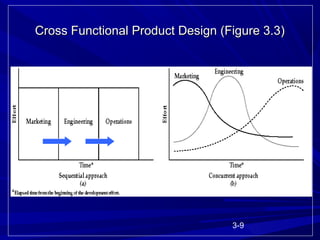
Cross Functional Product Design (Figure 3.3)Cross Functional Product Design (Figure 3.3)
3-10
Why Don’t Different Areas Cooperate?Why Don’t Different Areas Cooperate?
They don’t speak the same language.They don’t speak the same language.
They have different performance measures.They have different performance measures.
They tend to have different personality types, i.e.They tend to have different personality types, i.e.
they don’t think alike.they don’t think alike.
They are defensive about their own turfs.They are defensive about their own turfs.
They are in different physical locations.They are in different physical locations.
They “don’t have time.”They “don’t have time.”
3-11
Quality Function Deployment (QFD)Quality Function Deployment (QFD)
Also known as “House of Quality”Also known as “House of Quality”
Developed in Japan in 1972.Developed in Japan in 1972.
Tool for concurrent design of productsTool for concurrent design of products
Customer Attributes (“Voice of theCustomer Attributes (“Voice of the
Customer”)Customer”)
Engineering Characteristics (“Voice of theEngineering Characteristics (“Voice of the
Engineer”)Engineer”)
TradeoffsTradeoffs
Competitors’ ComparisonCompetitors’ Comparison
3-12
HOUSE OF QUALITY (QFD)
3-13
Design for Manufacturing (DFM)Design for Manufacturing (DFM)
Value Analysis (or engineering)Value Analysis (or engineering)
– Simplification of products and processesSimplification of products and processes
Modular DesignModular Design
– Multiple products using common parts,Multiple products using common parts,
processes and modules.processes and modules.
3-14
Value AnalysisValue Analysis
Terms in Value Analysis:Terms in Value Analysis:
– Objective: primary purpose of the productObjective: primary purpose of the product
– Basic Function: Makes the objective possibleBasic Function: Makes the objective possible
– Secondary Function: How to perform the basic functionSecondary Function: How to perform the basic function
Value analysis seeks to improve the secondaryValue analysis seeks to improve the secondary
function, e.g. how to open a can or make a tool box.function, e.g. how to open a can or make a tool box.
3-15
Objectives of Value AnalysisObjectives of Value Analysis
Enhance the design of a good or service to provideEnhance the design of a good or service to provide
higherhigher qualityquality at the sameat the same priceprice, or the same, or the same qualityquality
at a lowerat a lower priceprice..
Modify the design of production process to lower theModify the design of production process to lower the
costcost of a good or service while maintaining orof a good or service while maintaining or
improvingimproving qualityquality..
In other words, improve the ratio of usefulnessIn other words, improve the ratio of usefulness
((qualityquality) to) to costcost..
3-16
DFM: An ExampleDFM: An Example
(c) Final design
Design for push-and-snap
assembly
(b) Revised design
One-piece base &
elimination of fasteners
(a) The original design
Assembly using
common fasteners
3-17
DFM: An ExampleDFM: An Example (continued)(continued)
a. Original Design
• 24 different parts to assemble
• 7 unique parts to manage in inventory
b. Revised Design
• 4 different parts to assemble
• 3 unique parts to manage in inventory
c. Final Design
• 2 parts to assemble and manage
Question: How easy would it be to detect an assembly error with
each of the designs?
3-18
Value Analysis at ToyotaValue Analysis at Toyota
GM has 26 different seat frames.
Toyota has 2.
Toyota’s advantage: $500 million
Source: Business Week, 31 July 2006, p. 57.
3-19
Value Analysis at GMValue Analysis at GM
Bo Andersson (VP Global Purchasing)
discovered that door hinges on large SUVs
and trucks could be made from 3 parts
instead of 5. Savings: $21 per truck or
$100 million total. It still took him three
months to convince the engineers to change.
Source: Business Week, 31 July 2006, p. 57.
3-20
Modular DesignModular Design
Allows greater variety through ‘mixing and matching’Allows greater variety through ‘mixing and matching’
of modulesof modules
Develops a series of basic product componentsDevelops a series of basic product components
(modules) for later assembly into multiple products(modules) for later assembly into multiple products
Reduces complexity and costs associated with largeReduces complexity and costs associated with large
number of product variationsnumber of product variations
Easy to subcontract production of modulesEasy to subcontract production of modules
3-21
Modular DesignModular Design
Volvo P1 PlatformVolvo P1 Platform
– S40 sedanS40 sedan
– V50 station wagonV50 station wagon
– C70 convertibleC70 convertible
– C30 compactC30 compact
Chrysler LX PlatformChrysler LX Platform
– Dodge ChargerDodge Charger
– Chrysler 300Chrysler 300
– Chrysler 300C HemiChrysler 300C Hemi
– Dodge Magnum wagonDodge Magnum wagon
– Dodge ChallengerDodge Challenger
Source: Boston Globe, 19 February 2006, p. K1.Source: Boston Globe, 19 February 2006, p. K1.
3-22
Dana’s “Rolling Chassis”Dana’s “Rolling Chassis”
3-23
SummarySummary
DESIGN PROCESSDESIGN PROCESS
– Strategies for New-Product IntroductionStrategies for New-Product Introduction
– New-Product Development ProcessNew-Product Development Process
– Cross-Functional Product DesignCross-Functional Product Design
DESIGN TOOLSDESIGN TOOLS
– Quality Function DeploymentQuality Function Deployment
– Design for ManufacturingDesign for Manufacturing
Value AnalysisValue Analysis
Modular DesignModular Design

Product design-ppt

  • 1.
  • 2.
    3-2 OutlineOutline DESIGN PROCESSDESIGN PROCESS –Strategies for New-Product IntroductionStrategies for New-Product Introduction – New-Product Development ProcessNew-Product Development Process – Cross-Functional Product DesignCross-Functional Product Design DESIGN TOOLSDESIGN TOOLS – Quality Function DeploymentQuality Function Deployment – Design for ManufacturingDesign for Manufacturing Value AnalysisValue Analysis Modular DesignModular Design
  • 3.
    3-3 Product Design:Product Design: WhyDoes Operations Care?Why Does Operations Care? In the old days, “over the wall”In the old days, “over the wall” NowNow – must be able to make it (process)must be able to make it (process) technologytechnology availability of resourcesavailability of resources – must have the capacitymust have the capacity – must deliver a quality product or servicemust deliver a quality product or service – must decide inventory policiesmust decide inventory policies
  • 4.
    3-4 Strategies for New-ProductStrategiesfor New-Product IntroductionIntroduction Market PullMarket Pull (“We Make What We Can Sell”)(“We Make What We Can Sell”) – food industryfood industry Technology PushTechnology Push (“We Sell What We Can(“We Sell What We Can Make”)Make”) – electronicselectronics Interfunctional ViewInterfunctional View – personal computerspersonal computers
  • 5.
  • 6.
    3-6 New Product DevelopmentProcessNew Product Development Process Concept DevelopmentConcept Development Product or Service DesignProduct or Service Design Pilot Production/TestingPilot Production/Testing
  • 7.
    3-7 New Product DesignProcessNew Product Design Process (Figure 3.2)(Figure 3.2) Pilot production/testing Final process design Preliminary process design Concept development Product design
  • 8.
    3-8 New Product DesignProcessNew Product Design Process •To be ISO 9000 certified, an organization must define and follow a new product design process. •ISO = International Organization for Standards. www.iso.ch .
  • 9.
    3-9 Cross Functional ProductDesign (Figure 3.3)Cross Functional Product Design (Figure 3.3)
  • 10.
    3-10 Why Don’t DifferentAreas Cooperate?Why Don’t Different Areas Cooperate? They don’t speak the same language.They don’t speak the same language. They have different performance measures.They have different performance measures. They tend to have different personality types, i.e.They tend to have different personality types, i.e. they don’t think alike.they don’t think alike. They are defensive about their own turfs.They are defensive about their own turfs. They are in different physical locations.They are in different physical locations. They “don’t have time.”They “don’t have time.”
  • 11.
    3-11 Quality Function Deployment(QFD)Quality Function Deployment (QFD) Also known as “House of Quality”Also known as “House of Quality” Developed in Japan in 1972.Developed in Japan in 1972. Tool for concurrent design of productsTool for concurrent design of products Customer Attributes (“Voice of theCustomer Attributes (“Voice of the Customer”)Customer”) Engineering Characteristics (“Voice of theEngineering Characteristics (“Voice of the Engineer”)Engineer”) TradeoffsTradeoffs Competitors’ ComparisonCompetitors’ Comparison
  • 12.
  • 13.
    3-13 Design for Manufacturing(DFM)Design for Manufacturing (DFM) Value Analysis (or engineering)Value Analysis (or engineering) – Simplification of products and processesSimplification of products and processes Modular DesignModular Design – Multiple products using common parts,Multiple products using common parts, processes and modules.processes and modules.
  • 14.
    3-14 Value AnalysisValue Analysis Termsin Value Analysis:Terms in Value Analysis: – Objective: primary purpose of the productObjective: primary purpose of the product – Basic Function: Makes the objective possibleBasic Function: Makes the objective possible – Secondary Function: How to perform the basic functionSecondary Function: How to perform the basic function Value analysis seeks to improve the secondaryValue analysis seeks to improve the secondary function, e.g. how to open a can or make a tool box.function, e.g. how to open a can or make a tool box.
  • 15.
    3-15 Objectives of ValueAnalysisObjectives of Value Analysis Enhance the design of a good or service to provideEnhance the design of a good or service to provide higherhigher qualityquality at the sameat the same priceprice, or the same, or the same qualityquality at a lowerat a lower priceprice.. Modify the design of production process to lower theModify the design of production process to lower the costcost of a good or service while maintaining orof a good or service while maintaining or improvingimproving qualityquality.. In other words, improve the ratio of usefulnessIn other words, improve the ratio of usefulness ((qualityquality) to) to costcost..
  • 16.
    3-16 DFM: An ExampleDFM:An Example (c) Final design Design for push-and-snap assembly (b) Revised design One-piece base & elimination of fasteners (a) The original design Assembly using common fasteners
  • 17.
    3-17 DFM: An ExampleDFM:An Example (continued)(continued) a. Original Design • 24 different parts to assemble • 7 unique parts to manage in inventory b. Revised Design • 4 different parts to assemble • 3 unique parts to manage in inventory c. Final Design • 2 parts to assemble and manage Question: How easy would it be to detect an assembly error with each of the designs?
  • 18.
    3-18 Value Analysis atToyotaValue Analysis at Toyota GM has 26 different seat frames. Toyota has 2. Toyota’s advantage: $500 million Source: Business Week, 31 July 2006, p. 57.
  • 19.
    3-19 Value Analysis atGMValue Analysis at GM Bo Andersson (VP Global Purchasing) discovered that door hinges on large SUVs and trucks could be made from 3 parts instead of 5. Savings: $21 per truck or $100 million total. It still took him three months to convince the engineers to change. Source: Business Week, 31 July 2006, p. 57.
  • 20.
    3-20 Modular DesignModular Design Allowsgreater variety through ‘mixing and matching’Allows greater variety through ‘mixing and matching’ of modulesof modules Develops a series of basic product componentsDevelops a series of basic product components (modules) for later assembly into multiple products(modules) for later assembly into multiple products Reduces complexity and costs associated with largeReduces complexity and costs associated with large number of product variationsnumber of product variations Easy to subcontract production of modulesEasy to subcontract production of modules
  • 21.
    3-21 Modular DesignModular Design VolvoP1 PlatformVolvo P1 Platform – S40 sedanS40 sedan – V50 station wagonV50 station wagon – C70 convertibleC70 convertible – C30 compactC30 compact Chrysler LX PlatformChrysler LX Platform – Dodge ChargerDodge Charger – Chrysler 300Chrysler 300 – Chrysler 300C HemiChrysler 300C Hemi – Dodge Magnum wagonDodge Magnum wagon – Dodge ChallengerDodge Challenger Source: Boston Globe, 19 February 2006, p. K1.Source: Boston Globe, 19 February 2006, p. K1.
  • 22.
  • 23.
    3-23 SummarySummary DESIGN PROCESSDESIGN PROCESS –Strategies for New-Product IntroductionStrategies for New-Product Introduction – New-Product Development ProcessNew-Product Development Process – Cross-Functional Product DesignCross-Functional Product Design DESIGN TOOLSDESIGN TOOLS – Quality Function DeploymentQuality Function Deployment – Design for ManufacturingDesign for Manufacturing Value AnalysisValue Analysis Modular DesignModular Design