New Product develoPmeNt

        Presented By-
      Rameshwar Swami
        M.Phil Student
     Management SRTMUN
       Sub Center Latur
Definition
 New product development (NPD) is the
  complete process of bringing a new product to
  the market till its consumption & feedback
  from the end user of the business chain
  through the systematic procedure &
  parameter.
 It may be a Consumable product, service or
  idea.
Definition
 New product development (NPD) is the
  complete process of bringing a new product or
  service to market.
 New product development may be done to
  develop an item to compete with a particular
  product or may be done to improve an already
  established product.
Examples

 This type of development is considered the
  preliminary step in product or service
  development and involves a number of steps
  that must be completed before the product can
  be introduced to the market.
 Fair & lovely.
 Bajaj Pulsar.
 Samsung Mobile
Agenda

   Market Research/Opportunity Scan
   Concept Testing
   Prototype Development
   Market Testing
   Product Launch
Why New Products?
 New product development is essential to any
  business that must keep up with market trends
  and changes.
 Approximately one-third of the revenue a
  business generates is coming from products
  they did not sell five years ago
 Changing environment creates new demands
  and needs
Product Development
 Must be alert to quickly develop opportunities
 Focus on markets or product categories
  consistent with organization’s objectives,
  resources, capabilities and strengths
 Securing a competitive advantage
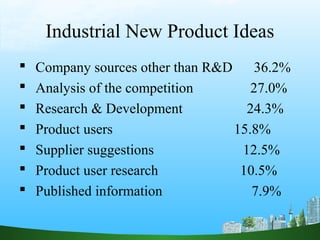
Industrial New Product Ideas
   Company sources other than R&D    36.2%
   Analysis of the competition       27.0%
   Research & Development           24.3%
   Product users                  15.8%
   Supplier suggestions            12.5%
   Product user research           10.5%
   Published information             7.9%
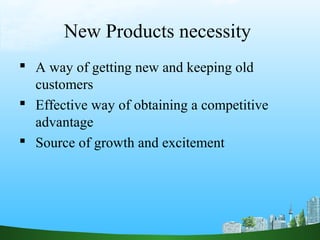
New Products necessity
 A way of getting new and keeping old
  customers
 Effective way of obtaining a competitive
  advantage
 Source of growth and excitement
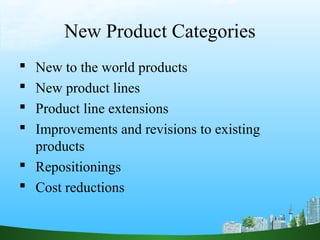
New Product Categories
 New to the world products
 New product lines
 Product line extensions
 Improvements and revisions to existing
  products
 Repositionings
 Cost reductions
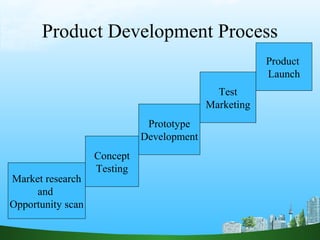
Product Development Process
                                                       Product
                                                       Launch
                                             Test
                                           Marketing
                              Prototype
                             Development
                   Concept
                   Testing
Market research
     and
Opportunity scan
Marketing
 Very important to product development success
 Key to successful marketing is imaginative,
  effective, creative communication
 Find a need and fill it.
 Mutually beneficial exchange relationships
Marketing Strategies
 Increase the number of customers
 Increase the average transaction
 Increase the frequency of repurchase
Marketing Concepts
   Consumer orientation
   Customer service orientation
   Profit orientation
   Society Benefit.
Market Research
 Who is my target audience?
 Are there enough members of this target group to
  make the business worthwhile?
 How large is the potential market and how much of
  that potential market can I capture?
 Who is my competition and what would make
  someone choose my product over their current?
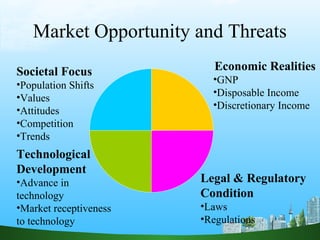
Market Opportunity and Threats
Societal Focus             Economic Realities
                          •GNP
•Population Shifts
                          •Disposable Income
•Values
                          •Discretionary Income
•Attitudes
•Competition
•Trends
Technological
Development
•Advance in             Legal & Regulatory
technology              Condition
•Market receptiveness   •Laws
to technology           •Regulations
Market Placement
1)Identify target markets
     Size and growth potential
     Ability and ease of reaching segment
     Good fit with organizational objectives
     Greatest revenue generation with least investment
Market Placement
2)Determine opportunity
     Segment size
     Annual usage potential
     Anticipated annual growth rate
     Margin
     Value in use
3)Evaluate competition
     Strengths/Limitations
     Implications
Pricing Strategies
 Goal is to achieve a target profit
 Can you hold a product’s manufacturing costs
  down to less than 25% of its perceived value?
 Estimating manufacturing costs
     Obtain price quotes from several suppliers
Concept Testing
Concept testing is the process of using
quantitative methods and qualitative methods
to evaluate consumer response to a product
idea prior to the introduction of a product to
the market.
Concept Testing
Determine
     Critical success factors
     Financial objectives
     Marketing mix strategies
         Product, Pricing, Promotion, Placement
     Marketing plan initiatives
         Activity, Budget, Timing
Prototype Development
 Prototype development is the process of
  preparing a device, technique or system that
  demonstrates the feasibility of a solution to a
  problem. For-
 1) Experimentation and learning in the
  product development process
 2) Testing and proofing product concepts
 3)Communicating concepts to the product
  development team members, management and
  customers.
Test Marketing
 Test marketing is an experiment conducted in
  a field laboratory ( test market) comprising of
  actual stores and real-life buying situations,
  without the buyers knowing they are
  participating in an evaluation exercise.
 Test marketing may last from few weeks to
  several months.
Prototype and Test Marketing

   Do you prefer this product over your current
    product?
   Does this product meet the need you thought it
    would?
   Does the way the product works provide an
    important benefit?
Promotion and Product Launch
 Publicity
     Trade journals
     Conferences
 Personal selling
 Word of mouth
Reasons For New Product Failures
   Poor marketing research
   Technical problems
   Insufficient marketing effort
   Bad timing
   The wrong group was targeted.
   Unrealistic forecast.
   Insufficient level of awareness.
Summary
 New product development drives growth.
 Market research is critical to the success of a
  new product launch.
 Market research is a continuous process as
  customer needs, your business and the
  environment changes.
New product devlopment ppt

New product devlopment ppt

  • 1.
    New Product develoPmeNt Presented By- Rameshwar Swami M.Phil Student Management SRTMUN Sub Center Latur
  • 2.
    Definition  New productdevelopment (NPD) is the complete process of bringing a new product to the market till its consumption & feedback from the end user of the business chain through the systematic procedure & parameter.  It may be a Consumable product, service or idea.
  • 3.
    Definition  New productdevelopment (NPD) is the complete process of bringing a new product or service to market.  New product development may be done to develop an item to compete with a particular product or may be done to improve an already established product.
  • 4.
    Examples  This typeof development is considered the preliminary step in product or service development and involves a number of steps that must be completed before the product can be introduced to the market.  Fair & lovely.  Bajaj Pulsar.  Samsung Mobile
  • 5.
    Agenda  Market Research/Opportunity Scan  Concept Testing  Prototype Development  Market Testing  Product Launch
  • 6.
    Why New Products? New product development is essential to any business that must keep up with market trends and changes.  Approximately one-third of the revenue a business generates is coming from products they did not sell five years ago  Changing environment creates new demands and needs
  • 7.
    Product Development  Mustbe alert to quickly develop opportunities  Focus on markets or product categories consistent with organization’s objectives, resources, capabilities and strengths  Securing a competitive advantage
  • 8.
    Industrial New ProductIdeas  Company sources other than R&D 36.2%  Analysis of the competition 27.0%  Research & Development 24.3%  Product users 15.8%  Supplier suggestions 12.5%  Product user research 10.5%  Published information 7.9%
  • 9.
    New Products necessity A way of getting new and keeping old customers  Effective way of obtaining a competitive advantage  Source of growth and excitement
  • 10.
    New Product Categories New to the world products  New product lines  Product line extensions  Improvements and revisions to existing products  Repositionings  Cost reductions
  • 11.
    Product Development Process Product Launch Test Marketing Prototype Development Concept Testing Market research and Opportunity scan
  • 12.
    Marketing  Very importantto product development success  Key to successful marketing is imaginative, effective, creative communication  Find a need and fill it.  Mutually beneficial exchange relationships
  • 13.
    Marketing Strategies  Increasethe number of customers  Increase the average transaction  Increase the frequency of repurchase
  • 14.
    Marketing Concepts  Consumer orientation  Customer service orientation  Profit orientation  Society Benefit.
  • 15.
    Market Research  Whois my target audience?  Are there enough members of this target group to make the business worthwhile?  How large is the potential market and how much of that potential market can I capture?  Who is my competition and what would make someone choose my product over their current?
  • 16.
    Market Opportunity andThreats Societal Focus Economic Realities •GNP •Population Shifts •Disposable Income •Values •Discretionary Income •Attitudes •Competition •Trends Technological Development •Advance in Legal & Regulatory technology Condition •Market receptiveness •Laws to technology •Regulations
  • 17.
    Market Placement 1)Identify targetmarkets  Size and growth potential  Ability and ease of reaching segment  Good fit with organizational objectives  Greatest revenue generation with least investment
  • 18.
    Market Placement 2)Determine opportunity  Segment size  Annual usage potential  Anticipated annual growth rate  Margin  Value in use 3)Evaluate competition  Strengths/Limitations  Implications
  • 19.
    Pricing Strategies  Goalis to achieve a target profit  Can you hold a product’s manufacturing costs down to less than 25% of its perceived value?  Estimating manufacturing costs  Obtain price quotes from several suppliers
  • 20.
    Concept Testing Concept testingis the process of using quantitative methods and qualitative methods to evaluate consumer response to a product idea prior to the introduction of a product to the market.
  • 21.
    Concept Testing Determine  Critical success factors  Financial objectives  Marketing mix strategies  Product, Pricing, Promotion, Placement  Marketing plan initiatives  Activity, Budget, Timing
  • 22.
    Prototype Development  Prototypedevelopment is the process of preparing a device, technique or system that demonstrates the feasibility of a solution to a problem. For-  1) Experimentation and learning in the product development process  2) Testing and proofing product concepts  3)Communicating concepts to the product development team members, management and customers.
  • 23.
    Test Marketing  Testmarketing is an experiment conducted in a field laboratory ( test market) comprising of actual stores and real-life buying situations, without the buyers knowing they are participating in an evaluation exercise.  Test marketing may last from few weeks to several months.
  • 24.
    Prototype and TestMarketing  Do you prefer this product over your current product?  Does this product meet the need you thought it would?  Does the way the product works provide an important benefit?
  • 25.
    Promotion and ProductLaunch  Publicity  Trade journals  Conferences  Personal selling  Word of mouth
  • 26.
    Reasons For NewProduct Failures  Poor marketing research  Technical problems  Insufficient marketing effort  Bad timing  The wrong group was targeted.  Unrealistic forecast.  Insufficient level of awareness.
  • 27.
    Summary  New productdevelopment drives growth.  Market research is critical to the success of a new product launch.  Market research is a continuous process as customer needs, your business and the environment changes.