PRODUCT DESIGN AND DEVELOPMENT Dr. Abdullah F. Al-Dwairi IE Dept., JUST
General Outline Introduction Some Definitions Product Design versus Development Design Fundamental Rules Concurrent Engineering
Introduction The MIJC: a step towards establishing a product design culture. The goal of this course is to give you the tools to develop an efficient design process regardless of the product being designed.
Definitions (1/3) Product :  A term used to describe all goods, services, and knowledge sold.
Definitions (2/3) A Product Development   Process  is the entire set of activities required to bring a new product concept to a state of market readiness. PD is the organization and management of people and the information they develop in the evolution of a product.
Definitions (3/3) A Design Process  is the set of  technical  activities within a PD process that work to meet marketing and business case vision.
Six Phases of PD Planning Concept development System-level design Detail design Testing and refinement Production ramp-up
Product Types Market-Pull Products (furniture, sporting goods, tools) Technology-Push Products (Cellular phones, ABS, Medical equipment)
The Life of a Product Identification of need Development of engineering requirements Design concept development Product design Manufacturing Assembly Distribution Installation Use Retirement, disassembly, reuse, and recycle.
Product Conceptual Design Design = Science + Art
FORM and FUNCTION The product FORM should reflect its FUNCTION FUNCTION = What the product is to do FORM = How the product is to do its FUNCTION
FORM = Shape (geometry), Material, Connections, Energy and Material Flow, Operation Procedure (Information Transfer), etc…. Design is the process of mapping function to form. Design problems have many satisfactory solutions and no clear best solution
Two Fundamental “Rules’ of Design I. The Function Rule:  Design requirements should be satisfied Independently…Hard to achieve! II. The Form Rule:  The design must have the least possible information content.
Fundamental Rules Updated I. The Function Rule:  Design requirements must be satisfied uniformly. II. The Form Rule:  The design must have the shortest production path.
The Golden Triangle Effectiveness of the design process is measured by: Product cost Product quality Time to market (TTM)
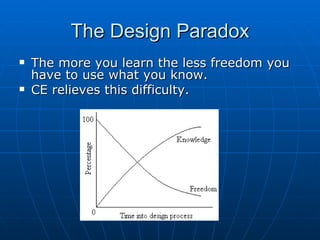
The Design Paradox The more you learn the less freedom you have to use what you know. CE relieves this difficulty.
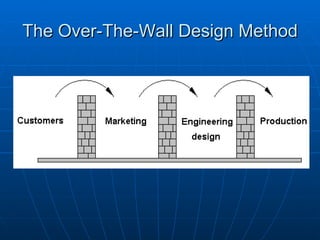
Design Process Evolution Craftsmanship – one person could design and manufacture an entire product By the middle of the 20 th  century: over-the-wall approach. From the late 1980s: concurrent engineering approach (CE).
The Over-The-Wall Design Method
Concurrent Engineering (CE) CE emphasizes the integration of cross-functional TEAMS to develop the product. The use of teams, including all the stakeholders, eliminates many of the problems with the over-the-wall method. Stakeholders = people who have a concern for the product.
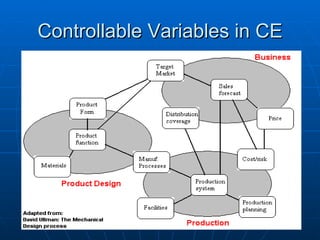
Controllable Variables in CE
The CE Design Team A team may be defined as two or more persons engaged in a common goal, who are dependent on one another for results, and who have joint accountability for the outcomes. The PRIDE principle should be followed in any product development project –  P urpose,  R espect,  I ndividuals,  D iscussions, and  E xcellence
Members of Design Teams Product design engineer Marketing manager Manufacturing engineer Drafter Technician Materials specialist Quality control/quality assurance specialist Analyst Industrial designer Assembly manager Vendor’s or supplier’s representative
Summary (1/2) Product design is a part of the product development process. PD must be centered on the CUSTOMER. The Japanese say: Listen to the VOC! Design is a process of function-to-form mapping.
Summary (2/2) Success at PD is measured by Cost, Quality, and TTM. Concurrent Engineering = early involvement of stakeholders CE suggests an integrated product and process design (IPPD) Early phases of design are the most critical to the design success.

Product Design & Development - 1

  • 1.
    PRODUCT DESIGN ANDDEVELOPMENT Dr. Abdullah F. Al-Dwairi IE Dept., JUST
  • 2.
    General Outline IntroductionSome Definitions Product Design versus Development Design Fundamental Rules Concurrent Engineering
  • 3.
    Introduction The MIJC:a step towards establishing a product design culture. The goal of this course is to give you the tools to develop an efficient design process regardless of the product being designed.
  • 4.
    Definitions (1/3) Product: A term used to describe all goods, services, and knowledge sold.
  • 5.
    Definitions (2/3) AProduct Development Process is the entire set of activities required to bring a new product concept to a state of market readiness. PD is the organization and management of people and the information they develop in the evolution of a product.
  • 6.
    Definitions (3/3) ADesign Process is the set of technical activities within a PD process that work to meet marketing and business case vision.
  • 7.
    Six Phases ofPD Planning Concept development System-level design Detail design Testing and refinement Production ramp-up
  • 8.
    Product Types Market-PullProducts (furniture, sporting goods, tools) Technology-Push Products (Cellular phones, ABS, Medical equipment)
  • 9.
    The Life ofa Product Identification of need Development of engineering requirements Design concept development Product design Manufacturing Assembly Distribution Installation Use Retirement, disassembly, reuse, and recycle.
  • 10.
    Product Conceptual DesignDesign = Science + Art
  • 11.
    FORM and FUNCTIONThe product FORM should reflect its FUNCTION FUNCTION = What the product is to do FORM = How the product is to do its FUNCTION
  • 12.
    FORM = Shape(geometry), Material, Connections, Energy and Material Flow, Operation Procedure (Information Transfer), etc…. Design is the process of mapping function to form. Design problems have many satisfactory solutions and no clear best solution
  • 13.
    Two Fundamental “Rules’of Design I. The Function Rule: Design requirements should be satisfied Independently…Hard to achieve! II. The Form Rule: The design must have the least possible information content.
  • 14.
    Fundamental Rules UpdatedI. The Function Rule: Design requirements must be satisfied uniformly. II. The Form Rule: The design must have the shortest production path.
  • 15.
    The Golden TriangleEffectiveness of the design process is measured by: Product cost Product quality Time to market (TTM)
  • 16.
    The Design ParadoxThe more you learn the less freedom you have to use what you know. CE relieves this difficulty.
  • 17.
    Design Process EvolutionCraftsmanship – one person could design and manufacture an entire product By the middle of the 20 th century: over-the-wall approach. From the late 1980s: concurrent engineering approach (CE).
  • 18.
  • 19.
    Concurrent Engineering (CE)CE emphasizes the integration of cross-functional TEAMS to develop the product. The use of teams, including all the stakeholders, eliminates many of the problems with the over-the-wall method. Stakeholders = people who have a concern for the product.
  • 20.
  • 21.
    The CE DesignTeam A team may be defined as two or more persons engaged in a common goal, who are dependent on one another for results, and who have joint accountability for the outcomes. The PRIDE principle should be followed in any product development project – P urpose, R espect, I ndividuals, D iscussions, and E xcellence
  • 22.
    Members of DesignTeams Product design engineer Marketing manager Manufacturing engineer Drafter Technician Materials specialist Quality control/quality assurance specialist Analyst Industrial designer Assembly manager Vendor’s or supplier’s representative
  • 23.
    Summary (1/2) Productdesign is a part of the product development process. PD must be centered on the CUSTOMER. The Japanese say: Listen to the VOC! Design is a process of function-to-form mapping.
  • 24.
    Summary (2/2) Successat PD is measured by Cost, Quality, and TTM. Concurrent Engineering = early involvement of stakeholders CE suggests an integrated product and process design (IPPD) Early phases of design are the most critical to the design success.

Editor's Notes

  • #2 Frequently, presenters must deliver material of a technical nature to an audience unfamiliar with the topic or vocabulary. The material may be complex or heavy with detail. To present technical material effectively, use the following guidelines from Dale Carnegie Training®.   Consider the amount of time available and prepare to organize your material. Narrow your topic. Divide your presentation into clear segments. Follow a logical progression. Maintain your focus throughout. Close the presentation with a summary, repetition of the key steps, or a logical conclusion.   Keep your audience in mind at all times. For example, be sure data is clear and information is relevant. Keep the level of detail and vocabulary appropriate for the audience. Use visuals to support key points or steps. Keep alert to the needs of your listeners, and you will have a more receptive audience.