Design for Environment
Teaching materials to accompany:
Product Design and Development
Chapter 12
Karl T. Ulrich and Steven D. Eppinger
5th Edition, Irwin McGraw-Hill, 2012.
Product Design and Development
Karl T. Ulrich and Steven D. Eppinger
5th edition, Irwin McGraw-Hill, 2012.
Chapter Table of Contents:
1.  Introduction
2.  Development Processes and Organizations
3.  Opportunity Identification
4.  Product Planning
5.  Identifying Customer Needs
6.  Product Specifications
7.  Concept Generation
8.  Concept Selection
9.  Concept Testing
10.  Product Architecture
11.  Industrial Design
12.  Design for Environment
13.  Design for Manufacturing
14.  Prototyping
15.  Robust Design
16.  Patents and Intellectual Property
17.  Product Development Economics
18.  Managing Projects
Preparation Assignment
•  Think about the environmental impact of
the products and services we use.
•  Identify a product or service with reduced
environmental impact.
•  Be prepared to describe the product or
service class.
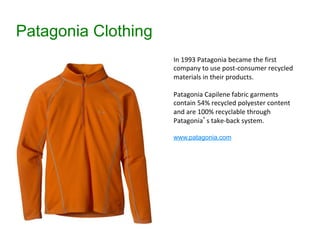
Patagonia Clothing
In	1993	Patagonia	became	the	first	
company	to	use	post-consumer	recycled	
materials	in	their	products.	
	
Patagonia	Capilene	fabric	garments	
contain	54%	recycled	polyester	content	
and	are	100%	recyclable	through	
Patagonia’s	take-back	system.	
	
www.patagonia.com
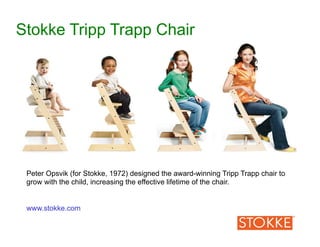
Peter Opsvik (for Stokke, 1972) designed the award-winning Tripp Trapp chair to
grow with the child, increasing the effective lifetime of the chair.
www.stokke.com
Stokke Tripp Trapp Chair
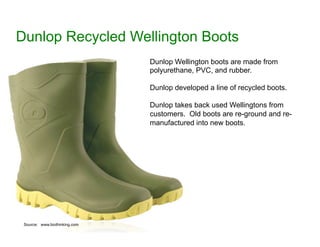
Dunlop Recycled Wellington Boots
Dunlop Wellington boots are made from
polyurethane, PVC, and rubber.
Dunlop developed a line of recycled boots.
Dunlop takes back used Wellingtons from
customers. Old boots are re-ground and re-
manufactured into new boots.
Source: www.biothinking.com
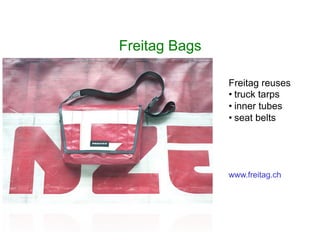
Freitag Bags
Freitag reuses
• truck tarps
• inner tubes
• seat belts
www.freitag.ch
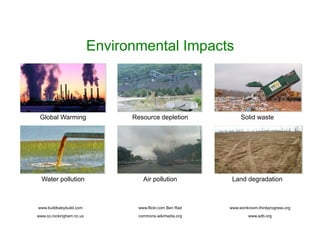
Environmental Impacts
Water pollution
Solid wasteGlobal Warming Resource depletion
Air pollution Land degradation
www.buildbabybuild.com www.flickr.com Ben Rad www.wonkroom.thinkprogress.org
www.co.rockingham.nc.us commons.wikimedia.org www.adb.org
a legacy problem?
a materials problem?
a solvable problem?
YES!
Is this …
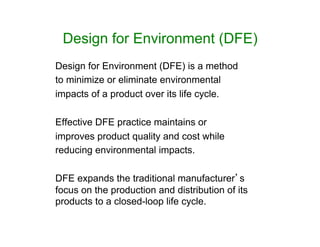
Design for Environment (DFE)
Design for Environment (DFE) is a method
to minimize or eliminate environmental
impacts of a product over its life cycle.
Effective DFE practice maintains or
improves product quality and cost while
reducing environmental impacts.
DFE expands the traditional manufacturer’s
focus on the production and distribution of its
products to a closed-loop life cycle.
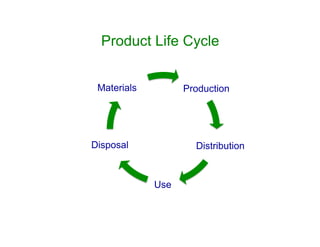
Product Life Cycle
Disposal
Materials Production
Distribution
Use
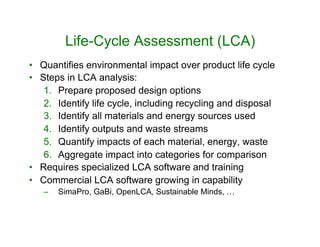
Life-Cycle Assessment (LCA)
•  Quantifies environmental impact over product life cycle
•  Steps in LCA analysis:
1.  Prepare proposed design options
2.  Identify life cycle, including recycling and disposal
3.  Identify all materials and energy sources used
4.  Identify outputs and waste streams
5.  Quantify impacts of each material, energy, waste
6.  Aggregate impact into categories for comparison
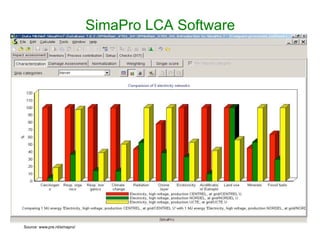
•  Requires specialized LCA software and training
•  Commercial LCA software growing in capability
–  SimaPro, GaBi, OpenLCA, Sustainable Minds, …
SimaPro LCA Software
Source: www.pre.nl/simapro/
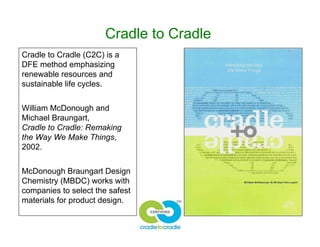
Cradle to Cradle
Cradle to Cradle (C2C) is a
DFE method emphasizing
renewable resources and
sustainable life cycles.
William McDonough and
Michael Braungart,
Cradle to Cradle: Remaking
the Way We Make Things,
2002.
McDonough Braungart Design
Chemistry (MBDC) works with
companies to select the safest
materials for product design.
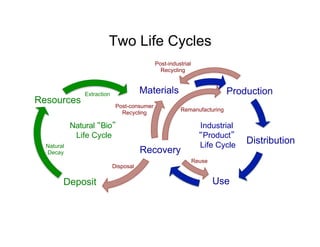
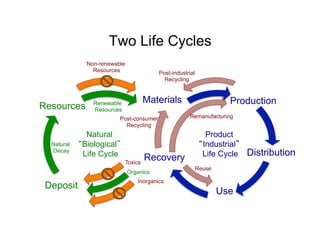
Two Life Cycles
Recovery
Materials Production
Distribution
UseDeposit
Resources
Post-consumer
Recycling
Remanufacturing
Reuse
Natural
Decay
Natural “Bio”
Life Cycle
Industrial
“Product”
Life Cycle
Disposal
Post-industrial
Recycling
Extraction
Two Life Cycles
Recovery
Materials Production
Distribution
Use
Deposit
Resources
Post-consumer
Recycling
Remanufacturing
Reuse
Natural
Decay
Organics
Post-industrial
Recycling
Natural
“Biological”
Life Cycle
Product
“Industrial”
Life Cycle
Inorganics
Non-renewable
Resources
Renewable
Resources
Toxics
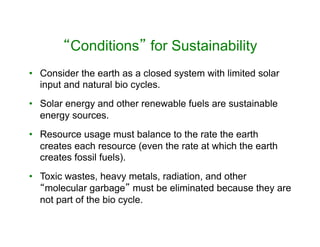
“Conditions” for Sustainability
•  Consider the earth as a closed system with limited solar
input and natural bio cycles.
•  Solar energy and other renewable fuels are sustainable
energy sources.
•  Resource usage must balance to the rate the earth
creates each resource (even the rate at which the earth
creates fossil fuels).
•  Toxic wastes, heavy metals, radiation, and other
“molecular garbage” must be eliminated because they are
not part of the bio cycle.
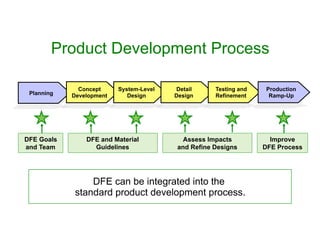
Planning
Product Development Process
Concept
Development
System-Level
Design
Detail
Design
Testing and
Refinement
Production
Ramp-Up
DFE can be integrated into the
standard product development process.
Assess Impacts
and Refine Designs
DFE Goals
and Team
DFE and Material
Guidelines
Improve
DFE Process
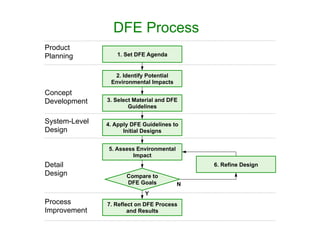
DFE Process
Detail
Design Compare to
DFE Goals
Concept
Development
System-Level
Design
Product
Planning 1. Set DFE Agenda
3. Select Material and DFE
Guidelines
2. Identify Potential
Environmental Impacts
5. Assess Environmental
Impact
4. Apply DFE Guidelines to
Initial Designs
N
7. Reflect on DFE Process
and Results
6. Refine Design
Y
Process
Improvement
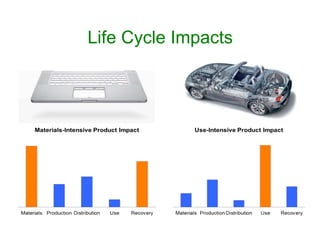
Life Cycle Impacts
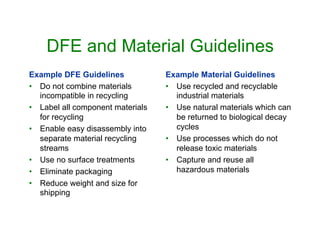
DFE and Material Guidelines
Example DFE Guidelines
•  Do not combine materials
incompatible in recycling
•  Label all component materials
for recycling
•  Enable easy disassembly into
separate material recycling
streams
•  Use no surface treatments
•  Eliminate packaging
•  Reduce weight and size for
shipping
Example Material Guidelines
•  Use recycled and recyclable
industrial materials
•  Use natural materials which can
be returned to biological decay
cycles
•  Use processes which do not
release toxic materials
•  Capture and reuse all
hazardous materials
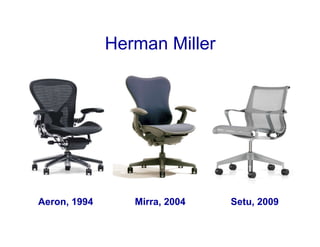
Herman Miller
Aeron, 1994 Mirra, 2004 Setu, 2009
Herman Miller’s Environmental Goals
Perfect Vision 2020
•  Zero landfill
•  Zero hazardous waste generation
•  Zero air emissions (VOC)
•  Zero process water use
•  100% green electrical energy use
•  100% of sales from DfE products
•  Company buildings constructed to a
minimum LEED Silver certification
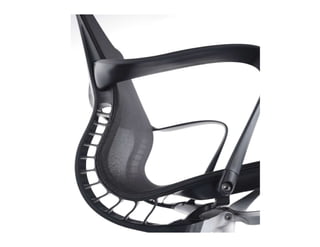
Setu Spine
Herman Miller
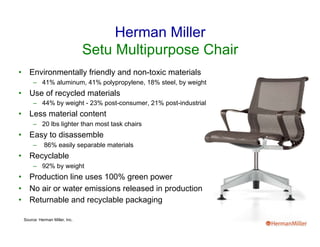
Setu Multipurpose Chair
•  Environmentally friendly and non-toxic materials
–  41% aluminum, 41% polypropylene, 18% steel, by weight
•  Use of recycled materials
–  44% by weight - 23% post-consumer, 21% post-industrial
•  Less material content
–  20 lbs lighter than most task chairs
•  Easy to disassemble
–  86% easily separable materials
•  Recyclable
–  92% by weight
•  Production line uses 100% green power
•  No air or water emissions released in production
•  Returnable and recyclable packaging
Source: Herman Miller, Inc.
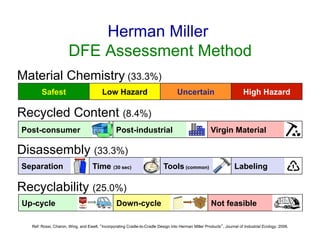
Herman Miller
DFE Assessment Method
Material Chemistry (33.3%)
Recycled Content (8.4%)
Disassembly (33.3%)
Recyclability (25.0%)
Safest Low Hazard Uncertain High Hazard
Separation Time (30 sec) Tools (common) Labeling
Post-consumer Post-industrial Virgin Material
Up-cycle Down-cycle Not feasible
Ref: Rossi, Charon, Wing, and Ewell, “Incorporating Cradle-to-Cradle Design into Herman Miller Products”, Journal of Industrial Ecology, 2006.
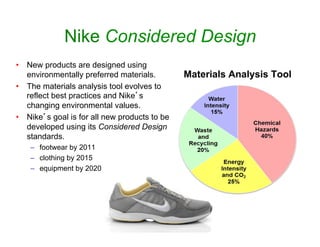
Nike Considered Design
•  New products are designed using
environmentally preferred materials.
•  The materials analysis tool evolves to
reflect best practices and Nike’s
changing environmental values.
•  Nike’s goal is for all new products to be
developed using its Considered Design
standards.
–  footwear by 2011
–  clothing by 2015
–  equipment by 2020
Materials Analysis Tool
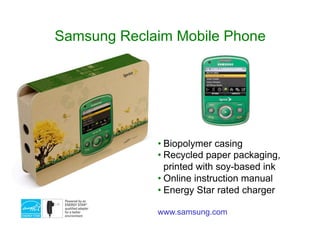
Samsung Reclaim Mobile Phone
• Biopolymer casing
• Recycled paper packaging,
printed with soy-based ink
• Online instruction manual
• Energy Star rated charger
www.samsung.com
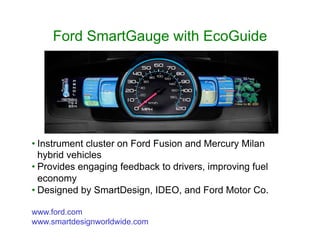
Ford SmartGauge with EcoGuide
• Instrument cluster on Ford Fusion and Mercury Milan
hybrid vehicles
• Provides engaging feedback to drivers, improving fuel
economy
• Designed by SmartDesign, IDEO, and Ford Motor Co.
www.ford.com
www.smartdesignworldwide.com
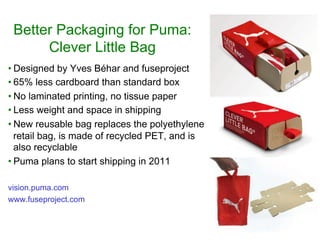
Better Packaging for Puma:
Clever Little Bag
• Designed by Yves Béhar and fuseproject
• 65% less cardboard than standard box
• No laminated printing, no tissue paper
• Less weight and space in shipping
• New reusable bag replaces the polyethylene
retail bag, is made of recycled PET, and is
also recyclable
• Puma plans to start shipping in 2011
vision.puma.com
www.fuseproject.com
Four Simple DFE Rules
1.  Design products and processes with industrial materials
that can be recycled continually with no loss in
performance, thereby creating new industrial materials.
2.  Design products and processes with natural materials that
can be fully returned to the earth’s natural cycles,
thereby creating new natural materials.
3.  Design products and processes that do not produce
unnatural, toxic materials that cannot be safely processed
by either natural or industrial cycles.
4.  Design products and processes with clean, renewable
sources of energy, rather than fossil fuels.
Final Message on
Green Design
•  This is hard.
•  This is important.
•  This is our responsibility.
•  This is a great opportunity…
– for businesses and entrepreneurs
– for scientists, engineers, and designers
– for researchers
The
Circular Economy
in the
Asia Pacific Region
www.circularecconomyasia.org

Design for Environment

  • 1.
    Design for Environment Teachingmaterials to accompany: Product Design and Development Chapter 12 Karl T. Ulrich and Steven D. Eppinger 5th Edition, Irwin McGraw-Hill, 2012.
  • 2.
    Product Design andDevelopment Karl T. Ulrich and Steven D. Eppinger 5th edition, Irwin McGraw-Hill, 2012. Chapter Table of Contents: 1.  Introduction 2.  Development Processes and Organizations 3.  Opportunity Identification 4.  Product Planning 5.  Identifying Customer Needs 6.  Product Specifications 7.  Concept Generation 8.  Concept Selection 9.  Concept Testing 10.  Product Architecture 11.  Industrial Design 12.  Design for Environment 13.  Design for Manufacturing 14.  Prototyping 15.  Robust Design 16.  Patents and Intellectual Property 17.  Product Development Economics 18.  Managing Projects
  • 3.
    Preparation Assignment •  Thinkabout the environmental impact of the products and services we use. •  Identify a product or service with reduced environmental impact. •  Be prepared to describe the product or service class.
  • 4.
  • 5.
    Peter Opsvik (forStokke, 1972) designed the award-winning Tripp Trapp chair to grow with the child, increasing the effective lifetime of the chair. www.stokke.com Stokke Tripp Trapp Chair
  • 6.
    Dunlop Recycled WellingtonBoots Dunlop Wellington boots are made from polyurethane, PVC, and rubber. Dunlop developed a line of recycled boots. Dunlop takes back used Wellingtons from customers. Old boots are re-ground and re- manufactured into new boots. Source: www.biothinking.com
  • 7.
    Freitag Bags Freitag reuses • trucktarps • inner tubes • seat belts www.freitag.ch
  • 8.
    Environmental Impacts Water pollution SolidwasteGlobal Warming Resource depletion Air pollution Land degradation www.buildbabybuild.com www.flickr.com Ben Rad www.wonkroom.thinkprogress.org www.co.rockingham.nc.us commons.wikimedia.org www.adb.org
  • 9.
    a legacy problem? amaterials problem? a solvable problem? YES! Is this …
  • 10.
    Design for Environment(DFE) Design for Environment (DFE) is a method to minimize or eliminate environmental impacts of a product over its life cycle. Effective DFE practice maintains or improves product quality and cost while reducing environmental impacts. DFE expands the traditional manufacturer’s focus on the production and distribution of its products to a closed-loop life cycle.
  • 11.
    Product Life Cycle Disposal MaterialsProduction Distribution Use
  • 12.
    Life-Cycle Assessment (LCA) • Quantifies environmental impact over product life cycle •  Steps in LCA analysis: 1.  Prepare proposed design options 2.  Identify life cycle, including recycling and disposal 3.  Identify all materials and energy sources used 4.  Identify outputs and waste streams 5.  Quantify impacts of each material, energy, waste 6.  Aggregate impact into categories for comparison •  Requires specialized LCA software and training •  Commercial LCA software growing in capability –  SimaPro, GaBi, OpenLCA, Sustainable Minds, …
  • 13.
    SimaPro LCA Software Source:www.pre.nl/simapro/
  • 14.
    Cradle to Cradle Cradleto Cradle (C2C) is a DFE method emphasizing renewable resources and sustainable life cycles. William McDonough and Michael Braungart, Cradle to Cradle: Remaking the Way We Make Things, 2002. McDonough Braungart Design Chemistry (MBDC) works with companies to select the safest materials for product design.
  • 15.
    Two Life Cycles Recovery MaterialsProduction Distribution UseDeposit Resources Post-consumer Recycling Remanufacturing Reuse Natural Decay Natural “Bio” Life Cycle Industrial “Product” Life Cycle Disposal Post-industrial Recycling Extraction
  • 16.
    Two Life Cycles Recovery MaterialsProduction Distribution Use Deposit Resources Post-consumer Recycling Remanufacturing Reuse Natural Decay Organics Post-industrial Recycling Natural “Biological” Life Cycle Product “Industrial” Life Cycle Inorganics Non-renewable Resources Renewable Resources Toxics
  • 17.
    “Conditions” for Sustainability • Consider the earth as a closed system with limited solar input and natural bio cycles. •  Solar energy and other renewable fuels are sustainable energy sources. •  Resource usage must balance to the rate the earth creates each resource (even the rate at which the earth creates fossil fuels). •  Toxic wastes, heavy metals, radiation, and other “molecular garbage” must be eliminated because they are not part of the bio cycle.
  • 18.
    Planning Product Development Process Concept Development System-Level Design Detail Design Testingand Refinement Production Ramp-Up DFE can be integrated into the standard product development process. Assess Impacts and Refine Designs DFE Goals and Team DFE and Material Guidelines Improve DFE Process
  • 19.
    DFE Process Detail Design Compareto DFE Goals Concept Development System-Level Design Product Planning 1. Set DFE Agenda 3. Select Material and DFE Guidelines 2. Identify Potential Environmental Impacts 5. Assess Environmental Impact 4. Apply DFE Guidelines to Initial Designs N 7. Reflect on DFE Process and Results 6. Refine Design Y Process Improvement
  • 20.
  • 21.
    DFE and MaterialGuidelines Example DFE Guidelines •  Do not combine materials incompatible in recycling •  Label all component materials for recycling •  Enable easy disassembly into separate material recycling streams •  Use no surface treatments •  Eliminate packaging •  Reduce weight and size for shipping Example Material Guidelines •  Use recycled and recyclable industrial materials •  Use natural materials which can be returned to biological decay cycles •  Use processes which do not release toxic materials •  Capture and reuse all hazardous materials
  • 22.
    Herman Miller Aeron, 1994Mirra, 2004 Setu, 2009
  • 23.
    Herman Miller’s EnvironmentalGoals Perfect Vision 2020 •  Zero landfill •  Zero hazardous waste generation •  Zero air emissions (VOC) •  Zero process water use •  100% green electrical energy use •  100% of sales from DfE products •  Company buildings constructed to a minimum LEED Silver certification
  • 24.
  • 25.
    Herman Miller Setu MultipurposeChair •  Environmentally friendly and non-toxic materials –  41% aluminum, 41% polypropylene, 18% steel, by weight •  Use of recycled materials –  44% by weight - 23% post-consumer, 21% post-industrial •  Less material content –  20 lbs lighter than most task chairs •  Easy to disassemble –  86% easily separable materials •  Recyclable –  92% by weight •  Production line uses 100% green power •  No air or water emissions released in production •  Returnable and recyclable packaging Source: Herman Miller, Inc.
  • 26.
    Herman Miller DFE AssessmentMethod Material Chemistry (33.3%) Recycled Content (8.4%) Disassembly (33.3%) Recyclability (25.0%) Safest Low Hazard Uncertain High Hazard Separation Time (30 sec) Tools (common) Labeling Post-consumer Post-industrial Virgin Material Up-cycle Down-cycle Not feasible Ref: Rossi, Charon, Wing, and Ewell, “Incorporating Cradle-to-Cradle Design into Herman Miller Products”, Journal of Industrial Ecology, 2006.
  • 27.
    Nike Considered Design • New products are designed using environmentally preferred materials. •  The materials analysis tool evolves to reflect best practices and Nike’s changing environmental values. •  Nike’s goal is for all new products to be developed using its Considered Design standards. –  footwear by 2011 –  clothing by 2015 –  equipment by 2020 Materials Analysis Tool
  • 28.
    Samsung Reclaim MobilePhone • Biopolymer casing • Recycled paper packaging, printed with soy-based ink • Online instruction manual • Energy Star rated charger www.samsung.com
  • 29.
    Ford SmartGauge withEcoGuide • Instrument cluster on Ford Fusion and Mercury Milan hybrid vehicles • Provides engaging feedback to drivers, improving fuel economy • Designed by SmartDesign, IDEO, and Ford Motor Co. www.ford.com www.smartdesignworldwide.com
  • 30.
    Better Packaging forPuma: Clever Little Bag • Designed by Yves Béhar and fuseproject • 65% less cardboard than standard box • No laminated printing, no tissue paper • Less weight and space in shipping • New reusable bag replaces the polyethylene retail bag, is made of recycled PET, and is also recyclable • Puma plans to start shipping in 2011 vision.puma.com www.fuseproject.com
  • 31.
    Four Simple DFERules 1.  Design products and processes with industrial materials that can be recycled continually with no loss in performance, thereby creating new industrial materials. 2.  Design products and processes with natural materials that can be fully returned to the earth’s natural cycles, thereby creating new natural materials. 3.  Design products and processes that do not produce unnatural, toxic materials that cannot be safely processed by either natural or industrial cycles. 4.  Design products and processes with clean, renewable sources of energy, rather than fossil fuels.
  • 32.
    Final Message on GreenDesign •  This is hard. •  This is important. •  This is our responsibility. •  This is a great opportunity… – for businesses and entrepreneurs – for scientists, engineers, and designers – for researchers
  • 33.
    The Circular Economy in the AsiaPacific Region www.circularecconomyasia.org