CONTENTS
 What is a product and product design?
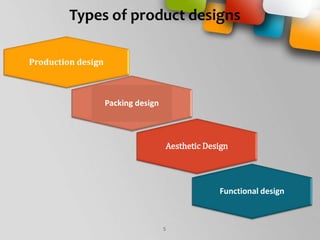
 Types of product designs
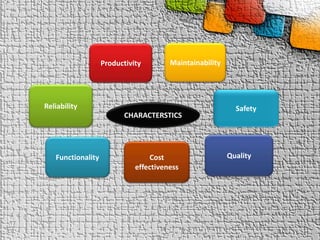
 Characteristics
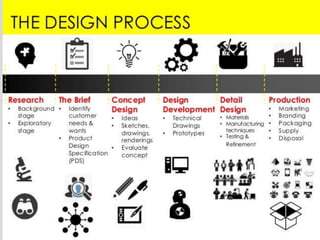
 Design process
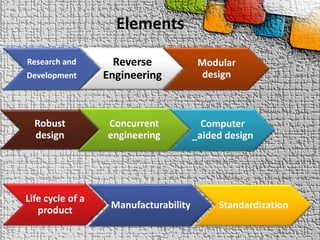
 Elements
 Factors
2
Your Logo
3
A product is a bundle of physical service and
symbolic particulars expected to yield satisfactions or benefits
to the buyers. A product can be a service or an item offered for
sale. It can be physical or in virtual or cyber form.
Design is a conversion of knowledge and
requirements in to a form, convenient and suitable for use for
manufacture .product design involves a broad approach to the
designing and making of innovative.
According to C.S. Deverell, ā€œProduct design in its
broadest sense includes the whole development of the
product through all the preliminary stages until actual
manufacturing beginsā€.
The process focuses on figuring out what is
required, brainstorming possible ideas, creating mock
prototypes, and then generating the product. however,
that is not the end of the process.
4
5
Aesthetic Design
Functional design
Production design
Packing design
Functional design :
• Functional design involves developing an idea in to a
tough model of the proposed product.
• After making a rough sketch of the proposed products, the
designer makes drafting room sketches of the individual
parts in correct dimension .
• Before moving to a product design, the model of the
proposed product should be thoroughly tested to make
sure that they will function properly for a certain
period.
6
Aesthetic Design:
• Before production on a commercial scale is
undertaken, another type of design must be
integrated for market acceptability.
• The emphasis on styling has become the functional
design during recent years.
• It is not enough to be sure that the functional
design of the proposed product is good and
economical ,but it should be appealing to the
customers eyes and holding them to buy the
product.
7
Production Design:
• The functional design is translated to
production design to make it easy to
manufacture.
• Production design means a design which may
result in affecting the economies without
effecting its functional efficiency.
• In carrying out production design ,any special
tools, jigs or fixtures needed in production
should be noted and their designing should be
carried out by the tool department.
8
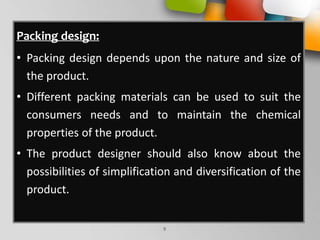
Packing design:
• Packing design depends upon the nature and size of
the product.
• Different packing materials can be used to suit the
consumers needs and to maintain the chemical
properties of the product.
• The product designer should also know about the
possibilities of simplification and diversification of the
product.
9
10
CHARACTERSTICS
Reliability
Functionality Quality
Safety
Productivity Maintainability
Cost
effectiveness
Your Logo
11
12
Reverse
Engineering
Modular
design
Robust
design
Computer
_aided design
Life cycle of a
product
Concurrent
engineering
StandardizationManufacturability
Research and
Development
Elements
Research and development: The design of new product
is done by the (R&D) department of organization with the
help of many other departments.
• In (R&D), fundamental research is the advancement of
the state of knowledge in a subject, though it may to
be practical converting in to commercial application.
Reverse Engineering: It is the process of carefully
dismantling an existing product.
• It helps in designing new product , which are better
than those of the competitors.
13
• In the field of consumer electronics , Sony
corp.is designing new innovative items such as
Walkman , handycam, digital camera ,etc...,
Modular design : It is the one of the significant
aspects of product designing . The modules are
sub assemblies of different components and
parts.
• The modular design concept gives consumers a
range of product options ,and it offers considerable
advantages in manufacturing. It directly effects the
complexity and cost of the conversion process.
Robust design: Robust design means designing a
product that is operational in varying environmental
conditions.
15
Concurrent Engineering: It is the product design
approach in which the design team includes personnel
from the marketing department ,engineering
,production departments.
Computer –Aided design: It is a software which helps
the designer to make the three dimensional design of a
product on the computer and design from various
angles.
16
• The design made on cad can be seen at different
workstations through intranets simultaneously.
Life cycle of a product:
• The product life cycle has five stages spread throughout
the life of a product.
• These are incubation , growth , maturity , saturation ,
and decline. The incubation stage witnesses a low
demand of the product owning to the customer not
being aware of new product.
17
• New features are added to a product over a
period of time , the demand starts growing and
this phase called the growth phase.
• Next follows the maturity stage , when the
demand is stable , and new features do not
appeal to the masses , leading to the saturation
phase and eventually the decline phase.
18
19
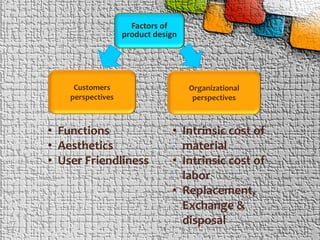
Factors of
product design
Customers
perspectives
Organizational
perspectives
• Functions
• Aesthetics
• User Friendliness
• Intrinsic cost of
material
• Intrinsic cost of
labor
• Replacement,
Exchange &
disposal
Your Logo
20

Product design

  • 2.
    CONTENTS  What isa product and product design?  Types of product designs  Characteristics  Design process  Elements  Factors 2
  • 3.
    Your Logo 3 A productis a bundle of physical service and symbolic particulars expected to yield satisfactions or benefits to the buyers. A product can be a service or an item offered for sale. It can be physical or in virtual or cyber form. Design is a conversion of knowledge and requirements in to a form, convenient and suitable for use for manufacture .product design involves a broad approach to the designing and making of innovative.
  • 4.
    According to C.S.Deverell, ā€œProduct design in its broadest sense includes the whole development of the product through all the preliminary stages until actual manufacturing beginsā€. The process focuses on figuring out what is required, brainstorming possible ideas, creating mock prototypes, and then generating the product. however, that is not the end of the process. 4
  • 5.
  • 6.
    Functional design : •Functional design involves developing an idea in to a tough model of the proposed product. • After making a rough sketch of the proposed products, the designer makes drafting room sketches of the individual parts in correct dimension . • Before moving to a product design, the model of the proposed product should be thoroughly tested to make sure that they will function properly for a certain period. 6
  • 7.
    Aesthetic Design: • Beforeproduction on a commercial scale is undertaken, another type of design must be integrated for market acceptability. • The emphasis on styling has become the functional design during recent years. • It is not enough to be sure that the functional design of the proposed product is good and economical ,but it should be appealing to the customers eyes and holding them to buy the product. 7
  • 8.
    Production Design: • Thefunctional design is translated to production design to make it easy to manufacture. • Production design means a design which may result in affecting the economies without effecting its functional efficiency. • In carrying out production design ,any special tools, jigs or fixtures needed in production should be noted and their designing should be carried out by the tool department. 8
  • 9.
    Packing design: • Packingdesign depends upon the nature and size of the product. • Different packing materials can be used to suit the consumers needs and to maintain the chemical properties of the product. • The product designer should also know about the possibilities of simplification and diversification of the product. 9
  • 10.
  • 11.
  • 12.
    12 Reverse Engineering Modular design Robust design Computer _aided design Life cycleof a product Concurrent engineering StandardizationManufacturability Research and Development Elements
  • 13.
    Research and development:The design of new product is done by the (R&D) department of organization with the help of many other departments. • In (R&D), fundamental research is the advancement of the state of knowledge in a subject, though it may to be practical converting in to commercial application. Reverse Engineering: It is the process of carefully dismantling an existing product. • It helps in designing new product , which are better than those of the competitors. 13
  • 14.
    • In thefield of consumer electronics , Sony corp.is designing new innovative items such as Walkman , handycam, digital camera ,etc..., Modular design : It is the one of the significant aspects of product designing . The modules are sub assemblies of different components and parts.
  • 15.
    • The modulardesign concept gives consumers a range of product options ,and it offers considerable advantages in manufacturing. It directly effects the complexity and cost of the conversion process. Robust design: Robust design means designing a product that is operational in varying environmental conditions. 15
  • 16.
    Concurrent Engineering: Itis the product design approach in which the design team includes personnel from the marketing department ,engineering ,production departments. Computer –Aided design: It is a software which helps the designer to make the three dimensional design of a product on the computer and design from various angles. 16
  • 17.
    • The designmade on cad can be seen at different workstations through intranets simultaneously. Life cycle of a product: • The product life cycle has five stages spread throughout the life of a product. • These are incubation , growth , maturity , saturation , and decline. The incubation stage witnesses a low demand of the product owning to the customer not being aware of new product. 17
  • 18.
    • New featuresare added to a product over a period of time , the demand starts growing and this phase called the growth phase. • Next follows the maturity stage , when the demand is stable , and new features do not appeal to the masses , leading to the saturation phase and eventually the decline phase. 18
  • 19.
    19 Factors of product design Customers perspectives Organizational perspectives •Functions • Aesthetics • User Friendliness • Intrinsic cost of material • Intrinsic cost of labor • Replacement, Exchange & disposal
  • 20.