Product Design &
Development
Velmurugan Sivaraman
PD&D - Product Design & Development
Agenda for the discussion
Introduction – Design & Disciplines
Factors inspiring PDD, Product Life Cycle (PLC)
Product Analysis
Value Engineering
Selection of materials
Selection of manufacturing process
Rapid prototyping & Summary
PD&D - Product Design & Development
Introduction - Product
What is
PD&D - Product Design & Development
Introduction - Product
Product refers to a physical product or service or an idea which a
customer or consumer needs and for which he is ready to pay.
Physical products include tangential goods like grocery items,
garments to name a few…
PD&D - Product Design & Development
Introduction - Product
Services are intangible products which are offered and purchased by
consumers. Services may also include an innovative idea on any
aspect of operation
PD&D - Product Design & Development
Introduction - Product
Benefits
Functional
benefits
Psychological
benefits
Social benefits
A consumer may purchase a product to get three types of benefits-Functional, Psychological
and Social benefits.
For example, the purchase of a motor cycle provides functional utility of a transportation, but at
the same time satisfy the need for prestige and esteem and provides social benefit by the way of
acceptance from a group, by riding the motor bike.
Thus all those aspects should be considered while planning for a product
PD&D - Product Design & Development
Introduction - Product
Product
Consumer
products
Industrial
products
PD&D - Product Design & Development
Introduction - Design
What is DESIGN?
PD&D - Product Design & Development
Introduction – Design
Design is the human power to conceive, plan, and realize products
that serve human beings, in the accomplishment of any individual or
collective purpose.
PD&D - Product Design & Development
Introduction – Design Disciplines
Applied Arts / Fine Arts:-
For aesthetics to objects of function and everyday use
For decorative purpose like Paintings, Portraits, etc.
PD&D - Product Design & Development
Introduction – Design Disciplines
Architecture:-
Usually for buildings and other physical structures
For aesthetics of objects
PD&D - Product Design & Development
Introduction – Design Disciplines
Fashion:-
For aesthetics or natural beauty to clothing and accessories
Influenced by cultural and social latitudes
For Garments, Texture, etc.
PD&D - Product Design & Development
Introduction – Design Disciplines
Gaming Industry:-
For content and rules of a game
Gameplay, environment, storyline and characters
PD&D - Product Design & Development
Introduction – Design Disciplines
Engineering Design:-
Preliminary design
Schematics, diagrams, layouts of the project
Detailed design
Operating parameters, Test, Materials, Packaging
Production planning and tool design
Jigs, fixtures, and tooling
Production
PD&D - Product Design & Development
Introduction – Design Disciplines
Mechanical Design
For Machines like Lathe, Drill, etc.
For Turbo-machines like Turbine, Propeller, etc.
For Automobile like Chassis, Transmission, etc.
For Components like Gears, Shafts, Joints, etc.
PD&D - Product Design & Development
Introduction - Development
What is DEVLOPEMENT?
PD&D - Product Design & Development
Introduction – Development
In business and engineering, new product development (NPD) is the
complete process of bringing a new product to market.
PD&D - What is a new product?
An old product
introduced in a new
market
An old product
packaged in a different
way
An old product
marketed in a different
way
A product that
significantly broadens
the market for an
existing product
A product that adopts
or replaces an existing
product
A product that opens
an entirely new market
PD&D - Type of new product?
•Innovative products
•New product lines – to allow the firm to enter an existing market
•Addition to product line – to supplement the firm’s existing product line
•Improvements and revisions of existing product
•Repositioned products – existing products targets at new market
•Cost reduction new product that provide similar performance at lower
cost
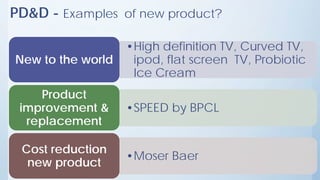
PD&D - Examples of new product?
•High definition TV, Curved TV,
ipod, flat screen TV, Probiotic
Ice Cream
New to the world
•SPEED by BPCL
Product
improvement &
replacement
•Moser Baer
Cost reduction
new product
PD&D - New products can be used to… …
Increase / defend market share by offering more choice or updating
older products
Appeal to new segments
Diversify into new markets
Improve relationship with distributors
Maintain the firm’s reputation a leading edge company
Even out peaks and troughs in demand
Make better use of the organization's resources
PD&D - Why develop new products?Tocreatestars
andcashcowsfor
thefuture
Toreplace
decliningproduct
Totake
advantageofnew
technology
Todefeatrivals
Tomaintain/
increasemarket
share
Tokeepupwith
rivals
Tomaintain
competitive
advantage
Tofillgapinthe
market
PD&D - New Product Planning
This is the strategic stage
The firm
assesses
1. It current product portfolio
2. Opportunities and threats
The firm then determines the type of product which
would best fit in with the corporate strategy
PD&D - New Product Development
New product development is a process which is designed to
design, develop, test (verification & validation) and consider
the viability of products which are new to the market in order
to ensure the Growth or survival of the organization.
PD&D – Stages in New Product development (NPD)
PD&D
Idea generation
Idea generation is continuous, systematic search for new
product opportunities. It involves delineating sources of new
ideas and methods for generating them
Ideas for new products can be obtained from basic research
using a SWOT analysis (OPPORTUNITY ANALYSIS), Market and
consumer trends, company's R&D department, competitors,
focus groups, employees, salespeople, corporate spies etc.
PD&D
Idea screening
The object is to eliminate unsound concepts prior to devoting resources to them
The screeners must ask these questions
Will the customer in the target market benefit from the product?
What is the size and growth forecasts of the market segment/target market?
What is the current or expected competitive pressure for the product idea?
What are the industry sales and market trends the product idea is based on?
Is it technically feasible to manufacture the product?
Will the product be profitable when manufactured and delivered to the customer at
the target price?
PD&D
Concept development & testing
Concept development & testing present the
consumer with a proposed product and measure
attitudes and intention at this early stage of
development
Concept development & testing of prototypes can
help avoid costly mistakes.
PD&D
Market strategy development
Includes development of three part strategy plan
Describe the market’s size, structure, and behavior, the planned
product positioning, and the sales, market share, and profit goals
for first few years.
Outlines the planned price, distribution strategy, and marketing
budget for the first year.
Describes the long-run sales and profit goals and marketing-mix
strategy over time
PD&D
Feasibility Study / Business Analysis
Estimate likely selling price based upon competition and
customer feedback
Estimate sales volume based upon size of market
Estimate profitability and breakeven point
PD&D
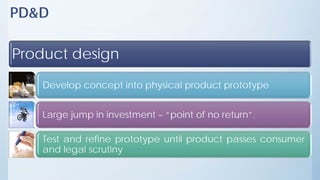
Product design
Develop concept into physical product prototype
Large jump in investment – “point of no return”.
Test and refine prototype until product passes consumer
and legal scrutiny
PD&D
Test marketing
Test marketing involves placing a product for sale in one
or more selected areas and observing its actual
performance under the proposed marketing plan
PD&D
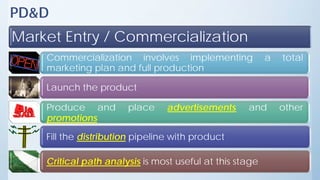
Market Entry / Commercialization
Commercialization involves implementing a total
marketing plan and full production
Launch the product
Produce and place advertisements and other
promotions
Fill the distribution pipeline with product
Critical path analysis is most useful at this stage
Product Design & Development
what makes a successful product?
Product Design & Development
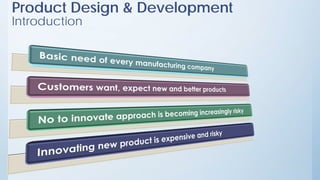
Introduction
Product Design & Development
Introduction
Product Design & Development
Introduction
Product Design & Development
Introduction
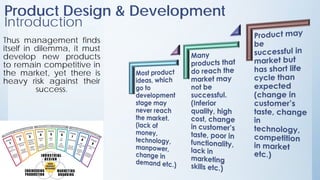
Thus management finds
itself in dilemma, it must
develop new products
to remain competitive in
the market, yet there is
heavy risk against their
success.
Product Design & Development
Introduction
Product Design & Development
Factors to study for PDD
Product Identification related factors
Gapindemand
–Demand>
Supply
Underutilized
resources–
contract
manufacturing/
lendingof
facilities
Diversification–
Limited
customerbase
Newproduct
Ideas–friends,
Co-workers,
environment
etc.
Product Design & Development
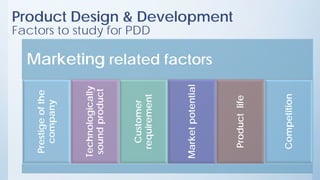
Factors to study for PDD
Marketing related factors
Prestigeofthe
company
Technologically
soundproduct
Customer
requirement
Marketpotential
Productlife
Competition
Product Design & Development
Factors to study for PDD
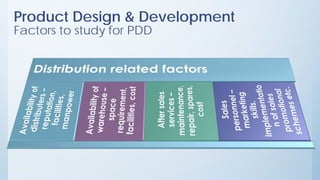
Product Design & Development
Factors to study for PDD
Finance related factors
Capitalinvestment–
Manufacturing
resources,plant&
machinery
Cashgeneration
Restrictionon
finance
Governmentsupport
Shares
Fixeddeposits
Marketborrowings
Product Design & Development
Factors to study for PDD
Product Design & Development
Factors to study for PDD
Product Design & Development
Factors to study for PDD
Product Design & Development
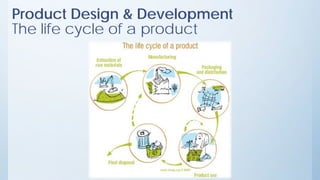
PLC - Product life cycle
a) Describes the stages a new product goes through
from beginning to end
b) Is a tool used by marketing professional to understand
the market, and plan the marketing mix
Product Design & Development
The life cycle of a product
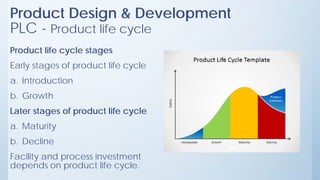
Product life cycle stages
Early stages of product life cycle
a. Introduction
b. Growth
Later stages of product life cycle
a. Maturity
b. Decline
Facility and process investment
depends on product life cycle.
Product Design & Development
PLC - Product life cycle
Product Design & Development
PLC - Product Launch
Also called MARKET INTRODUCTION
i. An expensive phase
ii. High costs are associated with design,
manufacturing, promotional activities,
and inventory to meet anticipated
demand
iii. Other costs include new packaging,
labeling and market research
iv. Who buys new products?
Early Adopters
Product Design & Development
PLC – Push & Pull
1. Push
a. Marketers focus on the product placement
and obtaining preferential shelf and floor
space
2. Pull
a. Create advertisements that create a “BUZZ”
for the product
b. Many use samples, coupons, and other
promotional techniques
Product Design & Development
PLC - Characteristics
1. High Investment – Low profit
2. Minimal competition
3. Company tries to create acceptance and gain
initial distribution
4. Company needs both PUSH & PULL promotions
5. Targeted towards customers to increase
awareness and demand for product
6. Targeted towards channel to increase confidence
in the product
Product Design & Development
PLC- Summary
Full-Scale Launch of New Products
1) High failure rates
2) Little competition
3) Frequent product modification
4) Limited distribution
5) High marketing and production costs
6) Negative profits
7) Promotion focuses on awareness and information
8) Intensive personal selling to channels
Product Design & Development
PLC - Growth
1. Once the early adapters find and
use a new product, other
consumers are likely to follow
2. The product is visible, either in
daily life or in media, and
consumers see neighbors and
friends using it
3. Viral marketing is important
(Word of mouth)
Product Design & Development
Growth
1. Most crucial stage for marketers as a product will either catch
up or fail
2. If a product is removed from market before it has recovered
the costs, it is called a “BUST”
Product Design & Development
PLC - Growth
Product Design & Development
PLC – Growth Characteristics
1. Product is successfully launched
2. Demand and distribution increase
3. Competition intensify
4. Company might introduce
secondary products or support
services
5. Better revenue generation and ROI
Product Design & Development
PLC - Growth Summary
Offered in more sizes, flavors, options
1) Increasing rate of sales
2) Entrance of competitors
3) Market consolidation
4) Initial healthy profits
5) Promotion emphasizes brand ads
6) Goal is wider distribution
7) Prices normally fall
8) Development costs are recovered
Product Design & Development
Maturity
1. Period during which sales of a product
increase more slowly, if at all
2. Marketers keep the name of their
brand in front of consumers and
reminds them of the product’s features
(UTILITY) and lasting power
Product Design & Development
PLC – Maturity Characteristics
1) Competition is great
2) Product is established and promotion
expenditures are less
3) Little growth potential for the product
4) Penetration pricing, and lower profit
margins
5) The major focus is towards extending the
life cycle and maintaining market share
6) Converting customers product to your
own is a major challenge in maturity
stage
Product Design & Development
PLC - Maturity Summary
Many consumer products are in Maturity Stage
1) Declining sales growth
2) Saturated markets
3) Extending product line
4) Stylistic product changes
5) Heavy promotions to dealers and consumers
6) Marginal competitors drop out
7) Prices and profits fall
8) Niche marketers emerge
Product Design & Development
PLC - Decline
1. Unable to find new customers for a given
product or service, that product is in DECLINE
stage
2. A temporary decline may be reversed by
changing the price or a new advertising
campaign
3. If efforts are unsuccessful, the company can
look to redesign, repackage, or reformulate
their marketing efforts.
Product Design & Development
Decline – Decision point stage
Options
1) Maintain the product in hopes that the
competitors will exit
2) Reducing the marketing support and coast
along until no more profit can be made
3) Discontinue the product when no more profit
can be made or there is a successor product
4) Modify the product and prelaunch it as “NEW
& IMPROVED”
Product Design & Development
PLC – Decline Summary
Rate of decline depends on change in tastes or
adoption of substitute products
1) Long-run drop in sales
2) Large inventories of unsold items
3) Elimination of all nonessential marketing expenses
Product Design & Development
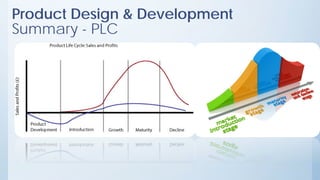
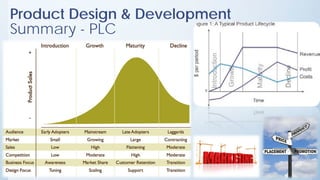
Summary - PLC
Product Design & Development
Summary - PLC
Product Design & Development
Cause of NEW PRODUCT’s failure
A. Overestimation of Market Size
B. Product Design Problems
C. Product Incorrectly Positioned, Priced or Advertised
D. Costs of Product Development
E. Competitive Actions
F. To create successful new products, the company
must:
understand it’s customers, markets and competitors
develop products that deliver superior value to
customers
Product Design & Development
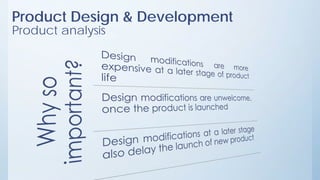
Product analysis
Product Design & Development
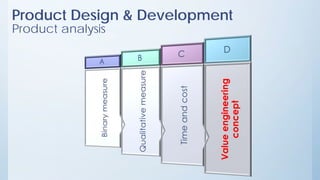
Product analysis
Product Design & Development
Product analysis
Additional
considerations
Ithastobe
manufactured
andassembled–
minimumand
ease
Additional
considerations
Producthasto
work
Additional
considerations
Ithastosell
Additional
considerations
Itmustbe
profitable
Product Design & Development
Product analysis – Several aspects are considered
Product Design & Development
Product analysis
Product Design & Development
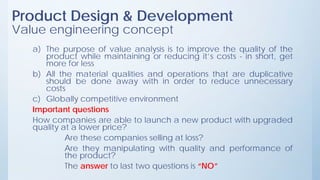
Value engineering concept
a) The purpose of value analysis is to improve the quality of the
product while maintaining or reducing it’s costs - in short, get
more for less
b) All the material qualities and operations that are duplicative
should be done away with in order to reduce unnecessary
costs
c) Globally competitive environment
Important questions
How companies are able to launch a new product with upgraded
quality at a lower price?
Are these companies selling at loss?
Are they manipulating with quality and performance of
the product?
The answer to last two questions is “NO”
Product Design & Development
what is Value engineering?
Is it cost
reduction
Is it item
elimination
Is it function
deletion
Is it use of
cheaper
material
Is it use of
lower cost
process
Answer to
all these
questions is
No. It is
more than
this.
Product Design & Development
Value engineering… … … … …
In 1947 a vice president at General Electric, HARRY ERLICKER,
observed the occurrence of a rather unusual phenomenon
that had been appearing throughout the industry… … …
And that unusual phenomenon led to the development of
VALUE ENGINEERING
Definition
The society of American value engineering defines the value
engineering as “the systematic application of recognized
techniques which identify the function of a product or
service, establish a monetary value for that function, and
provide the necessary function reliably at the lowest overall
cost.
Product Design & Development
Selection of materials
An ever increasing variety of materials are now available, each having it’s own
Characteristics
Applications
Advantages
Limitations
The challenge is to select the optimal material according to the requirement
Product Design & Development
Variety of materials
Ferrous metals
Non ferrous metals (aluminum, magnesium,
copper, nickel, titanium etc.)
Plastics (thermoplastics / thermosets)
Ceramics and diamond
Composite materials
Nano-materials, shape memory alloys
Product Design & Development
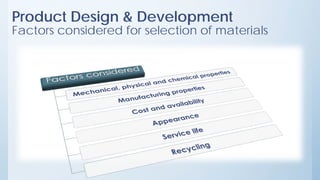
Factors considered for selection of materials
Product Design & Development
Criteria for selection of material
Product Design & Development
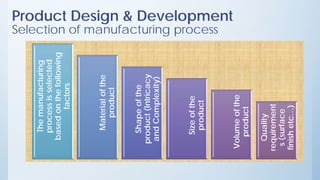
Selection of manufacturing process
Quality
requirement
s(surface
finishetc…)
Volumeofthe
product
Sizeofthe
product
Shapeofthe
product(Intricacy
andComplexity)
Materialofthe
product
Themanufacturing
processisselected
basedonthefollowing
factors
Product Design & Development
Rapid prototyping
What is prototyping?
A preliminary and original full or small scale and usually
functional version of something (new design or
construction)that has been or will be copied or will be
developed.
Why a prototype is needed?
To realize conceptualization of a design
For testing (functional, performance, durability, etc.)&
analysis modification in the actual product
Required before the full scale production of the
product.
Product Design & Development
what is Rapid prototyping?
Rapid - Fast
Prototyping
Making a first full or scale and usually functional version
of a new design or a construction
Definition of rapid prototyping
“Fabrication of a physical 3–Dimensional part of any
arbitrary shape directly from a CAD database by a
quick , highly automated and totally flexible process”
Product Design & Development
CAD / CAM
CAD/CAM = Computer Aided Design and Computer Aided
Manufacturing. It is the technology concerned with the use of
computers to perform design and manufacturing functions.
CAD can be defined as the use
of computer systems to perform
certain functions in the design
process
CAM is the use of computer
systems to plan, manage and
control the operations of
manufacturing plant through
either direct or indirect
computer interface with the
plant’s production resources
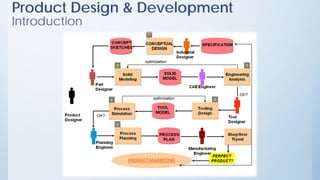
Product Design & Development
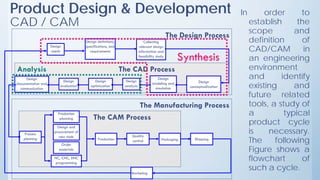
CAD / CAM
In order to
establish the
scope and
definition of
CAD/CAM in
an engineering
environment
and identify
existing and
future related
tools, a study of
a typical
product cycle
is necessary.
The following
Figure shows a
flowchart of
such a cycle.
The Manufacturing Process
The Design Process
Synthesis
Analysis The CAD Process
The CAM Process
Design
needs
Design definitions,
specifications, and
requirements
Collecting
relevant design
information and
feasibility study
Design
conceptualization
Design
modeling and
simulation
Design
analysis
Design
optimization
Design
evaluation
Design
documentation and
communication
Process
planning
Order
materials
Design and
procurement of
new tools
Production
planning
NC, CNC, DNC
programming
Production
Quality
control Packaging
Marketing
Shipping
Product Design & Development
CAD / CAM
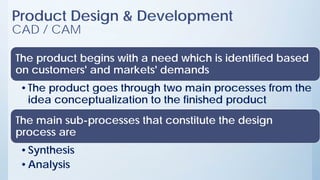
The product begins with a need which is identified based
on customers' and markets' demands
•The product goes through two main processes from the
idea conceptualization to the finished product
The main sub-processes that constitute the design
process are
•Synthesis
•Analysis
Product Design & Development
Summary
Product Design & Development
Summary
Product Design & Development
Summary
Product Design & Development
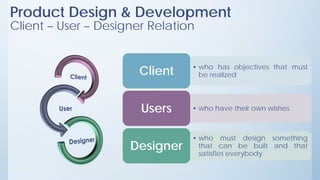
Client – User – Designer Relation
• who has objectives that must
be realizedClient
• who have their own wishesUsers
• who must design something
that can be built and that
satisfies everybody
Designer
Product Design & Development
Summary
Thank You
Questions

Product Design & Development

  • 1.
  • 2.
    PD&D - ProductDesign & Development Agenda for the discussion Introduction – Design & Disciplines Factors inspiring PDD, Product Life Cycle (PLC) Product Analysis Value Engineering Selection of materials Selection of manufacturing process Rapid prototyping & Summary
  • 3.
    PD&D - ProductDesign & Development Introduction - Product What is
  • 4.
    PD&D - ProductDesign & Development Introduction - Product Product refers to a physical product or service or an idea which a customer or consumer needs and for which he is ready to pay. Physical products include tangential goods like grocery items, garments to name a few…
  • 5.
    PD&D - ProductDesign & Development Introduction - Product Services are intangible products which are offered and purchased by consumers. Services may also include an innovative idea on any aspect of operation
  • 6.
    PD&D - ProductDesign & Development Introduction - Product Benefits Functional benefits Psychological benefits Social benefits A consumer may purchase a product to get three types of benefits-Functional, Psychological and Social benefits. For example, the purchase of a motor cycle provides functional utility of a transportation, but at the same time satisfy the need for prestige and esteem and provides social benefit by the way of acceptance from a group, by riding the motor bike. Thus all those aspects should be considered while planning for a product
  • 7.
    PD&D - ProductDesign & Development Introduction - Product Product Consumer products Industrial products
  • 8.
    PD&D - ProductDesign & Development Introduction - Design What is DESIGN?
  • 9.
    PD&D - ProductDesign & Development Introduction – Design Design is the human power to conceive, plan, and realize products that serve human beings, in the accomplishment of any individual or collective purpose.
  • 10.
    PD&D - ProductDesign & Development Introduction – Design Disciplines Applied Arts / Fine Arts:- For aesthetics to objects of function and everyday use For decorative purpose like Paintings, Portraits, etc.
  • 11.
    PD&D - ProductDesign & Development Introduction – Design Disciplines Architecture:- Usually for buildings and other physical structures For aesthetics of objects
  • 12.
    PD&D - ProductDesign & Development Introduction – Design Disciplines Fashion:- For aesthetics or natural beauty to clothing and accessories Influenced by cultural and social latitudes For Garments, Texture, etc.
  • 13.
    PD&D - ProductDesign & Development Introduction – Design Disciplines Gaming Industry:- For content and rules of a game Gameplay, environment, storyline and characters
  • 14.
    PD&D - ProductDesign & Development Introduction – Design Disciplines Engineering Design:- Preliminary design Schematics, diagrams, layouts of the project Detailed design Operating parameters, Test, Materials, Packaging Production planning and tool design Jigs, fixtures, and tooling Production
  • 15.
    PD&D - ProductDesign & Development Introduction – Design Disciplines Mechanical Design For Machines like Lathe, Drill, etc. For Turbo-machines like Turbine, Propeller, etc. For Automobile like Chassis, Transmission, etc. For Components like Gears, Shafts, Joints, etc.
  • 16.
    PD&D - ProductDesign & Development Introduction - Development What is DEVLOPEMENT?
  • 17.
    PD&D - ProductDesign & Development Introduction – Development In business and engineering, new product development (NPD) is the complete process of bringing a new product to market.
  • 18.
    PD&D - Whatis a new product? An old product introduced in a new market An old product packaged in a different way An old product marketed in a different way A product that significantly broadens the market for an existing product A product that adopts or replaces an existing product A product that opens an entirely new market
  • 19.
    PD&D - Typeof new product? •Innovative products •New product lines – to allow the firm to enter an existing market •Addition to product line – to supplement the firm’s existing product line •Improvements and revisions of existing product •Repositioned products – existing products targets at new market •Cost reduction new product that provide similar performance at lower cost
  • 20.
    PD&D - Examplesof new product? •High definition TV, Curved TV, ipod, flat screen TV, Probiotic Ice Cream New to the world •SPEED by BPCL Product improvement & replacement •Moser Baer Cost reduction new product
  • 21.
    PD&D - Newproducts can be used to… … Increase / defend market share by offering more choice or updating older products Appeal to new segments Diversify into new markets Improve relationship with distributors Maintain the firm’s reputation a leading edge company Even out peaks and troughs in demand Make better use of the organization's resources
  • 22.
    PD&D - Whydevelop new products?Tocreatestars andcashcowsfor thefuture Toreplace decliningproduct Totake advantageofnew technology Todefeatrivals Tomaintain/ increasemarket share Tokeepupwith rivals Tomaintain competitive advantage Tofillgapinthe market
  • 23.
    PD&D - NewProduct Planning This is the strategic stage The firm assesses 1. It current product portfolio 2. Opportunities and threats The firm then determines the type of product which would best fit in with the corporate strategy
  • 24.
    PD&D - NewProduct Development New product development is a process which is designed to design, develop, test (verification & validation) and consider the viability of products which are new to the market in order to ensure the Growth or survival of the organization.
  • 25.
    PD&D – Stagesin New Product development (NPD)
  • 26.
    PD&D Idea generation Idea generationis continuous, systematic search for new product opportunities. It involves delineating sources of new ideas and methods for generating them Ideas for new products can be obtained from basic research using a SWOT analysis (OPPORTUNITY ANALYSIS), Market and consumer trends, company's R&D department, competitors, focus groups, employees, salespeople, corporate spies etc.
  • 27.
    PD&D Idea screening The objectis to eliminate unsound concepts prior to devoting resources to them The screeners must ask these questions Will the customer in the target market benefit from the product? What is the size and growth forecasts of the market segment/target market? What is the current or expected competitive pressure for the product idea? What are the industry sales and market trends the product idea is based on? Is it technically feasible to manufacture the product? Will the product be profitable when manufactured and delivered to the customer at the target price?
  • 28.
    PD&D Concept development &testing Concept development & testing present the consumer with a proposed product and measure attitudes and intention at this early stage of development Concept development & testing of prototypes can help avoid costly mistakes.
  • 29.
    PD&D Market strategy development Includesdevelopment of three part strategy plan Describe the market’s size, structure, and behavior, the planned product positioning, and the sales, market share, and profit goals for first few years. Outlines the planned price, distribution strategy, and marketing budget for the first year. Describes the long-run sales and profit goals and marketing-mix strategy over time
  • 30.
    PD&D Feasibility Study /Business Analysis Estimate likely selling price based upon competition and customer feedback Estimate sales volume based upon size of market Estimate profitability and breakeven point
  • 31.
    PD&D Product design Develop conceptinto physical product prototype Large jump in investment – “point of no return”. Test and refine prototype until product passes consumer and legal scrutiny
  • 32.
    PD&D Test marketing Test marketinginvolves placing a product for sale in one or more selected areas and observing its actual performance under the proposed marketing plan
  • 33.
    PD&D Market Entry /Commercialization Commercialization involves implementing a total marketing plan and full production Launch the product Produce and place advertisements and other promotions Fill the distribution pipeline with product Critical path analysis is most useful at this stage
  • 34.
    Product Design &Development what makes a successful product?
  • 35.
    Product Design &Development Introduction
  • 36.
    Product Design &Development Introduction
  • 37.
    Product Design &Development Introduction
  • 38.
    Product Design &Development Introduction
  • 39.
    Thus management finds itselfin dilemma, it must develop new products to remain competitive in the market, yet there is heavy risk against their success. Product Design & Development Introduction
  • 40.
    Product Design &Development Factors to study for PDD Product Identification related factors Gapindemand –Demand> Supply Underutilized resources– contract manufacturing/ lendingof facilities Diversification– Limited customerbase Newproduct Ideas–friends, Co-workers, environment etc.
  • 41.
    Product Design &Development Factors to study for PDD Marketing related factors Prestigeofthe company Technologically soundproduct Customer requirement Marketpotential Productlife Competition
  • 42.
    Product Design &Development Factors to study for PDD
  • 43.
    Product Design &Development Factors to study for PDD Finance related factors Capitalinvestment– Manufacturing resources,plant& machinery Cashgeneration Restrictionon finance Governmentsupport Shares Fixeddeposits Marketborrowings
  • 44.
    Product Design &Development Factors to study for PDD
  • 45.
    Product Design &Development Factors to study for PDD
  • 46.
    Product Design &Development Factors to study for PDD
  • 47.
    Product Design &Development PLC - Product life cycle a) Describes the stages a new product goes through from beginning to end b) Is a tool used by marketing professional to understand the market, and plan the marketing mix
  • 48.
    Product Design &Development The life cycle of a product
  • 49.
    Product life cyclestages Early stages of product life cycle a. Introduction b. Growth Later stages of product life cycle a. Maturity b. Decline Facility and process investment depends on product life cycle. Product Design & Development PLC - Product life cycle
  • 50.
    Product Design &Development PLC - Product Launch Also called MARKET INTRODUCTION i. An expensive phase ii. High costs are associated with design, manufacturing, promotional activities, and inventory to meet anticipated demand iii. Other costs include new packaging, labeling and market research iv. Who buys new products? Early Adopters
  • 51.
    Product Design &Development PLC – Push & Pull 1. Push a. Marketers focus on the product placement and obtaining preferential shelf and floor space 2. Pull a. Create advertisements that create a “BUZZ” for the product b. Many use samples, coupons, and other promotional techniques
  • 52.
    Product Design &Development PLC - Characteristics 1. High Investment – Low profit 2. Minimal competition 3. Company tries to create acceptance and gain initial distribution 4. Company needs both PUSH & PULL promotions 5. Targeted towards customers to increase awareness and demand for product 6. Targeted towards channel to increase confidence in the product
  • 53.
    Product Design &Development PLC- Summary Full-Scale Launch of New Products 1) High failure rates 2) Little competition 3) Frequent product modification 4) Limited distribution 5) High marketing and production costs 6) Negative profits 7) Promotion focuses on awareness and information 8) Intensive personal selling to channels
  • 54.
    Product Design &Development PLC - Growth 1. Once the early adapters find and use a new product, other consumers are likely to follow 2. The product is visible, either in daily life or in media, and consumers see neighbors and friends using it 3. Viral marketing is important (Word of mouth)
  • 55.
    Product Design &Development Growth 1. Most crucial stage for marketers as a product will either catch up or fail 2. If a product is removed from market before it has recovered the costs, it is called a “BUST”
  • 56.
    Product Design &Development PLC - Growth
  • 57.
    Product Design &Development PLC – Growth Characteristics 1. Product is successfully launched 2. Demand and distribution increase 3. Competition intensify 4. Company might introduce secondary products or support services 5. Better revenue generation and ROI
  • 58.
    Product Design &Development PLC - Growth Summary Offered in more sizes, flavors, options 1) Increasing rate of sales 2) Entrance of competitors 3) Market consolidation 4) Initial healthy profits 5) Promotion emphasizes brand ads 6) Goal is wider distribution 7) Prices normally fall 8) Development costs are recovered
  • 59.
    Product Design &Development Maturity 1. Period during which sales of a product increase more slowly, if at all 2. Marketers keep the name of their brand in front of consumers and reminds them of the product’s features (UTILITY) and lasting power
  • 60.
    Product Design &Development PLC – Maturity Characteristics 1) Competition is great 2) Product is established and promotion expenditures are less 3) Little growth potential for the product 4) Penetration pricing, and lower profit margins 5) The major focus is towards extending the life cycle and maintaining market share 6) Converting customers product to your own is a major challenge in maturity stage
  • 61.
    Product Design &Development PLC - Maturity Summary Many consumer products are in Maturity Stage 1) Declining sales growth 2) Saturated markets 3) Extending product line 4) Stylistic product changes 5) Heavy promotions to dealers and consumers 6) Marginal competitors drop out 7) Prices and profits fall 8) Niche marketers emerge
  • 62.
    Product Design &Development PLC - Decline 1. Unable to find new customers for a given product or service, that product is in DECLINE stage 2. A temporary decline may be reversed by changing the price or a new advertising campaign 3. If efforts are unsuccessful, the company can look to redesign, repackage, or reformulate their marketing efforts.
  • 63.
    Product Design &Development Decline – Decision point stage Options 1) Maintain the product in hopes that the competitors will exit 2) Reducing the marketing support and coast along until no more profit can be made 3) Discontinue the product when no more profit can be made or there is a successor product 4) Modify the product and prelaunch it as “NEW & IMPROVED”
  • 64.
    Product Design &Development PLC – Decline Summary Rate of decline depends on change in tastes or adoption of substitute products 1) Long-run drop in sales 2) Large inventories of unsold items 3) Elimination of all nonessential marketing expenses
  • 65.
    Product Design &Development Summary - PLC
  • 66.
    Product Design &Development Summary - PLC
  • 67.
    Product Design &Development Cause of NEW PRODUCT’s failure A. Overestimation of Market Size B. Product Design Problems C. Product Incorrectly Positioned, Priced or Advertised D. Costs of Product Development E. Competitive Actions F. To create successful new products, the company must: understand it’s customers, markets and competitors develop products that deliver superior value to customers
  • 68.
    Product Design &Development Product analysis
  • 69.
    Product Design &Development Product analysis
  • 70.
    Product Design &Development Product analysis Additional considerations Ithastobe manufactured andassembled– minimumand ease Additional considerations Producthasto work Additional considerations Ithastosell Additional considerations Itmustbe profitable
  • 71.
    Product Design &Development Product analysis – Several aspects are considered
  • 72.
    Product Design &Development Product analysis
  • 73.
    Product Design &Development Value engineering concept a) The purpose of value analysis is to improve the quality of the product while maintaining or reducing it’s costs - in short, get more for less b) All the material qualities and operations that are duplicative should be done away with in order to reduce unnecessary costs c) Globally competitive environment Important questions How companies are able to launch a new product with upgraded quality at a lower price? Are these companies selling at loss? Are they manipulating with quality and performance of the product? The answer to last two questions is “NO”
  • 74.
    Product Design &Development what is Value engineering? Is it cost reduction Is it item elimination Is it function deletion Is it use of cheaper material Is it use of lower cost process Answer to all these questions is No. It is more than this.
  • 75.
    Product Design &Development Value engineering… … … … … In 1947 a vice president at General Electric, HARRY ERLICKER, observed the occurrence of a rather unusual phenomenon that had been appearing throughout the industry… … … And that unusual phenomenon led to the development of VALUE ENGINEERING Definition The society of American value engineering defines the value engineering as “the systematic application of recognized techniques which identify the function of a product or service, establish a monetary value for that function, and provide the necessary function reliably at the lowest overall cost.
  • 76.
    Product Design &Development Selection of materials An ever increasing variety of materials are now available, each having it’s own Characteristics Applications Advantages Limitations The challenge is to select the optimal material according to the requirement
  • 77.
    Product Design &Development Variety of materials Variety of materials Ferrous metals Non ferrous metals (aluminum, magnesium, copper, nickel, titanium etc.) Plastics (thermoplastics / thermosets) Ceramics and diamond Composite materials Nano-materials, shape memory alloys
  • 78.
    Product Design &Development Factors considered for selection of materials
  • 79.
    Product Design &Development Criteria for selection of material
  • 80.
    Product Design &Development Selection of manufacturing process Quality requirement s(surface finishetc…) Volumeofthe product Sizeofthe product Shapeofthe product(Intricacy andComplexity) Materialofthe product Themanufacturing processisselected basedonthefollowing factors
  • 81.
    Product Design &Development Rapid prototyping What is prototyping? A preliminary and original full or small scale and usually functional version of something (new design or construction)that has been or will be copied or will be developed. Why a prototype is needed? To realize conceptualization of a design For testing (functional, performance, durability, etc.)& analysis modification in the actual product Required before the full scale production of the product.
  • 82.
    Product Design &Development what is Rapid prototyping? Rapid - Fast Prototyping Making a first full or scale and usually functional version of a new design or a construction Definition of rapid prototyping “Fabrication of a physical 3–Dimensional part of any arbitrary shape directly from a CAD database by a quick , highly automated and totally flexible process”
  • 83.
    Product Design &Development CAD / CAM CAD/CAM = Computer Aided Design and Computer Aided Manufacturing. It is the technology concerned with the use of computers to perform design and manufacturing functions. CAD can be defined as the use of computer systems to perform certain functions in the design process CAM is the use of computer systems to plan, manage and control the operations of manufacturing plant through either direct or indirect computer interface with the plant’s production resources
  • 84.
    Product Design &Development CAD / CAM In order to establish the scope and definition of CAD/CAM in an engineering environment and identify existing and future related tools, a study of a typical product cycle is necessary. The following Figure shows a flowchart of such a cycle. The Manufacturing Process The Design Process Synthesis Analysis The CAD Process The CAM Process Design needs Design definitions, specifications, and requirements Collecting relevant design information and feasibility study Design conceptualization Design modeling and simulation Design analysis Design optimization Design evaluation Design documentation and communication Process planning Order materials Design and procurement of new tools Production planning NC, CNC, DNC programming Production Quality control Packaging Marketing Shipping
  • 85.
    Product Design &Development CAD / CAM The product begins with a need which is identified based on customers' and markets' demands •The product goes through two main processes from the idea conceptualization to the finished product The main sub-processes that constitute the design process are •Synthesis •Analysis
  • 86.
    Product Design &Development Summary
  • 87.
    Product Design &Development Summary
  • 88.
    Product Design &Development Summary
  • 89.
    Product Design &Development Client – User – Designer Relation • who has objectives that must be realizedClient • who have their own wishesUsers • who must design something that can be built and that satisfies everybody Designer
  • 90.
    Product Design &Development Summary Thank You Questions