St. Xavier’s College, Mahuadanr
1 | P a g e
Processing and modification of RNA
RNA processing
In eukaryotes, transcription and translation take place in different cellular compartments
like nucleus and cytoplasm respectively. In prokaryotes, transcription of mRNA and translation
occur simultaneously. Processing of mRNA undergo little or no modification. In contrast, pre-
tRNA and pre-rRNA undergo processing like cleavage, addition of nucleotides and chemical
modification after synthesis. Processing of eukaryotic pre-mRNA involves 5’ capping, 3’
cleavage/polyadenylation, splicing and RNA editing before being transported to the cytoplasm,
where they are translated by ribosomes.
Processing of eukaryotic pre-mRNA
5’ capping
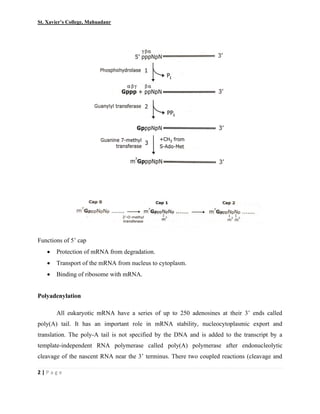
Eukaryotic mRNA has peculiar enzymatically appended cap structure, which consisting
of 7-methylguanosine reside joined through 5’-5’ triphosphate bridge. During transcription 7-
methylguanosine is added to 5’ end of nascent mRNA. Capping initiated by dimeric enzyme
associated with phosphorylated carboxyl-terminal tail domain (CTD) of RNA polymerase II.
One subunit of capping enzyme removes γ-phosphate, another subunit transfer the GMP of GTP
which creates 5’-5’ triphosphate structure. And final separation of enzyme transfers methyl
groups from s-adenosylmethionine to the N7
position of the guanine at 5’ end of RNA. If methyl
group is present at N7
position called as cap0. This is the first methylation step and occurs in all
eukaryotes. In some higher eukaryotes methyl group addition also occurs at second base, if
adenine is present and reaction involves at the N6
position. mRNA with methyl groups on the N7
position of the guanine and the 2’-OH position of the second nucleotide at the 5’ end is known as
cap1. Similarly, if methyl group is present at both second and third nucleotide then it is known as
cap2.
St. Xavier’s College, Mahuadanr
2 | P a g e
Functions of 5’ cap
• Protection of mRNA from degradation.
• Transport of the mRNA from nucleus to cytoplasm.
• Binding of ribosome with mRNA.
Polyadenylation
All eukaryotic mRNA have a series of up to 250 adenosines at their 3’ ends called
poly(A) tail. It has an important role in mRNA stability, nucleocytoplasmic export and
translation. The poly-A tail is not specified by the DNA and is added to the transcript by a
template-independent RNA polymerase called poly(A) polymerase after endonucleolytic
cleavage of the nascent RNA near the 3’ terminus. There two coupled reactions (cleavage and
St. Xavier’s College, Mahuadanr
3 | P a g e
formation of poly (A) tail), are collectively referred to as cleavage and polyadenylation or
simply, polyadenylation.
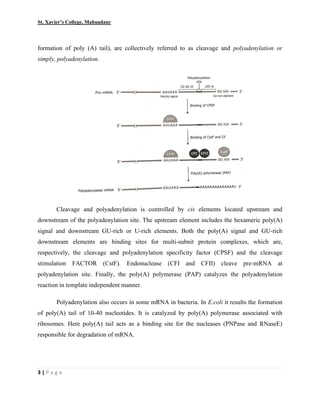
Cleavage and polyadenylation is controlled by cis elements located upstream and
downstream of the polyadenylation site. The upstream element includes the hexameric poly(A)
signal and downstream GU-rich or U-rich elements. Both the poly(A) signal and GU-rich
downstream elements are binding sites for multi-subnit protein complexes, which are,
respectively, the cleavage and polyadenylation specificity factor (CPSF) and the cleavage
stimulation FACTOR (CstF). Endonuclease (CFI and CFII) cleave pre-mRNA at
polyadenylation site. Finally, the poly(A) polymerase (PAP) catalyzes the polyadenylation
reaction in template independent manner.
Polyadenylation also occurs in some mRNA in bacteria. In E.coli it results the formation
of poly(A) tail of 10-40 nucleotides. It is catalyzed by poly(A) polymerase associated with
ribosomes. Here poly(A) tail acts as a binding site for the nucleases (PNPase and RNaseE)
responsible for degradation of mRNA.
St. Xavier’s College, Mahuadanr
4 | P a g e
Alternative polyadenylation:
In mRNAs, protein-coding genes have more than one polyadenylation site, so a gene can code
for several mRNAs that differ in the position of poly(A) tail. This process is termed as
alternative polyadenylation. This causes the formation of more than one transcript from a single
gene. One common example is occurring of poly(A) tail during the development of B-
lymphocytes.
Cytoplasmic polyadenylation:
The length of the poly(A) tail can be regulated in the cytoplasm. In some species, for example
the egg cell store mRNA in the cytoplasm for later use after fertilization. The stores mRNA has a
short poly(A) tail. Activation of the mRNA for translation includes lengthening of the poly(A)
tail. It has also been degraded. Cytoplasmic polyadenylation targets mRNAs that already contain
a short poly(A) tail, usually 20-30 nucleotides long and catalyzed by a cytoplamic poly(A)
polymerase.
Split genes-concept of introns and exons
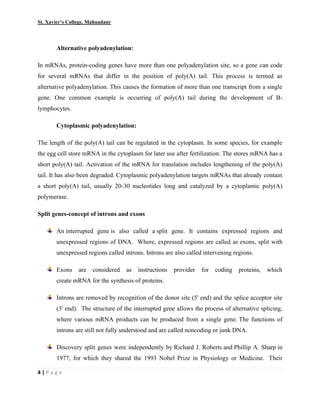
An interrupted gene is also called a split gene. It contains expressed regions and
unexpressed regions of DNA. Where, expressed regions are called as exons, split with
unexpressed regions called introns. Introns are also called intervening regions.
Exons are considered as instructions provider for coding proteins, which
create mRNA for the synthesis of proteins.
Introns are removed by recognition of the donor site (5' end) and the splice acceptor site
(3' end). The structure of the interrupted gene allows the process of alternative splicing,
where various mRNA products can be produced from a single gene. The functions of
introns are still not fully understood and are called noncoding or junk DNA.
Discovery split genes were independently by Richard J. Roberts and Phillip A. Sharp in
1977, for which they shared the 1993 Nobel Prize in Physiology or Medicine. Their
St. Xavier’s College, Mahuadanr
5 | P a g e
discovery directed to the existence of unknown machinery for splicing out introns and
assembling genes called as the spliceosome.
Unlike prokaryotic genomes, eukaryotic genomes were largely complex and inconsistent. It was
soon accepted that 94% of human genes are interrupted, and 50% of hereditary diseases are
involved in splicing intron errors out of interrupted genes. The best known example of a disease
caused by a splicing error is Beta-thalassemia (Inherited blood disorders), in which extra intronic
material is erroneously spliced into the gene for making hemoglobin.
Prokaryotes have a less complex genome. The structure of prokaryotic genomes contain fewer to
none regions of introns and have longer continuous lines of exons, or uninterrupted regions. In
other words, they contain more regions of DNA that are expressed. The idea that genome density
decreases as the complexity of the organism increases. This is due to the fact that eukaryotes
have a much stronger presence of introns than prokaryotes. For example, prokaryotes contain
about 1000 genes/Mb while humans contain about 6 genes/Mb.
RNA splicing
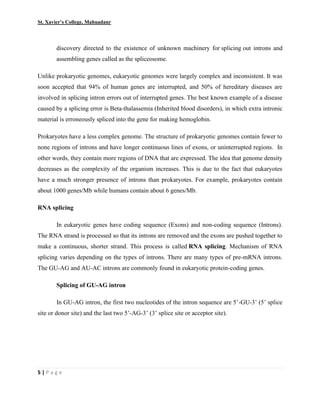
In eukaryotic genes have coding sequence (Exons) and non-coding sequence (Introns).
The RNA strand is processed so that its introns are removed and the exons are pushed together to
make a continuous, shorter strand. This process is called RNA splicing. Mechanism of RNA
splicing varies depending on the types of introns. There are many types of pre-mRNA introns.
The GU-AG and AU-AC introns are commonly found in eukaryotic protein-coding genes.
Splicing of GU-AG intron
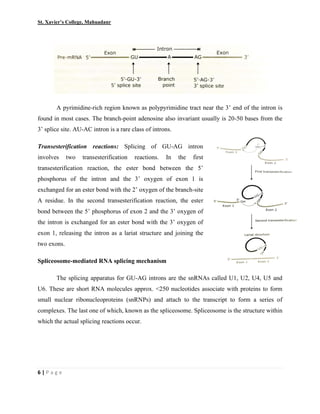
In GU-AG intron, the first two nucleotides of the intron sequence are 5’-GU-3’ (5’ splice
site or donor site) and the last two 5’-AG-3’ (3’ splice site or acceptor site).
St. Xavier’s College, Mahuadanr
6 | P a g e
A pyrimidine-rich region known as polypyrimidine tract near the 3’ end of the intron is
found in most cases. The branch-point adenosine also invariant usually is 20-50 bases from the
3’ splice site. AU-AC intron is a rare class of introns.
Transesterification reactions: Splicing of GU-AG intron
involves two transesterification reactions. In the first
transesterification reaction, the ester bond between the 5’
phosphorus of the intron and the 3’ oxygen of exon 1 is
exchanged for an ester bond with the 2’ oxygen of the branch-site
A residue. In the second transesterification reaction, the ester
bond between the 5’ phosphorus of exon 2 and the 3’ oxygen of
the intron is exchanged for an ester bond with the 3’ oxygen of
exon 1, releasing the intron as a lariat structure and joining the
two exons.
Spliceosome-mediated RNA splicing mechanism
The splicing apparatus for GU-AG introns are the snRNAs called U1, U2, U4, U5 and
U6. These are short RNA molecules approx. <250 nucleotides associate with proteins to form
small nuclear ribonucleoproteins (snRNPs) and attach to the transcript to form a series of
complexes. The last one of which, known as the spliceosome. Spliceosome is the structure within
which the actual splicing reactions occur.
St. Xavier’s College, Mahuadanr
7 | P a g e
The process of assembly of snRNP and various protein factors occur as follows:
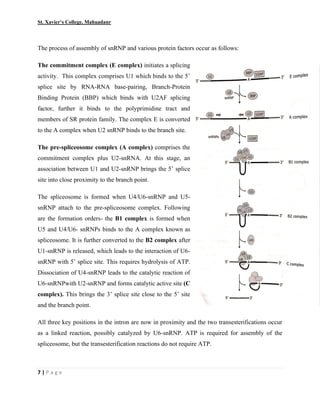
The commitment complex (E complex) initiates a splicing
activity. This complex comprises U1 which binds to the 5’
splice site by RNA-RNA base-pairing, Branch-Protein
Binding Protein (BBP) which binds with U2AF splicing
factor, further it binds to the polyprimidine tract and
members of SR protein family. The complex E is converted
to the A complex when U2 snRNP binds to the branch site.
The pre-spliceosome complex (A complex) comprises the
commitment complex plus U2-snRNA. At this stage, an
association between U1 and U2-snRNP brings the 5’ splice
site into close proximity to the branch point.
The spliceosome is formed when U4/U6-snRNP and U5-
snRNP attach to the pre-spliceosome complex. Following
are the formation orders- the B1 complex is formed when
U5 and U4/U6- snRNPs binds to the A complex known as
spliceosome. It is further converted to the B2 complex after
U1-snRNP is released, which leads to the interaction of U6-
snRNP with 5’ splice site. This requires hydrolysis of ATP.
Dissociation of U4-snRNP leads to the catalytic reaction of
U6-snRNPwith U2-snRNP and forms catalytic active site (C
complex). This brings the 3’ splice site close to the 5’ site
and the branch point.
All three key positions in the intron are now in proximity and the two transesterifications occur
as a linked reaction, possibly catalyzed by U6-snRNP. ATP is required for assembly of the
spliceosome, but the transesterification reactions do not require ATP.
St. Xavier’s College, Mahuadanr
8 | P a g e
Spliceosome-mediated RNA splicing mechanism
RNA splicing is catalyzed by a spliceosome formed from the assembly of U1, U2, U5
and U4/U6-snRNAs plus other components.
After assembly of the splicecosome, the reaction occurs in two steps:
• Step 1- The branch-point A nucleotide in the intron sequence, which is located close to
the 3’ splice site, attacks the 5’ splice site and cleave it. The cut 5’ end of the intron
sequence thereby, becomes covalently linked to this A nucleotide, forming the branched
nucleotide.
• Step 2- The 3’-OH end of the first exon sequence, which was created in the first step,
adds to the beginning of the second exon sequence, cleaving the RNA molecule at the 3’
splice site; the two exon sequences are, thereby, joined to each other and the intron
sequence is released as a lariat.
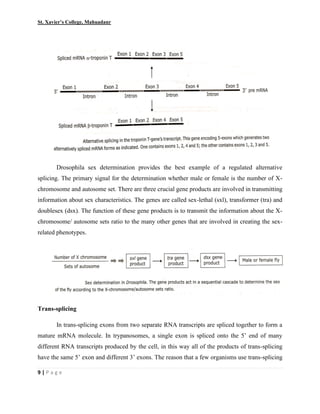
Alternative splicing
During RNA splicing, the introns are precisely removed and the exons ligated together.
The majority of nuclear pre-mRNAs are spliced constitutively that is only one mature mRNA
species is generated from a single pre-mRNA in all tissues. In some cases, production of more
than one mRNA species formed from a single pre-mRNA during splicing. The production of
different RNA products from a single product using of splicing junctions is described as
alternative splicing.
Alternative splicing has been documented for many eukaryotic genes. The utilization of
alternative 5’ or 3’ splice sites can result in structurally distinct mRNAs by either excluding
potential exon sequences or incorporating otherwise noncoding intron sequences. For some pre-
mRNAs, alternative splicing is a nonregulated event and for others it is regulated in a tissue-
specific manner.
St. Xavier’s College, Mahuadanr
9 | P a g e
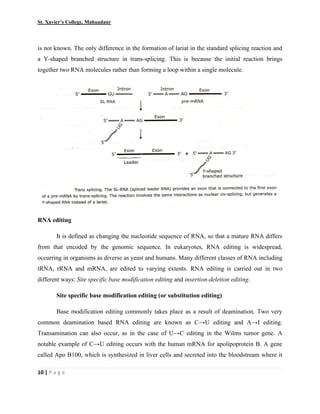
Drosophila sex determination provides the best example of a regulated alternative
splicing. The primary signal for the determination whether male or female is the number of X-
chromosome and autosome set. There are three crucial gene products are involved in transmitting
information about sex characteristics. The genes are called sex-lethal (sxl), transformer (tra) and
doublesex (dsx). The function of these gene products is to transmit the information about the X-
chromosome/ autosome sets ratio to the many other genes that are involved in creating the sex-
related phenotypes.
Trans-splicing
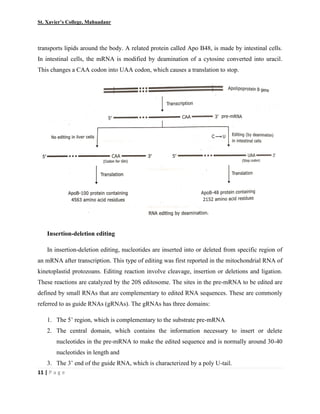
In trans-splicing exons from two separate RNA transcripts are spliced together to form a
mature mRNA molecule. In trypanosomes, a single exon is spliced onto the 5’ end of many
different RNA transcripts produced by the cell, in this way all of the products of trans-splicing
have the same 5’ exon and different 3’ exons. The reason that a few organisms use trans-splicing
St. Xavier’s College, Mahuadanr
10 | P a g e
is not known. The only difference in the formation of lariat in the standard splicing reaction and
a Y-shaped branched structure in trans-splicing. This is because the initial reaction brings
together two RNA molecules rather than forming a loop within a single molecule.
RNA editing
It is defined as changing the nucleotide sequence of RNA, so that a mature RNA differs
from that encoded by the genomic sequence. In eukaryotes, RNA editing is widespread,
occurring in organisms as diverse as yeast and humans. Many different classes of RNA including
tRNA, rRNA and mRNA, are edited to varying extents. RNA editing is carried out in two
different ways: Site specific base modification editing and insertion-deletion editing.
Site specific base modification editing (or substitution editing)
Base modification editing commonly takes place as a result of deamination. Two very
common deamination based RNA editing are known as C→U editing and A→I editing.
Transamination can also occur, as in the case of U→C editing in the Wilms tumor gene. A
notable example of C→U editing occurs with the human mRNA for apolipoprotein B. A gene
called Apo B100, which is synthesized in liver cells and secreted into the bloodstream where it
St. Xavier’s College, Mahuadanr
11 | P a g e
transports lipids around the body. A related protein called Apo B48, is made by intestinal cells.
In intestinal cells, the mRNA is modified by deamination of a cytosine converted into uracil.
This changes a CAA codon into UAA codon, which causes a translation to stop.
Insertion-deletion editing
In insertion-deletion editing, nucleotides are inserted into or deleted from specific region of
an mRNA after transcription. This type of editing was first reported in the mitochondrial RNA of
kinetoplastid protozoans. Editing reaction involve cleavage, insertion or deletions and ligation.
These reactions are catalyzed by the 20S editosome. The sites in the pre-mRNA to be edited are
defined by small RNAs that are complementary to edited RNA sequences. These are commonly
referred to as guide RNAs (gRNAs). The gRNAs has three domains:
1. The 5’ region, which is complementary to the substrate pre-mRNA
2. The central domain, which contains the information necessary to insert or delete
nucleotides in the pre-mRNA to make the edited sequence and is normally around 30-40
nucleotides in length and
3. The 3’ end of the guide RNA, which is characterized by a poly U-tail.

Processing and modification of RNA

  • 1.
    St. Xavier’s College,Mahuadanr 1 | P a g e Processing and modification of RNA RNA processing In eukaryotes, transcription and translation take place in different cellular compartments like nucleus and cytoplasm respectively. In prokaryotes, transcription of mRNA and translation occur simultaneously. Processing of mRNA undergo little or no modification. In contrast, pre- tRNA and pre-rRNA undergo processing like cleavage, addition of nucleotides and chemical modification after synthesis. Processing of eukaryotic pre-mRNA involves 5’ capping, 3’ cleavage/polyadenylation, splicing and RNA editing before being transported to the cytoplasm, where they are translated by ribosomes. Processing of eukaryotic pre-mRNA 5’ capping Eukaryotic mRNA has peculiar enzymatically appended cap structure, which consisting of 7-methylguanosine reside joined through 5’-5’ triphosphate bridge. During transcription 7- methylguanosine is added to 5’ end of nascent mRNA. Capping initiated by dimeric enzyme associated with phosphorylated carboxyl-terminal tail domain (CTD) of RNA polymerase II. One subunit of capping enzyme removes γ-phosphate, another subunit transfer the GMP of GTP which creates 5’-5’ triphosphate structure. And final separation of enzyme transfers methyl groups from s-adenosylmethionine to the N7 position of the guanine at 5’ end of RNA. If methyl group is present at N7 position called as cap0. This is the first methylation step and occurs in all eukaryotes. In some higher eukaryotes methyl group addition also occurs at second base, if adenine is present and reaction involves at the N6 position. mRNA with methyl groups on the N7 position of the guanine and the 2’-OH position of the second nucleotide at the 5’ end is known as cap1. Similarly, if methyl group is present at both second and third nucleotide then it is known as cap2.
  • 2.
    St. Xavier’s College,Mahuadanr 2 | P a g e Functions of 5’ cap • Protection of mRNA from degradation. • Transport of the mRNA from nucleus to cytoplasm. • Binding of ribosome with mRNA. Polyadenylation All eukaryotic mRNA have a series of up to 250 adenosines at their 3’ ends called poly(A) tail. It has an important role in mRNA stability, nucleocytoplasmic export and translation. The poly-A tail is not specified by the DNA and is added to the transcript by a template-independent RNA polymerase called poly(A) polymerase after endonucleolytic cleavage of the nascent RNA near the 3’ terminus. There two coupled reactions (cleavage and
  • 3.
    St. Xavier’s College,Mahuadanr 3 | P a g e formation of poly (A) tail), are collectively referred to as cleavage and polyadenylation or simply, polyadenylation. Cleavage and polyadenylation is controlled by cis elements located upstream and downstream of the polyadenylation site. The upstream element includes the hexameric poly(A) signal and downstream GU-rich or U-rich elements. Both the poly(A) signal and GU-rich downstream elements are binding sites for multi-subnit protein complexes, which are, respectively, the cleavage and polyadenylation specificity factor (CPSF) and the cleavage stimulation FACTOR (CstF). Endonuclease (CFI and CFII) cleave pre-mRNA at polyadenylation site. Finally, the poly(A) polymerase (PAP) catalyzes the polyadenylation reaction in template independent manner. Polyadenylation also occurs in some mRNA in bacteria. In E.coli it results the formation of poly(A) tail of 10-40 nucleotides. It is catalyzed by poly(A) polymerase associated with ribosomes. Here poly(A) tail acts as a binding site for the nucleases (PNPase and RNaseE) responsible for degradation of mRNA.
  • 4.
    St. Xavier’s College,Mahuadanr 4 | P a g e Alternative polyadenylation: In mRNAs, protein-coding genes have more than one polyadenylation site, so a gene can code for several mRNAs that differ in the position of poly(A) tail. This process is termed as alternative polyadenylation. This causes the formation of more than one transcript from a single gene. One common example is occurring of poly(A) tail during the development of B- lymphocytes. Cytoplasmic polyadenylation: The length of the poly(A) tail can be regulated in the cytoplasm. In some species, for example the egg cell store mRNA in the cytoplasm for later use after fertilization. The stores mRNA has a short poly(A) tail. Activation of the mRNA for translation includes lengthening of the poly(A) tail. It has also been degraded. Cytoplasmic polyadenylation targets mRNAs that already contain a short poly(A) tail, usually 20-30 nucleotides long and catalyzed by a cytoplamic poly(A) polymerase. Split genes-concept of introns and exons An interrupted gene is also called a split gene. It contains expressed regions and unexpressed regions of DNA. Where, expressed regions are called as exons, split with unexpressed regions called introns. Introns are also called intervening regions. Exons are considered as instructions provider for coding proteins, which create mRNA for the synthesis of proteins. Introns are removed by recognition of the donor site (5' end) and the splice acceptor site (3' end). The structure of the interrupted gene allows the process of alternative splicing, where various mRNA products can be produced from a single gene. The functions of introns are still not fully understood and are called noncoding or junk DNA. Discovery split genes were independently by Richard J. Roberts and Phillip A. Sharp in 1977, for which they shared the 1993 Nobel Prize in Physiology or Medicine. Their
  • 5.
    St. Xavier’s College,Mahuadanr 5 | P a g e discovery directed to the existence of unknown machinery for splicing out introns and assembling genes called as the spliceosome. Unlike prokaryotic genomes, eukaryotic genomes were largely complex and inconsistent. It was soon accepted that 94% of human genes are interrupted, and 50% of hereditary diseases are involved in splicing intron errors out of interrupted genes. The best known example of a disease caused by a splicing error is Beta-thalassemia (Inherited blood disorders), in which extra intronic material is erroneously spliced into the gene for making hemoglobin. Prokaryotes have a less complex genome. The structure of prokaryotic genomes contain fewer to none regions of introns and have longer continuous lines of exons, or uninterrupted regions. In other words, they contain more regions of DNA that are expressed. The idea that genome density decreases as the complexity of the organism increases. This is due to the fact that eukaryotes have a much stronger presence of introns than prokaryotes. For example, prokaryotes contain about 1000 genes/Mb while humans contain about 6 genes/Mb. RNA splicing In eukaryotic genes have coding sequence (Exons) and non-coding sequence (Introns). The RNA strand is processed so that its introns are removed and the exons are pushed together to make a continuous, shorter strand. This process is called RNA splicing. Mechanism of RNA splicing varies depending on the types of introns. There are many types of pre-mRNA introns. The GU-AG and AU-AC introns are commonly found in eukaryotic protein-coding genes. Splicing of GU-AG intron In GU-AG intron, the first two nucleotides of the intron sequence are 5’-GU-3’ (5’ splice site or donor site) and the last two 5’-AG-3’ (3’ splice site or acceptor site).
  • 6.
    St. Xavier’s College,Mahuadanr 6 | P a g e A pyrimidine-rich region known as polypyrimidine tract near the 3’ end of the intron is found in most cases. The branch-point adenosine also invariant usually is 20-50 bases from the 3’ splice site. AU-AC intron is a rare class of introns. Transesterification reactions: Splicing of GU-AG intron involves two transesterification reactions. In the first transesterification reaction, the ester bond between the 5’ phosphorus of the intron and the 3’ oxygen of exon 1 is exchanged for an ester bond with the 2’ oxygen of the branch-site A residue. In the second transesterification reaction, the ester bond between the 5’ phosphorus of exon 2 and the 3’ oxygen of the intron is exchanged for an ester bond with the 3’ oxygen of exon 1, releasing the intron as a lariat structure and joining the two exons. Spliceosome-mediated RNA splicing mechanism The splicing apparatus for GU-AG introns are the snRNAs called U1, U2, U4, U5 and U6. These are short RNA molecules approx. <250 nucleotides associate with proteins to form small nuclear ribonucleoproteins (snRNPs) and attach to the transcript to form a series of complexes. The last one of which, known as the spliceosome. Spliceosome is the structure within which the actual splicing reactions occur.
  • 7.
    St. Xavier’s College,Mahuadanr 7 | P a g e The process of assembly of snRNP and various protein factors occur as follows: The commitment complex (E complex) initiates a splicing activity. This complex comprises U1 which binds to the 5’ splice site by RNA-RNA base-pairing, Branch-Protein Binding Protein (BBP) which binds with U2AF splicing factor, further it binds to the polyprimidine tract and members of SR protein family. The complex E is converted to the A complex when U2 snRNP binds to the branch site. The pre-spliceosome complex (A complex) comprises the commitment complex plus U2-snRNA. At this stage, an association between U1 and U2-snRNP brings the 5’ splice site into close proximity to the branch point. The spliceosome is formed when U4/U6-snRNP and U5- snRNP attach to the pre-spliceosome complex. Following are the formation orders- the B1 complex is formed when U5 and U4/U6- snRNPs binds to the A complex known as spliceosome. It is further converted to the B2 complex after U1-snRNP is released, which leads to the interaction of U6- snRNP with 5’ splice site. This requires hydrolysis of ATP. Dissociation of U4-snRNP leads to the catalytic reaction of U6-snRNPwith U2-snRNP and forms catalytic active site (C complex). This brings the 3’ splice site close to the 5’ site and the branch point. All three key positions in the intron are now in proximity and the two transesterifications occur as a linked reaction, possibly catalyzed by U6-snRNP. ATP is required for assembly of the spliceosome, but the transesterification reactions do not require ATP.
  • 8.
    St. Xavier’s College,Mahuadanr 8 | P a g e Spliceosome-mediated RNA splicing mechanism RNA splicing is catalyzed by a spliceosome formed from the assembly of U1, U2, U5 and U4/U6-snRNAs plus other components. After assembly of the splicecosome, the reaction occurs in two steps: • Step 1- The branch-point A nucleotide in the intron sequence, which is located close to the 3’ splice site, attacks the 5’ splice site and cleave it. The cut 5’ end of the intron sequence thereby, becomes covalently linked to this A nucleotide, forming the branched nucleotide. • Step 2- The 3’-OH end of the first exon sequence, which was created in the first step, adds to the beginning of the second exon sequence, cleaving the RNA molecule at the 3’ splice site; the two exon sequences are, thereby, joined to each other and the intron sequence is released as a lariat. Alternative splicing During RNA splicing, the introns are precisely removed and the exons ligated together. The majority of nuclear pre-mRNAs are spliced constitutively that is only one mature mRNA species is generated from a single pre-mRNA in all tissues. In some cases, production of more than one mRNA species formed from a single pre-mRNA during splicing. The production of different RNA products from a single product using of splicing junctions is described as alternative splicing. Alternative splicing has been documented for many eukaryotic genes. The utilization of alternative 5’ or 3’ splice sites can result in structurally distinct mRNAs by either excluding potential exon sequences or incorporating otherwise noncoding intron sequences. For some pre- mRNAs, alternative splicing is a nonregulated event and for others it is regulated in a tissue- specific manner.
  • 9.
    St. Xavier’s College,Mahuadanr 9 | P a g e Drosophila sex determination provides the best example of a regulated alternative splicing. The primary signal for the determination whether male or female is the number of X- chromosome and autosome set. There are three crucial gene products are involved in transmitting information about sex characteristics. The genes are called sex-lethal (sxl), transformer (tra) and doublesex (dsx). The function of these gene products is to transmit the information about the X- chromosome/ autosome sets ratio to the many other genes that are involved in creating the sex- related phenotypes. Trans-splicing In trans-splicing exons from two separate RNA transcripts are spliced together to form a mature mRNA molecule. In trypanosomes, a single exon is spliced onto the 5’ end of many different RNA transcripts produced by the cell, in this way all of the products of trans-splicing have the same 5’ exon and different 3’ exons. The reason that a few organisms use trans-splicing
  • 10.
    St. Xavier’s College,Mahuadanr 10 | P a g e is not known. The only difference in the formation of lariat in the standard splicing reaction and a Y-shaped branched structure in trans-splicing. This is because the initial reaction brings together two RNA molecules rather than forming a loop within a single molecule. RNA editing It is defined as changing the nucleotide sequence of RNA, so that a mature RNA differs from that encoded by the genomic sequence. In eukaryotes, RNA editing is widespread, occurring in organisms as diverse as yeast and humans. Many different classes of RNA including tRNA, rRNA and mRNA, are edited to varying extents. RNA editing is carried out in two different ways: Site specific base modification editing and insertion-deletion editing. Site specific base modification editing (or substitution editing) Base modification editing commonly takes place as a result of deamination. Two very common deamination based RNA editing are known as C→U editing and A→I editing. Transamination can also occur, as in the case of U→C editing in the Wilms tumor gene. A notable example of C→U editing occurs with the human mRNA for apolipoprotein B. A gene called Apo B100, which is synthesized in liver cells and secreted into the bloodstream where it
  • 11.
    St. Xavier’s College,Mahuadanr 11 | P a g e transports lipids around the body. A related protein called Apo B48, is made by intestinal cells. In intestinal cells, the mRNA is modified by deamination of a cytosine converted into uracil. This changes a CAA codon into UAA codon, which causes a translation to stop. Insertion-deletion editing In insertion-deletion editing, nucleotides are inserted into or deleted from specific region of an mRNA after transcription. This type of editing was first reported in the mitochondrial RNA of kinetoplastid protozoans. Editing reaction involve cleavage, insertion or deletions and ligation. These reactions are catalyzed by the 20S editosome. The sites in the pre-mRNA to be edited are defined by small RNAs that are complementary to edited RNA sequences. These are commonly referred to as guide RNAs (gRNAs). The gRNAs has three domains: 1. The 5’ region, which is complementary to the substrate pre-mRNA 2. The central domain, which contains the information necessary to insert or delete nucleotides in the pre-mRNA to make the edited sequence and is normally around 30-40 nucleotides in length and 3. The 3’ end of the guide RNA, which is characterized by a poly U-tail.