DNC MACHINES TOOLS
Advantages & Limitations of CNC machine
tools
• Advantages
• Ease of program input.
• Multiple program storage.
• Online part programming and
editing.
• Use of advanced interpolation.
• Automatic tool compensation.
• Auto generation of part program
for existing components.
• Change in system of units.
• Limitations
• Higher investment cost.
• Higher maintenance cost.
• Requires specialized operators
Introduction DNC
• DNC is a manufacturing system in which a number
of machines are controlled by a computer through
direct- connection and in real time.
• Also, defined by EIA as: DNC is a system
connecting a set of NC machines to a common
memory for part program or machine program
storage with provision for on-demand
distribution of data to machines.
• The tape reader is omitted.
• Involves data connection and processing from the
machine tool back to the computer.
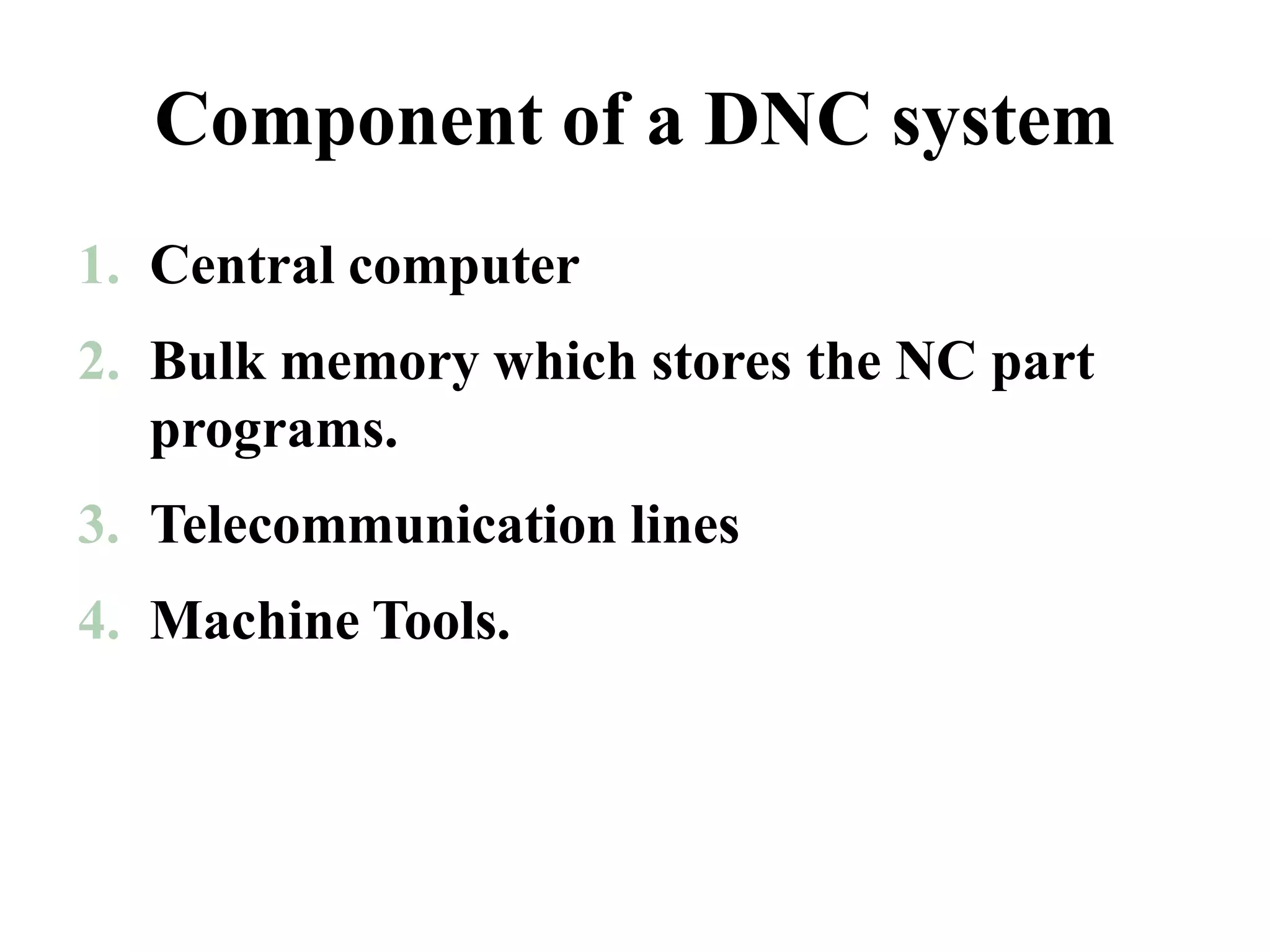
Component of a DNC system
1. Central computer
2. Bulk memory which stores the NC part
programs.
3. Telecommunication lines
4. Machine Tools.
Principle
Diagram
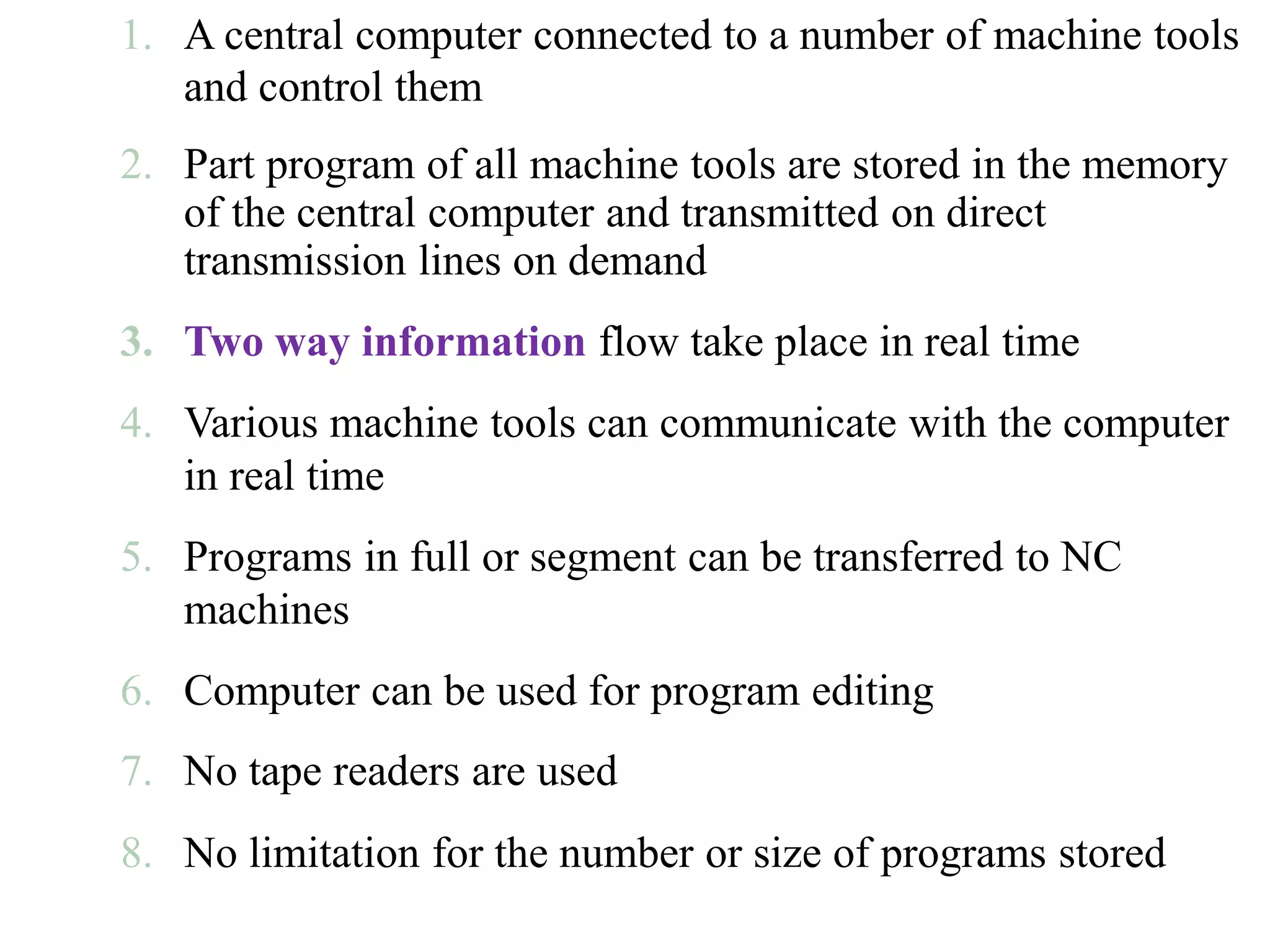
1. A central computer connected to a number of machine tools
and control them
2. Part program of all machine tools are stored in the memory
of the central computer and transmitted on direct
transmission lines on demand
3. Two way information flow take place in real time
4. Various machine tools can communicate with the computer
in real time
5. Programs in full or segment can be transferred to NC
machines
6. Computer can be used for program editing
7. No tape readers are used
8. No limitation for the number or size of programs stored
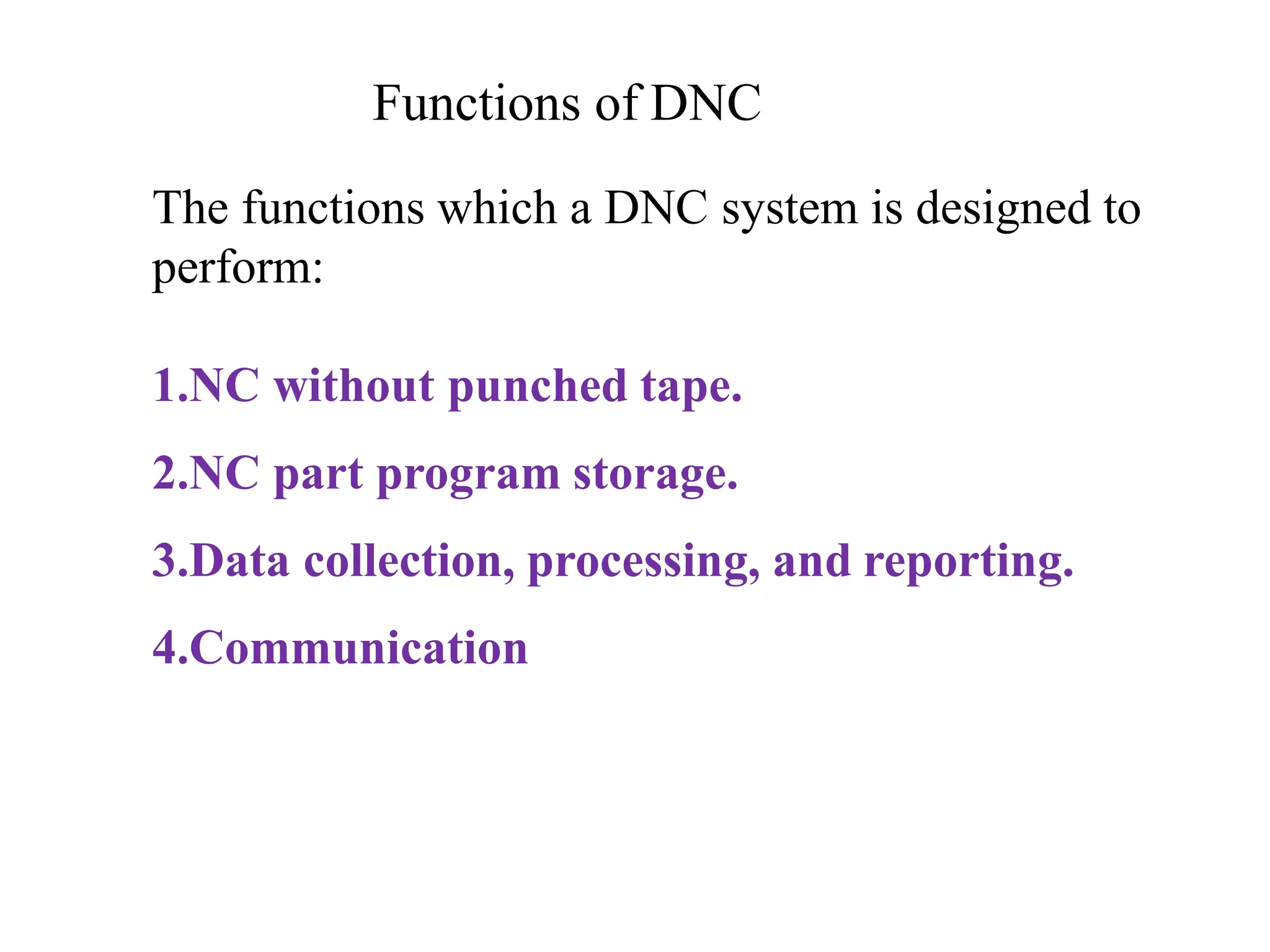
Functions of DNC
The functions which a DNC system is designed to
perform:
1.NC without punched tape.
2.NC part program storage.
3.Data collection, processing, and reporting.
4.Communication
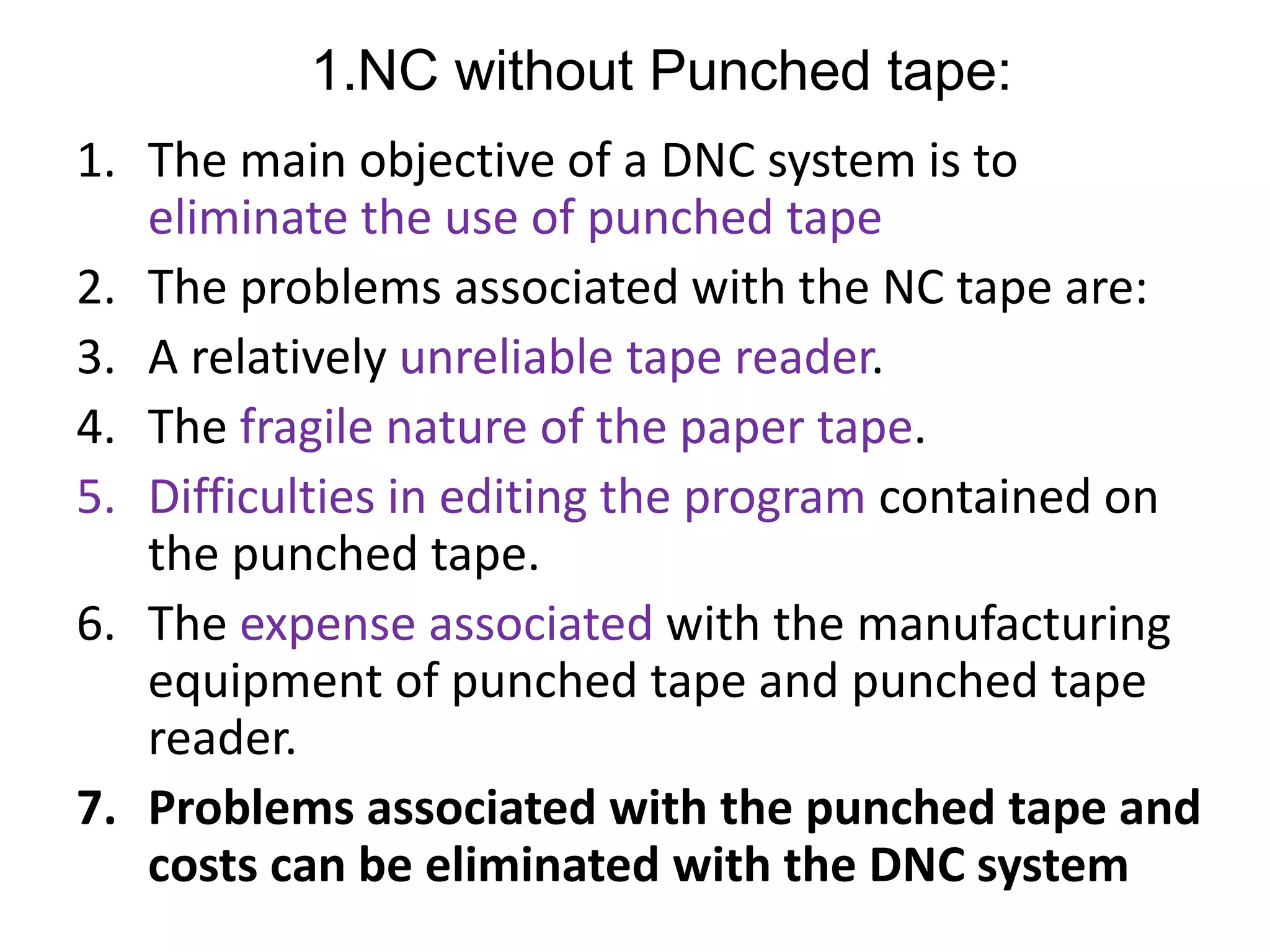
1.NC without Punched tape:
1. The main objective of a DNC system is to
eliminate the use of punched tape
2. The problems associated with the NC tape are:
3. A relatively unreliable tape reader.
4. The fragile nature of the paper tape.
5. Difficulties in editing the program contained on
the punched tape.
6. The expense associated with the manufacturing
equipment of punched tape and punched tape
reader.
7. Problems associated with the punched tape and
costs can be eliminated with the DNC system
2. NC part program storage.
1.The DNC program storage system consists of an
active storage and second storage.
2.The active storage used to storage NC programs,
which are frequently used.
3.The active storage can be readily accessed by the
DNC computer to drive an NC machine in production.
4.A typical mass storage device for this purpose would
be a Disk.
5.The secondary storage would be used for NC
programs , which are not frequently used.
Example: secondary storage include magnetic
tape, tape cassettes, floppy disk and disk packs.
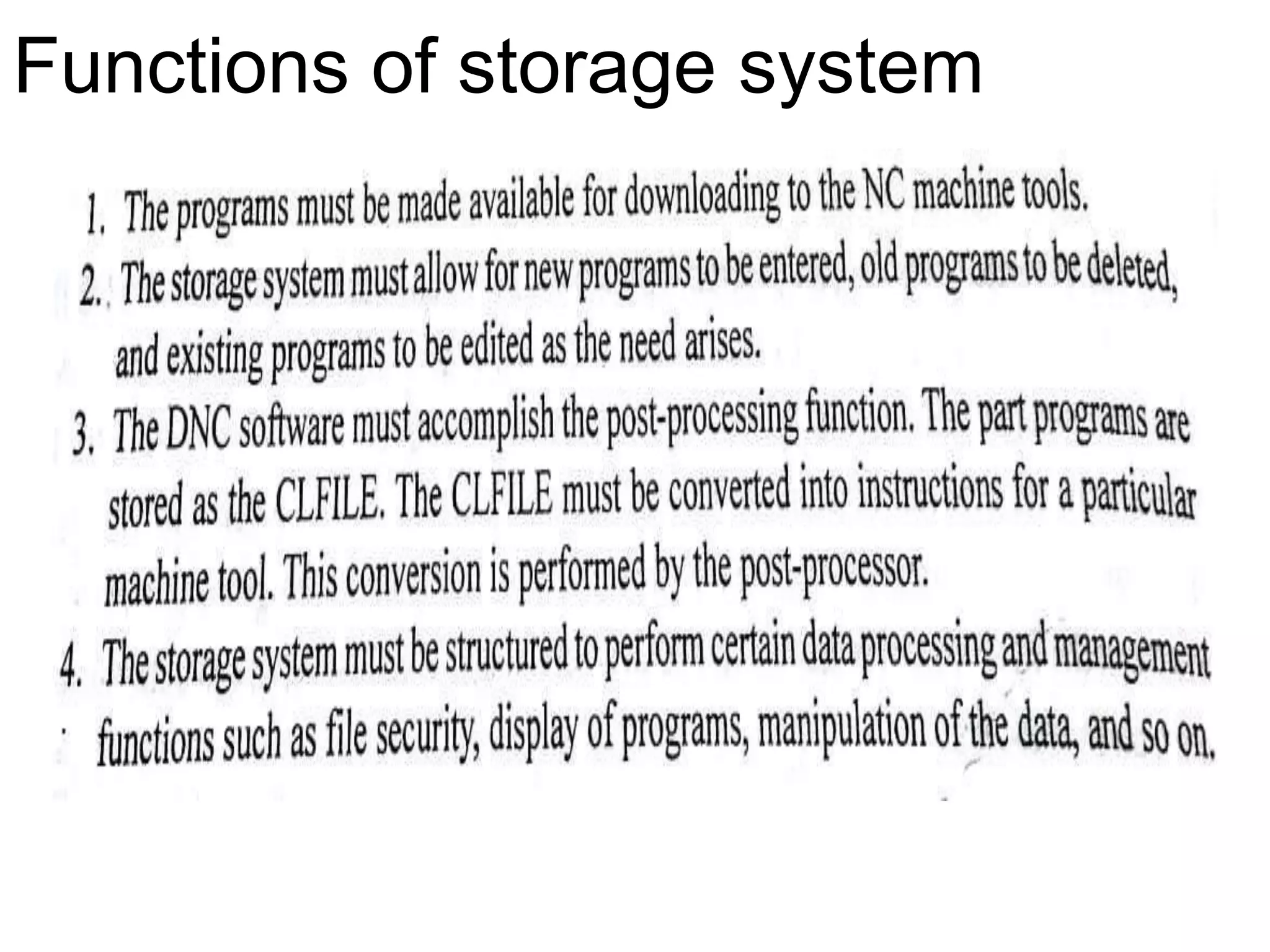
Functions of storage system
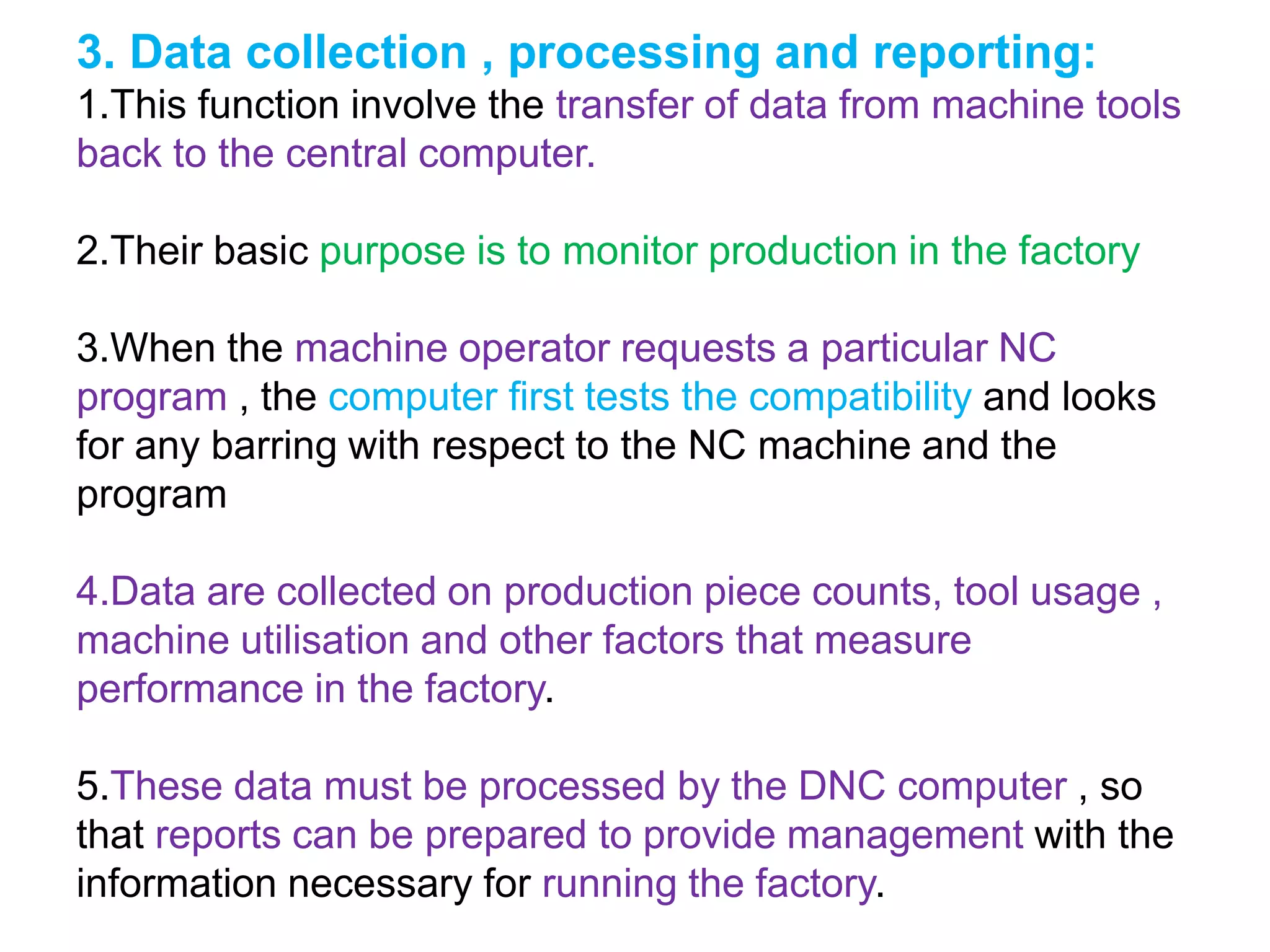
3. Data collection , processing and reporting:
1.This function involve the transfer of data from machine tools
back to the central computer.
2.Their basic purpose is to monitor production in the factory
3.When the machine operator requests a particular NC
program , the computer first tests the compatibility and looks
for any barring with respect to the NC machine and the
program
4.Data are collected on production piece counts, tool usage ,
machine utilisation and other factors that measure
performance in the factory.
5.These data must be processed by the DNC computer , so
that reports can be prepared to provide management with the
information necessary for running the factory.
4. Communications:
The important communications links in DNC system
are between the following of the system:
1.central computer and machine tools
2.Central computer and NC programmer terminals.
3.Central computer and bulk memory.
Types of DNC systems:
There are 2 types of systems by which the
communication link is established between the
control computer and the machine tool.
1.Behind the tape reader (BTR) System.
2.Special machine control unit (SMCU) system
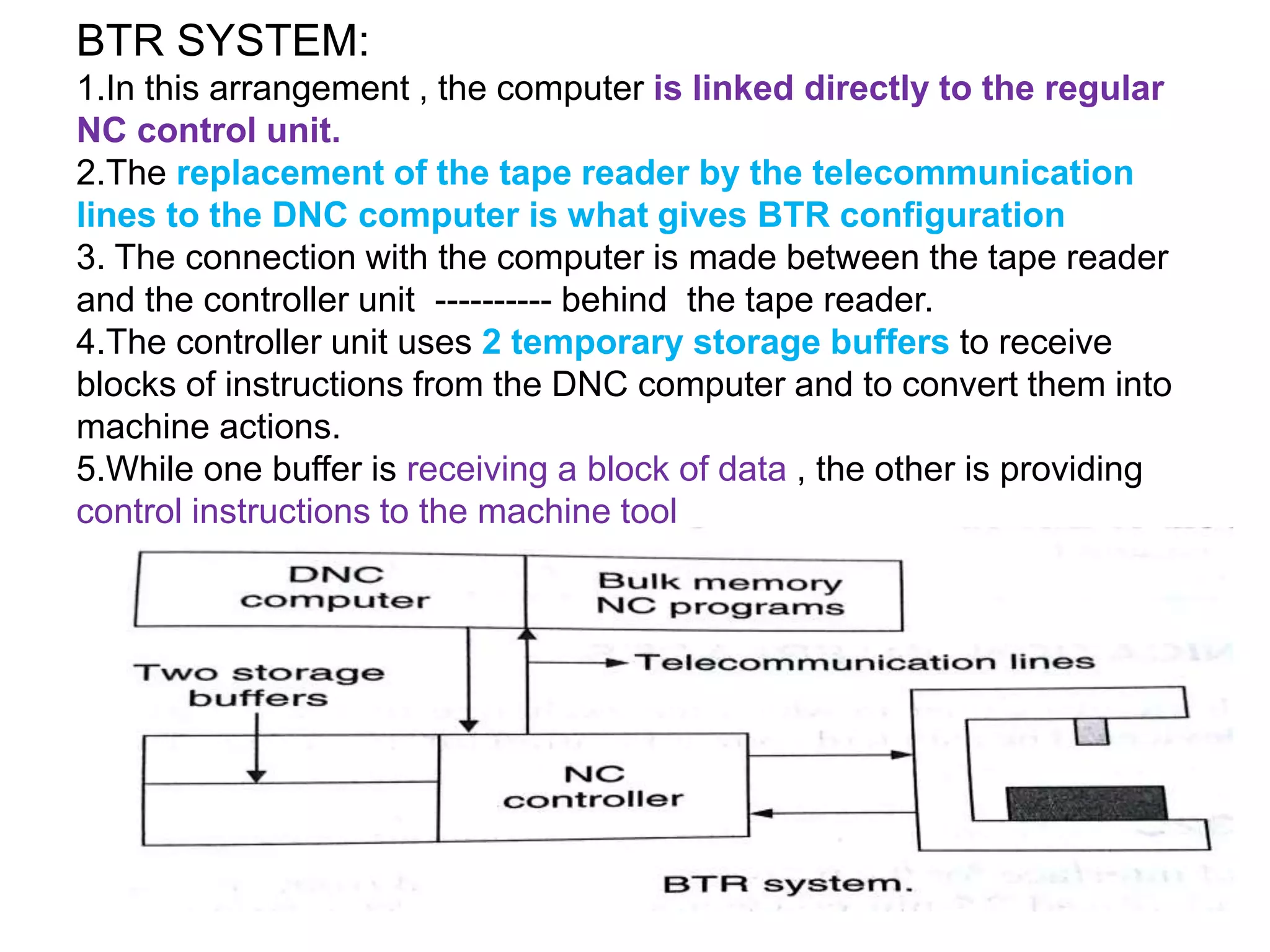
BTR SYSTEM:
1.In this arrangement , the computer is linked directly to the regular
NC control unit.
2.The replacement of the tape reader by the telecommunication
lines to the DNC computer is what gives BTR configuration
3. The connection with the computer is made between the tape reader
and the controller unit ---------- behind the tape reader.
4.The controller unit uses 2 temporary storage buffers to receive
blocks of instructions from the DNC computer and to convert them into
machine actions.
5.While one buffer is receiving a block of data , the other is providing
control instructions to the machine tool
SMCU SYSTEM:
1.In this arrangement , a special machine control unit completely replaces
the regular NC controller.
2.This special MCU is a device that is specially designed to facilitate
communication between the machine tool and the computer.
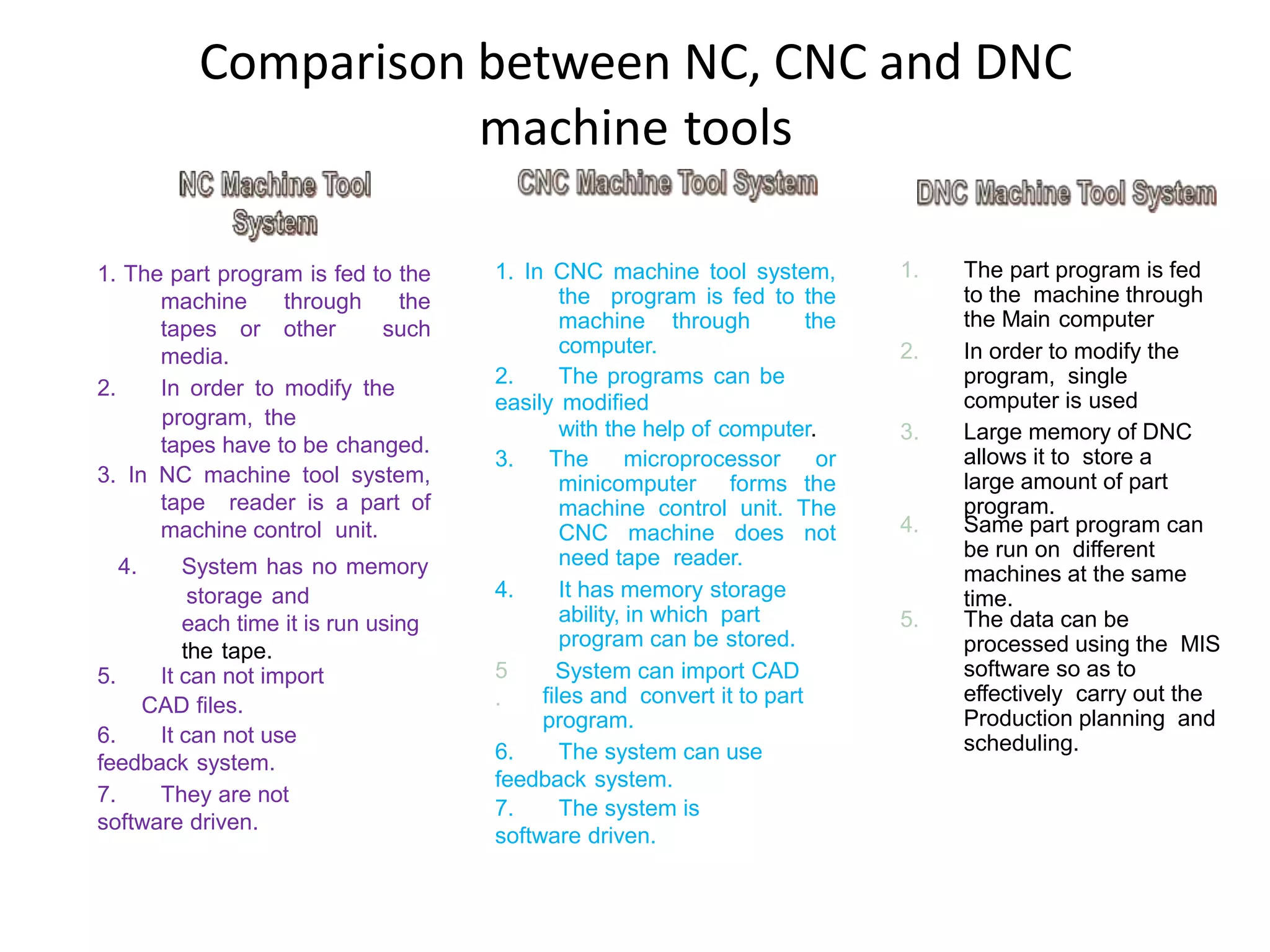
Comparison between NC, CNC and DNC
machine tools
1. The part program is fed to the
machine through the
tapes or other such
media.
2. In order to modify the
program, the
tapes have to be changed.
3. In NC machine tool system,
tape reader is a part of
machine control unit.
4. System has no memory
storage and
each time it is run using
the tape.
5. It can not import
CAD files.
6. It can not use
feedback system.
7. They are not
software driven.
1. In CNC machine tool system,
the program is fed to the
machine through the
computer.
2. The programs can be
easily modified
with the help of computer.
3. The microprocessor or
minicomputer forms the
machine control unit. The
CNC machine does not
need tape reader.
4. It has memory storage
ability, in which part
program can be stored.
5
.
System can import CAD
files and convert it to part
program.
6. The system can use
feedback system.
7. The system is
software driven.
1. The part program is fed
to the machine through
the Main computer
2. In order to modify the
program, single
computer is used
3. Large memory of DNC
allows it to store a
large amount of part
program.
4. Same part program can
be run on different
machines at the same
time.
5. The data can be
processed using the MIS
software so as to
effectively carry out the
Production planning and
scheduling.

DNC machines tools

  • 1.
  • 2.
    Advantages & Limitationsof CNC machine tools • Advantages • Ease of program input. • Multiple program storage. • Online part programming and editing. • Use of advanced interpolation. • Automatic tool compensation. • Auto generation of part program for existing components. • Change in system of units. • Limitations • Higher investment cost. • Higher maintenance cost. • Requires specialized operators
  • 3.
    Introduction DNC • DNCis a manufacturing system in which a number of machines are controlled by a computer through direct- connection and in real time. • Also, defined by EIA as: DNC is a system connecting a set of NC machines to a common memory for part program or machine program storage with provision for on-demand distribution of data to machines. • The tape reader is omitted. • Involves data connection and processing from the machine tool back to the computer.
  • 4.
    Component of aDNC system 1. Central computer 2. Bulk memory which stores the NC part programs. 3. Telecommunication lines 4. Machine Tools.
  • 5.
  • 6.
    1. A centralcomputer connected to a number of machine tools and control them 2. Part program of all machine tools are stored in the memory of the central computer and transmitted on direct transmission lines on demand 3. Two way information flow take place in real time 4. Various machine tools can communicate with the computer in real time 5. Programs in full or segment can be transferred to NC machines 6. Computer can be used for program editing 7. No tape readers are used 8. No limitation for the number or size of programs stored
  • 7.
    Functions of DNC Thefunctions which a DNC system is designed to perform: 1.NC without punched tape. 2.NC part program storage. 3.Data collection, processing, and reporting. 4.Communication
  • 8.
    1.NC without Punchedtape: 1. The main objective of a DNC system is to eliminate the use of punched tape 2. The problems associated with the NC tape are: 3. A relatively unreliable tape reader. 4. The fragile nature of the paper tape. 5. Difficulties in editing the program contained on the punched tape. 6. The expense associated with the manufacturing equipment of punched tape and punched tape reader. 7. Problems associated with the punched tape and costs can be eliminated with the DNC system
  • 9.
    2. NC partprogram storage. 1.The DNC program storage system consists of an active storage and second storage. 2.The active storage used to storage NC programs, which are frequently used. 3.The active storage can be readily accessed by the DNC computer to drive an NC machine in production. 4.A typical mass storage device for this purpose would be a Disk. 5.The secondary storage would be used for NC programs , which are not frequently used. Example: secondary storage include magnetic tape, tape cassettes, floppy disk and disk packs.
  • 10.
  • 11.
    3. Data collection, processing and reporting: 1.This function involve the transfer of data from machine tools back to the central computer. 2.Their basic purpose is to monitor production in the factory 3.When the machine operator requests a particular NC program , the computer first tests the compatibility and looks for any barring with respect to the NC machine and the program 4.Data are collected on production piece counts, tool usage , machine utilisation and other factors that measure performance in the factory. 5.These data must be processed by the DNC computer , so that reports can be prepared to provide management with the information necessary for running the factory.
  • 12.
    4. Communications: The importantcommunications links in DNC system are between the following of the system: 1.central computer and machine tools 2.Central computer and NC programmer terminals. 3.Central computer and bulk memory.
  • 13.
    Types of DNCsystems: There are 2 types of systems by which the communication link is established between the control computer and the machine tool. 1.Behind the tape reader (BTR) System. 2.Special machine control unit (SMCU) system
  • 14.
    BTR SYSTEM: 1.In thisarrangement , the computer is linked directly to the regular NC control unit. 2.The replacement of the tape reader by the telecommunication lines to the DNC computer is what gives BTR configuration 3. The connection with the computer is made between the tape reader and the controller unit ---------- behind the tape reader. 4.The controller unit uses 2 temporary storage buffers to receive blocks of instructions from the DNC computer and to convert them into machine actions. 5.While one buffer is receiving a block of data , the other is providing control instructions to the machine tool
  • 15.
    SMCU SYSTEM: 1.In thisarrangement , a special machine control unit completely replaces the regular NC controller. 2.This special MCU is a device that is specially designed to facilitate communication between the machine tool and the computer.
  • 17.
    Comparison between NC,CNC and DNC machine tools 1. The part program is fed to the machine through the tapes or other such media. 2. In order to modify the program, the tapes have to be changed. 3. In NC machine tool system, tape reader is a part of machine control unit. 4. System has no memory storage and each time it is run using the tape. 5. It can not import CAD files. 6. It can not use feedback system. 7. They are not software driven. 1. In CNC machine tool system, the program is fed to the machine through the computer. 2. The programs can be easily modified with the help of computer. 3. The microprocessor or minicomputer forms the machine control unit. The CNC machine does not need tape reader. 4. It has memory storage ability, in which part program can be stored. 5 . System can import CAD files and convert it to part program. 6. The system can use feedback system. 7. The system is software driven. 1. The part program is fed to the machine through the Main computer 2. In order to modify the program, single computer is used 3. Large memory of DNC allows it to store a large amount of part program. 4. Same part program can be run on different machines at the same time. 5. The data can be processed using the MIS software so as to effectively carry out the Production planning and scheduling.