CNC TOOLING
Submitted By:- Shaimin Shah
Kushal Shah
OVERVIEW OF PRESENTATION
•
•
•
•
•
•
•
•
•
•
•
•
CNC MACHINING
IDENTIFICATION OF WORKPIECE MATERIAL
TYPES OF TOOL MATERIALS
CNC MILLING
CNC DRILLS
CNC TURNING
TOOLHOLDER AND INSERT IDENTIFICATION
MODULAR TOOLING SYSTEMS FOR TURNING
TOOL PRESETTING
AUTOMATIC TOOL CHANGERS
TOOL CHANGE PROCEDURE
CNC CUTTING TOOLS DEVELOPMENT TRENDS
What is the CNC machine?
•
•
Now that we have seen what the NC machine is and its various
parts, it is easier to understand what the CNC machine is. CNC is
the short form for Computer Numerical control. We have seen that
the NC machine works as per the program of instructions fed into
the controller unit of the machine. The CNC machine comprises of
the mini computer or the microcomputer that acts as the controller
unit of the machine. While in the NC machine the program is fed
into the punch cards, in CNC machines the program of instructions
is fed directly into the computer via a small board similar to the
traditional keyboard.
In CNC machine the program is stored in the memory of the
computer. The programmer can easily write the codes, and edit the
programs as per the requirements. These programs can be used for
different parts, and they don’t have to be repeated again and again.
How the CNC machine works?
•
•
The CNC machine comprises of the computer in which the program
is fed for cutting of the metal of the job as per the requirements. All
the cutting processes that are to be carried out and all the final
dimensions are fed into the computer via the program. The
computer thus knows what exactly is to be done and carries out all
the cutting processes. CNC machine works like the Robot, which
has to be fed with the program and it follows all your instructions.
Some of the common machine tools that can run on the CNC are:
Lathe, Milling machines, Drilling Machine etc. The main purpose of
these machines is to remove some of the metal so as to give it
proper shape such as round, rectangular, etc. In the traditional
methods these machines are operated by the operators who are
experts in the operation of these machines. Most of the jobs need
to be machined accurately, and the operator should be expert
enough to make the precision jobs. In the CNC machines the role of
the operators is minimized. The operator has to merely feed the
program of instructions in the computer, load the required tools in
the machine, and rest of the work is done by the computer
automatically. The computer directs the machine tool to perform
various machining operations as per the program of instructions fed
by the operator.
CNC machine basic working
•
•
•
•
Motion control-The heart of CNC
All forms of CNC equipment have two or
more direction of motion called axes.
These axes can be precisely and
automatically positioned along their length
of travel.
The two most common axis types are:
1.linear(driven along a straight path)
2.Rotary(driven along a circular path)
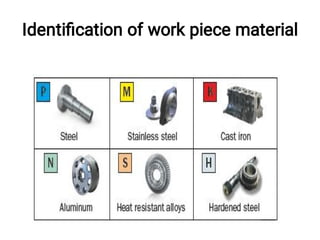
Identification of work piece material
•
•
Also the identification is done by different
aspects like by metal’s magnetic attraction,
density, thermal conductivity an
mechanical condition.
EX. Thermal conductivity:- Aluminium
feels warmer to the touch than stainless
steel with a similar finish.
REQUIREMENTS
•
•
•
•
Tools must resist abrasive wear
It must be capable of supporting and
retaining smooth , sharp edges
They must be rigid
Cutting and clearance angles must be
carefully selected
TYPES OF TOOL MATERIALS
•
•
•
•
•
•
High speed steel (HSS)
High carbon tool steel (HCS)
Cast alloy
Cemented carbide
Ceramics
Diamond
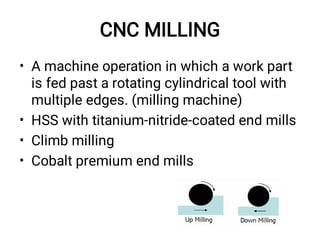
CNC MILLING
•
•
•
•
A machine operation in which a work part
is fed past a rotating cylindrical tool with
multiple edges. (milling machine)
HSS with titanium-nitride-coated end mills
Climb milling
Cobalt premium end mills
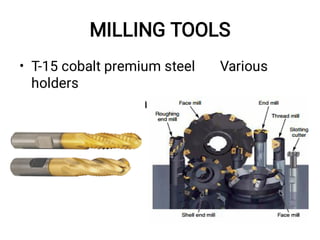
MILLING TOOLS
• T-15 cobalt premium steel Various
holders
ball end single end mill
CNC DRILLS
•
•
I.
II.
III.
Drilling is a cutting process that uses
a drill bit to cut or enlarge a hole of
circular cross-section in solid materials.
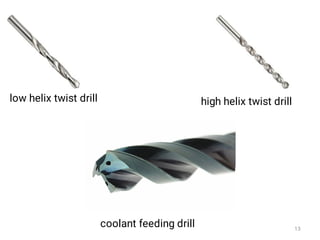
Types of drill bits
low helix twist drill
high helix twist drill
coolant feeding drill
13
low helix twist drill high helix twist drill
coolant feeding drill
CNC TURNING
•
•
I.
II.
Turning is a machining process in which
a cutting tool, typically a non-rotary tool bit,
describes a helicaltoolpath by moving
more or less linearly while the
workpiece rotates
Types of tools:-
Indexable insert tools
Standard brazed tools
14
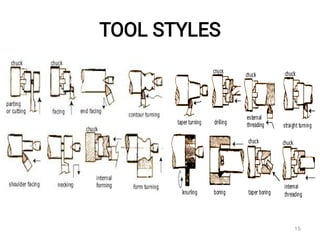
TOOL STYLES
15
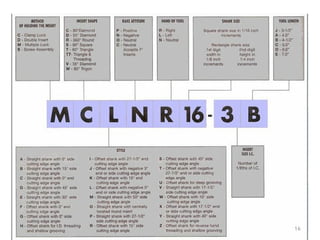
Toolholder identification
16
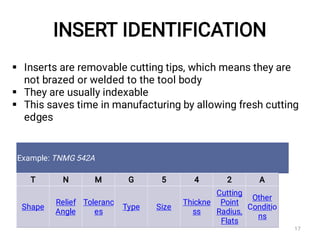
INSERT IDENTIFICATION
Example: TNMG 542A
T N M G 5 4 2 A
Shape
Relief
Angle
Toleranc
es
Type Size
Thickne
ss
Cutting
Point
Radius,
Flats
Other
Conditio
ns
17



Inserts are removable cutting tips, which means they are
not brazed or welded to the tool body
They are usually indexable
This saves time in manufacturing by allowing fresh cutting
edges
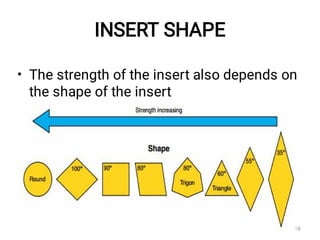
INSERT SHAPE
• The strength of the insert also depends on
the shape of the insert
18
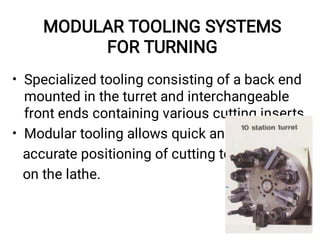
MODULAR TOOLING SYSTEMS
FOR TURNING
•
•
Specialized tooling consisting of a back end
mounted in the turret and interchangeable
front ends containing various cutting inserts
Modular tooling allows quick and
accurate positioning of cutting tools
on the lathe.
19
20
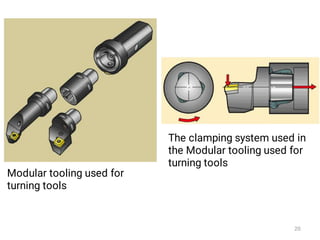
Modular tooling used for
turning tools
The clamping system used in
the Modular tooling used for
turning tools
TOOL PRESETTING
•
•
•
The setting of tool in advance at a place
away from the machine tool
A presetting device is used to preset axial
and radial positions of the tool tip on tool
holder
Once this is done, tool holder is ready to
be mounted on the machine
21
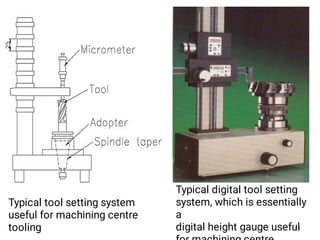
22
Typical tool setting system
useful for machining centre
tooling
Typical digital tool setting
system, which is essentially
a
digital height gauge useful
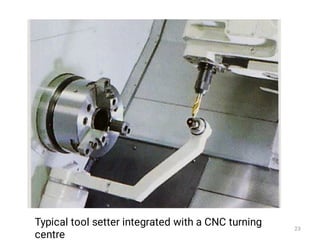
23
Typical tool setter integrated with a CNC turning
centre
AUTOMATIC TOOL CHANGERS
For the (ATC) to operate, it is necessary to have
the following:
a) A tool magazine where sufficient number of
tools can be stored.
b) The tool adopter that has a provision for
pick-up by the tool change arm.
c) The ability in the control to perform the tool
change function,
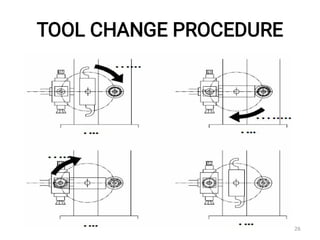
d) Tool change procedure
24
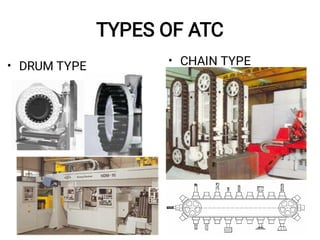
TYPES OF ATC
• DRUM TYPE • CHAIN TYPE
25
TOOL CHANGE PROCEDURE
26
CNC CUTTING TOOLS
DEVELOPMENT TRENDS
•
•
•
•
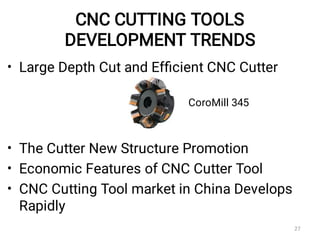
Large Depth Cut and Efficient CNC Cutter
The Cutter New Structure Promotion
Economic Features of CNC Cutter Tool
CNC Cutting Tool market in China Develops
Rapidly
27
CoroMill 345
CNC CUTTING TOOL
MANUFACTURERS
•
•
•
•
•
•
•
•
Cutting Tool Source (CTS)
Bharat Fritz Werner Limited (BFW)
Welding Aids, Delhi
Sai - Weld India, Mumbai
Patani Tools, Mumbai
Confidence Corporation, Rajkot
Bhagwati Traders, Panchkula
Shree Enterprises Manufacturing Co
28

Cnc tooling for cnc machine(130670119596)

  • 1.
    CNC TOOLING Submitted By:-Shaimin Shah Kushal Shah
  • 2.
    OVERVIEW OF PRESENTATION • • • • • • • • • • • • CNCMACHINING IDENTIFICATION OF WORKPIECE MATERIAL TYPES OF TOOL MATERIALS CNC MILLING CNC DRILLS CNC TURNING TOOLHOLDER AND INSERT IDENTIFICATION MODULAR TOOLING SYSTEMS FOR TURNING TOOL PRESETTING AUTOMATIC TOOL CHANGERS TOOL CHANGE PROCEDURE CNC CUTTING TOOLS DEVELOPMENT TRENDS
  • 3.
    What is theCNC machine? • • Now that we have seen what the NC machine is and its various parts, it is easier to understand what the CNC machine is. CNC is the short form for Computer Numerical control. We have seen that the NC machine works as per the program of instructions fed into the controller unit of the machine. The CNC machine comprises of the mini computer or the microcomputer that acts as the controller unit of the machine. While in the NC machine the program is fed into the punch cards, in CNC machines the program of instructions is fed directly into the computer via a small board similar to the traditional keyboard. In CNC machine the program is stored in the memory of the computer. The programmer can easily write the codes, and edit the programs as per the requirements. These programs can be used for different parts, and they don’t have to be repeated again and again.
  • 4.
    How the CNCmachine works? • • The CNC machine comprises of the computer in which the program is fed for cutting of the metal of the job as per the requirements. All the cutting processes that are to be carried out and all the final dimensions are fed into the computer via the program. The computer thus knows what exactly is to be done and carries out all the cutting processes. CNC machine works like the Robot, which has to be fed with the program and it follows all your instructions. Some of the common machine tools that can run on the CNC are: Lathe, Milling machines, Drilling Machine etc. The main purpose of these machines is to remove some of the metal so as to give it proper shape such as round, rectangular, etc. In the traditional methods these machines are operated by the operators who are experts in the operation of these machines. Most of the jobs need to be machined accurately, and the operator should be expert enough to make the precision jobs. In the CNC machines the role of the operators is minimized. The operator has to merely feed the program of instructions in the computer, load the required tools in the machine, and rest of the work is done by the computer automatically. The computer directs the machine tool to perform various machining operations as per the program of instructions fed by the operator.
  • 5.
    CNC machine basicworking • • • • Motion control-The heart of CNC All forms of CNC equipment have two or more direction of motion called axes. These axes can be precisely and automatically positioned along their length of travel. The two most common axis types are: 1.linear(driven along a straight path) 2.Rotary(driven along a circular path)
  • 6.
  • 7.
    • • Also the identificationis done by different aspects like by metal’s magnetic attraction, density, thermal conductivity an mechanical condition. EX. Thermal conductivity:- Aluminium feels warmer to the touch than stainless steel with a similar finish.
  • 8.
    REQUIREMENTS • • • • Tools must resistabrasive wear It must be capable of supporting and retaining smooth , sharp edges They must be rigid Cutting and clearance angles must be carefully selected
  • 9.
    TYPES OF TOOLMATERIALS • • • • • • High speed steel (HSS) High carbon tool steel (HCS) Cast alloy Cemented carbide Ceramics Diamond
  • 10.
    CNC MILLING • • • • A machineoperation in which a work part is fed past a rotating cylindrical tool with multiple edges. (milling machine) HSS with titanium-nitride-coated end mills Climb milling Cobalt premium end mills
  • 11.
    MILLING TOOLS • T-15cobalt premium steel Various holders ball end single end mill
  • 12.
    CNC DRILLS • • I. II. III. Drilling is a cutting processthat uses a drill bit to cut or enlarge a hole of circular cross-section in solid materials. Types of drill bits low helix twist drill high helix twist drill coolant feeding drill
  • 13.
    13 low helix twistdrill high helix twist drill coolant feeding drill
  • 14.
    CNC TURNING • • I. II. Turning is a machiningprocess in which a cutting tool, typically a non-rotary tool bit, describes a helicaltoolpath by moving more or less linearly while the workpiece rotates Types of tools:- Indexable insert tools Standard brazed tools 14
  • 15.
  • 16.
  • 17.
    INSERT IDENTIFICATION Example: TNMG 542A TN M G 5 4 2 A Shape Relief Angle Toleranc es Type Size Thickne ss Cutting Point Radius, Flats Other Conditio ns 17    Inserts are removable cutting tips, which means they are not brazed or welded to the tool body They are usually indexable This saves time in manufacturing by allowing fresh cutting edges
  • 18.
    INSERT SHAPE • Thestrength of the insert also depends on the shape of the insert 18
  • 19.
    MODULAR TOOLING SYSTEMS FORTURNING • • Specialized tooling consisting of a back end mounted in the turret and interchangeable front ends containing various cutting inserts Modular tooling allows quick and accurate positioning of cutting tools on the lathe. 19
  • 20.
    20 Modular tooling usedfor turning tools The clamping system used in the Modular tooling used for turning tools
  • 21.
    TOOL PRESETTING • • • The settingof tool in advance at a place away from the machine tool A presetting device is used to preset axial and radial positions of the tool tip on tool holder Once this is done, tool holder is ready to be mounted on the machine 21
  • 22.
    22 Typical tool settingsystem useful for machining centre tooling Typical digital tool setting system, which is essentially a digital height gauge useful
  • 23.
    23 Typical tool setterintegrated with a CNC turning centre
  • 24.
    AUTOMATIC TOOL CHANGERS Forthe (ATC) to operate, it is necessary to have the following: a) A tool magazine where sufficient number of tools can be stored. b) The tool adopter that has a provision for pick-up by the tool change arm. c) The ability in the control to perform the tool change function, d) Tool change procedure 24
  • 25.
    TYPES OF ATC •DRUM TYPE • CHAIN TYPE 25
  • 26.
  • 27.
    CNC CUTTING TOOLS DEVELOPMENTTRENDS • • • • Large Depth Cut and Efficient CNC Cutter The Cutter New Structure Promotion Economic Features of CNC Cutter Tool CNC Cutting Tool market in China Develops Rapidly 27 CoroMill 345
  • 28.
    CNC CUTTING TOOL MANUFACTURERS • • • • • • • • CuttingTool Source (CTS) Bharat Fritz Werner Limited (BFW) Welding Aids, Delhi Sai - Weld India, Mumbai Patani Tools, Mumbai Confidence Corporation, Rajkot Bhagwati Traders, Panchkula Shree Enterprises Manufacturing Co 28