PROCESS MAPPING
DEFINITION
 Structural analysis of a process flow (such as an order-to-
delivery cycle), by
distinguishing
how work is actually done from how it should be done
what functions a system should perform from how
the system is built to perform those functions.
Process mapping
Process maps are diagrams that show :-
 What an organization does and how it delivers services.
 Major processes in place, the key activities that make up
each process,
 Sequencing of those activities, the inputs and resources
required and outputs produced by each activity.
 Process maps are a way of ensuring that the activities
making up a particular process are:
 properly understood
 properly managed
in order to deliver the best services to customers.
Early history
 The first structured method for documenting process
flow, the flow process chart, was introduced by Frank
Gilbreth to members of ASME in 1921 .
 Gilbreth's tools were quickly integrated
into industrial engineering curricula.
 In 1947, ASME adopted a symbol set derived from
Gilbreth's original work as the ASME Standard for
Process Charts.
Two main elements
■ Flowcharts that show the sequencing of activities
in a particular process
■ Process definition charts: shows, for each
activity,
 inputs and resources that are required
 outputs that will result from the activity
 controls that regulate or influence the activity.
Combining flowcharts and process definition charts
will provide a complete process map, although many
services will find simply the production of flowcharts
a useful aid to service improvement.
Four Major Steps of Process Mapping
 Process identification :- Knowing the process of each
component of the company is crucial in understanding
how work should be done and how it could serve the
needs of customers.
 Information gathering :- regarding the key personnel
involved in the work process. These individuals can make
changes to the process so they should be involved in
crafting the process map. Other pertinent information
that should be gathered includes process objectives,
risks, control mechanisms, and measures of milestones.
Four Major Steps of Process Mapping
 Interviewing and mapping :- This step will
validate if the identified processes are clear and if
work set are being effectively carried out.
 Analysis :- The information gathered and the map
that was created should be analyzed. Any inefficiency
in the process should be purged immediately and
best practices should serve as a model for the whole
business process.
Benefits of process mapping
 Ensuring that managers and staff understand all the
activities, their sequencing, resources required, the
standards and performance targets to be met.
 Enabling roles and responsibilities to be clearly
agreed and defined, ensuring everyone involved in
the process, regardless of where they are in the
organization, knows who is meant to do what.
Benefits of process mapping
 Helping ensure that activities and services provided
on a multi departmental basis are properly
integrated and connected so that the customer does
not fall into the gaps between departments and
different organizations.
 Contributes directly to performance benchmarking,
performance improvement and service redesign.
Benefits of process mapping
 By producing a process map managers and staff are
encouraged to ask
 why?
 Why do we do this?
 Why do we do it this way?
 Why do we do it in this order?
 Why don’t we do it differently?
Example
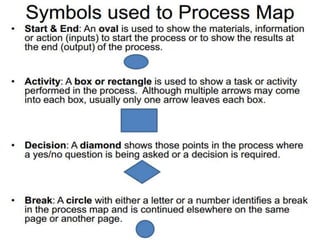
 Flowchart is a primary type of business process
mapping.
 It consists of some symbols such as arrows, circle,
diamond, box, oval or rectangle.
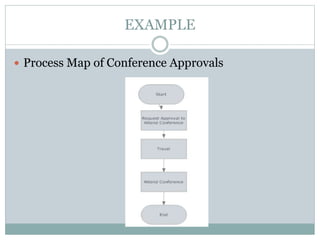
EXAMPLE
 Process Map of Conference Approvals
SAMPLE 2

Process mapping --- business process reengineering

  • 1.
  • 2.
    DEFINITION  Structural analysisof a process flow (such as an order-to- delivery cycle), by distinguishing how work is actually done from how it should be done what functions a system should perform from how the system is built to perform those functions.
  • 3.
    Process mapping Process mapsare diagrams that show :-  What an organization does and how it delivers services.  Major processes in place, the key activities that make up each process,  Sequencing of those activities, the inputs and resources required and outputs produced by each activity.  Process maps are a way of ensuring that the activities making up a particular process are:  properly understood  properly managed in order to deliver the best services to customers.
  • 4.
    Early history  Thefirst structured method for documenting process flow, the flow process chart, was introduced by Frank Gilbreth to members of ASME in 1921 .  Gilbreth's tools were quickly integrated into industrial engineering curricula.  In 1947, ASME adopted a symbol set derived from Gilbreth's original work as the ASME Standard for Process Charts.
  • 5.
    Two main elements ■Flowcharts that show the sequencing of activities in a particular process ■ Process definition charts: shows, for each activity,  inputs and resources that are required  outputs that will result from the activity  controls that regulate or influence the activity. Combining flowcharts and process definition charts will provide a complete process map, although many services will find simply the production of flowcharts a useful aid to service improvement.
  • 6.
    Four Major Stepsof Process Mapping  Process identification :- Knowing the process of each component of the company is crucial in understanding how work should be done and how it could serve the needs of customers.  Information gathering :- regarding the key personnel involved in the work process. These individuals can make changes to the process so they should be involved in crafting the process map. Other pertinent information that should be gathered includes process objectives, risks, control mechanisms, and measures of milestones.
  • 7.
    Four Major Stepsof Process Mapping  Interviewing and mapping :- This step will validate if the identified processes are clear and if work set are being effectively carried out.  Analysis :- The information gathered and the map that was created should be analyzed. Any inefficiency in the process should be purged immediately and best practices should serve as a model for the whole business process.
  • 8.
    Benefits of processmapping  Ensuring that managers and staff understand all the activities, their sequencing, resources required, the standards and performance targets to be met.  Enabling roles and responsibilities to be clearly agreed and defined, ensuring everyone involved in the process, regardless of where they are in the organization, knows who is meant to do what.
  • 9.
    Benefits of processmapping  Helping ensure that activities and services provided on a multi departmental basis are properly integrated and connected so that the customer does not fall into the gaps between departments and different organizations.  Contributes directly to performance benchmarking, performance improvement and service redesign.
  • 10.
    Benefits of processmapping  By producing a process map managers and staff are encouraged to ask  why?  Why do we do this?  Why do we do it this way?  Why do we do it in this order?  Why don’t we do it differently?
  • 11.
    Example  Flowchart isa primary type of business process mapping.  It consists of some symbols such as arrows, circle, diamond, box, oval or rectangle.
  • 13.
    EXAMPLE  Process Mapof Conference Approvals
  • 14.