


urmitamanna@yahoo.com
SHRM is the management of HR philosophies,
policies, and practices to enable the achievement of
the organizational strategy.
Generally, these philosophies, policies, practices,
develops a system to attract, develop, utilize, and
retain employees for smooth functioning of the
organization.
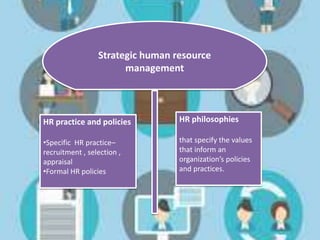
Strategic human resource
management
HR practice and policies
•Specific HR practice–
recruitment , selection ,
appraisal
•Formal HR policies
HR philosophies
that specify the values
that inform an
organization’s policies
and practices.
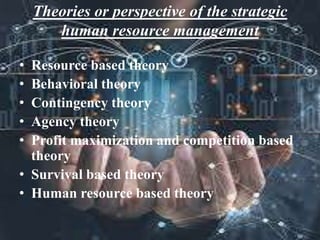
Theories or perspective of the strategic
human resource management
• Resource based theory
• Behavioral theory
• Contingency theory
• Agency theory
• Profit maximization and competition based
theory
• Survival based theory
• Human resource based theory
It is a process that helps your
organization identify current and future
HR needs to achieve your goals.
It should link HRM to the overall
strategic plan of an organization. It
involves developing a project plan
• HR should move from articulating perceived value (training
builds employee skills) to demonstrating real value(see the
economic value).
• The focus of HR must be on scoring points, not just coaching,
training or counting the number of players.
• The value of HR is seen in its ability to deliver the behaviors
needed to enable the organization’s strategy.
• The value of employees must be placed within strategic
framework.
• Value of HR must enable the organization to implement its
strategy.
• Employees must be able to demonstrate different behaviors
depending on the strategic goals.
Employees as Strategic Resources
 Employees can provide a firm with competitive
advantage.
 HR programs represent an investment in human
capital. This human capital is difficult to duplicate or
imitate.
 Strategic importance of human capital and intangible
assets have increased substantially. They are found in
human capital of the firm’s employees.
 The value of employees as a resource must be placed
within a strategic framework.
 An organization that manages its HR is more likely to
survive and profit.
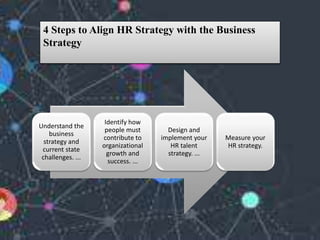
4 Steps to Align HR Strategy with the Business
Strategy
Understand the
business
strategy and
current state
challenges. ...
Identify how
people must
contribute to
organizational
growth and
success. ...
Design and
implement your
HR talent
strategy. ...
Measure your
HR strategy.
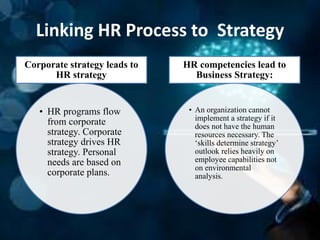
Linking HR Process to Strategy
Corporate strategy leads to
HR strategy
• HR programs flow
from corporate
strategy. Corporate
strategy drives HR
strategy. Personal
needs are based on
corporate plans.
HR competencies lead to
Business Strategy:
• An organization cannot
implement a strategy if it
does not have the human
resources necessary. The
‘skills determine strategy’
outlook relies heavily on
employee capabilities not
on environmental
analysis.
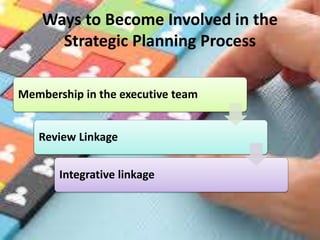
Ways to Become Involved in the
Strategic Planning Process
Membership in the executive team
Review Linkage
Integrative linkage
Characteristics of Effective HRM
strategy
 External Fit: It relates to programs, activities and strategies that the
organization develops to respond to the external environment.
 Internal Fit-the relationship between the different HR practices. Two types
of internal fit are-
• A fit with other functional areas
• A fit among all HR programs
 Focus on Results: the hard work of deciding on strategy is its
implementation and the tracking of results. James Harrington says,
‘Measurements are key. If you cannot measure it, you cannot control it. If
you cannot control it, then you cannot manage it.’
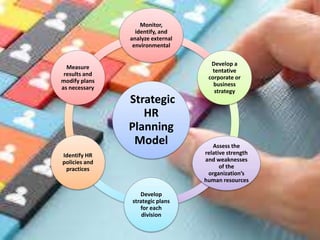
Strategic
HR
Planning
Model
Monitor,
identify, and
analyze external
environmental
Develop a
tentative
corporate or
business
strategy
Assess the
relative strength
and weaknesses
of the
organization’s
human resources
Develop
strategic plans
for each
division
Identify HR
policies and
practices
Measure
results and
modify plans
as necessary
Aligning human resources with strategy

Aligning human resources with strategy

  • 1.
  • 2.
    SHRM is themanagement of HR philosophies, policies, and practices to enable the achievement of the organizational strategy. Generally, these philosophies, policies, practices, develops a system to attract, develop, utilize, and retain employees for smooth functioning of the organization.
  • 3.
    Strategic human resource management HRpractice and policies •Specific HR practice– recruitment , selection , appraisal •Formal HR policies HR philosophies that specify the values that inform an organization’s policies and practices.
  • 4.
    Theories or perspectiveof the strategic human resource management • Resource based theory • Behavioral theory • Contingency theory • Agency theory • Profit maximization and competition based theory • Survival based theory • Human resource based theory
  • 5.
    It is aprocess that helps your organization identify current and future HR needs to achieve your goals. It should link HRM to the overall strategic plan of an organization. It involves developing a project plan
  • 6.
    • HR shouldmove from articulating perceived value (training builds employee skills) to demonstrating real value(see the economic value). • The focus of HR must be on scoring points, not just coaching, training or counting the number of players. • The value of HR is seen in its ability to deliver the behaviors needed to enable the organization’s strategy. • The value of employees must be placed within strategic framework. • Value of HR must enable the organization to implement its strategy. • Employees must be able to demonstrate different behaviors depending on the strategic goals.
  • 7.
    Employees as StrategicResources  Employees can provide a firm with competitive advantage.  HR programs represent an investment in human capital. This human capital is difficult to duplicate or imitate.  Strategic importance of human capital and intangible assets have increased substantially. They are found in human capital of the firm’s employees.  The value of employees as a resource must be placed within a strategic framework.  An organization that manages its HR is more likely to survive and profit.
  • 8.
    4 Steps toAlign HR Strategy with the Business Strategy Understand the business strategy and current state challenges. ... Identify how people must contribute to organizational growth and success. ... Design and implement your HR talent strategy. ... Measure your HR strategy.
  • 9.
    Linking HR Processto Strategy Corporate strategy leads to HR strategy • HR programs flow from corporate strategy. Corporate strategy drives HR strategy. Personal needs are based on corporate plans. HR competencies lead to Business Strategy: • An organization cannot implement a strategy if it does not have the human resources necessary. The ‘skills determine strategy’ outlook relies heavily on employee capabilities not on environmental analysis.
  • 10.
    Ways to BecomeInvolved in the Strategic Planning Process Membership in the executive team Review Linkage Integrative linkage
  • 11.
    Characteristics of EffectiveHRM strategy  External Fit: It relates to programs, activities and strategies that the organization develops to respond to the external environment.  Internal Fit-the relationship between the different HR practices. Two types of internal fit are- • A fit with other functional areas • A fit among all HR programs  Focus on Results: the hard work of deciding on strategy is its implementation and the tracking of results. James Harrington says, ‘Measurements are key. If you cannot measure it, you cannot control it. If you cannot control it, then you cannot manage it.’
  • 12.
    Strategic HR Planning Model Monitor, identify, and analyze external environmental Developa tentative corporate or business strategy Assess the relative strength and weaknesses of the organization’s human resources Develop strategic plans for each division Identify HR policies and practices Measure results and modify plans as necessary