Product Life cycle

          Level 3


 PRESENTED BY: NAVNEET JINGAR
                                1
Aims
• Discuss the Product Lifecycle
• Discuss each stage of the PLC
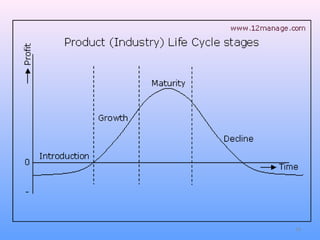
• Finally be able to draw a line of profit


                                             2
Product Lifecycle
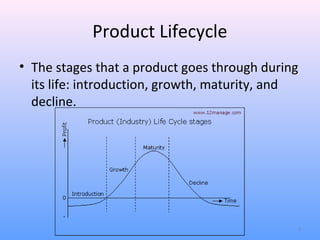
• The stages that a product goes through during
  its life: introduction, growth, maturity, and
  decline.


                                              3
Product Lifecycle
• The life cycle concept may apply to a brand or
  to a category of a product.

• Its duration maybe as short as a few months
  or years, depending on the product.

• As a product progresses through the stages,
  changes are made to how the product is
  marketed.
                                                   4
Introduction Stage
• Most products fail at this stage?
  – Why?
• This is the stage in which the product is
  initially promoted. Public awareness is very
  important to the success of a product. If
  people don't know about the product they
  won't go out and buy it.


                                                 5
Introduction Stage
• There are two different strategies you can use
  to introduce your product to consumers:

  – Penetration
  – Skimming


                                                   6
Introduction Stage
• Penetration
  – This strategy usually set the product price very
    high initially and then gradually lowers it over
    time.
  – This is a good strategy to use if there are few
    competitors for your product.
  – Profits are high with this strategy but there is also
    a great deal of risk. If people don't want to pay
    high prices you may lose out.

                                                            7
Introduction Stage
• Skimming
  – In this case you set your prices very low at the
    beginning and then gradually
    increase them.
  – This is a good strategy to use if there are a lot of
    competitors who control a large portion of the
    market.
  – Profits are not a concern under this strategy. The
    most important thing is to get you product known
    and worry about making money at a later time.

                                                           8
Growth
• The Growth stage is where your product starts
  to grow. In this stage a very large amount of
  money is spent on advertising. You want to
  concentrate of telling the consumer how
  much better your product is than your
  competitors' products.
• What are the ways in which you could prompt
  a product?

                                              9
Growth
• If you are successful with your advertising
  strategy then you will see an increase in sales.
  Once your sales begin to increase your share
  of the market will stabilise.


                                                 10
Maturity
• The third stage in the Product Life Cycle is the
  maturity stage. If your product completes the
  Introduction and Growth stages then it will
  then spend a great deal of time in the
  Maturity stage.

• During this stage sales grow at a very fast rate
  and then gradually begin to stabilise.

                                                     11
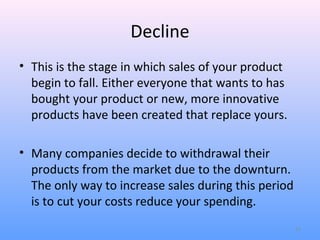
Decline
• This is the stage in which sales of your product
  begin to fall. Either everyone that wants to has
  bought your product or new, more innovative
  products have been created that replace yours.

• Many companies decide to withdrawal their
  products from the market due to the downturn.
  The only way to increase sales during this period
  is to cut your costs reduce your spending.
                                                      12
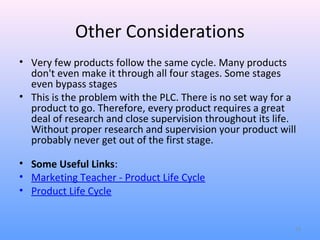
Other Considerations
• Very few products follow the same cycle. Many products
  don't even make it through all four stages. Some stages
  even bypass stages
• This is the problem with the PLC. There is no set way for a
  product to go. Therefore, every product requires a great
  deal of research and close supervision throughout its life.
  Without proper research and supervision your product will
  probably never get out of the first stage.

• Some Useful Links:
• Marketing Teacher - Product Life Cycle
• Product Life Cycle


                                                            13
14
Conclusion
• Discussed the Product Lifecycle
• Discussed each stage of the PLC
• Drew a line of Profit


                                    15
16

Product life cycle

  • 1.
    Product Life cycle Level 3 PRESENTED BY: NAVNEET JINGAR 1
  • 2.
    Aims • Discuss theProduct Lifecycle • Discuss each stage of the PLC • Finally be able to draw a line of profit 2
  • 3.
    Product Lifecycle • Thestages that a product goes through during its life: introduction, growth, maturity, and decline. 3
  • 4.
    Product Lifecycle • Thelife cycle concept may apply to a brand or to a category of a product. • Its duration maybe as short as a few months or years, depending on the product. • As a product progresses through the stages, changes are made to how the product is marketed. 4
  • 5.
    Introduction Stage • Mostproducts fail at this stage? – Why? • This is the stage in which the product is initially promoted. Public awareness is very important to the success of a product. If people don't know about the product they won't go out and buy it. 5
  • 6.
    Introduction Stage • Thereare two different strategies you can use to introduce your product to consumers: – Penetration – Skimming 6
  • 7.
    Introduction Stage • Penetration – This strategy usually set the product price very high initially and then gradually lowers it over time. – This is a good strategy to use if there are few competitors for your product. – Profits are high with this strategy but there is also a great deal of risk. If people don't want to pay high prices you may lose out. 7
  • 8.
    Introduction Stage • Skimming – In this case you set your prices very low at the beginning and then gradually increase them. – This is a good strategy to use if there are a lot of competitors who control a large portion of the market. – Profits are not a concern under this strategy. The most important thing is to get you product known and worry about making money at a later time. 8
  • 9.
    Growth • The Growthstage is where your product starts to grow. In this stage a very large amount of money is spent on advertising. You want to concentrate of telling the consumer how much better your product is than your competitors' products. • What are the ways in which you could prompt a product? 9
  • 10.
    Growth • If youare successful with your advertising strategy then you will see an increase in sales. Once your sales begin to increase your share of the market will stabilise. 10
  • 11.
    Maturity • The thirdstage in the Product Life Cycle is the maturity stage. If your product completes the Introduction and Growth stages then it will then spend a great deal of time in the Maturity stage. • During this stage sales grow at a very fast rate and then gradually begin to stabilise. 11
  • 12.
    Decline • This isthe stage in which sales of your product begin to fall. Either everyone that wants to has bought your product or new, more innovative products have been created that replace yours. • Many companies decide to withdrawal their products from the market due to the downturn. The only way to increase sales during this period is to cut your costs reduce your spending. 12
  • 13.
    Other Considerations • Veryfew products follow the same cycle. Many products don't even make it through all four stages. Some stages even bypass stages • This is the problem with the PLC. There is no set way for a product to go. Therefore, every product requires a great deal of research and close supervision throughout its life. Without proper research and supervision your product will probably never get out of the first stage. • Some Useful Links: • Marketing Teacher - Product Life Cycle • Product Life Cycle 13
  • 14.
  • 15.
    Conclusion • Discussed theProduct Lifecycle • Discussed each stage of the PLC • Drew a line of Profit 15
  • 16.