Business Process
Mapping
Usama Patel – 22M002
Content
 What is Business Process Mapping?
 Why is it required?
 Types of Business Process Maps
 Advantages of Business Process Mapping
 Disadvantages of Business Process Mapping
What is Business Process Mapping?
 Business Process Mapping is a framework used to create visual representations of
business processes. Business process maps reveal the relationship between
operational steps and inputs to produce an end-product or service.
 The main purpose of business process mapping is to promote transparency and
allow organizations to improve upon their current practices by creating a clear,
detailed visual representation of workflows.
 These documents are focused on what a business does, why it operates in that
way, what the standard is for success, who is responsible, and when and where
different steps will occur.
Why is it Required?
 Document the business process, which could include the operations/activities,
inputs, outputs and roles involved in the business process.
 Provide an “official reference” on the business process and a common
understanding of what is involved.
 Facilitate the analysis of current process (As-Is) and redesign of improved
process (To-Be).
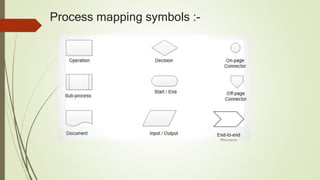
Process mapping symbols :-
Types of Business Process Maps
 Process can be modelled at different levels, from the high strategic level to the
operational / tactical level.
 Variety of process maps :-
1. SIPOC Map
2. Deployment Map
3. Swimlane Map
4. Value Stream Map
5. Business Process Model and Notation (BPMN)
1. SIPOC Map :-
• SIPOC, which is an abbreviation for
suppliers, inputs, processes, outputs
and customers, diagrams display
essential information for a task.
• Each word in the SIPOC abbreviation
is the subject of its own row, so, for
example, supplier information would
go under the supplier column.
2. Deployment Map :-
• These types of process maps are
used for the stakeholders. It gives
information on how the process
works.
• Stakeholders are neither interested
nor do they have any requirement to
know the detailed process steps;
however, the major process steps
would be covered in these maps.
• These maps would do not need to
contain the whole process
knowledge; therefore, it can be
prepared with the help of process
manager.
3. Swimlane Map :-
• The swimlane maps are those maps,
which have detailed info of the
process, it is the micro level process
maps.
• It gives the whole process steps at
once if a new processor can
understand how to do the task at
once.
• To see the whole process at once
take more time. And understand the
process is also a bit difficult, only the
expertise could understand.
4. Value Stream Map :-
• Value Stream Map is used to
understand what is valuable to the
process and what is non-value
added.
• The Value Stream has all the actions
which bring the main flows and give
the service to the customers.
• Greater amount of skill is required for
making the VSM, however, it consists
of excessive info.
5. Business Process Model and Notation (BPMN) :-
• An approach that goes into further detail is called a
Business Process Model and Notation, or BPMN.
• This is a notation that helps to standardize business
processes and establish a common language within
visual process maps, such as flowcharts.
• Since it is a common language, or notation, it can be
understood and used to more effectively.
Advantages Of Process Mapping
1. A process map captures your processes in an easy to understand and easy to
follow format. This gives you a blue print for how the process is done.
2. Capturing your processes captures knowledge that would otherwise be lost when
employees move on from your organisation.
3. With your processes documented, it becomes much easier to agree and adopt
consistent best practice.
4. process mapping captures what is actually happening; who is involved, where
information, data, materials are flowing and most importantly the handover points
between processes, departments and supply chains.
5. Process maps are also a great resource for induction and training. What a perfect
way to communicate best practice through an approved process map and support
new starters.
Disadvantages Of Process Mapping:-
• Not defining the start and end of the process clearly
• Confusing the use of operation block and decision block
• Poor discipline in using a consistent convention
• Criss-cross of process flow arrows leading to confusion
• Mapping without involving the right stakeholders
Conclusion :-
• Process mapping is an essential tool to understand the current
state of the process (As-Is) and to design the future state of the
process (To-Be).
• Disciplined use of process mapping will facilitate the identification
and resolution of process issues.

businessprocessmapping-220925095128-430e9953.pptx

  • 1.
  • 2.
    Content  What isBusiness Process Mapping?  Why is it required?  Types of Business Process Maps  Advantages of Business Process Mapping  Disadvantages of Business Process Mapping
  • 3.
    What is BusinessProcess Mapping?  Business Process Mapping is a framework used to create visual representations of business processes. Business process maps reveal the relationship between operational steps and inputs to produce an end-product or service.  The main purpose of business process mapping is to promote transparency and allow organizations to improve upon their current practices by creating a clear, detailed visual representation of workflows.  These documents are focused on what a business does, why it operates in that way, what the standard is for success, who is responsible, and when and where different steps will occur.
  • 4.
    Why is itRequired?  Document the business process, which could include the operations/activities, inputs, outputs and roles involved in the business process.  Provide an “official reference” on the business process and a common understanding of what is involved.  Facilitate the analysis of current process (As-Is) and redesign of improved process (To-Be).
  • 5.
  • 6.
    Types of BusinessProcess Maps  Process can be modelled at different levels, from the high strategic level to the operational / tactical level.  Variety of process maps :- 1. SIPOC Map 2. Deployment Map 3. Swimlane Map 4. Value Stream Map 5. Business Process Model and Notation (BPMN)
  • 7.
    1. SIPOC Map:- • SIPOC, which is an abbreviation for suppliers, inputs, processes, outputs and customers, diagrams display essential information for a task. • Each word in the SIPOC abbreviation is the subject of its own row, so, for example, supplier information would go under the supplier column. 2. Deployment Map :- • These types of process maps are used for the stakeholders. It gives information on how the process works. • Stakeholders are neither interested nor do they have any requirement to know the detailed process steps; however, the major process steps would be covered in these maps. • These maps would do not need to contain the whole process knowledge; therefore, it can be prepared with the help of process manager.
  • 8.
    3. Swimlane Map:- • The swimlane maps are those maps, which have detailed info of the process, it is the micro level process maps. • It gives the whole process steps at once if a new processor can understand how to do the task at once. • To see the whole process at once take more time. And understand the process is also a bit difficult, only the expertise could understand. 4. Value Stream Map :- • Value Stream Map is used to understand what is valuable to the process and what is non-value added. • The Value Stream has all the actions which bring the main flows and give the service to the customers. • Greater amount of skill is required for making the VSM, however, it consists of excessive info.
  • 9.
    5. Business ProcessModel and Notation (BPMN) :- • An approach that goes into further detail is called a Business Process Model and Notation, or BPMN. • This is a notation that helps to standardize business processes and establish a common language within visual process maps, such as flowcharts. • Since it is a common language, or notation, it can be understood and used to more effectively.
  • 10.
    Advantages Of ProcessMapping 1. A process map captures your processes in an easy to understand and easy to follow format. This gives you a blue print for how the process is done. 2. Capturing your processes captures knowledge that would otherwise be lost when employees move on from your organisation. 3. With your processes documented, it becomes much easier to agree and adopt consistent best practice. 4. process mapping captures what is actually happening; who is involved, where information, data, materials are flowing and most importantly the handover points between processes, departments and supply chains. 5. Process maps are also a great resource for induction and training. What a perfect way to communicate best practice through an approved process map and support new starters.
  • 11.
    Disadvantages Of ProcessMapping:- • Not defining the start and end of the process clearly • Confusing the use of operation block and decision block • Poor discipline in using a consistent convention • Criss-cross of process flow arrows leading to confusion • Mapping without involving the right stakeholders
  • 12.
    Conclusion :- • Processmapping is an essential tool to understand the current state of the process (As-Is) and to design the future state of the process (To-Be). • Disciplined use of process mapping will facilitate the identification and resolution of process issues.