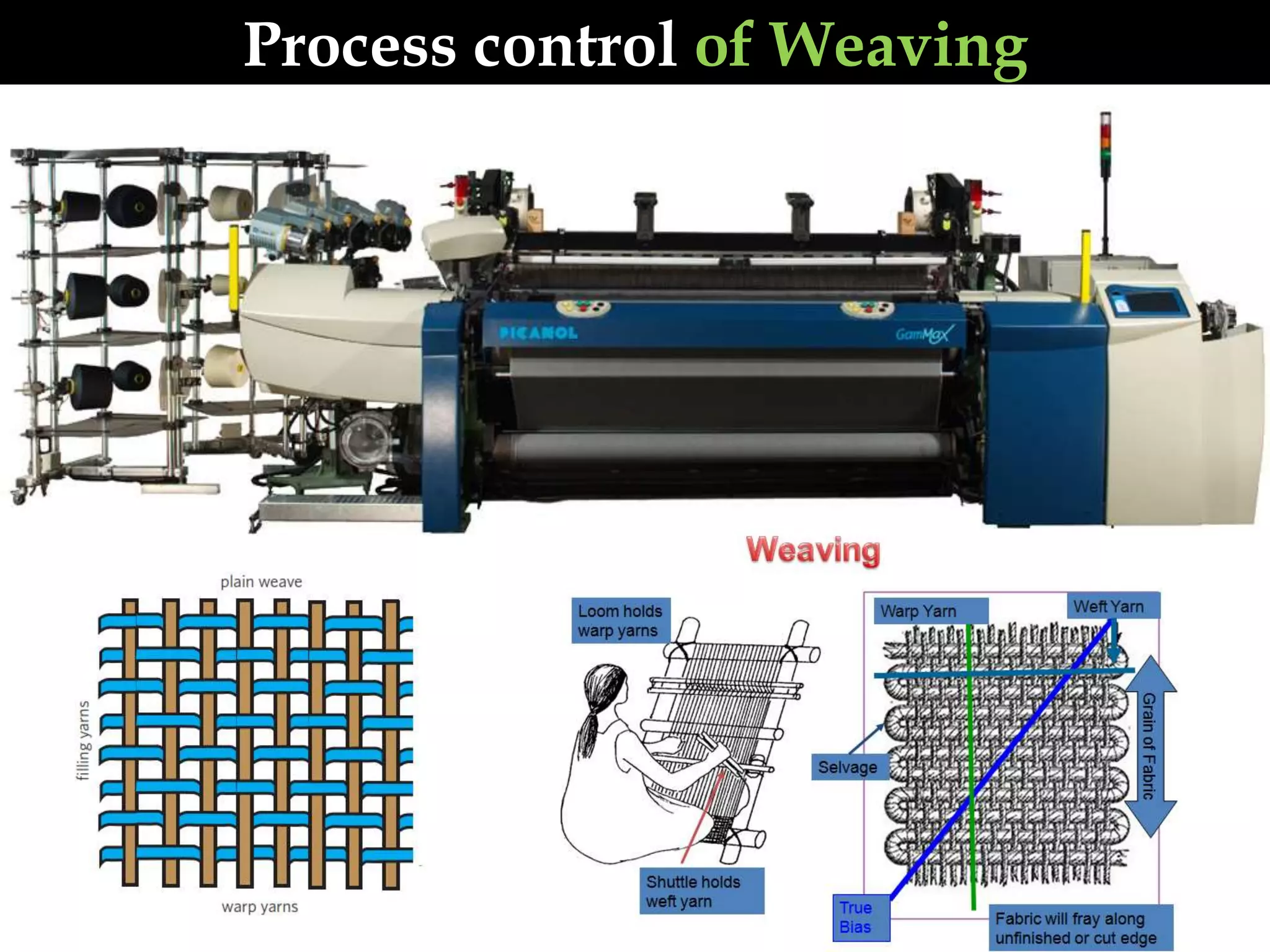
Process control of Weaving
Introduction : Process control is defined as a statistical & engineering tools or
discipline that deals with architecture ( structure ) , mechanism and algorithm
(sequence of finite instruction ) for controlling the output of a specific production
process . Quality is formed during production process . So, if a production process
is not controlled, the target production quality or reference parameter may not
achieved
INTRODUCTION
Process control is performed by six steps :
1. Step-1: Draw process flow chart showing real change in products geometry
2. Step-2 : Segregate or highlight the part of the flow chart where any change is
taking place
3. Step-3 : Find the set points or control points value at each step
4. Step-4 : Determine which output variables have gone out of the range of
standard / reference values beyond tolerance
5. Step- 5 : Identify cause which is responsible
6. Step-6 : Make recommendation as what to do
PROCESS CONTROL
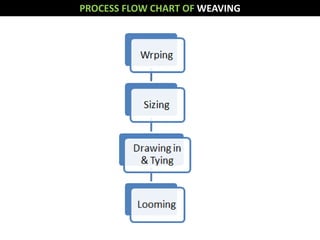
PROCESS FLOW CHART OF WEAVING
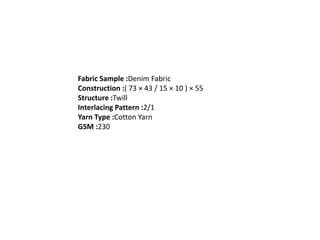
Fabric Sample :Denim Fabric
Construction :( 73 × 43 / 15 × 10 ) × 55
Structure :Twill
Interlacing Pattern :2/1
Yarn Type :Cotton Yarn
GSM :230
Process Control of Warping Section
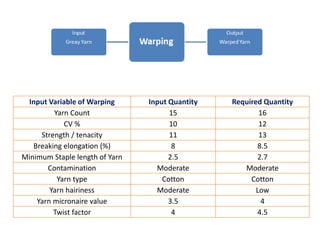
Input Variable of Warping Input Quantity Required Quantity
Yarn Count 15 16
CV % 10 12
Strength / tenacity 11 13
Breaking elongation (%) 8 8.5
Minimum Staple length of Yarn 2.5 2.7
Contamination Moderate Moderate
Yarn type Cotton Cotton
Yarn hairiness Moderate Low
Yarn micronaire value 3.5 4
Twist factor 4 4.5
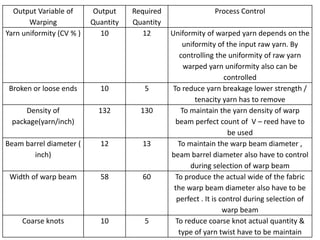
Output Variable of
Warping
Output
Quantity
Required
Quantity
Process Control
Yarn uniformity (CV % ) 10 12 Uniformity of warped yarn depends on the
uniformity of the input raw yarn. By
controlling the uniformity of raw yarn
warped yarn uniformity also can be
controlled
Broken or loose ends 10 5 To reduce yarn breakage lower strength /
tenacity yarn has to remove
Density of
package(yarn/inch)
132 130 To maintain the yarn density of warp
beam perfect count of V – reed have to
be used
Beam barrel diameter (
inch)
12 13 To maintain the warp beam diameter ,
beam barrel diameter also have to control
during selection of warp beam
Width of warp beam 58 60 To produce the actual wide of the fabric
the warp beam diameter also have to be
perfect . It is control during selection of
warp beam
Coarse knots 10 5 To reduce coarse knot actual quantity &
type of yarn twist have to be maintain
Process Control of Sizing Section
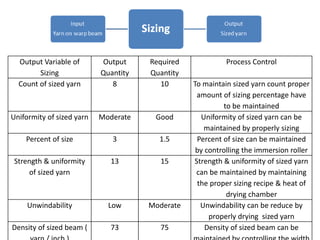
Output Variable of
Sizing
Output
Quantity
Required
Quantity
Process Control
Count of sized yarn 8 10 To maintain sized yarn count proper
amount of sizing percentage have
to be maintained
Uniformity of sized yarn Moderate Good Uniformity of sized yarn can be
maintained by properly sizing
Percent of size 3 1.5 Percent of size can be maintained
by controlling the immersion roller
Strength & uniformity
of sized yarn
13 15 Strength & uniformity of sized yarn
can be maintained by maintaining
the proper sizing recipe & heat of
drying chamber
Unwindability Low Moderate Unwindability can be reduce by
properly drying sized yarn
Density of sized beam ( 73 75 Density of sized beam can be
Process Control of Drawing-in & trying Section
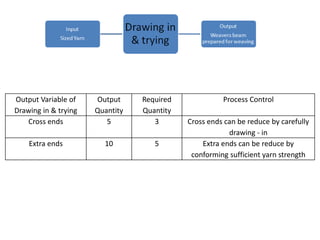
Output Variable of
Drawing in & trying
Output
Quantity
Required
Quantity
Process Control
Cross ends 5 3 Cross ends can be reduce by carefully
drawing - in
Extra ends 10 5 Extra ends can be reduce by
conforming sufficient yarn strength
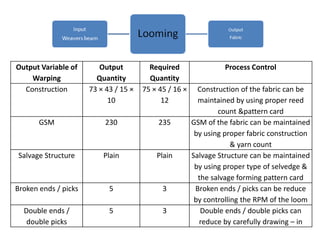
Process Control of Looming Section
Output Variable of
Warping
Output
Quantity
Required
Quantity
Process Control
Construction 73 × 43 / 15 ×
10
75 × 45 / 16 ×
12
Construction of the fabric can be
maintained by using proper reed
count &pattern card
GSM 230 235 GSM of the fabric can be maintained
by using proper fabric construction
& yarn count
Salvage Structure Plain Plain Salvage Structure can be maintained
by using proper type of selvedge &
the salvage forming pattern card
Broken ends / picks 5 3 Broken ends / picks can be reduce
by controlling the RPM of the loom
Double ends /
double picks
5 3 Double ends / double picks can
reduce by carefully drawing – in
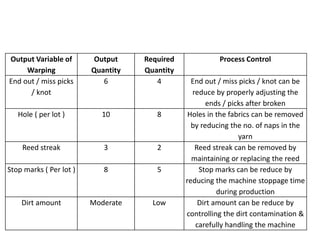
Output Variable of
Warping
Output
Quantity
Required
Quantity
Process Control
End out / miss picks
/ knot
6 4 End out / miss picks / knot can be
reduce by properly adjusting the
ends / picks after broken
Hole ( per lot ) 10 8 Holes in the fabrics can be removed
by reducing the no. of naps in the
yarn
Reed streak 3 2 Reed streak can be removed by
maintaining or replacing the reed
Stop marks ( Per lot ) 8 5 Stop marks can be reduce by
reducing the machine stoppage time
during production
Dirt amount Moderate Low Dirt amount can be reduce by
controlling the dirt contamination &
carefully handling the machine
Conclusion:
By this experiment we have learn about process quality control of
weaving section. Which has increased our practical knowledge about process
quality control. It will be helpful for our future practical knowledge.
CONCLUSION:

Process control of weaving

  • 1.
  • 2.
    Introduction : Processcontrol is defined as a statistical & engineering tools or discipline that deals with architecture ( structure ) , mechanism and algorithm (sequence of finite instruction ) for controlling the output of a specific production process . Quality is formed during production process . So, if a production process is not controlled, the target production quality or reference parameter may not achieved INTRODUCTION
  • 3.
    Process control isperformed by six steps : 1. Step-1: Draw process flow chart showing real change in products geometry 2. Step-2 : Segregate or highlight the part of the flow chart where any change is taking place 3. Step-3 : Find the set points or control points value at each step 4. Step-4 : Determine which output variables have gone out of the range of standard / reference values beyond tolerance 5. Step- 5 : Identify cause which is responsible 6. Step-6 : Make recommendation as what to do PROCESS CONTROL
  • 4.
  • 5.
    Fabric Sample :DenimFabric Construction :( 73 × 43 / 15 × 10 ) × 55 Structure :Twill Interlacing Pattern :2/1 Yarn Type :Cotton Yarn GSM :230
  • 6.
    Process Control ofWarping Section
  • 7.
    Input Variable ofWarping Input Quantity Required Quantity Yarn Count 15 16 CV % 10 12 Strength / tenacity 11 13 Breaking elongation (%) 8 8.5 Minimum Staple length of Yarn 2.5 2.7 Contamination Moderate Moderate Yarn type Cotton Cotton Yarn hairiness Moderate Low Yarn micronaire value 3.5 4 Twist factor 4 4.5
  • 8.
    Output Variable of Warping Output Quantity Required Quantity ProcessControl Yarn uniformity (CV % ) 10 12 Uniformity of warped yarn depends on the uniformity of the input raw yarn. By controlling the uniformity of raw yarn warped yarn uniformity also can be controlled Broken or loose ends 10 5 To reduce yarn breakage lower strength / tenacity yarn has to remove Density of package(yarn/inch) 132 130 To maintain the yarn density of warp beam perfect count of V – reed have to be used Beam barrel diameter ( inch) 12 13 To maintain the warp beam diameter , beam barrel diameter also have to control during selection of warp beam Width of warp beam 58 60 To produce the actual wide of the fabric the warp beam diameter also have to be perfect . It is control during selection of warp beam Coarse knots 10 5 To reduce coarse knot actual quantity & type of yarn twist have to be maintain
  • 9.
    Process Control ofSizing Section
  • 10.
    Output Variable of Sizing Output Quantity Required Quantity ProcessControl Count of sized yarn 8 10 To maintain sized yarn count proper amount of sizing percentage have to be maintained Uniformity of sized yarn Moderate Good Uniformity of sized yarn can be maintained by properly sizing Percent of size 3 1.5 Percent of size can be maintained by controlling the immersion roller Strength & uniformity of sized yarn 13 15 Strength & uniformity of sized yarn can be maintained by maintaining the proper sizing recipe & heat of drying chamber Unwindability Low Moderate Unwindability can be reduce by properly drying sized yarn Density of sized beam ( 73 75 Density of sized beam can be
  • 11.
    Process Control ofDrawing-in & trying Section
  • 12.
    Output Variable of Drawingin & trying Output Quantity Required Quantity Process Control Cross ends 5 3 Cross ends can be reduce by carefully drawing - in Extra ends 10 5 Extra ends can be reduce by conforming sufficient yarn strength
  • 13.
    Process Control ofLooming Section
  • 14.
    Output Variable of Warping Output Quantity Required Quantity ProcessControl Construction 73 × 43 / 15 × 10 75 × 45 / 16 × 12 Construction of the fabric can be maintained by using proper reed count &pattern card GSM 230 235 GSM of the fabric can be maintained by using proper fabric construction & yarn count Salvage Structure Plain Plain Salvage Structure can be maintained by using proper type of selvedge & the salvage forming pattern card Broken ends / picks 5 3 Broken ends / picks can be reduce by controlling the RPM of the loom Double ends / double picks 5 3 Double ends / double picks can reduce by carefully drawing – in
  • 15.
    Output Variable of Warping Output Quantity Required Quantity ProcessControl End out / miss picks / knot 6 4 End out / miss picks / knot can be reduce by properly adjusting the ends / picks after broken Hole ( per lot ) 10 8 Holes in the fabrics can be removed by reducing the no. of naps in the yarn Reed streak 3 2 Reed streak can be removed by maintaining or replacing the reed Stop marks ( Per lot ) 8 5 Stop marks can be reduce by reducing the machine stoppage time during production Dirt amount Moderate Low Dirt amount can be reduce by controlling the dirt contamination & carefully handling the machine
  • 16.
    Conclusion: By this experimentwe have learn about process quality control of weaving section. Which has increased our practical knowledge about process quality control. It will be helpful for our future practical knowledge. CONCLUSION: