warping
MD MAHBUBAY RABBANI MIM
DHAKA UNIVERSITY OF ENGINEERING AND
TECHNOLOGY(DUET),GAZIPUR
Contact number:-01767281858
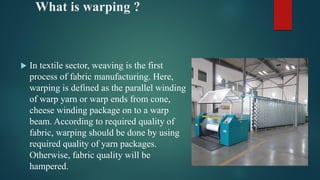
What is warping ?
 In textile sector, weaving is the first
process of fabric manufacturing. Here,
warping is defined as the parallel winding
of warp yarn or warp ends from cone,
cheese winding package on to a warp
beam. According to required quality of
fabric, warping should be done by using
required quality of yarn packages.
Otherwise, fabric quality will be
hampered.
Requirement of warping
 The individual ends of the sheet should be spaced uniformly across
its full width.
 All the ends in the sheet should be wound at almost uniform tension.
 The density of wound yarn beam should be uniform across the width
and from start to end of winding the sheet.
 The yarn breakage during warping should be as minimum as
possible.
Requirement of warping
 Density of the beam should be controlled not by increase yarn tension
but by adjusting the pressure roller on the beam in case of spindle
driven beam.
 The production rate of warping should be as high as possible.
 A predetermined warping length should be observed.
Types of warping:
1. High speed/ beam/ direct warping (preparatory
beam warping).
2. Sectional or pattern warping (conical drum or
dresser warping).
3. Ball/cross warping.
Direct warping
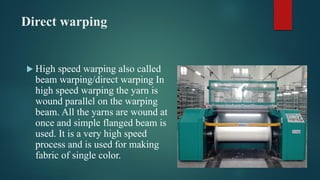
 High speed warping also called
beam warping/direct warping In
high speed warping the yarn is
wound parallel on the warping
beam. All the yarns are wound at
once and simple flanged beam is
used. It is a very high speed
process and is used for making
fabric of single color.
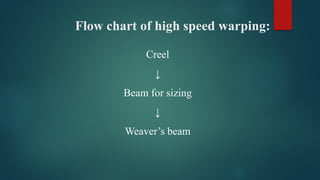
Flow chart of high speed warping:
Creel
↓
Beam for sizing
↓
Weaver’s beam
Features of high speed warping
1. It is used to make common fabrics in large quantities
2. It is used to produce weavers beam from single yarn
3. The production is high
4. Large amount of yarn is required to produce a weavers beam
5. Sizing is done
6. Simple flanged beam is used and drums are not required
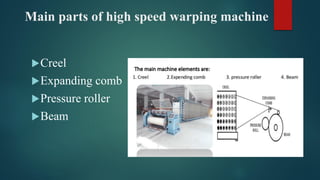
Main parts of high speed warping machine
Creel
Expanding comb
Pressure roller
Beam
• Creel: Creel is a part of direct warping machine which holds the
yarn packages. The creel capacity is about 600-800 in direct
warping.
• Expanding comb: Yarn pass through the expanding comb.
• Pressure Roller : It presses the warp beam with the surface contact
of driving drum.
• Beam: Beam is the machine parts where warp is wounded.
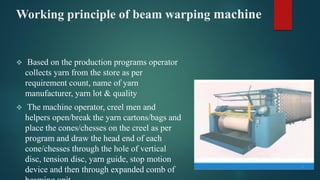
Working principle of beam warping machine
 Based on the production programs operator
collects yarn from the store as per
requirement count, name of yarn
manufacturer, yarn lot & quality
 The machine operator, creel men and
helpers open/break the yarn cartons/bags and
place the cones/chesses on the creel as per
program and draw the head end of each
cone/chesses through the hole of vertical
disc, tension disc, yarn guide, stop motion
device and then through expanded comb of
Merits & demerits of direct warping
Merits
 High production
 Less expensive
 Uniform tension of yarn
 Creel capacity is more.
 Beam speed is high
Merits & demerits of direct warping
Demerits
 Large amount of yarn required.
 Weavers beam is produced after sizing.
 Direct warping is not suitable to produced stripe effect.
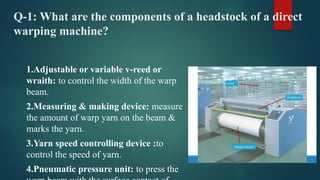
Q-1: What are the components of a headstock of a direct
warping machine?
1.Adjustable or variable v-reed or
wraith: to control the width of the warp
beam.
2.Measuring & making device: measure
the amount of warp yarn on the beam &
marks the yarn.
3.Yarn speed controlling device :to
control the speed of yarn.
4.Pneumatic pressure unit: to press the
5.Break assembly : It stop the machine instantly in case of yarn breakage.
6.Driving drum: beam is in contact & control with driving drum.
7.Stop motion: used to stop them after read length is wound on beam.
8.Beam bracket: to support & hold the beam.
9.Lease rod: used for separation of yarn individually.
Q-2:Why direct warping is not suitable to
produced stripe effect?
To produce stripe effect warp patterning is used. For creating stripe
effect, different types of colored yarn is needed. Warp patterning is not
possible in direct warping. For producing stripe effect sectional warping
must be needed.
That’s why direct warping is not suitable to produced stripe effect.
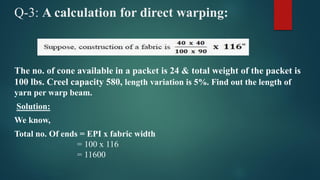
Q-3: A calculation for direct warping:
The no. of cone available in a packet is 24 & total weight of the packet is
100 lbs. Creel capacity 580, length variation is 5%. Find out the length of
yarn per warp beam.
Solution:
We know,
Total no. Of ends = EPI x fabric width
= 100 x 116
= 11600
A typical calculation for direct warping:
No. of warp beam = total no of ends /creel capacity
= 11600/580
= 20
Now 1 cone weight = total weight of the packet/ no. of cone in a packet
=100/24
= 4.16 lbs.
Now 1 cone length = warp count x cone wt. In lbs x 840
=40 x 4.16 x 840 yds.
= 40 x 4.16 x 840/1.0936 m
= 127812.73 m
A typical calculation for direct warping:
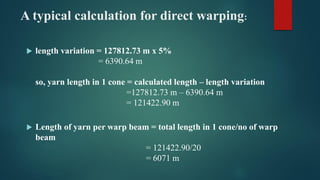
 length variation = 127812.73 m x 5%
= 6390.64 m
so, yarn length in 1 cone = calculated length – length variation
=127812.73 m – 6390.64 m
= 121422.90 m
 Length of yarn per warp beam = total length in 1 cone/no of warp
beam
= 121422.90/20
= 6071 m
Difference between direct & sectional
warping
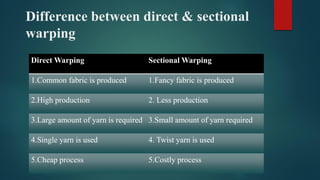
Direct Warping Sectional Warping
1.Common fabric is produced 1.Fancy fabric is produced
2.High production 2. Less production
3.Large amount of yarn is required 3.Small amount of yarn required
4.Single yarn is used 4. Twist yarn is used
5.Cheap process 5.Costly process
Faults of warping
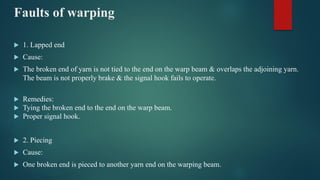
 1. Lapped end
 Cause:
 The broken end of yarn is not tied to the end on the warp beam & overlaps the adjoining yarn.
The beam is not properly brake & the signal hook fails to operate.
 Remedies:
 Tying the broken end to the end on the warp beam.
 Proper signal hook.
 2. Piecing
 Cause:
 One broken end is pieced to another yarn end on the warping beam.
Faults of warping
3.Soft ends on the warping beam
 Cause:
 Breakage of a group of ends & piecing them in bundle or by lapping. This defect is caused by the careless of the
operator.
 Remedies:
 Careful operation.
 Broken end should be piece up properly.
4.Broken ends on the beam
 Cause:
 A group of ends is broken & tied as a brunch or worked-in with overlapping.
 Remedies:
 Broken ends should be removed.
How to improve beam warping process?
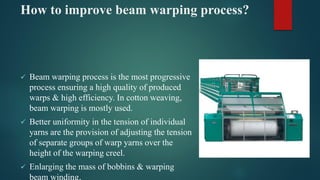
 Beam warping process is the most progressive
process ensuring a high quality of produced
warps & high efficiency. In cotton weaving,
beam warping is mostly used.
 Better uniformity in the tension of individual
yarns are the provision of adjusting the tension
of separate groups of warp yarns over the
height of the warping creel.
 Enlarging the mass of bobbins & warping
beam winding.
How to improve beam warping process?
 Increased number of bobbins when warping yarn of low linear
density & a greater number of yarns in the warp.
 Improved shape of winding on the warping beams &
uniformity of the specific density of winding.
 Higher accuracy in warp measuring & reduction of wastes
caused by irregular unwinding of warps from the beams at
sizing.
 Compensation of warp tension at starting & stopping of the
machine & slow running at starting a new warping beam.
 Increase of labor productivity in warping by partial or full
25
Thank You
Have you any question?

Warping and details

  • 1.
    warping MD MAHBUBAY RABBANIMIM DHAKA UNIVERSITY OF ENGINEERING AND TECHNOLOGY(DUET),GAZIPUR Contact number:-01767281858
  • 2.
    What is warping?  In textile sector, weaving is the first process of fabric manufacturing. Here, warping is defined as the parallel winding of warp yarn or warp ends from cone, cheese winding package on to a warp beam. According to required quality of fabric, warping should be done by using required quality of yarn packages. Otherwise, fabric quality will be hampered.
  • 3.
    Requirement of warping The individual ends of the sheet should be spaced uniformly across its full width.  All the ends in the sheet should be wound at almost uniform tension.  The density of wound yarn beam should be uniform across the width and from start to end of winding the sheet.  The yarn breakage during warping should be as minimum as possible.
  • 4.
    Requirement of warping Density of the beam should be controlled not by increase yarn tension but by adjusting the pressure roller on the beam in case of spindle driven beam.  The production rate of warping should be as high as possible.  A predetermined warping length should be observed.
  • 5.
    Types of warping: 1.High speed/ beam/ direct warping (preparatory beam warping). 2. Sectional or pattern warping (conical drum or dresser warping). 3. Ball/cross warping.
  • 6.
    Direct warping  Highspeed warping also called beam warping/direct warping In high speed warping the yarn is wound parallel on the warping beam. All the yarns are wound at once and simple flanged beam is used. It is a very high speed process and is used for making fabric of single color.
  • 7.
    Flow chart ofhigh speed warping: Creel ↓ Beam for sizing ↓ Weaver’s beam
  • 8.
    Features of highspeed warping 1. It is used to make common fabrics in large quantities 2. It is used to produce weavers beam from single yarn 3. The production is high 4. Large amount of yarn is required to produce a weavers beam 5. Sizing is done 6. Simple flanged beam is used and drums are not required
  • 9.
    Main parts ofhigh speed warping machine Creel Expanding comb Pressure roller Beam
  • 10.
    • Creel: Creelis a part of direct warping machine which holds the yarn packages. The creel capacity is about 600-800 in direct warping. • Expanding comb: Yarn pass through the expanding comb. • Pressure Roller : It presses the warp beam with the surface contact of driving drum. • Beam: Beam is the machine parts where warp is wounded.
  • 11.
    Working principle ofbeam warping machine  Based on the production programs operator collects yarn from the store as per requirement count, name of yarn manufacturer, yarn lot & quality  The machine operator, creel men and helpers open/break the yarn cartons/bags and place the cones/chesses on the creel as per program and draw the head end of each cone/chesses through the hole of vertical disc, tension disc, yarn guide, stop motion device and then through expanded comb of
  • 12.
    Merits & demeritsof direct warping Merits  High production  Less expensive  Uniform tension of yarn  Creel capacity is more.  Beam speed is high
  • 13.
    Merits & demeritsof direct warping Demerits  Large amount of yarn required.  Weavers beam is produced after sizing.  Direct warping is not suitable to produced stripe effect.
  • 14.
    Q-1: What arethe components of a headstock of a direct warping machine? 1.Adjustable or variable v-reed or wraith: to control the width of the warp beam. 2.Measuring & making device: measure the amount of warp yarn on the beam & marks the yarn. 3.Yarn speed controlling device :to control the speed of yarn. 4.Pneumatic pressure unit: to press the
  • 15.
    5.Break assembly :It stop the machine instantly in case of yarn breakage. 6.Driving drum: beam is in contact & control with driving drum. 7.Stop motion: used to stop them after read length is wound on beam. 8.Beam bracket: to support & hold the beam. 9.Lease rod: used for separation of yarn individually.
  • 16.
    Q-2:Why direct warpingis not suitable to produced stripe effect? To produce stripe effect warp patterning is used. For creating stripe effect, different types of colored yarn is needed. Warp patterning is not possible in direct warping. For producing stripe effect sectional warping must be needed. That’s why direct warping is not suitable to produced stripe effect.
  • 17.
    Q-3: A calculationfor direct warping: The no. of cone available in a packet is 24 & total weight of the packet is 100 lbs. Creel capacity 580, length variation is 5%. Find out the length of yarn per warp beam. Solution: We know, Total no. Of ends = EPI x fabric width = 100 x 116 = 11600
  • 18.
    A typical calculationfor direct warping: No. of warp beam = total no of ends /creel capacity = 11600/580 = 20 Now 1 cone weight = total weight of the packet/ no. of cone in a packet =100/24 = 4.16 lbs. Now 1 cone length = warp count x cone wt. In lbs x 840 =40 x 4.16 x 840 yds. = 40 x 4.16 x 840/1.0936 m = 127812.73 m
  • 19.
    A typical calculationfor direct warping:  length variation = 127812.73 m x 5% = 6390.64 m so, yarn length in 1 cone = calculated length – length variation =127812.73 m – 6390.64 m = 121422.90 m  Length of yarn per warp beam = total length in 1 cone/no of warp beam = 121422.90/20 = 6071 m
  • 20.
    Difference between direct& sectional warping Direct Warping Sectional Warping 1.Common fabric is produced 1.Fancy fabric is produced 2.High production 2. Less production 3.Large amount of yarn is required 3.Small amount of yarn required 4.Single yarn is used 4. Twist yarn is used 5.Cheap process 5.Costly process
  • 21.
    Faults of warping 1. Lapped end  Cause:  The broken end of yarn is not tied to the end on the warp beam & overlaps the adjoining yarn. The beam is not properly brake & the signal hook fails to operate.  Remedies:  Tying the broken end to the end on the warp beam.  Proper signal hook.  2. Piecing  Cause:  One broken end is pieced to another yarn end on the warping beam.
  • 22.
    Faults of warping 3.Softends on the warping beam  Cause:  Breakage of a group of ends & piecing them in bundle or by lapping. This defect is caused by the careless of the operator.  Remedies:  Careful operation.  Broken end should be piece up properly. 4.Broken ends on the beam  Cause:  A group of ends is broken & tied as a brunch or worked-in with overlapping.  Remedies:  Broken ends should be removed.
  • 23.
    How to improvebeam warping process?  Beam warping process is the most progressive process ensuring a high quality of produced warps & high efficiency. In cotton weaving, beam warping is mostly used.  Better uniformity in the tension of individual yarns are the provision of adjusting the tension of separate groups of warp yarns over the height of the warping creel.  Enlarging the mass of bobbins & warping beam winding.
  • 24.
    How to improvebeam warping process?  Increased number of bobbins when warping yarn of low linear density & a greater number of yarns in the warp.  Improved shape of winding on the warping beams & uniformity of the specific density of winding.  Higher accuracy in warp measuring & reduction of wastes caused by irregular unwinding of warps from the beams at sizing.  Compensation of warp tension at starting & stopping of the machine & slow running at starting a new warping beam.  Increase of labor productivity in warping by partial or full
  • 25.
    25 Thank You Have youany question?