Daffodil International
University
Name: S. M. Naeem Rahman
ID NO: 132-23-194
Department of Textile Engineering
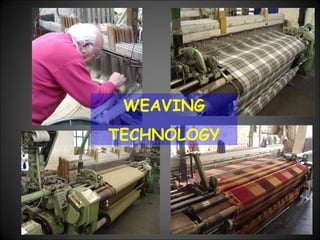
WEAVING
TECHNOLOGY
Weaving
The textile art in which two distinct sets of
yarns or threads, called the warp and the
filling or weft (older woof), are interlaced
with each other to form a fabric or cloth.
The warp threads run lengthways of the
piece of cloth, and the weft runs across
from side to side.
Yarn Preparation For Weaving Process
Weaving Principles
Basic Mechanism of Warp & Cloth Control
Weaving Structure
Woven Fabric Analysis
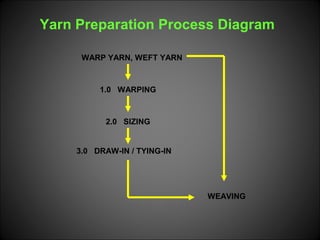
Yarn Preparation Process Diagram
WARP YARN, WEFT YARN
1.0 WARPING
2.0 SIZING
3.0 DRAW-IN / TYING-IN
WEAVING
1.0 WARPING
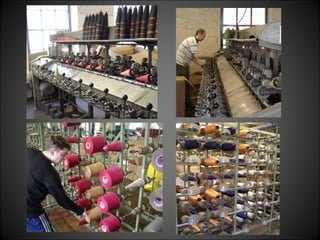
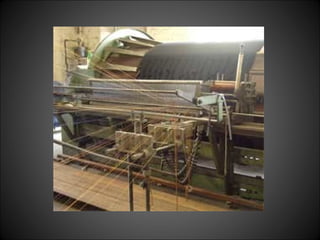
The warping process transfers the yarn from
multiple packages to a section beam.
To produce a quality beam suitable for weaving, the
following must be accomplished:
1) no lint, fly, wild yarn
2) no high or low selvage
3) maintain warper speed
4) maintain braking systems
5) no crossed or loose ends
6) uniform tension across beam
7) uniform tension beam to beam
8) smooth section beams, rollers
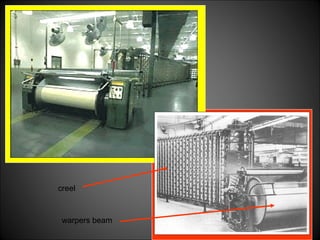
creel
warpers beam
• Application of sizing chemical to yarns
• The purposes of sizing process are :
1) To reduce the yarn hairiness that would interfere with the
weaving process.
2) To protect the yarn from various yarn-to-yarn and
yarn-to-loom abrasion.
3) To increase the strength of the yarn
2.0 SIZING
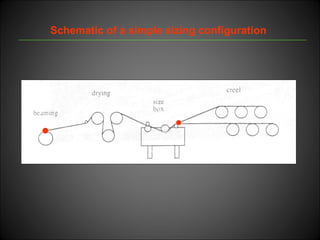
Schematic of a simple sizing configuration
• Entering of yarns from a new warp into the weaving elements of
a weaving machine (drop wires, healds, and reed) when staring
up a new fabric style.
Drop wires Healds Reed
3.0 DRAWING-IN
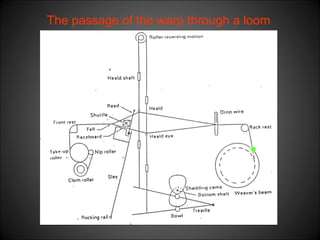
The passage of the warp through a loom
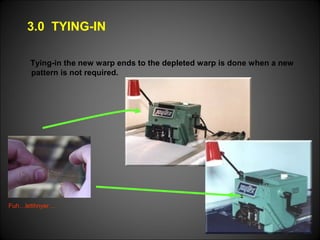
Tying-in the new warp ends to the depleted warp is done when a new
pattern is not required.
Fuh…letihnyer….
3.0 TYING-IN
Weaving Principles
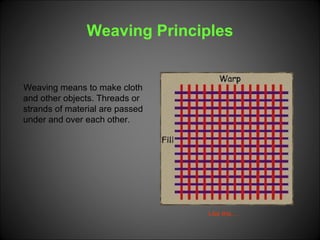
Weaving means to make cloth
and other objects. Threads or
strands of material are passed
under and over each other.
Like this…
In order to interlace warp and weft threads to produce fabric on any
type of weaving machine, three operations are necessary :
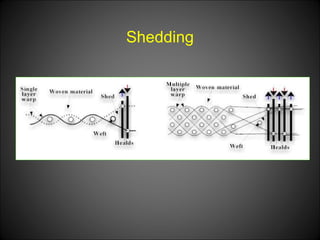
A) Shedding
Separating the warp threads, which run down the fabric into two
layers to form a tunnel known as the shed
B) Picking
Passing the weft thread, which traverses across the fabric, through
the shed
C) Beating-up
Pushing the newly inserted length of weft, known as the pick, into
the already woven fabric at a point known as the fell
Shedding
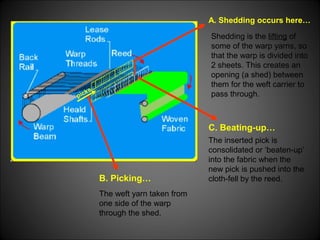
A. Shedding occurs here…
Shedding is the lifting of
some of the warp yarns, so
that the warp is divided into
2 sheets. This creates an
opening (a shed) between
them for the weft carrier to
pass through.
B. Picking…
The weft yarn taken from
one side of the warp
through the shed.
C. Beating-up…
The inserted pick is
consolidated or ‘beaten-up’
into the fabric when the
new pick is pushed into the
cloth-fell by the reed.
picks
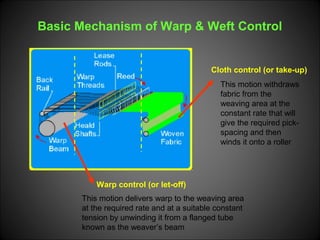
Warp control (or let-off)
This motion delivers warp to the weaving area
at the required rate and at a suitable constant
tension by unwinding it from a flanged tube
known as the weaver’s beam
Basic Mechanism of Warp & Weft Control
Cloth control (or take-up)
This motion withdraws
fabric from the
weaving area at the
constant rate that will
give the required pick-
spacing and then
winds it onto a roller
Auxiliary Functions :
• Temples – hold the cloth firm at the fell to assist in the formation of a uniform fabric
• A drop wire assembly, one wire for each warp yarn, to stop the loom when a warp
end is slack or broken
• A tension sensing and compensating whip roll assembly to maintain tension in the
warp sheet
• A mechanism to stop the loom when a filling yarn breaks
• Filling feeders to control tension on each pick
• Pick mixers to blend alternate picks from two or more packages (up to eight)
• Filling selection mechanism for feeding multi-type filling patterns
• Filling selvage devices such as trimmers, tuckers, holders and special weave
harnesses for selvage warp ends
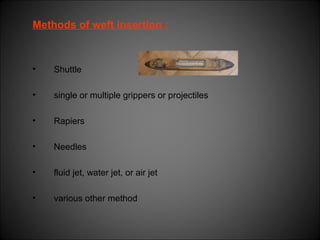
Methods of weft insertion :
• Shuttle
• single or multiple grippers or projectiles
• Rapiers
• Needles
• fluid jet, water jet, or air jet
• various other method
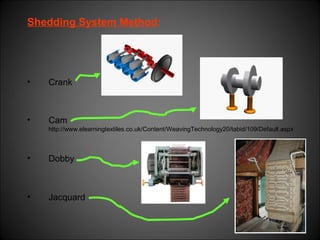
Shedding System Method:
• Crank
• Cam
http://www.elearningtextiles.co.uk/Content/WeavingTechnology20/tabid/109/Default.aspx
• Dobby
• Jacquard
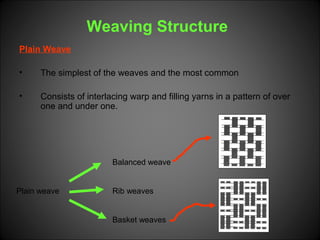
Weaving Structure
Plain Weave
• The simplest of the weaves and the most common
• Consists of interlacing warp and filling yarns in a pattern of over
one and under one.
Balanced weave
Plain weave Rib weaves
Basket weaves
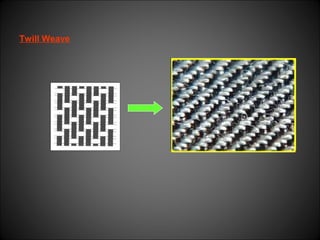
Twill Weave
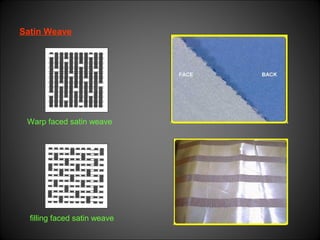
Satin Weave
Warp faced satin weave
filling faced satin weave
Woven Fabric Analysis
There are several analysis that can be done to the woven fabric.
Warp Density
Number of warp ends per unit length of fabric – spacing between warp threads.
Units: ends per cm (e.p.c) or ends per inch (e.p.i)
Weft Density
Number of picks per unit length of fabric – spacing between weft threads.
Unit: picks per cm (p.p.c) or picks per inch (p.p.i)
Count of cloth
The closeness or looseness of the weave.
Determined by the number of picks and ends (filling and warps) to the square inch.
Fabric Weight
Fabric weight is expressed in grams per square meter (W/m2
) or in grams per meter of
the fabric with full width (W/m)
% Crimp, %c = [(ly – lfab) / lfab] x 100
Crimp (waviness of yarns)
Fabric Take up
% Take up, %t = [(ly – lfab) / ly] x 100

Weaving ppt by aumi

  • 1.
    Daffodil International University Name: S.M. Naeem Rahman ID NO: 132-23-194 Department of Textile Engineering
  • 2.
  • 3.
    Weaving The textile artin which two distinct sets of yarns or threads, called the warp and the filling or weft (older woof), are interlaced with each other to form a fabric or cloth. The warp threads run lengthways of the piece of cloth, and the weft runs across from side to side.
  • 4.
    Yarn Preparation ForWeaving Process Weaving Principles Basic Mechanism of Warp & Cloth Control Weaving Structure Woven Fabric Analysis
  • 5.
    Yarn Preparation ProcessDiagram WARP YARN, WEFT YARN 1.0 WARPING 2.0 SIZING 3.0 DRAW-IN / TYING-IN WEAVING
  • 6.
    1.0 WARPING The warpingprocess transfers the yarn from multiple packages to a section beam. To produce a quality beam suitable for weaving, the following must be accomplished: 1) no lint, fly, wild yarn 2) no high or low selvage 3) maintain warper speed 4) maintain braking systems 5) no crossed or loose ends 6) uniform tension across beam 7) uniform tension beam to beam 8) smooth section beams, rollers
  • 7.
  • 10.
    • Application ofsizing chemical to yarns • The purposes of sizing process are : 1) To reduce the yarn hairiness that would interfere with the weaving process. 2) To protect the yarn from various yarn-to-yarn and yarn-to-loom abrasion. 3) To increase the strength of the yarn 2.0 SIZING
  • 11.
    Schematic of asimple sizing configuration
  • 12.
    • Entering ofyarns from a new warp into the weaving elements of a weaving machine (drop wires, healds, and reed) when staring up a new fabric style. Drop wires Healds Reed 3.0 DRAWING-IN
  • 13.
    The passage ofthe warp through a loom
  • 14.
    Tying-in the newwarp ends to the depleted warp is done when a new pattern is not required. Fuh…letihnyer…. 3.0 TYING-IN
  • 15.
    Weaving Principles Weaving meansto make cloth and other objects. Threads or strands of material are passed under and over each other. Like this…
  • 16.
    In order tointerlace warp and weft threads to produce fabric on any type of weaving machine, three operations are necessary : A) Shedding Separating the warp threads, which run down the fabric into two layers to form a tunnel known as the shed B) Picking Passing the weft thread, which traverses across the fabric, through the shed C) Beating-up Pushing the newly inserted length of weft, known as the pick, into the already woven fabric at a point known as the fell
  • 17.
  • 18.
    A. Shedding occurshere… Shedding is the lifting of some of the warp yarns, so that the warp is divided into 2 sheets. This creates an opening (a shed) between them for the weft carrier to pass through. B. Picking… The weft yarn taken from one side of the warp through the shed. C. Beating-up… The inserted pick is consolidated or ‘beaten-up’ into the fabric when the new pick is pushed into the cloth-fell by the reed. picks
  • 19.
    Warp control (orlet-off) This motion delivers warp to the weaving area at the required rate and at a suitable constant tension by unwinding it from a flanged tube known as the weaver’s beam Basic Mechanism of Warp & Weft Control Cloth control (or take-up) This motion withdraws fabric from the weaving area at the constant rate that will give the required pick- spacing and then winds it onto a roller
  • 20.
    Auxiliary Functions : •Temples – hold the cloth firm at the fell to assist in the formation of a uniform fabric • A drop wire assembly, one wire for each warp yarn, to stop the loom when a warp end is slack or broken • A tension sensing and compensating whip roll assembly to maintain tension in the warp sheet • A mechanism to stop the loom when a filling yarn breaks • Filling feeders to control tension on each pick • Pick mixers to blend alternate picks from two or more packages (up to eight) • Filling selection mechanism for feeding multi-type filling patterns • Filling selvage devices such as trimmers, tuckers, holders and special weave harnesses for selvage warp ends
  • 21.
    Methods of weftinsertion : • Shuttle • single or multiple grippers or projectiles • Rapiers • Needles • fluid jet, water jet, or air jet • various other method
  • 22.
    Shedding System Method: •Crank • Cam http://www.elearningtextiles.co.uk/Content/WeavingTechnology20/tabid/109/Default.aspx • Dobby • Jacquard
  • 23.
    Weaving Structure Plain Weave •The simplest of the weaves and the most common • Consists of interlacing warp and filling yarns in a pattern of over one and under one. Balanced weave Plain weave Rib weaves Basket weaves
  • 24.
  • 25.
    Satin Weave Warp facedsatin weave filling faced satin weave
  • 26.
    Woven Fabric Analysis Thereare several analysis that can be done to the woven fabric. Warp Density Number of warp ends per unit length of fabric – spacing between warp threads. Units: ends per cm (e.p.c) or ends per inch (e.p.i) Weft Density Number of picks per unit length of fabric – spacing between weft threads. Unit: picks per cm (p.p.c) or picks per inch (p.p.i) Count of cloth The closeness or looseness of the weave. Determined by the number of picks and ends (filling and warps) to the square inch. Fabric Weight Fabric weight is expressed in grams per square meter (W/m2 ) or in grams per meter of the fabric with full width (W/m)
  • 27.
    % Crimp, %c= [(ly – lfab) / lfab] x 100 Crimp (waviness of yarns) Fabric Take up % Take up, %t = [(ly – lfab) / ly] x 100