Weaving
From 0 To Product
Warping, Sizing ,Drawing In , Looming,
Calculation
s
Management
Working
Principal
Budget
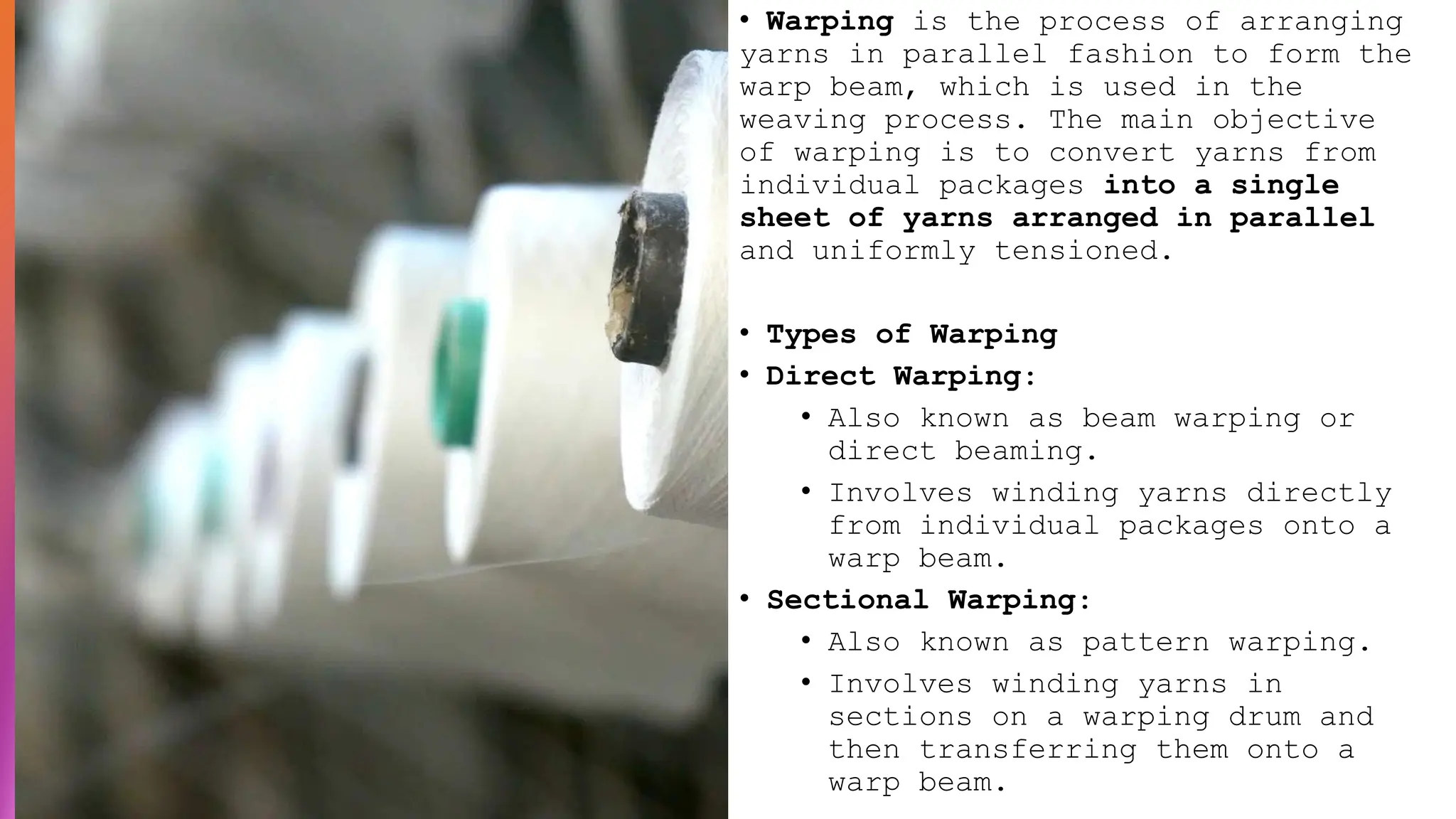
• Warping is the process of arranging
yarns in parallel fashion to form the
warp beam, which is used in the
weaving process. The main objective
of warping is to convert yarns from
individual packages into a single
sheet of yarns arranged in parallel
and uniformly tensioned.
• Types of Warping
• Direct Warping:
• Also known as beam warping or
direct beaming.
• Involves winding yarns directly
from individual packages onto a
warp beam.
• Sectional Warping:
• Also known as pattern warping.
• Involves winding yarns in
sections on a warping drum and
then transferring them onto a
warp beam.
• Calculations in Warping
• Yarn Count Calculation:
• The total length and weight of yarn
needed can be calculated based on the
yarn count and the warp density.
• Warp Density:
• The number of ends per unit width
(usually per inch or centimeter).
• Warp Length Calculation:
• Total Warp Length = (Fabric Length +
Loom Waste) * Number of Ends
• Beam Calculations:
• Determining the diameter and weight of
the warp beam based on the yarn count,
warp length, and density.
Working
Princip
le of
Warping
Alignment:
Yarns are
aligned in
parallel
fashion.
Management of
Warping
Process
Planning:
•Determine the
type of
warping
required based
on the fabric
design and
production
volume.
•Calculate the
necessary
quantities of
yarn and
allocate
resources
accordingly.
Monitorin
Budget
Considerations
in Warping
Initial
Investment:
•Cost of warping
machines (direct or
sectional warping
machines).
•Cost of additional
equipment (tension
devices, creels,
etc.).
Operational Costs:
•Cost of yarn.
•Labor costs.
•Maintenance and
repair costs of
warping machinery.
Efficiency and
Waste Management:
•Efficient use of
yarn to minimize
waste.
•Regular
maintenance to
prevent machine
downtime and
repair cost
• . Sizing
• Definition: Sizing is the process of applying a protective adhesive
coating to the warp yarns to strengthen them and reduce breakages
during weaving.
• Calculations
• Size Pick-Up Percentage: (Weight of sized yarn - Weight of unsized
yarn) / Weight of unsized yarn * 100
• Size Recipe: Amount of sizing agents needed based on yarn type and
• Management
• Recipe Management: Formulate and maintain
recipes for different yarn types.
• Process Monitoring: Ensure consistent
application of size to maintain yarn quality.
• Quality Control: Regularly check the
strength and flexibility of sized yarn.
• Working Principle
• Preparation: Mix sizing agents (starches,
resins, etc.) with water to create a size
bath.
• Application: Pass the warp yarns through the
size bath and then through drying cylinders to
remove excess moisture.
• Drying: Dry the yarns uniformly to ensure
even application of size.
• Budget
• Initial Investment: Sizing machine, drying
cylinders, and mixing equipment.
• Operational Costs: Sizing agents, water,
energy for drying, labor costs.
• Maintenance: Regular cleaning and
maintenance of sizing equipment to prevent
clogging and ensure efficiency.
• 2. Drawing-In
• Definition: Drawing-in
is the process of
threading warp yarns
through the various
parts of the loom
(heddles, reed, etc.) to
prepare for weaving.
• Calculations
• Ends per Dent: Number
of warp yarns per dent
in the reed.
• Total Ends: Number of
warp ends needed for the
width of the fabric.
• Drawing-In Time: Time
required to draw in a
specific number of warp
ends.
• .
• Management
• Plan: Develop a drawing-in
plan based on the fabric design.
• Training: Ensure workers are
skilled in the drawing-in
process to minimize errors.
• Inspection: Regularly inspect
the threading to prevent weaving
defects.
• Working Principle
• Preparation: Set up the loom
with the appropriate heddles and
reed.
• Threading: Pass each warp yarn
through the heddles and the reed
according to the drawing-in
plan.
• Verification: Check for
correct threading to ensure the
pattern and structure of the
fabric.
• Budget
• Initial Investment: Drawing-in
frame or machine.
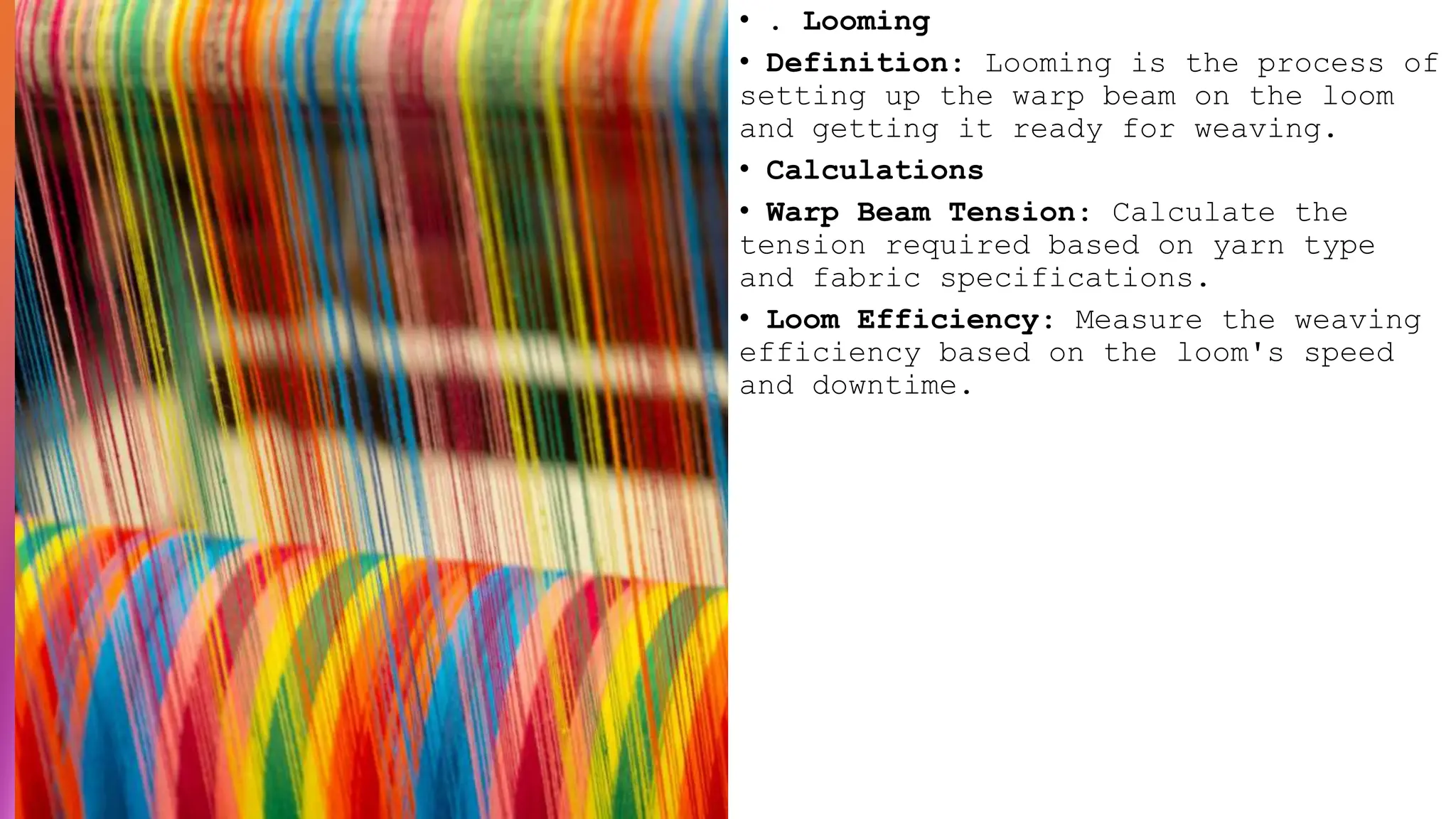
• . Looming
• Definition: Looming is the process of
setting up the warp beam on the loom
and getting it ready for weaving.
• Calculations
• Warp Beam Tension: Calculate the
tension required based on yarn type
and fabric specifications.
• Loom Efficiency: Measure the weaving
efficiency based on the loom's speed
and downtime.
• Management
• Setup: Efficiently set up the
warp beam and other loom
components to minimize downtime.
• Monitoring: Continuously monitor
the loom during operation to
detect and fix issues promptly.
• Maintenance: Regular maintenance
of the loom to ensure smooth
operation.
• Working Principle
• Mounting: Mount the warp beam
onto the loom.
• Tensioning: Apply the correct
tension to the warp yarns.
• Weaving Setup: Adjust the loom
settings (e.g., shuttle, heddles)
according to the fabric design.
• Budget
• Initial Investment: Purchase of
looms and auxiliary equipment.
• Operational Costs: Labor,
energy, and consumables (e.g.,
shuttle).
• Maintenance: Routine maintenance
and repairs of looms.
• . Folding
• Definition: Folding is the process
of folding the finished fabric in
preparation for storage or shipping.
• Calculations
• Fold Length: Determine the length of
each fold based on fabric width and
storage requirements.
• Fold Count: Calculate the number of
folds needed for a specific fabric
length.
• Management
• Efficiency: Streamline the folding
process to minimize handling time.
• Quality Control: Ensure uniform
folding to prevent creases and damage to
the fabric.
• Working Principle
• Manual or Automated: Fabric can be
folded manually or using automated
folding machines.
• Precision: Ensure precision in folding
to maintain fabric quality and
presentation.
• Budget
• Initial Investment: Folding tables or
folding machines.
• Operational Costs: Labor costs for
manual folding or maintenance for
automated machines.
• Storage: Costs associated with storage
materials (e.g., boxes, pallets).
• 5. Dispatch
• Definition: Dispatch involves the
final packaging and shipment of
finished fabric to customers or
retailers.
• Calculations
• Packaging: Calculate the amount of
packaging material needed based on
fabric volume and type.
• Shipping Costs: Estimate shipping
costs based on weight, distance, and
shipping method.
• Management
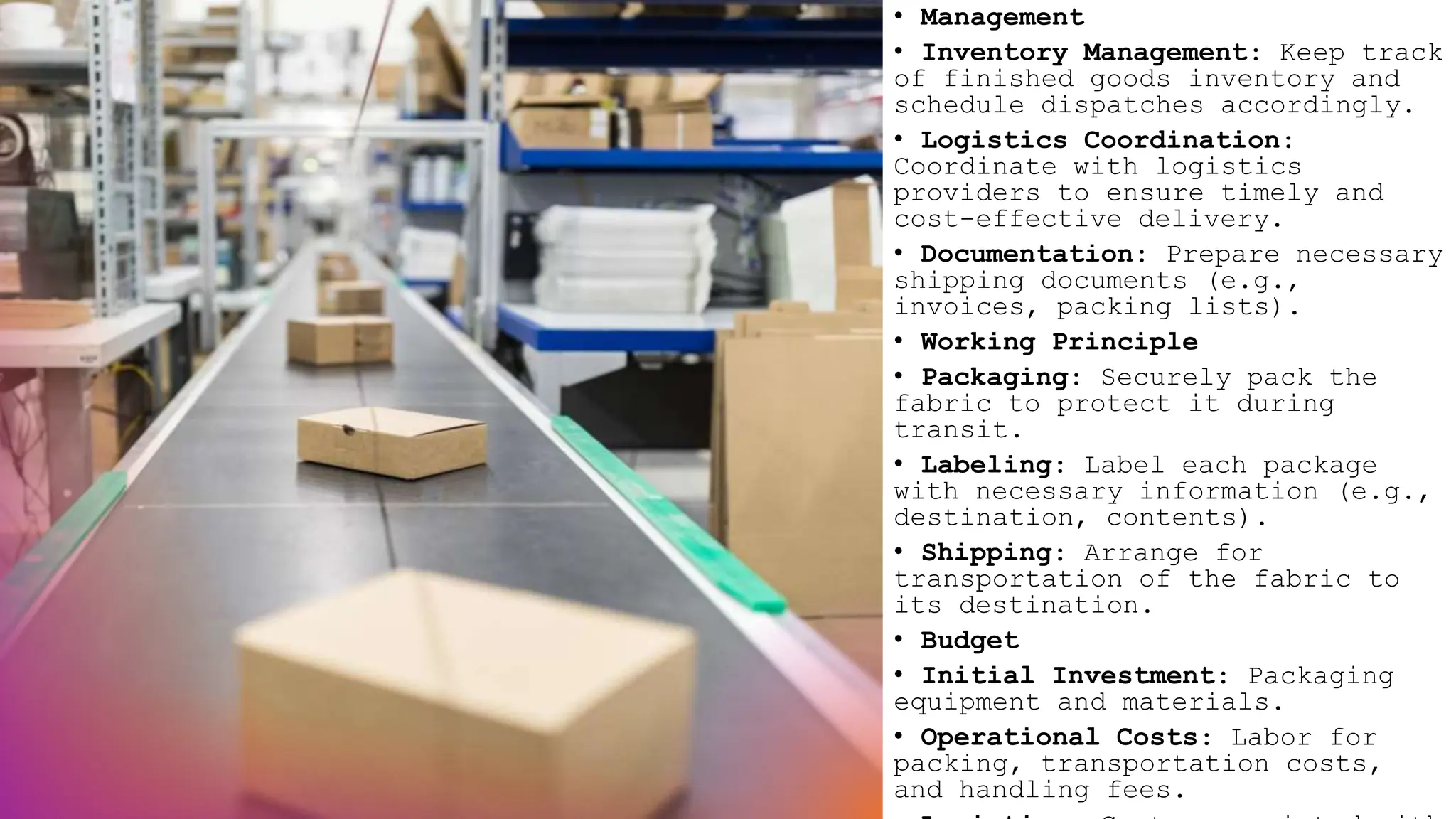
• Inventory Management: Keep track
of finished goods inventory and
schedule dispatches accordingly.
• Logistics Coordination:
Coordinate with logistics
providers to ensure timely and
cost-effective delivery.
• Documentation: Prepare necessary
shipping documents (e.g.,
invoices, packing lists).
• Working Principle
• Packaging: Securely pack the
fabric to protect it during
transit.
• Labeling: Label each package
with necessary information (e.g.,
destination, contents).
• Shipping: Arrange for
transportation of the fabric to
its destination.
• Budget
• Initial Investment: Packaging
equipment and materials.
• Operational Costs: Labor for
packing, transportation costs,
and handling fees.

Weaving (Textile) and its basic terms .pptx

  • 1.
    Weaving From 0 ToProduct Warping, Sizing ,Drawing In , Looming, Calculation s Management Working Principal Budget
  • 2.
    • Warping isthe process of arranging yarns in parallel fashion to form the warp beam, which is used in the weaving process. The main objective of warping is to convert yarns from individual packages into a single sheet of yarns arranged in parallel and uniformly tensioned. • Types of Warping • Direct Warping: • Also known as beam warping or direct beaming. • Involves winding yarns directly from individual packages onto a warp beam. • Sectional Warping: • Also known as pattern warping. • Involves winding yarns in sections on a warping drum and then transferring them onto a warp beam.
  • 3.
    • Calculations inWarping • Yarn Count Calculation: • The total length and weight of yarn needed can be calculated based on the yarn count and the warp density. • Warp Density: • The number of ends per unit width (usually per inch or centimeter). • Warp Length Calculation: • Total Warp Length = (Fabric Length + Loom Waste) * Number of Ends • Beam Calculations: • Determining the diameter and weight of the warp beam based on the yarn count, warp length, and density.
  • 4.
  • 5.
    Management of Warping Process Planning: •Determine the typeof warping required based on the fabric design and production volume. •Calculate the necessary quantities of yarn and allocate resources accordingly. Monitorin Budget Considerations in Warping Initial Investment: •Cost of warping machines (direct or sectional warping machines). •Cost of additional equipment (tension devices, creels, etc.). Operational Costs: •Cost of yarn. •Labor costs. •Maintenance and repair costs of warping machinery. Efficiency and Waste Management: •Efficient use of yarn to minimize waste. •Regular maintenance to prevent machine downtime and repair cost
  • 6.
    • . Sizing •Definition: Sizing is the process of applying a protective adhesive coating to the warp yarns to strengthen them and reduce breakages during weaving. • Calculations • Size Pick-Up Percentage: (Weight of sized yarn - Weight of unsized yarn) / Weight of unsized yarn * 100 • Size Recipe: Amount of sizing agents needed based on yarn type and
  • 7.
    • Management • RecipeManagement: Formulate and maintain recipes for different yarn types. • Process Monitoring: Ensure consistent application of size to maintain yarn quality. • Quality Control: Regularly check the strength and flexibility of sized yarn. • Working Principle • Preparation: Mix sizing agents (starches, resins, etc.) with water to create a size bath. • Application: Pass the warp yarns through the size bath and then through drying cylinders to remove excess moisture. • Drying: Dry the yarns uniformly to ensure even application of size. • Budget • Initial Investment: Sizing machine, drying cylinders, and mixing equipment. • Operational Costs: Sizing agents, water, energy for drying, labor costs. • Maintenance: Regular cleaning and maintenance of sizing equipment to prevent clogging and ensure efficiency.
  • 8.
    • 2. Drawing-In •Definition: Drawing-in is the process of threading warp yarns through the various parts of the loom (heddles, reed, etc.) to prepare for weaving. • Calculations • Ends per Dent: Number of warp yarns per dent in the reed. • Total Ends: Number of warp ends needed for the width of the fabric. • Drawing-In Time: Time required to draw in a specific number of warp ends. • .
  • 9.
    • Management • Plan:Develop a drawing-in plan based on the fabric design. • Training: Ensure workers are skilled in the drawing-in process to minimize errors. • Inspection: Regularly inspect the threading to prevent weaving defects. • Working Principle • Preparation: Set up the loom with the appropriate heddles and reed. • Threading: Pass each warp yarn through the heddles and the reed according to the drawing-in plan. • Verification: Check for correct threading to ensure the pattern and structure of the fabric. • Budget • Initial Investment: Drawing-in frame or machine.
  • 10.
    • . Looming •Definition: Looming is the process of setting up the warp beam on the loom and getting it ready for weaving. • Calculations • Warp Beam Tension: Calculate the tension required based on yarn type and fabric specifications. • Loom Efficiency: Measure the weaving efficiency based on the loom's speed and downtime.
  • 11.
    • Management • Setup:Efficiently set up the warp beam and other loom components to minimize downtime. • Monitoring: Continuously monitor the loom during operation to detect and fix issues promptly. • Maintenance: Regular maintenance of the loom to ensure smooth operation. • Working Principle • Mounting: Mount the warp beam onto the loom. • Tensioning: Apply the correct tension to the warp yarns. • Weaving Setup: Adjust the loom settings (e.g., shuttle, heddles) according to the fabric design. • Budget • Initial Investment: Purchase of looms and auxiliary equipment. • Operational Costs: Labor, energy, and consumables (e.g., shuttle). • Maintenance: Routine maintenance and repairs of looms.
  • 12.
    • . Folding •Definition: Folding is the process of folding the finished fabric in preparation for storage or shipping. • Calculations • Fold Length: Determine the length of each fold based on fabric width and storage requirements. • Fold Count: Calculate the number of folds needed for a specific fabric length.
  • 13.
    • Management • Efficiency:Streamline the folding process to minimize handling time. • Quality Control: Ensure uniform folding to prevent creases and damage to the fabric. • Working Principle • Manual or Automated: Fabric can be folded manually or using automated folding machines. • Precision: Ensure precision in folding to maintain fabric quality and presentation. • Budget • Initial Investment: Folding tables or folding machines. • Operational Costs: Labor costs for manual folding or maintenance for automated machines. • Storage: Costs associated with storage materials (e.g., boxes, pallets).
  • 14.
    • 5. Dispatch •Definition: Dispatch involves the final packaging and shipment of finished fabric to customers or retailers. • Calculations • Packaging: Calculate the amount of packaging material needed based on fabric volume and type. • Shipping Costs: Estimate shipping costs based on weight, distance, and shipping method.
  • 15.
    • Management • InventoryManagement: Keep track of finished goods inventory and schedule dispatches accordingly. • Logistics Coordination: Coordinate with logistics providers to ensure timely and cost-effective delivery. • Documentation: Prepare necessary shipping documents (e.g., invoices, packing lists). • Working Principle • Packaging: Securely pack the fabric to protect it during transit. • Labeling: Label each package with necessary information (e.g., destination, contents). • Shipping: Arrange for transportation of the fabric to its destination. • Budget • Initial Investment: Packaging equipment and materials. • Operational Costs: Labor for packing, transportation costs, and handling fees.