B A S I C C O U R S E
PRODUCTIVITY IN
WEAVING
Implementation partner
Germany
Implementation partner
Ethiopia
Introduction
 Productivity is the effectiveness of productive effort, especially in industry, as measured in
terms of the rate of output per unit of input.
 It is not only increasing the output, but also minimizing input and wastage.
 Productivity means more profit with less cost at the definite time.
 Everyone should play their own role in achieving better production rate.
 Among the textile process weaving is one of the main process and many factors affects its
productivity.
 Some general categories for these factors are product type, process/machine type, operators
skill/motivation, management, room condition, input material quality, maintenance,
Product type
• The type of weave design significantly affects the productivity of a loom.
Different weave designs have varied complexities and characteristics, which
influence factors such as speed, efficiency, and yarn consumption.
• Moreover, the number of picks or EPC have a significant effect on productivity.
• The heavier the fabric, the higher is the end breakage (heavy beat-up, lower
speed, high tension).
• As the design complexity increase the productivity decrease.
Product type
• Complexity of Weave Design
• Plain Weave:
Productivity: Very high productivity due to simple interlacing (over-and-under pattern) which
allows for faster weaving speeds.
- Productivity: Moderate productivity; more complex than plain weave but allows for
higher fabric strength and better drape.
-Use Case: Used for denim, gabardine, and khaki drill and require longer setup times
and adjustments.
• Satin Weave:
– Productivity: Lower productivity compared to plain and twill weaves; complex interlacing
pattern can slow down the weaving process.
– Use Case: Used for luxury fabrics like satin and silk, where more delicate handling is necessary.
Product type
• Warp andWeft Requirements
• Different weaves have varying requirements for warp and weft yarns, which influences how often
the loom can be operated:
– Higher Yarn Consumption: More complex weaves usually require a greater amount of
both warp and weft yarns, which can slow down production rates.
– Material Type: Using thicker or specialty yarns for certain designs may lead to slower
productivity due to handling and tension adjustments.
• Loom Settings and Adjustments
• Weave designs with higher complexity may require more frequent adjustments to the machine:
– Longer Setup Times: Different weave patterns may necessitate changes in settings, such as
tension and shedding mechanisms, which can reduce overall productivity.
Product type
• Fabric Quality and Defects
• More intricate weave designs may result in increased fabric defects (e.g., uneven tension
or flaws), requiring additional quality control measures:
• Batch Production and Orders
• The nature of the order can affect loom productivity:
– Short Runs: Complex designs are often inefficient for short production runs; looms
may operate slowly or be set up for long periods without generating sufficient fabric.
– Long Runs: For larger orders of a specific complex weave, the initial setup time
becomes a smaller fraction of total production time and may enhance overall
productivity.
Loom type
• The type of loom significantly impacts productivity, with shuttleless looms (air-jet, water-
jet, rapier) offering much higher speeds and efficiencies compared to traditional shuttle
looms.
• Shuttle Looms
Productivity: Lower productivity rates.
Characteristics:
• Uses a shuttle to carry the weft yarn.
• Slower operation due to stop-and-start weaving process.
• Requires more manual adjustments for shuttle changes.
Typical Speed: Generally around 200-400 meters per minute.
Loom type
* Rapier Looms
Productivity: Moderate to high.
Characteristics:
• Utilizes mechanical arms (rapiers) to transport the weft.
• Versatile for various fabric types, including heavier materials.
• Balances speed and complexity well.
*Typical Speed: Ranges from 500 to 1,200 meters per minute.
* Projectile Looms
Productivity: Moderate to high.
Characteristics:
• Uses a projectile mechanism to transport the weft.
• Good for medium to heavy fabrics.
• Offers a balance between speed and fabric complexity.
*Typical Speed:Approximately 600 to 1,200 meters per minute.
Loom type
* Air-Jet Looms
Productivity:Very high productivity rates.
Characteristics:
• Uses a jet of air to propel the weft yarn.
• High-speed operation with minimal downtime.
• Suitable for lighter fabrics and faster production.
*Typical Speed: Up to 1,200-1,500 meters per minute.
* Water-Jet Looms
Productivity:Very high productivity rates.
Characteristics:
• Employs jets of water to carry the weft yarn.
• Best for weaving synthetic fabrics; limited with natural fibers.
• Fast operation with reduced downtime.
Typical Speed: Up to 1,200-1,500 meters per minute.
Operator skill/motivation
• Operator skill is one of the most influential factor in weaving productivity.
• If the labors are well trained and aware of machine operations then production rate will be
high.
• Labors carelessness or ignorance during production process affected the production
efficiency.
• When machine stops due to breakage or any other reason; delay of restarting the machine
has an impact on production.
• Sometimes it happens due to negligence of workers because they don’t start the machine
at the right time.
• Furthermore, more labor on one machine cannot give the guarantee of high productivity
while on the other side competent labor can give the better results.
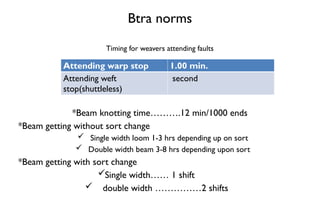
Btra norms
Timing for weavers attending faults
*Beam knotting time……….12 min/1000 ends
*Beam getting without sort change
 Single width loom 1-3 hrs depending up on sort
 Double width beam 3-8 hrs depending upon sort
*Beam getting with sort change
Single width…… 1 shift
 double width ……………2 shifts
Attending warp stop 1.00 min.
Attending weft
stop(shuttleless)
second
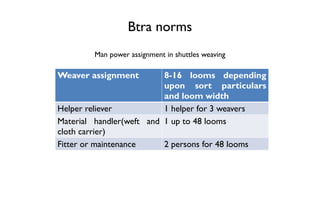
Btra norms
Man power assignment in shuttles weaving
Weaver assignment 8-16 looms depending
upon sort particulars
and loom width
Helper reliever 1 helper for 3 weavers
Material handler(weft and
cloth carrier)
1 up to 48 looms
Fitter or maintenance 2 persons for 48 looms
Quality of input material
• One of the main factor which contributes to the loss of production in loom is the
quality of input material such as warp and weft yarns.
• The strength and flexibility of warp yarn should be up to the standard. It should resist
the stress imposed by the loom during shedding and beating. Sizing of warp yarn has a
significant impact in this regard.
• The weft yarn also should be smooth and should be emulsified with steam to improve its
strength and reduce fluffs during weaving.
• The steamed packages should be kept under covering.The conditioned packages should
be consumed within 4 hours.
Air condition
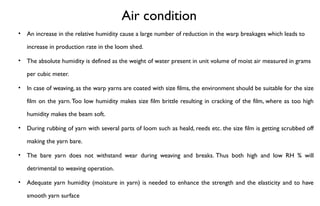
• An increase in the relative humidity cause a large number of reduction in the warp breakages which leads to
increase in production rate in the loom shed.
• The absolute humidity is defined as the weight of water present in unit volume of moist air measured in grams
per cubic meter.
• In case of weaving, as the warp yarns are coated with size films, the environment should be suitable for the size
film on the yarn.Too low humidity makes size film brittle resulting in cracking of the film, where as too high
humidity makes the beam soft.
• During rubbing of yarn with several parts of loom such as heald, reeds etc. the size film is getting scrubbed off
making the yarn bare.
• The bare yarn does not withstand wear during weaving and breaks. Thus both high and low RH % will
detrimental to weaving operation.
• Adequate yarn humidity (moisture in yarn) is needed to enhance the strength and the elasticity and to have
smooth yarn surface
Air condition
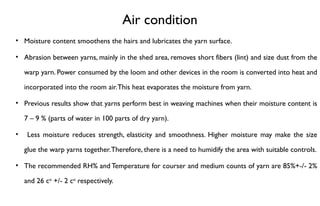
• Moisture content smoothens the hairs and lubricates the yarn surface.
• Abrasion between yarns, mainly in the shed area, removes short fibers (lint) and size dust from the
warp yarn. Power consumed by the loom and other devices in the room is converted into heat and
incorporated into the room air.This heat evaporates the moisture from yarn.
• Previous results show that yarns perform best in weaving machines when their moisture content is
7 – 9 % (parts of water in 100 parts of dry yarn).
• Less moisture reduces strength, elasticity and smoothness. Higher moisture may make the size
glue the warp yarns together.Therefore, there is a need to humidify the area with suitable controls.
• The recommended RH% and Temperature for courser and medium counts of yarn are 85%+-/- 2%
and 26 co
+/- 2 co
respectively.
Snap study
What is snap study?
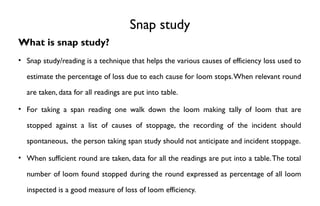
• Snap study/reading is a technique that helps the various causes of efficiency loss used to
estimate the percentage of loss due to each cause for loom stops.When relevant round
are taken, data for all readings are put into table.
• For taking a span reading one walk down the loom making tally of loom that are
stopped against a list of causes of stoppage, the recording of the incident should
spontaneous, the person taking span study should not anticipate and incident stoppage.
• When sufficient round are taken, data for all the readings are put into a table.The total
number of loom found stopped during the round expressed as percentage of all loom
inspected is a good measure of loss of loom efficiency.
Snap study
Example
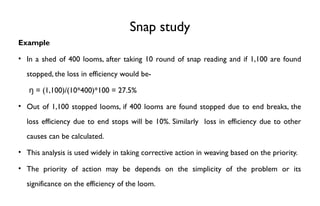
• In a shed of 400 looms, after taking 10 round of snap reading and if 1,100 are found
stopped, the loss in efficiency would be-
= (1,100)/(10*400)*100 = 27.5%
ŋ
• Out of 1,100 stopped looms, if 400 looms are found stopped due to end breaks, the
loss efficiency due to end stops will be 10%. Similarly loss in efficiency due to other
causes can be calculated.
• This analysis is used widely in taking corrective action in weaving based on the priority.
• The priority of action may be depends on the simplicity of the problem or its
significance on the efficiency of the loom.
Snap study
Activity
In a company having 200 looms, a total of 100 stops were found during snap
reading (50 warp stops, 20 weft stops, 20 awaiting knotting and 10 looms
stopped due to other problems.
Calculate total efficiency loss, and losses due to warp stops, weft stops,
knotting, and other stops.
Management
• Human resource is one of the vital assets for the organizational activities of Industries. So
human resource management is an integral part of industrial management.
• Regardless of the type of company you have, it is of the utmost importance you value your
employees and create a proper working environment that facilitates their performance.
• Not only is this aforementioned aspect important, but in order to maintain – and increase
– their motivation, specific actions are essential. Otherwise, if you do not value their
individual growth and acknowledge their performance, they won’t be incentivized to give
their best.
• An individual’s productivity is directly related to how motivated they are, and if they find
their work valuable, such motivation will increase. For this reason, increasing their
motivation is of the utmost importance.
Management
Recruiting operator: in weaving, recruiting proper operator is among the
most important activities.They should be adequate physically, because to stretch
to the drop wires and hedles during end breakage they should have sufficient
height depending on the looms available. It is not suitable for pregnant women
as it needs stretching over the backrest roller during warp breakage.
On the other hand, the company should value new perspectives, fresh eyes, and
different experiences from the new recruits.
Provide regular training:
In a textile manufacturing company, training should be provided at all times. Whether it is at the
beginning, when a new worker is hired, or through time, whenever new equipment is provided,
employers should be up to date with the technology.
As a company, offering training programs or workshops is a way of supporting your employees’ growth.
This way, you secure the development of the company itself.
The human capital of your company is the guarantee that the business’s objectives are met.
So, if your employees’ performance is not facilitated when needed, the business will be unable to
achieve good results.
What’s more, training your employees regularly is an effective way of motivating them.
The reason for this being that, with acquiring new skills, they are given a chance to improve individually.
This, in turn, will make them eligible for a promotion or getting a performance bonus. Individual
employee growth means collective development as a whole company.
Management
Prioritize health and safety:
• In the textile industry and a manufacturing company, the use of various types of
machinery is indispensable. Weaving machine operators have to handle the looms that
can be operated digitally or are manual.The sound of the loom may be harmful for the
workers.Therefore, it is common for workers to be exposed to specific risks.
• For this reason, it is of the utmost importance you adhere to health and safety measures
to ensure your employees are adequately taken care of and the risks of the job are
significantly decreased.
• In case an employee feels unwell due to the demand of the job, it is vital you allow them
the necessary time to seek professional help.
Management
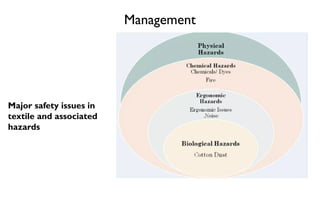
Major safety issues in
textile and associated
hazards
Management
Communicate openly and listen to them:
• Motivated employees bring many benefits to the company, given that the relationships between
them and their managers or team leaders are strong and promote productivity.
• A healthy workplace environment will reduce absenteeism and increase employee retention,
meaning that the workers trust you as an employer and are loyal, seeing you also have their best
interest in mind.This will motivate them to work at their fullest potential.
• To achieve this, it is essential you prioritize honest and open communication by focusing on building
work relationships.
• This way, in case of any issues or conflicts, you are more prepared to handle these types of tense
situations. Plus, employees see that you take an interest in them if you listen to their needs.
• Teams who are able to work seamlessly and effectively together are more productive, and only
with open communication can you accomplish this.
Management
Recognize good work and offer rewards:
• Monitor your employees’ performance closely and recognize whenever they achieve an objective and
reach a milestone, no matter how big or small.
• This shows them that you pay attention and, by knowing their work is acknowledged and rewarded, they
will be highly motivated. It is vital you empower and encourage innovative ideas.
• Some employees might make themselves more visible and represent an example for others.
• It is essential you recognize your employee’s good work and listen to ideas that could improve the
company’s performance.
• More often than not, employees are the ones who know for sure what areas need improvement in some
areas of the business. Hence, give them the opportunity to provide feedback and even come with
strategies that might improve performance.
• Apart from allowing them to express their opinions, it is also important you reward them whenever they
achieve an objective. Such incentives will motivate them.
Management
HR policies that promote a healthy culture:
• Although financial incentives or other rewards can increase motivation and prioritize your employees’
growth and well-being, the truth is that these actions have to be embedded in the company’s culture.
• An effective way of doing this is through HR policies that show you value your employees and their
work.
• For instance, it is crucial you allow them leave days whenever they might need it, provided they have a
good reason. Apart from vacation days, it is recommended you listen to your employees when or if
they have an urgent personal matter and let them take some days off.
• Another method of facilitating their work is by providing lunch breaks as well as smaller breaks to
avoid them getting overwhelmed with the workload.
• To promote a healthy culture and increase motivation, you could even create a habit of everyone
getting lunch together. It is an excellent chance to spend time collectively and strengthen work
relationships.
The role of a supervisor in weaving industry
• He/she should be aware of the looms and machineries in that particular shed. Their function,
positive / negative sides, how to operate, it`s maintenance schedule and best of the outcome.
• He/she must be capable to direct, educate his juniors how best the looms can produce the best
quality and production.
• He/she should be aware of the qualities running in that shed, the count/ den of warp & weft.
• He/she should be aware the details of the particulars i.e. loom width, loom speed, sorts running at
that loom, reed/ pick, Reed space, total ends, beam length, time to run out the beam.
• He/she must have the quality conception of the shed.
• He/she must be aware the day by day Production efficiency of the shed.
• He/she should aware of the breakage studies and the causes of breakages.
• He/she should be aware what the remedies are and how to minimize the breakage rate..
The role of a supervisor in weaving industry
• He/she must know the fabric defect, their causes and remedies. Should be able to guide the
jobbers, weavers, fitters how best the fabric defect can be minimized.
• He/she should aware about running maintenance, Preventive maintenance, predictive
maintenance so that the maintenance manager can get a proper feed back to correct the loom.
• Proper report preparation, record keeping, feed back to management are necessary for them.
• Waste control, % waste generation, the causes and remedies should be aware by them.
• His/her behavior with juniors, transparency in directing, understand the duties, responsibilities
should be reflected so that the juniors learn good working system.
• A hard working person with determination, are also necessary for him/her so that he/she can
create example with juniors who will follow them in positive direction.

factors considered in weaving productivity

  • 1.
    B A SI C C O U R S E PRODUCTIVITY IN WEAVING Implementation partner Germany Implementation partner Ethiopia
  • 2.
    Introduction  Productivity isthe effectiveness of productive effort, especially in industry, as measured in terms of the rate of output per unit of input.  It is not only increasing the output, but also minimizing input and wastage.  Productivity means more profit with less cost at the definite time.  Everyone should play their own role in achieving better production rate.  Among the textile process weaving is one of the main process and many factors affects its productivity.  Some general categories for these factors are product type, process/machine type, operators skill/motivation, management, room condition, input material quality, maintenance,
  • 3.
    Product type • Thetype of weave design significantly affects the productivity of a loom. Different weave designs have varied complexities and characteristics, which influence factors such as speed, efficiency, and yarn consumption. • Moreover, the number of picks or EPC have a significant effect on productivity. • The heavier the fabric, the higher is the end breakage (heavy beat-up, lower speed, high tension). • As the design complexity increase the productivity decrease.
  • 4.
    Product type • Complexityof Weave Design • Plain Weave: Productivity: Very high productivity due to simple interlacing (over-and-under pattern) which allows for faster weaving speeds. - Productivity: Moderate productivity; more complex than plain weave but allows for higher fabric strength and better drape. -Use Case: Used for denim, gabardine, and khaki drill and require longer setup times and adjustments. • Satin Weave: – Productivity: Lower productivity compared to plain and twill weaves; complex interlacing pattern can slow down the weaving process. – Use Case: Used for luxury fabrics like satin and silk, where more delicate handling is necessary.
  • 5.
    Product type • WarpandWeft Requirements • Different weaves have varying requirements for warp and weft yarns, which influences how often the loom can be operated: – Higher Yarn Consumption: More complex weaves usually require a greater amount of both warp and weft yarns, which can slow down production rates. – Material Type: Using thicker or specialty yarns for certain designs may lead to slower productivity due to handling and tension adjustments. • Loom Settings and Adjustments • Weave designs with higher complexity may require more frequent adjustments to the machine: – Longer Setup Times: Different weave patterns may necessitate changes in settings, such as tension and shedding mechanisms, which can reduce overall productivity.
  • 6.
    Product type • FabricQuality and Defects • More intricate weave designs may result in increased fabric defects (e.g., uneven tension or flaws), requiring additional quality control measures: • Batch Production and Orders • The nature of the order can affect loom productivity: – Short Runs: Complex designs are often inefficient for short production runs; looms may operate slowly or be set up for long periods without generating sufficient fabric. – Long Runs: For larger orders of a specific complex weave, the initial setup time becomes a smaller fraction of total production time and may enhance overall productivity.
  • 7.
    Loom type • Thetype of loom significantly impacts productivity, with shuttleless looms (air-jet, water- jet, rapier) offering much higher speeds and efficiencies compared to traditional shuttle looms. • Shuttle Looms Productivity: Lower productivity rates. Characteristics: • Uses a shuttle to carry the weft yarn. • Slower operation due to stop-and-start weaving process. • Requires more manual adjustments for shuttle changes. Typical Speed: Generally around 200-400 meters per minute.
  • 8.
    Loom type * RapierLooms Productivity: Moderate to high. Characteristics: • Utilizes mechanical arms (rapiers) to transport the weft. • Versatile for various fabric types, including heavier materials. • Balances speed and complexity well. *Typical Speed: Ranges from 500 to 1,200 meters per minute. * Projectile Looms Productivity: Moderate to high. Characteristics: • Uses a projectile mechanism to transport the weft. • Good for medium to heavy fabrics. • Offers a balance between speed and fabric complexity. *Typical Speed:Approximately 600 to 1,200 meters per minute.
  • 9.
    Loom type * Air-JetLooms Productivity:Very high productivity rates. Characteristics: • Uses a jet of air to propel the weft yarn. • High-speed operation with minimal downtime. • Suitable for lighter fabrics and faster production. *Typical Speed: Up to 1,200-1,500 meters per minute. * Water-Jet Looms Productivity:Very high productivity rates. Characteristics: • Employs jets of water to carry the weft yarn. • Best for weaving synthetic fabrics; limited with natural fibers. • Fast operation with reduced downtime. Typical Speed: Up to 1,200-1,500 meters per minute.
  • 10.
    Operator skill/motivation • Operatorskill is one of the most influential factor in weaving productivity. • If the labors are well trained and aware of machine operations then production rate will be high. • Labors carelessness or ignorance during production process affected the production efficiency. • When machine stops due to breakage or any other reason; delay of restarting the machine has an impact on production. • Sometimes it happens due to negligence of workers because they don’t start the machine at the right time. • Furthermore, more labor on one machine cannot give the guarantee of high productivity while on the other side competent labor can give the better results.
  • 11.
    Btra norms Timing forweavers attending faults *Beam knotting time……….12 min/1000 ends *Beam getting without sort change  Single width loom 1-3 hrs depending up on sort  Double width beam 3-8 hrs depending upon sort *Beam getting with sort change Single width…… 1 shift  double width ……………2 shifts Attending warp stop 1.00 min. Attending weft stop(shuttleless) second
  • 12.
    Btra norms Man powerassignment in shuttles weaving Weaver assignment 8-16 looms depending upon sort particulars and loom width Helper reliever 1 helper for 3 weavers Material handler(weft and cloth carrier) 1 up to 48 looms Fitter or maintenance 2 persons for 48 looms
  • 13.
    Quality of inputmaterial • One of the main factor which contributes to the loss of production in loom is the quality of input material such as warp and weft yarns. • The strength and flexibility of warp yarn should be up to the standard. It should resist the stress imposed by the loom during shedding and beating. Sizing of warp yarn has a significant impact in this regard. • The weft yarn also should be smooth and should be emulsified with steam to improve its strength and reduce fluffs during weaving. • The steamed packages should be kept under covering.The conditioned packages should be consumed within 4 hours.
  • 14.
    Air condition • Anincrease in the relative humidity cause a large number of reduction in the warp breakages which leads to increase in production rate in the loom shed. • The absolute humidity is defined as the weight of water present in unit volume of moist air measured in grams per cubic meter. • In case of weaving, as the warp yarns are coated with size films, the environment should be suitable for the size film on the yarn.Too low humidity makes size film brittle resulting in cracking of the film, where as too high humidity makes the beam soft. • During rubbing of yarn with several parts of loom such as heald, reeds etc. the size film is getting scrubbed off making the yarn bare. • The bare yarn does not withstand wear during weaving and breaks. Thus both high and low RH % will detrimental to weaving operation. • Adequate yarn humidity (moisture in yarn) is needed to enhance the strength and the elasticity and to have smooth yarn surface
  • 15.
    Air condition • Moisturecontent smoothens the hairs and lubricates the yarn surface. • Abrasion between yarns, mainly in the shed area, removes short fibers (lint) and size dust from the warp yarn. Power consumed by the loom and other devices in the room is converted into heat and incorporated into the room air.This heat evaporates the moisture from yarn. • Previous results show that yarns perform best in weaving machines when their moisture content is 7 – 9 % (parts of water in 100 parts of dry yarn). • Less moisture reduces strength, elasticity and smoothness. Higher moisture may make the size glue the warp yarns together.Therefore, there is a need to humidify the area with suitable controls. • The recommended RH% and Temperature for courser and medium counts of yarn are 85%+-/- 2% and 26 co +/- 2 co respectively.
  • 16.
    Snap study What issnap study? • Snap study/reading is a technique that helps the various causes of efficiency loss used to estimate the percentage of loss due to each cause for loom stops.When relevant round are taken, data for all readings are put into table. • For taking a span reading one walk down the loom making tally of loom that are stopped against a list of causes of stoppage, the recording of the incident should spontaneous, the person taking span study should not anticipate and incident stoppage. • When sufficient round are taken, data for all the readings are put into a table.The total number of loom found stopped during the round expressed as percentage of all loom inspected is a good measure of loss of loom efficiency.
  • 17.
    Snap study Example • Ina shed of 400 looms, after taking 10 round of snap reading and if 1,100 are found stopped, the loss in efficiency would be- = (1,100)/(10*400)*100 = 27.5% ŋ • Out of 1,100 stopped looms, if 400 looms are found stopped due to end breaks, the loss efficiency due to end stops will be 10%. Similarly loss in efficiency due to other causes can be calculated. • This analysis is used widely in taking corrective action in weaving based on the priority. • The priority of action may be depends on the simplicity of the problem or its significance on the efficiency of the loom.
  • 18.
    Snap study Activity In acompany having 200 looms, a total of 100 stops were found during snap reading (50 warp stops, 20 weft stops, 20 awaiting knotting and 10 looms stopped due to other problems. Calculate total efficiency loss, and losses due to warp stops, weft stops, knotting, and other stops.
  • 19.
    Management • Human resourceis one of the vital assets for the organizational activities of Industries. So human resource management is an integral part of industrial management. • Regardless of the type of company you have, it is of the utmost importance you value your employees and create a proper working environment that facilitates their performance. • Not only is this aforementioned aspect important, but in order to maintain – and increase – their motivation, specific actions are essential. Otherwise, if you do not value their individual growth and acknowledge their performance, they won’t be incentivized to give their best. • An individual’s productivity is directly related to how motivated they are, and if they find their work valuable, such motivation will increase. For this reason, increasing their motivation is of the utmost importance.
  • 20.
    Management Recruiting operator: inweaving, recruiting proper operator is among the most important activities.They should be adequate physically, because to stretch to the drop wires and hedles during end breakage they should have sufficient height depending on the looms available. It is not suitable for pregnant women as it needs stretching over the backrest roller during warp breakage. On the other hand, the company should value new perspectives, fresh eyes, and different experiences from the new recruits.
  • 21.
    Provide regular training: Ina textile manufacturing company, training should be provided at all times. Whether it is at the beginning, when a new worker is hired, or through time, whenever new equipment is provided, employers should be up to date with the technology. As a company, offering training programs or workshops is a way of supporting your employees’ growth. This way, you secure the development of the company itself. The human capital of your company is the guarantee that the business’s objectives are met. So, if your employees’ performance is not facilitated when needed, the business will be unable to achieve good results. What’s more, training your employees regularly is an effective way of motivating them. The reason for this being that, with acquiring new skills, they are given a chance to improve individually. This, in turn, will make them eligible for a promotion or getting a performance bonus. Individual employee growth means collective development as a whole company.
  • 22.
    Management Prioritize health andsafety: • In the textile industry and a manufacturing company, the use of various types of machinery is indispensable. Weaving machine operators have to handle the looms that can be operated digitally or are manual.The sound of the loom may be harmful for the workers.Therefore, it is common for workers to be exposed to specific risks. • For this reason, it is of the utmost importance you adhere to health and safety measures to ensure your employees are adequately taken care of and the risks of the job are significantly decreased. • In case an employee feels unwell due to the demand of the job, it is vital you allow them the necessary time to seek professional help.
  • 23.
    Management Major safety issuesin textile and associated hazards
  • 24.
    Management Communicate openly andlisten to them: • Motivated employees bring many benefits to the company, given that the relationships between them and their managers or team leaders are strong and promote productivity. • A healthy workplace environment will reduce absenteeism and increase employee retention, meaning that the workers trust you as an employer and are loyal, seeing you also have their best interest in mind.This will motivate them to work at their fullest potential. • To achieve this, it is essential you prioritize honest and open communication by focusing on building work relationships. • This way, in case of any issues or conflicts, you are more prepared to handle these types of tense situations. Plus, employees see that you take an interest in them if you listen to their needs. • Teams who are able to work seamlessly and effectively together are more productive, and only with open communication can you accomplish this.
  • 25.
    Management Recognize good workand offer rewards: • Monitor your employees’ performance closely and recognize whenever they achieve an objective and reach a milestone, no matter how big or small. • This shows them that you pay attention and, by knowing their work is acknowledged and rewarded, they will be highly motivated. It is vital you empower and encourage innovative ideas. • Some employees might make themselves more visible and represent an example for others. • It is essential you recognize your employee’s good work and listen to ideas that could improve the company’s performance. • More often than not, employees are the ones who know for sure what areas need improvement in some areas of the business. Hence, give them the opportunity to provide feedback and even come with strategies that might improve performance. • Apart from allowing them to express their opinions, it is also important you reward them whenever they achieve an objective. Such incentives will motivate them.
  • 26.
    Management HR policies thatpromote a healthy culture: • Although financial incentives or other rewards can increase motivation and prioritize your employees’ growth and well-being, the truth is that these actions have to be embedded in the company’s culture. • An effective way of doing this is through HR policies that show you value your employees and their work. • For instance, it is crucial you allow them leave days whenever they might need it, provided they have a good reason. Apart from vacation days, it is recommended you listen to your employees when or if they have an urgent personal matter and let them take some days off. • Another method of facilitating their work is by providing lunch breaks as well as smaller breaks to avoid them getting overwhelmed with the workload. • To promote a healthy culture and increase motivation, you could even create a habit of everyone getting lunch together. It is an excellent chance to spend time collectively and strengthen work relationships.
  • 27.
    The role ofa supervisor in weaving industry • He/she should be aware of the looms and machineries in that particular shed. Their function, positive / negative sides, how to operate, it`s maintenance schedule and best of the outcome. • He/she must be capable to direct, educate his juniors how best the looms can produce the best quality and production. • He/she should be aware of the qualities running in that shed, the count/ den of warp & weft. • He/she should be aware the details of the particulars i.e. loom width, loom speed, sorts running at that loom, reed/ pick, Reed space, total ends, beam length, time to run out the beam. • He/she must have the quality conception of the shed. • He/she must be aware the day by day Production efficiency of the shed. • He/she should aware of the breakage studies and the causes of breakages. • He/she should be aware what the remedies are and how to minimize the breakage rate..
  • 28.
    The role ofa supervisor in weaving industry • He/she must know the fabric defect, their causes and remedies. Should be able to guide the jobbers, weavers, fitters how best the fabric defect can be minimized. • He/she should aware about running maintenance, Preventive maintenance, predictive maintenance so that the maintenance manager can get a proper feed back to correct the loom. • Proper report preparation, record keeping, feed back to management are necessary for them. • Waste control, % waste generation, the causes and remedies should be aware by them. • His/her behavior with juniors, transparency in directing, understand the duties, responsibilities should be reflected so that the juniors learn good working system. • A hard working person with determination, are also necessary for him/her so that he/she can create example with juniors who will follow them in positive direction.

Editor's Notes

  • #1 LESETEXT: Calibri 14pt