Welcome
to
Presentation
Presentation On
Weaving Factory
Presented By:
Tareq Aziz
BM Riaz
Tonmoy Bhoumik
Papon Singha
Introduction
 The process of producing fabric by interlacement of two
set yarn is called woven fabric.
 There are various type of woven fabric basis of the fabric
structure like Plain, Twill, Sateen, Satin.
 There are about 802 weaving mills in Bangladesh.
* Source: Bangladesh textile mills Association (BTMA) 2016 report.
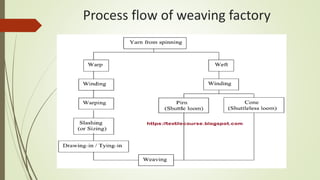
Process flow of weaving factory
Winding Process
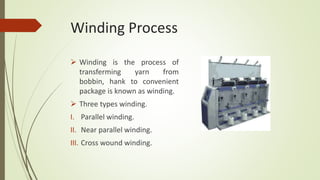
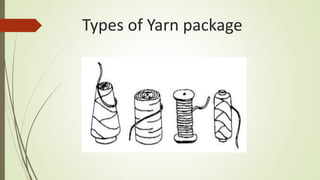
 Winding is the process of
transferming yarn from
bobbin, hank to convenient
package is known as winding.
 Three types winding.
I. Parallel winding.
II. Near parallel winding.
III. Cross wound winding.
Types of Yarn package
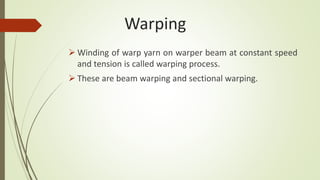
Warping
 Winding of warp yarn on warper beam at constant speed
and tension is called warping process.
 These are beam warping and sectional warping.
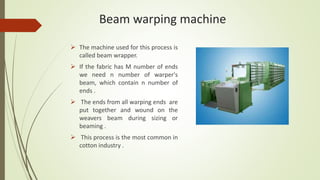
Beam warping machine
 The machine used for this process is
called beam wrapper.
 If the fabric has M number of ends
we need n number of warper's
beam, which contain n number of
ends .
 The ends from all warping ends are
put together and wound on the
weavers beam during sizing or
beaming .
 This process is the most common in
cotton industry .
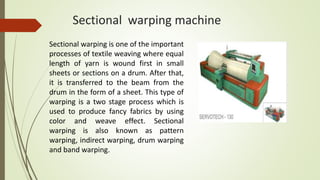
Sectional warping machine
Sectional warping is one of the important
processes of textile weaving where equal
length of yarn is wound first in small
sheets or sections on a drum. After that,
it is transferred to the beam from the
drum in the form of a sheet. This type of
warping is a two stage process which is
used to produce fancy fabrics by using
color and weave effect. Sectional
warping is also known as pattern
warping, indirect warping, drum warping
and band warping.
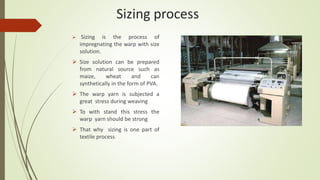
Sizing process
 Sizing is the process of
impregnating the warp with size
solution.
 Size solution can be prepared
from natural source such as
maize, wheat and can
synthetically in the form of PVA.
 The warp yarn is subjected a
great stress during weaving
 To with stand this stress the
warp yarn should be strong
 That why sizing is one part of
textile process
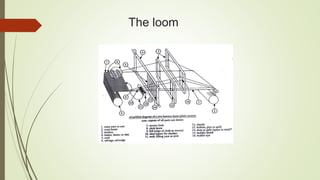
The loom
Weaving machine classification
 Weaving machine mainly classified as shuttle and shuttles
loom.
 In shuttle loom the filling yarn in inserted through the
shed by a small carrier device called a shuttle.
 Shuttle less loom don't have shuttle.
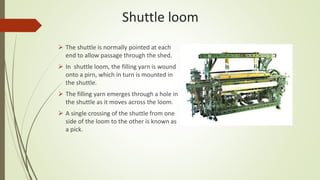
Shuttle loom
 The shuttle is normally pointed at each
end to allow passage through the shed.
 In shuttle loom, the filling yarn is wound
onto a pirn, which in turn is mounted in
the shuttle.
 The filling yarn emerges through a hole in
the shuttle as it moves across the loom.
 A single crossing of the shuttle from one
side of the loom to the other is known as
a pick.
Shuttleless loom
Some of the common shuttleless looms include:
 Water-jet looms .
 Air-jet looms.
 Rapier looms.
 And projectile looms.
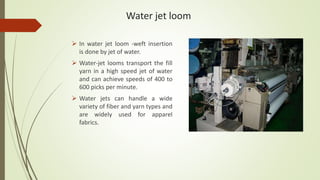
Water jet loom
 In water jet loom -weft insertion
is done by jet of water.
 Water-jet looms transport the fill
yarn in a high speed jet of water
and can achieve speeds of 400 to
600 picks per minute.
 Water jets can handle a wide
variety of fiber and yarn types and
are widely used for apparel
fabrics.
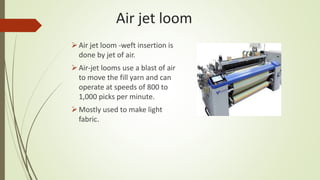
Air jet loom
Air jet loom -weft insertion is
done by jet of air.
Air-jet looms use a blast of air
to move the fill yarn and can
operate at speeds of 800 to
1,000 picks per minute.
Mostly used to make light
fabric.
Weaving wastages:
Weaving process includes wastages from warping, sizing, weft winding and weaving.
The wastage occurs here are balance yarns in warping creel and cones, trial run
quantity, weaving defects, roll making etc.
 Wastage in winding: In winding section, different reasons can cause wastage.
The followings are the main reasons:
1.Knots on package
2.Ends are still remained after tying.
3.Yarn slough off.
4.Coil is remained on the yarn package.
5.Short ends dropped at threading.
6.Greasy and dirty yarn.
7.Workers negligence.
The sizes of the spinning bobbin and breakage rate have great influence on the
quantity of wastage. Increasing the package size and reducing the breakage
rate of yarn, wastage in winding is fallen.
Cont………..
Warping wastages:
This wast is generated in the warping creel section. It is not possible to empty a
cone/cheese completely. There is always some small amount of yearn left in the
package.
 Wastages in sizing:
at the end of a sizing set, a relatively a large length of warp sheet (equal to the yarn
path length in the sizing machine) is required to be left in the sizing machines as waste.
These warp yarns are used to tie-in the warps of the next set of sizing. When the next
set is started, the sized yarn of the previous set is pulled out and thrown away as waste.
Apart from this, a substantial amount of warp sheet is also wasted at the end of sizing
as residual or left over yarn on the warp beams situated in the creel section of the sizing
machine.
Cont……..
 Knotting wastages:
To perform knotting efficiently, small lengths of warp sheet from both the newly installed
weaver's beam and existing warp ends (in the loom) are eliminated. This is done to ensure
that all the warp ends of the two beams are available for attaching together.
 Residual warp wastages:
The residual warp yarn remaining in the beam at the end of weaving is known as residual
warp waste
Cont…..
 Loom setting wastages:
When starting to weave a new weaver’s beam on a loom some warp (also weft) yarns are
wasted due to trial and error practice before the loom is set to weave the intended fabric
perfectly. Apart from this, a little portion of warp is also wasted in forms of sample grey (6”–
10”) fabric to test or check and assure that the right quality is being woven on the loom.
 Weft wastages:
In an air jet loom, after successful insertion of each pick, it is necessary to cut each pick at
the ends of the fabric width. This is done to maintain a uniform selvedge fringe at the two
sides of the fabric. At the main nozzle end, i.e., at the starting end, there is no cut fringe, so
there is no wastage. But at the finishing end, the extent of each pick is different and needs to
be cut so that the extreme fringe of the fabric looks uniform. On average 1½“ – 2“ excess of
each pick is maintained in the finishing end of the loom
Safty risk:
Weaving presents only a moderate worker safety risk. However, there
are a number of typical safety hazards and minimization measures.
 Falls
 Machinery
 Materials handling
 Fires and ignition
Health risks
Health risks in modern weaving are generally
limited to noise-induced hearing loss and to
pulmonary disorders associated with some
types of fibres used in the yarn.
 Noise
 Fibre dust
References
 https://www.google.com/search?q=wastage+i
n+weaving+factory&oq=wastage+in+weaving
+factory&aqs=chrome..69i57j33.19435j1j4&s
ourceid=chrome&ie=UTF-8
 http://www.iloencyclopaedia.org/part-xiv-
42166/textile-goods-industry/144-89-textile-
goods-industry/weaving-and-knitting
Thank you.....

Process flow of a Weaving factory.

  • 1.
  • 2.
    Presentation On Weaving Factory PresentedBy: Tareq Aziz BM Riaz Tonmoy Bhoumik Papon Singha
  • 3.
    Introduction  The processof producing fabric by interlacement of two set yarn is called woven fabric.  There are various type of woven fabric basis of the fabric structure like Plain, Twill, Sateen, Satin.  There are about 802 weaving mills in Bangladesh. * Source: Bangladesh textile mills Association (BTMA) 2016 report.
  • 4.
    Process flow ofweaving factory
  • 5.
    Winding Process  Windingis the process of transferming yarn from bobbin, hank to convenient package is known as winding.  Three types winding. I. Parallel winding. II. Near parallel winding. III. Cross wound winding.
  • 6.
  • 7.
    Warping  Winding ofwarp yarn on warper beam at constant speed and tension is called warping process.  These are beam warping and sectional warping.
  • 8.
    Beam warping machine The machine used for this process is called beam wrapper.  If the fabric has M number of ends we need n number of warper's beam, which contain n number of ends .  The ends from all warping ends are put together and wound on the weavers beam during sizing or beaming .  This process is the most common in cotton industry .
  • 9.
    Sectional warping machine Sectionalwarping is one of the important processes of textile weaving where equal length of yarn is wound first in small sheets or sections on a drum. After that, it is transferred to the beam from the drum in the form of a sheet. This type of warping is a two stage process which is used to produce fancy fabrics by using color and weave effect. Sectional warping is also known as pattern warping, indirect warping, drum warping and band warping.
  • 10.
    Sizing process  Sizingis the process of impregnating the warp with size solution.  Size solution can be prepared from natural source such as maize, wheat and can synthetically in the form of PVA.  The warp yarn is subjected a great stress during weaving  To with stand this stress the warp yarn should be strong  That why sizing is one part of textile process
  • 11.
  • 12.
    Weaving machine classification Weaving machine mainly classified as shuttle and shuttles loom.  In shuttle loom the filling yarn in inserted through the shed by a small carrier device called a shuttle.  Shuttle less loom don't have shuttle.
  • 13.
    Shuttle loom  Theshuttle is normally pointed at each end to allow passage through the shed.  In shuttle loom, the filling yarn is wound onto a pirn, which in turn is mounted in the shuttle.  The filling yarn emerges through a hole in the shuttle as it moves across the loom.  A single crossing of the shuttle from one side of the loom to the other is known as a pick.
  • 14.
    Shuttleless loom Some ofthe common shuttleless looms include:  Water-jet looms .  Air-jet looms.  Rapier looms.  And projectile looms.
  • 15.
    Water jet loom In water jet loom -weft insertion is done by jet of water.  Water-jet looms transport the fill yarn in a high speed jet of water and can achieve speeds of 400 to 600 picks per minute.  Water jets can handle a wide variety of fiber and yarn types and are widely used for apparel fabrics.
  • 16.
    Air jet loom Airjet loom -weft insertion is done by jet of air. Air-jet looms use a blast of air to move the fill yarn and can operate at speeds of 800 to 1,000 picks per minute. Mostly used to make light fabric.
  • 17.
    Weaving wastages: Weaving processincludes wastages from warping, sizing, weft winding and weaving. The wastage occurs here are balance yarns in warping creel and cones, trial run quantity, weaving defects, roll making etc.  Wastage in winding: In winding section, different reasons can cause wastage. The followings are the main reasons: 1.Knots on package 2.Ends are still remained after tying. 3.Yarn slough off. 4.Coil is remained on the yarn package. 5.Short ends dropped at threading. 6.Greasy and dirty yarn. 7.Workers negligence. The sizes of the spinning bobbin and breakage rate have great influence on the quantity of wastage. Increasing the package size and reducing the breakage rate of yarn, wastage in winding is fallen.
  • 18.
    Cont……….. Warping wastages: This wastis generated in the warping creel section. It is not possible to empty a cone/cheese completely. There is always some small amount of yearn left in the package.  Wastages in sizing: at the end of a sizing set, a relatively a large length of warp sheet (equal to the yarn path length in the sizing machine) is required to be left in the sizing machines as waste. These warp yarns are used to tie-in the warps of the next set of sizing. When the next set is started, the sized yarn of the previous set is pulled out and thrown away as waste. Apart from this, a substantial amount of warp sheet is also wasted at the end of sizing as residual or left over yarn on the warp beams situated in the creel section of the sizing machine.
  • 19.
    Cont……..  Knotting wastages: Toperform knotting efficiently, small lengths of warp sheet from both the newly installed weaver's beam and existing warp ends (in the loom) are eliminated. This is done to ensure that all the warp ends of the two beams are available for attaching together.  Residual warp wastages: The residual warp yarn remaining in the beam at the end of weaving is known as residual warp waste
  • 20.
    Cont…..  Loom settingwastages: When starting to weave a new weaver’s beam on a loom some warp (also weft) yarns are wasted due to trial and error practice before the loom is set to weave the intended fabric perfectly. Apart from this, a little portion of warp is also wasted in forms of sample grey (6”– 10”) fabric to test or check and assure that the right quality is being woven on the loom.  Weft wastages: In an air jet loom, after successful insertion of each pick, it is necessary to cut each pick at the ends of the fabric width. This is done to maintain a uniform selvedge fringe at the two sides of the fabric. At the main nozzle end, i.e., at the starting end, there is no cut fringe, so there is no wastage. But at the finishing end, the extent of each pick is different and needs to be cut so that the extreme fringe of the fabric looks uniform. On average 1½“ – 2“ excess of each pick is maintained in the finishing end of the loom
  • 21.
    Safty risk: Weaving presentsonly a moderate worker safety risk. However, there are a number of typical safety hazards and minimization measures.  Falls  Machinery  Materials handling  Fires and ignition
  • 22.
    Health risks Health risksin modern weaving are generally limited to noise-induced hearing loss and to pulmonary disorders associated with some types of fibres used in the yarn.  Noise  Fibre dust
  • 23.
  • 24.