Chapter 4: Organizing
1
Learning Objectives
2
At the end of the chapter, the students are expected to understand
the following:
 Definition of Organizing
 Nature of Organizing
 Organizing as a Process
 The Nature and Development of Organization
 Types of Organization Structures
 The Nature of Line and Staff Relationship
 Organization Chart
 Results of Good Organization
 The Elements of Delegation
 Informal and Formal Organization
Centralized and Decentralized Organization
What is Organizing?
3
 The process of grouping together of
men and establishing relationships among
them, defining the authority and
responsibility of personnel by using the
company’s other basic resources to attain
predetermined goals and objectives.
 The identification of the grouping of
work to be done, the delegation of
authority and responsibility to the
employees, and the establishment of
relationships among the personnel in
order to use to maximum advantage the
company’s basic material resources in the
Organizing – Nature and Process
4
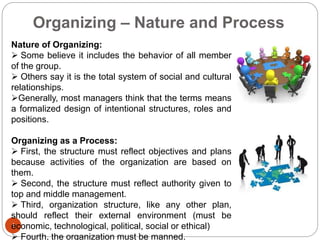
Nature of Organizing:
 Some believe it includes the behavior of all member
of the group.
 Others say it is the total system of social and cultural
relationships.
Generally, most managers think that the terms means
a formalized design of intentional structures, roles and
positions.
Organizing as a Process:
 First, the structure must reflect objectives and plans
because activities of the organization are based on
them.
 Second, the structure must reflect authority given to
top and middle management.
 Third, organization structure, like any other plan,
should reflect their external environment (must be
economic, technological, political, social or ethical)
 Fourth, the organization must be manned.
What is an Organization?
5
 “Executive structure of a business” ,
Webster – It indicates that organization
is the framework or backbone
 Connotes a “creative process”. – All
the parts of a business do not come into
existence spontaneously. They are the
results of managerial efforts to carry out
a predetermined course of action.
 Sometimes used to mean the “total
business organization”, including
facilities, materials, money, and
manpower.
Types of Organization Structures
6
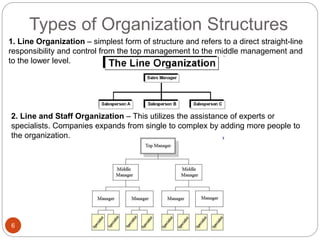
1. Line Organization – simplest form of structure and refers to a direct straight-line
responsibility and control from the top management to the middle management and
to the lower level.
2. Line and Staff Organization – This utilizes the assistance of experts or
specialists. Companies expands from single to complex by adding more people to
the organization.
Types of Organization Structures
7
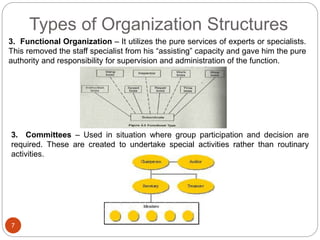
3. Functional Organization – It utilizes the pure services of experts or specialists.
This removed the staff specialist from his “assisting” capacity and gave him the pure
authority and responsibility for supervision and administration of the function.
3. Committees – Used in situation where group participation and decision are
required. These are created to undertake special activities rather than routinary
activities.
Organization Chart
8
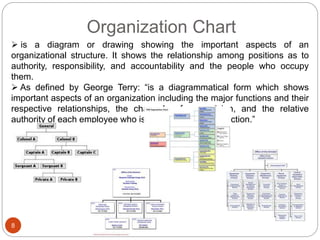
 is a diagram or drawing showing the important aspects of an
organizational structure. It shows the relationship among positions as to
authority, responsibility, and accountability and the people who occupy
them.
 As defined by George Terry: “is a diagrammatical form which shows
important aspects of an organization including the major functions and their
respective relationships, the channels of supervision, and the relative
authority of each employee who is in charge of each function.”
Purpose and Types of Organization
Chart
9
Purpose:
 assists one to view the firm’s structure as a whole. It shows the principal
divisions and lines of formal authority.
 assists management to divide the different duties or functions in the
business establishment so that they will be performed effectively and
efficiently.
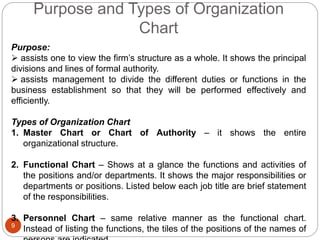
Types of Organization Chart
1. Master Chart or Chart of Authority – it shows the entire
organizational structure.
2. Functional Chart – Shows at a glance the functions and activities of
the positions and/or departments. It shows the major responsibilities or
departments or positions. Listed below each job title are brief statement
of the responsibilities.
3. Personnel Chart – same relative manner as the functional chart.
Instead of listing the functions, the tiles of the positions of the names of
Reorganization
10
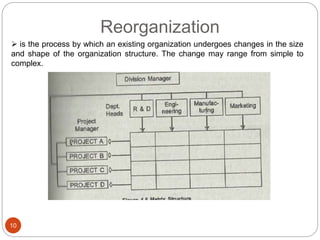
 is the process by which an existing organization undergoes changes in the size
and shape of the organization structure. The change may range from simple to
complex.
Departmentation
11
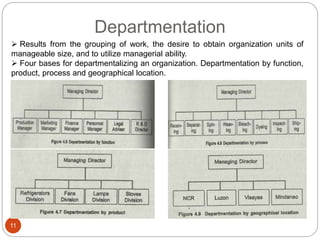
 Results from the grouping of work, the desire to obtain organization units of
manageable size, and to utilize managerial ability.
 Four bases for departmentalizing an organization. Departmentation by function,
product, process and geographical location.
Results of Good Organization
12
A good organization would result in the following
1. Establishing responsibility and preventing “buck passing.”
2. Providing for easier communication
3. Eliminating jurisdictional disputes between individuals
4. Helping develop executive ability
5. Aiding in measuring a person’s performance against his charges and
responsibilities
6. Aiding in equitable distribution of work, functions, and/or personnel
supervision
7. Permitting expansion and contraction without seriously disrupting the
structure.
8. Pointing out “dead-end” jobs.
9. Affording movement in the direction of the “ideal” organization, in times of
change.
10.Establishing closer cooperation and higher morale.
11.Delineating avenues of promotion.
12.Preventing duplication of work.
13.Making growth possible with adequate control and without literally killing
The Elements of Delegation
13
 Delegation is the process of entrusting and transferring
responsibility and authority by the top management to the lowest
level.
The elements of delegation are the following:
1. Responsibility – the work or duty assigned to a particular
position. Involves mental and physical activities which must be
performed to carry out a task or duty. Two categories:
management functions which covers POSDICON and operative
functions which include all activities that have to do directly with
their specialization.
2. Authority – refers to the power or the right to be obeyed.
3. Accountability – this is the answerability of the obligation to
perform the delegated responsibility and to exercise the authority
for the proper performance of the work. It cannot be delegated. It
is given to the person who accepts the responsibility and is
accountable only to the extent that he is given the authority to
The Art of Delegation
14
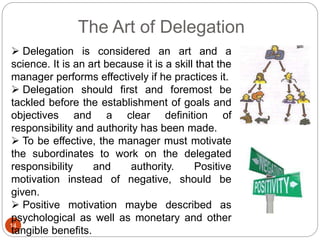
 Delegation is considered an art and a
science. It is an art because it is a skill that the
manager performs effectively if he practices it.
 Delegation should first and foremost be
tackled before the establishment of goals and
objectives and a clear definition of
responsibility and authority has been made.
 To be effective, the manager must motivate
the subordinates to work on the delegated
responsibility and authority. Positive
motivation instead of negative, should be
given.
 Positive motivation maybe described as
psychological as well as monetary and other
tangible benefits.
The Exception Principle
15
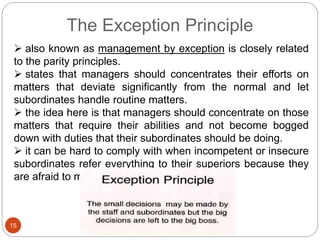
 also known as management by exception is closely related
to the parity principles.
 states that managers should concentrates their efforts on
matters that deviate significantly from the normal and let
subordinates handle routine matters.
 the idea here is that managers should concentrate on those
matters that require their abilities and not become bogged
down with duties that their subordinates should be doing.
 it can be hard to comply with when incompetent or insecure
subordinates refer everything to their superiors because they
are afraid to make decisions.
Formal and Informal Organizations
16
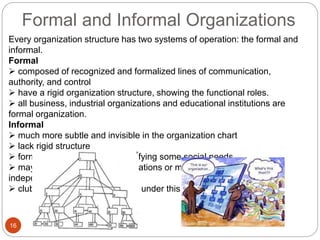
Every organization structure has two systems of operation: the formal and
informal.
Formal
 composed of recognized and formalized lines of communication,
authority, and control
 have a rigid organization structure, showing the functional roles.
 all business, industrial organizations and educational institutions are
formal organization.
Informal
 much more subtle and invisible in the organization chart
 lack rigid structure
 formed for the purpose of satisfying some social needs
 may exist in the formal organizations or may exist and operate
independently.
 clubs, teams, associates come under this category.
Centralized and
Decentralized Organizations
17
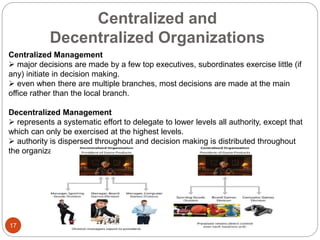
Centralized Management
 major decisions are made by a few top executives, subordinates exercise little (if
any) initiate in decision making.
 even when there are multiple branches, most decisions are made at the main
office rather than the local branch.
Decentralized Management
 represents a systematic effort to delegate to lower levels all authority, except that
which can only be exercised at the highest levels.
 authority is dispersed throughout and decision making is distributed throughout
the organization.
Nature of Line and Staff Relationship
18
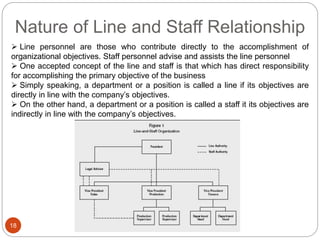
 Line personnel are those who contribute directly to the accomplishment of
organizational objectives. Staff personnel advise and assists the line personnel
 One accepted concept of the line and staff is that which has direct responsibility
for accomplishing the primary objective of the business
 Simply speaking, a department or a position is called a line if its objectives are
directly in line with the company’s objectives.
 On the other hand, a department or a position is called a staff it its objectives are
indirectly in line with the company’s objectives.
“Flat” and “Tall” Structures
19
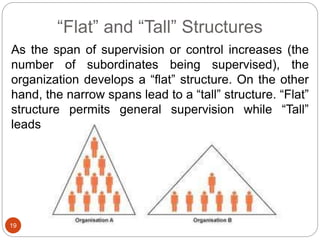
As the span of supervision or control increases (the
number of subordinates being supervised), the
organization develops a “flat” structure. On the other
hand, the narrow spans lead to a “tall” structure. “Flat”
structure permits general supervision while “Tall”
leads to close or tight supervision.

Principles of Management Chapter 4 Organizing

  • 1.
  • 2.
    Learning Objectives 2 At theend of the chapter, the students are expected to understand the following:  Definition of Organizing  Nature of Organizing  Organizing as a Process  The Nature and Development of Organization  Types of Organization Structures  The Nature of Line and Staff Relationship  Organization Chart  Results of Good Organization  The Elements of Delegation  Informal and Formal Organization Centralized and Decentralized Organization
  • 3.
    What is Organizing? 3 The process of grouping together of men and establishing relationships among them, defining the authority and responsibility of personnel by using the company’s other basic resources to attain predetermined goals and objectives.  The identification of the grouping of work to be done, the delegation of authority and responsibility to the employees, and the establishment of relationships among the personnel in order to use to maximum advantage the company’s basic material resources in the
  • 4.
    Organizing – Natureand Process 4 Nature of Organizing:  Some believe it includes the behavior of all member of the group.  Others say it is the total system of social and cultural relationships. Generally, most managers think that the terms means a formalized design of intentional structures, roles and positions. Organizing as a Process:  First, the structure must reflect objectives and plans because activities of the organization are based on them.  Second, the structure must reflect authority given to top and middle management.  Third, organization structure, like any other plan, should reflect their external environment (must be economic, technological, political, social or ethical)  Fourth, the organization must be manned.
  • 5.
    What is anOrganization? 5  “Executive structure of a business” , Webster – It indicates that organization is the framework or backbone  Connotes a “creative process”. – All the parts of a business do not come into existence spontaneously. They are the results of managerial efforts to carry out a predetermined course of action.  Sometimes used to mean the “total business organization”, including facilities, materials, money, and manpower.
  • 6.
    Types of OrganizationStructures 6 1. Line Organization – simplest form of structure and refers to a direct straight-line responsibility and control from the top management to the middle management and to the lower level. 2. Line and Staff Organization – This utilizes the assistance of experts or specialists. Companies expands from single to complex by adding more people to the organization.
  • 7.
    Types of OrganizationStructures 7 3. Functional Organization – It utilizes the pure services of experts or specialists. This removed the staff specialist from his “assisting” capacity and gave him the pure authority and responsibility for supervision and administration of the function. 3. Committees – Used in situation where group participation and decision are required. These are created to undertake special activities rather than routinary activities.
  • 8.
    Organization Chart 8  isa diagram or drawing showing the important aspects of an organizational structure. It shows the relationship among positions as to authority, responsibility, and accountability and the people who occupy them.  As defined by George Terry: “is a diagrammatical form which shows important aspects of an organization including the major functions and their respective relationships, the channels of supervision, and the relative authority of each employee who is in charge of each function.”
  • 9.
    Purpose and Typesof Organization Chart 9 Purpose:  assists one to view the firm’s structure as a whole. It shows the principal divisions and lines of formal authority.  assists management to divide the different duties or functions in the business establishment so that they will be performed effectively and efficiently. Types of Organization Chart 1. Master Chart or Chart of Authority – it shows the entire organizational structure. 2. Functional Chart – Shows at a glance the functions and activities of the positions and/or departments. It shows the major responsibilities or departments or positions. Listed below each job title are brief statement of the responsibilities. 3. Personnel Chart – same relative manner as the functional chart. Instead of listing the functions, the tiles of the positions of the names of
  • 10.
    Reorganization 10  is theprocess by which an existing organization undergoes changes in the size and shape of the organization structure. The change may range from simple to complex.
  • 11.
    Departmentation 11  Results fromthe grouping of work, the desire to obtain organization units of manageable size, and to utilize managerial ability.  Four bases for departmentalizing an organization. Departmentation by function, product, process and geographical location.
  • 12.
    Results of GoodOrganization 12 A good organization would result in the following 1. Establishing responsibility and preventing “buck passing.” 2. Providing for easier communication 3. Eliminating jurisdictional disputes between individuals 4. Helping develop executive ability 5. Aiding in measuring a person’s performance against his charges and responsibilities 6. Aiding in equitable distribution of work, functions, and/or personnel supervision 7. Permitting expansion and contraction without seriously disrupting the structure. 8. Pointing out “dead-end” jobs. 9. Affording movement in the direction of the “ideal” organization, in times of change. 10.Establishing closer cooperation and higher morale. 11.Delineating avenues of promotion. 12.Preventing duplication of work. 13.Making growth possible with adequate control and without literally killing
  • 13.
    The Elements ofDelegation 13  Delegation is the process of entrusting and transferring responsibility and authority by the top management to the lowest level. The elements of delegation are the following: 1. Responsibility – the work or duty assigned to a particular position. Involves mental and physical activities which must be performed to carry out a task or duty. Two categories: management functions which covers POSDICON and operative functions which include all activities that have to do directly with their specialization. 2. Authority – refers to the power or the right to be obeyed. 3. Accountability – this is the answerability of the obligation to perform the delegated responsibility and to exercise the authority for the proper performance of the work. It cannot be delegated. It is given to the person who accepts the responsibility and is accountable only to the extent that he is given the authority to
  • 14.
    The Art ofDelegation 14  Delegation is considered an art and a science. It is an art because it is a skill that the manager performs effectively if he practices it.  Delegation should first and foremost be tackled before the establishment of goals and objectives and a clear definition of responsibility and authority has been made.  To be effective, the manager must motivate the subordinates to work on the delegated responsibility and authority. Positive motivation instead of negative, should be given.  Positive motivation maybe described as psychological as well as monetary and other tangible benefits.
  • 15.
    The Exception Principle 15 also known as management by exception is closely related to the parity principles.  states that managers should concentrates their efforts on matters that deviate significantly from the normal and let subordinates handle routine matters.  the idea here is that managers should concentrate on those matters that require their abilities and not become bogged down with duties that their subordinates should be doing.  it can be hard to comply with when incompetent or insecure subordinates refer everything to their superiors because they are afraid to make decisions.
  • 16.
    Formal and InformalOrganizations 16 Every organization structure has two systems of operation: the formal and informal. Formal  composed of recognized and formalized lines of communication, authority, and control  have a rigid organization structure, showing the functional roles.  all business, industrial organizations and educational institutions are formal organization. Informal  much more subtle and invisible in the organization chart  lack rigid structure  formed for the purpose of satisfying some social needs  may exist in the formal organizations or may exist and operate independently.  clubs, teams, associates come under this category.
  • 17.
    Centralized and Decentralized Organizations 17 CentralizedManagement  major decisions are made by a few top executives, subordinates exercise little (if any) initiate in decision making.  even when there are multiple branches, most decisions are made at the main office rather than the local branch. Decentralized Management  represents a systematic effort to delegate to lower levels all authority, except that which can only be exercised at the highest levels.  authority is dispersed throughout and decision making is distributed throughout the organization.
  • 18.
    Nature of Lineand Staff Relationship 18  Line personnel are those who contribute directly to the accomplishment of organizational objectives. Staff personnel advise and assists the line personnel  One accepted concept of the line and staff is that which has direct responsibility for accomplishing the primary objective of the business  Simply speaking, a department or a position is called a line if its objectives are directly in line with the company’s objectives.  On the other hand, a department or a position is called a staff it its objectives are indirectly in line with the company’s objectives.
  • 19.
    “Flat” and “Tall”Structures 19 As the span of supervision or control increases (the number of subordinates being supervised), the organization develops a “flat” structure. On the other hand, the narrow spans lead to a “tall” structure. “Flat” structure permits general supervision while “Tall” leads to close or tight supervision.