
Organizing - Syllabus
• Organizing - meaning - nature and purpose -
Dimension of structure - horizontal and
vertical - dimensions - formal and informal
dimensions - organisation chart and manual -
Delegation – Decentralisation -
Departmentation - Span of management.
Organizing determines
What tasks are to be done
Who are able to do that
How the tasks are to be grouped
Who will report to whom
What decisions are to be made
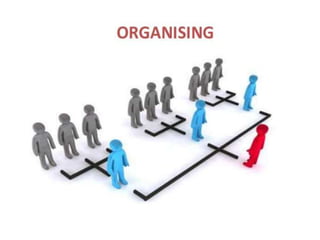
Organizing:
• Organizing is the function of management
that involves developing an organizational
structure and allocating human resources to
ensure the accomplishment of objectives.
• Organizing is the process of defining and
grouping activities, and establishing authority
relationships among them to attain
organizational objectives.
Organizing - Definition
• According to Louis A Allen,
" Organizing is the process of identifying and
grouping of the works to be performed,
defining and delegating responsibility and
authority & establishing relationships for the
purpose of enabling people to work most
efficiently together in accomplishing
objectives.”
Purpose of Organizing
Divide the work to be done into specific jobs and
Departments
Assign tasks and responsibilities associated with
individual
Coordinates diverse organizational tasks.
Clusters job in to Units.
Establish relationship among individuals, group,
and departments
Allocates and deploys organizational resources
Organization
• Organization is a group of people working
together to achieve common goal.
• Organization is an entity comprising multiple
people that has a particular purpose.
• Organization is a formalized structure of roles
& positions.
• Organization structure represents the hierarchical
arrangement of various positions in an
organization.
• It defines how the jobs are formally divided,
grouped and coordinated.
• The framework in which the organization defines
how tasks are divided, resources are deployed,
and departments are coordinated.
• An organization's structure dictates who is in a
position of authority, how work is divided and
how employees are assigned duties.
Organization Structure
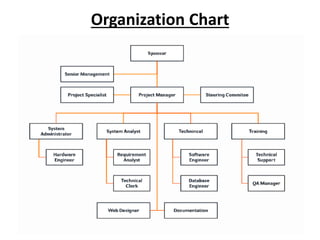
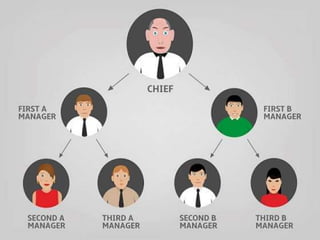
Organization Chart
Organization Chart
• It is a graphic representation of the structure of
an organization showing the relationships of the
positions or jobs within it.
• It is also used to show the relation of one
department to another, or others, or the function
of an organization to another.
• An organizational chart is a diagram that shows
the structure of an organization and the
relationships and relative ranks of its parts and
positions/jobs.
Dimensions of Organization Structure
• An organization's structure dictates who is in a
position of authority, how work is divided and
how employees are assigned duties.
They are,
• Vertical
• Horizontal
Vertical
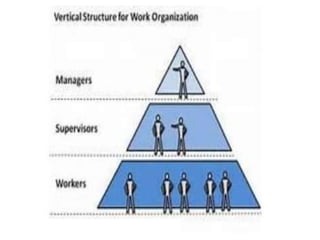
• The vertical organization has a structure with
power emanating from the top - down.
• There's a well-defined chain of command with
a vertical organization, and the person at the
top of the organizational chart has the most
power.
• Employees report to the person directly
above them in the organizational structure.
Horizontal
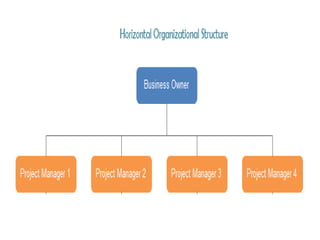
• A horizontal organization has a less-defined
chain of command.
• Employees may perform many different
functions and may report to several
supervisors, rather than a single boss.
• Employees may work in teams, with everyone
on the team having input.
Horizontal structure
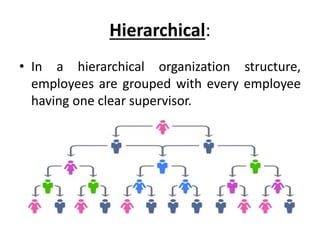
Hierarchical:
• In a hierarchical organization structure,
employees are grouped with every employee
having one clear supervisor.
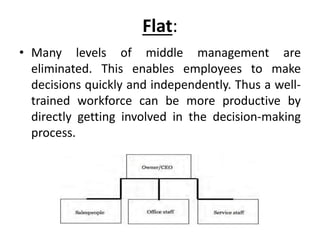
Flat:
• Many levels of middle management are
eliminated. This enables employees to make
decisions quickly and independently. Thus a well-
trained workforce can be more productive by
directly getting involved in the decision-making
process.
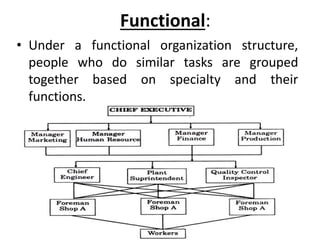
Functional:
• Under a functional organization structure,
people who do similar tasks are grouped
together based on specialty and their
functions.
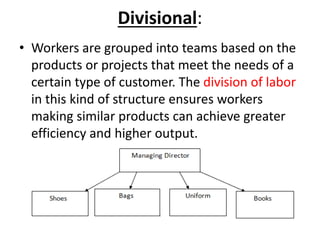
Divisional:
• Workers are grouped into teams based on the
products or projects that meet the needs of a
certain type of customer. The division of labor
in this kind of structure ensures workers
making similar products can achieve greater
efficiency and higher output.
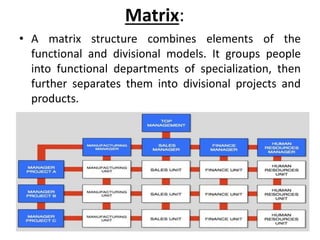
Matrix:
• A matrix structure combines elements of the
functional and divisional models. It groups people
into functional departments of specialization, then
further separates them into divisional projects and
products.
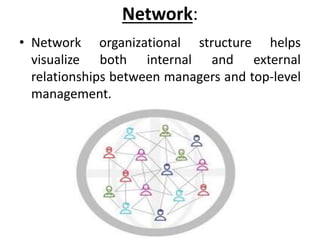
Network:
• Network organizational structure helps
visualize both internal and external
relationships between managers and top-level
management.
Elements of Organization Structure
(Organizational Design)
Work Specialization
Delegation of Authority
Departmentalization
Chain of Command
Span of Management
Centralization & Decentralization
Formalization
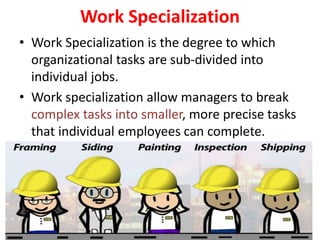
Work Specialization
• Work Specialization is the degree to which
organizational tasks are sub-divided into
individual jobs.
• Work specialization allow managers to break
complex tasks into smaller, more precise tasks
that individual employees can complete.
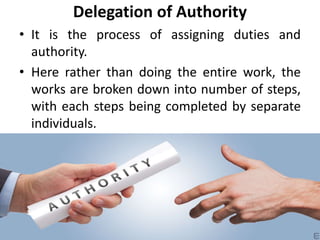
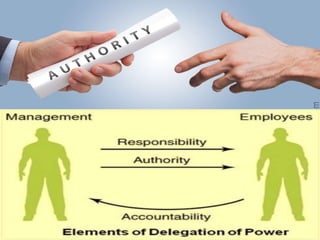
Delegation of Authority
• It is the process of assigning duties and
authority.
• Here rather than doing the entire work, the
works are broken down into number of steps,
with each steps being completed by separate
individuals.
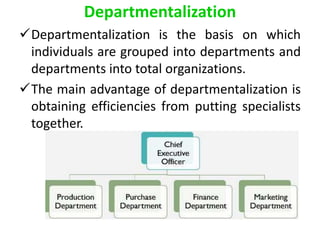
Departmentalization
Departmentalization is the basis on which
individuals are grouped into departments and
departments into total organizations.
The main advantage of departmentalization is
obtaining efficiencies from putting specialists
together.
Departmentalization includes,
• Functional
• Product / Service
• Geography
• Process
• Customer
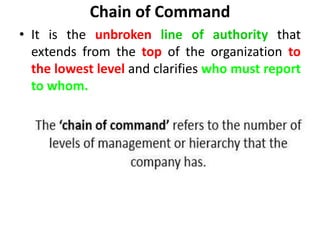
Chain of Command
• It is the unbroken line of authority that
extends from the top of the organization to
the lowest level and clarifies who must report
to whom.
Span of Management
• The total number of subordinates who can be
effectively and efficiently supervised and
controlled by a manager.
• Two Types
Narrow Span
Wide Span
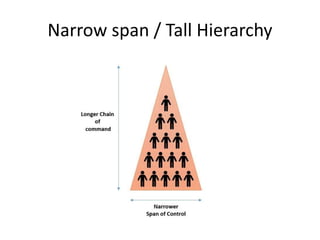
Narrow span / Tall Hierarchy
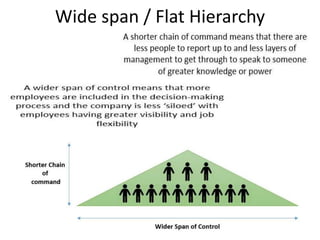
Wide span / Flat Hierarchy
Centralization & Decentralization
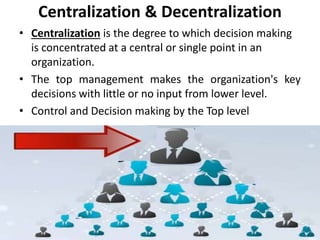
• Centralization is the degree to which decision making
is concentrated at a central or single point in an
organization.
• The top management makes the organization's key
decisions with little or no input from lower level.
• Control and Decision making by the Top level
Decentralization
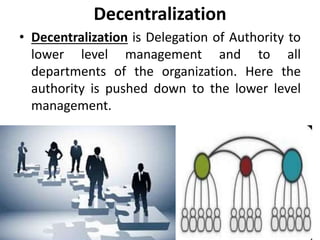
• Decentralization is Delegation of Authority to
lower level management and to all
departments of the organization. Here the
authority is pushed down to the lower level
management.
Formalization
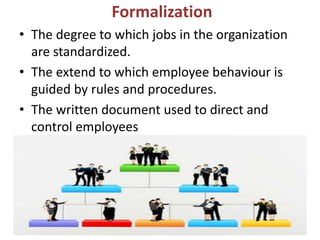
• The degree to which jobs in the organization
are standardized.
• The extend to which employee behaviour is
guided by rules and procedures.
• The written document used to direct and
control employees
Organizing bba-2019
Organizing bba-2019

Organizing bba-2019

  • 2.
    Organizing - Syllabus •Organizing - meaning - nature and purpose - Dimension of structure - horizontal and vertical - dimensions - formal and informal dimensions - organisation chart and manual - Delegation – Decentralisation - Departmentation - Span of management.
  • 3.
    Organizing determines What tasksare to be done Who are able to do that How the tasks are to be grouped Who will report to whom What decisions are to be made
  • 4.
    Organizing: • Organizing isthe function of management that involves developing an organizational structure and allocating human resources to ensure the accomplishment of objectives. • Organizing is the process of defining and grouping activities, and establishing authority relationships among them to attain organizational objectives.
  • 5.
    Organizing - Definition •According to Louis A Allen, " Organizing is the process of identifying and grouping of the works to be performed, defining and delegating responsibility and authority & establishing relationships for the purpose of enabling people to work most efficiently together in accomplishing objectives.”
  • 6.
    Purpose of Organizing Dividethe work to be done into specific jobs and Departments Assign tasks and responsibilities associated with individual Coordinates diverse organizational tasks. Clusters job in to Units. Establish relationship among individuals, group, and departments Allocates and deploys organizational resources
  • 7.
    Organization • Organization isa group of people working together to achieve common goal. • Organization is an entity comprising multiple people that has a particular purpose. • Organization is a formalized structure of roles & positions.
  • 8.
    • Organization structurerepresents the hierarchical arrangement of various positions in an organization. • It defines how the jobs are formally divided, grouped and coordinated. • The framework in which the organization defines how tasks are divided, resources are deployed, and departments are coordinated. • An organization's structure dictates who is in a position of authority, how work is divided and how employees are assigned duties. Organization Structure
  • 9.
  • 10.
    Organization Chart • Itis a graphic representation of the structure of an organization showing the relationships of the positions or jobs within it. • It is also used to show the relation of one department to another, or others, or the function of an organization to another. • An organizational chart is a diagram that shows the structure of an organization and the relationships and relative ranks of its parts and positions/jobs.
  • 11.
    Dimensions of OrganizationStructure • An organization's structure dictates who is in a position of authority, how work is divided and how employees are assigned duties. They are, • Vertical • Horizontal
  • 12.
    Vertical • The verticalorganization has a structure with power emanating from the top - down. • There's a well-defined chain of command with a vertical organization, and the person at the top of the organizational chart has the most power. • Employees report to the person directly above them in the organizational structure.
  • 14.
    Horizontal • A horizontalorganization has a less-defined chain of command. • Employees may perform many different functions and may report to several supervisors, rather than a single boss. • Employees may work in teams, with everyone on the team having input.
  • 15.
  • 16.
    Hierarchical: • In ahierarchical organization structure, employees are grouped with every employee having one clear supervisor.
  • 17.
    Flat: • Many levelsof middle management are eliminated. This enables employees to make decisions quickly and independently. Thus a well- trained workforce can be more productive by directly getting involved in the decision-making process.
  • 18.
    Functional: • Under afunctional organization structure, people who do similar tasks are grouped together based on specialty and their functions.
  • 19.
    Divisional: • Workers aregrouped into teams based on the products or projects that meet the needs of a certain type of customer. The division of labor in this kind of structure ensures workers making similar products can achieve greater efficiency and higher output.
  • 20.
    Matrix: • A matrixstructure combines elements of the functional and divisional models. It groups people into functional departments of specialization, then further separates them into divisional projects and products.
  • 21.
    Network: • Network organizationalstructure helps visualize both internal and external relationships between managers and top-level management.
  • 22.
    Elements of OrganizationStructure (Organizational Design) Work Specialization Delegation of Authority Departmentalization Chain of Command Span of Management Centralization & Decentralization Formalization
  • 23.
    Work Specialization • WorkSpecialization is the degree to which organizational tasks are sub-divided into individual jobs. • Work specialization allow managers to break complex tasks into smaller, more precise tasks that individual employees can complete.
  • 24.
    Delegation of Authority •It is the process of assigning duties and authority. • Here rather than doing the entire work, the works are broken down into number of steps, with each steps being completed by separate individuals.
  • 26.
    Departmentalization Departmentalization is thebasis on which individuals are grouped into departments and departments into total organizations. The main advantage of departmentalization is obtaining efficiencies from putting specialists together.
  • 27.
    Departmentalization includes, • Functional •Product / Service • Geography • Process • Customer
  • 28.
    Chain of Command •It is the unbroken line of authority that extends from the top of the organization to the lowest level and clarifies who must report to whom.
  • 30.
    Span of Management •The total number of subordinates who can be effectively and efficiently supervised and controlled by a manager. • Two Types Narrow Span Wide Span
  • 31.
    Narrow span /Tall Hierarchy
  • 32.
    Wide span /Flat Hierarchy
  • 33.
    Centralization & Decentralization •Centralization is the degree to which decision making is concentrated at a central or single point in an organization. • The top management makes the organization's key decisions with little or no input from lower level. • Control and Decision making by the Top level
  • 34.
    Decentralization • Decentralization isDelegation of Authority to lower level management and to all departments of the organization. Here the authority is pushed down to the lower level management.
  • 35.
    Formalization • The degreeto which jobs in the organization are standardized. • The extend to which employee behaviour is guided by rules and procedures. • The written document used to direct and control employees