




ORGANIZING DEFINED
NATURE OF ORGANIZATION
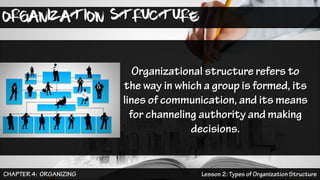
ORGANIZATION STRUCTURE
•
•
ORGANIZATION STRUCTURE
•
•
•
•
•
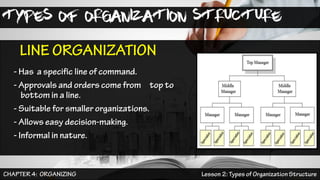
TYPES OF ORGANIZATION STRUCTURE
•
•
•
•
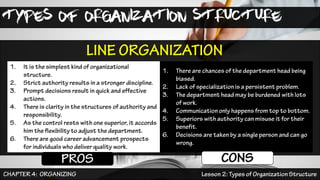
TYPES OF ORGANIZATION STRUCTURE
•
•
TYPES OF ORGANIZATION STRUCTURE
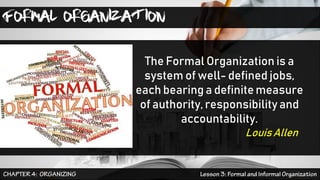
FORMAL ORGANIZATION
The Formal Organization is a
system of well- defined jobs,
each bearing a definitemeasure
of authority, responsibility and
accountability.
LouisAllen
Characteristics of FORMAL ORGANIZATION
WELL-DEFINED
RULES AND
REGULATION
Characteristics of FORMAL ORGANIZATION
ARBITRARY
STRUCTURE
Characteristics of FORMAL ORGANIZATION
LIMITATION ON THE
ACTIVITIES ON THE
INDIVIDUAL
Characteristics of FORMAL ORGANIZATION
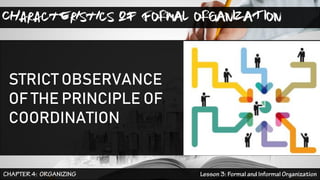
STRICT OBSERVANCE
OF THE PRINCIPLE OF
COORDINATION
Characteristics of FORMAL ORGANIZATION
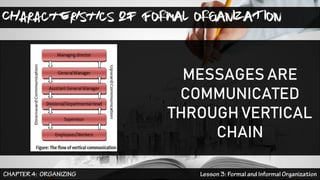
MESSAGES ARE
COMMUNICATED
THROUGH VERTICAL
CHAIN
Characteristics of FORMAL ORGANIZATION
STATUS SYMBOL
INFORMAL ORGANIZATION
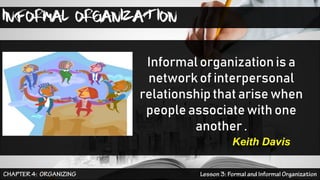
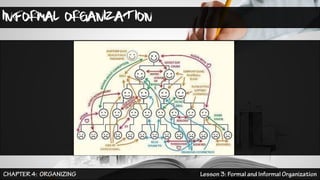
Informal organization is a
network of interpersonal
relationship that arise when
people associate with one
another .
Keith Davis
INFORMAL ORGANIZATION
The leader of an informal organization
is elected by the members of the
groups for different reasons such as
age, seniority, technical, competence,
work location, and responsive
personality, etc. depending upon
the work situation.
functions of FORMAL ORGANIZATION
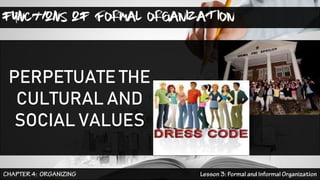
PERPETUATE THE
CULTURAL AND
SOCIAL VALUES
functions of FORMAL ORGANIZATION
PROVIDE SOCIAL
STATUS AND
SATISFACTION
functions of FORMAL ORGANIZATION
PROMOTE
COMMUNICATION
AMONG MEMBERS
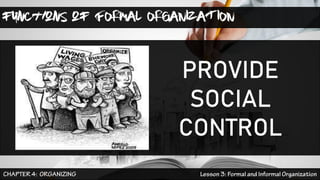
functions of FORMAL ORGANIZATION
PROVIDE
SOCIAL
CONTROL
Differences between Formal and Informal Organization
Formal organization is created deliberately and consciously by
management.
Informal organization emerges spontaneously on account of
socio psychological forces operating at the work place.
Differences between Formal and Informal Organization
Formal Organization is created for achieving the legitimate
objective of the organization.
Informal Organization is created by the members of the
organization for their social and psychological satisfaction.
Differences between Formal and Informal Organization
Formal group may be quite large in size.
Informal groups tent to be small.
Differences between Formal and Informal Organization
Formal organization is bound together by a
hierarchical structure.
In Informal organization all members are equal
Differences between Formal and Informal Organization
In formal organization behavior of the members were
governed by formal rules and regulations.
In the informal organization the behavior of the
members is governed by norms beliefs and value of the
group
In formal organization, communication normally flows
through the prescribed chain of command.
In informal organization communications pass through the
informal channels.
Differences between Formal and Informal Organization
Management can abolish the formal groups at any time.
Management has no control over informal groups which
are the creation of natural desire of human beings to
interact.
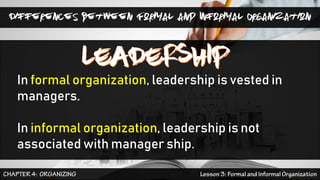
Differences between Formal and Informal Organization
In formal organization, leadership is vested in
managers.
In informal organization, leadership is not
associated with manager ship.
Differences between Formal and Informal Organization
There are sharp status differentials among the
members of formal organization, which inhibit free
interaction and socialization.
In informal organization there may be social ranking
among people but these do not prevent free interaction
among people.
Chapter 4 organizing

Chapter 4 organizing