OBJECTIVES:
1.Nature of organizing
2.Types of organization structures
3.Organization theories and application
4.Delegation
5.Formal & informal organizations
Organizing
Organizing
-Is the function of management that involves
developing an organizational structure and
allocating human resources to ensure the
accomplishment of objectives.
- Determining what tasks are to be done, who
is to do them, how the tasks are to be
grouped, who reports to whom, and where
decisions are to be made..
Organization Structure
-A set of formal tasks assigned to individuals and
departments.
-Formal reporting relationships, including lines of
authority, decision responsibility, number of
hierarchical levels and span of managers control.
-The design of systems to ensure effective
coordination of employees across departments.
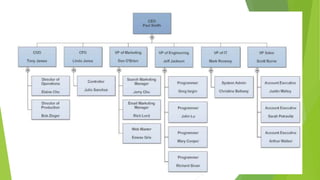
The set of formal tasks and formal
reporting relationships provides a
framework for vertical control of the
organization. The characteristics of
vertical structure are portrayed in
the organization chart, which is the
visual representation of an
organization’s structure.
Features of
Organization Structure
Features of Organization Structure
1. Work specialization
 Work specialization (also called division of labor or
job specialization) is the degree to which
organizational tasks are sub-divided into individual
jobs. It may increase the efficiency of workers,
but with too much specialization, employees may
feel isolated and bored. Many organizations
enlarge jobs or rotate assigned tasks to provide
greater challenges.
Features of Organization Structure
2. Chain of command
The chain of command (can also be called “hierarchy of
authority”) is an unbroken line of authority that links all
persons in an organization and shows who reports to
whom. It is associated with two underlying principles:
 Unity of Command – means that each employee is held
accountable to only one supervisor.
 Scalar Principle – refers to a clearly defined line of
authority in the organization that includes all
employees
Authority is a manager's formal and legitimate
right to make decisions, issue orders, and
allocate resources to achieve organizationally
desired outcomes and it is distinguished by
three characteristics:
Authority is vested in organizational positions,
not people.
Authority is accepted by subordinates.
Authority flows down the vertical hierarchy.
Responsibility means an
employee's duty to perform
assigned task or activities.
Accountability means that those
with authority and responsibility must
report and justify task outcomes to
those above them in the chain of
command.
Features of Organization Structure
3. Span of management – sometimes called
the span of control; the number of
employees reporting to a supervisor
Categories:
a.Direct single relationship.
b.Direct group relationships.
c.Cross relationship.
Types of Organization Structures
1.According to Bateman and Snell (2008), a
vertical structure clears out issues related to
authority rights, responsibilities, and reporting
relationships.
Authority rights – refer to the legitimate rights of
individuals, appointed in a position like president,
vice-president, manager, and the like, to give
orders to their subordinates, who in turn, report to
them what they have done.
Types of Organization Structures
2. A horizontal structure refers to the
departmentalization of an organization
into smaller work units as tasks
become increasingly varied and
numerous.
Types of Department
1.Line Departments – deal directly with the
firm’s primary goods and services;
responsible for manufacturing, selling, and
providing services to clients.
2.Staff departments – support the activities
of the line departments by doing research,
attending to legal matters, performing
public relations duties
Departmentalization may be done using
three approaches:
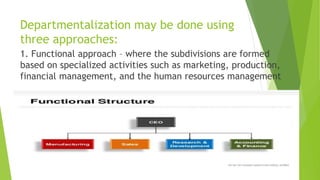
1. Functional approach – where the subdivisions are formed
based on specialized activities such as marketing, production,
financial management, and the human resources management
Departmentalization may be done using
three approaches:
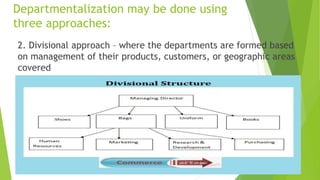
2. Divisional approach – where the departments are formed based
on management of their products, customers, or geographic areas
covered
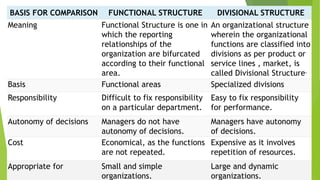
BASIS FOR COMPARISON FUNCTIONAL STRUCTURE DIVISIONAL STRUCTURE
Meaning Functional Structure is one in
which the reporting
relationships of the
organization are bifurcated
according to their functional
area.
An organizational structure
wherein the organizational
functions are classified into
divisions as per product or
service lines , market, is
called Divisional Structure.
Basis Functional areas Specialized divisions
Responsibility Difficult to fix responsibility
on a particular department.
Easy to fix responsibility
for performance.
Autonomy of decisions Managers do not have
autonomy of decisions.
Managers have autonomy
of decisions.
Cost Economical, as the functions
are not repeated.
Expensive as it involves
repetition of resources.
Appropriate for Small and simple
organizations.
Large and dynamic
organizations.
Departmentalization may be done using
three approaches:
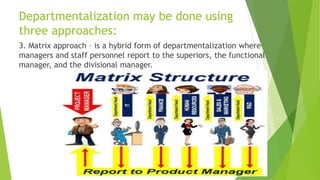
3. Matrix approach – is a hybrid form of departmentalization where
managers and staff personnel report to the superiors, the functional
manager, and the divisional manager.
Types of Organization Structures
3. A network structure is a
collection of independent, usually
single function
organizations/companies that work
together in order to produce a
product or service
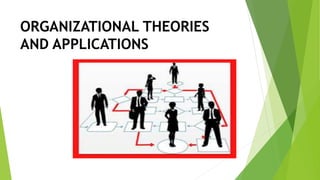
ORGANIZATIONAL THEORIES
AND APPLICATIONS
ORGANIZATIONAL THEORIES AND APPLICATIONS
There are two main classifications of theories
regarding organizational design (Robbins and
Coulter, 2009)
a.Traditional – pertains to the usual or old-
fashioned ways
b.Modern – refers to contemporary or new
design theories
Traditional organizational design theories
include:
1. Simple – this organizational design has few
departments, wide spans of control, or a big
number of subordinates directly reporting to a
manager
- has a centralized authority figure and has very
little formalization of work
- usually used by companies that start out as
entrepreneurial ventures
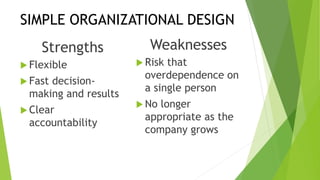
SIMPLE ORGANIZATIONAL DESIGN
Strengths
 Flexible
 Fast decision-
making and results
 Clear
accountability
Weaknesses
 Risk that
overdependence on
a single person
 No longer
appropriate as the
company grows
Traditional organizational design theories
include:
2.Functional – this organizational design groups
together similar or related specialties
- Generally, functional departmentalization is
utilized and put into practice in an entire
organization
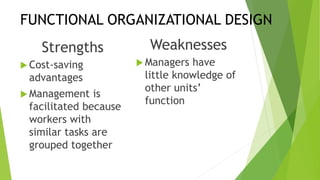
FUNCTIONAL ORGANIZATIONAL DESIGN
Strengths
 Cost-saving
advantages
 Management is
facilitated because
workers with
similar tasks are
grouped together
Weaknesses
 Managers have
little knowledge of
other units’
function
Traditional organizational design theories
include:
3. Divisional – this organizational design is made
up of separate business divisions or units, where
the parent corporation acts as overseer to
coordinate and control the different divisions and
provide financial and legal support services.
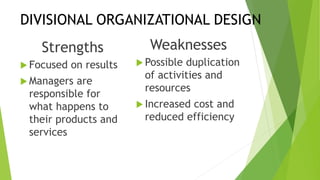
DIVISIONAL ORGANIZATIONAL DESIGN
Strengths
 Focused on results
 Managers are
responsible for
what happens to
their products and
services
Weaknesses
 Possible duplication
of activities and
resources
 Increased cost and
reduced efficiency
Modern organizational design theories
include:
1. Team Design – in here, the entire
organization is made up of work
groups or teams.
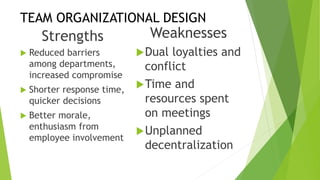
TEAM ORGANIZATIONAL DESIGN
Strengths
 Reduced barriers
among departments,
increased compromise
 Shorter response time,
quicker decisions
 Better morale,
enthusiasm from
employee involvement
Weaknesses
Dual loyalties and
conflict
Time and
resources spent
on meetings
Unplanned
decentralization
Modern organizational design theories
include:
2. Matrix-Project Design – this refers to an
organization design where specialist from
different departments work on projects that are
supervised by a project manager
Project design – refers to an organization design
where employees continuously work on a project
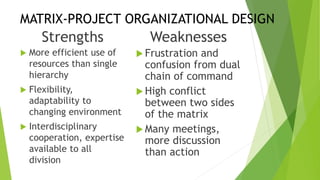
MATRIX-PROJECT ORGANIZATIONAL DESIGN
Strengths
 More efficient use of
resources than single
hierarchy
 Flexibility,
adaptability to
changing environment
 Interdisciplinary
cooperation, expertise
available to all
division
Weaknesses
 Frustration and
confusion from dual
chain of command
 High conflict
between two sides
of the matrix
 Many meetings,
more discussion
than action
Modern organizational design theories
include:
3. Boundary-less Design (Virtual Network Design)– this
organization design is not defined or limited by vertical,
horizontal, and external boundaries. In other words,
there are no hierarchical levels that separate
employees, no departmentalization, and no boundaries
that separate the organization from customers,
suppliers, and other stakeholders.
Small groups of full-time employees and outside
specialists are temporarily hired to work on projects
(outsourcing).
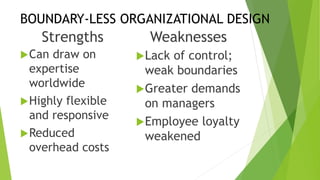
BOUNDARY-LESS ORGANIZATIONAL DESIGN
Strengths
Can draw on
expertise
worldwide
Highly flexible
and responsive
Reduced
overhead costs
Weaknesses
Lack of control;
weak boundaries
Greater demands
on managers
Employee loyalty
weakened
DELEGATION
- is the assignment of any
responsibility or authority to
another person to carry out
specific activities.
Priming Activity:
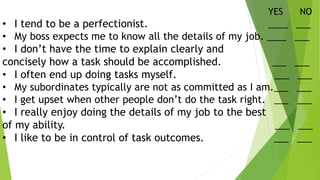
Are you a positive delegator?
Positive delegation is the way an
organization implements decentralization.
Do you help or hinder the decentralization
process? Answer yes or no to the following
questions.
)
YES NO
• I tend to be a perfectionist. ____ ___
• My boss expects me to know all the details of my job. ____ ___
• I don’t have the time to explain clearly and
concisely how a task should be accomplished. ___ ___
• I often end up doing tasks myself. ___ ___
• My subordinates typically are not as committed as I am.___ ___
• I get upset when other people don’t do the task right. ___ ___
• I really enjoy doing the details of my job to the best
of my ability. ___ ___
• I like to be in control of task outcomes. ___ ___
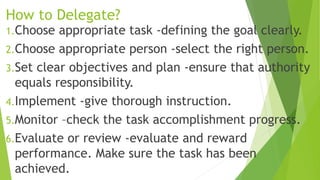
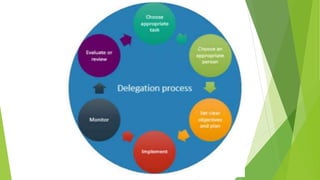
How to Delegate?
1.Choose appropriate task -defining the goal clearly.
2.Choose appropriate person -select the right person.
3.Set clear objectives and plan -ensure that authority
equals responsibility.
4.Implement -give thorough instruction.
5.Monitor –check the task accomplishment progress.
6.Evaluate or review -evaluate and reward
performance. Make sure the task has been
achieved.
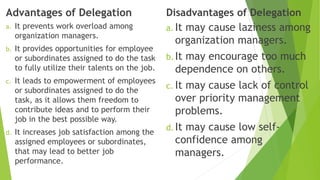
Advantages of Delegation
a. It prevents work overload among
organization managers.
b. It provides opportunities for employee
or subordinates assigned to do the task
to fully utilize their talents on the job.
c. It leads to empowerment of employees
or subordinates assigned to do the
task, as it allows them freedom to
contribute ideas and to perform their
job in the best possible way.
d. It increases job satisfaction among the
assigned employees or subordinates,
that may lead to better job
performance.
Disadvantages of Delegation
a. It may cause laziness among
organization managers.
b.It may encourage too much
dependence on others.
c. It may cause lack of control
over priority management
problems.
d.It may cause low self-
confidence among
managers.
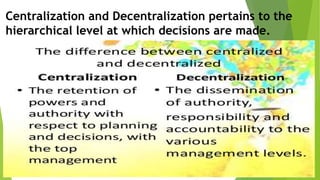
Centralization and Decentralization pertains to the
hierarchical level at which decisions are made.
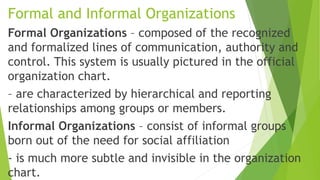
Formal and Informal Organizations
Formal Organizations – composed of the recognized
and formalized lines of communication, authority and
control. This system is usually pictured in the official
organization chart.
– are characterized by hierarchical and reporting
relationships among groups or members.
Informal Organizations – consist of informal groups
born out of the need for social affiliation
- is much more subtle and invisible in the organization
chart.
Functions of Formal Organization
1.Accomplish goals that require cooperation or
collaboration among formal groups in the
organization.
2.Produce or bring about new and creative ideas and
solutions to company problems.
3.Coordinate interdepartmental activities.
4.Implement company rules/regulations and
policies.
5.Orient/train new employees.
Functions of Informal Organization
1.Satisfy the members’ need for affiliation.
2.Give the individual members a chance to develop
their self-esteem.
3.Give individual members an opportunity to share
their ideas.
4.Lessen individual members’ insecurity.
5.Provide a mechanism to solve members’ personal
and interpersonal problems.
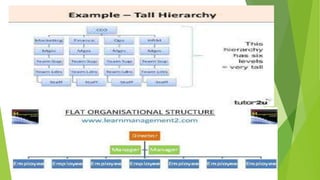
TALL VS. FLAT ORGANIZATIONAL STRUCTURE
Tall Organizational Structure – consist of several layers
of management…. These employees report to the next
layer, or the first layer of management…. Each layer of
manager reports to the next layer of manager which
culminates with the president of the company.
Flat Organizational Structure – with few or no levels of
management between management at staff level
employees. The flat organization supervises employees
less while promoting their increased involvement in the
decision-making process
THANK YOU
and
GODBLESS…..

Organizing

  • 1.
    OBJECTIVES: 1.Nature of organizing 2.Typesof organization structures 3.Organization theories and application 4.Delegation 5.Formal & informal organizations
  • 2.
  • 3.
    Organizing -Is the functionof management that involves developing an organizational structure and allocating human resources to ensure the accomplishment of objectives. - Determining what tasks are to be done, who is to do them, how the tasks are to be grouped, who reports to whom, and where decisions are to be made..
  • 4.
    Organization Structure -A setof formal tasks assigned to individuals and departments. -Formal reporting relationships, including lines of authority, decision responsibility, number of hierarchical levels and span of managers control. -The design of systems to ensure effective coordination of employees across departments.
  • 5.
    The set offormal tasks and formal reporting relationships provides a framework for vertical control of the organization. The characteristics of vertical structure are portrayed in the organization chart, which is the visual representation of an organization’s structure.
  • 7.
  • 8.
    Features of OrganizationStructure 1. Work specialization  Work specialization (also called division of labor or job specialization) is the degree to which organizational tasks are sub-divided into individual jobs. It may increase the efficiency of workers, but with too much specialization, employees may feel isolated and bored. Many organizations enlarge jobs or rotate assigned tasks to provide greater challenges.
  • 9.
    Features of OrganizationStructure 2. Chain of command The chain of command (can also be called “hierarchy of authority”) is an unbroken line of authority that links all persons in an organization and shows who reports to whom. It is associated with two underlying principles:  Unity of Command – means that each employee is held accountable to only one supervisor.  Scalar Principle – refers to a clearly defined line of authority in the organization that includes all employees
  • 10.
    Authority is amanager's formal and legitimate right to make decisions, issue orders, and allocate resources to achieve organizationally desired outcomes and it is distinguished by three characteristics: Authority is vested in organizational positions, not people. Authority is accepted by subordinates. Authority flows down the vertical hierarchy.
  • 11.
    Responsibility means an employee'sduty to perform assigned task or activities. Accountability means that those with authority and responsibility must report and justify task outcomes to those above them in the chain of command.
  • 12.
    Features of OrganizationStructure 3. Span of management – sometimes called the span of control; the number of employees reporting to a supervisor Categories: a.Direct single relationship. b.Direct group relationships. c.Cross relationship.
  • 13.
    Types of OrganizationStructures 1.According to Bateman and Snell (2008), a vertical structure clears out issues related to authority rights, responsibilities, and reporting relationships. Authority rights – refer to the legitimate rights of individuals, appointed in a position like president, vice-president, manager, and the like, to give orders to their subordinates, who in turn, report to them what they have done.
  • 14.
    Types of OrganizationStructures 2. A horizontal structure refers to the departmentalization of an organization into smaller work units as tasks become increasingly varied and numerous.
  • 15.
    Types of Department 1.LineDepartments – deal directly with the firm’s primary goods and services; responsible for manufacturing, selling, and providing services to clients. 2.Staff departments – support the activities of the line departments by doing research, attending to legal matters, performing public relations duties
  • 16.
    Departmentalization may bedone using three approaches: 1. Functional approach – where the subdivisions are formed based on specialized activities such as marketing, production, financial management, and the human resources management
  • 17.
    Departmentalization may bedone using three approaches: 2. Divisional approach – where the departments are formed based on management of their products, customers, or geographic areas covered
  • 18.
    BASIS FOR COMPARISONFUNCTIONAL STRUCTURE DIVISIONAL STRUCTURE Meaning Functional Structure is one in which the reporting relationships of the organization are bifurcated according to their functional area. An organizational structure wherein the organizational functions are classified into divisions as per product or service lines , market, is called Divisional Structure. Basis Functional areas Specialized divisions Responsibility Difficult to fix responsibility on a particular department. Easy to fix responsibility for performance. Autonomy of decisions Managers do not have autonomy of decisions. Managers have autonomy of decisions. Cost Economical, as the functions are not repeated. Expensive as it involves repetition of resources. Appropriate for Small and simple organizations. Large and dynamic organizations.
  • 19.
    Departmentalization may bedone using three approaches: 3. Matrix approach – is a hybrid form of departmentalization where managers and staff personnel report to the superiors, the functional manager, and the divisional manager.
  • 20.
    Types of OrganizationStructures 3. A network structure is a collection of independent, usually single function organizations/companies that work together in order to produce a product or service
  • 21.
  • 22.
    ORGANIZATIONAL THEORIES ANDAPPLICATIONS There are two main classifications of theories regarding organizational design (Robbins and Coulter, 2009) a.Traditional – pertains to the usual or old- fashioned ways b.Modern – refers to contemporary or new design theories
  • 23.
    Traditional organizational designtheories include: 1. Simple – this organizational design has few departments, wide spans of control, or a big number of subordinates directly reporting to a manager - has a centralized authority figure and has very little formalization of work - usually used by companies that start out as entrepreneurial ventures
  • 24.
    SIMPLE ORGANIZATIONAL DESIGN Strengths Flexible  Fast decision- making and results  Clear accountability Weaknesses  Risk that overdependence on a single person  No longer appropriate as the company grows
  • 25.
    Traditional organizational designtheories include: 2.Functional – this organizational design groups together similar or related specialties - Generally, functional departmentalization is utilized and put into practice in an entire organization
  • 26.
    FUNCTIONAL ORGANIZATIONAL DESIGN Strengths Cost-saving advantages  Management is facilitated because workers with similar tasks are grouped together Weaknesses  Managers have little knowledge of other units’ function
  • 27.
    Traditional organizational designtheories include: 3. Divisional – this organizational design is made up of separate business divisions or units, where the parent corporation acts as overseer to coordinate and control the different divisions and provide financial and legal support services.
  • 28.
    DIVISIONAL ORGANIZATIONAL DESIGN Strengths Focused on results  Managers are responsible for what happens to their products and services Weaknesses  Possible duplication of activities and resources  Increased cost and reduced efficiency
  • 29.
    Modern organizational designtheories include: 1. Team Design – in here, the entire organization is made up of work groups or teams.
  • 30.
    TEAM ORGANIZATIONAL DESIGN Strengths Reduced barriers among departments, increased compromise  Shorter response time, quicker decisions  Better morale, enthusiasm from employee involvement Weaknesses Dual loyalties and conflict Time and resources spent on meetings Unplanned decentralization
  • 31.
    Modern organizational designtheories include: 2. Matrix-Project Design – this refers to an organization design where specialist from different departments work on projects that are supervised by a project manager Project design – refers to an organization design where employees continuously work on a project
  • 32.
    MATRIX-PROJECT ORGANIZATIONAL DESIGN Strengths More efficient use of resources than single hierarchy  Flexibility, adaptability to changing environment  Interdisciplinary cooperation, expertise available to all division Weaknesses  Frustration and confusion from dual chain of command  High conflict between two sides of the matrix  Many meetings, more discussion than action
  • 33.
    Modern organizational designtheories include: 3. Boundary-less Design (Virtual Network Design)– this organization design is not defined or limited by vertical, horizontal, and external boundaries. In other words, there are no hierarchical levels that separate employees, no departmentalization, and no boundaries that separate the organization from customers, suppliers, and other stakeholders. Small groups of full-time employees and outside specialists are temporarily hired to work on projects (outsourcing).
  • 34.
    BOUNDARY-LESS ORGANIZATIONAL DESIGN Strengths Candraw on expertise worldwide Highly flexible and responsive Reduced overhead costs Weaknesses Lack of control; weak boundaries Greater demands on managers Employee loyalty weakened
  • 35.
    DELEGATION - is theassignment of any responsibility or authority to another person to carry out specific activities.
  • 36.
    Priming Activity: Are youa positive delegator? Positive delegation is the way an organization implements decentralization. Do you help or hinder the decentralization process? Answer yes or no to the following questions. )
  • 37.
    YES NO • Itend to be a perfectionist. ____ ___ • My boss expects me to know all the details of my job. ____ ___ • I don’t have the time to explain clearly and concisely how a task should be accomplished. ___ ___ • I often end up doing tasks myself. ___ ___ • My subordinates typically are not as committed as I am.___ ___ • I get upset when other people don’t do the task right. ___ ___ • I really enjoy doing the details of my job to the best of my ability. ___ ___ • I like to be in control of task outcomes. ___ ___
  • 39.
    How to Delegate? 1.Chooseappropriate task -defining the goal clearly. 2.Choose appropriate person -select the right person. 3.Set clear objectives and plan -ensure that authority equals responsibility. 4.Implement -give thorough instruction. 5.Monitor –check the task accomplishment progress. 6.Evaluate or review -evaluate and reward performance. Make sure the task has been achieved.
  • 40.
    Advantages of Delegation a.It prevents work overload among organization managers. b. It provides opportunities for employee or subordinates assigned to do the task to fully utilize their talents on the job. c. It leads to empowerment of employees or subordinates assigned to do the task, as it allows them freedom to contribute ideas and to perform their job in the best possible way. d. It increases job satisfaction among the assigned employees or subordinates, that may lead to better job performance. Disadvantages of Delegation a. It may cause laziness among organization managers. b.It may encourage too much dependence on others. c. It may cause lack of control over priority management problems. d.It may cause low self- confidence among managers.
  • 41.
    Centralization and Decentralizationpertains to the hierarchical level at which decisions are made.
  • 42.
    Formal and InformalOrganizations Formal Organizations – composed of the recognized and formalized lines of communication, authority and control. This system is usually pictured in the official organization chart. – are characterized by hierarchical and reporting relationships among groups or members. Informal Organizations – consist of informal groups born out of the need for social affiliation - is much more subtle and invisible in the organization chart.
  • 43.
    Functions of FormalOrganization 1.Accomplish goals that require cooperation or collaboration among formal groups in the organization. 2.Produce or bring about new and creative ideas and solutions to company problems. 3.Coordinate interdepartmental activities. 4.Implement company rules/regulations and policies. 5.Orient/train new employees.
  • 44.
    Functions of InformalOrganization 1.Satisfy the members’ need for affiliation. 2.Give the individual members a chance to develop their self-esteem. 3.Give individual members an opportunity to share their ideas. 4.Lessen individual members’ insecurity. 5.Provide a mechanism to solve members’ personal and interpersonal problems.
  • 45.
    TALL VS. FLATORGANIZATIONAL STRUCTURE Tall Organizational Structure – consist of several layers of management…. These employees report to the next layer, or the first layer of management…. Each layer of manager reports to the next layer of manager which culminates with the president of the company. Flat Organizational Structure – with few or no levels of management between management at staff level employees. The flat organization supervises employees less while promoting their increased involvement in the decision-making process
  • 47.

Editor's Notes

  • #4 Organizing is a function by which the concern is able to define the role position, the job related and the coordination between authority and responsibility Giving the right person the right job Hierarchical relationship Aligning of different act, dif. Work dif. People min. of errors maximum of effeciency Process of arranging people and resources to work towards a commom goal. Divide up the work, arrange the resources, coordinate activities Planning to set the direction, a manager decides what is to be done in future In organising, he decides the ways and means through wich it will be easier to achieve what has been plnned
  • #18 The functional organisational structure is one where employees are grouped together, according to their area of specialisation. On the other hand, divisional organisation structure refers to the structure wherein the organisational functions are grouped together, into divisions, depending on product, service, market or geographies
  • #19 Bifurcated – divide into two branches Responsibility – state or fact of having a duty to deal with something or of having control over someone The state or fact of being accountable or to blame for something. Functional Areas – teams of employees who have similar skills and expertise Autonomy – independence or freedom, as of the will or one’s actions Economical – giving good value or services in relation to the amount of mone time or effort spent; careful not to waste money or resources.
  • #20 Hybrid – a thing made be combining
  • #24 Etrepreneural ventures – individual who starts a business with a limited resources and planning. And is responsible for all the risks and rewards of his or her bus. venture
  • #36 Delegation occurs when someone with authority confers upon another person the power to do a particular task Normally from a manager to a subordinate Who is accountable for the outcome of the delegated work
  • #37 (for the teachers: if students answer yes to more than three of the following questions, they may have a problem delegating
  • #38 (for the teachers: if students answer yes to more than three of the following questions, they may have a problem delegating
  • #45 Mechanism – a habitual manner of acting to achieve an end. A usually unconscious mental and emotional pattern that shapes behaviour in a given situation or environment: a defense mechanism A natural or established process by which something takes place or is brought about..
  • #46 Reach a climax or point of highest development