UNIT III
ORGANIZING
• Nature and purpose of organizing
• Organization structure – Formal and informal
groups / organization
• Line and Staff authority – Departmentation –
Span of Control – Centralization and
Decentralization – Delegation of authority
• Staffing – Selection and Recruitment
• Orientation Career Development – Career
stages – Training – Performance Appraisal.
ORGANIZING
• Organizing is the process of identifying and
grouping of activities required to attain the
objectives, delegating authority, creating
responsibilities and establishing relationship
for people to work effectively
Responsibility,
Responsibility is the obligation of a subordinate to perform the
assigned duties. When a subordinate accepts duties, he has to
perform those duties in the manner desired by the superior.
Duties are assigned to subordinates when a manager has to share
the work with them.
Authority,
When a person is given certain duties to perform, he must be
given necessary authority also. Otherwise, he will not be able to
do the work. A typist, for example, cannot do the typing job if he is
not given the right to use facilities such as a place to sit in, a table,
a chair, a typewriter, typing and carbon papers. Authority should
always follow responsibility*******
Accountability:
•Accountability means answerability. That is, each person has to
report to his superior how the work has been done and how
authority has been used. Accountability is always upward.
•Each subordinate is accountable to his superior who in turn is
accountable to his own superior. In this way, every person
becomes accountable to top management.
•Accountability ensures that the work is done as planned and
authority is properly used.
•An important principle of accountability is the principle of single
accountability. A person should be accountable to one superior
only. If a person is accountable to two or more persons, he may
avoid the work or he may be in difficulty to decide whom to obey
first.
Nature of organizing
• Common objective
• Specialization or division of labor
• Authority of structure
• Group of persons
• Co-ordination
• Communication
• Environment
• Rules and regulations
Process of organizing
1. Determination of activities
2. Grouping of activities
3. Assignment of duties
4. Delegation of authority
5. Establishment of structural relationship
6. Co-ordination of activities
Purpose of organizing
• To facilitate administration
• To increase the efficiency of management
• To facilitate growth and diversification
• To ensure optimum use of man and material
resources
• To facilitate co-ordination and communication
• To permit optimum use of technological innovation
• To simulate creativity and initiative
• To facilitate the development of managerial ability
6–8
Organization chart
• Organization Chart
– A chart that shows the structure of the
organization including the title of each manager’s
position and, by means of connecting lines, who is
accountable to whom and who has authority for
each area.
– Org. Chart also indicates the
chain of command.
The content of Organization chart
• Basic organization structure and flow of authority
• Authority and responsibilities of various
executives
• Relationship between the line and staff personnel
• Name of component of organization
• Position of various office personnel
• Channel of communication
• Total number of person working in an
organization
• Way of promotion and salary particulars
Types of Organization chart
• Top-down or vertical chart
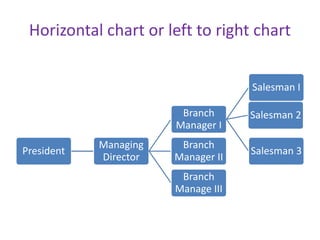
• Horizontal chart or left to right chart
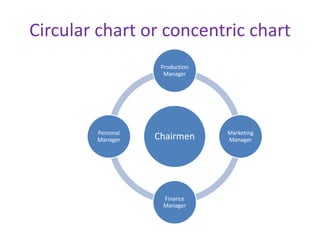
• Circular chart or concentric chart
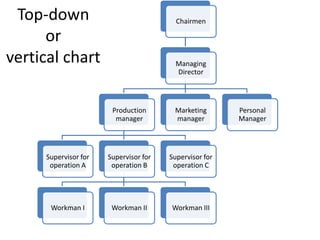
Top-down
or
vertical chart
Chairmen
Managing
Director
Production
manager
Supervisor for
operation A
Supervisor for
operation B
Workman I Workman II Workman III
Supervisor for
operation C
Marketing
manager
Personal
Manager
Horizontal chart or left to right chart
President
Managing
Director
Branch
Manager I
Salesman I
Salesman 2
Salesman 3
Branch
Manager II
Branch
Manage III
Circular chart or concentric chart
Chairmen
Production
Manager
Marketing
Manager
Finance
Manager
Personal
Manager
Advantages of organization chart
• It shows the various positions and relationship
• It shows the line of authority and
responsibility
• It serve as valuable guide to the new
personnel
• Strength and weakness of an organization are
evaluated
• It provide good clues to the line of promotion
Disadvantages of organization chart
• It provide a clear picture of only formal
authority relationship and omits many
informal relationship
• If the charts are not prepared correctly, that
will lead to misleading inference
• It may create psychological problem among
individual by providing the superior or
subordinate positions more prominently
Organization structure
• Organization structure is the formal pattern of
interaction and coordination designed by
management to link the tasks of individuals
and groups in achieving organizational goal.
• It should be designed to clarify who is to do,
what task and who is responsible for what
result.
Types of organization structure
• Based on the power flow within the organization
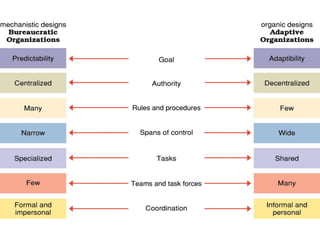
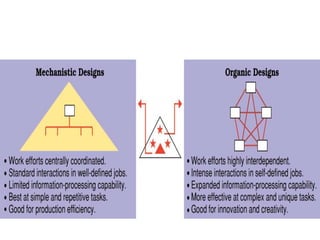
1. Bureaucratic or mechanistic structure
2. Organic or adaptive structure
• Based on the formation of department
3. Functional structure
4. Divisional structure
5. Matrix structure
6. Team structure
7. Network structure
Bureaucratic or mechanistic structure
• A bureaucracy is a form of organization based on
logic and the legitimate use of formal authority.
• Bureaucracies are meant to be orderly, fair, and
highly efficient.
• Their feature include
– Clear cut division of labor
– Strict hierarchy of authority
– Formal rules and procedure
– Promotion based on competency
Organic or adaptive structure
• This structure is opposite in nature to the
bureaucratic structure
• This structure maintain high degree of
openness to inputs from the internal and
external environments.
• This structure tends to work better in dynamic
environment where managers need to react
quickly
• It is much less formal and much more flexible
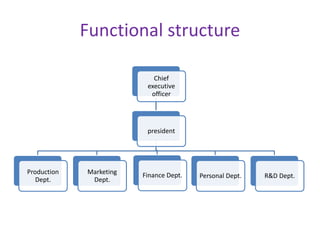
Functional structure
Chief
executive
officer
president
Production
Dept.
Marketing
Dept.
Finance Dept. Personal Dept. R&D Dept.
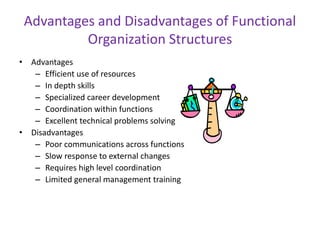
Advantages and Disadvantages of Functional
Organization Structures
• Advantages
– Efficient use of resources
– In depth skills
– Specialized career development
– Coordination within functions
– Excellent technical problems solving
• Disadvantages
– Poor communications across functions
– Slow response to external changes
– Requires high level coordination
– Limited general management training
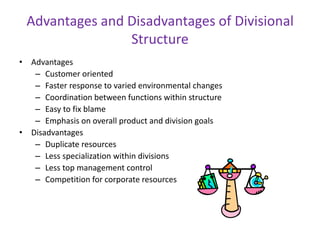
Advantages and Disadvantages of Divisional
Structure
• Advantages
– Customer oriented
– Faster response to varied environmental changes
– Coordination between functions within structure
– Easy to fix blame
– Emphasis on overall product and division goals
• Disadvantages
– Duplicate resources
– Less specialization within divisions
– Less top management control
– Competition for corporate resources
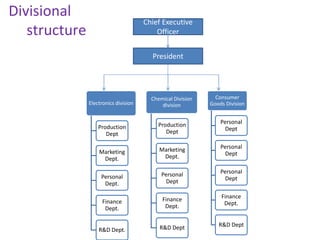
Divisional
structure
Electronics division
Production
Dept
Marketing
Dept.
Personal
Dept.
Finance
Dept.
R&D Dept.
Chemical Division
division
Production
Dept
Marketing
Dept.
Personal
Dept
Finance
Dept.
R&D Dept
Consumer
Goods Division
Personal
Dept
Personal
Dept
Personal
Dept
Finance
Dept.
R&D Dept
Chief Executive
Officer
President
Matrix organization
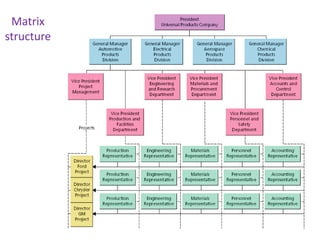
• It is an organizational design that combines both functional
and product departmentalization
• Several projects can be conducted simultaneously
• Employees have two bosses
• It violates the unity of command concept
• Creates a number of problems such as conflicting directives
from two bosses, roles may not be clearly defined, power
struggle between the two bosses, and subordinates may be
confused regarding to whom they should report
Matrix
structure
Matrix Organizations
Advantages
• Proponents of matrix management suggest that
there are two main advantages
– First, it allows team members to share information more
readily across task boundaries.
– Second, it allows for specialization that can increase depth
of knowledge and allow professional development and
career progression to be managed.
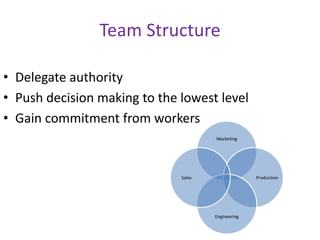
Team Structure
• Delegate authority
• Push decision making to the lowest level
• Gain commitment from workers
Marketing
Production
Engineering
Sales
Team Approach
• Advantages
– Same as functional departments
– Reduces barriers among functions
– Lower response time
– Better morale and enthusiasm
– Less overhead
• Disadvantages
– Lots of meetings
– Dual loyalties
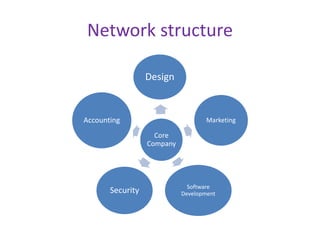
Network structure
Core
Company
Design
Marketing
Software
Development
Security
Accounting
Line and Staff Organizations
• Line departments perform the organization’s
primary tasks.
– Production, marketing, sales, R&D
• Staff Departments provide specialized skills in
support of line departments.
– Engineering, Human Resources, Legal,
– Advise and council in areas of expertise
Line Positions Staff Positions
• What is the difference between line positions
and staff positions?
- Directly involved in the
processes used to create
goods and services
– Typically found in
areas such as
• Production
• Marketing
• Finance
• Sales
- Provide the
administrative and support
services that line
employees need to achieve
the firm’s goals
– Found in areas such as
• Legal counseling
• Managerial consulting
• Human resource management
Departmentation
--The process through which an organization’s
activities are grouped together and assigned
to managers; the organization wide division of
work.
Example: business activities can be divided into different
functions like
1= manufacturing department
2= sales department
3= purchasing department
4= accounts department
4=human resource department
Functional office=There is an office for
each department known as functional
office. Like sales department office
General office= Functional offices are
controlled and coordinated by the main
office. Like head office
Departmentation
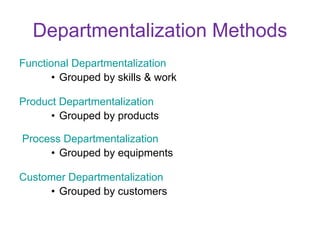
Departmentalization Methods
Functional Departmentalization
• Grouped by skills & work
Product Departmentalization
• Grouped by products
Process Departmentalization
• Grouped by equipments
Customer Departmentalization
• Grouped by customers
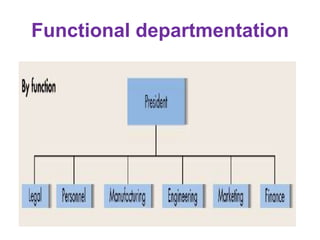
Functional departmentation
This is the most formal division of business
activities, bases on the different functions it
performs.
or
Grouping individuals into units, and units into departments like
A=Production department
B=Purchase department
C=Marketing department
D=Accounts department
Functional departmentation
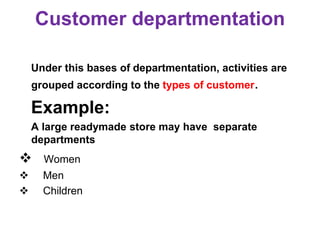
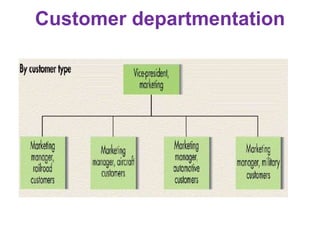
Customer departmentation
Under this bases of departmentation, activities are
grouped according to the types of customer.
Example:
A large readymade store may have separate
departments
 Women
 Men
 Children
Customer departmentation
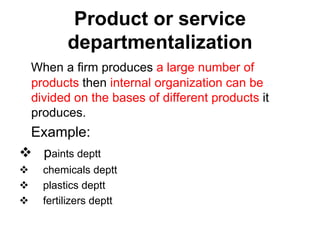
Product or service
departmentalization
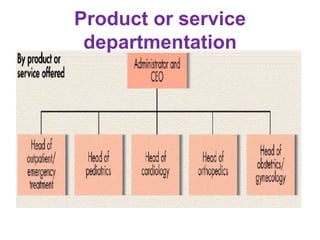
When a firm produces a large number of
products then internal organization can be
divided on the bases of different products it
produces.
Example:
 paints deptt
 chemicals deptt
 plastics deptt
 fertilizers deptt
Product or service
departmentation
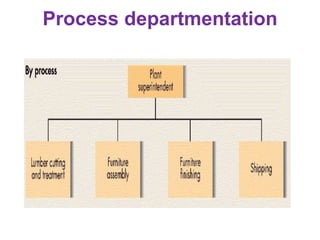
Process departmentation
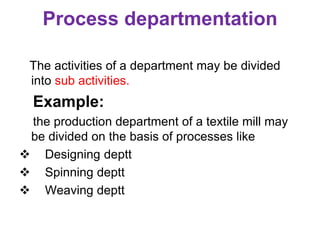
The activities of a department may be divided
into sub activities.
Example:
the production department of a textile mill may
be divided on the basis of processes like
 Designing deptt
 Spinning deptt
 Weaving deptt
Process departmentation
Span of control
The number of people who report to one manager or
supervisor.
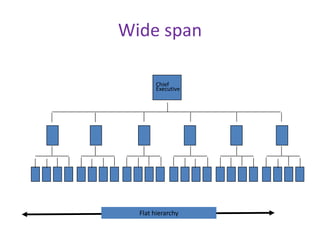
 Wide Span of Control
 Flat organization – large number of employees reporting to one
supervisor
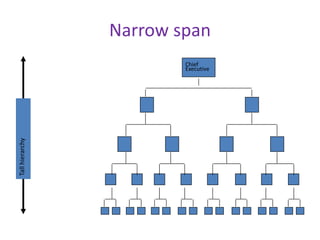
 Narrow Span of Control
 Tall organization – a small number of employees report to a
supervisor, necessitating a larger number of supervisors
Narrow span
Chief
Executive
Tall
hierarchy
Organization with narrow span:
we have…
 close control
 Superiors tend to get too involved in subordinates work.
 Many levels of management
 Excessive distance between lowest and top level.
Span of control
Wide span
Chief
Executive
Flat hierarchy
Organization with wide span:
We have:
 More load on superior level of management
 Not many levels of management
 Danger of superiors loss of control
 Requires exceptional qualities of managers.
Span of control
Factors influencing span of control
• Considerable available assistance: Managers can supervise more people
when they have considerable additional help, such as assistant.
• High competency level: High job related skills and abilities of manager and
subordinates make it possible for manager to manage more subordinates
• Work similarity: when subordinates do similar work, it becomes easy for
a supervisor to give adequate supervision.
• Low problem frequency: When serious problems are infrequent, there is
less need for management attention.
• Few non supervisory duties of managers: Managers can handle more
subordinates when they have few non supervisory duties to perform.
Delegation of authority
• Delegation of authority is a process which
enables a person to assign works to others
and delegates them with adequate authorities
to do it.
Features of Delegation of authority
• It makes the organization operative
• It gives life to the organization
• An organization can only exist if authority has been
delegated
• Top management must create the mood by preaching
and practicing broad delegation of authority
• It is distributed throughout an organization, starts at the
top and flows downward throughout the various levels of
management
Features of Delegation of Authority
• It follows the principles of chain of command or
scalar chain and unity of command
• Frees the time of managers
• Increases morale, interest, and enthusiasm for
work
• Provides a training ground and helps identify up
coming leaders
• Authority hoarders must be discouraged
• Supervisors who carefully delegate authority
does not lose status or free them from their
responsibilities
Types of delegation
• Over delegation
• Under delegation
Process of delegation
• Determination of result expected
• Assignment of duties
• Delegation of authority
• Creation of accountability
Personal attitude towards
delegation
• Lack of receptiveness(open to new ideas)
• Willingness to let go
• Willingness to let others make mistakes
• Willingness to trust subordinates
• Willingness to establish and use broad
controls
Making Delegation Effective
• Establishment of definite goal
• Right person for the right
• Establishment of definite responsibility
• Motivate subordinates
• Appropriate environment
• Free flow of information
• Proper training to subordinates
• Establish adequate controls
Line authority
• Authority is based on superior-subordinate
relationships and is managerial in nature
• Authority to give orders to subordinates
• The authority to direct subordinates and
require them to comply to decisions,
policies, plans, and objectives
• Generally follows the principle of unity of
command
Staff Authority
• Authority is based on expertise in specialty
areas
• Provides information, counsel, advice, and
guidance in specialty areas and is not
managerial in nature
• The authority to make recommendations
to line organization
• The recommendations can be accepted,
rejected, or altered by the line organization
Functional authority
• The CEO or administrator gives a staff
member special limited right to command
• The right is based on expertise in a
specialized area
• It allows maximum effective use of staff
specialists
• It violates the principle of unity of
command

Unit III Organizing

  • 1.
    UNIT III ORGANIZING • Natureand purpose of organizing • Organization structure – Formal and informal groups / organization • Line and Staff authority – Departmentation – Span of Control – Centralization and Decentralization – Delegation of authority • Staffing – Selection and Recruitment • Orientation Career Development – Career stages – Training – Performance Appraisal.
  • 2.
    ORGANIZING • Organizing isthe process of identifying and grouping of activities required to attain the objectives, delegating authority, creating responsibilities and establishing relationship for people to work effectively
  • 3.
    Responsibility, Responsibility is theobligation of a subordinate to perform the assigned duties. When a subordinate accepts duties, he has to perform those duties in the manner desired by the superior. Duties are assigned to subordinates when a manager has to share the work with them. Authority, When a person is given certain duties to perform, he must be given necessary authority also. Otherwise, he will not be able to do the work. A typist, for example, cannot do the typing job if he is not given the right to use facilities such as a place to sit in, a table, a chair, a typewriter, typing and carbon papers. Authority should always follow responsibility*******
  • 4.
    Accountability: •Accountability means answerability.That is, each person has to report to his superior how the work has been done and how authority has been used. Accountability is always upward. •Each subordinate is accountable to his superior who in turn is accountable to his own superior. In this way, every person becomes accountable to top management. •Accountability ensures that the work is done as planned and authority is properly used. •An important principle of accountability is the principle of single accountability. A person should be accountable to one superior only. If a person is accountable to two or more persons, he may avoid the work or he may be in difficulty to decide whom to obey first.
  • 5.
    Nature of organizing •Common objective • Specialization or division of labor • Authority of structure • Group of persons • Co-ordination • Communication • Environment • Rules and regulations
  • 6.
    Process of organizing 1.Determination of activities 2. Grouping of activities 3. Assignment of duties 4. Delegation of authority 5. Establishment of structural relationship 6. Co-ordination of activities
  • 7.
    Purpose of organizing •To facilitate administration • To increase the efficiency of management • To facilitate growth and diversification • To ensure optimum use of man and material resources • To facilitate co-ordination and communication • To permit optimum use of technological innovation • To simulate creativity and initiative • To facilitate the development of managerial ability
  • 8.
    6–8 Organization chart • OrganizationChart – A chart that shows the structure of the organization including the title of each manager’s position and, by means of connecting lines, who is accountable to whom and who has authority for each area. – Org. Chart also indicates the chain of command.
  • 9.
    The content ofOrganization chart • Basic organization structure and flow of authority • Authority and responsibilities of various executives • Relationship between the line and staff personnel • Name of component of organization • Position of various office personnel • Channel of communication • Total number of person working in an organization • Way of promotion and salary particulars
  • 10.
    Types of Organizationchart • Top-down or vertical chart • Horizontal chart or left to right chart • Circular chart or concentric chart
  • 11.
    Top-down or vertical chart Chairmen Managing Director Production manager Supervisor for operationA Supervisor for operation B Workman I Workman II Workman III Supervisor for operation C Marketing manager Personal Manager
  • 12.
    Horizontal chart orleft to right chart President Managing Director Branch Manager I Salesman I Salesman 2 Salesman 3 Branch Manager II Branch Manage III
  • 13.
    Circular chart orconcentric chart Chairmen Production Manager Marketing Manager Finance Manager Personal Manager
  • 14.
    Advantages of organizationchart • It shows the various positions and relationship • It shows the line of authority and responsibility • It serve as valuable guide to the new personnel • Strength and weakness of an organization are evaluated • It provide good clues to the line of promotion
  • 15.
    Disadvantages of organizationchart • It provide a clear picture of only formal authority relationship and omits many informal relationship • If the charts are not prepared correctly, that will lead to misleading inference • It may create psychological problem among individual by providing the superior or subordinate positions more prominently
  • 16.
    Organization structure • Organizationstructure is the formal pattern of interaction and coordination designed by management to link the tasks of individuals and groups in achieving organizational goal. • It should be designed to clarify who is to do, what task and who is responsible for what result.
  • 17.
    Types of organizationstructure • Based on the power flow within the organization 1. Bureaucratic or mechanistic structure 2. Organic or adaptive structure • Based on the formation of department 3. Functional structure 4. Divisional structure 5. Matrix structure 6. Team structure 7. Network structure
  • 18.
    Bureaucratic or mechanisticstructure • A bureaucracy is a form of organization based on logic and the legitimate use of formal authority. • Bureaucracies are meant to be orderly, fair, and highly efficient. • Their feature include – Clear cut division of labor – Strict hierarchy of authority – Formal rules and procedure – Promotion based on competency
  • 19.
    Organic or adaptivestructure • This structure is opposite in nature to the bureaucratic structure • This structure maintain high degree of openness to inputs from the internal and external environments. • This structure tends to work better in dynamic environment where managers need to react quickly • It is much less formal and much more flexible
  • 22.
  • 23.
    Advantages and Disadvantagesof Functional Organization Structures • Advantages – Efficient use of resources – In depth skills – Specialized career development – Coordination within functions – Excellent technical problems solving • Disadvantages – Poor communications across functions – Slow response to external changes – Requires high level coordination – Limited general management training
  • 24.
    Advantages and Disadvantagesof Divisional Structure • Advantages – Customer oriented – Faster response to varied environmental changes – Coordination between functions within structure – Easy to fix blame – Emphasis on overall product and division goals • Disadvantages – Duplicate resources – Less specialization within divisions – Less top management control – Competition for corporate resources
  • 25.
    Divisional structure Electronics division Production Dept Marketing Dept. Personal Dept. Finance Dept. R&D Dept. ChemicalDivision division Production Dept Marketing Dept. Personal Dept Finance Dept. R&D Dept Consumer Goods Division Personal Dept Personal Dept Personal Dept Finance Dept. R&D Dept Chief Executive Officer President
  • 26.
    Matrix organization • Itis an organizational design that combines both functional and product departmentalization • Several projects can be conducted simultaneously • Employees have two bosses • It violates the unity of command concept • Creates a number of problems such as conflicting directives from two bosses, roles may not be clearly defined, power struggle between the two bosses, and subordinates may be confused regarding to whom they should report
  • 27.
  • 28.
    Matrix Organizations Advantages • Proponentsof matrix management suggest that there are two main advantages – First, it allows team members to share information more readily across task boundaries. – Second, it allows for specialization that can increase depth of knowledge and allow professional development and career progression to be managed.
  • 29.
    Team Structure • Delegateauthority • Push decision making to the lowest level • Gain commitment from workers Marketing Production Engineering Sales
  • 30.
    Team Approach • Advantages –Same as functional departments – Reduces barriers among functions – Lower response time – Better morale and enthusiasm – Less overhead • Disadvantages – Lots of meetings – Dual loyalties
  • 31.
  • 32.
    Line and StaffOrganizations • Line departments perform the organization’s primary tasks. – Production, marketing, sales, R&D • Staff Departments provide specialized skills in support of line departments. – Engineering, Human Resources, Legal, – Advise and council in areas of expertise
  • 33.
    Line Positions StaffPositions • What is the difference between line positions and staff positions? - Directly involved in the processes used to create goods and services – Typically found in areas such as • Production • Marketing • Finance • Sales - Provide the administrative and support services that line employees need to achieve the firm’s goals – Found in areas such as • Legal counseling • Managerial consulting • Human resource management
  • 34.
    Departmentation --The process throughwhich an organization’s activities are grouped together and assigned to managers; the organization wide division of work. Example: business activities can be divided into different functions like 1= manufacturing department 2= sales department 3= purchasing department 4= accounts department 4=human resource department
  • 35.
    Functional office=There isan office for each department known as functional office. Like sales department office General office= Functional offices are controlled and coordinated by the main office. Like head office Departmentation
  • 36.
    Departmentalization Methods Functional Departmentalization •Grouped by skills & work Product Departmentalization • Grouped by products Process Departmentalization • Grouped by equipments Customer Departmentalization • Grouped by customers
  • 37.
    Functional departmentation This isthe most formal division of business activities, bases on the different functions it performs. or Grouping individuals into units, and units into departments like A=Production department B=Purchase department C=Marketing department D=Accounts department
  • 38.
  • 39.
    Customer departmentation Under thisbases of departmentation, activities are grouped according to the types of customer. Example: A large readymade store may have separate departments  Women  Men  Children
  • 40.
  • 41.
    Product or service departmentalization Whena firm produces a large number of products then internal organization can be divided on the bases of different products it produces. Example:  paints deptt  chemicals deptt  plastics deptt  fertilizers deptt
  • 42.
  • 43.
    Process departmentation The activitiesof a department may be divided into sub activities. Example: the production department of a textile mill may be divided on the basis of processes like  Designing deptt  Spinning deptt  Weaving deptt
  • 44.
  • 45.
    Span of control Thenumber of people who report to one manager or supervisor.  Wide Span of Control  Flat organization – large number of employees reporting to one supervisor  Narrow Span of Control  Tall organization – a small number of employees report to a supervisor, necessitating a larger number of supervisors
  • 46.
  • 47.
    Organization with narrowspan: we have…  close control  Superiors tend to get too involved in subordinates work.  Many levels of management  Excessive distance between lowest and top level. Span of control
  • 48.
  • 49.
    Organization with widespan: We have:  More load on superior level of management  Not many levels of management  Danger of superiors loss of control  Requires exceptional qualities of managers. Span of control
  • 50.
    Factors influencing spanof control • Considerable available assistance: Managers can supervise more people when they have considerable additional help, such as assistant. • High competency level: High job related skills and abilities of manager and subordinates make it possible for manager to manage more subordinates • Work similarity: when subordinates do similar work, it becomes easy for a supervisor to give adequate supervision. • Low problem frequency: When serious problems are infrequent, there is less need for management attention. • Few non supervisory duties of managers: Managers can handle more subordinates when they have few non supervisory duties to perform.
  • 51.
    Delegation of authority •Delegation of authority is a process which enables a person to assign works to others and delegates them with adequate authorities to do it.
  • 52.
    Features of Delegationof authority • It makes the organization operative • It gives life to the organization • An organization can only exist if authority has been delegated • Top management must create the mood by preaching and practicing broad delegation of authority • It is distributed throughout an organization, starts at the top and flows downward throughout the various levels of management
  • 53.
    Features of Delegationof Authority • It follows the principles of chain of command or scalar chain and unity of command • Frees the time of managers • Increases morale, interest, and enthusiasm for work • Provides a training ground and helps identify up coming leaders • Authority hoarders must be discouraged • Supervisors who carefully delegate authority does not lose status or free them from their responsibilities
  • 54.
    Types of delegation •Over delegation • Under delegation
  • 55.
    Process of delegation •Determination of result expected • Assignment of duties • Delegation of authority • Creation of accountability
  • 56.
    Personal attitude towards delegation •Lack of receptiveness(open to new ideas) • Willingness to let go • Willingness to let others make mistakes • Willingness to trust subordinates • Willingness to establish and use broad controls
  • 57.
    Making Delegation Effective •Establishment of definite goal • Right person for the right • Establishment of definite responsibility • Motivate subordinates • Appropriate environment • Free flow of information • Proper training to subordinates • Establish adequate controls
  • 58.
    Line authority • Authorityis based on superior-subordinate relationships and is managerial in nature • Authority to give orders to subordinates • The authority to direct subordinates and require them to comply to decisions, policies, plans, and objectives • Generally follows the principle of unity of command
  • 59.
    Staff Authority • Authorityis based on expertise in specialty areas • Provides information, counsel, advice, and guidance in specialty areas and is not managerial in nature • The authority to make recommendations to line organization • The recommendations can be accepted, rejected, or altered by the line organization
  • 60.
    Functional authority • TheCEO or administrator gives a staff member special limited right to command • The right is based on expertise in a specialized area • It allows maximum effective use of staff specialists • It violates the principle of unity of command