OBJECTIVES STRATEGIES  & PLANNING PREMISES
Objectives  Important ends towards which organizational and individual activities  are directed Objectives are desired outcomes for entire organizations or groups (as well as individuals)
HIERARCHY OF OBJECTIVES Mission Overall objectives  Specific main objectives Division objectives Department objectives Unit objectives Individual objectives Personal development objectives
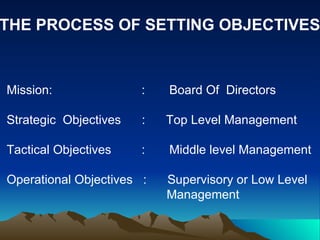
THE PROCESS OF SETTING OBJECTIVES Mission:     :  Board Of  Directors Strategic  Objectives  :  Top Level Management  Tactical Objectives    :  Middle level Management Operational Objectives  :  Supervisory or Low Level     Management
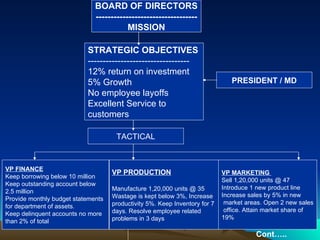
BOARD OF DIRECTORS ---------------------------------- MISSION STRATEGIC OBJECTIVES ---------------------------------- 12% return on investment 5% Growth No employee layoffs Excellent Service to  customers PRESIDENT / MD TACTICAL VP PRODUCTION Manufacture 1,20,000 units @ 35 Wastage is kept below 3%, Increase productivity 5%. Keep Inventory for 7  days. Resolve employee related  problems in 3 days VP FINANCE Keep borrowing below 10 million Keep outstanding account below  2.5 million Provide monthly budget statements  for department of assets. Keep delinquent accounts no more than 2% of total VP MARKETING  Sell 1,20,000 units @ 47 Introduce 1 new product line Increase sales by 5% in new market areas. Open 2 new sales office. Attain market share of  19% Cont…..
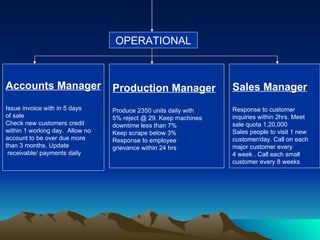
OPERATIONAL Production Manager Produce 2350 units daily with 5% reject @ 29. Keep machines downtime less than 7% Keep scrape below 3% Response to employee  grievance within 24 hrs Accounts Manager Issue invoice with in 5 days  of sale Check new customers credit within 1 working day.  Allow no  account to be over due more  than 3 months. Update receivable/ payments daily Sales Manager Response to customer  inquiries within 2hrs. Meet sale quota 1,20,000 Sales people to visit 1 new customer/day. Call on each major customer every  4 week . Call each small  customer every 8 weeks
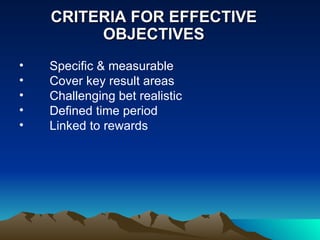
CRITERIA FOR EFFECTIVE OBJECTIVES Specific & measurable  Cover key result areas Challenging bet realistic Defined time period  Linked to rewards
SETTING OBJECTIVES: GUIDELINES Setting Objectives A difficult task Requires intelligent briefing by supervisors Requires constant practice by sub-ordinates. Cont….
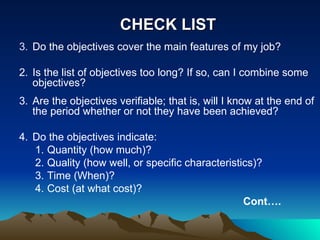
CHECK LIST Do the objectives cover the main features of my job? 2. Is the list of objectives too long? If so, can I combine some objectives? 3. Are the objectives verifiable; that is, will I know at the end of the period whether or not they have been achieved? 4. Do the objectives indicate: Quantity (how much)? Quality (how well, or specific characteristics)? Time (When)? Cost (at what cost)? Cont….
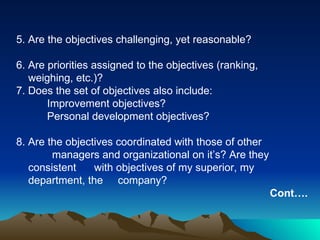
5. Are the objectives challenging, yet reasonable? 6. Are priorities assigned to the objectives (ranking,  weighing, etc.)? 7. Does the set of objectives also include: Improvement objectives? Personal development objectives? 8. Are the objectives coordinated with those of other  managers and organizational on it’s? Are they consistent  with objectives of my superior, my department, the  company? Cont….
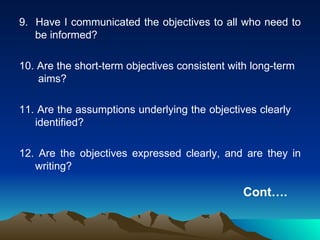
9.  Have I communicated the objectives to all who need to be informed? 10. Are the short-term objectives consistent with long-term  aims? 11. Are the assumptions underlying the objectives clearly  identified? 12. Are the objectives expressed clearly, and are they in writing? Cont….
13. Do objectives provide for timely feedback so that I can  take any necessary corrective steps? 14. Are my resources and authority sufficient for achieving the objectives? 15. Have I given the individuals who are expected to accomplish objectives a chance to suggest their objectives? 16. Do my subordinates have control over aspects for which they are assigned responsibility?
MANAGEMENT BY OBJECTIVES MBO A method of management whereby managers and employees define objectives for every department, project and person and use them to monitor subsequent performance
MAJOR ACTIVITIES  MBO Setting objectives.  Developing action plans. Reviewing progress. Appraising overall performance.
STEPS IN MBO PROGRAM The organizations’ overall objectives and strategies are formulated. Major objectives are allocated among divisional and departmental units. Unit manager collaboratively sets specific objectives for their units with their supervisors. Specific objectives are jointly set for all departmental members. Action plans, defining how objectives are to be achieved, are specified and agreed upon by managers and subordinates. The action plans are implemented. Progress toward objectives is periodically reviewed and feed-back is provided. Successful achievement of objectives is reinforced by performance based rewards
BENEFITS OF  MBO Manager and employee efforts are focused on activities that will lead to attainment of objectives. Performance is improved at all levels of organization. Employees are motivated. Departmental and individual objectives are in line with organizational objectives. Organizational structure and roles are clarified. Effective planning and effective control are encouraged and generated.
WEAKNESSES OF  MBO Constant change prevents MBO from taking hold. Poor employer-employee relationship reduces its effectiveness. Operational objectives overtake strategic objectives. Setting objectives is difficult at lower levels. Emphasis on short-term objectives. Too much paper work harms efficiency.
STRATEGIC PLANNING The set of decisions and actions used to formulate and implement strategies that will provide a competitive fit between the organization and its environment so as to achieve organizational objectives
STRATEGY The determination of the purpose ( or mission ) and basic long-term objectives of an organization and the adoption of courses of action and allocation of resources necessary to achieve these objectives
Corporate level Strategy. Business level Strategy. Functional level Strategy. Grand Strategy.  LEVELS OF STRATEGY
GRAND STRATEGY The general plan of major action by which an organization intends to achieve its long-term objectives.
CORPORATE LEVEL STRATEGY It seeks to determine what business an organization should be doing.
BUSINESS LEVEL STRATEGY It seeks to determine how an organization should compete in each of business it does.
FUNCTION  LEVEL STRATEGY It seeks to determine how to support the business level strategy .
STRATEGIC PLANNING PROCESS Key Elements Inputs. Organization Profile. Orientation of Top Management. Purpose and major objectives. External environment. Internal environment. Development of alternative strategies. Evaluation & choice of strategies.  Contingency plans.
INPUTS Employees. Managerial skills. Technical knowledge and skills. Capital. INTERNAL Employees. Capital. Technological. Managerial. EXTERNAL Consumers. Suppliers. Stock holders. Government. Community.
ORGANIZATIONAL PROFILE  It is the starting point of determining where the organization is and where it should go. Basic purpose (or mission) Competitive environment Geographic orientation
ORIENTATION OF  TOP MANAGERS  Manager’s values, preferences and attitudes toward risk –taking have direct impact on strategy. Managers set organizational climate and determine the general direction for the organization.
PURPOSE & MAJOR OBJECTIVE  The purpose (or mission) and the major objective are the end points toward which the activities of organization are directed.
EXTERNAL ENVIRONMENT  External environment must be assessed in terms of threats and opportunities : Economic Social Political Legal Demographic Geographic
INTERNAL ENVIRONMENT  Internal environment should be evaluated in respect to its resources and its weakness and strengths in: Research & development Production Procurement Marketing Services Human Resources Financial image, structure & Climate, planning & control system Relations with customers
DEVELOPMENT OF ALTERNATIVE    STRATEGIES Alternative Strategies are developed on the basis of analysis of external and internal environment: Specialize or concentrate Diversify Joint venture , merger Go international
EVALUATION & CHOICE OF  STRATEGIES Evaluation & choice of strategies are done in light of : Risks Timing Reaction of competition
CONTINGENCY PLANS  Contingency plans are prepared to cater for changes that may occur in the environment. These plans provide a degree of preparation for the un-expected change.
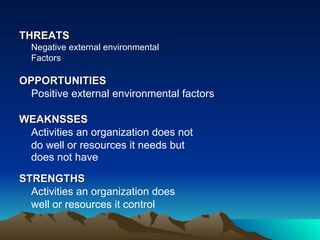
THREATS Negative external environmental Factors OPPORTUNITIES Positive external environmental factors WEAKNSSES Activities an organization does not do well or resources it needs but  does not have   STRENGTHS Activities an organization does well or resources it control
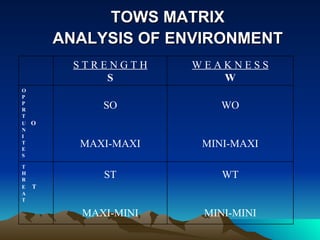
TOWS MATRIX ANALYSIS OF ENVIRONMENT WT MINI-MINI ST MAXI-MINI T H R E  T A T WO MINI-MAXI SO MAXI-MAXI O P P R T U  O N I T E S W E A K N E S S W S T R E N G T H S
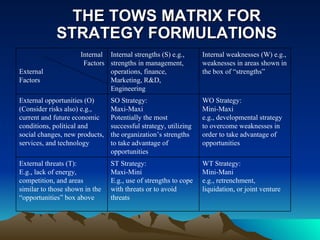
THE TOWS MATRIX FOR STRATEGY FORMULATIONS WT Strategy: Mini-Mani e.g., retrenchment, liquidation, or joint venture ST Strategy: Maxi-Mini E.g., use of strengths to cope with threats or to avoid threats External threats (T): E.g., lack of energy, competition, and areas similar to those shown in the “opportunities” box above WO Strategy: Mini-Maxi e.g., developmental strategy to overcome weaknesses in order to take advantage of opportunities SO Strategy: Maxi-Maxi Potentially the most successful strategy, utilizing the organization’s strengths to take advantage of opportunities External opportunities (O) (Consider risks also) e.g., current and future economic conditions, political and social changes, new products, services, and technology Internal weaknesses (W) e.g., weaknesses in areas shown in the box of “strengths”  Internal strengths (S) e.g., strengths in management, operations, finance, Marketing, R&D, Engineering Internal  Factors External  Factors
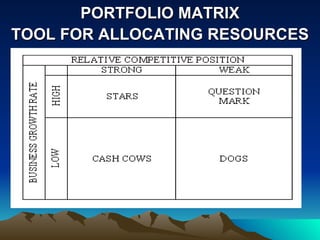
PORTFOLIO MATRIX TOOL FOR ALLOCATING RESOURCES
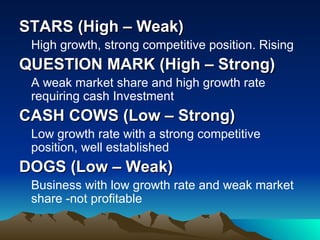
STARS (High – Weak) High growth, strong competitive position. Rising QUESTION MARK (High – Strong) A weak market share and high growth rate requiring cash Investment  CASH COWS (Low – Strong) Low growth rate with a strong competitive position, well established DOGS (Low – Weak) Business with low growth rate and weak market share -not profitable
EFFECTIVE IMPLEMENTATION OF STRATEGIES FAILURE Managers are in-adequately prepared. Information for preparing plans and their implementation is insufficient.  Objectives are too vague to be of value. Responsibilities of implementing plans are not clearly defined. Reviews of plan implementation are not done effectively. Link between planning and control is weak
SUCCESSFUL IMPLEMENTATION OF STRATEGIES  Communicating strategies to all key decision- making managers Proper development of planning premises Ensuring action plans contribute to and reflect major objectives and strategies Reviewing strategies regularly Developing contingency plans Creating appropriate structure to fit planning needs
FORECASTING An effort to spot trends that enable managers to predict future events. PREMISING  Anticipating environment in which plans are expected to operate.  They include assumptions or forecasts of the future and known conditions that will affect the operation of plan.
AREAS OF FORECASTING  Economic Social Political Legal Technological
DELPHI TECHNIQUE FOR MAKING FORECASTS  A panel of experts is selected-from both inside and outside the organization. Experts make their (anonymously) forecasts. All individual forecasts are compiled. Composite result are fed back to experts. Based on composite information, further estimates of future are made. Above process (may be) repeated several times As convergence of opinion begin to evolve, results are finalized as acceptable forecasts.
Process of Effective Premising  Selecting premises that bear materially on course of action. Development of alternative premises for contingency planning. Verification of consistency of premises at all levels. Dissemination of selected premises to all planners.

Principles of Management

  • 1.
    OBJECTIVES STRATEGIES & PLANNING PREMISES
  • 2.
    Objectives Importantends towards which organizational and individual activities are directed Objectives are desired outcomes for entire organizations or groups (as well as individuals)
  • 3.
    HIERARCHY OF OBJECTIVESMission Overall objectives Specific main objectives Division objectives Department objectives Unit objectives Individual objectives Personal development objectives
  • 4.
    THE PROCESS OFSETTING OBJECTIVES Mission: : Board Of Directors Strategic Objectives : Top Level Management Tactical Objectives : Middle level Management Operational Objectives : Supervisory or Low Level Management
  • 5.
    BOARD OF DIRECTORS---------------------------------- MISSION STRATEGIC OBJECTIVES ---------------------------------- 12% return on investment 5% Growth No employee layoffs Excellent Service to customers PRESIDENT / MD TACTICAL VP PRODUCTION Manufacture 1,20,000 units @ 35 Wastage is kept below 3%, Increase productivity 5%. Keep Inventory for 7 days. Resolve employee related problems in 3 days VP FINANCE Keep borrowing below 10 million Keep outstanding account below 2.5 million Provide monthly budget statements for department of assets. Keep delinquent accounts no more than 2% of total VP MARKETING Sell 1,20,000 units @ 47 Introduce 1 new product line Increase sales by 5% in new market areas. Open 2 new sales office. Attain market share of 19% Cont…..
  • 6.
    OPERATIONAL Production ManagerProduce 2350 units daily with 5% reject @ 29. Keep machines downtime less than 7% Keep scrape below 3% Response to employee grievance within 24 hrs Accounts Manager Issue invoice with in 5 days of sale Check new customers credit within 1 working day. Allow no account to be over due more than 3 months. Update receivable/ payments daily Sales Manager Response to customer inquiries within 2hrs. Meet sale quota 1,20,000 Sales people to visit 1 new customer/day. Call on each major customer every 4 week . Call each small customer every 8 weeks
  • 7.
    CRITERIA FOR EFFECTIVEOBJECTIVES Specific & measurable Cover key result areas Challenging bet realistic Defined time period Linked to rewards
  • 8.
    SETTING OBJECTIVES: GUIDELINESSetting Objectives A difficult task Requires intelligent briefing by supervisors Requires constant practice by sub-ordinates. Cont….
  • 9.
    CHECK LIST Dothe objectives cover the main features of my job? 2. Is the list of objectives too long? If so, can I combine some objectives? 3. Are the objectives verifiable; that is, will I know at the end of the period whether or not they have been achieved? 4. Do the objectives indicate: Quantity (how much)? Quality (how well, or specific characteristics)? Time (When)? Cost (at what cost)? Cont….
  • 10.
    5. Are theobjectives challenging, yet reasonable? 6. Are priorities assigned to the objectives (ranking, weighing, etc.)? 7. Does the set of objectives also include: Improvement objectives? Personal development objectives? 8. Are the objectives coordinated with those of other managers and organizational on it’s? Are they consistent with objectives of my superior, my department, the company? Cont….
  • 11.
    9. HaveI communicated the objectives to all who need to be informed? 10. Are the short-term objectives consistent with long-term aims? 11. Are the assumptions underlying the objectives clearly identified? 12. Are the objectives expressed clearly, and are they in writing? Cont….
  • 12.
    13. Do objectivesprovide for timely feedback so that I can take any necessary corrective steps? 14. Are my resources and authority sufficient for achieving the objectives? 15. Have I given the individuals who are expected to accomplish objectives a chance to suggest their objectives? 16. Do my subordinates have control over aspects for which they are assigned responsibility?
  • 13.
    MANAGEMENT BY OBJECTIVESMBO A method of management whereby managers and employees define objectives for every department, project and person and use them to monitor subsequent performance
  • 14.
    MAJOR ACTIVITIES MBO Setting objectives. Developing action plans. Reviewing progress. Appraising overall performance.
  • 15.
    STEPS IN MBOPROGRAM The organizations’ overall objectives and strategies are formulated. Major objectives are allocated among divisional and departmental units. Unit manager collaboratively sets specific objectives for their units with their supervisors. Specific objectives are jointly set for all departmental members. Action plans, defining how objectives are to be achieved, are specified and agreed upon by managers and subordinates. The action plans are implemented. Progress toward objectives is periodically reviewed and feed-back is provided. Successful achievement of objectives is reinforced by performance based rewards
  • 16.
    BENEFITS OF MBO Manager and employee efforts are focused on activities that will lead to attainment of objectives. Performance is improved at all levels of organization. Employees are motivated. Departmental and individual objectives are in line with organizational objectives. Organizational structure and roles are clarified. Effective planning and effective control are encouraged and generated.
  • 17.
    WEAKNESSES OF MBO Constant change prevents MBO from taking hold. Poor employer-employee relationship reduces its effectiveness. Operational objectives overtake strategic objectives. Setting objectives is difficult at lower levels. Emphasis on short-term objectives. Too much paper work harms efficiency.
  • 18.
    STRATEGIC PLANNING Theset of decisions and actions used to formulate and implement strategies that will provide a competitive fit between the organization and its environment so as to achieve organizational objectives
  • 19.
    STRATEGY The determinationof the purpose ( or mission ) and basic long-term objectives of an organization and the adoption of courses of action and allocation of resources necessary to achieve these objectives
  • 20.
    Corporate level Strategy.Business level Strategy. Functional level Strategy. Grand Strategy. LEVELS OF STRATEGY
  • 21.
    GRAND STRATEGY Thegeneral plan of major action by which an organization intends to achieve its long-term objectives.
  • 22.
    CORPORATE LEVEL STRATEGYIt seeks to determine what business an organization should be doing.
  • 23.
    BUSINESS LEVEL STRATEGYIt seeks to determine how an organization should compete in each of business it does.
  • 24.
    FUNCTION LEVELSTRATEGY It seeks to determine how to support the business level strategy .
  • 25.
    STRATEGIC PLANNING PROCESSKey Elements Inputs. Organization Profile. Orientation of Top Management. Purpose and major objectives. External environment. Internal environment. Development of alternative strategies. Evaluation & choice of strategies. Contingency plans.
  • 26.
    INPUTS Employees. Managerialskills. Technical knowledge and skills. Capital. INTERNAL Employees. Capital. Technological. Managerial. EXTERNAL Consumers. Suppliers. Stock holders. Government. Community.
  • 27.
    ORGANIZATIONAL PROFILE It is the starting point of determining where the organization is and where it should go. Basic purpose (or mission) Competitive environment Geographic orientation
  • 28.
    ORIENTATION OF TOP MANAGERS Manager’s values, preferences and attitudes toward risk –taking have direct impact on strategy. Managers set organizational climate and determine the general direction for the organization.
  • 29.
    PURPOSE & MAJOROBJECTIVE The purpose (or mission) and the major objective are the end points toward which the activities of organization are directed.
  • 30.
    EXTERNAL ENVIRONMENT External environment must be assessed in terms of threats and opportunities : Economic Social Political Legal Demographic Geographic
  • 31.
    INTERNAL ENVIRONMENT Internal environment should be evaluated in respect to its resources and its weakness and strengths in: Research & development Production Procurement Marketing Services Human Resources Financial image, structure & Climate, planning & control system Relations with customers
  • 32.
    DEVELOPMENT OF ALTERNATIVE STRATEGIES Alternative Strategies are developed on the basis of analysis of external and internal environment: Specialize or concentrate Diversify Joint venture , merger Go international
  • 33.
    EVALUATION & CHOICEOF STRATEGIES Evaluation & choice of strategies are done in light of : Risks Timing Reaction of competition
  • 34.
    CONTINGENCY PLANS Contingency plans are prepared to cater for changes that may occur in the environment. These plans provide a degree of preparation for the un-expected change.
  • 35.
    THREATS Negative externalenvironmental Factors OPPORTUNITIES Positive external environmental factors WEAKNSSES Activities an organization does not do well or resources it needs but does not have STRENGTHS Activities an organization does well or resources it control
  • 36.
    TOWS MATRIX ANALYSISOF ENVIRONMENT WT MINI-MINI ST MAXI-MINI T H R E T A T WO MINI-MAXI SO MAXI-MAXI O P P R T U O N I T E S W E A K N E S S W S T R E N G T H S
  • 37.
    THE TOWS MATRIXFOR STRATEGY FORMULATIONS WT Strategy: Mini-Mani e.g., retrenchment, liquidation, or joint venture ST Strategy: Maxi-Mini E.g., use of strengths to cope with threats or to avoid threats External threats (T): E.g., lack of energy, competition, and areas similar to those shown in the “opportunities” box above WO Strategy: Mini-Maxi e.g., developmental strategy to overcome weaknesses in order to take advantage of opportunities SO Strategy: Maxi-Maxi Potentially the most successful strategy, utilizing the organization’s strengths to take advantage of opportunities External opportunities (O) (Consider risks also) e.g., current and future economic conditions, political and social changes, new products, services, and technology Internal weaknesses (W) e.g., weaknesses in areas shown in the box of “strengths” Internal strengths (S) e.g., strengths in management, operations, finance, Marketing, R&D, Engineering Internal Factors External Factors
  • 38.
    PORTFOLIO MATRIX TOOLFOR ALLOCATING RESOURCES
  • 39.
    STARS (High –Weak) High growth, strong competitive position. Rising QUESTION MARK (High – Strong) A weak market share and high growth rate requiring cash Investment CASH COWS (Low – Strong) Low growth rate with a strong competitive position, well established DOGS (Low – Weak) Business with low growth rate and weak market share -not profitable
  • 40.
    EFFECTIVE IMPLEMENTATION OFSTRATEGIES FAILURE Managers are in-adequately prepared. Information for preparing plans and their implementation is insufficient. Objectives are too vague to be of value. Responsibilities of implementing plans are not clearly defined. Reviews of plan implementation are not done effectively. Link between planning and control is weak
  • 41.
    SUCCESSFUL IMPLEMENTATION OFSTRATEGIES Communicating strategies to all key decision- making managers Proper development of planning premises Ensuring action plans contribute to and reflect major objectives and strategies Reviewing strategies regularly Developing contingency plans Creating appropriate structure to fit planning needs
  • 42.
    FORECASTING An effortto spot trends that enable managers to predict future events. PREMISING Anticipating environment in which plans are expected to operate. They include assumptions or forecasts of the future and known conditions that will affect the operation of plan.
  • 43.
    AREAS OF FORECASTING Economic Social Political Legal Technological
  • 44.
    DELPHI TECHNIQUE FORMAKING FORECASTS A panel of experts is selected-from both inside and outside the organization. Experts make their (anonymously) forecasts. All individual forecasts are compiled. Composite result are fed back to experts. Based on composite information, further estimates of future are made. Above process (may be) repeated several times As convergence of opinion begin to evolve, results are finalized as acceptable forecasts.
  • 45.
    Process of EffectivePremising Selecting premises that bear materially on course of action. Development of alternative premises for contingency planning. Verification of consistency of premises at all levels. Dissemination of selected premises to all planners.