ORGANIZING PROCESS
By: CAMCabanlit
Cebu Institute of Technology – University
N. Bacalso Avenue, Cebu City
Learning Objectives
You should be able to:
 Describe organizing process
DEFINITION
 ORGANIZING – is a management function which refers
to “the structuring of resources and activities to
accomplish objectives in an efficient and effective
manner.”
 Purposes of the structure:
1. It defines the relationships between tasks and authority
for individuals and departments.
2. It defines the formal reporting relationships, the number
of levels in the hierarchy of the organization and the
span of control.
3. It defines the groupings of individuals into departments
and departments into organization.
4. It defines the system to effect coordination of effort in
both vertical (authority) and horizontal (tasks)
directions.
DEFINITION
 When structuring an organization, the engineer manager
must be concerned with the following:
1. Division of labor – determining the scope of work and
how it is combined in a job.
2. Delegation of authority – the process of assigning
various degrees of decision-making authority to
subordinates.
3. Departmentalization – the grouping of related jobs,
activities, or processes into major organizational
subunits
4. Span of control – the number of people who report
directly to a given manager
5. Coordination – the linking of activities in the
organization that serves to achieve a common goal or
TYPES OF ORGANIZATION
 FORMAL ORGANIZATION – the structure that
details lines of responsibilities, authority and
position. It is the planned structure and it represents
the deliberate attempt to establish patterned
relationships among components that will meet the
objectives effectively.
 It is described by the management through:
a. Organization chart
b. Organization Manual
c. Policy Manual
TYPES OF ORGANIZATION
 INFORMAL ORGANIZATION – when members of an
organization spontaneously form a group with
friendship as a principal reason for belonging.
- often times very useful in the accomplishment of
major tasks, especially if these tasks conform with
the expectations of the members of the informal
group.
- “It is vulnerable to expediency, manipulation, and
opportunism.” according to Valentine.
TYPES OF ORGANIZATIONAL STRUCTURE
 FUNCTIONAL ORGANIZATION – this is a form of
departmentalization in which everyone engaged in
one functional activity, such as engineering or
marketing is grouped into one unit.
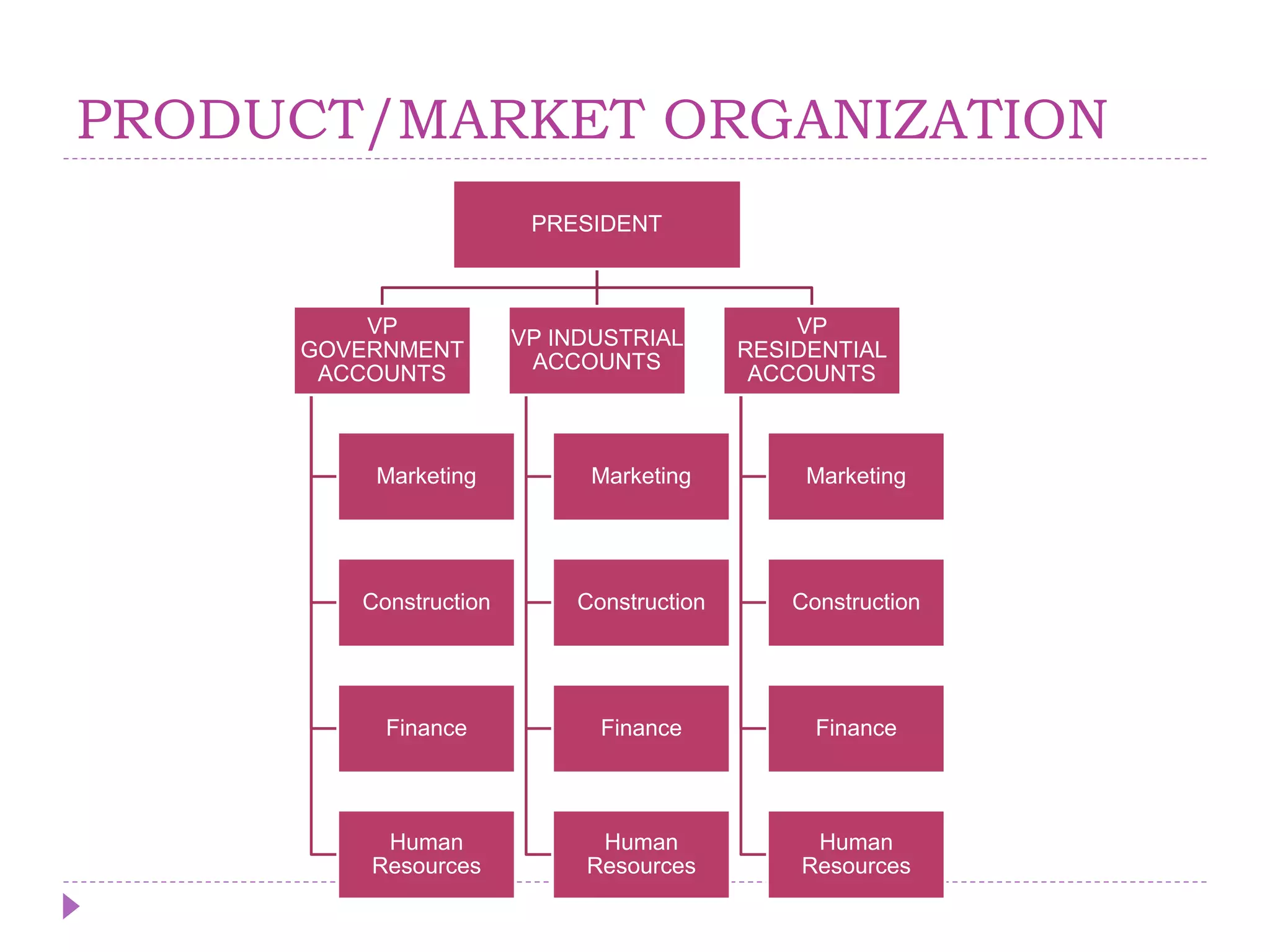
 PRODUCT OR MARKET ORGANIZATION – this
refers to the organization of a company by divisions
that brings together all those involved with a certain
type of product or customer.
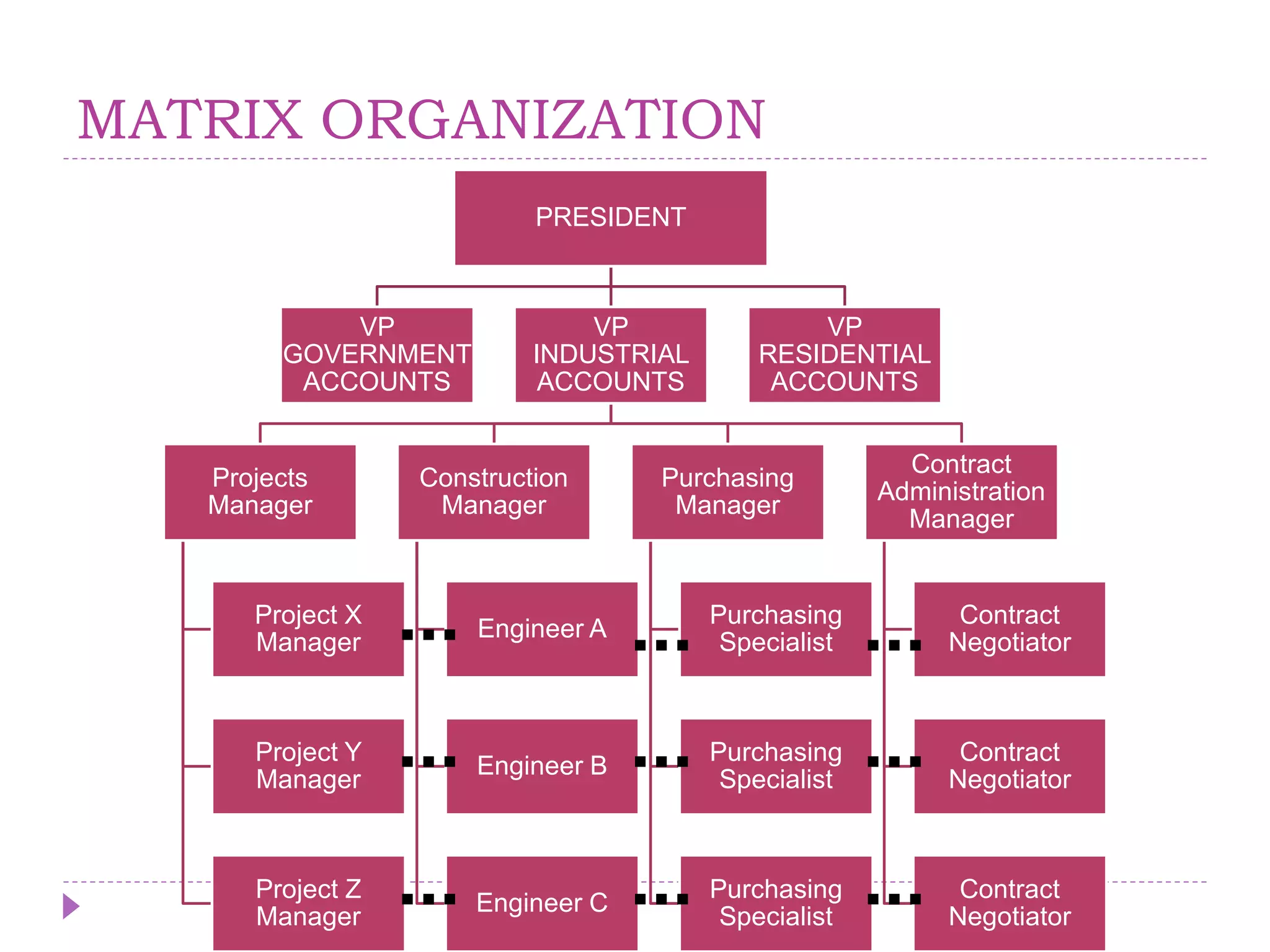
 MATRIX ORGANIZATION – an organizational
structure in which each employee reports to both a
functional or division manager and to a project or
group manager.
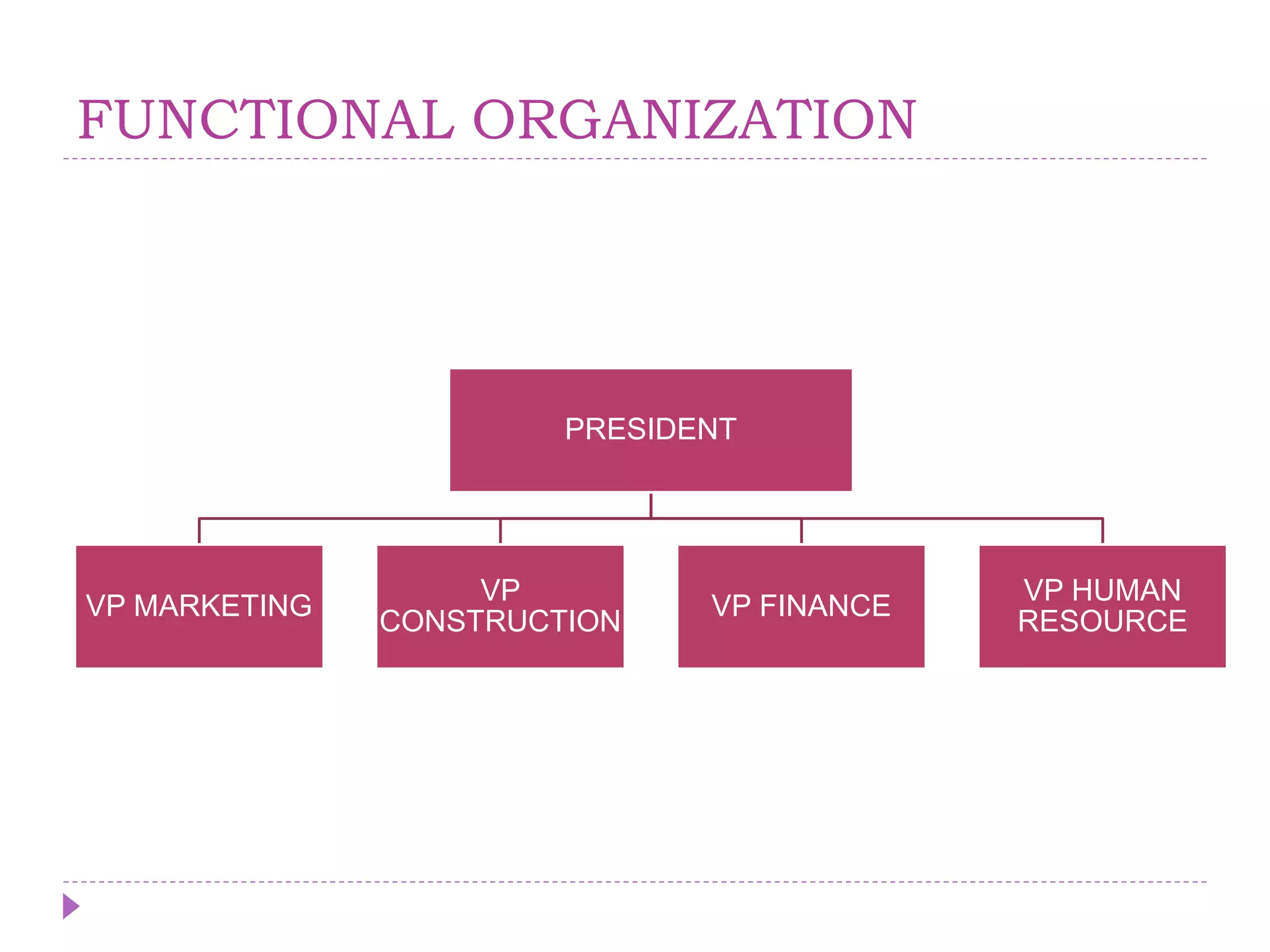
FUNCTIONAL ORGANIZATION
PRESIDENT
VP MARKETING
VP
CONSTRUCTION
VP FINANCE
VP HUMAN
RESOURCE
ADVANTAGES
 FUNCTIONAL ORGANIZATION
 -the grouping of employees who perform a common task
permit economies of scale and efficient resource use
 -since the chain of command converges at the top of the
organization, decision-making is centralized, providing
unified direction from the top.
 -Communication and coordination among employees
within each department are excellent.
 -The structure promotes high quality technical problem
solving.
 -The organization is provided with in depth skill
specialization and development.
DISADVANTAGES
 FUNCTIONAL ORGANIZATION
 -communication and coordination between departments
are often poor
 Decisions involving more than one department pile up at
the top management level and are often delayed.
 Work specialization and division of labor, which are
stressed in a functional organization, produce routine,
nonmotivationg employee tasks.
 It is difficult to identify which section or group is
responsible for certain problems.
 There is limited view of organizational goals by
employees.
 There is limited general management training for
employees.
PRODUCT/MARKET ORGANIZATION
PRESIDENT
VP
GOVERNMENT
ACCOUNTS
Marketing
Construction
Finance
Human
Resources
VP INDUSTRIAL
ACCOUNTS
Marketing
Construction
Finance
Human
Resources
VP
RESIDENTIAL
ACCOUNTS
Marketing
Construction
Finance
Human
Resources
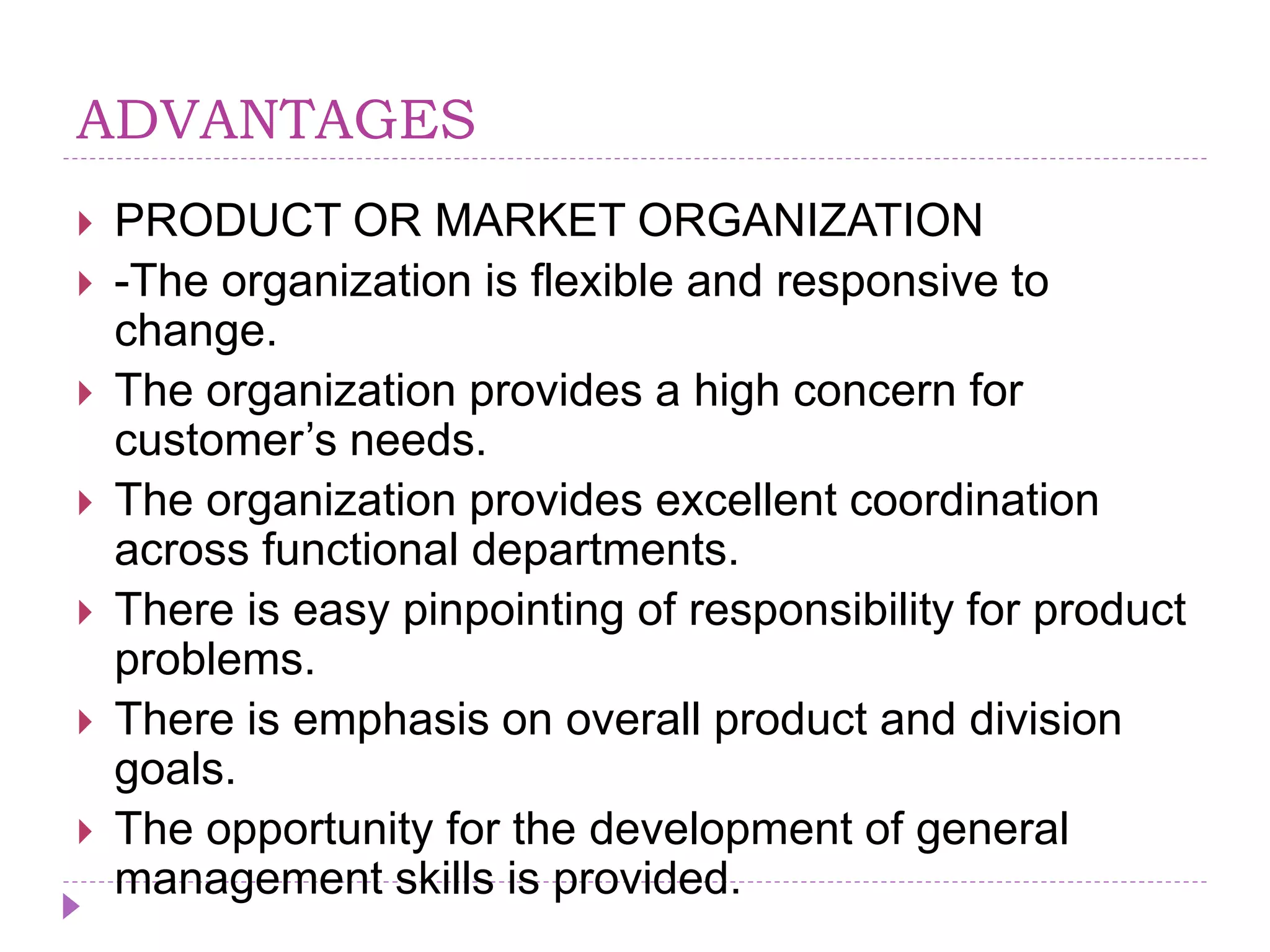
ADVANTAGES
 PRODUCT OR MARKET ORGANIZATION
 -The organization is flexible and responsive to
change.
 The organization provides a high concern for
customer’s needs.
 The organization provides excellent coordination
across functional departments.
 There is easy pinpointing of responsibility for product
problems.
 There is emphasis on overall product and division
goals.
 The opportunity for the development of general
management skills is provided.
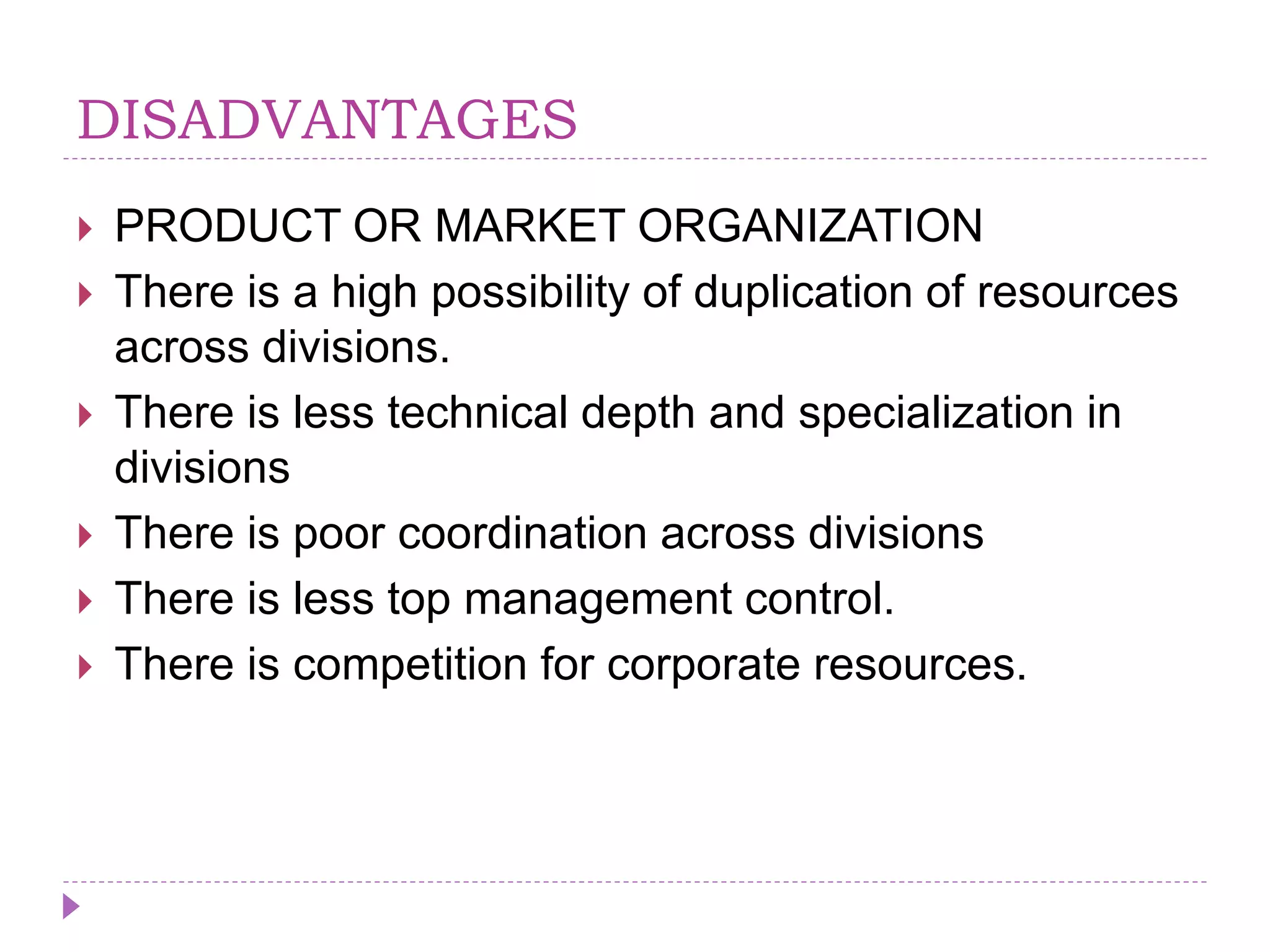
DISADVANTAGES
 PRODUCT OR MARKET ORGANIZATION
 There is a high possibility of duplication of resources
across divisions.
 There is less technical depth and specialization in
divisions
 There is poor coordination across divisions
 There is less top management control.
 There is competition for corporate resources.
MATRIX ORGANIZATION
PRESIDENT
VP
GOVERNMENT
ACCOUNTS
VP
INDUSTRIAL
ACCOUNTS
Projects
Manager
Project X
Manager
Project Y
Manager
Project Z
Manager
Construction
Manager
Engineer A
Engineer B
Engineer C
Purchasing
Manager
Purchasing
Specialist
Purchasing
Specialist
Purchasing
Specialist
Contract
Administration
Manager
Contract
Negotiator
Contract
Negotiator
Contract
Negotiator
VP
RESIDENTIAL
ACCOUNTS
ADVANTAGES
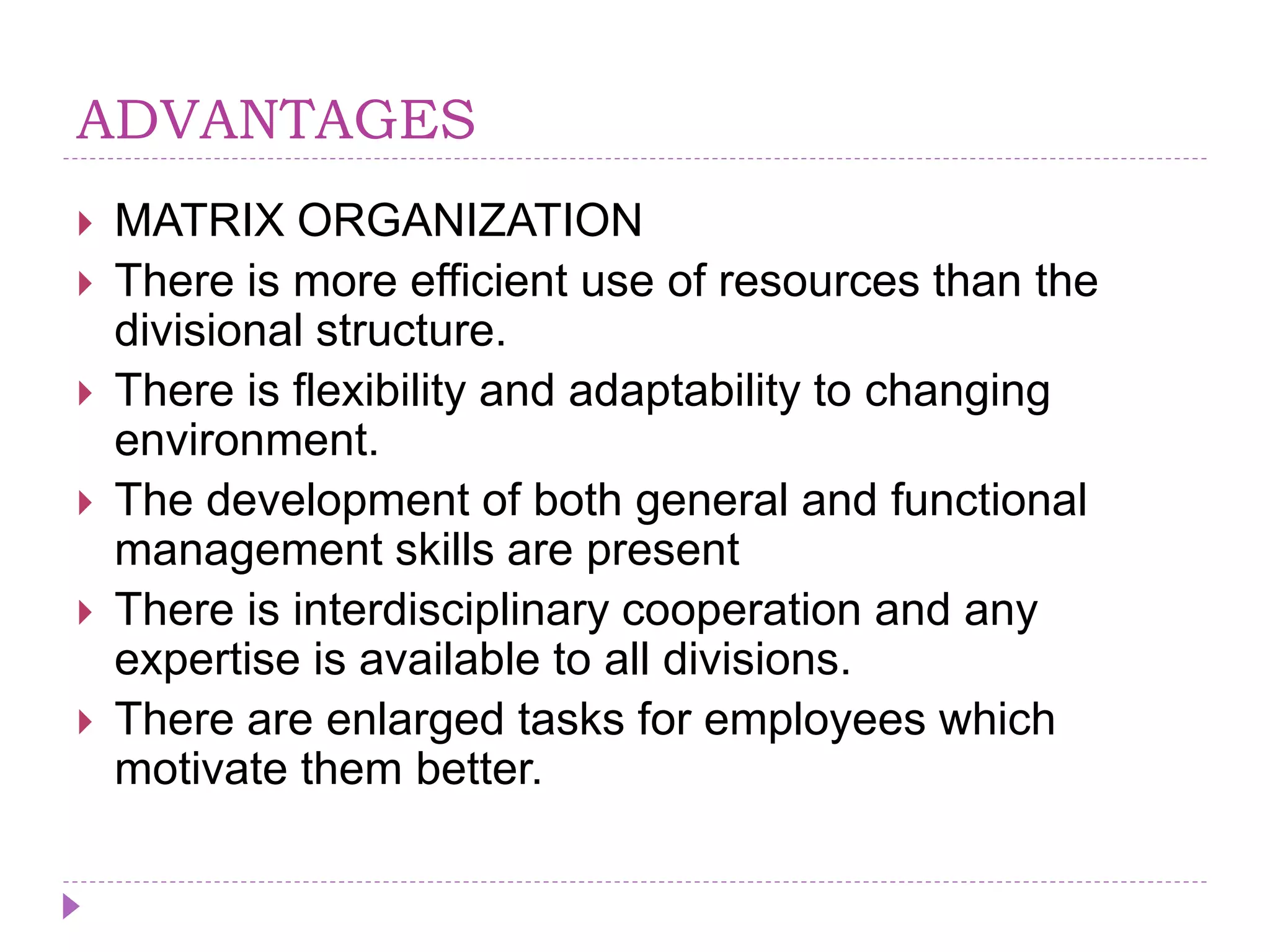
 MATRIX ORGANIZATION
 There is more efficient use of resources than the
divisional structure.
 There is flexibility and adaptability to changing
environment.
 The development of both general and functional
management skills are present
 There is interdisciplinary cooperation and any
expertise is available to all divisions.
 There are enlarged tasks for employees which
motivate them better.
DISADVANTAGES
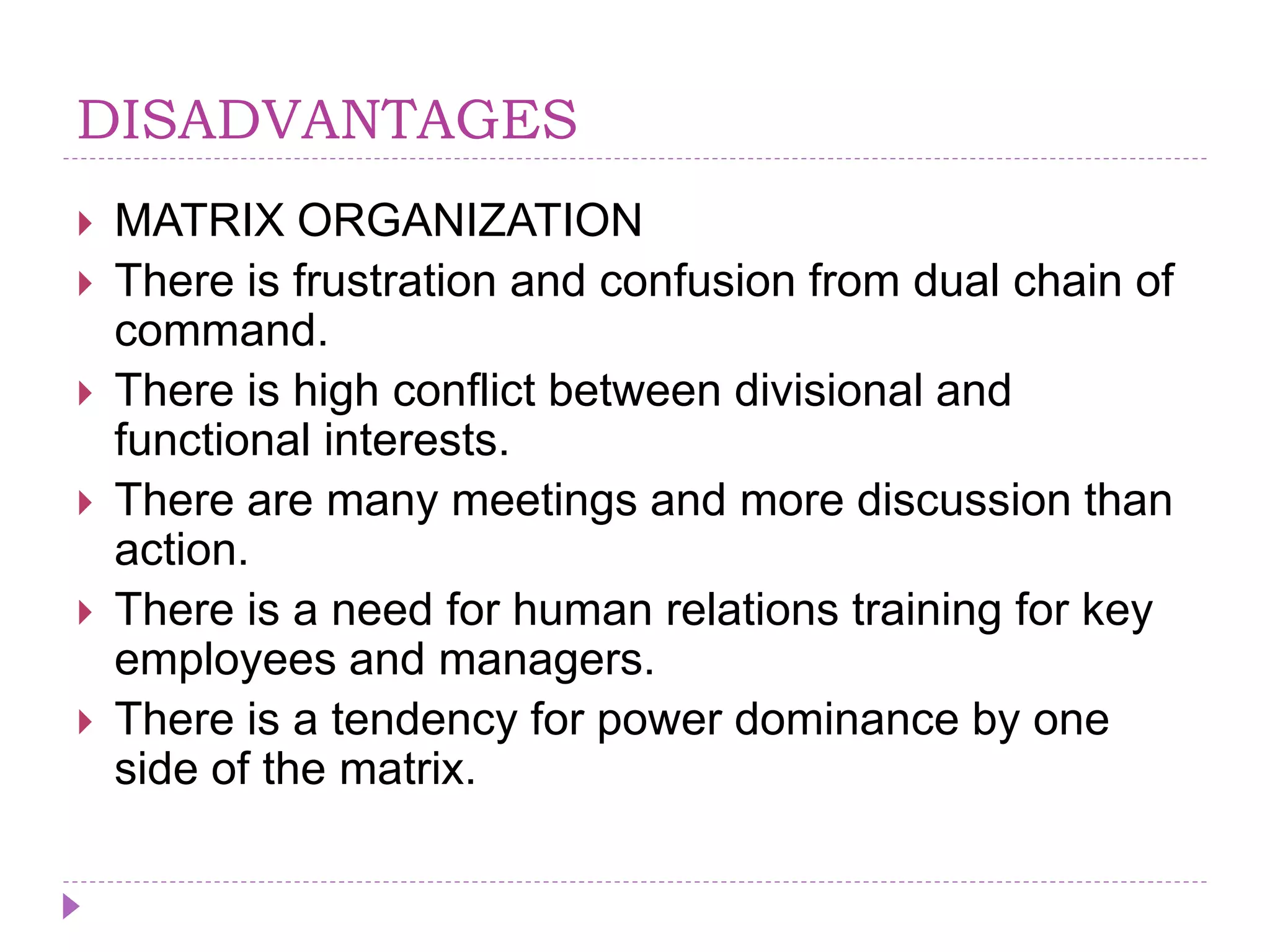
 MATRIX ORGANIZATION
 There is frustration and confusion from dual chain of
command.
 There is high conflict between divisional and
functional interests.
 There are many meetings and more discussion than
action.
 There is a need for human relations training for key
employees and managers.
 There is a tendency for power dominance by one
side of the matrix.
TYPES OF AUTHORITY
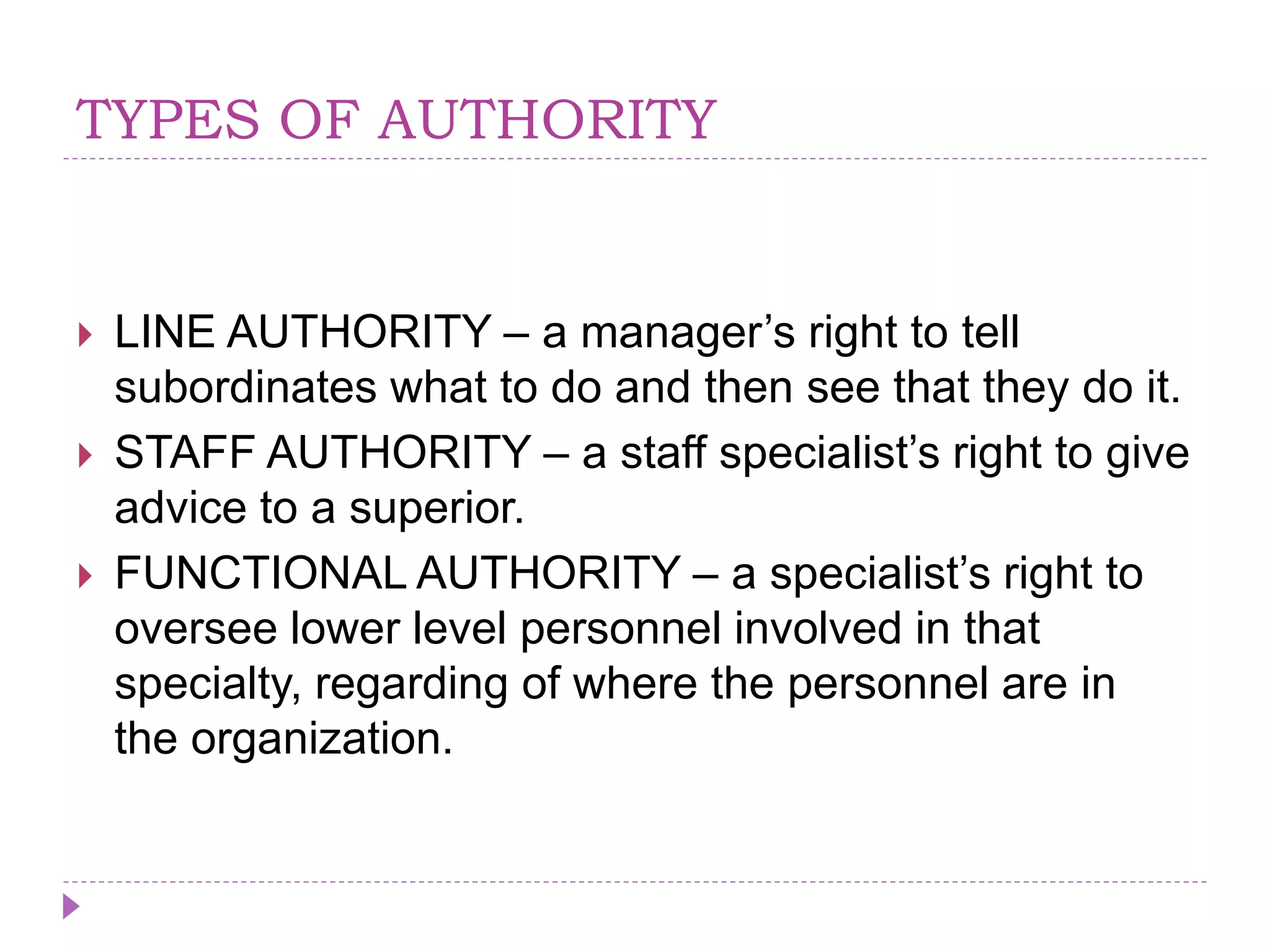
 LINE AUTHORITY – a manager’s right to tell
subordinates what to do and then see that they do it.
 STAFF AUTHORITY – a staff specialist’s right to give
advice to a superior.
 FUNCTIONAL AUTHORITY – a specialist’s right to
oversee lower level personnel involved in that
specialty, regarding of where the personnel are in
the organization.
TYPES OF AUTHORITY
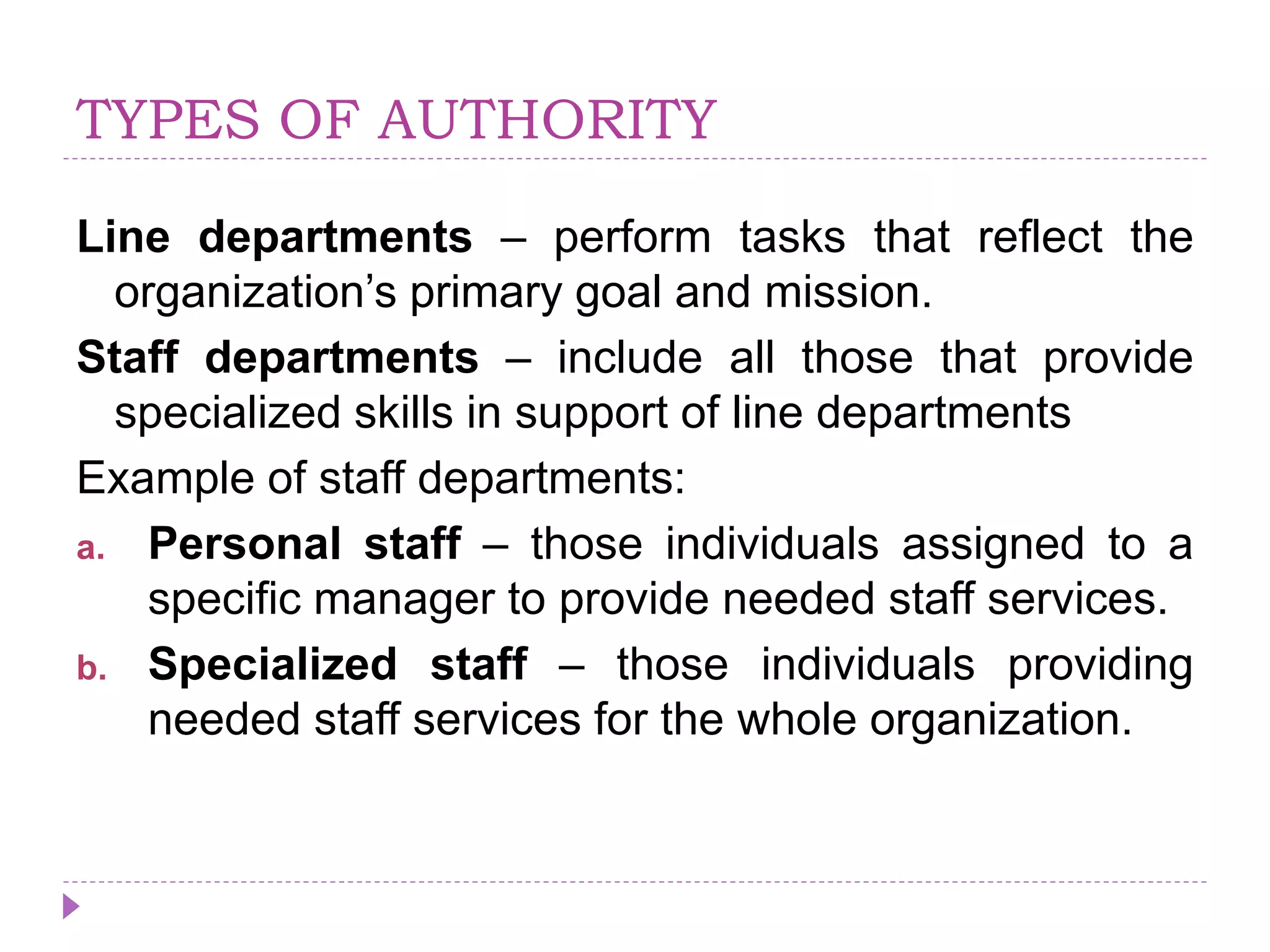
Line departments – perform tasks that reflect the
organization’s primary goal and mission.
Staff departments – include all those that provide
specialized skills in support of line departments
Example of staff departments:
a. Personal staff – those individuals assigned to a
specific manager to provide needed staff services.
b. Specialized staff – those individuals providing
needed staff services for the whole organization.
DELEGATION
 Objective - To improve manager’s overall efficiency
by selectively distributing work for employees to do
 Process - Managers delegate the responsibility and
needed authority of doing specific work to
employees and create upward accountability in them
for securing the anticipated results
Elements of Delegation
 Responsibility
 involves mental and physical activities which must be
formed to carry out a task, duty or position
Elements of Delegation
 Authority
 power or right to be obeyed. It is the sum of the powers
and rights entrusted to make possible the performance of
the work delegated.
Types:
 Line Authority
 Staff Authority
 Function Authority
Elements of Delegation
 Accountability
 answerability of the obligation to perform delegated
responsibility and to exercise the authority for the proper
performance of work.
PURPOSE OF COMMITTEES
 When certain formal groups are deemed
inappropriate to meet expectations, committees are
harnessed to achieve organizational goals.
Classification:
 Ad hoc committee – one created for short-term
purpose and have a limited life
 Standing committee – is a relatively permanent
committee that deals with issues on an ongoing
basis

Mgt function2 organizing

  • 1.
    ORGANIZING PROCESS By: CAMCabanlit CebuInstitute of Technology – University N. Bacalso Avenue, Cebu City
  • 2.
    Learning Objectives You shouldbe able to:  Describe organizing process
  • 3.
    DEFINITION  ORGANIZING –is a management function which refers to “the structuring of resources and activities to accomplish objectives in an efficient and effective manner.”  Purposes of the structure: 1. It defines the relationships between tasks and authority for individuals and departments. 2. It defines the formal reporting relationships, the number of levels in the hierarchy of the organization and the span of control. 3. It defines the groupings of individuals into departments and departments into organization. 4. It defines the system to effect coordination of effort in both vertical (authority) and horizontal (tasks) directions.
  • 4.
    DEFINITION  When structuringan organization, the engineer manager must be concerned with the following: 1. Division of labor – determining the scope of work and how it is combined in a job. 2. Delegation of authority – the process of assigning various degrees of decision-making authority to subordinates. 3. Departmentalization – the grouping of related jobs, activities, or processes into major organizational subunits 4. Span of control – the number of people who report directly to a given manager 5. Coordination – the linking of activities in the organization that serves to achieve a common goal or
  • 5.
    TYPES OF ORGANIZATION FORMAL ORGANIZATION – the structure that details lines of responsibilities, authority and position. It is the planned structure and it represents the deliberate attempt to establish patterned relationships among components that will meet the objectives effectively.  It is described by the management through: a. Organization chart b. Organization Manual c. Policy Manual
  • 6.
    TYPES OF ORGANIZATION INFORMAL ORGANIZATION – when members of an organization spontaneously form a group with friendship as a principal reason for belonging. - often times very useful in the accomplishment of major tasks, especially if these tasks conform with the expectations of the members of the informal group. - “It is vulnerable to expediency, manipulation, and opportunism.” according to Valentine.
  • 7.
    TYPES OF ORGANIZATIONALSTRUCTURE  FUNCTIONAL ORGANIZATION – this is a form of departmentalization in which everyone engaged in one functional activity, such as engineering or marketing is grouped into one unit.  PRODUCT OR MARKET ORGANIZATION – this refers to the organization of a company by divisions that brings together all those involved with a certain type of product or customer.  MATRIX ORGANIZATION – an organizational structure in which each employee reports to both a functional or division manager and to a project or group manager.
  • 8.
  • 9.
    ADVANTAGES  FUNCTIONAL ORGANIZATION -the grouping of employees who perform a common task permit economies of scale and efficient resource use  -since the chain of command converges at the top of the organization, decision-making is centralized, providing unified direction from the top.  -Communication and coordination among employees within each department are excellent.  -The structure promotes high quality technical problem solving.  -The organization is provided with in depth skill specialization and development.
  • 10.
    DISADVANTAGES  FUNCTIONAL ORGANIZATION -communication and coordination between departments are often poor  Decisions involving more than one department pile up at the top management level and are often delayed.  Work specialization and division of labor, which are stressed in a functional organization, produce routine, nonmotivationg employee tasks.  It is difficult to identify which section or group is responsible for certain problems.  There is limited view of organizational goals by employees.  There is limited general management training for employees.
  • 11.
  • 12.
    ADVANTAGES  PRODUCT ORMARKET ORGANIZATION  -The organization is flexible and responsive to change.  The organization provides a high concern for customer’s needs.  The organization provides excellent coordination across functional departments.  There is easy pinpointing of responsibility for product problems.  There is emphasis on overall product and division goals.  The opportunity for the development of general management skills is provided.
  • 13.
    DISADVANTAGES  PRODUCT ORMARKET ORGANIZATION  There is a high possibility of duplication of resources across divisions.  There is less technical depth and specialization in divisions  There is poor coordination across divisions  There is less top management control.  There is competition for corporate resources.
  • 14.
    MATRIX ORGANIZATION PRESIDENT VP GOVERNMENT ACCOUNTS VP INDUSTRIAL ACCOUNTS Projects Manager Project X Manager ProjectY Manager Project Z Manager Construction Manager Engineer A Engineer B Engineer C Purchasing Manager Purchasing Specialist Purchasing Specialist Purchasing Specialist Contract Administration Manager Contract Negotiator Contract Negotiator Contract Negotiator VP RESIDENTIAL ACCOUNTS
  • 15.
    ADVANTAGES  MATRIX ORGANIZATION There is more efficient use of resources than the divisional structure.  There is flexibility and adaptability to changing environment.  The development of both general and functional management skills are present  There is interdisciplinary cooperation and any expertise is available to all divisions.  There are enlarged tasks for employees which motivate them better.
  • 16.
    DISADVANTAGES  MATRIX ORGANIZATION There is frustration and confusion from dual chain of command.  There is high conflict between divisional and functional interests.  There are many meetings and more discussion than action.  There is a need for human relations training for key employees and managers.  There is a tendency for power dominance by one side of the matrix.
  • 17.
    TYPES OF AUTHORITY LINE AUTHORITY – a manager’s right to tell subordinates what to do and then see that they do it.  STAFF AUTHORITY – a staff specialist’s right to give advice to a superior.  FUNCTIONAL AUTHORITY – a specialist’s right to oversee lower level personnel involved in that specialty, regarding of where the personnel are in the organization.
  • 18.
    TYPES OF AUTHORITY Linedepartments – perform tasks that reflect the organization’s primary goal and mission. Staff departments – include all those that provide specialized skills in support of line departments Example of staff departments: a. Personal staff – those individuals assigned to a specific manager to provide needed staff services. b. Specialized staff – those individuals providing needed staff services for the whole organization.
  • 19.
    DELEGATION  Objective -To improve manager’s overall efficiency by selectively distributing work for employees to do  Process - Managers delegate the responsibility and needed authority of doing specific work to employees and create upward accountability in them for securing the anticipated results
  • 20.
    Elements of Delegation Responsibility  involves mental and physical activities which must be formed to carry out a task, duty or position
  • 21.
    Elements of Delegation Authority  power or right to be obeyed. It is the sum of the powers and rights entrusted to make possible the performance of the work delegated. Types:  Line Authority  Staff Authority  Function Authority
  • 22.
    Elements of Delegation Accountability  answerability of the obligation to perform delegated responsibility and to exercise the authority for the proper performance of work.
  • 23.
    PURPOSE OF COMMITTEES When certain formal groups are deemed inappropriate to meet expectations, committees are harnessed to achieve organizational goals. Classification:  Ad hoc committee – one created for short-term purpose and have a limited life  Standing committee – is a relatively permanent committee that deals with issues on an ongoing basis
Editor's Notes

  • #3 In the end of this session, you will be able to:
  • #10 According to these three departments, these are their definition
  • #11 According to these three departments, these are their definition
  • #12 According to these three departments, these are their definition
  • #13 According to these three departments, these are their definition
  • #14 According to these three departments, these are their definition
  • #15 According to these three departments, these are their definition
  • #16 According to these three departments, these are their definition
  • #17 According to these three departments, these are their definition
  • #18 According to these three departments, these are their definition
  • #19 According to these three departments, these are their definition