OrganizationDesign 
Prof.dr.dr.dr.h.c. Constantin Bratianu 
Faculty of Business Administration 
Academy of Economic Studies
Learning objectives 
Define and explain the process of 
organizational structuring 
Define and explain the process of 
functional structuring 
Identify forces that influence organization design 
Compare tall and flat organizational structures 
Describe the main types of organizational structures
Structure 
A structurerepresents a certain arrangement of elements in a given entity and their connections 
In natural and technological systems this arrangement is in concordance with a physical or mathematical law. Example: the law of gravity 
In organizational systems there is no such specific law. The field of gravity is built up by management 
In any organization there are 2 types of structures: 
-organizational structure 
-functional structure
Organizational structure 
Organizational structureis the result of defining organizational entities (divisions, branches, plants, departments, centers, offices) and hierarchical connections. 
The organizational structure is represented by a chart 
A university has as organizational entities: faculties, chairs, departments, administration offices. 
Each entity contains a group of people having similar jobs. It can be described by a certain work homogeneity 
There is no perfect structure for a given organization
Functional structure 
Functional structureis the result of defining functional entities, with respect to a given production process. 
It is the result of breaking down any process into sub-processes, and these into activities and tasks. 
This a result of the specializationtheory developed by Adam Smith. 
Specialization is the key of increasing efficiency, and it has been developed first in industrial organizations.
Specialization 
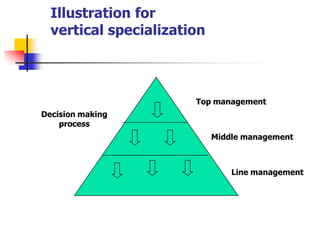
Vertical specializationrefers to the extent to which responsibilities at different levels are defined 
Vertical specialization reflects the field of decision making process 
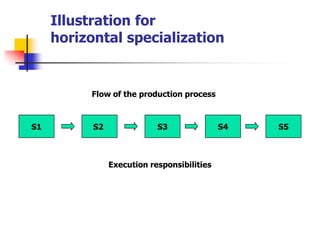
Horizontal specializationis the degree to which tasks are divided among separate people or departments 
Horizontal specialization is done at the same level of decision power, and reflects the breaking down of the production process –division of labor
Division of labor –making a pin (Adam Smith –The Wealth of Nations, 1993, p.12) 
“One man draws out the wire, another straights it, a third cuts it, a fourth points it, a fifth grinds it at the top for receiving the head; to make the head requires two or three distinct operations; to put it on, is a peculiar business, to whiten the pins is another; it is even a trade by itself to put them into the paper; and the important business of making a pin is, in this manner, divided into about eighteen distinct operations, which in some manufactories are all performed by distinct hands.”
Illustration forvertical specialization 
Decision making process 
Top management 
Middle management 
Line management
Structure in five –Design effcetive organizations (Henry Mintzberg, 1993, p. 2) 
“Every organized activity –from the making of pots to the placing of a man on the moon –gives rise to two fundamental and opposing requirements: the division of laborinto various tasks to be performed, and the coordinationof these tasks to accomplish the activity. The structure of an organization can be defined simply as the sum total of the ways in which its labor is divided into distinct tasks and then its coordination is achieved among these tasks.”
Structure in five (Henry Mintzberg , 1993, p. 3) 
The elements of a structure should be selected to achieve an internal consistency or harmony, as well as a basic consistency with the organization’s situation –its size, its age, the kind of environment in which it functions, the technical systems it uses, and so on.
Five coordinating mechanisms (Henry Mintzberg, 1993, p. 4) 
Five coordinating mechanisms seem to explain the fundamental ways in which organizations coordinate their work: mutual adjustment, direct supervision, standardization of work processes, standardization of work outputs, and standardization of worker skills. 
These should be considered the most basic elements of structure, the glue that holds organization together
Five coordinating mechanisms (Henry Mintzberg, 1993, p. 4) 
Mutual adjustment achieves the coordination of work by simple process of informal communication 
Direct supervision achieves coordination by having one person take responsibility for the work of others, issuing instructions to them and monitoring their actions 
Work processes are standardized when the contents of the work are specified, or programmed 
Outputs are standardized when the results of the work are specified 
Skills and knowledge are standardized when the kind of training required to performed the work is specified
Authority (I) 
Authorityis the right that o person in a specified role has to make decisions, allocate resources or give instructions 
Authority comes from the managerial position. It goes with the job 
Delegationoccurs when one person gives another the authority to undertake specific activities or decisions 
Poweris the individual capacity to influence decisions. Authority is only a part of the power a certain person may have. 
The differencebetween power and authority may come from individual personality, or from his informal relations with those who have formal authority
Authority (II) 
Authority is vested in organizational positions, not people.Managers have authority because of the position they hold, and other people in their position would have the same authority. 
Authority is accepted by subordinates. 
Authority flows down the vertical hierarchy.Positions at the top of the hierarchy are vested with more formal authority than are positions at the bottom
Types of Power 
Coercive power –Power based on fear 
Reward power –Power based on the ability to distribute something that others value 
Legitimate power –Power based on one’s position in the formal hierarchy 
Expert power –Power based on one’s experise, special skills, or knowledge 
Referent power –Power based on identification with a person who has desirable resources or personal traits
Responsibility 
Responsibility. The duty to perform the task or activity an employee has been assigned. Responsibility is the flip side of the authority coin. When managers have more responsibility than authority, the job is difficult and managers must rely on persuasion. When managers have less responsibility than authority, they may become dictators. 
Accountability.The fact that the people with authority and responsibility are subject to reporting and justifying task outcomes to those above them in chain of control.
Command & Control 
Chain of command= a continuous line of authority that extends from the highest levels in an organization to the lowest levels and clarifies whoreports to whom 
Unity of control= the management principle that each person should report to only one boss 
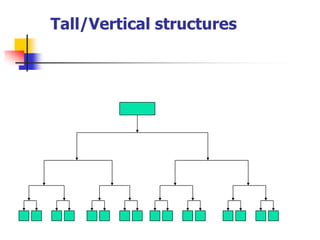
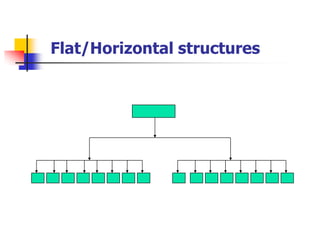
Span of control/Span of management = The number of subordinates a manager can control directly. In vertical structures SC= 7-9; in flat structures SC= 30-40.
Hierarchy structures 
Vertical/Tall structure= A management structure characterized by an overall narrow span of management and a relatively large number of hierarchical levels. 
Horizontal/ Flat structure= A management structure characterized by an overall broad span of control and relatively few hierarchical levels.
Centralization vs. Decentralization 
Centralization= the concentration of authority in the top management level. It comes from the will to control everything 
Centralization is characteristic for industry type organizations (mechanical type), and small organizations 
Decentralization= pushing down to the lower managerial levels of the decision making process 
Decentralization is characteristic for the new emerging type of organizations (organic type)
Departmentalization 
Departmentalization= The basis on which individuals are grouped into departments and departments into the total organization. 
Functional structure= the grouping of positions into departments based on similar skills, expertise, work activities and resource use. A functional structure can be thought of as departmentalization by organizational resources, because each type of functional activity –accounting, human resources, engineering, manufacturing –represents specific resources for performing the organization’s tasks.
Illustration forhorizontal specialization 
S1 
S2 
S3 
S4 
S5 
Execution responsibilities 
Flow of the production process
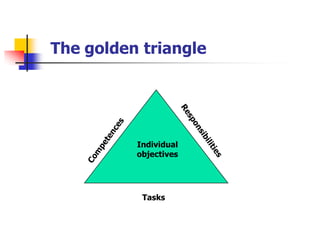
The golden triangle 
Individual objectives 
Tasks
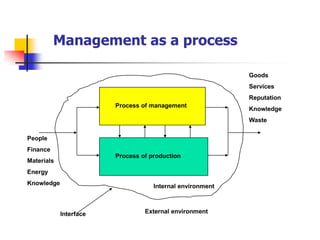
Management as a process 
Process of management 
Process of productionInternal environmentPeopleFinanceMaterialsEnergyKnowledge 
Goods 
Services 
Reputation 
Knowledge 
Waste 
External environment 
Interface
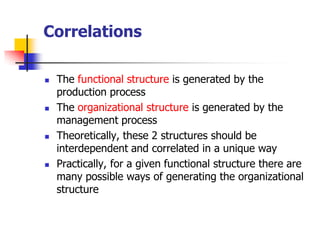
Correlations 
The functional structureis generated by the production process 
The organizational structureis generated by the management process 
Theoretically, these 2 structures should be interdependent and correlated in a unique way 
Practically, for a given functional structure there are many possible ways of generating the organizational structure
Tall/Vertical structures
Flat/Horizontal structures
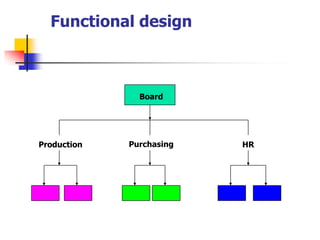
Functional design 
Production 
Purchasing 
HR 
Board
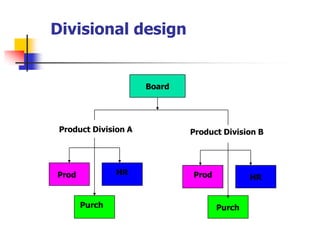
Divisional design 
Product Division A 
Product Division B 
Prod 
Purch 
HR 
Prod 
HR 
Purch 
Board
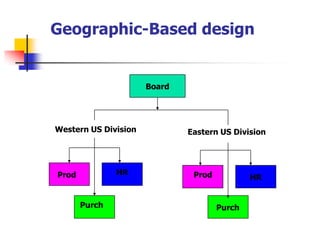
Geographic-Based design 
Western US Division 
Eastern US Division 
Prod 
Purch 
HR 
Prod 
HR 
Purch 
Board
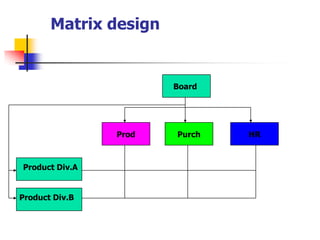
Matrix design 
Board 
Prod 
Purch 
HR 
Product Div.A 
Product Div.B
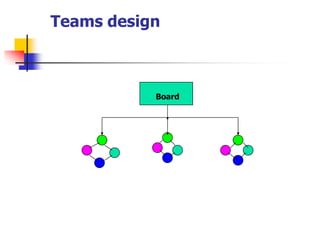
Teams design 
Board
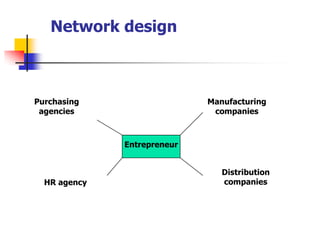
Network design 
Entrepreneur 
Manufacturing companies 
Distribution companies 
Purchasing agencies 
HR agency
Modular approach 
Modular approach 
A manufacturing company uses outside suppliers to provide large components of the product, which are then assembled into a final product by a few workers.
Mechanistic organization 
Rigid hierarchical relationships 
Fixed duties 
Many rules 
Formalized communication channels 
Centralized decision authority 
Taller structures
Organic organization 
Collaboration (both vertical and horizontal) 
Adaptable duties 
Few rules 
Informal communication 
Decentralized decision authority 
Flatter structures
Factors to influence structures 
The size of the company 
The dynamics of the external business environment 
The strategies to be implemented 
The specific of processes and technologies 
The role of IT

Bm 07 Organization design

  • 1.
    OrganizationDesign Prof.dr.dr.dr.h.c. ConstantinBratianu Faculty of Business Administration Academy of Economic Studies
  • 2.
    Learning objectives Defineand explain the process of organizational structuring Define and explain the process of functional structuring Identify forces that influence organization design Compare tall and flat organizational structures Describe the main types of organizational structures
  • 3.
    Structure A structurerepresentsa certain arrangement of elements in a given entity and their connections In natural and technological systems this arrangement is in concordance with a physical or mathematical law. Example: the law of gravity In organizational systems there is no such specific law. The field of gravity is built up by management In any organization there are 2 types of structures: -organizational structure -functional structure
  • 4.
    Organizational structure Organizationalstructureis the result of defining organizational entities (divisions, branches, plants, departments, centers, offices) and hierarchical connections. The organizational structure is represented by a chart A university has as organizational entities: faculties, chairs, departments, administration offices. Each entity contains a group of people having similar jobs. It can be described by a certain work homogeneity There is no perfect structure for a given organization
  • 5.
    Functional structure Functionalstructureis the result of defining functional entities, with respect to a given production process. It is the result of breaking down any process into sub-processes, and these into activities and tasks. This a result of the specializationtheory developed by Adam Smith. Specialization is the key of increasing efficiency, and it has been developed first in industrial organizations.
  • 6.
    Specialization Vertical specializationrefersto the extent to which responsibilities at different levels are defined Vertical specialization reflects the field of decision making process Horizontal specializationis the degree to which tasks are divided among separate people or departments Horizontal specialization is done at the same level of decision power, and reflects the breaking down of the production process –division of labor
  • 7.
    Division of labor–making a pin (Adam Smith –The Wealth of Nations, 1993, p.12) “One man draws out the wire, another straights it, a third cuts it, a fourth points it, a fifth grinds it at the top for receiving the head; to make the head requires two or three distinct operations; to put it on, is a peculiar business, to whiten the pins is another; it is even a trade by itself to put them into the paper; and the important business of making a pin is, in this manner, divided into about eighteen distinct operations, which in some manufactories are all performed by distinct hands.”
  • 8.
    Illustration forvertical specialization Decision making process Top management Middle management Line management
  • 9.
    Structure in five–Design effcetive organizations (Henry Mintzberg, 1993, p. 2) “Every organized activity –from the making of pots to the placing of a man on the moon –gives rise to two fundamental and opposing requirements: the division of laborinto various tasks to be performed, and the coordinationof these tasks to accomplish the activity. The structure of an organization can be defined simply as the sum total of the ways in which its labor is divided into distinct tasks and then its coordination is achieved among these tasks.”
  • 10.
    Structure in five(Henry Mintzberg , 1993, p. 3) The elements of a structure should be selected to achieve an internal consistency or harmony, as well as a basic consistency with the organization’s situation –its size, its age, the kind of environment in which it functions, the technical systems it uses, and so on.
  • 11.
    Five coordinating mechanisms(Henry Mintzberg, 1993, p. 4) Five coordinating mechanisms seem to explain the fundamental ways in which organizations coordinate their work: mutual adjustment, direct supervision, standardization of work processes, standardization of work outputs, and standardization of worker skills. These should be considered the most basic elements of structure, the glue that holds organization together
  • 12.
    Five coordinating mechanisms(Henry Mintzberg, 1993, p. 4) Mutual adjustment achieves the coordination of work by simple process of informal communication Direct supervision achieves coordination by having one person take responsibility for the work of others, issuing instructions to them and monitoring their actions Work processes are standardized when the contents of the work are specified, or programmed Outputs are standardized when the results of the work are specified Skills and knowledge are standardized when the kind of training required to performed the work is specified
  • 13.
    Authority (I) Authorityisthe right that o person in a specified role has to make decisions, allocate resources or give instructions Authority comes from the managerial position. It goes with the job Delegationoccurs when one person gives another the authority to undertake specific activities or decisions Poweris the individual capacity to influence decisions. Authority is only a part of the power a certain person may have. The differencebetween power and authority may come from individual personality, or from his informal relations with those who have formal authority
  • 14.
    Authority (II) Authorityis vested in organizational positions, not people.Managers have authority because of the position they hold, and other people in their position would have the same authority. Authority is accepted by subordinates. Authority flows down the vertical hierarchy.Positions at the top of the hierarchy are vested with more formal authority than are positions at the bottom
  • 15.
    Types of Power Coercive power –Power based on fear Reward power –Power based on the ability to distribute something that others value Legitimate power –Power based on one’s position in the formal hierarchy Expert power –Power based on one’s experise, special skills, or knowledge Referent power –Power based on identification with a person who has desirable resources or personal traits
  • 16.
    Responsibility Responsibility. Theduty to perform the task or activity an employee has been assigned. Responsibility is the flip side of the authority coin. When managers have more responsibility than authority, the job is difficult and managers must rely on persuasion. When managers have less responsibility than authority, they may become dictators. Accountability.The fact that the people with authority and responsibility are subject to reporting and justifying task outcomes to those above them in chain of control.
  • 17.
    Command & Control Chain of command= a continuous line of authority that extends from the highest levels in an organization to the lowest levels and clarifies whoreports to whom Unity of control= the management principle that each person should report to only one boss Span of control/Span of management = The number of subordinates a manager can control directly. In vertical structures SC= 7-9; in flat structures SC= 30-40.
  • 18.
    Hierarchy structures Vertical/Tallstructure= A management structure characterized by an overall narrow span of management and a relatively large number of hierarchical levels. Horizontal/ Flat structure= A management structure characterized by an overall broad span of control and relatively few hierarchical levels.
  • 19.
    Centralization vs. Decentralization Centralization= the concentration of authority in the top management level. It comes from the will to control everything Centralization is characteristic for industry type organizations (mechanical type), and small organizations Decentralization= pushing down to the lower managerial levels of the decision making process Decentralization is characteristic for the new emerging type of organizations (organic type)
  • 20.
    Departmentalization Departmentalization= Thebasis on which individuals are grouped into departments and departments into the total organization. Functional structure= the grouping of positions into departments based on similar skills, expertise, work activities and resource use. A functional structure can be thought of as departmentalization by organizational resources, because each type of functional activity –accounting, human resources, engineering, manufacturing –represents specific resources for performing the organization’s tasks.
  • 21.
    Illustration forhorizontal specialization S1 S2 S3 S4 S5 Execution responsibilities Flow of the production process
  • 22.
    The golden triangle Individual objectives Tasks
  • 23.
    Management as aprocess Process of management Process of productionInternal environmentPeopleFinanceMaterialsEnergyKnowledge Goods Services Reputation Knowledge Waste External environment Interface
  • 24.
    Correlations The functionalstructureis generated by the production process The organizational structureis generated by the management process Theoretically, these 2 structures should be interdependent and correlated in a unique way Practically, for a given functional structure there are many possible ways of generating the organizational structure
  • 25.
  • 26.
  • 27.
    Functional design Production Purchasing HR Board
  • 28.
    Divisional design ProductDivision A Product Division B Prod Purch HR Prod HR Purch Board
  • 29.
    Geographic-Based design WesternUS Division Eastern US Division Prod Purch HR Prod HR Purch Board
  • 30.
    Matrix design Board Prod Purch HR Product Div.A Product Div.B
  • 31.
  • 32.
    Network design Entrepreneur Manufacturing companies Distribution companies Purchasing agencies HR agency
  • 33.
    Modular approach Modularapproach A manufacturing company uses outside suppliers to provide large components of the product, which are then assembled into a final product by a few workers.
  • 34.
    Mechanistic organization Rigidhierarchical relationships Fixed duties Many rules Formalized communication channels Centralized decision authority Taller structures
  • 35.
    Organic organization Collaboration(both vertical and horizontal) Adaptable duties Few rules Informal communication Decentralized decision authority Flatter structures
  • 36.
    Factors to influencestructures The size of the company The dynamics of the external business environment The strategies to be implemented The specific of processes and technologies The role of IT