PRESENTETION ON
PRINCIPAL OF CARBURETION
SUBMITTED TO: SUBMITTED BY:
MR. AMARDEEP SIR HARIOHM KR.
PRASAD
DEPT. MECH.ENG. K11057,6TH
SEM,MECH
 The principles of carburetion are presented so you may
better understand the inner workings of a carburetor
and how the other components of the fuel system
function to provide a combustible mixture or air and
fuel to the engine cylinders.
 Air is composed of various gases, mostly nitrogen and
oxygen (78 percent nitrogen and 21 percent oxygen by
volume). These gases are, in turn, made up of tiny
particles called molecules. All substances, whether solid,
liquid, or gas, are made up of molecules. In solids, such
as ice or iron, the particles are held closely together so
that they seem to have no motion. In liquids, the
molecules are not held together tightly, so they can move
freely with respect to each other. In gases, there is still
less tendency for the molecules to bond; therefore, the
molecules can move quite freely. The molecules of gas
are attracted to the earth by gravity or by their weight. It
is the combined weight of the countless molecules in the
air that make up atmospheric pressure.
 EVAPORATION
is the changing of a liquid to a vapor.
*The rate of evaporation is dependent on the following
1- TEMPERATURE.
2- ATMOSPHERIC PRESSURE
3- VOLATILITY.
4- ATOMIZATION
The rate of movement of the molecules increase with
temperature. Because of this, the amount of molecules
leaving the liquid for a given time will increase, as the
temperature increases.
As atmospheric pressure increases, the amount of air
molecules present over the liquid also increases. The
increased presence of air molecules will slow the rate
of evaporation. This is because the molecules of liquid
will have more air molecules to collide with. In many
cases, they will fall back into the liquid after the
collision
 The term volatility refers to how fast a liquid
vaporizes. Some liquid vaporizes easily at room
temperature. Alcohol, for instance, vaporizes more
easily than water. A highly volatile liquid is one that
is considered to evaporate easily.
 Atomization is the process of
breaking up a liquid into tiny
particles or droplets.
 When a liquid is atomized, the
droplets are all exposed
individually to the air.
 For this reason, atomization
greatly increases evaporation by
increasing the exposed surface area
of the liquid.
 A carburetor is basically a device for mixing air and
fuel in the correct amounts for efficient combustion.
The carburetor bolts to the engine intake manifold. The
air cleaner fits over the top of the carburetor to trap
dust and dirt.
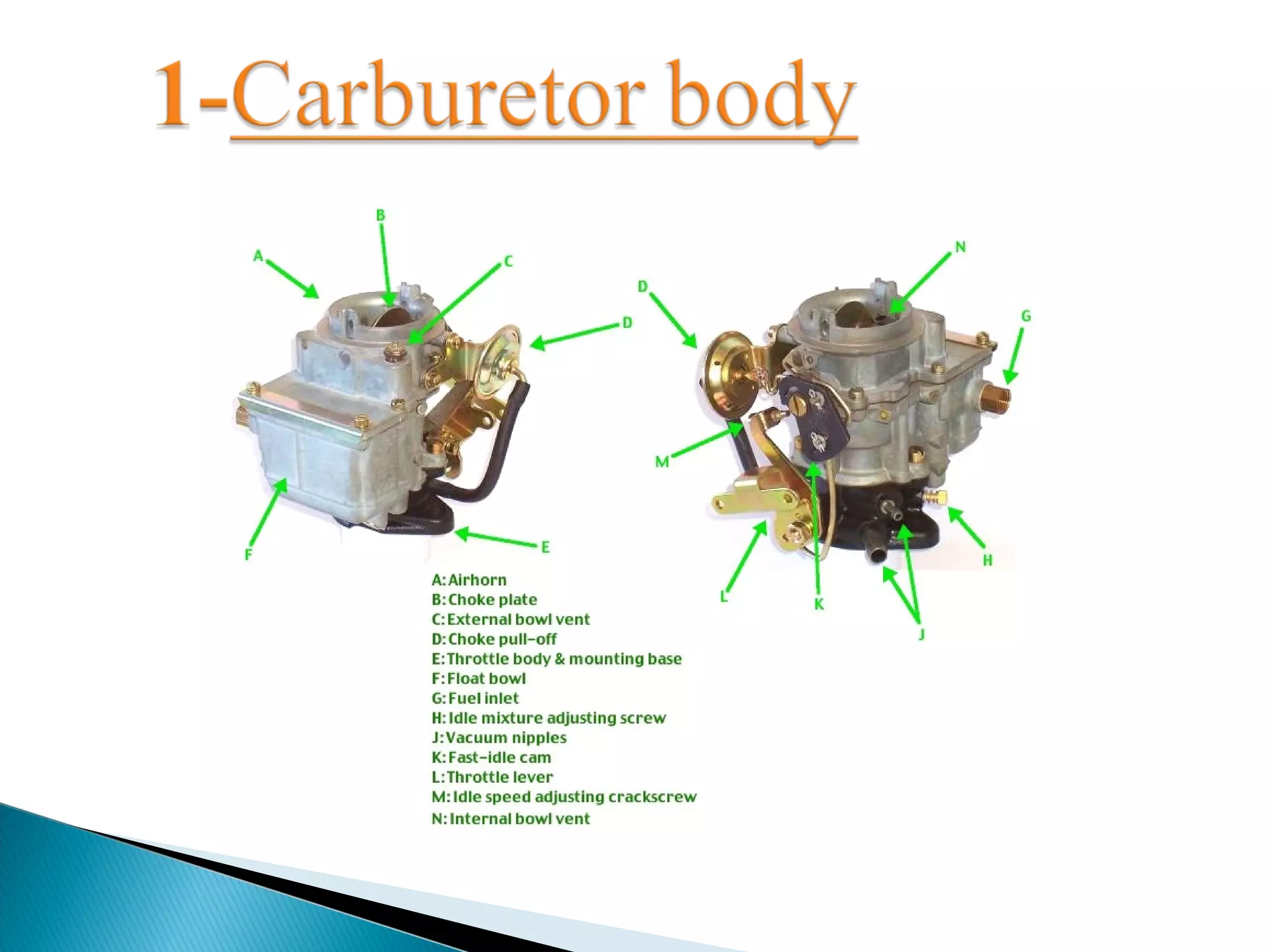
1-Carburetor body
2-Air horn
3-Throttle valve
4-Ventur
5-Main discharge tube
6-Fuel bowl
 The air horn is also called the throat or barrel.
The parts which often fasten to the air horn body are as
follows: the choke, the hot idle compensator, the fast idle
linkage rod, the choke vacuum break, and sometimes the
float and pump mechanisms.
 This disc-shaped valve
controls air flow through
the air horn.
 When closed, it restricts
the flow of air and fuel into
the engine, and when
opened, air flow, fuel flow,
and engine power increase.
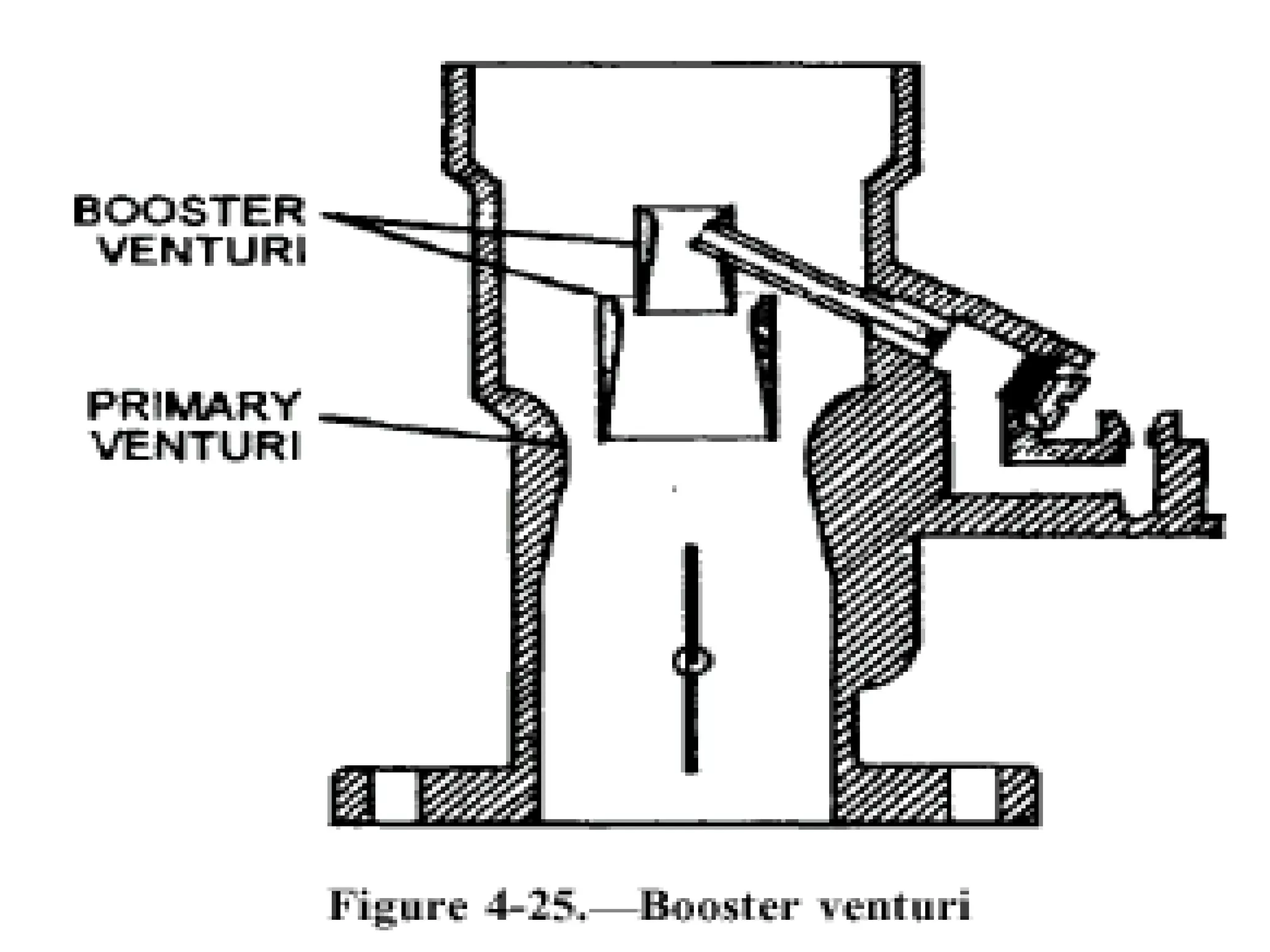
 The venturi produces
sufficient suction to pull
fuel out of the main
discharge tube
 The main discharge
tube is also called the
main fuel nozzle
• It is a passage that
connects the fuel bowl to
the center of the venturi.
 The fuel bowl holds a
supply of fuel that is
NOT under fuel pump
pressure
 Carburetor size is stated in CFM (cubic feet of air per
minute).
 This is the amount of air that can flow through the
carburetor at wide, open throttle.
 CPM is an indication of the maximum air flow
capacity. Usually, small CPM carburetors are more
fuel-efficient than larger carburetors. Air velocity, fuel
mixing, and atomization are better with small throttle
bores. A larger CPM rating is desirable for high engine
power output
1. Float system
2. Idle system
3. Off idle system
4. Acceleration system
5. High-speed system
6. Full-power system
 The float system (fig. 4-20) maintains a steady working
supply of gasoline at a constant level in the carburetor.
This action is critical to the proper operation of the
carburetor. Since the carburetor uses differences in
pressure to force fuel into the air horn,
The float system keeps the fuel pump from forcing too
much gasoline into the carburetor bowl
An excessively high float level will cause fuel to flow
too freely from the discharge tube, causing an overly
rich mixture
whereas an excessively low float level will cause an
overly lean mixture
The basic parts of the float system are the
fuel bowl, the float, the needle valve, the
needle seat, the bowl vent
• The carburetor float rides on top of the fuel in the fuel
bowl to open and close the needle valve.
• It is normally made of thin brass or plastic. One end of the
float is hinged to the side of the carburetor body and the
other end is free to swing up and down.
* The needle valve is usually made of brass
 The off idle, also known as the part throttle, feeds
more fuel into the air horn when the throttle plate is
partially open. It is an extension of the idle system. It
functions above approximately 800 rpm or 20 mph.
 Without the off idle system, the fuel mixture would
become too lean slightly above idle. The idle system
alone is not capable of supplying enough fuel to the
air stream passing through the carburetor. The off
idle system helps supply fuel during the change from
idle to high speed.
The carburetor acceleration system, like the off idle system,
provides extra fuel when changing from the idle system to
the high-speed system. The acceleration system squirts a
stream of fuel into the air horn when the fuel pedal is
pressed and the throttle plates swing open.
Without the acceleration system, too much fuel would rush
into the engine, as the throttle quickly opened. The
mixture would become too lean for combustion and the
engine would stall or hesitate. The acceleration system
prevents a lean air-fuel mixture from upsetting a smooth
increase in engine speed.
The, high-speed system, also called the main
metering system, supplies the engine air-fuel
mixture at normal cruising speeds.
This system begins to function when the throttle
plate is opened wide enough for the venturi action.
Air flow through the carburetor must be relatively
high for venturi vacuum to draw fuel out of the
main discharge tube.
The high-speed system provides the leanest, most
fuel efficient air-fuel ratio. It functions from about
20 to 55 mph or 2,000 to 3,000 rpm.
The full-power system provides a means of enriching the
fuel mixture for high-speed, high-power conditions.
This system operates, for example, when the driver
presses the fuel pedal to pass another vehicle or to
climb a steep hill.
The full-power system is an addition to the high-speed
system. Either a metering rod or a power valve (jet) can
be used to provide variable, high-speed air-fuel ratio.
When the engine is cold, the fuel tends to condense
into large drops in the manifold, rather than
vaporizing. By supplying a richer mixture (8:1 to
9:1), there will be enough vapor to assure complete
combustion.
The carburetor is fitted with a choke system to
provide this richer mixture.
The choke system provides a very rich mixture to start
the engine and to make the mixture less rich
gradually, as the engine reaches operating
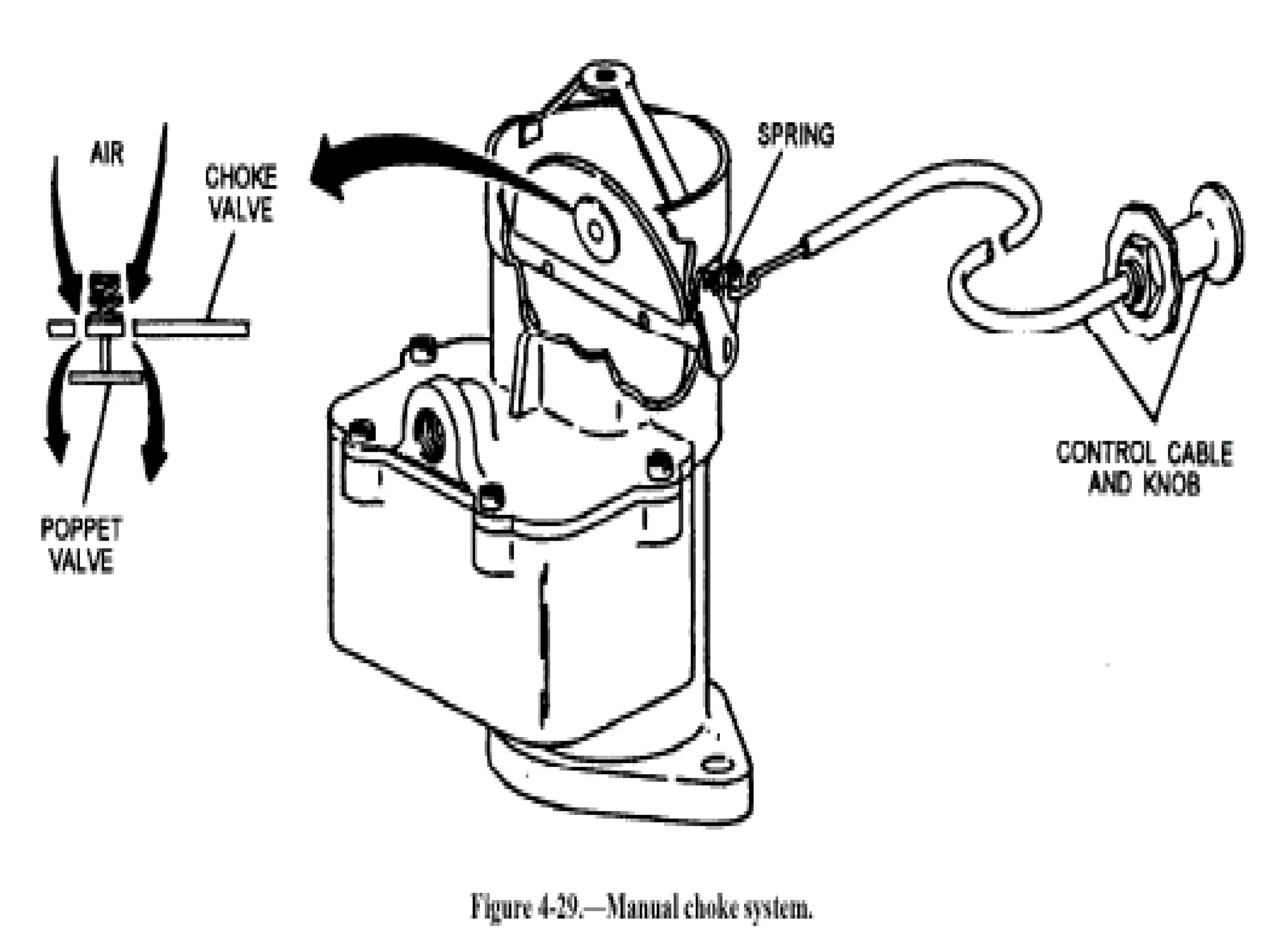
temperature. The two types of choke systems are the
manual and automatic
A computer-controlled carburetor uses a solenoid-
operated valve to respond to commands from the
microcomputer (electronic control unit). The system
uses various sensors to send information to the
computer that calculates how rich or lean to set the
carburetor air-fuel mixture.
The system is also known as a computer controlled
emission system which consists of the following:
oxygen sensor, temperature sensor, pressure
sensor, electromechanical carburetor, mixture
control solenoid, computer, and idle speed actuator
1-The oxygen sensor, or exhaust gas sensor, monitors
the oxygen content in the engine exhaust
2-The temperature sensor detects the operating
temperature of the engine
3-The manifold pressure sensor (MAP) measures
intake manifold vacuum and engine load.
4-The computer, also called the electronic control unit
(ECU), uses sensor information to operate the
mixture control solenoid of the carburetor
1-EXCESSIVE FUEL CONSUMPTION
2-A SLUGGISH ENGINE
3-POOR IDLING
4-FAILURE OF THE ENGINE TO START
5-HARD STARTING OF A WARM ENGINE
6-SLOW ENGINE WARM-UP
7-A BACKFIRING ENGINE
There are several devices used on carburetors to
improve drivability and economy.
These devices are as follows:
The fast idle solenoid, the throttle return dashpot, the hot
idle compensator, and the altitude compensator. Their
applications vary from vehicle to vehicle
THANK YOU

Principles of carburetion

  • 1.
    PRESENTETION ON PRINCIPAL OFCARBURETION SUBMITTED TO: SUBMITTED BY: MR. AMARDEEP SIR HARIOHM KR. PRASAD DEPT. MECH.ENG. K11057,6TH SEM,MECH
  • 2.
     The principlesof carburetion are presented so you may better understand the inner workings of a carburetor and how the other components of the fuel system function to provide a combustible mixture or air and fuel to the engine cylinders.
  • 3.
     Air iscomposed of various gases, mostly nitrogen and oxygen (78 percent nitrogen and 21 percent oxygen by volume). These gases are, in turn, made up of tiny particles called molecules. All substances, whether solid, liquid, or gas, are made up of molecules. In solids, such as ice or iron, the particles are held closely together so that they seem to have no motion. In liquids, the molecules are not held together tightly, so they can move freely with respect to each other. In gases, there is still less tendency for the molecules to bond; therefore, the molecules can move quite freely. The molecules of gas are attracted to the earth by gravity or by their weight. It is the combined weight of the countless molecules in the air that make up atmospheric pressure.
  • 4.
     EVAPORATION is thechanging of a liquid to a vapor. *The rate of evaporation is dependent on the following 1- TEMPERATURE. 2- ATMOSPHERIC PRESSURE 3- VOLATILITY. 4- ATOMIZATION
  • 5.
    The rate ofmovement of the molecules increase with temperature. Because of this, the amount of molecules leaving the liquid for a given time will increase, as the temperature increases.
  • 6.
    As atmospheric pressureincreases, the amount of air molecules present over the liquid also increases. The increased presence of air molecules will slow the rate of evaporation. This is because the molecules of liquid will have more air molecules to collide with. In many cases, they will fall back into the liquid after the collision
  • 7.
     The termvolatility refers to how fast a liquid vaporizes. Some liquid vaporizes easily at room temperature. Alcohol, for instance, vaporizes more easily than water. A highly volatile liquid is one that is considered to evaporate easily.
  • 8.
     Atomization isthe process of breaking up a liquid into tiny particles or droplets.  When a liquid is atomized, the droplets are all exposed individually to the air.  For this reason, atomization greatly increases evaporation by increasing the exposed surface area of the liquid.
  • 9.
     A carburetoris basically a device for mixing air and fuel in the correct amounts for efficient combustion. The carburetor bolts to the engine intake manifold. The air cleaner fits over the top of the carburetor to trap dust and dirt.
  • 10.
    1-Carburetor body 2-Air horn 3-Throttlevalve 4-Ventur 5-Main discharge tube 6-Fuel bowl
  • 13.
     The airhorn is also called the throat or barrel. The parts which often fasten to the air horn body are as follows: the choke, the hot idle compensator, the fast idle linkage rod, the choke vacuum break, and sometimes the float and pump mechanisms.
  • 15.
     This disc-shapedvalve controls air flow through the air horn.  When closed, it restricts the flow of air and fuel into the engine, and when opened, air flow, fuel flow, and engine power increase.
  • 16.
     The venturiproduces sufficient suction to pull fuel out of the main discharge tube
  • 17.
     The maindischarge tube is also called the main fuel nozzle • It is a passage that connects the fuel bowl to the center of the venturi.
  • 18.
     The fuelbowl holds a supply of fuel that is NOT under fuel pump pressure
  • 19.
     Carburetor sizeis stated in CFM (cubic feet of air per minute).  This is the amount of air that can flow through the carburetor at wide, open throttle.  CPM is an indication of the maximum air flow capacity. Usually, small CPM carburetors are more fuel-efficient than larger carburetors. Air velocity, fuel mixing, and atomization are better with small throttle bores. A larger CPM rating is desirable for high engine power output
  • 20.
    1. Float system 2.Idle system 3. Off idle system 4. Acceleration system 5. High-speed system 6. Full-power system
  • 22.
     The floatsystem (fig. 4-20) maintains a steady working supply of gasoline at a constant level in the carburetor. This action is critical to the proper operation of the carburetor. Since the carburetor uses differences in pressure to force fuel into the air horn, The float system keeps the fuel pump from forcing too much gasoline into the carburetor bowl
  • 23.
    An excessively highfloat level will cause fuel to flow too freely from the discharge tube, causing an overly rich mixture whereas an excessively low float level will cause an overly lean mixture The basic parts of the float system are the fuel bowl, the float, the needle valve, the needle seat, the bowl vent
  • 24.
    • The carburetorfloat rides on top of the fuel in the fuel bowl to open and close the needle valve. • It is normally made of thin brass or plastic. One end of the float is hinged to the side of the carburetor body and the other end is free to swing up and down. * The needle valve is usually made of brass
  • 26.
     The offidle, also known as the part throttle, feeds more fuel into the air horn when the throttle plate is partially open. It is an extension of the idle system. It functions above approximately 800 rpm or 20 mph.  Without the off idle system, the fuel mixture would become too lean slightly above idle. The idle system alone is not capable of supplying enough fuel to the air stream passing through the carburetor. The off idle system helps supply fuel during the change from idle to high speed.
  • 27.
    The carburetor accelerationsystem, like the off idle system, provides extra fuel when changing from the idle system to the high-speed system. The acceleration system squirts a stream of fuel into the air horn when the fuel pedal is pressed and the throttle plates swing open. Without the acceleration system, too much fuel would rush into the engine, as the throttle quickly opened. The mixture would become too lean for combustion and the engine would stall or hesitate. The acceleration system prevents a lean air-fuel mixture from upsetting a smooth increase in engine speed.
  • 30.
    The, high-speed system,also called the main metering system, supplies the engine air-fuel mixture at normal cruising speeds. This system begins to function when the throttle plate is opened wide enough for the venturi action. Air flow through the carburetor must be relatively high for venturi vacuum to draw fuel out of the main discharge tube. The high-speed system provides the leanest, most fuel efficient air-fuel ratio. It functions from about 20 to 55 mph or 2,000 to 3,000 rpm.
  • 32.
    The full-power systemprovides a means of enriching the fuel mixture for high-speed, high-power conditions. This system operates, for example, when the driver presses the fuel pedal to pass another vehicle or to climb a steep hill. The full-power system is an addition to the high-speed system. Either a metering rod or a power valve (jet) can be used to provide variable, high-speed air-fuel ratio.
  • 33.
    When the engineis cold, the fuel tends to condense into large drops in the manifold, rather than vaporizing. By supplying a richer mixture (8:1 to 9:1), there will be enough vapor to assure complete combustion. The carburetor is fitted with a choke system to provide this richer mixture. The choke system provides a very rich mixture to start the engine and to make the mixture less rich gradually, as the engine reaches operating temperature. The two types of choke systems are the manual and automatic
  • 35.
    A computer-controlled carburetoruses a solenoid- operated valve to respond to commands from the microcomputer (electronic control unit). The system uses various sensors to send information to the computer that calculates how rich or lean to set the carburetor air-fuel mixture. The system is also known as a computer controlled emission system which consists of the following: oxygen sensor, temperature sensor, pressure sensor, electromechanical carburetor, mixture control solenoid, computer, and idle speed actuator
  • 36.
    1-The oxygen sensor,or exhaust gas sensor, monitors the oxygen content in the engine exhaust 2-The temperature sensor detects the operating temperature of the engine 3-The manifold pressure sensor (MAP) measures intake manifold vacuum and engine load. 4-The computer, also called the electronic control unit (ECU), uses sensor information to operate the mixture control solenoid of the carburetor
  • 37.
    1-EXCESSIVE FUEL CONSUMPTION 2-ASLUGGISH ENGINE 3-POOR IDLING 4-FAILURE OF THE ENGINE TO START 5-HARD STARTING OF A WARM ENGINE 6-SLOW ENGINE WARM-UP 7-A BACKFIRING ENGINE
  • 38.
    There are severaldevices used on carburetors to improve drivability and economy. These devices are as follows: The fast idle solenoid, the throttle return dashpot, the hot idle compensator, and the altitude compensator. Their applications vary from vehicle to vehicle
  • 39.