UNIT II ENGINE AUXILIARY SYSTEMS
Syllabus
Syllabus
Ele
Electr
ctroni
onical
cally
ly cont
control
rolled
led gaso
gasolin
line
e inj
inject
ection
ion sys
system
tem for
for SI
SI engi
engines,
nes, Ele
Electr
ctroni
onical
cally
ly
con
contr
trol
olle
led
d di
dies
esel
el in
inje
jecti
ction
on sy
syste
stem
m (U
(Uni
nit
t in
inje
ject
ctor
or sy
syste
stem,
m, Ro
Rota
tary
ry di
dist
stri
ribu
buto
tor
r ty
type
pe an
and
d
com
common
mon rail
rail dir
direct
ect inj
inject
ection
ion sys
system
tem),
), Ele
Electr
ctroni
onic
c ign
igniti
ition
on syst
system
em (Tra
(Transi
nsistor
storize
ized
d coi
coil
l
ign
ignit
ition
ion syst
system
em,
, cap
capaci
acitiv
tive
e disc
discharg
harge
e ign
igniti
ition
on sys
system
tem),
), Turb
Turbo
o cha
charge
rgers
rs (WG
(WGT,
T, VGT
VGT),
),
Engine emission control by three way catalytic converter system, Emission norms (Euro
and BS).
and BS).
Electronically controlled gasoline injection system for SI engines
CARBURETION
CARBURETION
Introduction
Introduction
Spark-i
Spark-igniti
gnition
on engine
engines
s normal
normally
ly use
use volati
volatile liquid
le liquid fuels. Preparati
fuels. Preparation
on of
of fuel-ai
fuel-air
r mixtu
mixture
re is
is
done outside the engine cylinder and formation of a homogeneous mixture is normally not
com
comple
plete
ted
d in
in th
the
e in
inle
let
t ma
manif
nifol
old.
d. Fu
Fuel
el dro
dropl
plet
ets,
s, wh
whic
ich
h rem
remai
ain
n in
in sus
suspe
pensi
nsion
on,
, co
cont
ntin
inue
ue to
to
evaporate and mix with air even during suction and compression processes. The process of 
mi
mixt
xture
ure pre
prepar
parat
atio
ion
n is
is ext
extrem
remel
ely
y im
impor
porta
tant
nt for
for sp
spark
ark-i
-igni
gniti
tion
on eng
engin
ines
es.
. Th
The
e pur
purpos
pose
e of 
of 
carburetion is to provide a combustible mixture of fuel and air in the required quantity and
quali
quality for
ty for effici
efficient operation of
ent operation of the engine
the engine under all
under all condi
conditions.
tions.
Definition of Carburetion
The process of formation of a combustible fuel-air mixture by mixing the proper amount
of fuel with air before admission to engine cylinder is called carburetion and the device which
does this job is called a carburetor.
The Simple
The Simple Carbur
Carburetor
etor
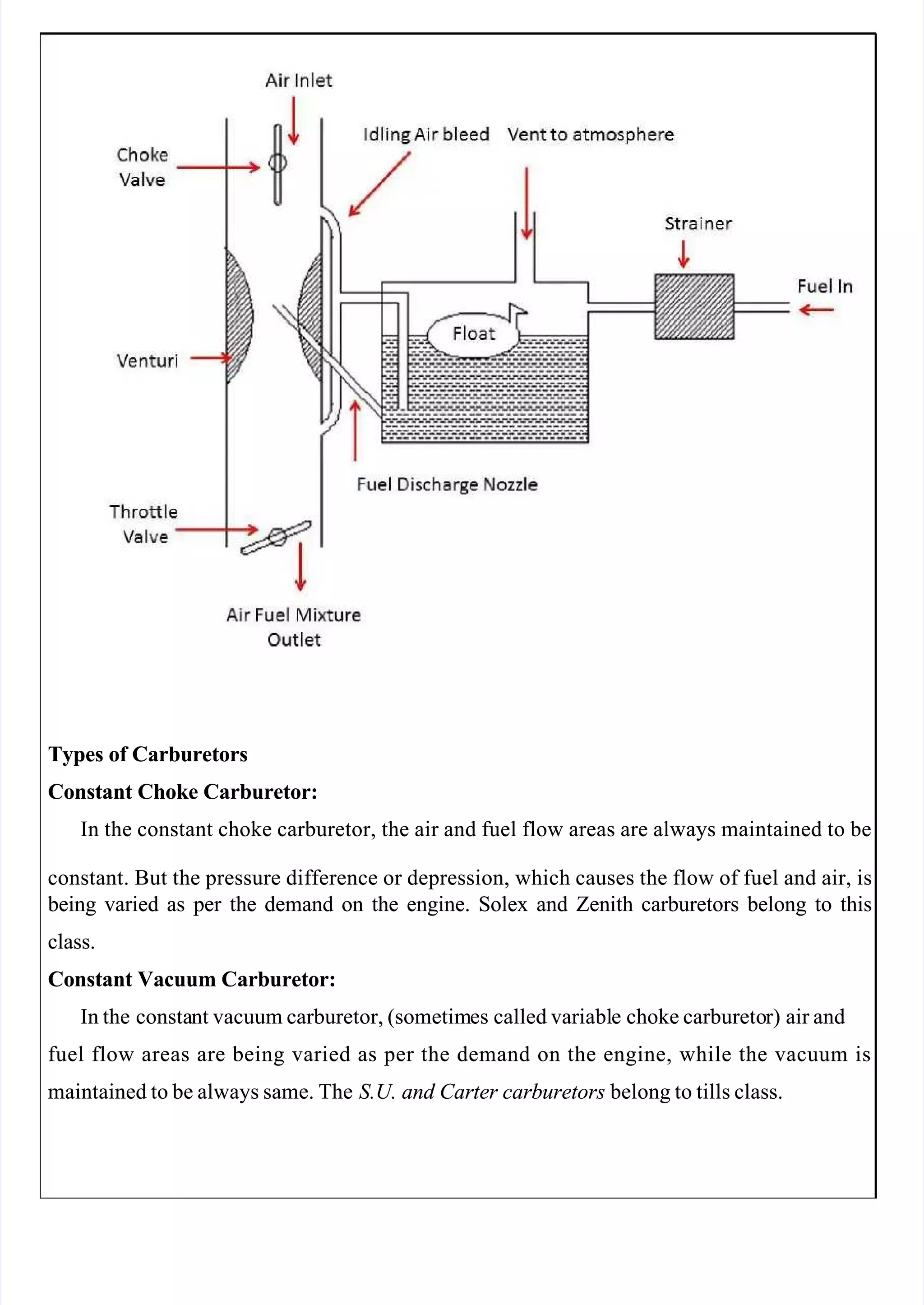
Carburetors are highly complex. Let us first understand the working principle bf a simple
or elementary carburetor that provides an air fuel mixture for cruising or normal range at a
single speed. Later, other mechanisms to provide for the various special requirements like
starting, idling, variable load and speed operation and acceleration will be included.
 
 
Types of Carburetors
Constant Choke Carburetor:
In the constant choke carburetor, the air and fuel flow areas are always maintained to be
constant. But the pressure difference or depression, which causes the flow of fuel and air, is
 being
 being varied
varied as
as per
per the
the demand
demand on
on the
the engine.
engine. Solex
Solex and
and Zenith
Zenith carburetors
carburetors belong
belong to
to this
this
class.
class.
Constant Vacuum Carburetor:
In the
In the consta
constant vacuum carburetor, (sometim
nt vacuum carburetor, (sometimes
es called variabl
called variable
e choke carbureto
choke carburetor)
r) air and
air and
fuel flow areas are being varied as per the demand on the engine, while the vacuum is
maintained to be always same. The
maintained to be always same. The S.U. and Carter carburetors
 S.U. and Carter carburetors belong to tills class.
 belong to tills class.
 
 
Multiple Venturi Carburetor:
Mu
Mult
ltip
iple
le ven
ventu
turi
ri sy
syste
stem
m us
uses
es dou
doubl
ble
e or
or tr
trip
iple
le ven
ventu
turi
ri.
. Th
The
e boo
boost
st ven
ventu
turi
ri is
is lo
loca
cate
ted
d
concentrically within the main venturi.The discharge edge of the boost venturi is located at
the throat of the main venturi. The boost venturi is positioned upstream of the throat of the
larger main venturi. Only a fraction of the total air flows though the boost venturi.
 Now
 Now the
the pressure
pressure at
at the
the boost
boost venturi
venturi exit
exit equals
equals the
the pressure
pressure at
at the
the main
main venturi
venturi throat.
throat. The
The
fuel nozzle is located at the throat of the boost venturi.
GASOLINE INJECTION AND IGNITION SYSTEM
Introduction
Introduction
In
In in
inte
terna
rnal
l co
comb
mbust
ustio
ion
n eng
engin
ines
es,
, gas
gasol
olin
ine
e di
dire
rect
ct in
inje
ject
ctio
ion
n (G
(GDI
DI),
), is
is a
a var
varia
iant
nt of
of fue
fuel
l
injection employed in modern two-stroke and four-stroke gasoline engines. The gasoline is
hi
highl
ghly
y pre
pressu
ssuri
rize
zed
d in
in a
a co
comm
mmon
on rai
rail
l fu
fuel
el li
line
ne and
and in
inje
ject
ctor
ors
s in
inje
ject
cts
s fue
fuel
l di
direc
rectl
tly
y in
into
to th
the
e
combustion chamber of each cylinder.It is opposed to conventional multi-point fuel injection
which injects fuel to the intake manifold. Gasoline direct injection enables a stratified fuel
charge (ultra lean burn) combustion for improved fuel efficiency, and reduced emission levels
at low load.
at low load.
TRANSITION OF FUEL SUPPLY SYSTEM
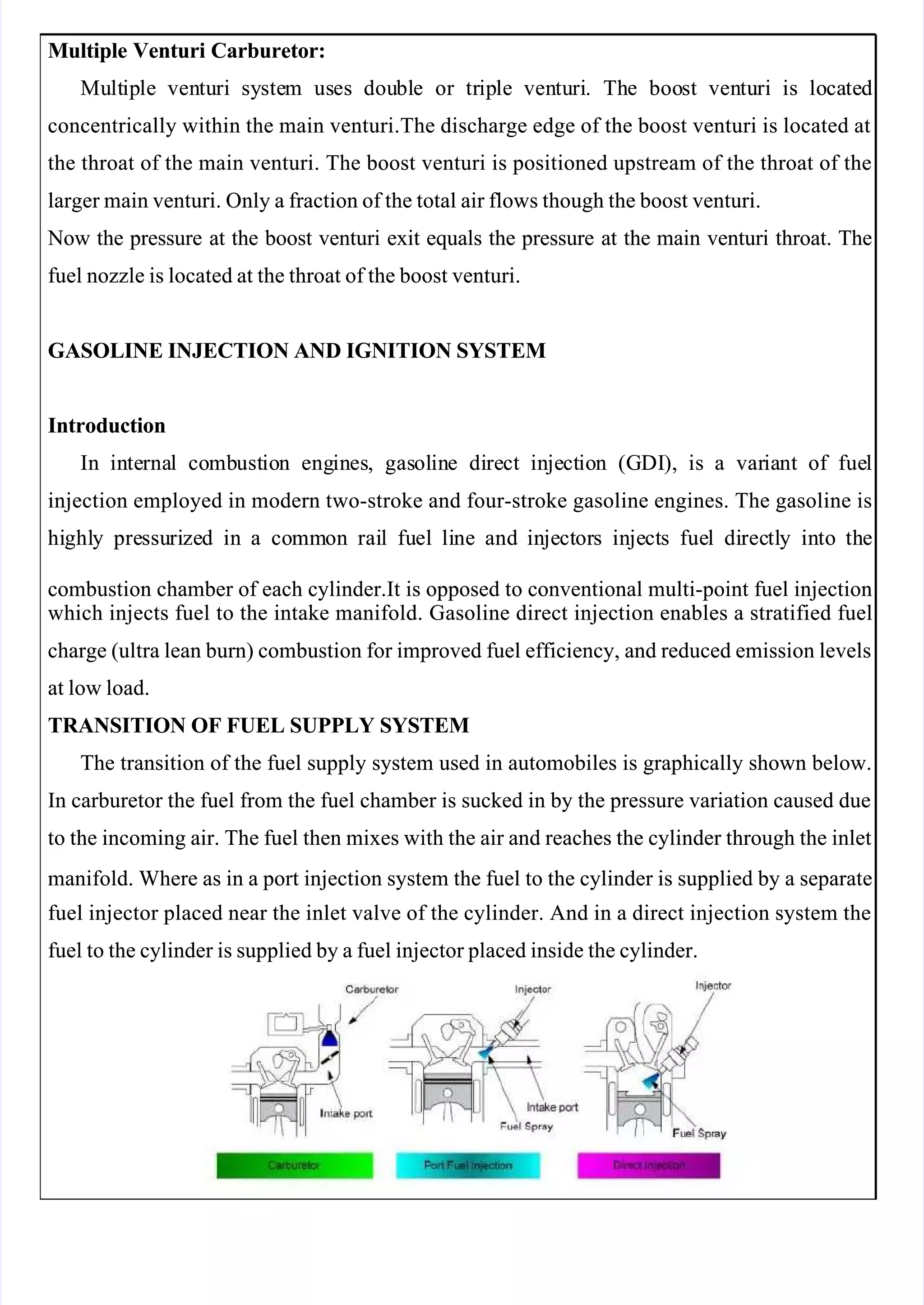
The transition of the fuel supply system used in automobiles is graphically shown below.
In carburetor the fuel from the fuel chamber is sucked in by the pressure variation caused due
to the incoming air. The fuel then mixes with the air and reaches the cylinder through the inlet
manifold. Where as in a port injection system the fuel to the cylinder is supplied by a separate
fuel injector placed near the inlet valve of the cylinder. And in a direct injection system the
fuel to the cylinder is supplied by a fuel injector placed inside the cylinder.
 
 
OPERATING DIFFICULTIES FOR A CARBURETOR.
Some problems associat
Some problems associated with
ed with comfor
comfortable running of
table running of the carburetor are
the carburetor are discus
discussed here.
sed here.
1. Ice formation:
1. Ice formation: The vaporisation of the fuel injected in the current of the air requires latent
 The vaporisation of the fuel injected in the current of the air requires latent
heat and the taken mainly from the incoming air. As a result of this, the temperature of the air 
drops below the dew point of the water vapour in the air and it condenses and many times
freeze into ice if the temperature falls below dew point temperature.
2. Vapour Lock:
2. Vapour Lock: The improved volatility of modern fuels and the necessity of providing heat
 The improved volatility of modern fuels and the necessity of providing heat
to prevent the ice formation, has created carburetion difficulties due to vaporisation of fuel in
 pipes
 pipes and
and float
float chamber.
chamber. The
The heating
heating may
may also
also occur
occur due
due to
to petrol
petrol pipes
pipes being
being near
near the
the engine.
engine.
If the fuel supply is large and supply is small, a high velocity will result causing high vacuum.
This causes considerable drop which may also cause the formation of vapour bubbles. If these
 bubbles
 bubbles formed
formed accumulate
accumulate at
at the
the tube
tube bend,
bend, then
then they
they may
may interrupt
interrupt the
the fuel
fuel flow
flow from
from the
the
tank or the fuel pump and engine will stop because of lack of fuel. Vapour lock is formed
 because
 because of
of rapid
rapid bubbling
bubbling of
of fuel
fuel and
and usually
usually happens
happens in
in hot
hot summer.
summer.
3. Back Firing:
3. Back Firing: During the starting of an engine under cold working conditions, the usual
 During the starting of an engine under cold working conditions, the usual
manipulation of the choke varies the mixture from too lean to too rich. A very lean mixture
will burn very slowly and the flame may still exist in cylinder when the exhaust valve is about
to open. The fresh charge in the intake manifold is about to open. The fresh charge in the
intake manifold is not so diluted as when inducted into the cylinder and mixed with the
clearance gases and consequently burn more rapidly than the charge in the cylinder. If lean
charge comes in contact with flames existing in the cylinder, there will be flash of flame back 
through the intake manifold, burning the charge therein and causing the customary back firing
in the carburetor.
in the carburetor.
ADVANTAGES OF FUEL INJECTION OVER CARBURETOR 
The fuel injection eliminates several intake manifold distribution problems. One of the
most difficult problems in a carbureted system is to get the same amount and richness of 
air-fuel mixture to each cylinder. The problem is that the intake manifold acts as a storing
device, sending a richer air fuel mixture to the end cylinders. The air flows readily around the
 
 
corners and through various shaped passages. However the fuel, because it is heavier is unable
to travel as easily around the bends in the intake manifold. As a result, some of fuel particles
continue to move to the end of the intake manifold, accumulating there. This enriches the
mixture going the end cylinder. The center cylinder closest to the carburetor gets the leanest
mixture. The port injection solves this problem because the same amount of fuel is injected at
each intake valve port. Each cylinder gets the same amount of air-fuel mixture of the same
mixture richness.
mixture richness.
Another advantage of the fuel injection system is that the intake manifold can be designed
for the most efficient flow of air only. It does not have to handle fuel. Also, because only a
throttle body is used, instead of a complete carburetor.
With fuel injection, fuel mixture requires no extra heating during warm up. No manifold
heat control valve or heated air system is required. Throttle response is faster because the fuel
is
is un
unde
der
r pre
pressu
ssure
re at
at th
the
e in
inje
ject
ctio
ion
n va
valv
lves
es at
at al
all
l ti
time
mes.
s. An
An el
elec
ectr
tric
ic fue
fuel
l pu
pump
mp su
supp
ppli
lies
es th
the
e
 pressure.
 pressure. The
The carburetor
carburetor will
will depend
depend on
on differences
differences in
in air
air pressure
pressure as
as the
the force
force that
that causes
causes the
the
fuel to feed into the air passing through.
Fu
Fuel
el in
inje
ject
ctio
ion
n ha
has
s no
no ch
choke
oke,
, bu
but
t spr
spray
ays
s at
atom
omiz
ized
ed fue
fuel
l di
direc
rectl
tly
y in
into
to th
the
e en
engi
gine
ne.
. Thi
This
s
eliminates most of the cold start problems associated with carburetors.
Ele
Electr
ctroni
onic
c fuel
fuel inj
inject
ection
ion als
also
o int
integra
egrates
tes mor
more
e eas
easily
ily wit
with
h com
comput
puteri
erized
zed eng
engine
ine cont
control
rol
systems because the injectors are more easily controlled than a mechanical carburetor with
electronic add-ons.
electronic add-ons.
Multi port fuel injection (where each cylinder has its own injector) delivers a more evenly
distributed mixture of air and fuel to each of the engine's cylinders, which improves power 
and performance.
and performance.
 
 
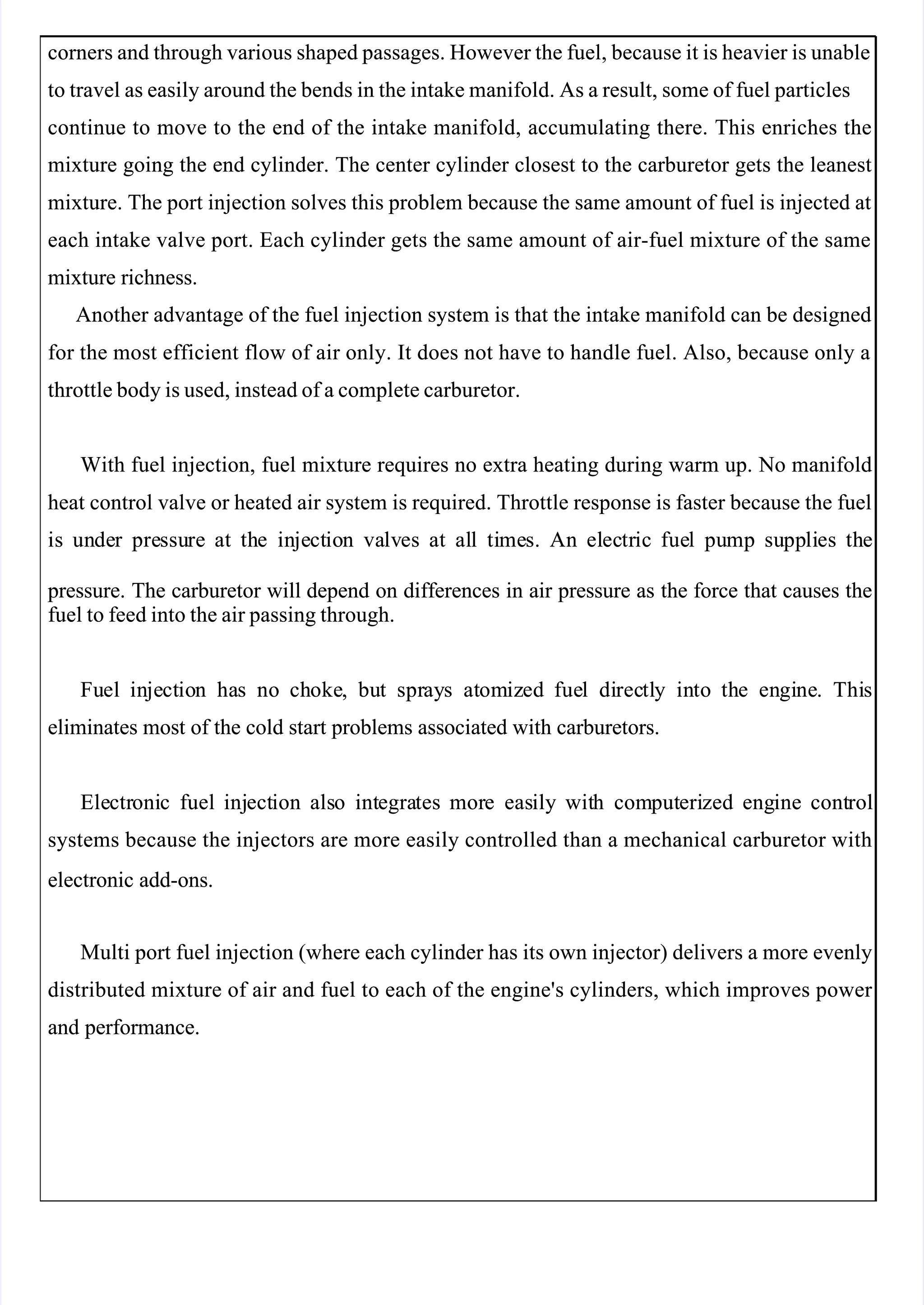
ELECTRONIC FUEL INJECTION
Engine Sensors: In order to provide the correct amount of fuel for every operating condition,
the engine control unit (ECU) has to monitor a huge number of input sensors.
Various Sensors used in a GDI system
 Mass airflow sensor
 Mass airflow sensor -
- Tells the ECU the mass of air entering the engine
 Tells the ECU the mass of air entering the engine
Oxygen sensor - The device measures the amount of oxygen in the exhaust gas and sends
this information to the electronic control unit. If there is too much oxygen, the mixture is too
lean. If there is too little, the mixture is too rich. In either case, the electronic control unit
adjusts the air fuel ratio by changing the fuel injected. It is usually used with closed loop
mode of the ECU.
mode of the ECU.
Thr
Throttl
ottle
e pos
positio
ition
n sens
sensor
or -
- Monitors the throttle valve position (which determines how
 Monitors the throttle valve position (which determines how
much air goes into the engine) so the ECU can respond quickly to changes, increasing or 
decreasing the fuel rate as necessary
Coolant temperature sensor -
Coolant temperature sensor - Allows the ECU to determine when the engine has reached
 Allows the ECU to determine when the engine has reached
its proper operating temperature
Voltage sensor -
Voltage sensor - Monitors the system voltage in the car so the ECU can raise the idle
 Monitors the system voltage in the car so the ECU can raise the idle
speed if voltage is dropping (which would indicate a high electrical load)
 Manifo
 Manifold
ld absolute
absolute pressure
pressure sensor
sensor -
-   Mo
  Moni
nito
tors
rs th
the
e pr
pres
essu
sure
re of
of th
the
e ai
air
r in
in th
the
e in
inta
take
ke
manifold. The amount of air being drawn into the engine is a good indication of how much
 
 
 power
 power it
it is
is producing;
producing; and
and the
the more
more air
air that
that goes
goes into
into the
the engine,
engine, the
the lower
lower the
the manifold
manifold
 pressure,
 pressure, so
so this
this reading
reading is
is used
used to
to gauge
gauge how
how much
much power
power is
is being
being produced.
produced.
 Engine
 Engine speed
speed sensor
sensor -
-   Mo
  Moni
nito
tors
rs en
engi
gine
ne sp
spee
eed,
d, wh
whic
ich
h is
is on
one
e of
of th
the
e fa
fact
ctor
ors
s us
used
ed to
to
calculate the pulse width.
Crank Angle sensor -
Crank Angle sensor - Monitors the position of the piston and gives the information to the
 Monitors the position of the piston and gives the information to the
ECU. Accordingly the ECU adjusts the valve timing.
Fuel Injectors:
Fuel Injectors:
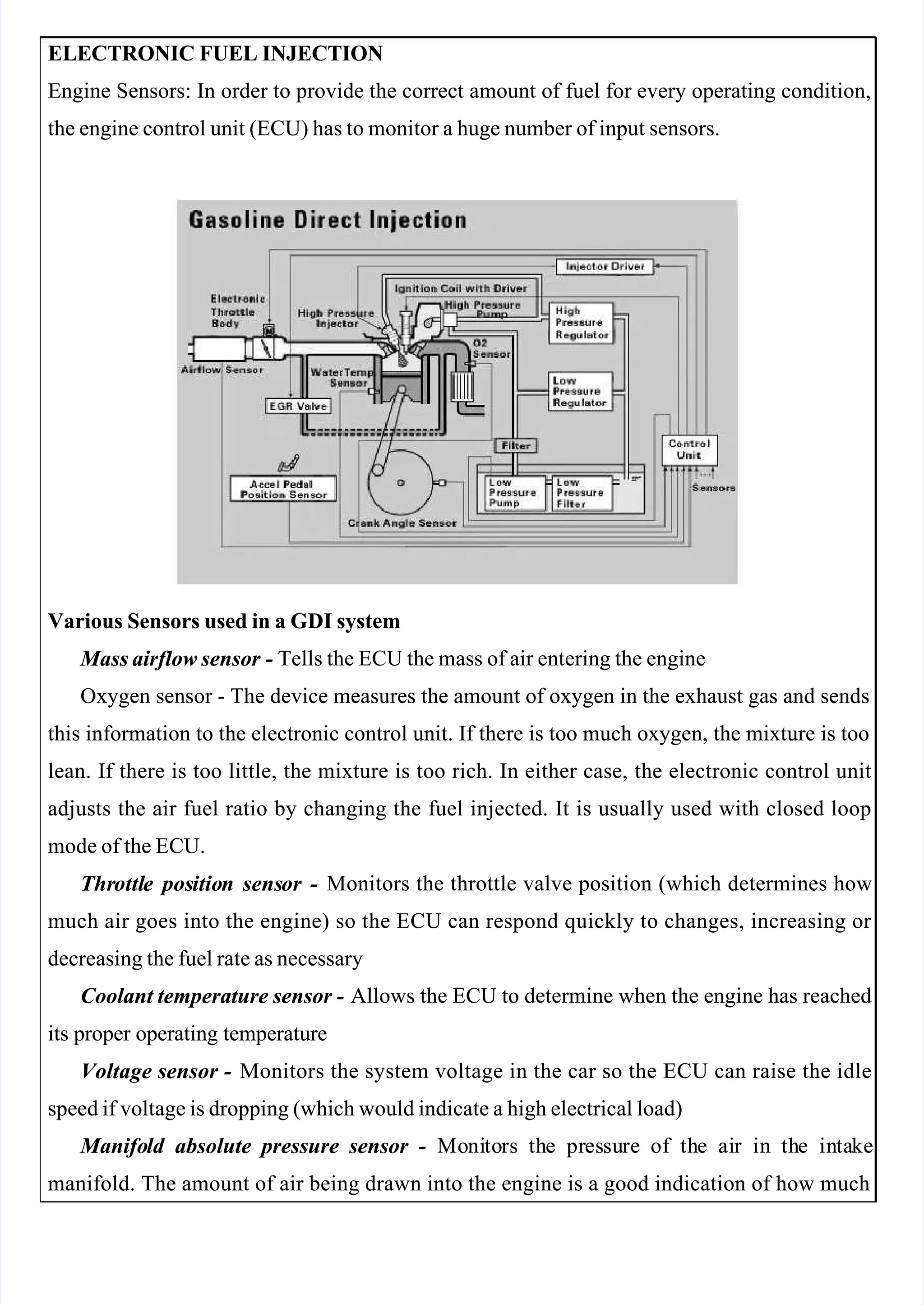
The solenoid-operated fuel injector is shown in the figure above. It consists of a valve
 body
 body and
and needle
needle valve
valve to
to which
which the
the solenoid
solenoid plunger
plunger is
is rigidly
rigidly attached.
attached. The
The fuel
fuel is
is supplied
supplied
to the injector under pressure from the electric fuel pump passing through the filter. The
needle valve is pressed against a seat in the valve body by a helical spring to keep it closed
until the solenoid winding is energized. When the current pulse is received from the electronic
control unit, a magnetic field builds up in the solenoid which attracts a plunger and lifts the
needle valve from its seat. This opens the path to pressurised fuel to emerge as a finely
atomised spray.
atomised spray.
 
 
ELECTRONIC FUEL INJECTION
There are two types of electronic fuel injection. They are,
1. Multipoint Fuel Injection (MPFI)
2. Gasoline Direct Injection (GDI)
MULTI POINT FUEL INJECTION (MPFI)
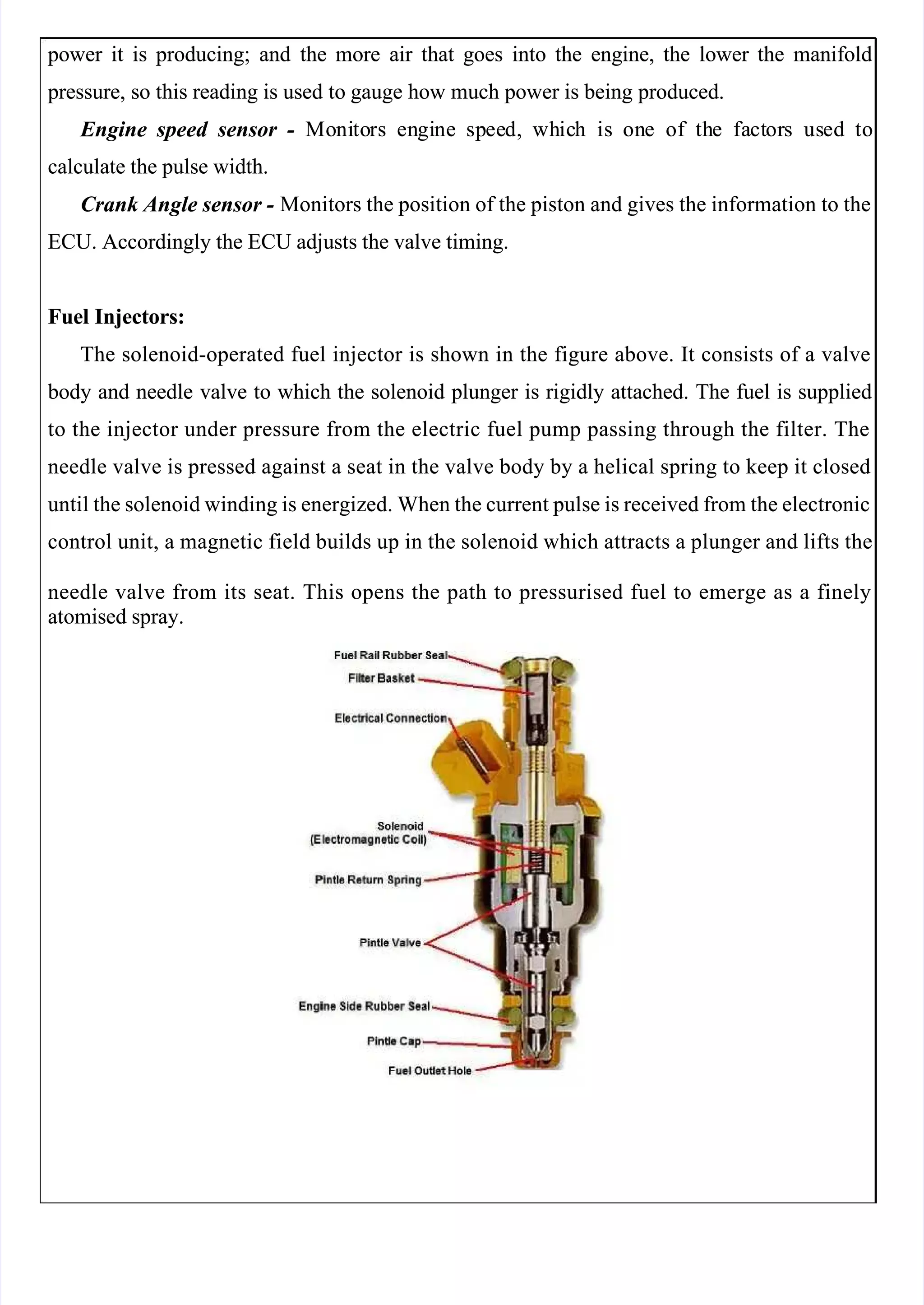
Engines with multi port injection have a separate fuel injector for each cylinder, mounted
in the intake manifold or head just above the intake port.
Thus, a four-cylinder engine would have four injectors, a V6 would have six injectors and
a V8 would have eight injectors. Multi port injection systems are more expensive because of 
the added number of injectors. But having a separate injector for each cylinder makes a big
difference in performance. The same engine with multi port injection will typically produce
10 to 40 more horsepower than one with carburetor because of better cylinder-to-cylinder fuel
distribution. Injecting fuel directly into the intake ports also eliminates the need to preheat the
in
inta
take
ke ma
mani
nifol
fold
d si
sinc
nce
e on
only
ly ai
air
r flo
flows
ws th
throu
rough
gh th
the
e ma
manif
nifol
old.
d. Th
This
is,
, in
in tu
turn
rn,
, pro
provi
vide
des
s mo
more
re
freedom for tuning the intake plumbing to produce maximum torque.
 
 
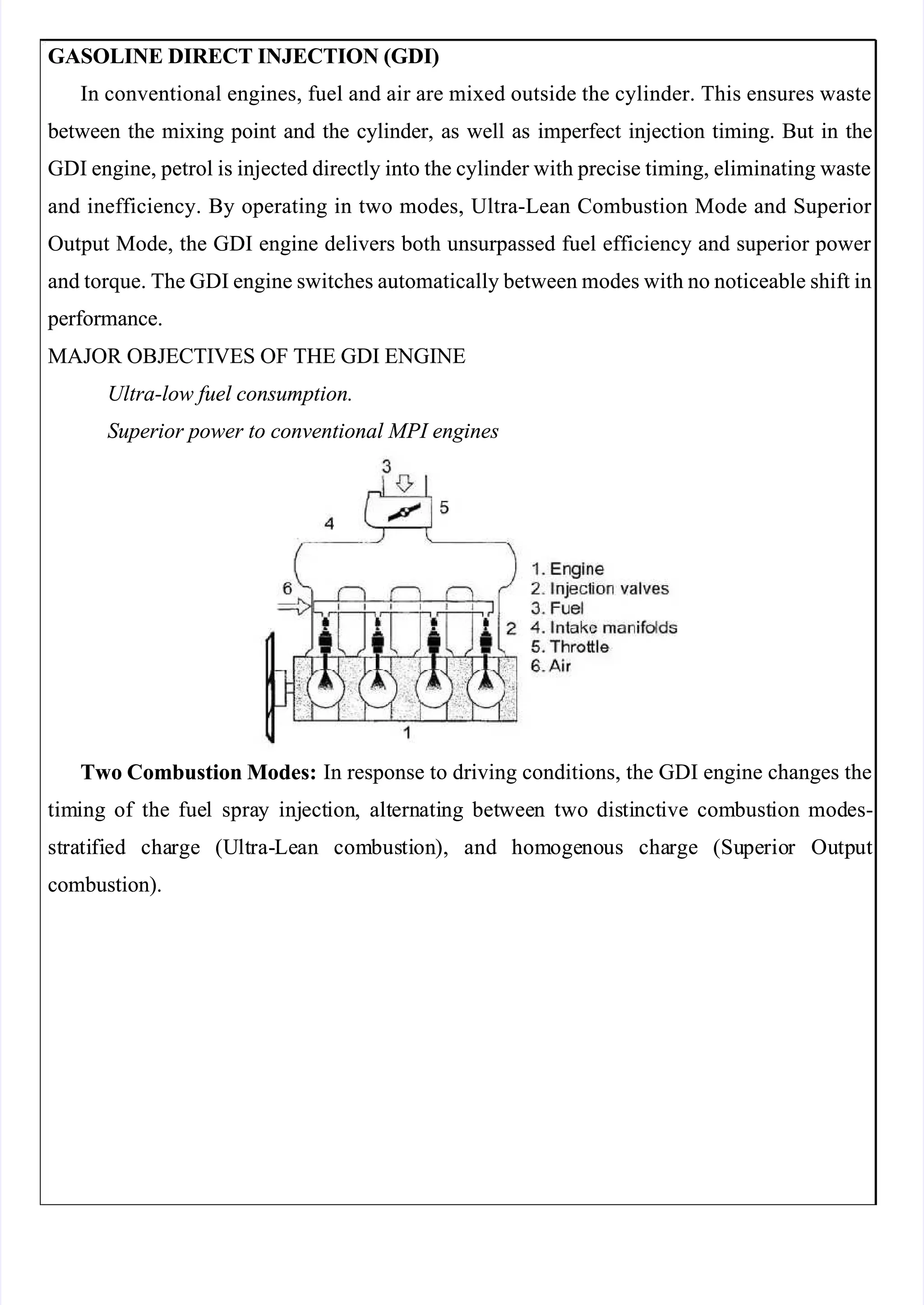
GASOLINE DIRECT INJECTION (GDI)
In conventional engines, fuel and air are mixed outside the cylinder. This ensures waste
 between
 between the
the mixing
mixing point
point and
and the
the cylinder,
cylinder, as
as well
well as
as imperfect
imperfect injection
injection timing.
timing. But
But in
in the
the
GDI engine, petrol is injected directly into the cylinder with precise timing, eliminating waste
and inefficiency. By operating in two modes, Ultra-Lean Combustion Mode and Superior 
Output Mode, the GDI engine delivers both unsurpassed fuel efficiency and superior power 
and torque. The GDI engine switches automatically between modes with no noticeable shift in
 performance.
 performance.
MAJOR OBJECTIVES OF THE GDI ENGINE
Ultra-low fuel consumption.
Superior power to conventional MPI engines
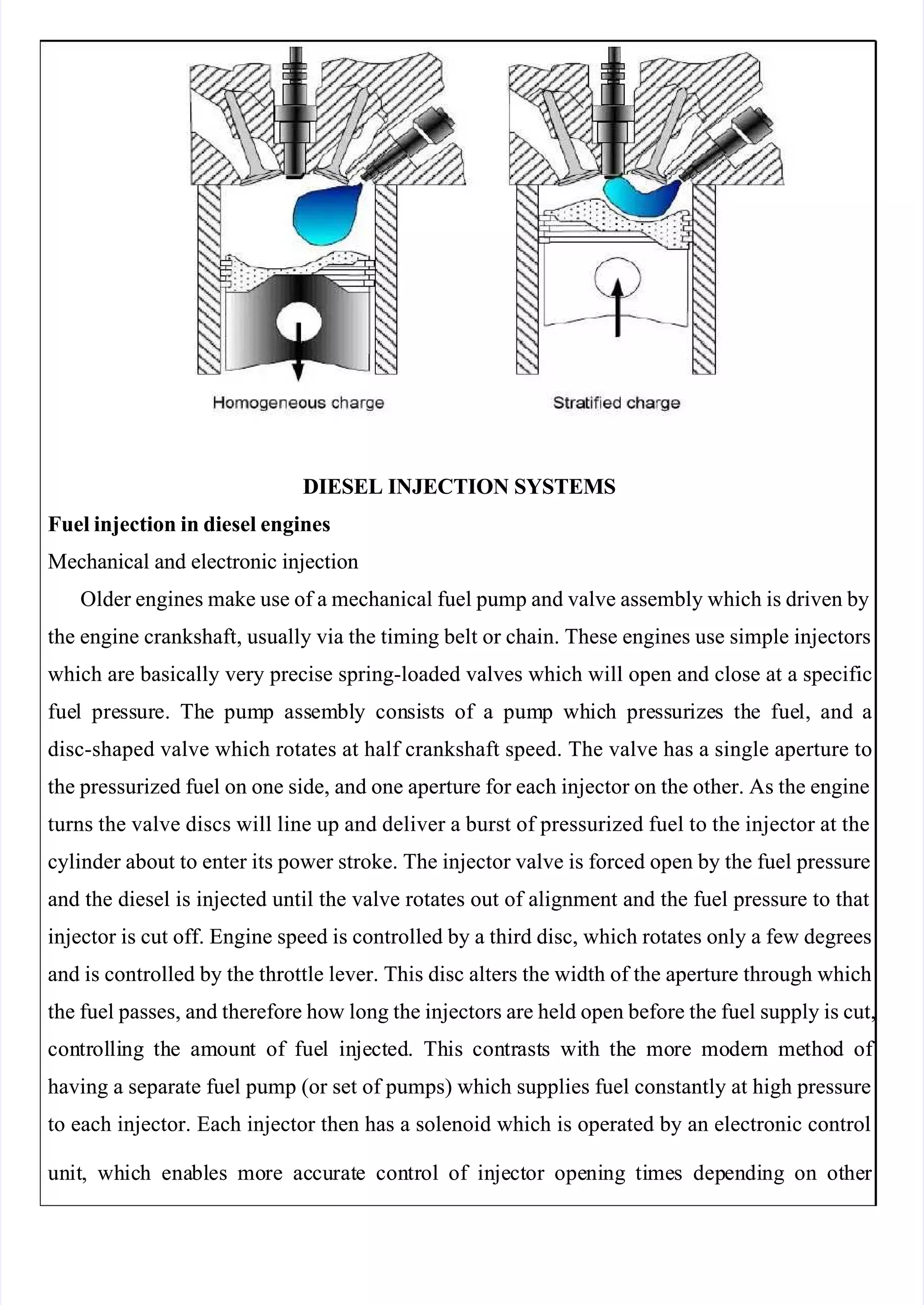
Two Combustion Modes:
Two Combustion Modes: In response to driving conditions, the GDI engine changes the
 In response to driving conditions, the GDI engine changes the
tim
timing
ing of
of the
the fue
fuel
l spra
spray
y inj
inject
ection
ion,
, alt
altern
ernati
ating
ng bet
betwee
ween
n two
two dis
disti
tinct
nctive
ive com
combust
bustion
ion mod
modes-
es-
st
stra
rati
tifi
fied
ed cha
charge
rge (U
(Ult
ltra-
ra-Le
Lean
an com
combus
busti
tion
on),
), and
and hom
homoge
ogeno
nous
us cha
charge
rge (Su
(Supe
perio
rior
r Ou
Outp
tput
ut
combustion).
combustion).
 
 
DIESEL INJECTION SYSTEMS
Fuel injection in diesel engines
Mechanical and electronic injection
Older engines make use of a mechanical fuel pump and valve assembly which is driven by
the engine crankshaft, usually via the timing belt or chain. These engines use simple injectors
which are basically very precise spring-loaded valves which will open and close at a specific
fue
fuel
l pre
press
ssur
ure.
e. Th
The
e pum
pump
p ass
assem
embl
bly
y con
consi
sist
sts
s of
of a
a pum
pump
p wh
whic
ich
h pre
press
ssur
urize
izes
s th
the
e fue
fuel,
l, and
and a
a
disc-shaped valve which rotates at half crankshaft speed. The valve has a single aperture to
the pressurized fuel on one side, and one aperture for each injector on the other. As the engine
turns the valve discs will line up and deliver a burst of pressurized fuel to the injector at the
cylinder about to enter its power stroke. The injector valve is forced open by the fuel pressure
and the diesel is injected until the valve rotates out of alignment and the fuel pressure to that
injector is cut off. Engine speed is controlled by a third disc, which rotates only a few degrees
and is controlled by the throttle lever. This disc alters the width of the aperture through which
the fuel passes, and therefore how long the injectors are held open before the fuel supply is cut,
con
contr
trol
olli
ling
ng th
the
e am
amoun
ount
t of
of fue
fuel
l in
inje
ject
cted
ed.
. Th
This
is con
contr
trast
asts
s wi
with
th th
the
e mo
more
re mo
moder
dern
n me
metho
thod
d of 
of 
having a separate fuel pump (or set of pumps) which supplies fuel constantly at high pressure
to each injector. Each injector then has a solenoid which is operated by an electronic control
un
unit
it,
, wh
whic
ich
h ena
enabl
bles
es mo
more
re ac
accu
curat
rate
e con
contr
trol
ol of
of in
inje
ject
ctor
or ope
openi
ning
ng ti
time
mes
s dep
depen
endi
ding
ng on
on ot
othe
her 
r 
 
 
control conditions such as engine speed and loading, resulting in better engine performance
and fuel economy. This design is also mechanically simpler than the combined pump and
va
valv
lve
e de
desi
sign
gn,
, m
mak
akin
ing
g it
it ge
gene
nera
rall
lly
y mo
more
re re
reli
liab
able
le,
, an
and
d le
less
ss no
nois
isy,
y, th
than
an it
its
s me
mech
chan
anic
ical
al
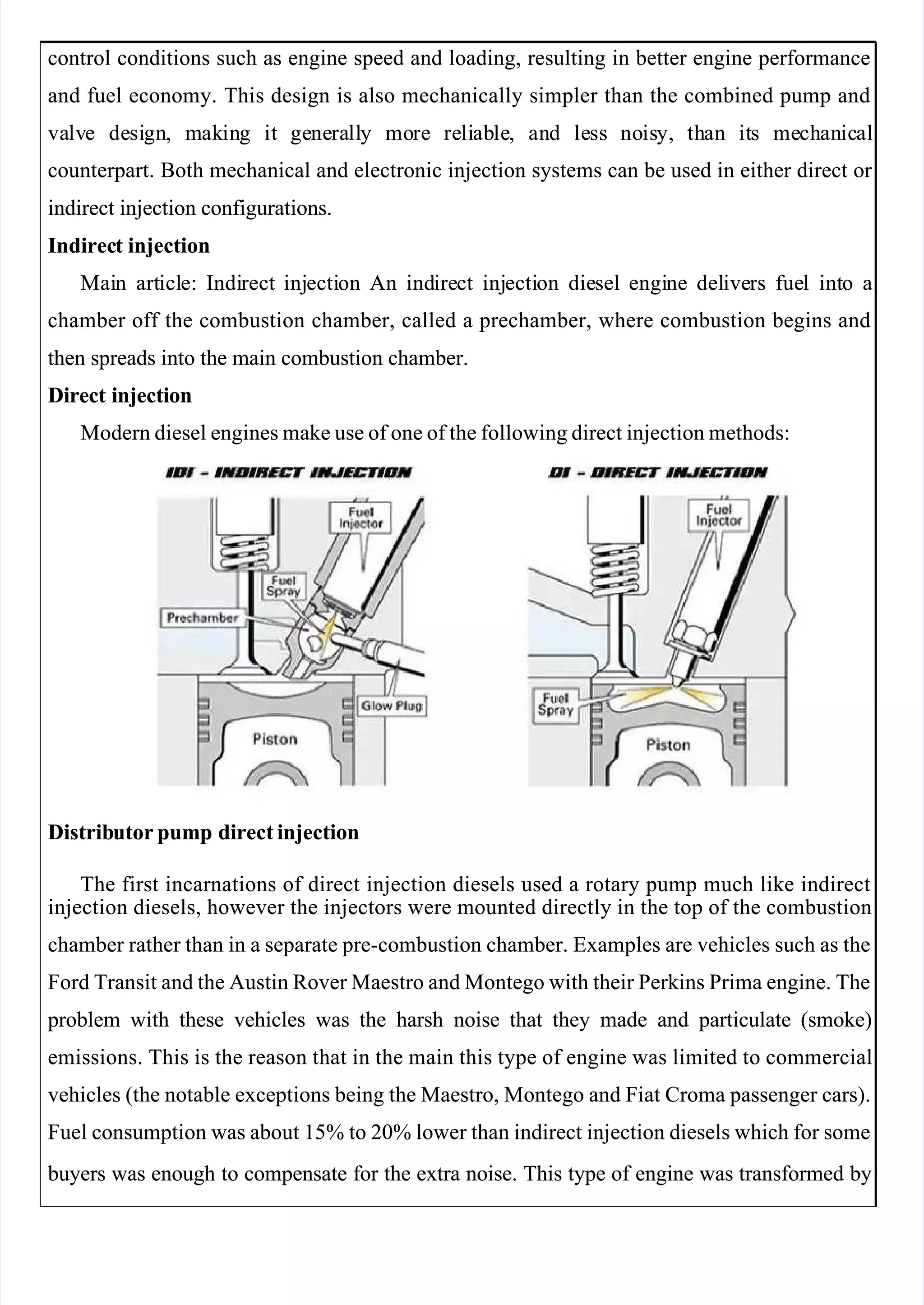
counterpart. Both mechanical and electronic injection systems can be used in either direct or 
indirect injection configurations.
Indirec
Indirect
t injection
injection
Mai
Main
n art
articl
icle:
e: Indi
Indirect
rect inj
injecti
ection
on An
An ind
indire
irect
ct inj
injecti
ection
on die
diesel
sel engi
engine
ne del
delive
ivers
rs fue
fuel
l int
into
o a
a
chamber off the combustion chamber, called a prechamber, where combustion begins and
then spreads into the main combustion chamber.
Direct injection
Direct injection
Modern diesel engines make use of one of the following direct injection methods:
Distrib
Distributor pump
utor pump direct injection
direct injection
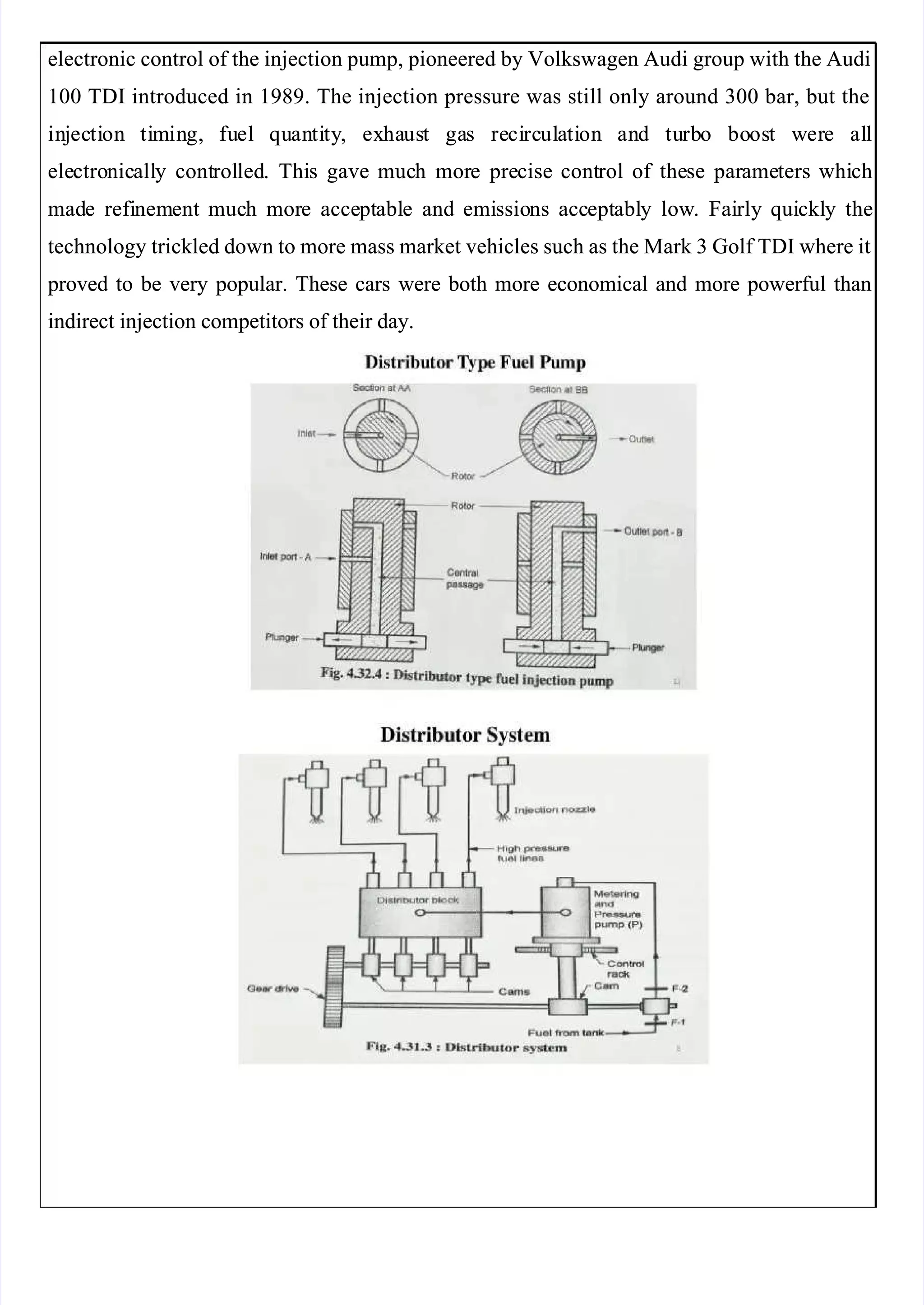
The first incarnations of direct injection diesels used a rotary pump much like indirect
injection diesels, however the injectors were mounted directly in the top of the combustion
chamber rather than in a separate pre-combustion chamber. Examples are vehicles such as the
Ford Transit and the Austin Rover Maestro and Montego with their Perkins Prima engine. The
 problem
 problem with
with these
these vehicles
vehicles was
was the
the harsh
harsh noise
noise that
that they
they made
made and
and particulate
particulate (smoke)
(smoke)
emissions. This is the reason that in the main this type of engine was limited to commercial
vehicles (the notable exceptions being the Maestro, Montego and Fiat Croma passenger cars).
Fuel consumption was about 15% to 20% lower than indirect injection diesels which for some
 buyers
 buyers was
was enough
enough to
to compensate
compensate for
for the
the extra
extra noise.
noise. This
This type
type of
of engine
engine was
was transformed
transformed by
by
 
 
electronic control of the injection pump, pioneered by Volkswagen Audi group with the Audi
100 TDI introduced in 1989. The injection pressure was still only around 300 bar, but the
in
inj
jec
ecti
tion
on ti
tim
min
ing,
g, fu
fuel
el qu
quan
anti
tity
ty,
, ex
exha
haus
ust
t ga
gas
s re
reci
circ
rcul
ula
ati
tion
on an
and
d tu
turb
rbo
o bo
boos
ost
t w
wer
ere
e al
all
l
ele
electro
ctronic
nicall
ally
y cont
control
rolled
led.
. Thi
This
s gave
gave muc
much
h mor
more
e pre
precise
cise cont
control
rol of
of the
these
se par
parame
ameters
ters whi
which
ch
mad
made
e refi
refinem
nement
ent muc
much
h mor
more
e acce
accept
ptabl
able
e and
and emi
emissio
ssions
ns acc
accept
eptabl
ably
y low
low.
. Fai
Fairly
rly qui
quickl
ckly
y the
the
technology trickled down to more mass market vehicles such as the Mark 3 Golf TDI where it
 proved
 proved to
to be
be very
very popular.
popular. These
These cars
cars were
were both
both more
more economical
economical and
and more
more powerful
powerful than
than
indirect injection competitors of their day.
 
 
Common rail direct injection
Mai
Main
n arti
article
cle:
: Com
Common
mon rail
rail In
In old
older
er die
diesel
sel engi
engines,
nes, a
a dist
distrib
ributo
utor-t
r-type
ype inj
injecti
ection
on pum
pump,
p,
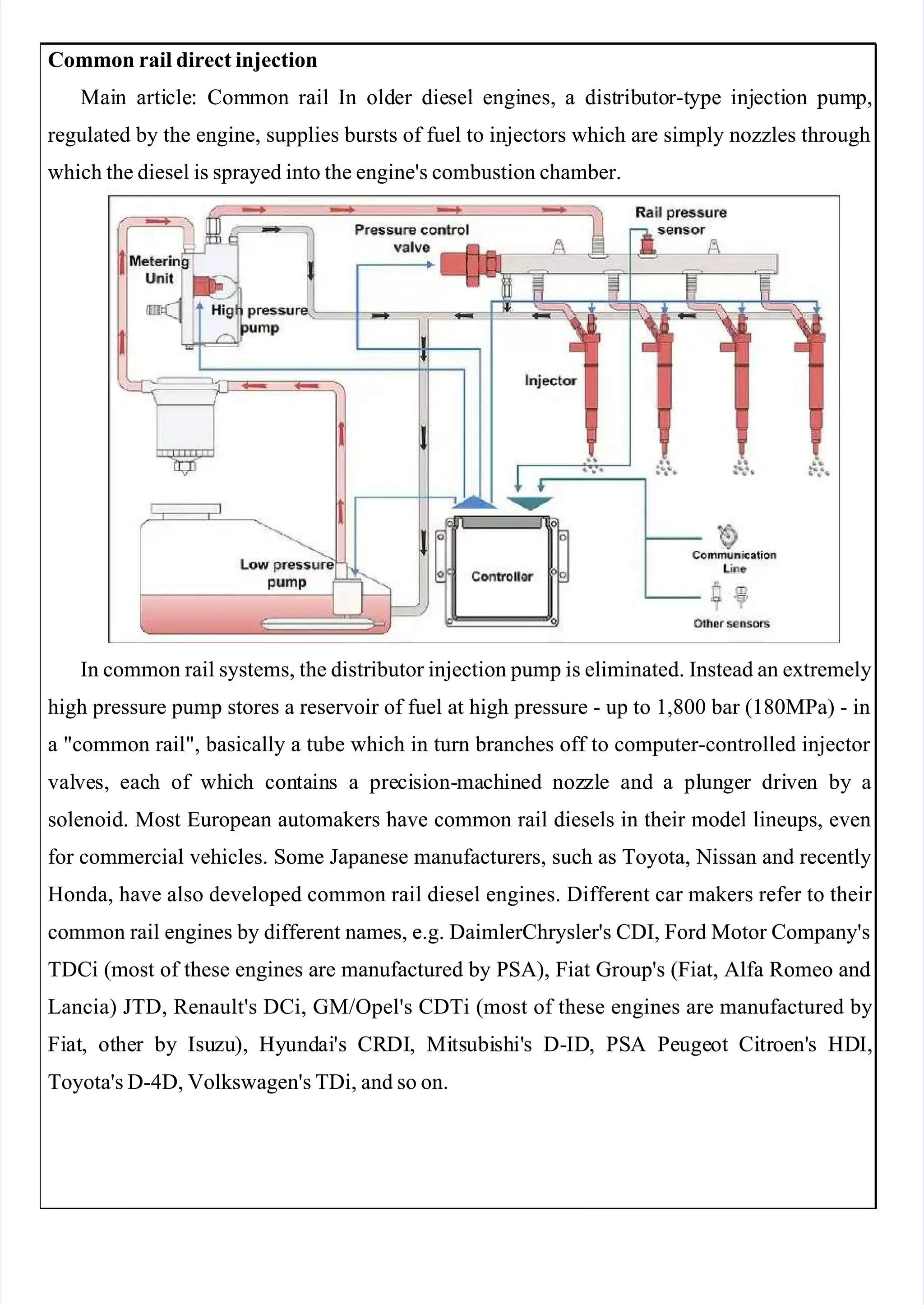
regulated by the engine, supplies bursts of fuel to injectors which are simply nozzles through
which the diesel is sprayed into the engine's combustion chamber.
In common rail systems, the distributor injection pump is eliminated. Instead an extremely
high pressure pump stores a reservoir of fuel at high pressure - up to 1,800 bar (180MPa) - in
a "common rail", basically a tube which in turn branches off to computer-controlled injector 
val
valve
ves,
s, eac
each
h of
of wh
whic
ich
h con
conta
tain
ins
s a
a pre
preci
cisi
sion-
on-ma
mach
chin
ined
ed noz
nozzl
zle
e and
and a
a pl
plun
unge
ger
r dri
drive
ven
n by
by a
a
solenoid. Most European automakers have common rail diesels in their model lineups, even
for commercial vehicles. Some Japanese manufacturers, such as Toyota, Nissan and recently
Honda, have also developed common rail diesel engines. Different car makers refer to their 
common rail engines by different names, e.g. DaimlerChrysler's CDI, Ford Motor Company's
TDCi (most of these engines are manufactured by PSA), Fiat Group's (Fiat, Alfa Romeo and
Lancia) JTD, Renault's DCi, GM/Opel's CDTi (most of these engines are manufactured by
Fi
Fiat
at,
, ot
othe
her
r by
by Isu
Isuzu
zu),
), Hy
Hyund
undai
ai's
's CR
CRDI
DI,
, Mi
Mits
tsubi
ubish
shi'
i's
s D-
D-ID
ID,
, PS
PSA
A Pe
Peuge
ugeot
ot Ci
Citr
troe
oen'
n's
s HD
HDI,
I,
Toyota's D-4D, Volkswagen's TDi, and so on.
 
 
Unit direct injection
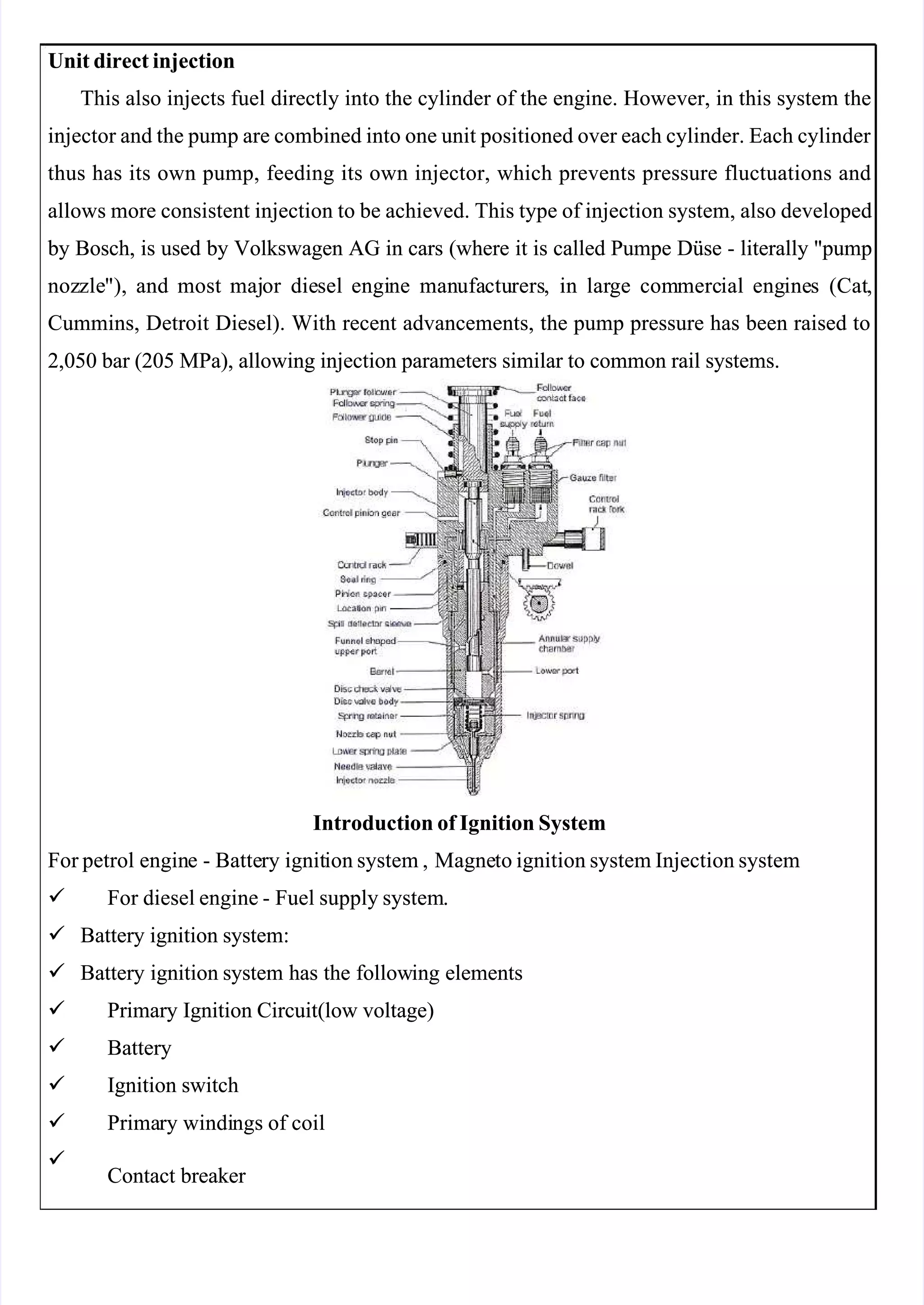
This also injects fuel directly into the cylinder of the engine. However, in this system the
injector and the pump are combined into one unit positioned over each cylinder. Each cylinder 
thus has its own pump, feeding its own injector, which prevents pressure fluctuations and
allows more consistent injection to be achieved. This type of injection system, also developed
 by
 by Bosch,
Bosch, is
is used
used by
by Volkswagen
Volkswagen AG
AG in
in cars
cars (where
(where it
it is
is called
called Pumpe
Pumpe Düse
Düse -
- literally
literally "pump
"pump
noz
nozzle
zle"),
"), and
and most
most maj
major
or die
diesel
sel engi
engine
ne man
manufa
ufactu
cturers
rers,
, in
in lar
large
ge com
commerc
mercial
ial eng
engine
ines
s (Cat
(Cat,
,
Cummins, Detroit Diesel). With recent advancements, the pump pressure has been raised to
2,050 bar (205 MPa), allowing injection parameters similar to common rail systems.
Introduction of Ignition System
For petrol
For petrol engin
engine
e -
- Batte
Battery
ry ignit
ignition system ,
ion system , Magne
Magneto ignition system Injection system
to ignition system Injection system

    For
For diesel
diesel engine
engine -
- Fuel
Fuel supply
supply system
system.
.

    Battery
Battery ignition
ignition system:
system:

    Battery ignition
Battery ignition system has the follow
system has the following elements
ing elements

    Primary
Primary Ignition
Ignition Circuit(low
Circuit(low voltage)
voltage)

   Battery
  Battery

    Ignition
Ignition switch
switch

    Prima
Primary
ry windi
windings
ngs of
of coil
coil


   Contact
Contact breaker 
breaker 
 
 

   capacitor 
  capacitor 

    Secondary
Secondary Ignition
Ignition Circuit
Circuit (
( high
high voltage)
voltage)

    Seconda
Secondary
ry windi
windings
ngs of
of coil
coil

    Distri
Distributor
butor cap
cap and
and rotor
rotor (if
(if the
the vehicl
vehicle i
e is so
s so equipp
equipped)
ed)

    Spark
Spark plug
plug wires
wires &
&

    Spark
Spark plugs
plugs
IGNITION SYSTEM – Magneto System Ignition Switch Distribution Contact Breaker Coil
Magneto Condenser Power Generation Spark Generation Magneto Unit Rotor Arm
IGNITION SYSTEM – Dynamo/Alternator System Dynamo/ Alternator Distributor Contact
Breaker Coil Ignition Switch Secondary Windings Primary Windings Condenser Battery
Ignition Switch Coil Packs IGNITION SYSTEM – Electronic Systems Control Unit Timing
Sensor 
Sensor 
Timing Disc Engine Speed Sensing Unit Alternator Battery
In all
In all spark ignitio
spark ignition engines which work
n engines which work on the
on the Gasoli
Gasoline either 2-Stroke or
ne either 2-Stroke or 4-Stro
4-Stroke cycle
ke cycle
 principle
 principle and
and utilize
utilize a
a carburetor
carburetor or
or fuel
fuel injection
injection system,
system, the
the combustion
combustion of
of the
the air-fuel
air-fuel
mixture is initiated by an electric spark.
The term ‘Spark Ignition’ means that a brief electric arc is produced between the electrodes
of a spark plug, the energy for which is derived from an external power source. In most cases
th
this
is pow
power
er sou
sourc
rce
e is
is th
the
e veh
vehic
icle
le ba
batt
ttery
ery,
, wh
whic
ich
h is
is con
const
stan
antl
tly
y be
bein
ing
g sup
suppl
plem
ement
ented
ed by
by th
the
e
alternate while the vehicle is mobile.
A different method of ignition is employed in diesel engines. This is called ‘compression
ig
igni
niti
tion
on’
’ and
and rel
relie
ies
s on
on th
the
e fa
fact
ct th
that
at wh
when
en ai
air
r com
compre
presse
ssed,
d, it
its
s te
temp
mpera
eratu
ture
re ri
rise
ses.
s. In
In di
dies
esel
el
en
engi
gine
nes,
s, co
com
mpr
pres
essi
sion
on ra
rati
tio
o of
of be
betw
twee
een
n 16
16:1
:1 an
and
d 25
25:1
:1 ar
are
e co
com
mmo
mon,
n, an
and
d at
at th
the
e en
end
d of
of a
a
compression the temperature of the trapped air is sufficiently high to ignite the diesel fuel that
is sprayed into the The functions of ignition system
The functions of the coil ignition systems in general use on motor vehicle may be divided
into three areas. These are:
Production of the high voltage necessary to produce a spark at the plug gap.
Distribute the spark to all the cylinders at proper time based on the firing order.
 
 
Varying the timing of the spark depending on the various operating conditions of the
engine like cranking time, varying speed and load, so that the best performance is obtained
from the
from the engin
engine
e under all
under all operat
operating condition
ing conditions.
s.
Mechanism of Ignition
It must be remembered that vehicle battery voltages are usually 12 volt or 24 volt and this
value is too low to produce a heavy spark at the plug gap in a cylinder under compression. For 
this reason one of the major functions of the battery ignition system is to raise the battery
voltage to the required level and then apply it to spark plugs.
This process is
This process is correct
correctly initiat
ly initiated in
ed in the primary circuit and completed in the
the primary circuit and completed in the second
secondary
ary
winding of the ignition coil. Depending on the type of engine and the conditions existing in
the cylinders, a voltage of between 5,000 to 20,000 volts is required and this is called the
ionizing voltage or firing voltage.
This firing voltage forces the electrons to jump between the electrodes of the spark plug in
the gap to produce the required spark. The electric spark has sufficient heat energy to ignite
the air 
the air  
 fuel mixture which later continues to
fuel mixture which later continues to burn itself.
burn itself.
The conventional coil ignition system Inductive ignition systems: that uses an ignition coil to
 perform
 perform the
the step
step up
up transformer
transformer action
action and
and to
to increase
increase the
the electrical
electrical voltage.
voltage. The
The ignition
ignition coils
coils
of the inductive ignition systems operate on the principle of electromagnetic induction (EMI)
irrespective of whether it is triggered by contact breakers or by electronic triggering units.
Transis
Transistorize
torized
d coil ignition
coil ignition system
system
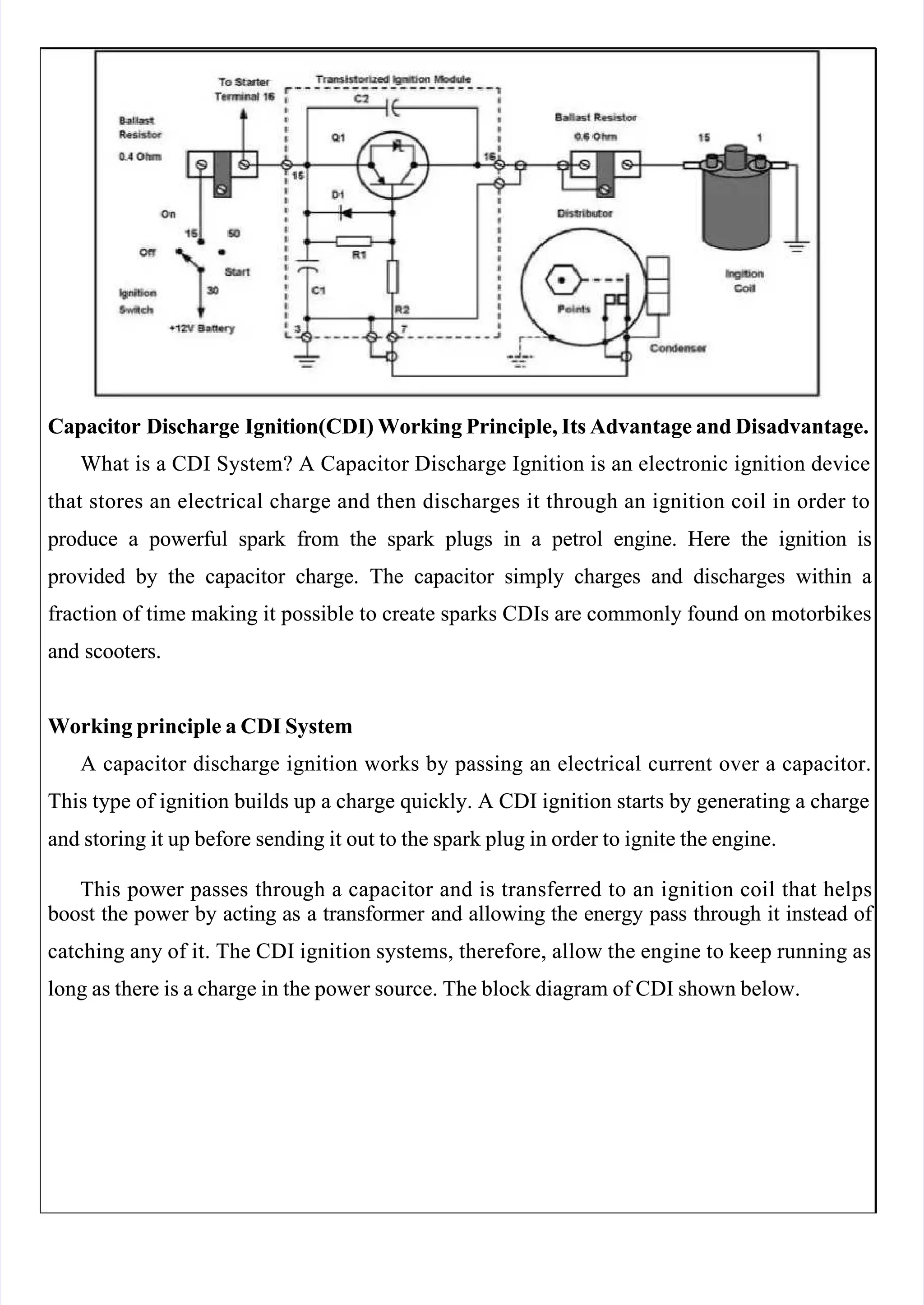
When the ignition switch is set to the ON/RUN position, +12 Volts is applied to terminal
15 of the ignition module through the 0.4 Ohm ballast resistor. When the ignition switch is set
to the START position (engine cranking) +12 volts is applied directly to terminal 15 of the
ignition module from the solenoid on the starter motor. This effectively bypasses the 0.4 ohm
 ballast r
 ballast resistor
esistor and
and offers
offers higher
higher voltage
voltage during
during cranking.
cranking.
When the engine starts and the ignition switch is returned to the ON/RUN position, +12
Volts is again supplied to terminal 15 of the ignition module through the 0.4 Ohm ballast
resistor.
resistor.
 
 
A typical firing sequence is as follows.
+12 Volts is applied to the ignition module through the 0.4Ω ballast resistor 
As
Assu
sumi
ming
ng th
that
at th
the
e po
poin
ints
ts in
in th
the
e di
dist
stri
ribu
buto
tor
r are
are ope
open,
n, tr
tran
ansi
sist
stor
or Q1
Q1 is
is tu
turn
rned
ed off
off be
beca
cause
use
terminal 7 of the ignition module is open (no ground from the points). No voltage is present at
terminal 16 of the ignition module, thus no current flows through the 0.6 Ohm ballast resistor 
or the ignition coil.
As the engine cranks, the hexagonal cam in the distributor begins to turn and the points
close.
close.
Wh
When
en th
the
e po
poin
ints
ts cl
clos
ose,
e, a
a gro
groun
und
d is
is ap
appl
plie
ied
d to
to te
term
rmina
inal
l 7
7 of
of th
the
e ig
igni
niti
tion
on mo
modu
dule
le and
and
transistor Ql turns on. This applies +12 Volts to terminal 15 of the ignition coil through the
0.6Ω ballast resistor. The current through the points is extremely small (thousandths of an
Ampere or milli-amperes) instead of 4-5 Amperes as seen in a non-transistorized system.
When transistor Q1 is turned ON, capacitor C2 is discharged (shorted by Q1).
When the points open, capacitor C2 begins to charge. The charge path is: +12 Volts from the
ignition switch - 0.4Ω ballast resistor - C2 - 0.6Ω ballast resistor and the ignition coil to
ground.
ground.
As capacitor C2 begins to charge, a pulse is created in the ignition coil, which causes a
high voltage to be generated and sent to the appropriate spark plug.
When the points close again, transistor Q1 is turned ON and the cycle repeats.
Po
Poin
int
t we
wear
ar an
and
d st
stres
ress
s is
is si
signi
gnifi
fica
cant
ntly
ly red
reduc
uced
ed si
sinc
nce
e th
the
e tr
tran
ansi
sist
stor
or is
is han
handl
dlin
ing
g th
the
e cur
curre
rent
nt
through the coil (4-5 Amperes). The points were designed to switch high currents repeatedly
for tens-of-thousands of miles, therefore, when switching a very small current, they should
la
last
st for
for a
a mu
much
ch lo
long
nger
er ti
time
me.
. Tu
Tune
ne-u
-up
p in
inte
terva
rvals
ls (du
(due
e to
to po
poin
int
t fai
failu
lure)
re) bec
becom
ome
e lo
long
nger
er and
and
vehicle maintenance becomes cheaper.
But (yes, there's always a "but"), we still have the points. Points are mechanical, subject to
 bounce
 bounce and
and vibration
vibration and
and must
must be
be actuated
actuated -
- mechanically
mechanically -
- by
by the
the camshaft
camshaft in
in the
the distributor.
distributor.
Whereas the wear on the point contacts has been reduced, the fiber pawl, which rides between
the points and the distributor camshaft, can still wear out or break.
 
 
Capacitor Discharge Ignitio
Capacitor Discharge Ignition(CDI) Wor
n(CDI) Working Principle, Its Advantage and Disadvantage.
king Principle, Its Advantage and Disadvantage.
What is a CDI System? A Capacitor Discharge Ignition is an electronic ignition device
that stores an electrical charge and then discharges it through an ignition coil in order to
 produce
 produce a
a powerful
powerful spark
spark from
from the
the spark
spark plugs
plugs in
in a
a petrol
petrol engine.
engine. Here
Here the
the ignition
ignition is
is
 provided
 provided by
by the
the capacitor
capacitor charge.
charge. The
The capacitor
capacitor simply
simply charges
charges and
and discharges
discharges within
within a
a
fraction of time making it possible to create sparks CDIs are commonly found on motorbikes
and scooters.
and scooters.
Working principle a CDI System
A capacitor discharge ignition works by passing an electrical current over a capacitor.
This type of ignition builds up a charge quickly. A CDI ignition starts by generating a charge
and storing it up before sending it out to the spark plug in order to ignite the engine.
This power passes throu
This power passes through a capacit
gh a capacitor and is transferred to an ignition coil that helps
or and is transferred to an ignition coil that helps
 boost
 boost the
the power
power by
by acting
acting as
as a
a transformer
transformer and
and allowing
allowing the
the energy
energy pass
pass through
through it
it instead
instead of 
of 
catching any of it. The CDI ignition systems, therefore, allow the engine to keep running as
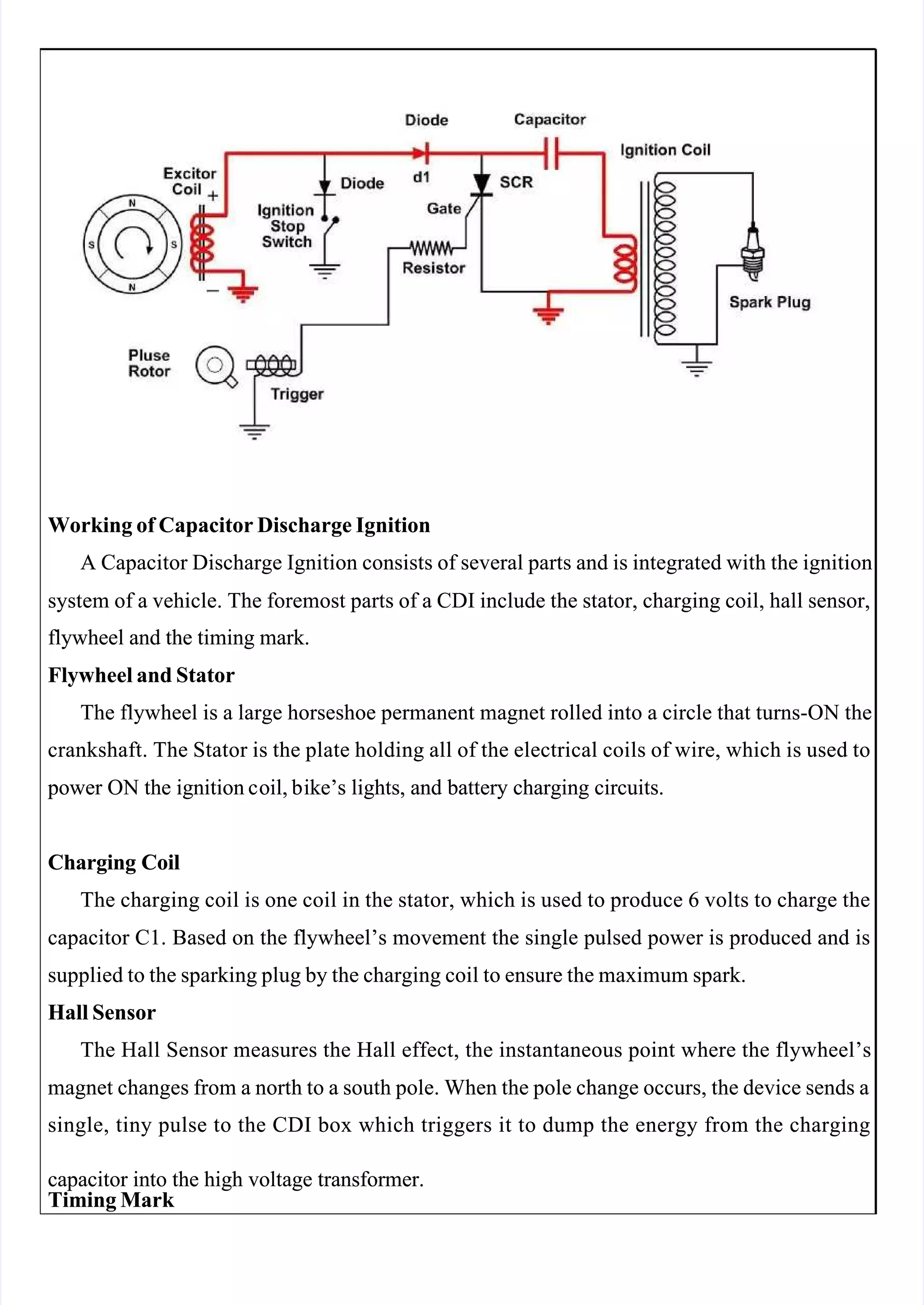
long as there is a charge in the power source. The block diagram of CDI shown below.
 
 
Working of Capacitor Discharge Ignition
A Capacitor Discharge Ignition consists of several parts and is integrated with the ignition
system of a vehicle. The foremost parts of a CDI include the stator, charging coil, hall sensor,
flywheel and the timing mark.
Flywheel and Stator
Flywheel and Stator
The flywheel is a large horseshoe permanent magnet rolled into a circle that turns-ON the
crankshaft. The Stator is the plate holding all of the electrical coils of wire, which is used to
 power
 power ON
ON the
the ignition c
ignition coil, b
oil, bike’s
ike’s lights,
lights, and
and battery
battery charging
charging circuits.
circuits.
Charging Coil
Charging Coil
The charging coil is one coil in the stator, which is used to produce 6 volts to charge the
capacitor C1. Based on the flywheel’s movement the single pulsed power is produced and is
supplied to the sparking plug by the charging coil to ensure the maximum spark.
Hall Sensor
Hall Sensor
The Hall Sensor measures the Hall effect, the instantaneous point where the flywheel’s
magnet changes from a north to a south pole. When the pole change occurs, the device sends a
single, tiny pulse to the CDI box which triggers it to dump the energy from the charging
capacitor into the high voltage transformer.
Timing Mark 
Timing Mark 
 
 
The timing mark is an arbitrary alignment point shared by the engine case and stator plate.
It indicates the point at which the top of the piston’s travel is equivalent to the trigger point on
the flywheel and
the flywheel and stator.
stator.
Advantages of CDI
Advantages of CDI
The major advantage of CDI is that the capacitor can be fully charged in a very short time
(typically 1ms). So the CDI is suited to an application where the insufficient dwell time is
available.
available.
The capacitor discharge ignition system has a short transient response, a fast voltage rise
(between 3 to 10 kV/ µs) compared to inductive systems (300 to 500 V/ µs) and shorter spark 
durati
duration (about
on (about 50-80 µs).
50-80 µs).
The fast voltage rising makes CDI systems unaffected to shunt resistance.
Disadvantages of CDI
The capacitor discharge ignition system generates huge electromagnetic noise and this is
the main reason why CDIs are rarely used by automobile manufacturers.
The short spark duration is not good for lighting relatively lean mixtures as used at low
 power
 power levels.
levels. To
To solve
solve this
this problem
problem many
many CDI
CDI ignitions
ignitions release
release multiple
multiple sparks
sparks at
at low
low engine
engine
speeds.
speeds.
Turbochargers
Turbochargers
Th
The
e tu
turb
rboc
ocha
harg
rger
er ha
has
s be
been
en a
a gr
grea
eat
t so
sour
urce
ce of
of ma
maxi
xim
miz
izin
ing
g ef
effi
fici
cien
ency
cy of
of an
an in
inte
tern
rnal
al
combustion engine since the late 1920’s. Alfred Buchi was the engineer that came up with the
idea to utilize the wasted energy that is expelled through the exhaust system. It was in 1915
that he created his first prototype, which failed. This however did not stop the persistent
in
inve
vent
ntor
or.
. He
He wo
work
rked
ed on
on it
it fo
for
r an
anot
othe
her
r 10
10 ye
year
ars
s be
befo
fore
re he
he pr
prod
oduc
uced
ed th
the
e fi
firs
rst
t pr
prac
acti
tica
cal,
l,
functi
functioning turbocha
oning turbocharger that
rger that increa
increase
se effici
efficiency of
ency of an engine
an engine by
by 40%.
40%.
 
 
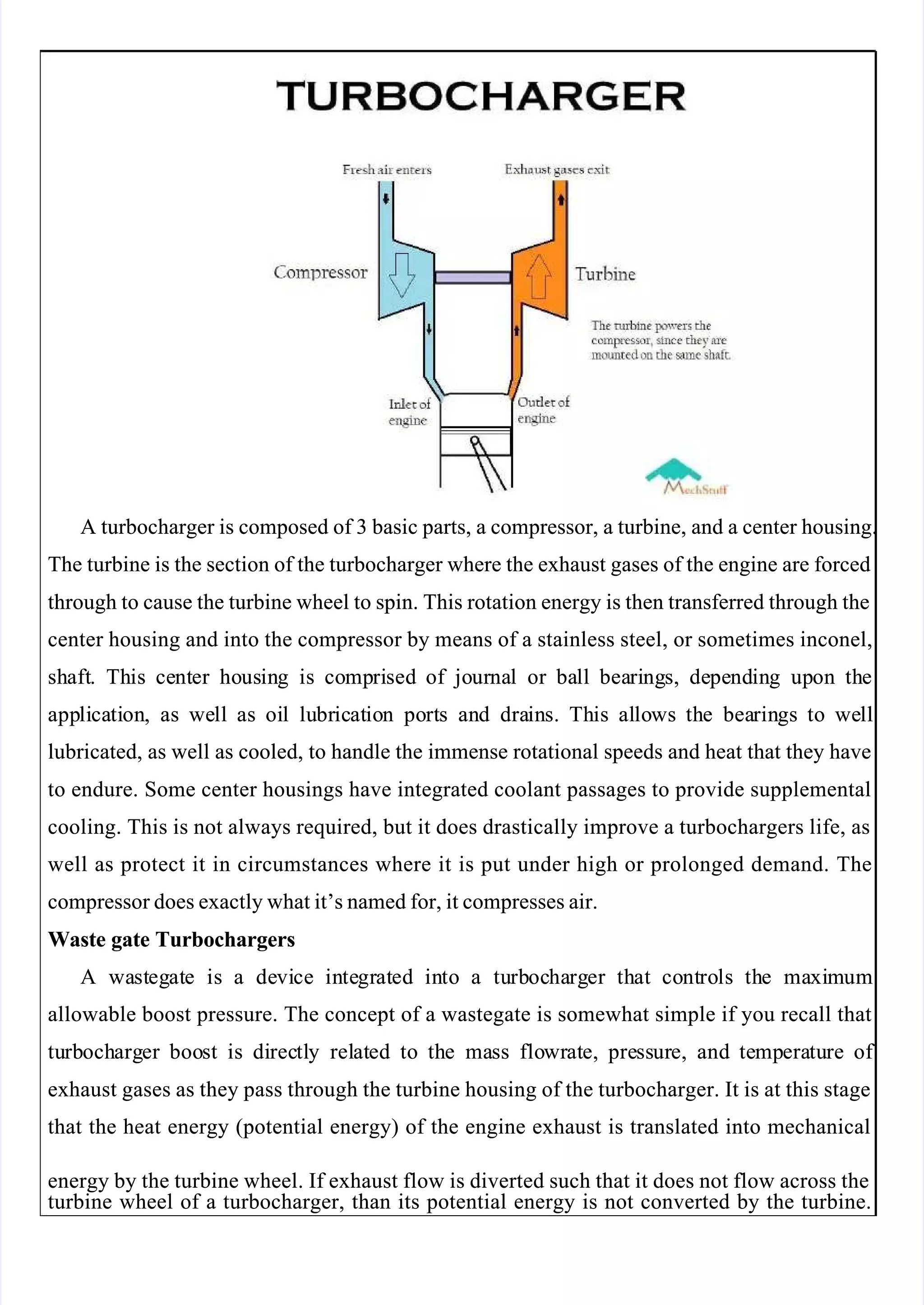
A turbocharger is composed of 3 basic parts, a compressor, a turbine, and a center housing.
The turbine is the section of the turbocharger where the exhaust gases of the engine are forced
through to cause the turbine wheel to spin. This rotation energy is then transferred through the
center housing and into the compressor by means of a stainless steel, or sometimes inconel,
sh
shaft
aft.
. Th
This
is ce
cent
nter
er ho
hous
usin
ing
g is
is co
comp
mpri
rised
sed of
of jo
jour
urna
nal
l or
or ba
ball
ll bea
beari
ring
ngs,
s, de
depe
pend
ndin
ing
g up
upon
on th
the
e
app
appli
lica
cati
tion
on,
, as
as we
well
ll as
as oi
oil
l lu
lubr
bric
icat
atio
ion
n po
port
rts
s an
and
d dra
drain
ins.
s. Th
This
is al
allo
lows
ws th
the
e bea
bearin
rings
gs to
to we
well
ll
lubricated, as well as cooled, to handle the immense rotational speeds and heat that they have
to endure. Some center housings have integrated coolant passages to provide supplemental
cooling. This is not always required, but it does drastically improve a turbochargers life, as
well as protect it in circumstances where it is put under high or prolonged demand. The
compressor does exactly what it’s named for, it compresses air.
Waste gate Turbochargers
A
A wa
wast
steg
egat
ate
e is
is a
a de
devi
vice
ce in
inte
tegr
grat
ated
ed in
into
to a
a tu
turb
rboc
ocha
harg
rger
er th
that
at co
cont
ntro
rols
ls th
the
e ma
maxi
xim
mum
um
allowable boost pressure. The concept of a wastegate is somewhat simple if you recall that
tu
turb
rboch
ocharg
arger
er boo
boost
st is
is di
direc
rectl
tly
y rel
relat
ated
ed to
to th
the
e ma
mass
ss flo
flowr
wrat
ate,
e, pre
press
ssur
ure,
e, and
and te
temp
mpera
eratu
ture
re of 
of 
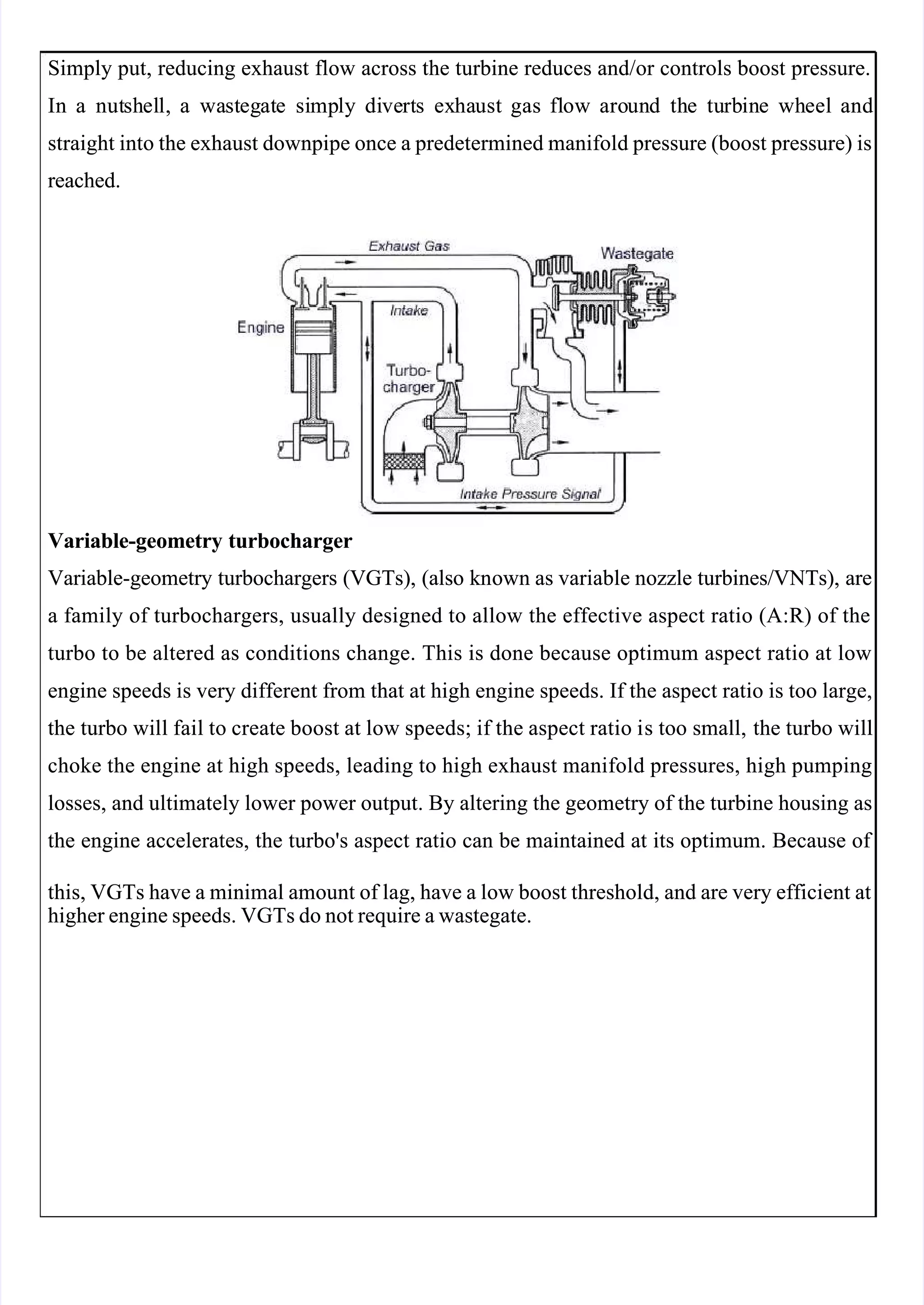
exhaust gases as they pass through the turbine housing of the turbocharger. It is at this stage
that the heat energy (potential energy) of the engine exhaust is translated into mechanical
energy by the turbine wheel. If exhaust flow is diverted such that it does not flow across the
turbine wheel of a turbocharger, than its potential energy is not converted by the turbine.
 
 
Simply put, reducing exhaust flow across the turbine reduces and/or controls boost pressure.
In
In a
a nut
nutsh
shel
ell,
l, a
a wa
wast
steg
egat
ate
e si
simp
mply
ly di
dive
vert
rts
s ex
exha
haust
ust gas
gas fl
flow
ow aro
aroun
und
d th
the
e tu
turb
rbin
ine
e wh
wheel
eel and
and
straight into the exhaust downpipe once a predetermined manifold pressure (boost pressure) is
reached.
reached.
Variable-geometry turbocharger
Variable-geometry turbochargers (VGTs), (also kn
Variable-geometry turbochargers (VGTs), (also known as variable n
own as variable nozzle turbines/V
ozzle turbines/V NTs),
 NTs), are
are
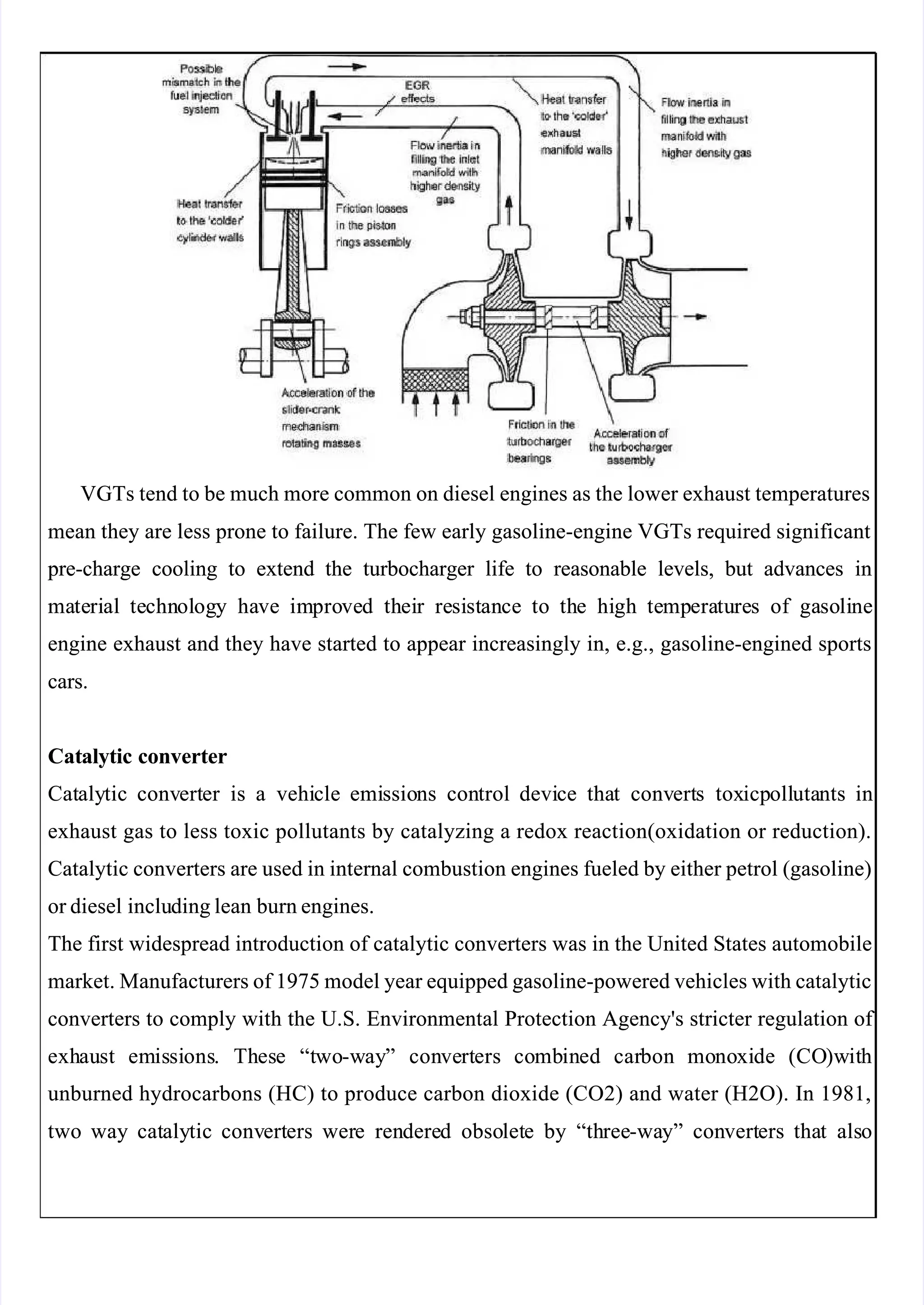
a family of turbochargers, usually designed to allow the effective aspect ratio (A:R) of the
turbo to be altered as conditions change. This is done because optimum aspect ratio at low
engine speeds is very different from that at high engine speeds. If the aspect ratio is too large,
the turbo wi
the turbo will fail to creat
ll fail to create boost at low speeds; if the aspect ratio i
e boost at low speeds; if the aspect ratio is too small,
s too small, the turbo will
 the turbo will
choke the engine at high speeds, leading to high exhaust manifold pressures, high pumping
losses, and ultimately lower power output. By altering the geometry of the turbine housing as
the engine accelerates, the turbo's aspect ratio can be maintained at its optimum. Because of 
this, VGTs have a minimal amount of lag, have a low boost threshold, and are very efficient at
higher engine speeds. VGTs do not require a wastegate.
 
 
VGTs tend to be much more common on diesel engines as the lower exhaust temperatures
mean they are less prone to failure. The few early gasoline-engine VGTs required significant
 pre-charge
 pre-charge cooling
cooling to
to extend
extend the
the turbocharger
turbocharger life
life to
to reasonable
reasonable levels,
levels, but
but advances
advances in
in
ma
mate
teri
rial
al te
techn
chnol
olog
ogy
y ha
have
ve im
impro
prove
ved
d th
thei
eir
r re
resi
sist
stan
ance
ce to
to th
the
e hi
high
gh te
temp
mpera
eratu
ture
res
s of
of ga
gaso
soli
line
ne
engine exhaust and they have started to appear increasingly in, e.g., gasoline-engined sports
cars.
cars.
Cat
Catalytic converte
alytic converter
r
Cat
Cataly
alytic
tic conv
convert
erter
er is
is a
a vehi
vehicle
cle emi
emissio
ssions
ns con
control
trol devi
device
ce tha
that
t conv
convert
erts
s tox
toxicp
icpoll
olluta
utants
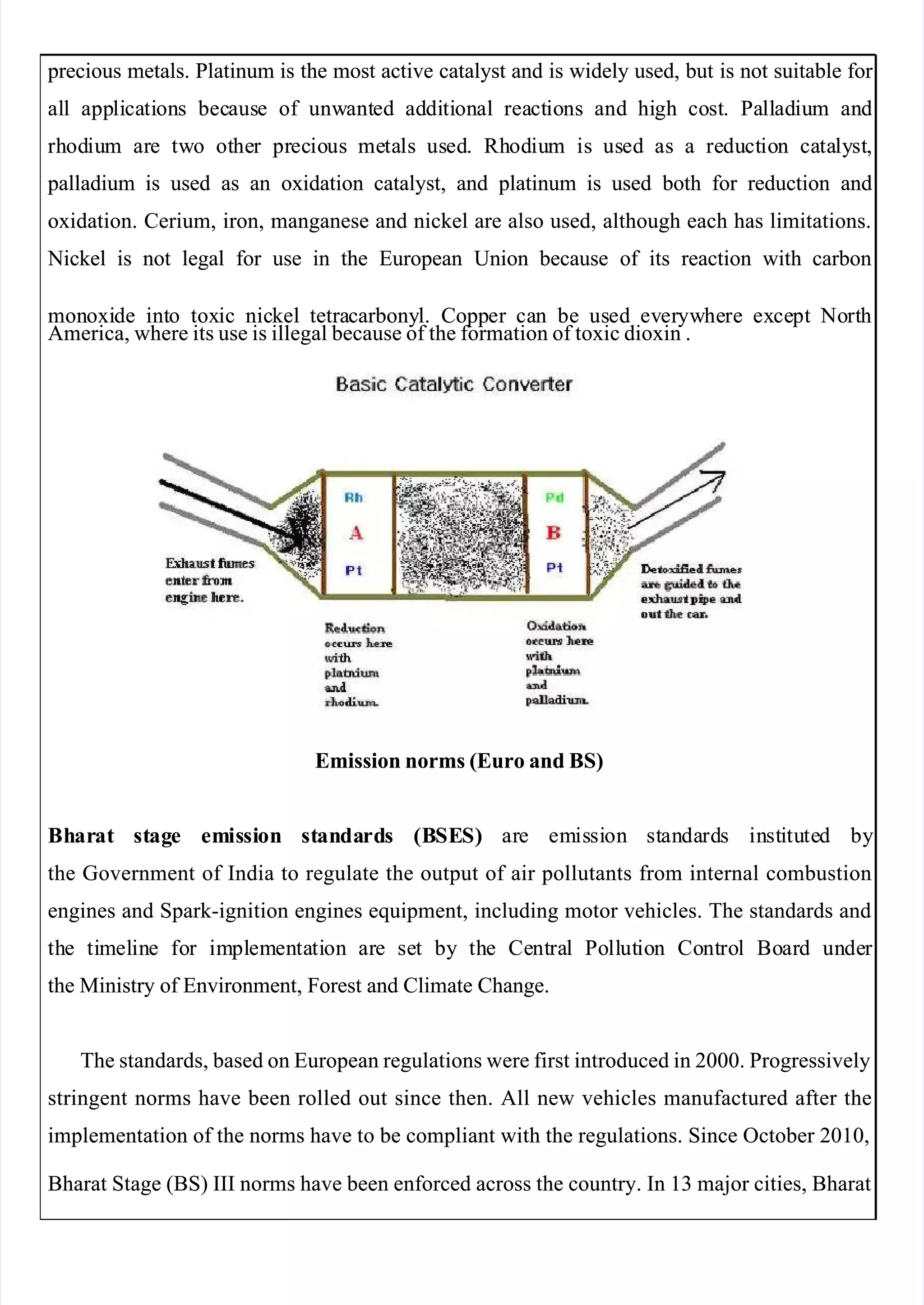
nts in
in
exhaust gas to less toxic pollutants by catalyzing a redox reaction(oxidation or reduction).
Catalytic converters are used in internal combustion engines fueled by either petrol (gasoline)
or diesel
or diesel inclu
including lean
ding lean burn engines.
burn engines.
The first widespread introduction of catalytic converters was in the United States automobile
market. Manufacturers of 1975 model year equipped gasoline-powered vehicles with catalytic
converters to comply with the U.S. Environmental Protection Agency's stricter regulation of 
exh
exhau
aust
st em
emis
issi
sions
ons.
. Th
Thes
ese
e “t
“two
wo-w
-way
ay”
” con
conve
vert
rters
ers co
comb
mbin
ined
ed car
carbon
bon mo
mono
noxi
xide
de (CO
(CO)w
)wit
ith
h
unburned hydrocarbons (HC) to produce carbon dioxide (CO2) and water (H2O). In 1981,
two
two way
way cat
cataly
alytic
tic conv
convert
erters
ers wer
were
e ren
rendere
dered
d obso
obsolet
lete
e by
by “th
“three
ree-wa
-way”
y” con
convert
verters
ers tha
that
t als
also
o
 
 
reduce oxides of nitrogen (NOx); however, two-way converters are still used for lean burn
engines.
engines.
Al
Alth
thou
ough
gh ca
cata
taly
lyti
tic
c co
conv
nver
erte
ters
rs ar
are
e mo
most
st co
com
mmo
monl
nly
y ap
appl
plie
ied
d to
to ex
exha
haus
ust
t sy
syst
stem
ems
s in
in
automobiles, they are also used on electrical generators, forklifts, mining equipment, trucks,
 buses,
 buses, locomotives,
locomotives, motorcycles,
motorcycles, and
and airplanes.
airplanes. They
They are
are also
also used
used on
on some
some wood
wood stoves
stoves to
to
control emissions. This is usually in response to government regulation, either through direct
environmental regulation or through health and safety regulations.
Construction of a catalytic converter;
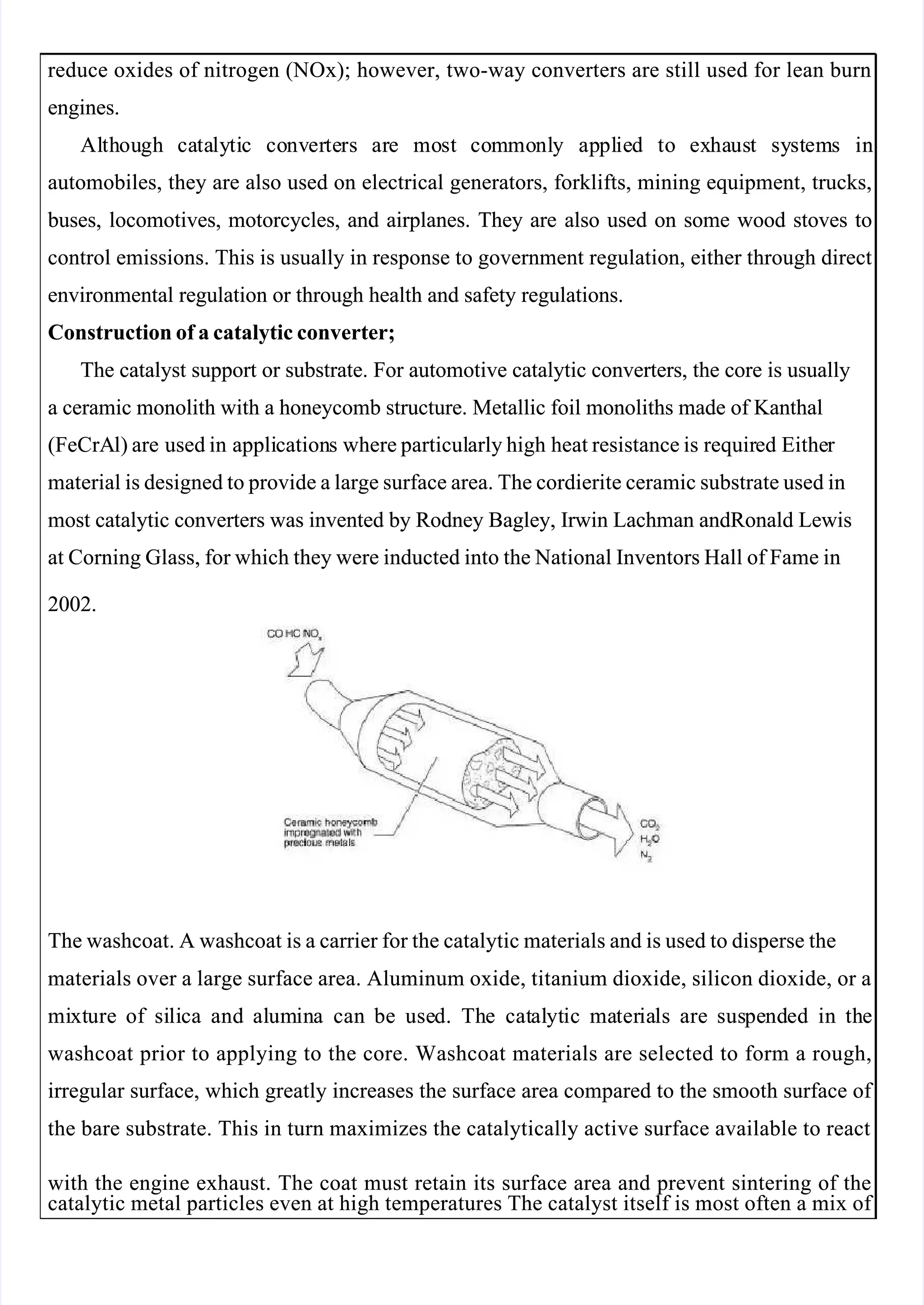
The catalyst support or substrate. For automotive catalytic converters, the core is usually
a ceramic monolith with a honeycomb structure. Metallic foil monoliths made of Kanthal
(FeCrA
(FeCrAl) are
l) are used in
used in appli
application
cations
s where particul
where particularly high
arly high heat resistance is
heat resistance is requir
required
ed Eithe
Either 
r 
material is designed to provide a large surface area. The cordierite ceramic substrate used in
most catalytic converters was invented by Rodney Bagley, Irwin Lachman andRonald Lewis
at Corning Glass, for which they were inducted into the National Inventors Hall of Fame in
2002.
2002.
The washcoat. A washcoat is a carrier for the catalytic materials and is used to disperse the
materials over a large surface area. Aluminum oxide, titanium dioxide, silicon dioxide, or a
mi
mixt
xture
ure of
of si
sili
lica
ca and
and al
alum
umin
ina
a can
can be
be use
used.
d. Th
The
e cat
catal
alyt
ytic
ic ma
mater
teria
ials
ls are
are sus
suspe
pend
nded
ed in
in th
the
e
washcoat prior to applying to the core. Washcoat materials are selected to form a rough,
irregular surface, which greatly increases the surface area compared to the smooth surface of 
the bare substrate. This in turn maximizes the catalytically active surface available to react
with the engine exhaust. The coat must retain its surface area and prevent sintering of the
catalytic metal particles even at high temperatures The catalyst itself is most often a mix of 
 
 
 precious
 precious metals.
metals. Platinum
Platinum is
is the
the most
most active
active catalyst
catalyst and
and is
is widely
widely used,
used, but
but is
is not
not suitable
suitable for 
for 
al
all
l app
appli
lica
cati
tion
ons
s bec
becaus
ause
e of
of unw
unwant
anted
ed ad
addi
diti
tion
onal
al rea
react
ctio
ions
ns and
and hi
high
gh co
cost
st.
. Pa
Pall
llad
adiu
ium
m an
and
d
rh
rhod
odiu
ium
m ar
are
e tw
two
o ot
othe
her
r pr
prec
ecio
ious
us me
meta
tals
ls us
used
ed.
. Rh
Rhod
odiu
ium
m is
is us
used
ed as
as a
a re
redu
duct
ctio
ion
n ca
cata
taly
lyst
st,
,
 palladium
 palladium is
is used
used as
as an
an oxidation
oxidation catalyst,
catalyst, and
and platinum
platinum is
is used
used both
both for
for reduction
reduction and
and
oxidation. Cerium, iron, manganese and nickel are also used, although each has limitations.
 Nickel
 Nickel is
is not
not legal
legal for
for use
use in
in the
the European
European Union
Union because
because of
of its
its reaction
reaction with
with carbon
carbon
mon
monoxi
oxide
de int
into
o tox
toxic
ic nic
nickel
kel  tetra
  tetracarbony
carbonyl.
l. Copp
Copper
er ca
can
n be
be us
used
ed ev
ever
eryw
ywhe
here
re ex
exce
cept
pt No
Nort
rth
h
America, where its use is illegal because of the formation of toxic dioxin .
Emission norms (Euro and BS)
Bh
Bhar
arat
at st
stag
age
e em
emis
issi
sion
on st
stan
anda
dard
rds
s (B
(BSE
SES)
S)   ar
  are
e em
emis
issi
sion
on st
stan
anda
dard
rds
s in
inst
sti
itu
tute
ted
d by
by
the Government of India to regulate the output of air pollutants from internal combustion
engines and Spark-ignition engines equipment, including motor vehicles. The standards and
th
the
e ti
tim
mel
elin
ine
e fo
for
r im
impl
plem
emen
enta
tati
tion
on ar
are
e se
set
t by
by th
the
e Ce
Cent
ntra
ral
l Po
Poll
llut
utio
ion
n Co
Cont
ntro
rol
l Bo
Boar
ard
d un
unde
der 
r 
the Ministry of Environment, Forest and Climate Change.
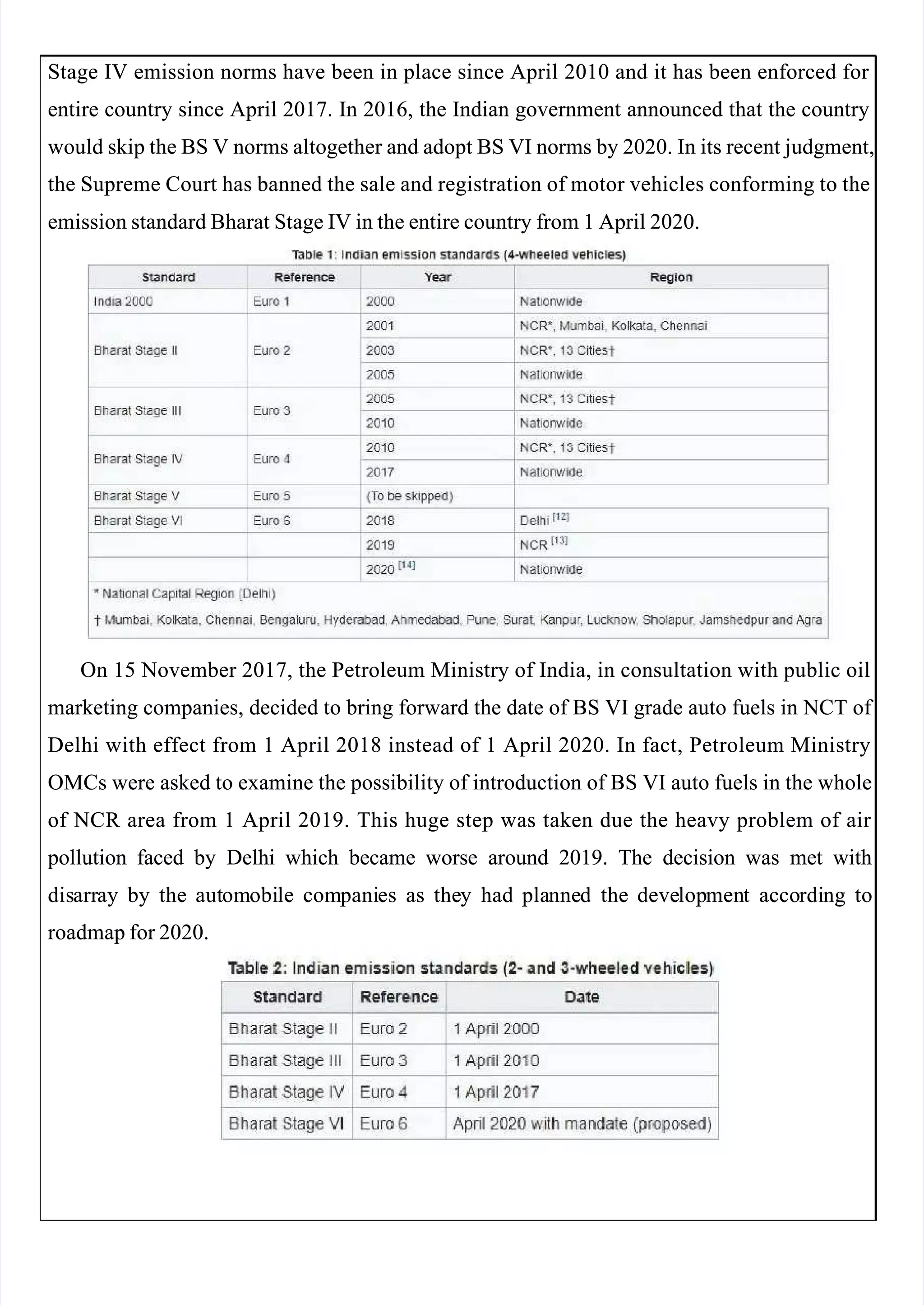
The standards, based on European regulations were first introduced in 2000. Progressively
stringent norms have been rolled out since then. All new vehicles manufactured after the
implementation of the norms have to be compliant with the regulations. Since October 2010,
Bharat Stage (BS) III norms have been enforced across the country. In 13 major cities, Bharat
 
 
Stage IV emission norms have been in place since April 2010 and it has been enforced for 
entire country since April 2017. In 2016, the Indian government announced that the country
would skip the BS V norms altogether and adopt BS VI norms by 2020. In its recent judgment,
the Supreme Court has banned the sale and registration of motor vehicles conforming to the
emission standard Bharat Stage IV in the entire country from 1 April 2020.
On 15 November 2017, the Petroleum Ministry of India, in consultation with public oil
marketing companies, decided to bring forward the date of BS VI grade auto fuels in NCT of 
Delhi with effect from 1 April 2018 instead of 1 April 2020. In fact, Petroleum Ministry
OMCs were asked to examine the possibility of introduction of BS VI auto fuels in the whole
of NCR area from 1 April 2019. This huge step was taken due the heavy problem of air 
 pollution
 pollution faced
faced by
by Delhi
Delhi which
which became
became worse
worse around
around 2019.
2019. The
The decision
decision was
was met
met with
with
dis
disarr
array
ay by
by the
the aut
autom
omobi
obile
le com
compani
panies
es as
as the
they
y had
had pla
planne
nned
d the
the deve
develop
lopmen
ment
t acco
accordi
rding
ng to
to
roadmap for 2020.
roadmap for 2020.
 
 
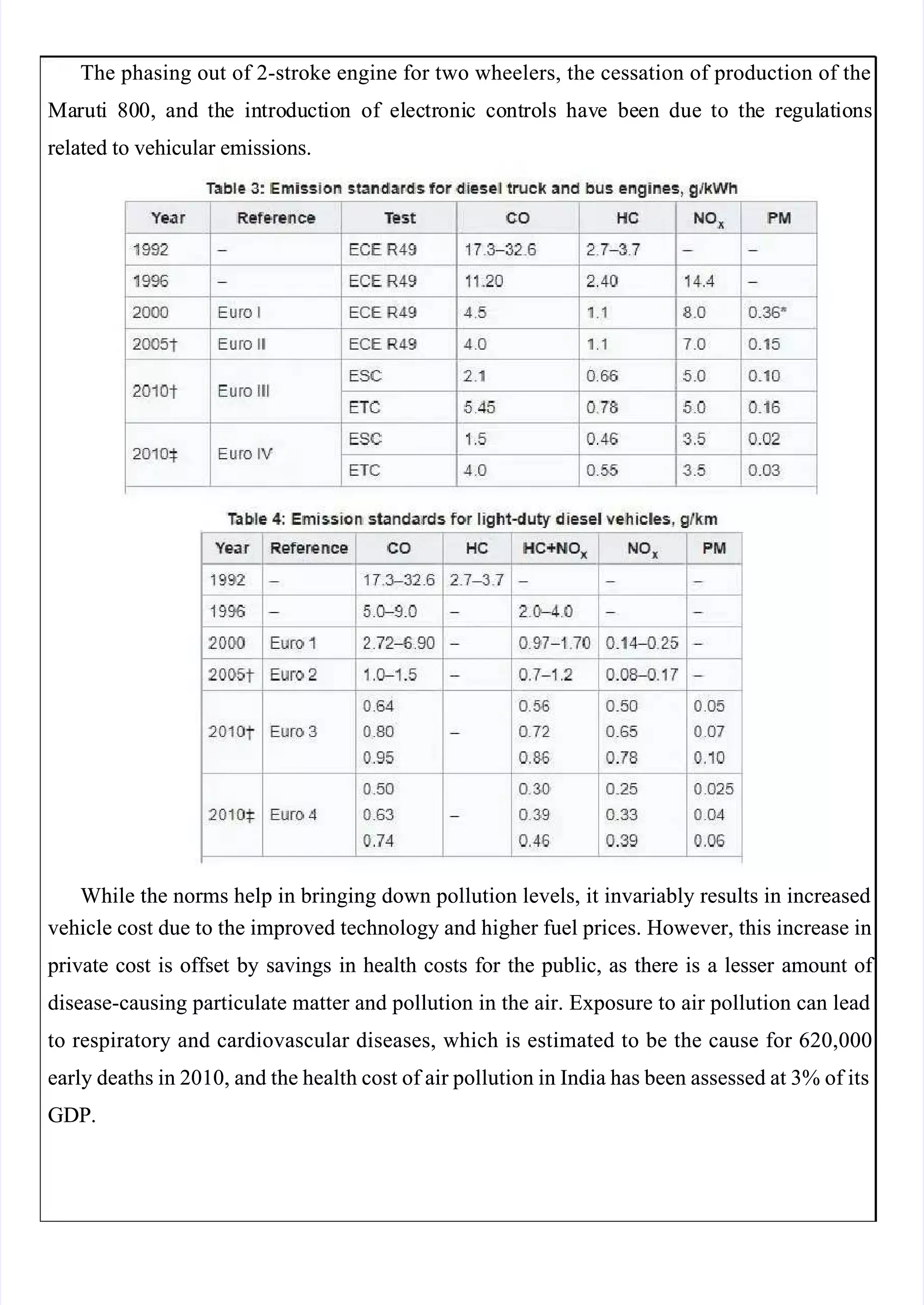
The phasing out of 2-stroke engine for two wheelers, the cessation of production of the
Ma
Marut
ruti
i 80
800,
0, and
and th
the
e in
intro
trodu
duct
ctio
ion
n of
of el
elec
ectr
troni
onic
c co
cont
ntro
rols
ls hav
have
e be
been
en due
due to
to th
the
e re
regul
gulat
atio
ions
ns
related to vehicular emissions.
While the norms help in bringing down pollution levels, it invariably results in increased
vehicle cost due to the improved technology and higher fuel prices. However, this increase in
 private
 private cost
cost is
is offset
offset by
by savings
savings in
in health
health costs
costs for
for the
the public,
public, as
as there
there is
is a
a lesser
lesser amount
amount of 
of 
disease-causing particulate matter and pollution in the air. Exposure to air pollution can lead
to respiratory and cardiovascular diseases, which is estimated to be the cause for 620,000
early deaths in 2010, and the health cost of air pollution in India has been assessed at 3% of its
GDP.
GDP.
pdf-unit-ii-engine-auxiliary-systems_compress.pdf

pdf-unit-ii-engine-auxiliary-systems_compress.pdf

  • 1.
        UNIT II ENGINEAUXILIARY SYSTEMS UNIT II ENGINE AUXILIARY SYSTEMS Syllabus Syllabus Ele Electr ctroni onical cally ly cont control rolled led gaso gasolin line e inj inject ection ion sys system tem for for SI SI engi engines, nes, Ele Electr ctroni onical cally ly con contr trol olle led d di dies esel el in inje jecti ction on sy syste stem m (U (Uni nit t in inje ject ctor or sy syste stem, m, Ro Rota tary ry di dist stri ribu buto tor r ty type pe an and d com common mon rail rail dir direct ect inj inject ection ion sys system tem), ), Ele Electr ctroni onic c ign igniti ition on syst system em (Tra (Transi nsistor storize ized d coi coil l ign ignit ition ion syst system em, , cap capaci acitiv tive e disc discharg harge e ign igniti ition on sys system tem), ), Turb Turbo o cha charge rgers rs (WG (WGT, T, VGT VGT), ), Engine emission control by three way catalytic converter system, Emission norms (Euro Engine emission control by three way catalytic converter system, Emission norms (Euro and BS). and BS). Electronically controlled gasoline injection system for SI engines Electronically controlled gasoline injection system for SI engines CARBURETION CARBURETION Introduction Introduction Spark-i Spark-igniti gnition on engine engines s normal normally ly use use volati volatile liquid le liquid fuels. Preparati fuels. Preparation on of of fuel-ai fuel-air r mixtu mixture re is is done outside the engine cylinder and formation of a homogeneous mixture is normally not done outside the engine cylinder and formation of a homogeneous mixture is normally not com comple plete ted d in in th the e in inle let t ma manif nifol old. d. Fu Fuel el dro dropl plet ets, s, wh whic ich h rem remai ain n in in sus suspe pensi nsion on, , co cont ntin inue ue to to evaporate and mix with air even during suction and compression processes. The process of  evaporate and mix with air even during suction and compression processes. The process of  mi mixt xture ure pre prepar parat atio ion n is is ext extrem remel ely y im impor porta tant nt for for sp spark ark-i -igni gniti tion on eng engin ines es. . Th The e pur purpos pose e of  of  carburetion is to provide a combustible mixture of fuel and air in the required quantity and carburetion is to provide a combustible mixture of fuel and air in the required quantity and quali quality for ty for effici efficient operation of ent operation of the engine the engine under all under all condi conditions. tions. Definition of Carburetion Definition of Carburetion The process of formation of a combustible fuel-air mixture by mixing the proper amount The process of formation of a combustible fuel-air mixture by mixing the proper amount of fuel with air before admission to engine cylinder is called carburetion and the device which of fuel with air before admission to engine cylinder is called carburetion and the device which does this job is called a carburetor. does this job is called a carburetor. The Simple The Simple Carbur Carburetor etor Carburetors are highly complex. Let us first understand the working principle bf a simple Carburetors are highly complex. Let us first understand the working principle bf a simple or elementary carburetor that provides an air fuel mixture for cruising or normal range at a or elementary carburetor that provides an air fuel mixture for cruising or normal range at a single speed. Later, other mechanisms to provide for the various special requirements like single speed. Later, other mechanisms to provide for the various special requirements like starting, idling, variable load and speed operation and acceleration will be included. starting, idling, variable load and speed operation and acceleration will be included.
  • 2.
        Types of Carburetors Typesof Carburetors Constant Choke Carburetor: Constant Choke Carburetor: In the constant choke carburetor, the air and fuel flow areas are always maintained to be In the constant choke carburetor, the air and fuel flow areas are always maintained to be constant. But the pressure difference or depression, which causes the flow of fuel and air, is constant. But the pressure difference or depression, which causes the flow of fuel and air, is  being  being varied varied as as per per the the demand demand on on the the engine. engine. Solex Solex and and Zenith Zenith carburetors carburetors belong belong to to this this class. class. Constant Vacuum Carburetor: Constant Vacuum Carburetor: In the In the consta constant vacuum carburetor, (sometim nt vacuum carburetor, (sometimes es called variabl called variable e choke carbureto choke carburetor) r) air and air and fuel flow areas are being varied as per the demand on the engine, while the vacuum is fuel flow areas are being varied as per the demand on the engine, while the vacuum is maintained to be always same. The maintained to be always same. The S.U. and Carter carburetors  S.U. and Carter carburetors belong to tills class.  belong to tills class.
  • 3.
        Multiple Venturi Carburetor: MultipleVenturi Carburetor: Mu Mult ltip iple le ven ventu turi ri sy syste stem m us uses es dou doubl ble e or or tr trip iple le ven ventu turi ri. . Th The e boo boost st ven ventu turi ri is is lo loca cate ted d concentrically within the main venturi.The discharge edge of the boost venturi is located at concentrically within the main venturi.The discharge edge of the boost venturi is located at the throat of the main venturi. The boost venturi is positioned upstream of the throat of the the throat of the main venturi. The boost venturi is positioned upstream of the throat of the larger main venturi. Only a fraction of the total air flows though the boost venturi. larger main venturi. Only a fraction of the total air flows though the boost venturi.  Now  Now the the pressure pressure at at the the boost boost venturi venturi exit exit equals equals the the pressure pressure at at the the main main venturi venturi throat. throat. The The fuel nozzle is located at the throat of the boost venturi. fuel nozzle is located at the throat of the boost venturi. GASOLINE INJECTION AND IGNITION SYSTEM GASOLINE INJECTION AND IGNITION SYSTEM Introduction Introduction In In in inte terna rnal l co comb mbust ustio ion n eng engin ines es, , gas gasol olin ine e di dire rect ct in inje ject ctio ion n (G (GDI DI), ), is is a a var varia iant nt of of fue fuel l injection employed in modern two-stroke and four-stroke gasoline engines. The gasoline is injection employed in modern two-stroke and four-stroke gasoline engines. The gasoline is hi highl ghly y pre pressu ssuri rize zed d in in a a co comm mmon on rai rail l fu fuel el li line ne and and in inje ject ctor ors s in inje ject cts s fue fuel l di direc rectl tly y in into to th the e combustion chamber of each cylinder.It is opposed to conventional multi-point fuel injection combustion chamber of each cylinder.It is opposed to conventional multi-point fuel injection which injects fuel to the intake manifold. Gasoline direct injection enables a stratified fuel which injects fuel to the intake manifold. Gasoline direct injection enables a stratified fuel charge (ultra lean burn) combustion for improved fuel efficiency, and reduced emission levels charge (ultra lean burn) combustion for improved fuel efficiency, and reduced emission levels at low load. at low load. TRANSITION OF FUEL SUPPLY SYSTEM TRANSITION OF FUEL SUPPLY SYSTEM The transition of the fuel supply system used in automobiles is graphically shown below. The transition of the fuel supply system used in automobiles is graphically shown below. In carburetor the fuel from the fuel chamber is sucked in by the pressure variation caused due In carburetor the fuel from the fuel chamber is sucked in by the pressure variation caused due to the incoming air. The fuel then mixes with the air and reaches the cylinder through the inlet to the incoming air. The fuel then mixes with the air and reaches the cylinder through the inlet manifold. Where as in a port injection system the fuel to the cylinder is supplied by a separate manifold. Where as in a port injection system the fuel to the cylinder is supplied by a separate fuel injector placed near the inlet valve of the cylinder. And in a direct injection system the fuel injector placed near the inlet valve of the cylinder. And in a direct injection system the fuel to the cylinder is supplied by a fuel injector placed inside the cylinder. fuel to the cylinder is supplied by a fuel injector placed inside the cylinder.
  • 4.
        OPERATING DIFFICULTIES FORA CARBURETOR. OPERATING DIFFICULTIES FOR A CARBURETOR. Some problems associat Some problems associated with ed with comfor comfortable running of table running of the carburetor are the carburetor are discus discussed here. sed here. 1. Ice formation: 1. Ice formation: The vaporisation of the fuel injected in the current of the air requires latent  The vaporisation of the fuel injected in the current of the air requires latent heat and the taken mainly from the incoming air. As a result of this, the temperature of the air  heat and the taken mainly from the incoming air. As a result of this, the temperature of the air  drops below the dew point of the water vapour in the air and it condenses and many times drops below the dew point of the water vapour in the air and it condenses and many times freeze into ice if the temperature falls below dew point temperature. freeze into ice if the temperature falls below dew point temperature. 2. Vapour Lock: 2. Vapour Lock: The improved volatility of modern fuels and the necessity of providing heat  The improved volatility of modern fuels and the necessity of providing heat to prevent the ice formation, has created carburetion difficulties due to vaporisation of fuel in to prevent the ice formation, has created carburetion difficulties due to vaporisation of fuel in  pipes  pipes and and float float chamber. chamber. The The heating heating may may also also occur occur due due to to petrol petrol pipes pipes being being near near the the engine. engine. If the fuel supply is large and supply is small, a high velocity will result causing high vacuum. If the fuel supply is large and supply is small, a high velocity will result causing high vacuum. This causes considerable drop which may also cause the formation of vapour bubbles. If these This causes considerable drop which may also cause the formation of vapour bubbles. If these  bubbles  bubbles formed formed accumulate accumulate at at the the tube tube bend, bend, then then they they may may interrupt interrupt the the fuel fuel flow flow from from the the tank or the fuel pump and engine will stop because of lack of fuel. Vapour lock is formed tank or the fuel pump and engine will stop because of lack of fuel. Vapour lock is formed  because  because of of rapid rapid bubbling bubbling of of fuel fuel and and usually usually happens happens in in hot hot summer. summer. 3. Back Firing: 3. Back Firing: During the starting of an engine under cold working conditions, the usual  During the starting of an engine under cold working conditions, the usual manipulation of the choke varies the mixture from too lean to too rich. A very lean mixture manipulation of the choke varies the mixture from too lean to too rich. A very lean mixture will burn very slowly and the flame may still exist in cylinder when the exhaust valve is about will burn very slowly and the flame may still exist in cylinder when the exhaust valve is about to open. The fresh charge in the intake manifold is about to open. The fresh charge in the to open. The fresh charge in the intake manifold is about to open. The fresh charge in the intake manifold is not so diluted as when inducted into the cylinder and mixed with the intake manifold is not so diluted as when inducted into the cylinder and mixed with the clearance gases and consequently burn more rapidly than the charge in the cylinder. If lean clearance gases and consequently burn more rapidly than the charge in the cylinder. If lean charge comes in contact with flames existing in the cylinder, there will be flash of flame back  charge comes in contact with flames existing in the cylinder, there will be flash of flame back  through the intake manifold, burning the charge therein and causing the customary back firing through the intake manifold, burning the charge therein and causing the customary back firing in the carburetor. in the carburetor. ADVANTAGES OF FUEL INJECTION OVER CARBURETOR  ADVANTAGES OF FUEL INJECTION OVER CARBURETOR  The fuel injection eliminates several intake manifold distribution problems. One of the The fuel injection eliminates several intake manifold distribution problems. One of the most difficult problems in a carbureted system is to get the same amount and richness of  most difficult problems in a carbureted system is to get the same amount and richness of  air-fuel mixture to each cylinder. The problem is that the intake manifold acts as a storing air-fuel mixture to each cylinder. The problem is that the intake manifold acts as a storing device, sending a richer air fuel mixture to the end cylinders. The air flows readily around the device, sending a richer air fuel mixture to the end cylinders. The air flows readily around the
  • 5.
        corners and throughvarious shaped passages. However the fuel, because it is heavier is unable corners and through various shaped passages. However the fuel, because it is heavier is unable to travel as easily around the bends in the intake manifold. As a result, some of fuel particles to travel as easily around the bends in the intake manifold. As a result, some of fuel particles continue to move to the end of the intake manifold, accumulating there. This enriches the continue to move to the end of the intake manifold, accumulating there. This enriches the mixture going the end cylinder. The center cylinder closest to the carburetor gets the leanest mixture going the end cylinder. The center cylinder closest to the carburetor gets the leanest mixture. The port injection solves this problem because the same amount of fuel is injected at mixture. The port injection solves this problem because the same amount of fuel is injected at each intake valve port. Each cylinder gets the same amount of air-fuel mixture of the same each intake valve port. Each cylinder gets the same amount of air-fuel mixture of the same mixture richness. mixture richness. Another advantage of the fuel injection system is that the intake manifold can be designed Another advantage of the fuel injection system is that the intake manifold can be designed for the most efficient flow of air only. It does not have to handle fuel. Also, because only a for the most efficient flow of air only. It does not have to handle fuel. Also, because only a throttle body is used, instead of a complete carburetor. throttle body is used, instead of a complete carburetor. With fuel injection, fuel mixture requires no extra heating during warm up. No manifold With fuel injection, fuel mixture requires no extra heating during warm up. No manifold heat control valve or heated air system is required. Throttle response is faster because the fuel heat control valve or heated air system is required. Throttle response is faster because the fuel is is un unde der r pre pressu ssure re at at th the e in inje ject ctio ion n va valv lves es at at al all l ti time mes. s. An An el elec ectr tric ic fue fuel l pu pump mp su supp ppli lies es th the e  pressure.  pressure. The The carburetor carburetor will will depend depend on on differences differences in in air air pressure pressure as as the the force force that that causes causes the the fuel to feed into the air passing through. fuel to feed into the air passing through. Fu Fuel el in inje ject ctio ion n ha has s no no ch choke oke, , bu but t spr spray ays s at atom omiz ized ed fue fuel l di direc rectl tly y in into to th the e en engi gine ne. . Thi This s eliminates most of the cold start problems associated with carburetors. eliminates most of the cold start problems associated with carburetors. Ele Electr ctroni onic c fuel fuel inj inject ection ion als also o int integra egrates tes mor more e eas easily ily wit with h com comput puteri erized zed eng engine ine cont control rol systems because the injectors are more easily controlled than a mechanical carburetor with systems because the injectors are more easily controlled than a mechanical carburetor with electronic add-ons. electronic add-ons. Multi port fuel injection (where each cylinder has its own injector) delivers a more evenly Multi port fuel injection (where each cylinder has its own injector) delivers a more evenly distributed mixture of air and fuel to each of the engine's cylinders, which improves power  distributed mixture of air and fuel to each of the engine's cylinders, which improves power  and performance. and performance.
  • 6.
        ELECTRONIC FUEL INJECTION ELECTRONICFUEL INJECTION Engine Sensors: In order to provide the correct amount of fuel for every operating condition, Engine Sensors: In order to provide the correct amount of fuel for every operating condition, the engine control unit (ECU) has to monitor a huge number of input sensors. the engine control unit (ECU) has to monitor a huge number of input sensors. Various Sensors used in a GDI system Various Sensors used in a GDI system  Mass airflow sensor  Mass airflow sensor - - Tells the ECU the mass of air entering the engine  Tells the ECU the mass of air entering the engine Oxygen sensor - The device measures the amount of oxygen in the exhaust gas and sends Oxygen sensor - The device measures the amount of oxygen in the exhaust gas and sends this information to the electronic control unit. If there is too much oxygen, the mixture is too this information to the electronic control unit. If there is too much oxygen, the mixture is too lean. If there is too little, the mixture is too rich. In either case, the electronic control unit lean. If there is too little, the mixture is too rich. In either case, the electronic control unit adjusts the air fuel ratio by changing the fuel injected. It is usually used with closed loop adjusts the air fuel ratio by changing the fuel injected. It is usually used with closed loop mode of the ECU. mode of the ECU. Thr Throttl ottle e pos positio ition n sens sensor or - - Monitors the throttle valve position (which determines how  Monitors the throttle valve position (which determines how much air goes into the engine) so the ECU can respond quickly to changes, increasing or  much air goes into the engine) so the ECU can respond quickly to changes, increasing or  decreasing the fuel rate as necessary decreasing the fuel rate as necessary Coolant temperature sensor - Coolant temperature sensor - Allows the ECU to determine when the engine has reached  Allows the ECU to determine when the engine has reached its proper operating temperature its proper operating temperature Voltage sensor - Voltage sensor - Monitors the system voltage in the car so the ECU can raise the idle  Monitors the system voltage in the car so the ECU can raise the idle speed if voltage is dropping (which would indicate a high electrical load) speed if voltage is dropping (which would indicate a high electrical load)  Manifo  Manifold ld absolute absolute pressure pressure sensor sensor - -   Mo   Moni nito tors rs th the e pr pres essu sure re of of th the e ai air r in in th the e in inta take ke manifold. The amount of air being drawn into the engine is a good indication of how much manifold. The amount of air being drawn into the engine is a good indication of how much
  • 7.
         power  power it it is isproducing; producing; and and the the more more air air that that goes goes into into the the engine, engine, the the lower lower the the manifold manifold  pressure,  pressure, so so this this reading reading is is used used to to gauge gauge how how much much power power is is being being produced. produced.  Engine  Engine speed speed sensor sensor - -   Mo   Moni nito tors rs en engi gine ne sp spee eed, d, wh whic ich h is is on one e of of th the e fa fact ctor ors s us used ed to to calculate the pulse width. calculate the pulse width. Crank Angle sensor - Crank Angle sensor - Monitors the position of the piston and gives the information to the  Monitors the position of the piston and gives the information to the ECU. Accordingly the ECU adjusts the valve timing. ECU. Accordingly the ECU adjusts the valve timing. Fuel Injectors: Fuel Injectors: The solenoid-operated fuel injector is shown in the figure above. It consists of a valve The solenoid-operated fuel injector is shown in the figure above. It consists of a valve  body  body and and needle needle valve valve to to which which the the solenoid solenoid plunger plunger is is rigidly rigidly attached. attached. The The fuel fuel is is supplied supplied to the injector under pressure from the electric fuel pump passing through the filter. The to the injector under pressure from the electric fuel pump passing through the filter. The needle valve is pressed against a seat in the valve body by a helical spring to keep it closed needle valve is pressed against a seat in the valve body by a helical spring to keep it closed until the solenoid winding is energized. When the current pulse is received from the electronic until the solenoid winding is energized. When the current pulse is received from the electronic control unit, a magnetic field builds up in the solenoid which attracts a plunger and lifts the control unit, a magnetic field builds up in the solenoid which attracts a plunger and lifts the needle valve from its seat. This opens the path to pressurised fuel to emerge as a finely needle valve from its seat. This opens the path to pressurised fuel to emerge as a finely atomised spray. atomised spray.
  • 8.
        ELECTRONIC FUEL INJECTION ELECTRONICFUEL INJECTION There are two types of electronic fuel injection. They are, There are two types of electronic fuel injection. They are, 1. Multipoint Fuel Injection (MPFI) 1. Multipoint Fuel Injection (MPFI) 2. Gasoline Direct Injection (GDI) 2. Gasoline Direct Injection (GDI) MULTI POINT FUEL INJECTION (MPFI) MULTI POINT FUEL INJECTION (MPFI) Engines with multi port injection have a separate fuel injector for each cylinder, mounted Engines with multi port injection have a separate fuel injector for each cylinder, mounted in the intake manifold or head just above the intake port. in the intake manifold or head just above the intake port. Thus, a four-cylinder engine would have four injectors, a V6 would have six injectors and Thus, a four-cylinder engine would have four injectors, a V6 would have six injectors and a V8 would have eight injectors. Multi port injection systems are more expensive because of  a V8 would have eight injectors. Multi port injection systems are more expensive because of  the added number of injectors. But having a separate injector for each cylinder makes a big the added number of injectors. But having a separate injector for each cylinder makes a big difference in performance. The same engine with multi port injection will typically produce difference in performance. The same engine with multi port injection will typically produce 10 to 40 more horsepower than one with carburetor because of better cylinder-to-cylinder fuel 10 to 40 more horsepower than one with carburetor because of better cylinder-to-cylinder fuel distribution. Injecting fuel directly into the intake ports also eliminates the need to preheat the distribution. Injecting fuel directly into the intake ports also eliminates the need to preheat the in inta take ke ma mani nifol fold d si sinc nce e on only ly ai air r flo flows ws th throu rough gh th the e ma manif nifol old. d. Th This is, , in in tu turn rn, , pro provi vide des s mo more re freedom for tuning the intake plumbing to produce maximum torque. freedom for tuning the intake plumbing to produce maximum torque.
  • 9.
        GASOLINE DIRECT INJECTION(GDI) GASOLINE DIRECT INJECTION (GDI) In conventional engines, fuel and air are mixed outside the cylinder. This ensures waste In conventional engines, fuel and air are mixed outside the cylinder. This ensures waste  between  between the the mixing mixing point point and and the the cylinder, cylinder, as as well well as as imperfect imperfect injection injection timing. timing. But But in in the the GDI engine, petrol is injected directly into the cylinder with precise timing, eliminating waste GDI engine, petrol is injected directly into the cylinder with precise timing, eliminating waste and inefficiency. By operating in two modes, Ultra-Lean Combustion Mode and Superior  and inefficiency. By operating in two modes, Ultra-Lean Combustion Mode and Superior  Output Mode, the GDI engine delivers both unsurpassed fuel efficiency and superior power  Output Mode, the GDI engine delivers both unsurpassed fuel efficiency and superior power  and torque. The GDI engine switches automatically between modes with no noticeable shift in and torque. The GDI engine switches automatically between modes with no noticeable shift in  performance.  performance. MAJOR OBJECTIVES OF THE GDI ENGINE MAJOR OBJECTIVES OF THE GDI ENGINE Ultra-low fuel consumption. Ultra-low fuel consumption. Superior power to conventional MPI engines Superior power to conventional MPI engines Two Combustion Modes: Two Combustion Modes: In response to driving conditions, the GDI engine changes the  In response to driving conditions, the GDI engine changes the tim timing ing of of the the fue fuel l spra spray y inj inject ection ion, , alt altern ernati ating ng bet betwee ween n two two dis disti tinct nctive ive com combust bustion ion mod modes- es- st stra rati tifi fied ed cha charge rge (U (Ult ltra- ra-Le Lean an com combus busti tion on), ), and and hom homoge ogeno nous us cha charge rge (Su (Supe perio rior r Ou Outp tput ut combustion). combustion).
  • 10.
        DIESEL INJECTION SYSTEMS DIESELINJECTION SYSTEMS Fuel injection in diesel engines Fuel injection in diesel engines Mechanical and electronic injection Mechanical and electronic injection Older engines make use of a mechanical fuel pump and valve assembly which is driven by Older engines make use of a mechanical fuel pump and valve assembly which is driven by the engine crankshaft, usually via the timing belt or chain. These engines use simple injectors the engine crankshaft, usually via the timing belt or chain. These engines use simple injectors which are basically very precise spring-loaded valves which will open and close at a specific which are basically very precise spring-loaded valves which will open and close at a specific fue fuel l pre press ssur ure. e. Th The e pum pump p ass assem embl bly y con consi sist sts s of of a a pum pump p wh whic ich h pre press ssur urize izes s th the e fue fuel, l, and and a a disc-shaped valve which rotates at half crankshaft speed. The valve has a single aperture to disc-shaped valve which rotates at half crankshaft speed. The valve has a single aperture to the pressurized fuel on one side, and one aperture for each injector on the other. As the engine the pressurized fuel on one side, and one aperture for each injector on the other. As the engine turns the valve discs will line up and deliver a burst of pressurized fuel to the injector at the turns the valve discs will line up and deliver a burst of pressurized fuel to the injector at the cylinder about to enter its power stroke. The injector valve is forced open by the fuel pressure cylinder about to enter its power stroke. The injector valve is forced open by the fuel pressure and the diesel is injected until the valve rotates out of alignment and the fuel pressure to that and the diesel is injected until the valve rotates out of alignment and the fuel pressure to that injector is cut off. Engine speed is controlled by a third disc, which rotates only a few degrees injector is cut off. Engine speed is controlled by a third disc, which rotates only a few degrees and is controlled by the throttle lever. This disc alters the width of the aperture through which and is controlled by the throttle lever. This disc alters the width of the aperture through which the fuel passes, and therefore how long the injectors are held open before the fuel supply is cut, the fuel passes, and therefore how long the injectors are held open before the fuel supply is cut, con contr trol olli ling ng th the e am amoun ount t of of fue fuel l in inje ject cted ed. . Th This is con contr trast asts s wi with th th the e mo more re mo moder dern n me metho thod d of  of  having a separate fuel pump (or set of pumps) which supplies fuel constantly at high pressure having a separate fuel pump (or set of pumps) which supplies fuel constantly at high pressure to each injector. Each injector then has a solenoid which is operated by an electronic control to each injector. Each injector then has a solenoid which is operated by an electronic control un unit it, , wh whic ich h ena enabl bles es mo more re ac accu curat rate e con contr trol ol of of in inje ject ctor or ope openi ning ng ti time mes s dep depen endi ding ng on on ot othe her  r 
  • 11.
        control conditions suchas engine speed and loading, resulting in better engine performance control conditions such as engine speed and loading, resulting in better engine performance and fuel economy. This design is also mechanically simpler than the combined pump and and fuel economy. This design is also mechanically simpler than the combined pump and va valv lve e de desi sign gn, , m mak akin ing g it it ge gene nera rall lly y mo more re re reli liab able le, , an and d le less ss no nois isy, y, th than an it its s me mech chan anic ical al counterpart. Both mechanical and electronic injection systems can be used in either direct or  counterpart. Both mechanical and electronic injection systems can be used in either direct or  indirect injection configurations. indirect injection configurations. Indirec Indirect t injection injection Mai Main n art articl icle: e: Indi Indirect rect inj injecti ection on An An ind indire irect ct inj injecti ection on die diesel sel engi engine ne del delive ivers rs fue fuel l int into o a a chamber off the combustion chamber, called a prechamber, where combustion begins and chamber off the combustion chamber, called a prechamber, where combustion begins and then spreads into the main combustion chamber. then spreads into the main combustion chamber. Direct injection Direct injection Modern diesel engines make use of one of the following direct injection methods: Modern diesel engines make use of one of the following direct injection methods: Distrib Distributor pump utor pump direct injection direct injection The first incarnations of direct injection diesels used a rotary pump much like indirect The first incarnations of direct injection diesels used a rotary pump much like indirect injection diesels, however the injectors were mounted directly in the top of the combustion injection diesels, however the injectors were mounted directly in the top of the combustion chamber rather than in a separate pre-combustion chamber. Examples are vehicles such as the chamber rather than in a separate pre-combustion chamber. Examples are vehicles such as the Ford Transit and the Austin Rover Maestro and Montego with their Perkins Prima engine. The Ford Transit and the Austin Rover Maestro and Montego with their Perkins Prima engine. The  problem  problem with with these these vehicles vehicles was was the the harsh harsh noise noise that that they they made made and and particulate particulate (smoke) (smoke) emissions. This is the reason that in the main this type of engine was limited to commercial emissions. This is the reason that in the main this type of engine was limited to commercial vehicles (the notable exceptions being the Maestro, Montego and Fiat Croma passenger cars). vehicles (the notable exceptions being the Maestro, Montego and Fiat Croma passenger cars). Fuel consumption was about 15% to 20% lower than indirect injection diesels which for some Fuel consumption was about 15% to 20% lower than indirect injection diesels which for some  buyers  buyers was was enough enough to to compensate compensate for for the the extra extra noise. noise. This This type type of of engine engine was was transformed transformed by by
  • 12.
        electronic control ofthe injection pump, pioneered by Volkswagen Audi group with the Audi electronic control of the injection pump, pioneered by Volkswagen Audi group with the Audi 100 TDI introduced in 1989. The injection pressure was still only around 300 bar, but the 100 TDI introduced in 1989. The injection pressure was still only around 300 bar, but the in inj jec ecti tion on ti tim min ing, g, fu fuel el qu quan anti tity ty, , ex exha haus ust t ga gas s re reci circ rcul ula ati tion on an and d tu turb rbo o bo boos ost t w wer ere e al all l ele electro ctronic nicall ally y cont control rolled led. . Thi This s gave gave muc much h mor more e pre precise cise cont control rol of of the these se par parame ameters ters whi which ch mad made e refi refinem nement ent muc much h mor more e acce accept ptabl able e and and emi emissio ssions ns acc accept eptabl ably y low low. . Fai Fairly rly qui quickl ckly y the the technology trickled down to more mass market vehicles such as the Mark 3 Golf TDI where it technology trickled down to more mass market vehicles such as the Mark 3 Golf TDI where it  proved  proved to to be be very very popular. popular. These These cars cars were were both both more more economical economical and and more more powerful powerful than than indirect injection competitors of their day. indirect injection competitors of their day.
  • 13.
        Common rail directinjection Common rail direct injection Mai Main n arti article cle: : Com Common mon rail rail In In old older er die diesel sel engi engines, nes, a a dist distrib ributo utor-t r-type ype inj injecti ection on pum pump, p, regulated by the engine, supplies bursts of fuel to injectors which are simply nozzles through regulated by the engine, supplies bursts of fuel to injectors which are simply nozzles through which the diesel is sprayed into the engine's combustion chamber. which the diesel is sprayed into the engine's combustion chamber. In common rail systems, the distributor injection pump is eliminated. Instead an extremely In common rail systems, the distributor injection pump is eliminated. Instead an extremely high pressure pump stores a reservoir of fuel at high pressure - up to 1,800 bar (180MPa) - in high pressure pump stores a reservoir of fuel at high pressure - up to 1,800 bar (180MPa) - in a "common rail", basically a tube which in turn branches off to computer-controlled injector  a "common rail", basically a tube which in turn branches off to computer-controlled injector  val valve ves, s, eac each h of of wh whic ich h con conta tain ins s a a pre preci cisi sion- on-ma mach chin ined ed noz nozzl zle e and and a a pl plun unge ger r dri drive ven n by by a a solenoid. Most European automakers have common rail diesels in their model lineups, even solenoid. Most European automakers have common rail diesels in their model lineups, even for commercial vehicles. Some Japanese manufacturers, such as Toyota, Nissan and recently for commercial vehicles. Some Japanese manufacturers, such as Toyota, Nissan and recently Honda, have also developed common rail diesel engines. Different car makers refer to their  Honda, have also developed common rail diesel engines. Different car makers refer to their  common rail engines by different names, e.g. DaimlerChrysler's CDI, Ford Motor Company's common rail engines by different names, e.g. DaimlerChrysler's CDI, Ford Motor Company's TDCi (most of these engines are manufactured by PSA), Fiat Group's (Fiat, Alfa Romeo and TDCi (most of these engines are manufactured by PSA), Fiat Group's (Fiat, Alfa Romeo and Lancia) JTD, Renault's DCi, GM/Opel's CDTi (most of these engines are manufactured by Lancia) JTD, Renault's DCi, GM/Opel's CDTi (most of these engines are manufactured by Fi Fiat at, , ot othe her r by by Isu Isuzu zu), ), Hy Hyund undai ai's 's CR CRDI DI, , Mi Mits tsubi ubish shi' i's s D- D-ID ID, , PS PSA A Pe Peuge ugeot ot Ci Citr troe oen' n's s HD HDI, I, Toyota's D-4D, Volkswagen's TDi, and so on. Toyota's D-4D, Volkswagen's TDi, and so on.
  • 14.
        Unit direct injection Unitdirect injection This also injects fuel directly into the cylinder of the engine. However, in this system the This also injects fuel directly into the cylinder of the engine. However, in this system the injector and the pump are combined into one unit positioned over each cylinder. Each cylinder  injector and the pump are combined into one unit positioned over each cylinder. Each cylinder  thus has its own pump, feeding its own injector, which prevents pressure fluctuations and thus has its own pump, feeding its own injector, which prevents pressure fluctuations and allows more consistent injection to be achieved. This type of injection system, also developed allows more consistent injection to be achieved. This type of injection system, also developed  by  by Bosch, Bosch, is is used used by by Volkswagen Volkswagen AG AG in in cars cars (where (where it it is is called called Pumpe Pumpe Düse Düse - - literally literally "pump "pump noz nozzle zle"), "), and and most most maj major or die diesel sel engi engine ne man manufa ufactu cturers rers, , in in lar large ge com commerc mercial ial eng engine ines s (Cat (Cat, , Cummins, Detroit Diesel). With recent advancements, the pump pressure has been raised to Cummins, Detroit Diesel). With recent advancements, the pump pressure has been raised to 2,050 bar (205 MPa), allowing injection parameters similar to common rail systems. 2,050 bar (205 MPa), allowing injection parameters similar to common rail systems. Introduction of Ignition System Introduction of Ignition System For petrol For petrol engin engine e - - Batte Battery ry ignit ignition system , ion system , Magne Magneto ignition system Injection system to ignition system Injection system      For For diesel diesel engine engine - - Fuel Fuel supply supply system system. .      Battery Battery ignition ignition system: system:      Battery ignition Battery ignition system has the follow system has the following elements ing elements      Primary Primary Ignition Ignition Circuit(low Circuit(low voltage) voltage)     Battery   Battery      Ignition Ignition switch switch      Prima Primary ry windi windings ngs of of coil coil      Contact Contact breaker  breaker 
  • 15.
            capacitor   capacitor       Secondary Secondary Ignition Ignition Circuit Circuit ( ( high high voltage) voltage)      Seconda Secondary ry windi windings ngs of of coil coil      Distri Distributor butor cap cap and and rotor rotor (if (if the the vehicl vehicle i e is so s so equipp equipped) ed)      Spark Spark plug plug wires wires & &      Spark Spark plugs plugs IGNITION SYSTEM – Magneto System Ignition Switch Distribution Contact Breaker Coil IGNITION SYSTEM – Magneto System Ignition Switch Distribution Contact Breaker Coil Magneto Condenser Power Generation Spark Generation Magneto Unit Rotor Arm Magneto Condenser Power Generation Spark Generation Magneto Unit Rotor Arm IGNITION SYSTEM – Dynamo/Alternator System Dynamo/ Alternator Distributor Contact IGNITION SYSTEM – Dynamo/Alternator System Dynamo/ Alternator Distributor Contact Breaker Coil Ignition Switch Secondary Windings Primary Windings Condenser Battery Breaker Coil Ignition Switch Secondary Windings Primary Windings Condenser Battery Ignition Switch Coil Packs IGNITION SYSTEM – Electronic Systems Control Unit Timing Ignition Switch Coil Packs IGNITION SYSTEM – Electronic Systems Control Unit Timing Sensor  Sensor  Timing Disc Engine Speed Sensing Unit Alternator Battery Timing Disc Engine Speed Sensing Unit Alternator Battery In all In all spark ignitio spark ignition engines which work n engines which work on the on the Gasoli Gasoline either 2-Stroke or ne either 2-Stroke or 4-Stro 4-Stroke cycle ke cycle  principle  principle and and utilize utilize a a carburetor carburetor or or fuel fuel injection injection system, system, the the combustion combustion of of the the air-fuel air-fuel mixture is initiated by an electric spark. mixture is initiated by an electric spark. The term ‘Spark Ignition’ means that a brief electric arc is produced between the electrodes The term ‘Spark Ignition’ means that a brief electric arc is produced between the electrodes of a spark plug, the energy for which is derived from an external power source. In most cases of a spark plug, the energy for which is derived from an external power source. In most cases th this is pow power er sou sourc rce e is is th the e veh vehic icle le ba batt ttery ery, , wh whic ich h is is con const stan antl tly y be bein ing g sup suppl plem ement ented ed by by th the e alternate while the vehicle is mobile. alternate while the vehicle is mobile. A different method of ignition is employed in diesel engines. This is called ‘compression A different method of ignition is employed in diesel engines. This is called ‘compression ig igni niti tion on’ ’ and and rel relie ies s on on th the e fa fact ct th that at wh when en ai air r com compre presse ssed, d, it its s te temp mpera eratu ture re ri rise ses. s. In In di dies esel el en engi gine nes, s, co com mpr pres essi sion on ra rati tio o of of be betw twee een n 16 16:1 :1 an and d 25 25:1 :1 ar are e co com mmo mon, n, an and d at at th the e en end d of of a a compression the temperature of the trapped air is sufficiently high to ignite the diesel fuel that compression the temperature of the trapped air is sufficiently high to ignite the diesel fuel that is sprayed into the The functions of ignition system is sprayed into the The functions of ignition system The functions of the coil ignition systems in general use on motor vehicle may be divided The functions of the coil ignition systems in general use on motor vehicle may be divided into three areas. These are: into three areas. These are: Production of the high voltage necessary to produce a spark at the plug gap. Production of the high voltage necessary to produce a spark at the plug gap. Distribute the spark to all the cylinders at proper time based on the firing order. Distribute the spark to all the cylinders at proper time based on the firing order.
  • 16.
        Varying the timingof the spark depending on the various operating conditions of the Varying the timing of the spark depending on the various operating conditions of the engine like cranking time, varying speed and load, so that the best performance is obtained engine like cranking time, varying speed and load, so that the best performance is obtained from the from the engin engine e under all under all operat operating condition ing conditions. s. Mechanism of Ignition Mechanism of Ignition It must be remembered that vehicle battery voltages are usually 12 volt or 24 volt and this It must be remembered that vehicle battery voltages are usually 12 volt or 24 volt and this value is too low to produce a heavy spark at the plug gap in a cylinder under compression. For  value is too low to produce a heavy spark at the plug gap in a cylinder under compression. For  this reason one of the major functions of the battery ignition system is to raise the battery this reason one of the major functions of the battery ignition system is to raise the battery voltage to the required level and then apply it to spark plugs. voltage to the required level and then apply it to spark plugs. This process is This process is correct correctly initiat ly initiated in ed in the primary circuit and completed in the the primary circuit and completed in the second secondary ary winding of the ignition coil. Depending on the type of engine and the conditions existing in winding of the ignition coil. Depending on the type of engine and the conditions existing in the cylinders, a voltage of between 5,000 to 20,000 volts is required and this is called the the cylinders, a voltage of between 5,000 to 20,000 volts is required and this is called the ionizing voltage or firing voltage. ionizing voltage or firing voltage. This firing voltage forces the electrons to jump between the electrodes of the spark plug in This firing voltage forces the electrons to jump between the electrodes of the spark plug in the gap to produce the required spark. The electric spark has sufficient heat energy to ignite the gap to produce the required spark. The electric spark has sufficient heat energy to ignite the air  the air    fuel mixture which later continues to fuel mixture which later continues to burn itself. burn itself. The conventional coil ignition system Inductive ignition systems: that uses an ignition coil to The conventional coil ignition system Inductive ignition systems: that uses an ignition coil to  perform  perform the the step step up up transformer transformer action action and and to to increase increase the the electrical electrical voltage. voltage. The The ignition ignition coils coils of the inductive ignition systems operate on the principle of electromagnetic induction (EMI) of the inductive ignition systems operate on the principle of electromagnetic induction (EMI) irrespective of whether it is triggered by contact breakers or by electronic triggering units. irrespective of whether it is triggered by contact breakers or by electronic triggering units. Transis Transistorize torized d coil ignition coil ignition system system When the ignition switch is set to the ON/RUN position, +12 Volts is applied to terminal When the ignition switch is set to the ON/RUN position, +12 Volts is applied to terminal 15 of the ignition module through the 0.4 Ohm ballast resistor. When the ignition switch is set 15 of the ignition module through the 0.4 Ohm ballast resistor. When the ignition switch is set to the START position (engine cranking) +12 volts is applied directly to terminal 15 of the to the START position (engine cranking) +12 volts is applied directly to terminal 15 of the ignition module from the solenoid on the starter motor. This effectively bypasses the 0.4 ohm ignition module from the solenoid on the starter motor. This effectively bypasses the 0.4 ohm  ballast r  ballast resistor esistor and and offers offers higher higher voltage voltage during during cranking. cranking. When the engine starts and the ignition switch is returned to the ON/RUN position, +12 When the engine starts and the ignition switch is returned to the ON/RUN position, +12 Volts is again supplied to terminal 15 of the ignition module through the 0.4 Ohm ballast Volts is again supplied to terminal 15 of the ignition module through the 0.4 Ohm ballast resistor. resistor.
  • 17.
        A typical firingsequence is as follows. A typical firing sequence is as follows. +12 Volts is applied to the ignition module through the 0.4Ω ballast resistor  +12 Volts is applied to the ignition module through the 0.4Ω ballast resistor  As Assu sumi ming ng th that at th the e po poin ints ts in in th the e di dist stri ribu buto tor r are are ope open, n, tr tran ansi sist stor or Q1 Q1 is is tu turn rned ed off off be beca cause use terminal 7 of the ignition module is open (no ground from the points). No voltage is present at terminal 7 of the ignition module is open (no ground from the points). No voltage is present at terminal 16 of the ignition module, thus no current flows through the 0.6 Ohm ballast resistor  terminal 16 of the ignition module, thus no current flows through the 0.6 Ohm ballast resistor  or the ignition coil. or the ignition coil. As the engine cranks, the hexagonal cam in the distributor begins to turn and the points As the engine cranks, the hexagonal cam in the distributor begins to turn and the points close. close. Wh When en th the e po poin ints ts cl clos ose, e, a a gro groun und d is is ap appl plie ied d to to te term rmina inal l 7 7 of of th the e ig igni niti tion on mo modu dule le and and transistor Ql turns on. This applies +12 Volts to terminal 15 of the ignition coil through the transistor Ql turns on. This applies +12 Volts to terminal 15 of the ignition coil through the 0.6Ω ballast resistor. The current through the points is extremely small (thousandths of an 0.6Ω ballast resistor. The current through the points is extremely small (thousandths of an Ampere or milli-amperes) instead of 4-5 Amperes as seen in a non-transistorized system. Ampere or milli-amperes) instead of 4-5 Amperes as seen in a non-transistorized system. When transistor Q1 is turned ON, capacitor C2 is discharged (shorted by Q1). When transistor Q1 is turned ON, capacitor C2 is discharged (shorted by Q1). When the points open, capacitor C2 begins to charge. The charge path is: +12 Volts from the When the points open, capacitor C2 begins to charge. The charge path is: +12 Volts from the ignition switch - 0.4Ω ballast resistor - C2 - 0.6Ω ballast resistor and the ignition coil to ignition switch - 0.4Ω ballast resistor - C2 - 0.6Ω ballast resistor and the ignition coil to ground. ground. As capacitor C2 begins to charge, a pulse is created in the ignition coil, which causes a As capacitor C2 begins to charge, a pulse is created in the ignition coil, which causes a high voltage to be generated and sent to the appropriate spark plug. high voltage to be generated and sent to the appropriate spark plug. When the points close again, transistor Q1 is turned ON and the cycle repeats. When the points close again, transistor Q1 is turned ON and the cycle repeats. Po Poin int t we wear ar an and d st stres ress s is is si signi gnifi fica cant ntly ly red reduc uced ed si sinc nce e th the e tr tran ansi sist stor or is is han handl dlin ing g th the e cur curre rent nt through the coil (4-5 Amperes). The points were designed to switch high currents repeatedly through the coil (4-5 Amperes). The points were designed to switch high currents repeatedly for tens-of-thousands of miles, therefore, when switching a very small current, they should for tens-of-thousands of miles, therefore, when switching a very small current, they should la last st for for a a mu much ch lo long nger er ti time me. . Tu Tune ne-u -up p in inte terva rvals ls (du (due e to to po poin int t fai failu lure) re) bec becom ome e lo long nger er and and vehicle maintenance becomes cheaper. vehicle maintenance becomes cheaper. But (yes, there's always a "but"), we still have the points. Points are mechanical, subject to But (yes, there's always a "but"), we still have the points. Points are mechanical, subject to  bounce  bounce and and vibration vibration and and must must be be actuated actuated - - mechanically mechanically - - by by the the camshaft camshaft in in the the distributor. distributor. Whereas the wear on the point contacts has been reduced, the fiber pawl, which rides between Whereas the wear on the point contacts has been reduced, the fiber pawl, which rides between the points and the distributor camshaft, can still wear out or break. the points and the distributor camshaft, can still wear out or break.
  • 18.
        Capacitor Discharge Ignitio CapacitorDischarge Ignition(CDI) Wor n(CDI) Working Principle, Its Advantage and Disadvantage. king Principle, Its Advantage and Disadvantage. What is a CDI System? A Capacitor Discharge Ignition is an electronic ignition device What is a CDI System? A Capacitor Discharge Ignition is an electronic ignition device that stores an electrical charge and then discharges it through an ignition coil in order to that stores an electrical charge and then discharges it through an ignition coil in order to  produce  produce a a powerful powerful spark spark from from the the spark spark plugs plugs in in a a petrol petrol engine. engine. Here Here the the ignition ignition is is  provided  provided by by the the capacitor capacitor charge. charge. The The capacitor capacitor simply simply charges charges and and discharges discharges within within a a fraction of time making it possible to create sparks CDIs are commonly found on motorbikes fraction of time making it possible to create sparks CDIs are commonly found on motorbikes and scooters. and scooters. Working principle a CDI System Working principle a CDI System A capacitor discharge ignition works by passing an electrical current over a capacitor. A capacitor discharge ignition works by passing an electrical current over a capacitor. This type of ignition builds up a charge quickly. A CDI ignition starts by generating a charge This type of ignition builds up a charge quickly. A CDI ignition starts by generating a charge and storing it up before sending it out to the spark plug in order to ignite the engine. and storing it up before sending it out to the spark plug in order to ignite the engine. This power passes throu This power passes through a capacit gh a capacitor and is transferred to an ignition coil that helps or and is transferred to an ignition coil that helps  boost  boost the the power power by by acting acting as as a a transformer transformer and and allowing allowing the the energy energy pass pass through through it it instead instead of  of  catching any of it. The CDI ignition systems, therefore, allow the engine to keep running as catching any of it. The CDI ignition systems, therefore, allow the engine to keep running as long as there is a charge in the power source. The block diagram of CDI shown below. long as there is a charge in the power source. The block diagram of CDI shown below.
  • 19.
        Working of CapacitorDischarge Ignition Working of Capacitor Discharge Ignition A Capacitor Discharge Ignition consists of several parts and is integrated with the ignition A Capacitor Discharge Ignition consists of several parts and is integrated with the ignition system of a vehicle. The foremost parts of a CDI include the stator, charging coil, hall sensor, system of a vehicle. The foremost parts of a CDI include the stator, charging coil, hall sensor, flywheel and the timing mark. flywheel and the timing mark. Flywheel and Stator Flywheel and Stator The flywheel is a large horseshoe permanent magnet rolled into a circle that turns-ON the The flywheel is a large horseshoe permanent magnet rolled into a circle that turns-ON the crankshaft. The Stator is the plate holding all of the electrical coils of wire, which is used to crankshaft. The Stator is the plate holding all of the electrical coils of wire, which is used to  power  power ON ON the the ignition c ignition coil, b oil, bike’s ike’s lights, lights, and and battery battery charging charging circuits. circuits. Charging Coil Charging Coil The charging coil is one coil in the stator, which is used to produce 6 volts to charge the The charging coil is one coil in the stator, which is used to produce 6 volts to charge the capacitor C1. Based on the flywheel’s movement the single pulsed power is produced and is capacitor C1. Based on the flywheel’s movement the single pulsed power is produced and is supplied to the sparking plug by the charging coil to ensure the maximum spark. supplied to the sparking plug by the charging coil to ensure the maximum spark. Hall Sensor Hall Sensor The Hall Sensor measures the Hall effect, the instantaneous point where the flywheel’s The Hall Sensor measures the Hall effect, the instantaneous point where the flywheel’s magnet changes from a north to a south pole. When the pole change occurs, the device sends a magnet changes from a north to a south pole. When the pole change occurs, the device sends a single, tiny pulse to the CDI box which triggers it to dump the energy from the charging single, tiny pulse to the CDI box which triggers it to dump the energy from the charging capacitor into the high voltage transformer. capacitor into the high voltage transformer. Timing Mark  Timing Mark 
  • 20.
        The timing markis an arbitrary alignment point shared by the engine case and stator plate. The timing mark is an arbitrary alignment point shared by the engine case and stator plate. It indicates the point at which the top of the piston’s travel is equivalent to the trigger point on It indicates the point at which the top of the piston’s travel is equivalent to the trigger point on the flywheel and the flywheel and stator. stator. Advantages of CDI Advantages of CDI The major advantage of CDI is that the capacitor can be fully charged in a very short time The major advantage of CDI is that the capacitor can be fully charged in a very short time (typically 1ms). So the CDI is suited to an application where the insufficient dwell time is (typically 1ms). So the CDI is suited to an application where the insufficient dwell time is available. available. The capacitor discharge ignition system has a short transient response, a fast voltage rise The capacitor discharge ignition system has a short transient response, a fast voltage rise (between 3 to 10 kV/ µs) compared to inductive systems (300 to 500 V/ µs) and shorter spark  (between 3 to 10 kV/ µs) compared to inductive systems (300 to 500 V/ µs) and shorter spark  durati duration (about on (about 50-80 µs). 50-80 µs). The fast voltage rising makes CDI systems unaffected to shunt resistance. The fast voltage rising makes CDI systems unaffected to shunt resistance. Disadvantages of CDI Disadvantages of CDI The capacitor discharge ignition system generates huge electromagnetic noise and this is The capacitor discharge ignition system generates huge electromagnetic noise and this is the main reason why CDIs are rarely used by automobile manufacturers. the main reason why CDIs are rarely used by automobile manufacturers. The short spark duration is not good for lighting relatively lean mixtures as used at low The short spark duration is not good for lighting relatively lean mixtures as used at low  power  power levels. levels. To To solve solve this this problem problem many many CDI CDI ignitions ignitions release release multiple multiple sparks sparks at at low low engine engine speeds. speeds. Turbochargers Turbochargers Th The e tu turb rboc ocha harg rger er ha has s be been en a a gr grea eat t so sour urce ce of of ma maxi xim miz izin ing g ef effi fici cien ency cy of of an an in inte tern rnal al combustion engine since the late 1920’s. Alfred Buchi was the engineer that came up with the combustion engine since the late 1920’s. Alfred Buchi was the engineer that came up with the idea to utilize the wasted energy that is expelled through the exhaust system. It was in 1915 idea to utilize the wasted energy that is expelled through the exhaust system. It was in 1915 that he created his first prototype, which failed. This however did not stop the persistent that he created his first prototype, which failed. This however did not stop the persistent in inve vent ntor or. . He He wo work rked ed on on it it fo for r an anot othe her r 10 10 ye year ars s be befo fore re he he pr prod oduc uced ed th the e fi firs rst t pr prac acti tica cal, l, functi functioning turbocha oning turbocharger that rger that increa increase se effici efficiency of ency of an engine an engine by by 40%. 40%.
  • 21.
        A turbocharger iscomposed of 3 basic parts, a compressor, a turbine, and a center housing. A turbocharger is composed of 3 basic parts, a compressor, a turbine, and a center housing. The turbine is the section of the turbocharger where the exhaust gases of the engine are forced The turbine is the section of the turbocharger where the exhaust gases of the engine are forced through to cause the turbine wheel to spin. This rotation energy is then transferred through the through to cause the turbine wheel to spin. This rotation energy is then transferred through the center housing and into the compressor by means of a stainless steel, or sometimes inconel, center housing and into the compressor by means of a stainless steel, or sometimes inconel, sh shaft aft. . Th This is ce cent nter er ho hous usin ing g is is co comp mpri rised sed of of jo jour urna nal l or or ba ball ll bea beari ring ngs, s, de depe pend ndin ing g up upon on th the e app appli lica cati tion on, , as as we well ll as as oi oil l lu lubr bric icat atio ion n po port rts s an and d dra drain ins. s. Th This is al allo lows ws th the e bea bearin rings gs to to we well ll lubricated, as well as cooled, to handle the immense rotational speeds and heat that they have lubricated, as well as cooled, to handle the immense rotational speeds and heat that they have to endure. Some center housings have integrated coolant passages to provide supplemental to endure. Some center housings have integrated coolant passages to provide supplemental cooling. This is not always required, but it does drastically improve a turbochargers life, as cooling. This is not always required, but it does drastically improve a turbochargers life, as well as protect it in circumstances where it is put under high or prolonged demand. The well as protect it in circumstances where it is put under high or prolonged demand. The compressor does exactly what it’s named for, it compresses air. compressor does exactly what it’s named for, it compresses air. Waste gate Turbochargers Waste gate Turbochargers A A wa wast steg egat ate e is is a a de devi vice ce in inte tegr grat ated ed in into to a a tu turb rboc ocha harg rger er th that at co cont ntro rols ls th the e ma maxi xim mum um allowable boost pressure. The concept of a wastegate is somewhat simple if you recall that allowable boost pressure. The concept of a wastegate is somewhat simple if you recall that tu turb rboch ocharg arger er boo boost st is is di direc rectl tly y rel relat ated ed to to th the e ma mass ss flo flowr wrat ate, e, pre press ssur ure, e, and and te temp mpera eratu ture re of  of  exhaust gases as they pass through the turbine housing of the turbocharger. It is at this stage exhaust gases as they pass through the turbine housing of the turbocharger. It is at this stage that the heat energy (potential energy) of the engine exhaust is translated into mechanical that the heat energy (potential energy) of the engine exhaust is translated into mechanical energy by the turbine wheel. If exhaust flow is diverted such that it does not flow across the energy by the turbine wheel. If exhaust flow is diverted such that it does not flow across the turbine wheel of a turbocharger, than its potential energy is not converted by the turbine. turbine wheel of a turbocharger, than its potential energy is not converted by the turbine.
  • 22.
        Simply put, reducingexhaust flow across the turbine reduces and/or controls boost pressure. Simply put, reducing exhaust flow across the turbine reduces and/or controls boost pressure. In In a a nut nutsh shel ell, l, a a wa wast steg egat ate e si simp mply ly di dive vert rts s ex exha haust ust gas gas fl flow ow aro aroun und d th the e tu turb rbin ine e wh wheel eel and and straight into the exhaust downpipe once a predetermined manifold pressure (boost pressure) is straight into the exhaust downpipe once a predetermined manifold pressure (boost pressure) is reached. reached. Variable-geometry turbocharger Variable-geometry turbocharger Variable-geometry turbochargers (VGTs), (also kn Variable-geometry turbochargers (VGTs), (also known as variable n own as variable nozzle turbines/V ozzle turbines/V NTs),  NTs), are are a family of turbochargers, usually designed to allow the effective aspect ratio (A:R) of the a family of turbochargers, usually designed to allow the effective aspect ratio (A:R) of the turbo to be altered as conditions change. This is done because optimum aspect ratio at low turbo to be altered as conditions change. This is done because optimum aspect ratio at low engine speeds is very different from that at high engine speeds. If the aspect ratio is too large, engine speeds is very different from that at high engine speeds. If the aspect ratio is too large, the turbo wi the turbo will fail to creat ll fail to create boost at low speeds; if the aspect ratio i e boost at low speeds; if the aspect ratio is too small, s too small, the turbo will  the turbo will choke the engine at high speeds, leading to high exhaust manifold pressures, high pumping choke the engine at high speeds, leading to high exhaust manifold pressures, high pumping losses, and ultimately lower power output. By altering the geometry of the turbine housing as losses, and ultimately lower power output. By altering the geometry of the turbine housing as the engine accelerates, the turbo's aspect ratio can be maintained at its optimum. Because of  the engine accelerates, the turbo's aspect ratio can be maintained at its optimum. Because of  this, VGTs have a minimal amount of lag, have a low boost threshold, and are very efficient at this, VGTs have a minimal amount of lag, have a low boost threshold, and are very efficient at higher engine speeds. VGTs do not require a wastegate. higher engine speeds. VGTs do not require a wastegate.
  • 23.
        VGTs tend tobe much more common on diesel engines as the lower exhaust temperatures VGTs tend to be much more common on diesel engines as the lower exhaust temperatures mean they are less prone to failure. The few early gasoline-engine VGTs required significant mean they are less prone to failure. The few early gasoline-engine VGTs required significant  pre-charge  pre-charge cooling cooling to to extend extend the the turbocharger turbocharger life life to to reasonable reasonable levels, levels, but but advances advances in in ma mate teri rial al te techn chnol olog ogy y ha have ve im impro prove ved d th thei eir r re resi sist stan ance ce to to th the e hi high gh te temp mpera eratu ture res s of of ga gaso soli line ne engine exhaust and they have started to appear increasingly in, e.g., gasoline-engined sports engine exhaust and they have started to appear increasingly in, e.g., gasoline-engined sports cars. cars. Cat Catalytic converte alytic converter r Cat Cataly alytic tic conv convert erter er is is a a vehi vehicle cle emi emissio ssions ns con control trol devi device ce tha that t conv convert erts s tox toxicp icpoll olluta utants nts in in exhaust gas to less toxic pollutants by catalyzing a redox reaction(oxidation or reduction). exhaust gas to less toxic pollutants by catalyzing a redox reaction(oxidation or reduction). Catalytic converters are used in internal combustion engines fueled by either petrol (gasoline) Catalytic converters are used in internal combustion engines fueled by either petrol (gasoline) or diesel or diesel inclu including lean ding lean burn engines. burn engines. The first widespread introduction of catalytic converters was in the United States automobile The first widespread introduction of catalytic converters was in the United States automobile market. Manufacturers of 1975 model year equipped gasoline-powered vehicles with catalytic market. Manufacturers of 1975 model year equipped gasoline-powered vehicles with catalytic converters to comply with the U.S. Environmental Protection Agency's stricter regulation of  converters to comply with the U.S. Environmental Protection Agency's stricter regulation of  exh exhau aust st em emis issi sions ons. . Th Thes ese e “t “two wo-w -way ay” ” con conve vert rters ers co comb mbin ined ed car carbon bon mo mono noxi xide de (CO (CO)w )wit ith h unburned hydrocarbons (HC) to produce carbon dioxide (CO2) and water (H2O). In 1981, unburned hydrocarbons (HC) to produce carbon dioxide (CO2) and water (H2O). In 1981, two two way way cat cataly alytic tic conv convert erters ers wer were e ren rendere dered d obso obsolet lete e by by “th “three ree-wa -way” y” con convert verters ers tha that t als also o
  • 24.
        reduce oxides ofnitrogen (NOx); however, two-way converters are still used for lean burn reduce oxides of nitrogen (NOx); however, two-way converters are still used for lean burn engines. engines. Al Alth thou ough gh ca cata taly lyti tic c co conv nver erte ters rs ar are e mo most st co com mmo monl nly y ap appl plie ied d to to ex exha haus ust t sy syst stem ems s in in automobiles, they are also used on electrical generators, forklifts, mining equipment, trucks, automobiles, they are also used on electrical generators, forklifts, mining equipment, trucks,  buses,  buses, locomotives, locomotives, motorcycles, motorcycles, and and airplanes. airplanes. They They are are also also used used on on some some wood wood stoves stoves to to control emissions. This is usually in response to government regulation, either through direct control emissions. This is usually in response to government regulation, either through direct environmental regulation or through health and safety regulations. environmental regulation or through health and safety regulations. Construction of a catalytic converter; Construction of a catalytic converter; The catalyst support or substrate. For automotive catalytic converters, the core is usually The catalyst support or substrate. For automotive catalytic converters, the core is usually a ceramic monolith with a honeycomb structure. Metallic foil monoliths made of Kanthal a ceramic monolith with a honeycomb structure. Metallic foil monoliths made of Kanthal (FeCrA (FeCrAl) are l) are used in used in appli application cations s where particul where particularly high arly high heat resistance is heat resistance is requir required ed Eithe Either  r  material is designed to provide a large surface area. The cordierite ceramic substrate used in material is designed to provide a large surface area. The cordierite ceramic substrate used in most catalytic converters was invented by Rodney Bagley, Irwin Lachman andRonald Lewis most catalytic converters was invented by Rodney Bagley, Irwin Lachman andRonald Lewis at Corning Glass, for which they were inducted into the National Inventors Hall of Fame in at Corning Glass, for which they were inducted into the National Inventors Hall of Fame in 2002. 2002. The washcoat. A washcoat is a carrier for the catalytic materials and is used to disperse the The washcoat. A washcoat is a carrier for the catalytic materials and is used to disperse the materials over a large surface area. Aluminum oxide, titanium dioxide, silicon dioxide, or a materials over a large surface area. Aluminum oxide, titanium dioxide, silicon dioxide, or a mi mixt xture ure of of si sili lica ca and and al alum umin ina a can can be be use used. d. Th The e cat catal alyt ytic ic ma mater teria ials ls are are sus suspe pend nded ed in in th the e washcoat prior to applying to the core. Washcoat materials are selected to form a rough, washcoat prior to applying to the core. Washcoat materials are selected to form a rough, irregular surface, which greatly increases the surface area compared to the smooth surface of  irregular surface, which greatly increases the surface area compared to the smooth surface of  the bare substrate. This in turn maximizes the catalytically active surface available to react the bare substrate. This in turn maximizes the catalytically active surface available to react with the engine exhaust. The coat must retain its surface area and prevent sintering of the with the engine exhaust. The coat must retain its surface area and prevent sintering of the catalytic metal particles even at high temperatures The catalyst itself is most often a mix of  catalytic metal particles even at high temperatures The catalyst itself is most often a mix of 
  • 25.
         precious  precious metals. metals. Platinum Platinumis is the the most most active active catalyst catalyst and and is is widely widely used, used, but but is is not not suitable suitable for  for  al all l app appli lica cati tion ons s bec becaus ause e of of unw unwant anted ed ad addi diti tion onal al rea react ctio ions ns and and hi high gh co cost st. . Pa Pall llad adiu ium m an and d rh rhod odiu ium m ar are e tw two o ot othe her r pr prec ecio ious us me meta tals ls us used ed. . Rh Rhod odiu ium m is is us used ed as as a a re redu duct ctio ion n ca cata taly lyst st, ,  palladium  palladium is is used used as as an an oxidation oxidation catalyst, catalyst, and and platinum platinum is is used used both both for for reduction reduction and and oxidation. Cerium, iron, manganese and nickel are also used, although each has limitations. oxidation. Cerium, iron, manganese and nickel are also used, although each has limitations.  Nickel  Nickel is is not not legal legal for for use use in in the the European European Union Union because because of of its its reaction reaction with with carbon carbon mon monoxi oxide de int into o tox toxic ic nic nickel kel  tetra   tetracarbony carbonyl. l. Copp Copper er ca can n be be us used ed ev ever eryw ywhe here re ex exce cept pt No Nort rth h America, where its use is illegal because of the formation of toxic dioxin . America, where its use is illegal because of the formation of toxic dioxin . Emission norms (Euro and BS) Emission norms (Euro and BS) Bh Bhar arat at st stag age e em emis issi sion on st stan anda dard rds s (B (BSE SES) S)   ar   are e em emis issi sion on st stan anda dard rds s in inst sti itu tute ted d by by the Government of India to regulate the output of air pollutants from internal combustion the Government of India to regulate the output of air pollutants from internal combustion engines and Spark-ignition engines equipment, including motor vehicles. The standards and engines and Spark-ignition engines equipment, including motor vehicles. The standards and th the e ti tim mel elin ine e fo for r im impl plem emen enta tati tion on ar are e se set t by by th the e Ce Cent ntra ral l Po Poll llut utio ion n Co Cont ntro rol l Bo Boar ard d un unde der  r  the Ministry of Environment, Forest and Climate Change. the Ministry of Environment, Forest and Climate Change. The standards, based on European regulations were first introduced in 2000. Progressively The standards, based on European regulations were first introduced in 2000. Progressively stringent norms have been rolled out since then. All new vehicles manufactured after the stringent norms have been rolled out since then. All new vehicles manufactured after the implementation of the norms have to be compliant with the regulations. Since October 2010, implementation of the norms have to be compliant with the regulations. Since October 2010, Bharat Stage (BS) III norms have been enforced across the country. In 13 major cities, Bharat Bharat Stage (BS) III norms have been enforced across the country. In 13 major cities, Bharat
  • 26.
        Stage IV emissionnorms have been in place since April 2010 and it has been enforced for  Stage IV emission norms have been in place since April 2010 and it has been enforced for  entire country since April 2017. In 2016, the Indian government announced that the country entire country since April 2017. In 2016, the Indian government announced that the country would skip the BS V norms altogether and adopt BS VI norms by 2020. In its recent judgment, would skip the BS V norms altogether and adopt BS VI norms by 2020. In its recent judgment, the Supreme Court has banned the sale and registration of motor vehicles conforming to the the Supreme Court has banned the sale and registration of motor vehicles conforming to the emission standard Bharat Stage IV in the entire country from 1 April 2020. emission standard Bharat Stage IV in the entire country from 1 April 2020. On 15 November 2017, the Petroleum Ministry of India, in consultation with public oil On 15 November 2017, the Petroleum Ministry of India, in consultation with public oil marketing companies, decided to bring forward the date of BS VI grade auto fuels in NCT of  marketing companies, decided to bring forward the date of BS VI grade auto fuels in NCT of  Delhi with effect from 1 April 2018 instead of 1 April 2020. In fact, Petroleum Ministry Delhi with effect from 1 April 2018 instead of 1 April 2020. In fact, Petroleum Ministry OMCs were asked to examine the possibility of introduction of BS VI auto fuels in the whole OMCs were asked to examine the possibility of introduction of BS VI auto fuels in the whole of NCR area from 1 April 2019. This huge step was taken due the heavy problem of air  of NCR area from 1 April 2019. This huge step was taken due the heavy problem of air   pollution  pollution faced faced by by Delhi Delhi which which became became worse worse around around 2019. 2019. The The decision decision was was met met with with dis disarr array ay by by the the aut autom omobi obile le com compani panies es as as the they y had had pla planne nned d the the deve develop lopmen ment t acco accordi rding ng to to roadmap for 2020. roadmap for 2020.
  • 27.
        The phasing outof 2-stroke engine for two wheelers, the cessation of production of the The phasing out of 2-stroke engine for two wheelers, the cessation of production of the Ma Marut ruti i 80 800, 0, and and th the e in intro trodu duct ctio ion n of of el elec ectr troni onic c co cont ntro rols ls hav have e be been en due due to to th the e re regul gulat atio ions ns related to vehicular emissions. related to vehicular emissions. While the norms help in bringing down pollution levels, it invariably results in increased While the norms help in bringing down pollution levels, it invariably results in increased vehicle cost due to the improved technology and higher fuel prices. However, this increase in vehicle cost due to the improved technology and higher fuel prices. However, this increase in  private  private cost cost is is offset offset by by savings savings in in health health costs costs for for the the public, public, as as there there is is a a lesser lesser amount amount of  of  disease-causing particulate matter and pollution in the air. Exposure to air pollution can lead disease-causing particulate matter and pollution in the air. Exposure to air pollution can lead to respiratory and cardiovascular diseases, which is estimated to be the cause for 620,000 to respiratory and cardiovascular diseases, which is estimated to be the cause for 620,000 early deaths in 2010, and the health cost of air pollution in India has been assessed at 3% of its early deaths in 2010, and the health cost of air pollution in India has been assessed at 3% of its GDP. GDP.