1
Internal Combustion Engines
Lecture-11
Ujjwal K Saha, Ph.D.
Department of Mechanical Engineering
Indian Institute of Technology Guwahati
Prepared under
QIP-CD Cell Project
2
Carburetion
‰ The process of mixture preparation in an SI
engine is called carburetion. This air-fuel mixture
is prepared outside the cylinder in a device
called CARBURETOR.
‰ The carburetor atomizes the fuel and mixes
with air in different proportions for various LOAD
conditions.
Loads
Starting
Idling
Cruising
Accelerating
3
Petrol & Diesel Engines
4
Functions
‰ It must run the engine smoothly by
supplying a correct mixture strength.
‰ It must atomize, vaporize and mix the
fuel homogeneously with air.
‰ It must supply correct amount of air-
fuel mixture in correct proportion under
all load conditions and speed of the
engine.
5
Factors affecting Carburetion
‰ the quality of the fuel supplied
‰ the time available for mixture preparation
‰ the temperature of the incoming air
‰ the engine speed
‰ the design of the carburetor
6
Remark
™ The temperature affects the vaporization of
fuel. High temperature leads to high rate of
vaporization. This is achieved by heating the
induction manifold in some cases. However,
this causes a reduction in the power output
because of decrease in mass flow rate.
™ For high speed engines (3000 rpm), the time
available for mixture preparation is very small
(0.02 sec).
™ The design of carburetor, as such, is very
complicated because the optimum air-fuel
ratio varies over its operating range.
7
Air-Fuel Mixtures
Vary
Load/
speed
‰ Chemically Correct (15:1)
‰ Rich Mixture (10:1)
‰ Lean Mixture (17:1)
8
Variation of power output and sfc with A-F ratio in SI engine
(Full throttle and constant speed)
‰ Maximum Output = 12:1 (Best power mixture)
‰ Minimum Fuel Consumption = 16:1 (Best economy mixture)
9
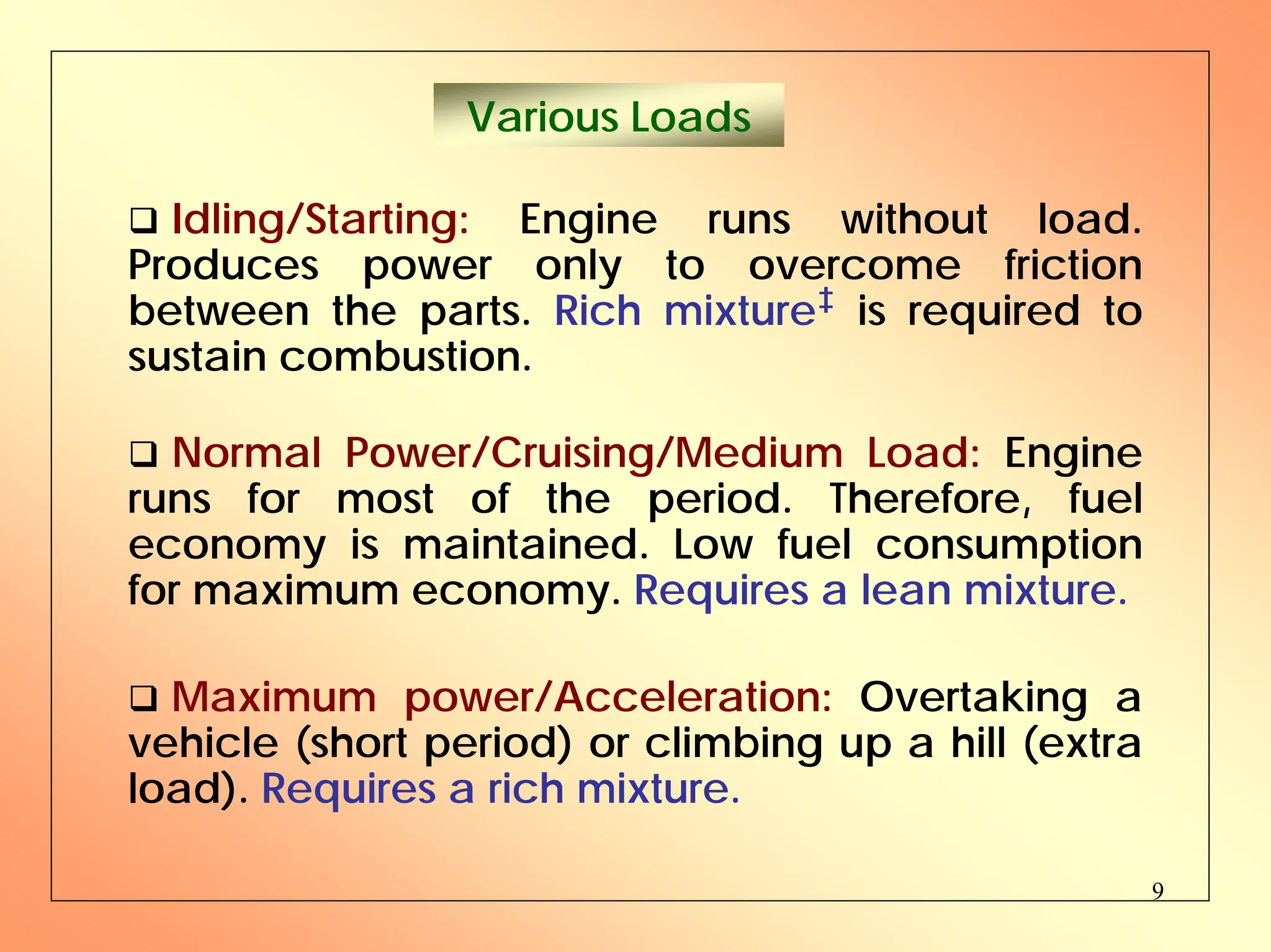
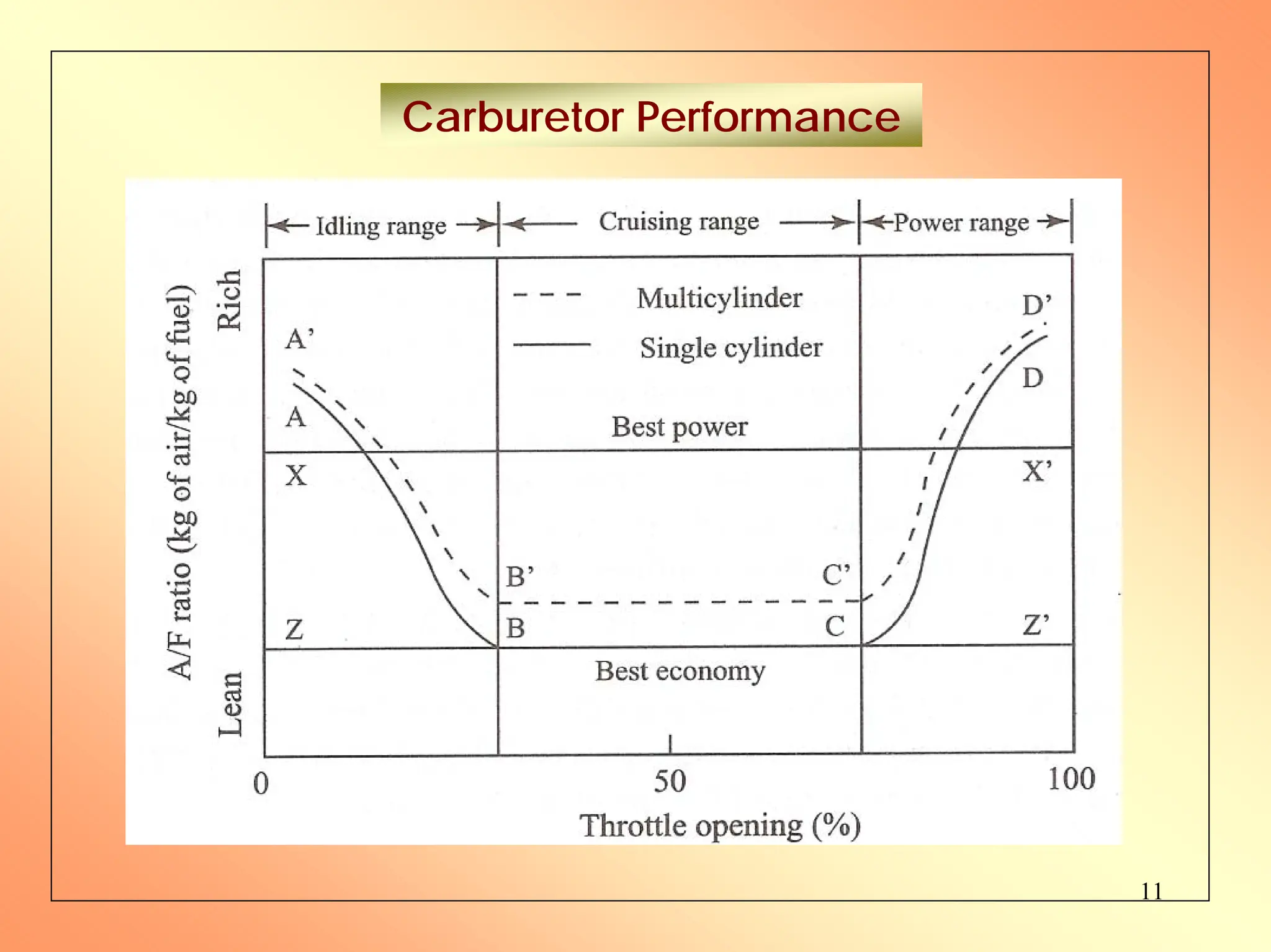
Various Loads
‰ Idling/Starting: Engine runs without load.
Produces power only to overcome friction
between the parts. Rich mixture‡ is required to
sustain combustion.
‰ Normal Power/Cruising/Medium Load: Engine
runs for most of the period. Therefore, fuel
economy is maintained. Low fuel consumption
for maximum economy. Requires a lean mixture.
‰ Maximum power/Acceleration: Overtaking a
vehicle (short period) or climbing up a hill (extra
load). Requires a rich mixture.
10
Starting a Cold Engine
‰ When an engine is cold, a very small % fuel
will vaporize in the intake and compression
process. The fuel is also cold, and much more
viscous, creating a lower flow rate. The engine
metal parts are cold and inhibit vaporization.
Further, during the compression stroke, cold
cylinder walls will absorb heat and reduce
vaporization. Engine lubrication is cold and
more viscous, making the engine turn more
slowly in the starting process.
11
Carburetor Performance
12
Simple Carburetor
Fuel
Float
Vent
Float
Chamber
Throttle
Fuel discharge
nozzle
Fuel metering
jet lip, h
Choke
Air
Inlet
Valve
Fuel
from
supply
13
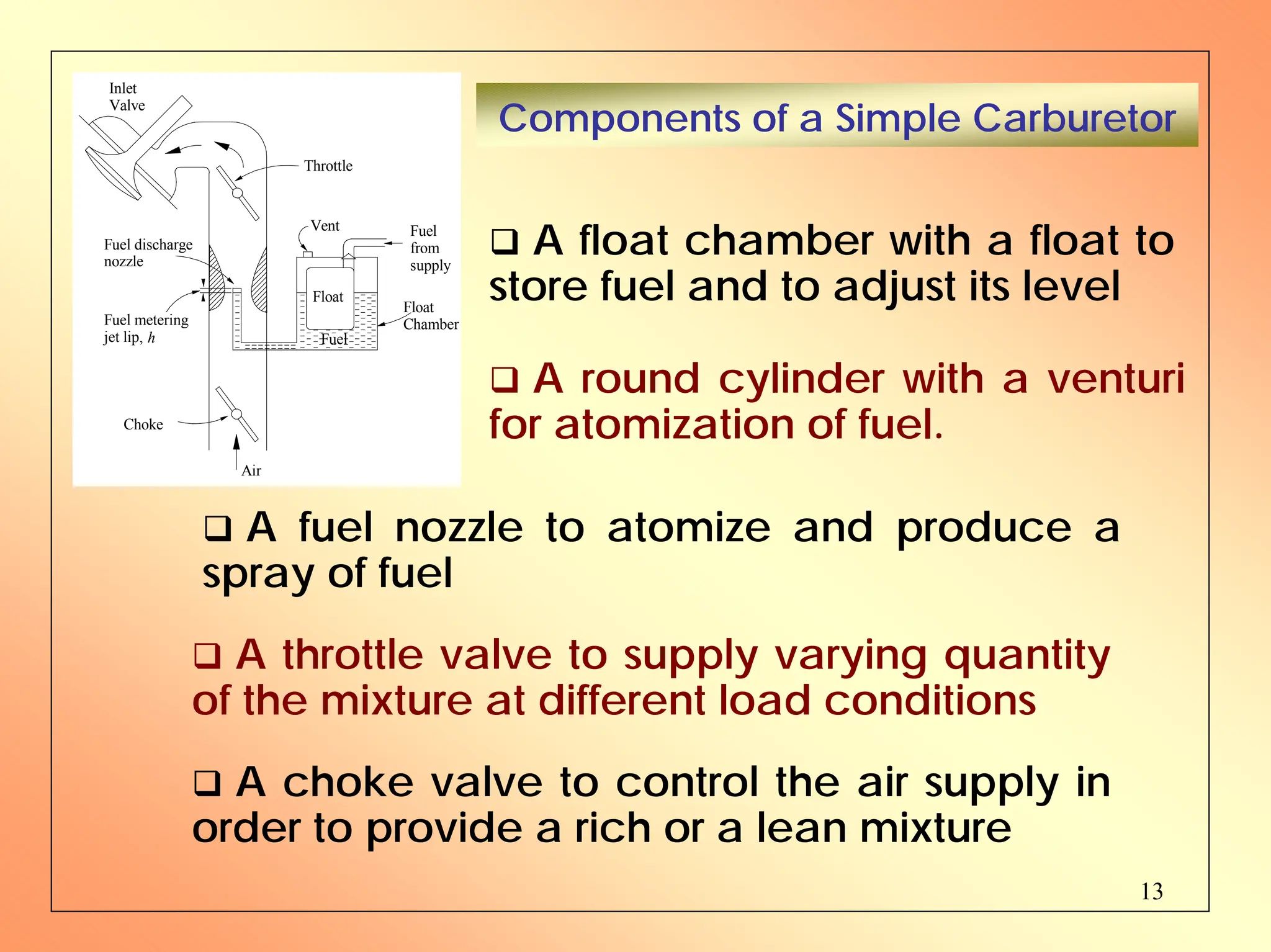
‰ A float chamber with a float to
store fuel and to adjust its level
‰ A choke valve to control the air supply in
order to provide a rich or a lean mixture
‰ A round cylinder with a venturi
for atomization of fuel.
‰ A fuel nozzle to atomize and produce a
spray of fuel
‰ A throttle valve to supply varying quantity
of the mixture at different load conditions
Components of a Simple Carburetor
Fuel
Float
Vent
Float
Chamber
Throttle
Fuel discharge
nozzle
Fuel metering
jet lip, h
Choke
Air
Inlet
Valve
Fuel
from
supply
14
Venturi-type Carburetor
P+1/2 ρV2 = Constant
Bernoulli Effect:
Valve Stem
Fuel Inlet
Float
Metering Orifice
Throttle Plate
Air/Fuel Mixture To Engine
Choke Plate
Fuel
Nozzle
Inlet Air
Bowl
Atomized Fuel
Venturi
15
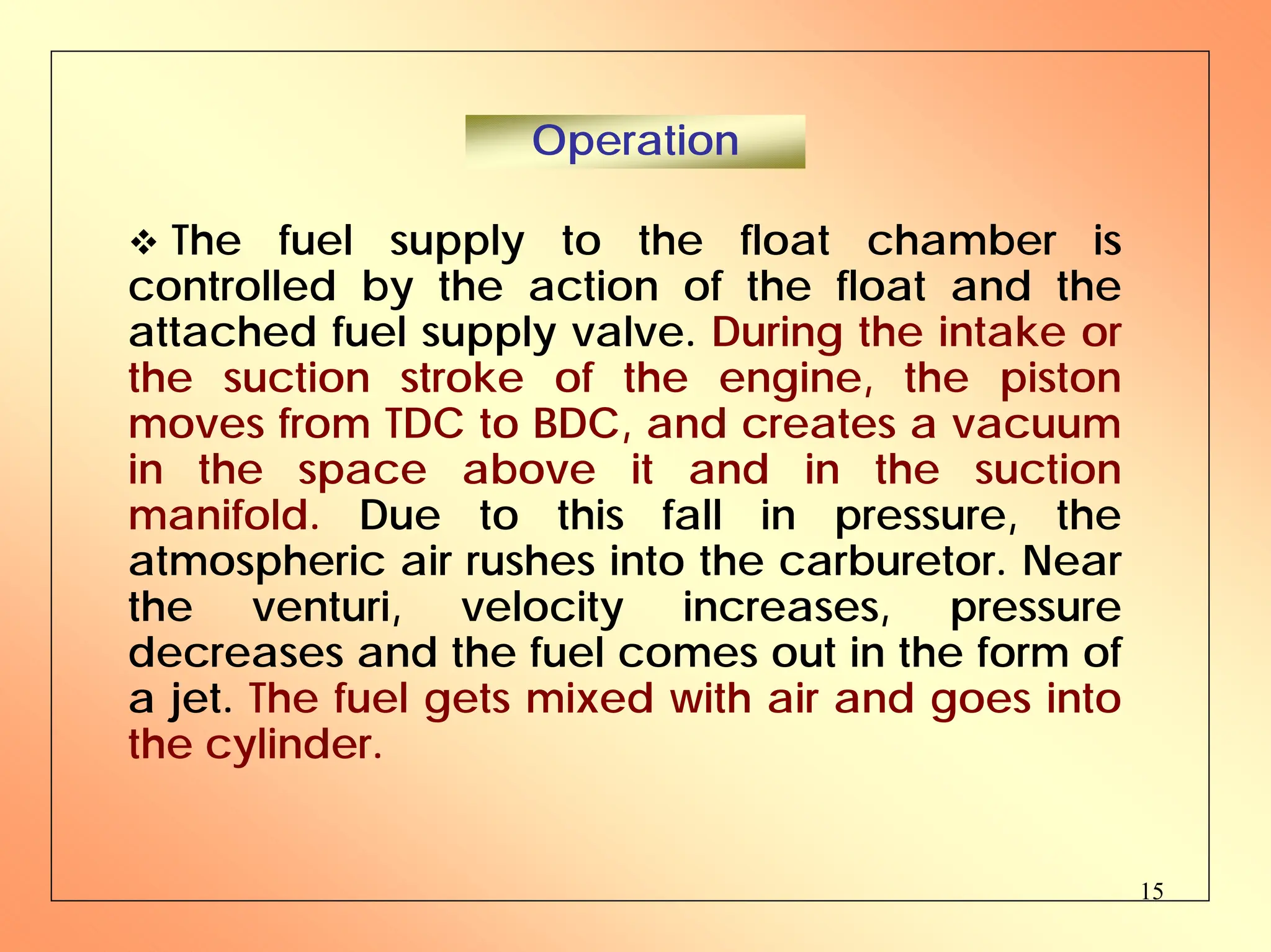
™ The fuel supply to the float chamber is
controlled by the action of the float and the
attached fuel supply valve. During the intake or
the suction stroke of the engine, the piston
moves from TDC to BDC, and creates a vacuum
in the space above it and in the suction
manifold. Due to this fall in pressure, the
atmospheric air rushes into the carburetor. Near
the venturi, velocity increases, pressure
decreases and the fuel comes out in the form of
a jet. The fuel gets mixed with air and goes into
the cylinder.
Operation
16
™ Because of the narrow passage at the venturi
throat, the air velocity increases but its pressure falls.
This causes a partial vacuum (called carburetor
depression) at the venturi throat. This carburetor
depression causes fuel to come out as jet in the
form of a spray. This fuel spray vaporizes and mixes
with the incoming air, and the mixture goes into the
cylinder through the throttle valve.
Operation
Fuel
Higher Pressure
Outside Engine
Venturi
Choke Throttle
17
™ A simple carburetor as described
suffers from the fact that it provides the
required air-fuel ratio only at one
throttle position.
™ At all other throttle positions, the
mixture is either leaner or richer
depending on whether the throttle is
opened less or more.
Drawback of Simple Carburetor
18
Drawback of Simple Carburetor
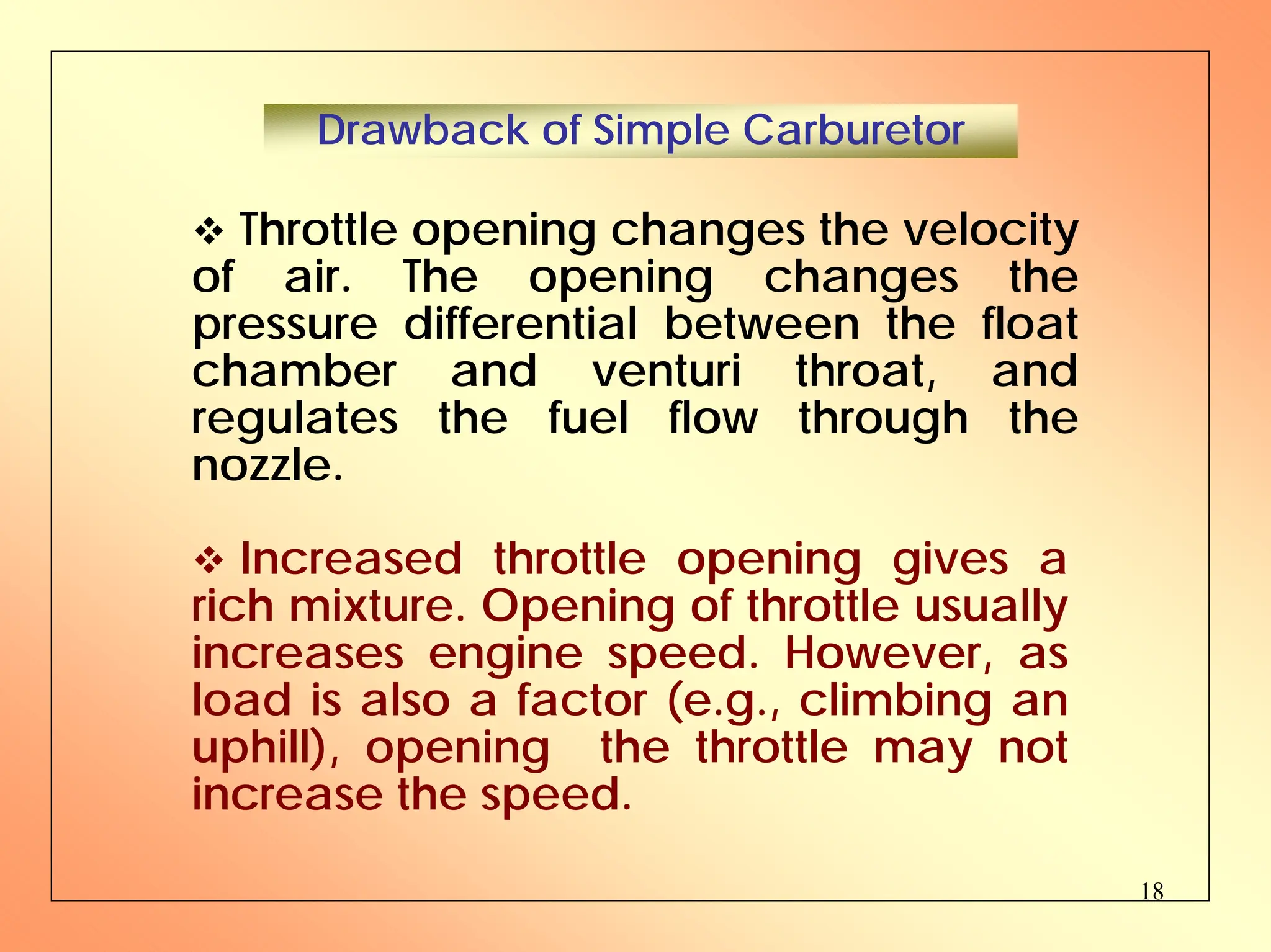
™ Throttle opening changes the velocity
of air. The opening changes the
pressure differential between the float
chamber and venturi throat, and
regulates the fuel flow through the
nozzle.
™ Increased throttle opening gives a
rich mixture. Opening of throttle usually
increases engine speed. However, as
load is also a factor (e.g., climbing an
uphill), opening the throttle may not
increase the speed.
19
Calculation of Air-Fuel Ratio
™ Let the tip of
the fuel nozzle
be at a height z
from fuel level
in the float
chamber.
i.e., we need to
calculate
m
A a
F m f
=
20
2 1 2 1
1 2 2
( )
2
q w h h c c
− = − + −
™ Applying SFEE between A-A (point 1) and B-B
(point 2) and considering unit mass of airflow
For adiabatic flow,
1
0, 0, 0
q w and c
= = ≈
We have,
2 1 2
2 1 2
2( )
2 ( )
c h h
c C T T
p
= −
= −
21
1 1 1 2 2 2
1 1 2 2
1 2
m A C A C
a
A C A C
ma v v
ρ ρ
= =
= =
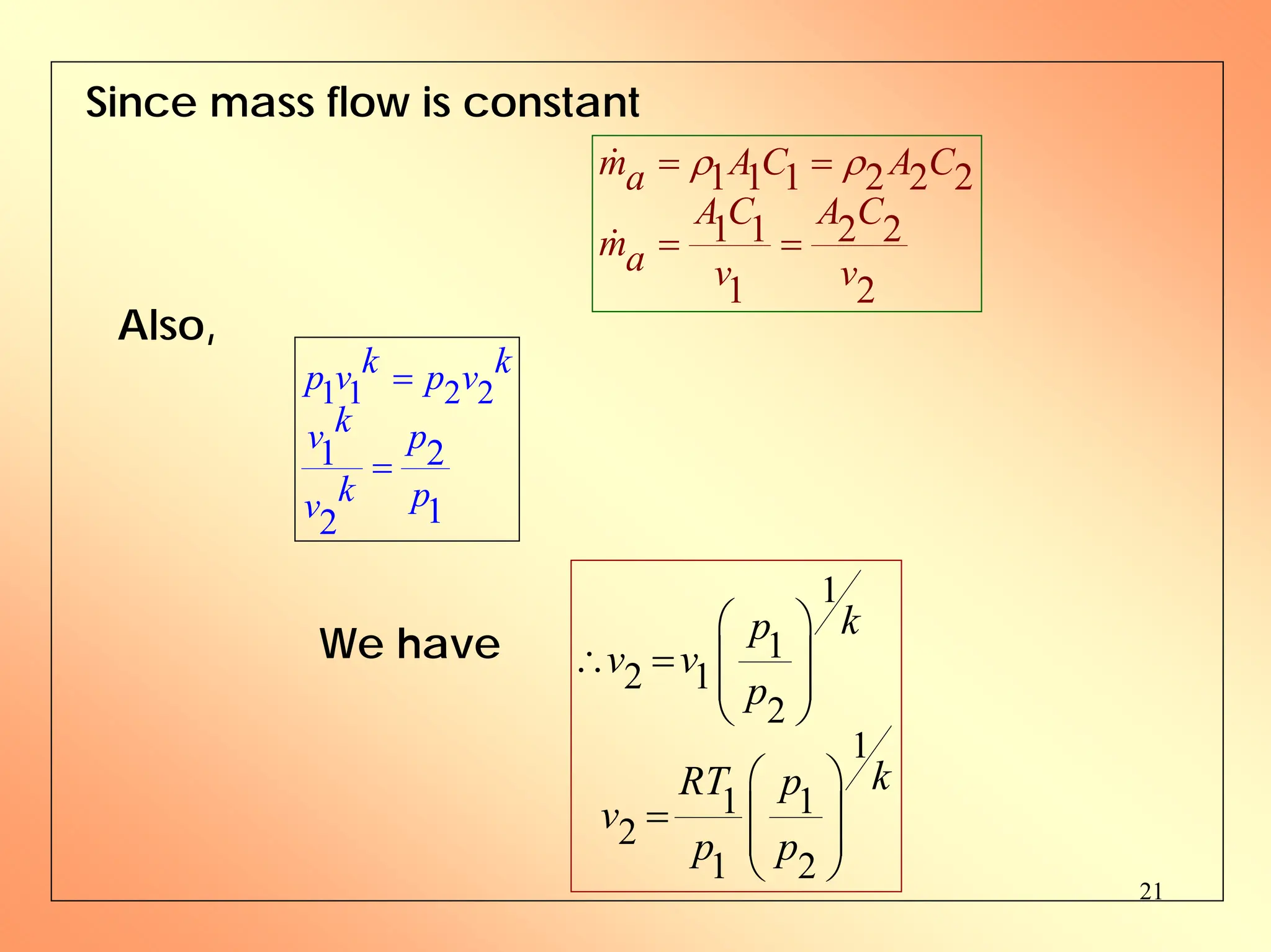
Since mass flow is constant
Also,
1 1 2 2
1 2
1
2
k k
p v p v
k
v p
k p
v
=
=
1
1
2 1
2
1
1 1
2
1 2
k
p
v v
p
k
RT p
v
p p
⎛ ⎞
∴ = ⎜ ⎟
⎜ ⎟
⎝ ⎠
⎛ ⎞
= ⎜ ⎟
⎜ ⎟
⎝ ⎠
We have
22
1
2
1
1
1
1 1
1 2
2 2
2
2 2 1
A C
ma v
k
k
A p
m C T
a p p
k
RT p
p p
gives
∴ =
−
⎡ ⎤
⎛ ⎞
⎢ ⎥
= −⎜ ⎟
⎢ ⎥
⎜ ⎟
⎝ ⎠
⎢ ⎥
⎛ ⎞
⎣ ⎦
⎜ ⎟
⎜ ⎟
⎝ ⎠
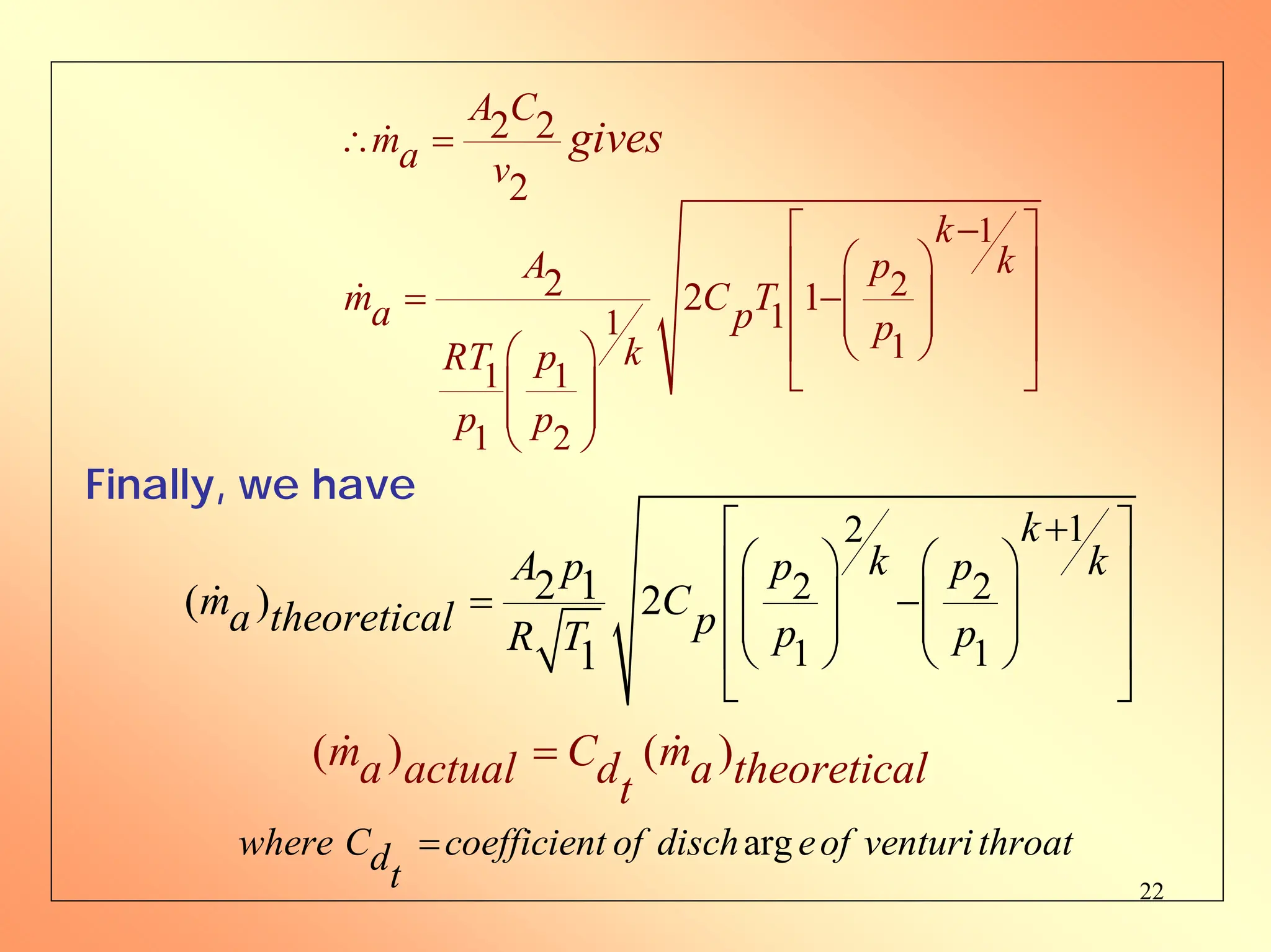
Finally, we have
1
2
2 2
1 1
2 1
( ) 2
1
k
k k
A p p p
m C
a theoretical p p p
R T
+
⎡ ⎤
⎛ ⎞ ⎛ ⎞
⎢ ⎥
= −
⎜ ⎟ ⎜ ⎟
⎢ ⎥
⎜ ⎟ ⎜ ⎟
⎝ ⎠ ⎝ ⎠
⎢ ⎥
⎣ ⎦
( ) ( )
m C m
a actual d a theoretical
t
=
arg
where C coefficient of disch eof venturithroat
dt
=
23
To find mass flow rate of fuel
1 2 2
2
2
p p C
z
g
γ γ
= + +
Assuming fuel to be incompressible, we have
from Bernoulli’s theorem
1 2
2
2
f
f f
C
p p
gz
ρ ρ
∴ − = +
1 2
2
f
f
p p
C gz
ρ
⎛ ⎞
−
∴ = −
⎜ ⎟
⎜ ⎟
⎝ ⎠
ρf being the density of fuel, Cf is the fuel velocity
at the nozzle exit and z is the nozzle lip.
24
Thus, we have velocity of fuel at the nozzle exit
arg
where C coefficient of disch eof fuel nozzle
d f
=
1 2
( )
( ) 2 ( )
f
f
f
f f
f f f
m A C
theoretical
m A p p gz
theoretical
ρ
ρ ρ
=
∴ = − −
∵
( ) ( )
f f
m C m
actual d theoretical
f
∴ =
1 2
2
f
f
p p
C gz
ρ
⎛ ⎞
−
∴ = −
⎜ ⎟
⎜ ⎟
⎝ ⎠
25
™ A simple carburetor is capable to supply a
correct air-fuel mixture to the engine only at a
particular load and speed. In order to meet the
engine demand at various operating conditions,
the following additional systems are added to the
simple carburetor.
‰ idling system
‰ auxiliary port system
‰ power enrichment by economizer system
‰ accelerating pump system
‰ choke
Complete Carburetor
26
™ During starting
or idling, engine
runs without load
and the throttle
valve remains in
closed position.
Engine produces
power only to
overcome friction
between the parts,
and a rich mixture
is to be fed to the
engine to sustain
combustion.
Idling system
Idling jet
Air bleed
Adjusting
screw
Float chamber
Main
jet
Air
Throttle
27
™ The idling system as
shown consists of an idling
fuel passage and an idling
port. When the throttle is
partially closed, a
depression past the throttle
allows the fuel to go into
the intake through the idle
tube. The depression also
draws air through the idle
air bleed and mixes with
fuel. The fuel flow depends
on the location of the idle
nozzle and the adjustment
of the idle screw.
Idling system – contd.
Idling jet
Air bleed
Adjusting
screw
Float chamber
Main
jet
Air
Throttle
28
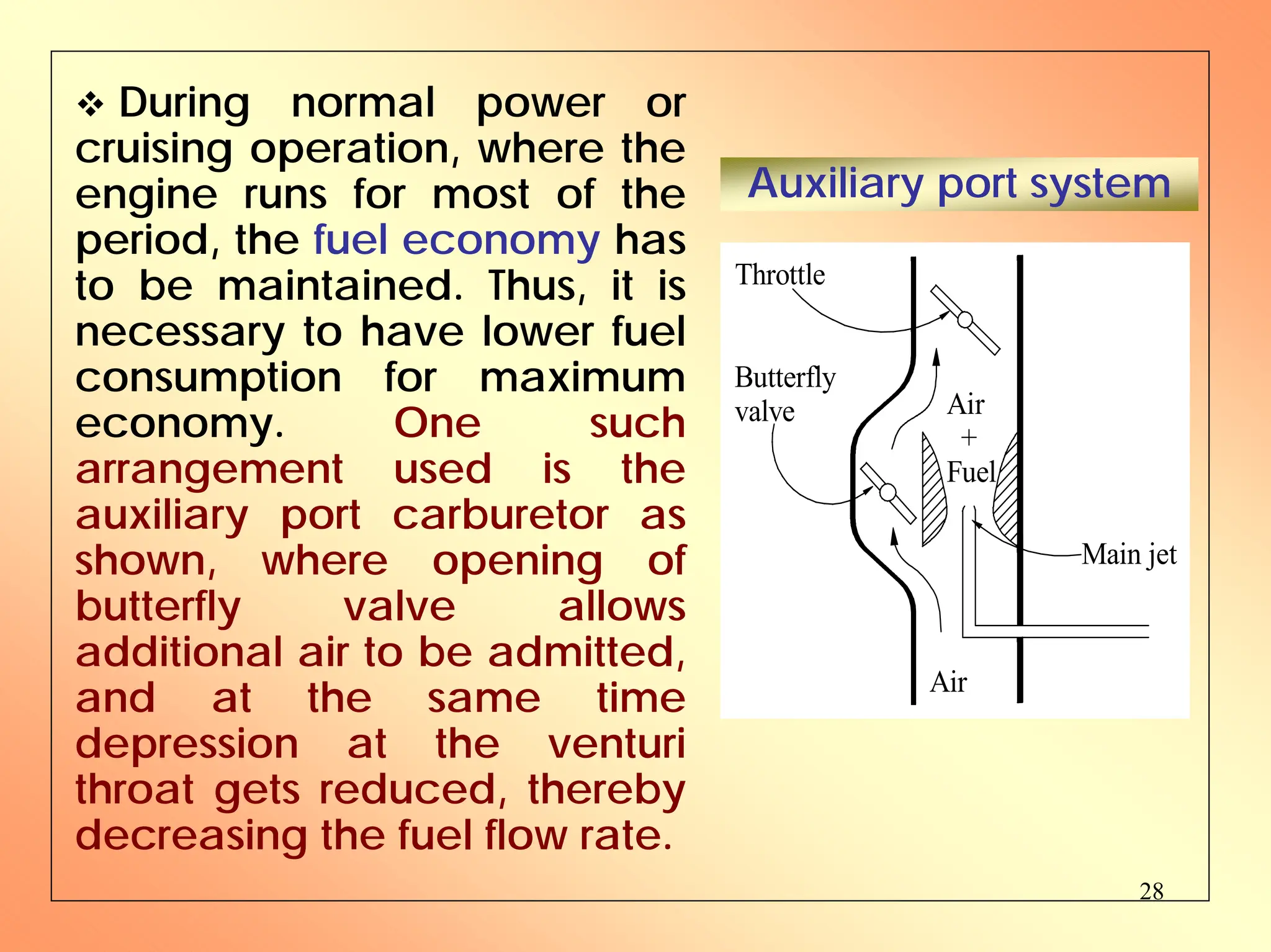
™ During normal power or
cruising operation, where the
engine runs for most of the
period, the fuel economy has
to be maintained. Thus, it is
necessary to have lower fuel
consumption for maximum
economy. One such
arrangement used is the
auxiliary port carburetor as
shown, where opening of
butterfly valve allows
additional air to be admitted,
and at the same time
depression at the venturi
throat gets reduced, thereby
decreasing the fuel flow rate.
Auxiliary port system
Butterfly
valve
Throttle
Main jet
Air
Air
+
Fuel
29
™ In order to obtain
maximum power, the
carburetor must supply
a rich mixture. This
additional fuel required
is supplied by a power
enrichment system that
contains a meter rod
economizer that
provides a larger orifice
opening to the main jet
as the throttle is opened
beyond a certain point.
Power enrichment system
30
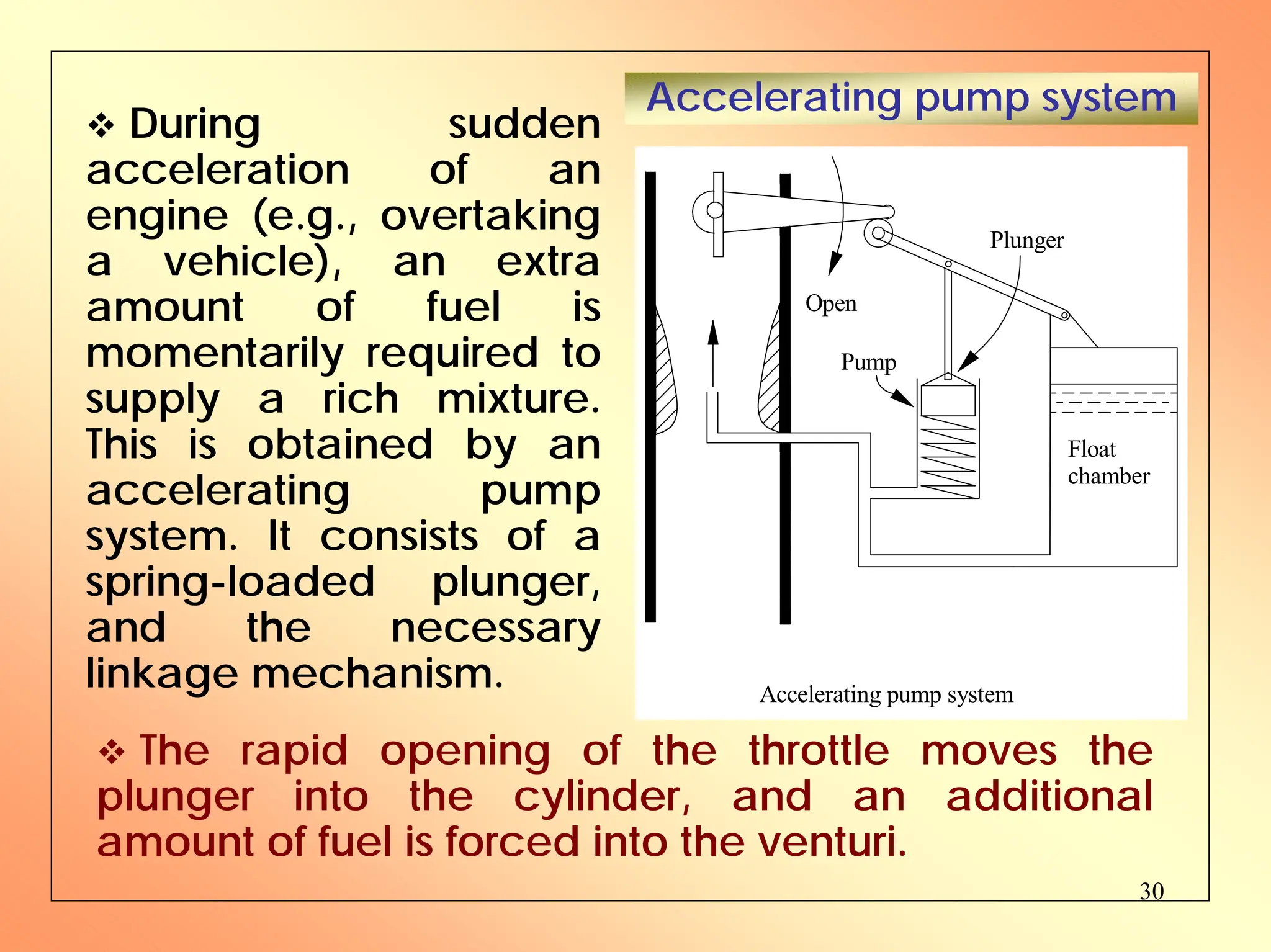
™ During sudden
acceleration of an
engine (e.g., overtaking
a vehicle), an extra
amount of fuel is
momentarily required to
supply a rich mixture.
This is obtained by an
accelerating pump
system. It consists of a
spring-loaded plunger,
and the necessary
linkage mechanism.
Accelerating pump system
Pump
Open
Plunger
Float
chamber
Accelerating pump system
™ The rapid opening of the throttle moves the
plunger into the cylinder, and an additional
amount of fuel is forced into the venturi.
31
™ During cold starting period, at low cranking
speed and before the engine gets warmed up,
a rich mixture has to be supplied, simply
because a large fraction of the fuel remains in
liquid state in the cylinder, and only the vapor
fraction forms the combustible mixture with air.
The most common method of obtaining this rich
mixture is to use a choke valve between the
entry to the carburetor and the venturi throat.
Remark
32
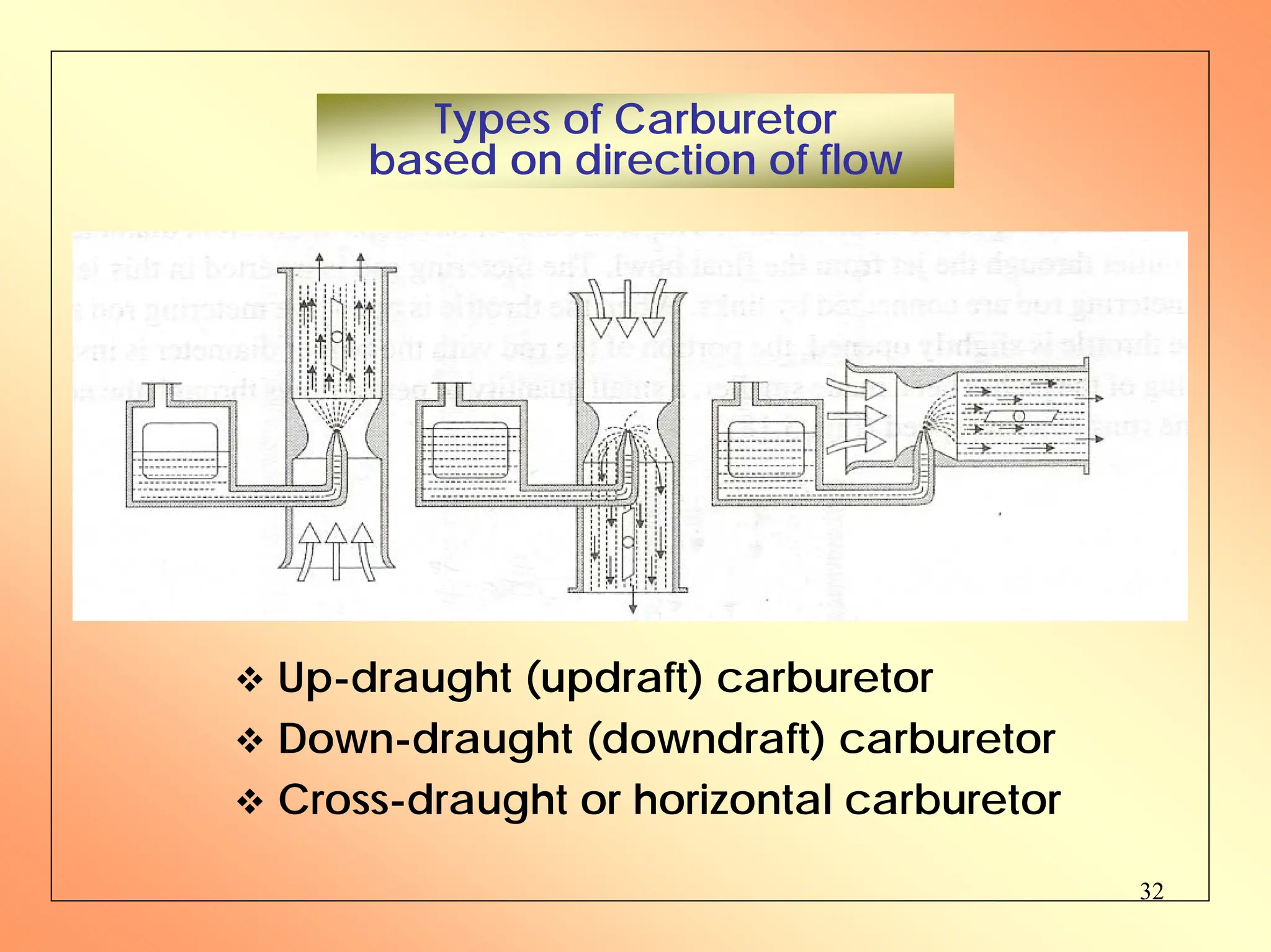
™ Up-draught (updraft) carburetor
™ Down-draught (downdraft) carburetor
™ Cross-draught or horizontal carburetor
Types of Carburetor
based on direction of flow
33
™ A single barrel carburetor has one outlet
connected to the intake manifold of engine.
Multi-barrel Carburetor
™ A multi-barrel barrel carburetor is one with two
outlets connected to two intake manifolds of
engine. Such unit is basically one with two
carburetors.
™ As such, a multi-barrel barrel carburetor has
two numbers of idling, power and accelerating
systems, two chokes, two throttles but with
alternate cylinders in the firing order. As for
example, in a six cylinder engine, one barrel
supplies mixture to cylinders 1, 3 and 2; while
the other barrel supplies to 5, 6 and 4.
34
™ Automobile carburetors are calibrated at
sea-level conditions
Aircraft Carburetors
‰ Lower altitudes (than sea-level): Lean mixture
‰ Higher altitudes (than sea-level): Rich mixture
(emits hydrocarbon, CO)
™ At higher altitudes, density decreases and
hence, the mass flow rate gets reduced.
35
Enrichment
(due to variation of air density)
If ρ/ρ0 = 0.84,
0
0
0
0
0
1
1
1
E
p RT
E
RT p
p T
E
pT
ρ
ρ
+ =
+ =
+ =
1
1 1.091
0.84
0.091 9.1%
E
E
+ = =
= =
™ Enrichment of mixture over the calibrated ratio
36
Altitude Compensation Device
‰ Admit more air and less fuel into the
induction manifold.
METHODS
‰ As density decreases, the mass flow rate also
decreases and hence the Power gets reduced.
‰ Reduction of pressure in float chamber
‰ Auxiliary air valve/air port
‰ Supercharger
37
Basic Carburetor
1. The carburetor is a
device which mixes air
and fuel in a
reciprocating internal
combustion engine.
Carburetors are still
found in small engines
and in older or
specialized automobiles
such as racing cars.
However, most cars
built since the early
1980s use fuel injection
instead of carburetion.
Summary
38
Summary
2. Most carbureted (as opposed to fuel
injected) engines have a single carburetor,
though some, primarily higher performance
engines, can have multiple carburetors. Most
automotive carburetors are either downdraft
(flow of air is downwards) or side-draft (flow of
air is sideways). In the United States, downdraft
carburetors were almost ubiquitous, partly
because a downdraft unit is ideal for V
engines. In Europe, side-draft carburetors are
much more common in performance
applications. Small propeller-driven flat
airplane engines have the carburetor below
the engine (updraft).
39
1.
1. Crouse WH,
Crouse WH, and
and Anglin DL
Anglin DL, (1985), Automotive Engines, Tata McGraw Hill.
2.
2. Eastop TD,
Eastop TD, and
and McConkey A,
McConkey A, (1993), Applied Thermodynamics for Engg.
Technologists, Addison Wisley.
3.
3. Fergusan CR,
Fergusan CR, and
and Kirkpatrick AT
Kirkpatrick AT,
, (2001), Internal Combustion Engines, John
Wiley & Sons.
4.
4. Ganesan V
Ganesan V,
, (2003), Internal Combustion Engines, Tata McGraw Hill.
5.
5. Gill PW, Smith JH,
Gill PW, Smith JH, and
and Ziurys EJ
Ziurys EJ,
, (1959), Fundamentals of I. C. Engines, Oxford
and IBH Pub Ltd.
6.
6. Heisler H,
Heisler H, (1999), Vehicle and Engine Technology, Arnold Publishers.
7.
7. Heywood JB,
Heywood JB, (1989), Internal Combustion Engine Fundamentals, McGraw Hill.
8.
8. Heywood JB,
Heywood JB, and
and Sher E,
Sher E, (1999), The Two-Stroke Cycle Engine, Taylor & Francis.
9.
9. Joel R,
Joel R, (1996),
(1996), Basic Engineering Thermodynamics, Addison-Wesley.
10.
10. Mathur ML, and Sharma RP,
Mathur ML, and Sharma RP, (1994), A Course in Internal Combustion Engines,
Dhanpat Rai & Sons, New Delhi.
11.
11. Pulkrabek WW,
Pulkrabek WW, (1997), Engineering Fundamentals of the I. C. Engine, Prentice Hall.
12.
12. Rogers GFC,
Rogers GFC, and
and Mayhew YR
Mayhew YR, (1992), Engineering Thermodynamics, Addison
Wisley.
13.
13. Srinivasan S,
Srinivasan S, (2001), Automotive Engines, Tata McGraw Hill.
14.
14. Stone R,
Stone R, (1992), Internal Combustion Engines, The Macmillan Press Limited, London.
15.
15. Taylor CF,
Taylor CF, (1985), The Internal-Combustion Engine in Theory and Practice, Vol.1 & 2,
The MIT Press, Cambridge, Massachusetts.
References
40
1. http://www.mne.psu.edu/simpson/courses
2. http://me.queensu.ca/courses
3. http://www.eng.fsu.edu
4. http://www.personal.utulsa.edu
5. http://www.glenroseffa.org/
6. http://www.howstuffworks.com
7. http://www.me.psu.edu
8. http://www.uic.edu/classes/me/ me429/lecture-air-cyc-web%5B1%5D.ppt
9. http://www.osti.gov/fcvt/HETE2004/Stable.pdf
10. http://www.rmi.org/sitepages/pid457.php
11. http://www.tpub.com/content/engine/14081/css
12. http://webpages.csus.edu
13. http://www.nebo.edu/misc/learning_resources/ ppt/6-12
14. http://netlogo.modelingcomplexity.org/Small_engines.ppt
15. http://www.ku.edu/~kunrotc/academics/180/Lesson%2008%20Diesel.ppt
16. http://navsci.berkeley.edu/NS10/PPT/
17. http://www.career-center.org/ secondary/powerpoint/sge-parts.ppt
18. http://mcdetflw.tecom.usmc.mil
19. http://ferl.becta.org.uk/display.cfm
20. http://www.eng.fsu.edu/ME_senior_design/2002/folder14/ccd/Combustion
21. http://www.me.udel.edu
22. http://online.physics.uiuc.edu/courses/phys140
23. http://widget.ecn.purdue.edu/~yanchen/ME200/ME200-8.ppt -
Web Resources

detail information about working and mechanism of carburetors

  • 1.
    1 Internal Combustion Engines Lecture-11 UjjwalK Saha, Ph.D. Department of Mechanical Engineering Indian Institute of Technology Guwahati Prepared under QIP-CD Cell Project
  • 2.
    2 Carburetion ‰ The processof mixture preparation in an SI engine is called carburetion. This air-fuel mixture is prepared outside the cylinder in a device called CARBURETOR. ‰ The carburetor atomizes the fuel and mixes with air in different proportions for various LOAD conditions. Loads Starting Idling Cruising Accelerating
  • 3.
  • 4.
    4 Functions ‰ It mustrun the engine smoothly by supplying a correct mixture strength. ‰ It must atomize, vaporize and mix the fuel homogeneously with air. ‰ It must supply correct amount of air- fuel mixture in correct proportion under all load conditions and speed of the engine.
  • 5.
    5 Factors affecting Carburetion ‰the quality of the fuel supplied ‰ the time available for mixture preparation ‰ the temperature of the incoming air ‰ the engine speed ‰ the design of the carburetor
  • 6.
    6 Remark ™ The temperatureaffects the vaporization of fuel. High temperature leads to high rate of vaporization. This is achieved by heating the induction manifold in some cases. However, this causes a reduction in the power output because of decrease in mass flow rate. ™ For high speed engines (3000 rpm), the time available for mixture preparation is very small (0.02 sec). ™ The design of carburetor, as such, is very complicated because the optimum air-fuel ratio varies over its operating range.
  • 7.
    7 Air-Fuel Mixtures Vary Load/ speed ‰ ChemicallyCorrect (15:1) ‰ Rich Mixture (10:1) ‰ Lean Mixture (17:1)
  • 8.
    8 Variation of poweroutput and sfc with A-F ratio in SI engine (Full throttle and constant speed) ‰ Maximum Output = 12:1 (Best power mixture) ‰ Minimum Fuel Consumption = 16:1 (Best economy mixture)
  • 9.
    9 Various Loads ‰ Idling/Starting:Engine runs without load. Produces power only to overcome friction between the parts. Rich mixture‡ is required to sustain combustion. ‰ Normal Power/Cruising/Medium Load: Engine runs for most of the period. Therefore, fuel economy is maintained. Low fuel consumption for maximum economy. Requires a lean mixture. ‰ Maximum power/Acceleration: Overtaking a vehicle (short period) or climbing up a hill (extra load). Requires a rich mixture.
  • 10.
    10 Starting a ColdEngine ‰ When an engine is cold, a very small % fuel will vaporize in the intake and compression process. The fuel is also cold, and much more viscous, creating a lower flow rate. The engine metal parts are cold and inhibit vaporization. Further, during the compression stroke, cold cylinder walls will absorb heat and reduce vaporization. Engine lubrication is cold and more viscous, making the engine turn more slowly in the starting process.
  • 11.
  • 12.
    12 Simple Carburetor Fuel Float Vent Float Chamber Throttle Fuel discharge nozzle Fuelmetering jet lip, h Choke Air Inlet Valve Fuel from supply
  • 13.
    13 ‰ A floatchamber with a float to store fuel and to adjust its level ‰ A choke valve to control the air supply in order to provide a rich or a lean mixture ‰ A round cylinder with a venturi for atomization of fuel. ‰ A fuel nozzle to atomize and produce a spray of fuel ‰ A throttle valve to supply varying quantity of the mixture at different load conditions Components of a Simple Carburetor Fuel Float Vent Float Chamber Throttle Fuel discharge nozzle Fuel metering jet lip, h Choke Air Inlet Valve Fuel from supply
  • 14.
    14 Venturi-type Carburetor P+1/2 ρV2= Constant Bernoulli Effect: Valve Stem Fuel Inlet Float Metering Orifice Throttle Plate Air/Fuel Mixture To Engine Choke Plate Fuel Nozzle Inlet Air Bowl Atomized Fuel Venturi
  • 15.
    15 ™ The fuelsupply to the float chamber is controlled by the action of the float and the attached fuel supply valve. During the intake or the suction stroke of the engine, the piston moves from TDC to BDC, and creates a vacuum in the space above it and in the suction manifold. Due to this fall in pressure, the atmospheric air rushes into the carburetor. Near the venturi, velocity increases, pressure decreases and the fuel comes out in the form of a jet. The fuel gets mixed with air and goes into the cylinder. Operation
  • 16.
    16 ™ Because ofthe narrow passage at the venturi throat, the air velocity increases but its pressure falls. This causes a partial vacuum (called carburetor depression) at the venturi throat. This carburetor depression causes fuel to come out as jet in the form of a spray. This fuel spray vaporizes and mixes with the incoming air, and the mixture goes into the cylinder through the throttle valve. Operation Fuel Higher Pressure Outside Engine Venturi Choke Throttle
  • 17.
    17 ™ A simplecarburetor as described suffers from the fact that it provides the required air-fuel ratio only at one throttle position. ™ At all other throttle positions, the mixture is either leaner or richer depending on whether the throttle is opened less or more. Drawback of Simple Carburetor
  • 18.
    18 Drawback of SimpleCarburetor ™ Throttle opening changes the velocity of air. The opening changes the pressure differential between the float chamber and venturi throat, and regulates the fuel flow through the nozzle. ™ Increased throttle opening gives a rich mixture. Opening of throttle usually increases engine speed. However, as load is also a factor (e.g., climbing an uphill), opening the throttle may not increase the speed.
  • 19.
    19 Calculation of Air-FuelRatio ™ Let the tip of the fuel nozzle be at a height z from fuel level in the float chamber. i.e., we need to calculate m A a F m f =
  • 20.
    20 2 1 21 1 2 2 ( ) 2 q w h h c c − = − + − ™ Applying SFEE between A-A (point 1) and B-B (point 2) and considering unit mass of airflow For adiabatic flow, 1 0, 0, 0 q w and c = = ≈ We have, 2 1 2 2 1 2 2( ) 2 ( ) c h h c C T T p = − = −
  • 21.
    21 1 1 12 2 2 1 1 2 2 1 2 m A C A C a A C A C ma v v ρ ρ = = = = Since mass flow is constant Also, 1 1 2 2 1 2 1 2 k k p v p v k v p k p v = = 1 1 2 1 2 1 1 1 2 1 2 k p v v p k RT p v p p ⎛ ⎞ ∴ = ⎜ ⎟ ⎜ ⎟ ⎝ ⎠ ⎛ ⎞ = ⎜ ⎟ ⎜ ⎟ ⎝ ⎠ We have
  • 22.
    22 1 2 1 1 1 1 1 1 2 22 2 2 2 1 A C ma v k k A p m C T a p p k RT p p p gives ∴ = − ⎡ ⎤ ⎛ ⎞ ⎢ ⎥ = −⎜ ⎟ ⎢ ⎥ ⎜ ⎟ ⎝ ⎠ ⎢ ⎥ ⎛ ⎞ ⎣ ⎦ ⎜ ⎟ ⎜ ⎟ ⎝ ⎠ Finally, we have 1 2 2 2 1 1 2 1 ( ) 2 1 k k k A p p p m C a theoretical p p p R T + ⎡ ⎤ ⎛ ⎞ ⎛ ⎞ ⎢ ⎥ = − ⎜ ⎟ ⎜ ⎟ ⎢ ⎥ ⎜ ⎟ ⎜ ⎟ ⎝ ⎠ ⎝ ⎠ ⎢ ⎥ ⎣ ⎦ ( ) ( ) m C m a actual d a theoretical t = arg where C coefficient of disch eof venturithroat dt =
  • 23.
    23 To find massflow rate of fuel 1 2 2 2 2 p p C z g γ γ = + + Assuming fuel to be incompressible, we have from Bernoulli’s theorem 1 2 2 2 f f f C p p gz ρ ρ ∴ − = + 1 2 2 f f p p C gz ρ ⎛ ⎞ − ∴ = − ⎜ ⎟ ⎜ ⎟ ⎝ ⎠ ρf being the density of fuel, Cf is the fuel velocity at the nozzle exit and z is the nozzle lip.
  • 24.
    24 Thus, we havevelocity of fuel at the nozzle exit arg where C coefficient of disch eof fuel nozzle d f = 1 2 ( ) ( ) 2 ( ) f f f f f f f f m A C theoretical m A p p gz theoretical ρ ρ ρ = ∴ = − − ∵ ( ) ( ) f f m C m actual d theoretical f ∴ = 1 2 2 f f p p C gz ρ ⎛ ⎞ − ∴ = − ⎜ ⎟ ⎜ ⎟ ⎝ ⎠
  • 25.
    25 ™ A simplecarburetor is capable to supply a correct air-fuel mixture to the engine only at a particular load and speed. In order to meet the engine demand at various operating conditions, the following additional systems are added to the simple carburetor. ‰ idling system ‰ auxiliary port system ‰ power enrichment by economizer system ‰ accelerating pump system ‰ choke Complete Carburetor
  • 26.
    26 ™ During starting oridling, engine runs without load and the throttle valve remains in closed position. Engine produces power only to overcome friction between the parts, and a rich mixture is to be fed to the engine to sustain combustion. Idling system Idling jet Air bleed Adjusting screw Float chamber Main jet Air Throttle
  • 27.
    27 ™ The idlingsystem as shown consists of an idling fuel passage and an idling port. When the throttle is partially closed, a depression past the throttle allows the fuel to go into the intake through the idle tube. The depression also draws air through the idle air bleed and mixes with fuel. The fuel flow depends on the location of the idle nozzle and the adjustment of the idle screw. Idling system – contd. Idling jet Air bleed Adjusting screw Float chamber Main jet Air Throttle
  • 28.
    28 ™ During normalpower or cruising operation, where the engine runs for most of the period, the fuel economy has to be maintained. Thus, it is necessary to have lower fuel consumption for maximum economy. One such arrangement used is the auxiliary port carburetor as shown, where opening of butterfly valve allows additional air to be admitted, and at the same time depression at the venturi throat gets reduced, thereby decreasing the fuel flow rate. Auxiliary port system Butterfly valve Throttle Main jet Air Air + Fuel
  • 29.
    29 ™ In orderto obtain maximum power, the carburetor must supply a rich mixture. This additional fuel required is supplied by a power enrichment system that contains a meter rod economizer that provides a larger orifice opening to the main jet as the throttle is opened beyond a certain point. Power enrichment system
  • 30.
    30 ™ During sudden accelerationof an engine (e.g., overtaking a vehicle), an extra amount of fuel is momentarily required to supply a rich mixture. This is obtained by an accelerating pump system. It consists of a spring-loaded plunger, and the necessary linkage mechanism. Accelerating pump system Pump Open Plunger Float chamber Accelerating pump system ™ The rapid opening of the throttle moves the plunger into the cylinder, and an additional amount of fuel is forced into the venturi.
  • 31.
    31 ™ During coldstarting period, at low cranking speed and before the engine gets warmed up, a rich mixture has to be supplied, simply because a large fraction of the fuel remains in liquid state in the cylinder, and only the vapor fraction forms the combustible mixture with air. The most common method of obtaining this rich mixture is to use a choke valve between the entry to the carburetor and the venturi throat. Remark
  • 32.
    32 ™ Up-draught (updraft)carburetor ™ Down-draught (downdraft) carburetor ™ Cross-draught or horizontal carburetor Types of Carburetor based on direction of flow
  • 33.
    33 ™ A singlebarrel carburetor has one outlet connected to the intake manifold of engine. Multi-barrel Carburetor ™ A multi-barrel barrel carburetor is one with two outlets connected to two intake manifolds of engine. Such unit is basically one with two carburetors. ™ As such, a multi-barrel barrel carburetor has two numbers of idling, power and accelerating systems, two chokes, two throttles but with alternate cylinders in the firing order. As for example, in a six cylinder engine, one barrel supplies mixture to cylinders 1, 3 and 2; while the other barrel supplies to 5, 6 and 4.
  • 34.
    34 ™ Automobile carburetorsare calibrated at sea-level conditions Aircraft Carburetors ‰ Lower altitudes (than sea-level): Lean mixture ‰ Higher altitudes (than sea-level): Rich mixture (emits hydrocarbon, CO) ™ At higher altitudes, density decreases and hence, the mass flow rate gets reduced.
  • 35.
    35 Enrichment (due to variationof air density) If ρ/ρ0 = 0.84, 0 0 0 0 0 1 1 1 E p RT E RT p p T E pT ρ ρ + = + = + = 1 1 1.091 0.84 0.091 9.1% E E + = = = = ™ Enrichment of mixture over the calibrated ratio
  • 36.
    36 Altitude Compensation Device ‰Admit more air and less fuel into the induction manifold. METHODS ‰ As density decreases, the mass flow rate also decreases and hence the Power gets reduced. ‰ Reduction of pressure in float chamber ‰ Auxiliary air valve/air port ‰ Supercharger
  • 37.
    37 Basic Carburetor 1. Thecarburetor is a device which mixes air and fuel in a reciprocating internal combustion engine. Carburetors are still found in small engines and in older or specialized automobiles such as racing cars. However, most cars built since the early 1980s use fuel injection instead of carburetion. Summary
  • 38.
    38 Summary 2. Most carbureted(as opposed to fuel injected) engines have a single carburetor, though some, primarily higher performance engines, can have multiple carburetors. Most automotive carburetors are either downdraft (flow of air is downwards) or side-draft (flow of air is sideways). In the United States, downdraft carburetors were almost ubiquitous, partly because a downdraft unit is ideal for V engines. In Europe, side-draft carburetors are much more common in performance applications. Small propeller-driven flat airplane engines have the carburetor below the engine (updraft).
  • 39.
    39 1. 1. Crouse WH, CrouseWH, and and Anglin DL Anglin DL, (1985), Automotive Engines, Tata McGraw Hill. 2. 2. Eastop TD, Eastop TD, and and McConkey A, McConkey A, (1993), Applied Thermodynamics for Engg. Technologists, Addison Wisley. 3. 3. Fergusan CR, Fergusan CR, and and Kirkpatrick AT Kirkpatrick AT, , (2001), Internal Combustion Engines, John Wiley & Sons. 4. 4. Ganesan V Ganesan V, , (2003), Internal Combustion Engines, Tata McGraw Hill. 5. 5. Gill PW, Smith JH, Gill PW, Smith JH, and and Ziurys EJ Ziurys EJ, , (1959), Fundamentals of I. C. Engines, Oxford and IBH Pub Ltd. 6. 6. Heisler H, Heisler H, (1999), Vehicle and Engine Technology, Arnold Publishers. 7. 7. Heywood JB, Heywood JB, (1989), Internal Combustion Engine Fundamentals, McGraw Hill. 8. 8. Heywood JB, Heywood JB, and and Sher E, Sher E, (1999), The Two-Stroke Cycle Engine, Taylor & Francis. 9. 9. Joel R, Joel R, (1996), (1996), Basic Engineering Thermodynamics, Addison-Wesley. 10. 10. Mathur ML, and Sharma RP, Mathur ML, and Sharma RP, (1994), A Course in Internal Combustion Engines, Dhanpat Rai & Sons, New Delhi. 11. 11. Pulkrabek WW, Pulkrabek WW, (1997), Engineering Fundamentals of the I. C. Engine, Prentice Hall. 12. 12. Rogers GFC, Rogers GFC, and and Mayhew YR Mayhew YR, (1992), Engineering Thermodynamics, Addison Wisley. 13. 13. Srinivasan S, Srinivasan S, (2001), Automotive Engines, Tata McGraw Hill. 14. 14. Stone R, Stone R, (1992), Internal Combustion Engines, The Macmillan Press Limited, London. 15. 15. Taylor CF, Taylor CF, (1985), The Internal-Combustion Engine in Theory and Practice, Vol.1 & 2, The MIT Press, Cambridge, Massachusetts. References
  • 40.
    40 1. http://www.mne.psu.edu/simpson/courses 2. http://me.queensu.ca/courses 3.http://www.eng.fsu.edu 4. http://www.personal.utulsa.edu 5. http://www.glenroseffa.org/ 6. http://www.howstuffworks.com 7. http://www.me.psu.edu 8. http://www.uic.edu/classes/me/ me429/lecture-air-cyc-web%5B1%5D.ppt 9. http://www.osti.gov/fcvt/HETE2004/Stable.pdf 10. http://www.rmi.org/sitepages/pid457.php 11. http://www.tpub.com/content/engine/14081/css 12. http://webpages.csus.edu 13. http://www.nebo.edu/misc/learning_resources/ ppt/6-12 14. http://netlogo.modelingcomplexity.org/Small_engines.ppt 15. http://www.ku.edu/~kunrotc/academics/180/Lesson%2008%20Diesel.ppt 16. http://navsci.berkeley.edu/NS10/PPT/ 17. http://www.career-center.org/ secondary/powerpoint/sge-parts.ppt 18. http://mcdetflw.tecom.usmc.mil 19. http://ferl.becta.org.uk/display.cfm 20. http://www.eng.fsu.edu/ME_senior_design/2002/folder14/ccd/Combustion 21. http://www.me.udel.edu 22. http://online.physics.uiuc.edu/courses/phys140 23. http://widget.ecn.purdue.edu/~yanchen/ME200/ME200-8.ppt - Web Resources