SUBMITTED TO SUBMITTED BY
MR.BHUPENDRA GAHLOT SIR HARIOHM
DEPT. MECH. ENG. PRASAD
K11057 6th sem mech.
 INTRODUCTION
 MATERIALS AND METHOD
 PROCEDURE AND DATA COLLECTION
 FACTER ANYLISIS
 COMPERISSION
 CONCLUSION
 Total Quality Management (TQM) is one of the
most prominent developments in management
for the past two decades. TQM started in Japan
in the early 1980s and spread to the Western
countries and Australia. In the 1990s, TQM
topics became very important, and many
companies were looking to apply TQM and use
it to develop and improve their businesses.
Total Quality Management is defined as “a
management philosophy concerned with
people and work processes that focuses on
customer satisfaction and improves
organizational performance”. These days,
health organizations face many challenges that
can be classified into four major areas:
increases in the cost of health services, rapidly
growing technology dependence, pressure on
health organizations to decrease costs and
improve.
 Research design A comparative cross-
sectional study was used to collect data from
respondents.
 Setting Data were collected from four
hospitals, which were purposely chosen to
represent the four health sectors.
 A convenient sampling technique was used to
collect data from nurses in the four hospitals.
Potential respondents consisted of nurses on
the morning shift on that day.
 Self-administered questionnaires developed by
the researcher were used to collect data for the
nurses’ sociodemographic information
(gender, age, education level, experience, work
department and number of patients served
daily) and items that measured the extent of
implementing various principles of TQM.
 The aim of the study and details of answering
the questionnaire were explained to the nurses,
and a verbal agreement was obtained from each
respondent.
 Each questionnaire had a cover letter that
contained a brief summary of the purpose of
the study and confidential considerations. The
questionnaires were given to each participant
with full instructions on how to answer it.
 Factor Analysis was applied to identify the
principles of Total Quality Management (TQM)
applied in the hospitals. Five principles
resulted from using Principal Component by
Rotation Method: continuous improvement,
teamwork, training, top management
commitment and customer focus.
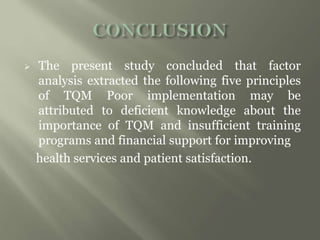
 The present study concluded that factor
analysis extracted the following five principles
of TQM Poor implementation may be
attributed to deficient knowledge about the
importance of TQM and insufficient training
programs and financial support for improving
health services and patient satisfaction.
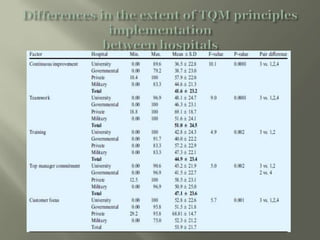
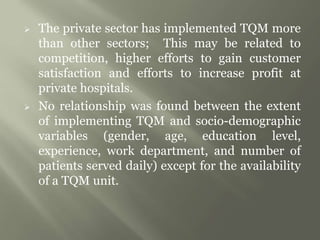
 The private sector has implemented TQM more
than other sectors; This may be related to
competition, higher efforts to gain customer
satisfaction and efforts to increase profit at
private hospitals.
 No relationship was found between the extent
of implementing TQM and socio-demographic
variables (gender, age, education level,
experience, work department, and number of
patients served daily) except for the availability
of a TQM unit.

Hariomopc

  • 1.
    SUBMITTED TO SUBMITTEDBY MR.BHUPENDRA GAHLOT SIR HARIOHM DEPT. MECH. ENG. PRASAD K11057 6th sem mech.
  • 2.
     INTRODUCTION  MATERIALSAND METHOD  PROCEDURE AND DATA COLLECTION  FACTER ANYLISIS  COMPERISSION  CONCLUSION
  • 3.
     Total QualityManagement (TQM) is one of the most prominent developments in management for the past two decades. TQM started in Japan in the early 1980s and spread to the Western countries and Australia. In the 1990s, TQM topics became very important, and many companies were looking to apply TQM and use it to develop and improve their businesses.
  • 4.
    Total Quality Managementis defined as “a management philosophy concerned with people and work processes that focuses on customer satisfaction and improves organizational performance”. These days, health organizations face many challenges that can be classified into four major areas: increases in the cost of health services, rapidly growing technology dependence, pressure on health organizations to decrease costs and improve.
  • 5.
     Research designA comparative cross- sectional study was used to collect data from respondents.  Setting Data were collected from four hospitals, which were purposely chosen to represent the four health sectors.  A convenient sampling technique was used to collect data from nurses in the four hospitals. Potential respondents consisted of nurses on the morning shift on that day.
  • 6.
     Self-administered questionnairesdeveloped by the researcher were used to collect data for the nurses’ sociodemographic information (gender, age, education level, experience, work department and number of patients served daily) and items that measured the extent of implementing various principles of TQM.
  • 7.
     The aimof the study and details of answering the questionnaire were explained to the nurses, and a verbal agreement was obtained from each respondent.  Each questionnaire had a cover letter that contained a brief summary of the purpose of the study and confidential considerations. The questionnaires were given to each participant with full instructions on how to answer it.
  • 8.
     Factor Analysiswas applied to identify the principles of Total Quality Management (TQM) applied in the hospitals. Five principles resulted from using Principal Component by Rotation Method: continuous improvement, teamwork, training, top management commitment and customer focus.
  • 10.
     The presentstudy concluded that factor analysis extracted the following five principles of TQM Poor implementation may be attributed to deficient knowledge about the importance of TQM and insufficient training programs and financial support for improving health services and patient satisfaction.
  • 11.
     The privatesector has implemented TQM more than other sectors; This may be related to competition, higher efforts to gain customer satisfaction and efforts to increase profit at private hospitals.  No relationship was found between the extent of implementing TQM and socio-demographic variables (gender, age, education level, experience, work department, and number of patients served daily) except for the availability of a TQM unit.