11 de outubro de 2016 | 1
SistemasAutomóveis
Fuel systems – SI engines
Mário Alves (mjf@isep.ipp.pt)
11 de outubro de 2016 | 2
SistemasAutomóveis
Outline
• Objective of fuel systems
• Classification of fuel systems
• Evolution – technology, regulations
• Carburetor-based fuel systems
• Electronic Fuel Injection (EFI) systems
• Engine control – fundamentals
• Air/fuel mixture and combustion control subsystems
• Injection, idle speed and throttle position, fuel pump/pressure, ignition,
supercharging
• Exhaust subsystem
• exhaust, EGR, oxygen sensors heating
• Other subsystems controlled by the engine ECU
• Radiator fan, Variable valves timing control, A/C compressor control,
OBD/Check engine lamp
• Sensors
• Actuators
11 de outubro de 2016 | 3
SistemasAutomóveis
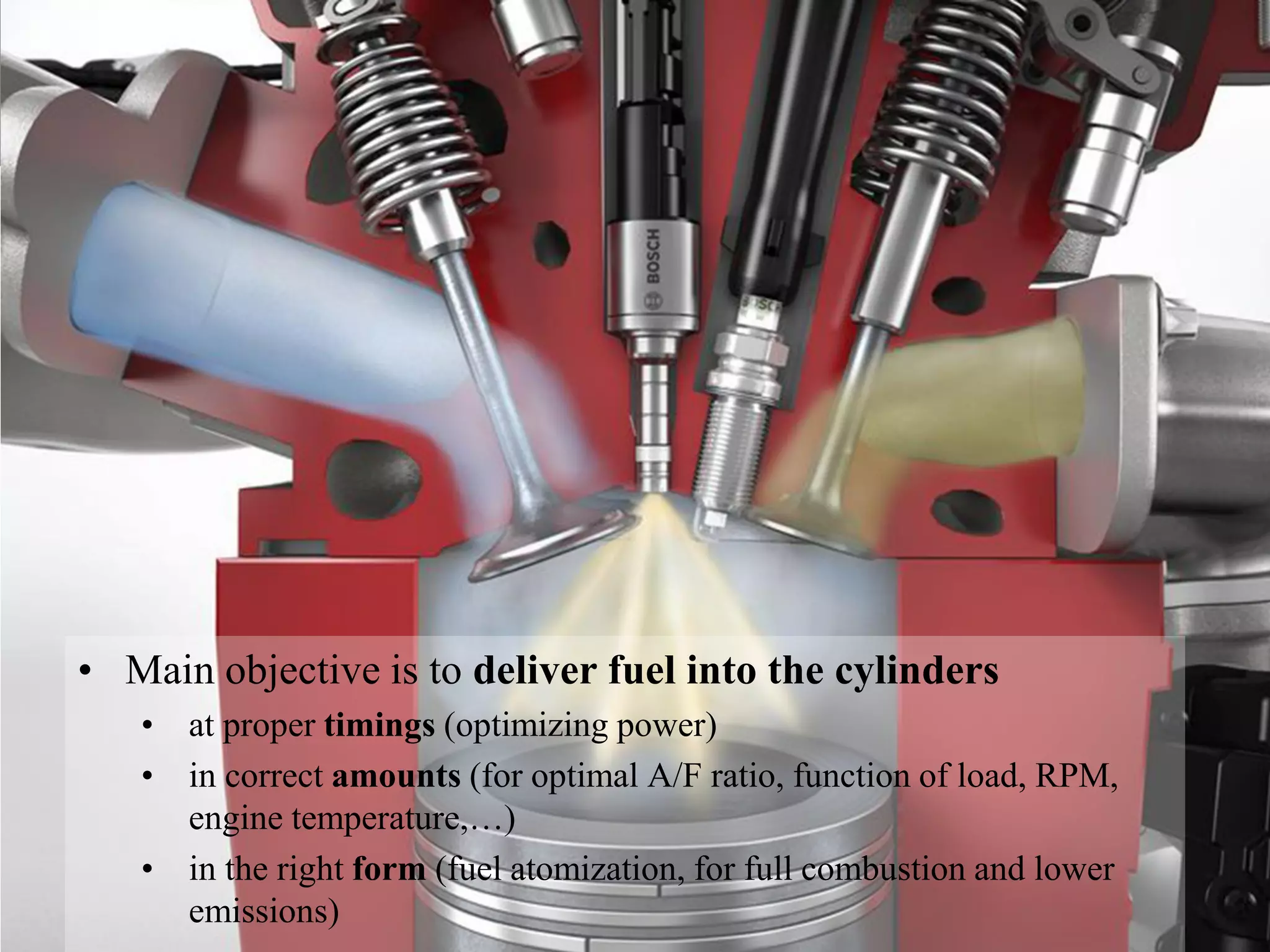
• Main objective is to deliver fuel into the cylinders
• at proper timings (optimizing power)
• in correct amounts (for optimal A/F ratio, function of load, RPM,
engine temperature,…)
• in the right form (fuel atomization, for full combustion and lower
emissions)
11 de outubro de 2016 | 4
SistemasAutomóveis
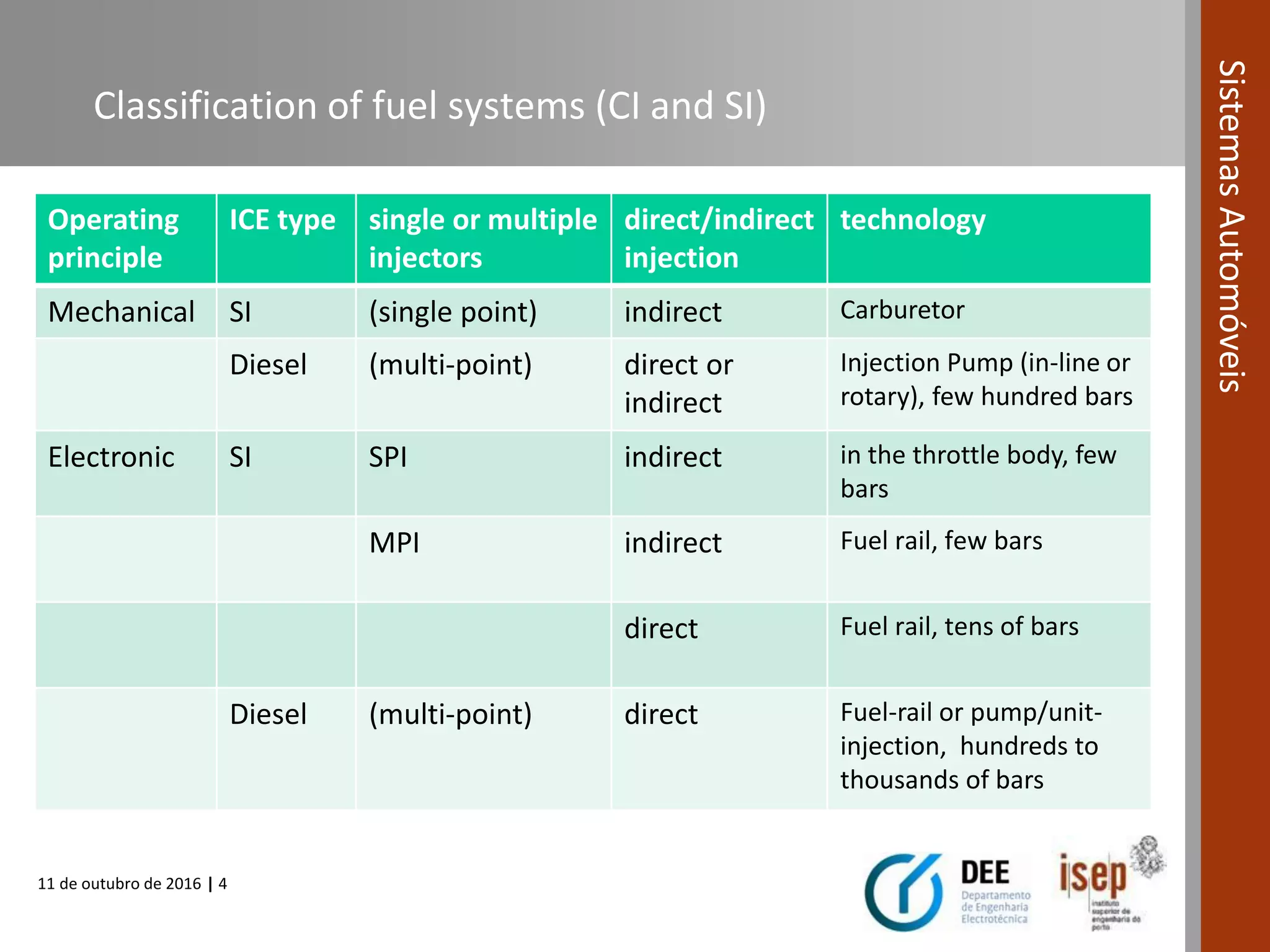
Classification of fuel systems (CI and SI)
Operating
principle
ICE type single or multiple
injectors
direct/indirect
injection
technology
Mechanical SI (single point) indirect Carburetor
Diesel (multi-point) direct or
indirect
Injection Pump (in-line or
rotary), few hundred bars
Electronic SI SPI indirect in the throttle body, few
bars
MPI indirect Fuel rail, few bars
direct Fuel rail, tens of bars
Diesel (multi-point) direct Fuel-rail or pump/unit-
injection, hundreds to
thousands of bars
11 de outubro de 2016 | 5
SistemasAutomóveis
Classification of fuel systems
• Fuel system types
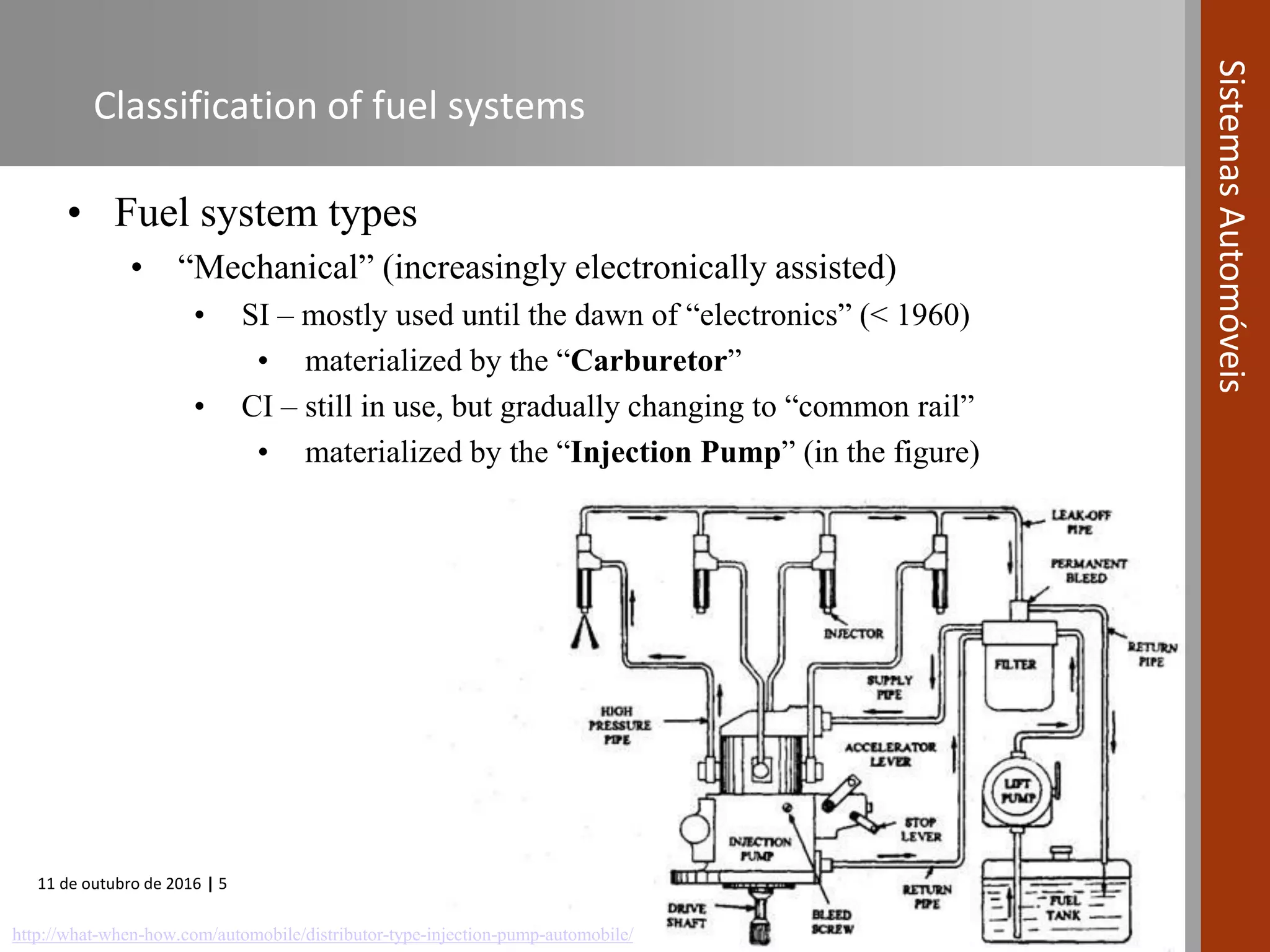
• “Mechanical” (increasingly electronically assisted)
• SI – mostly used until the dawn of “electronics” (< 1960)
• materialized by the “Carburetor”
• CI – still in use, but gradually changing to “common rail”
• materialized by the “Injection Pump” (in the figure)
http://what-when-how.com/automobile/distributor-type-injection-pump-automobile/
11 de outubro de 2016 | 6
SistemasAutomóveis
Classification of fuel systems
• Fuel system types
• “Electronic” (ECU-based)
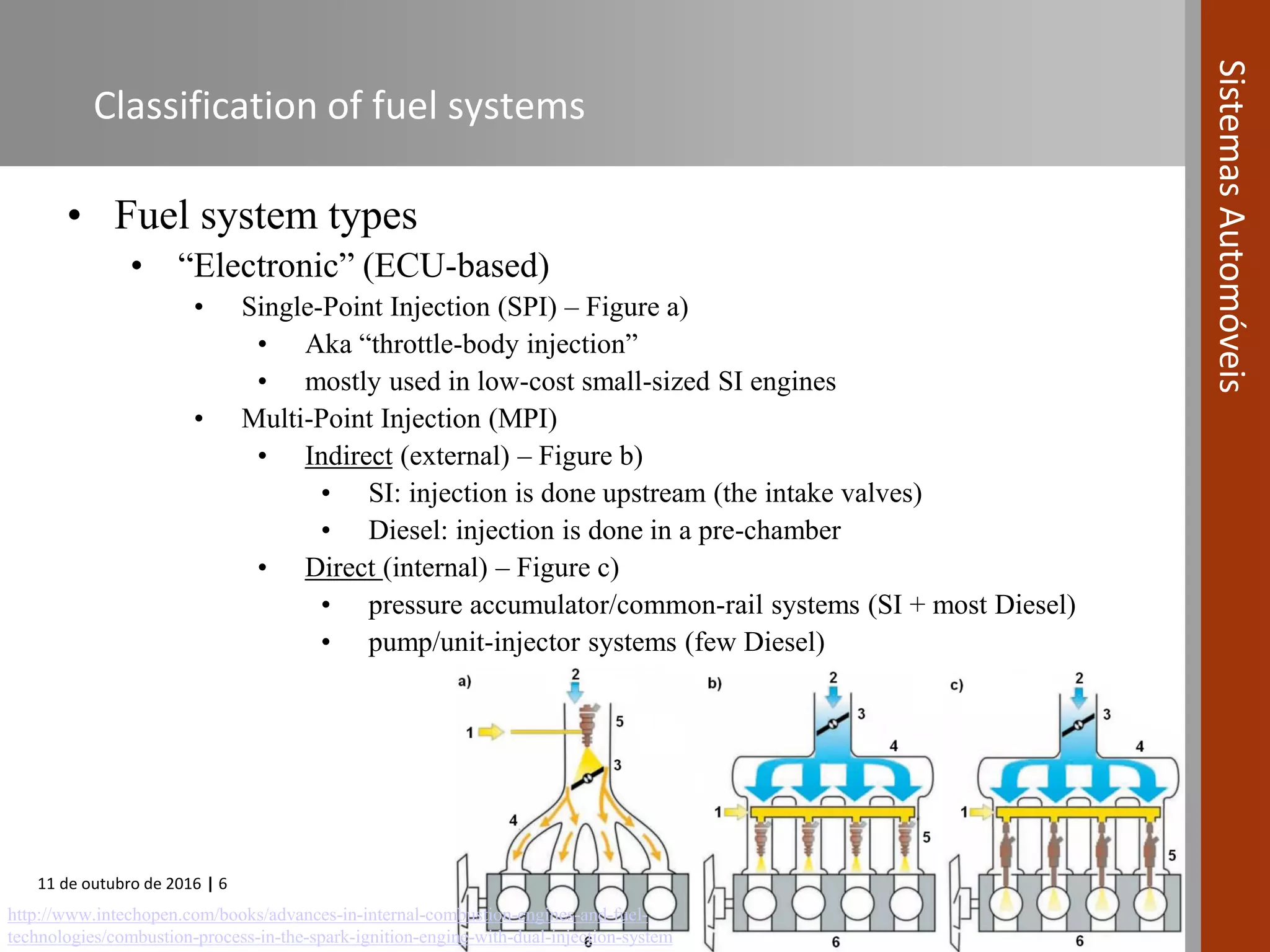
• Single-Point Injection (SPI) – Figure a)
• Aka “throttle-body injection”
• mostly used in low-cost small-sized SI engines
• Multi-Point Injection (MPI)
• Indirect (external) – Figure b)
• SI: injection is done upstream (the intake valves)
• Diesel: injection is done in a pre-chamber
• Direct (internal) – Figure c)
• pressure accumulator/common-rail systems (SI + most Diesel)
• pump/unit-injector systems (few Diesel)
http://www.intechopen.com/books/advances-in-internal-combustion-engines-and-fuel-
technologies/combustion-process-in-the-spark-ignition-engine-with-dual-injection-system
11 de outubro de 2016 | 7
SistemasAutomóveis
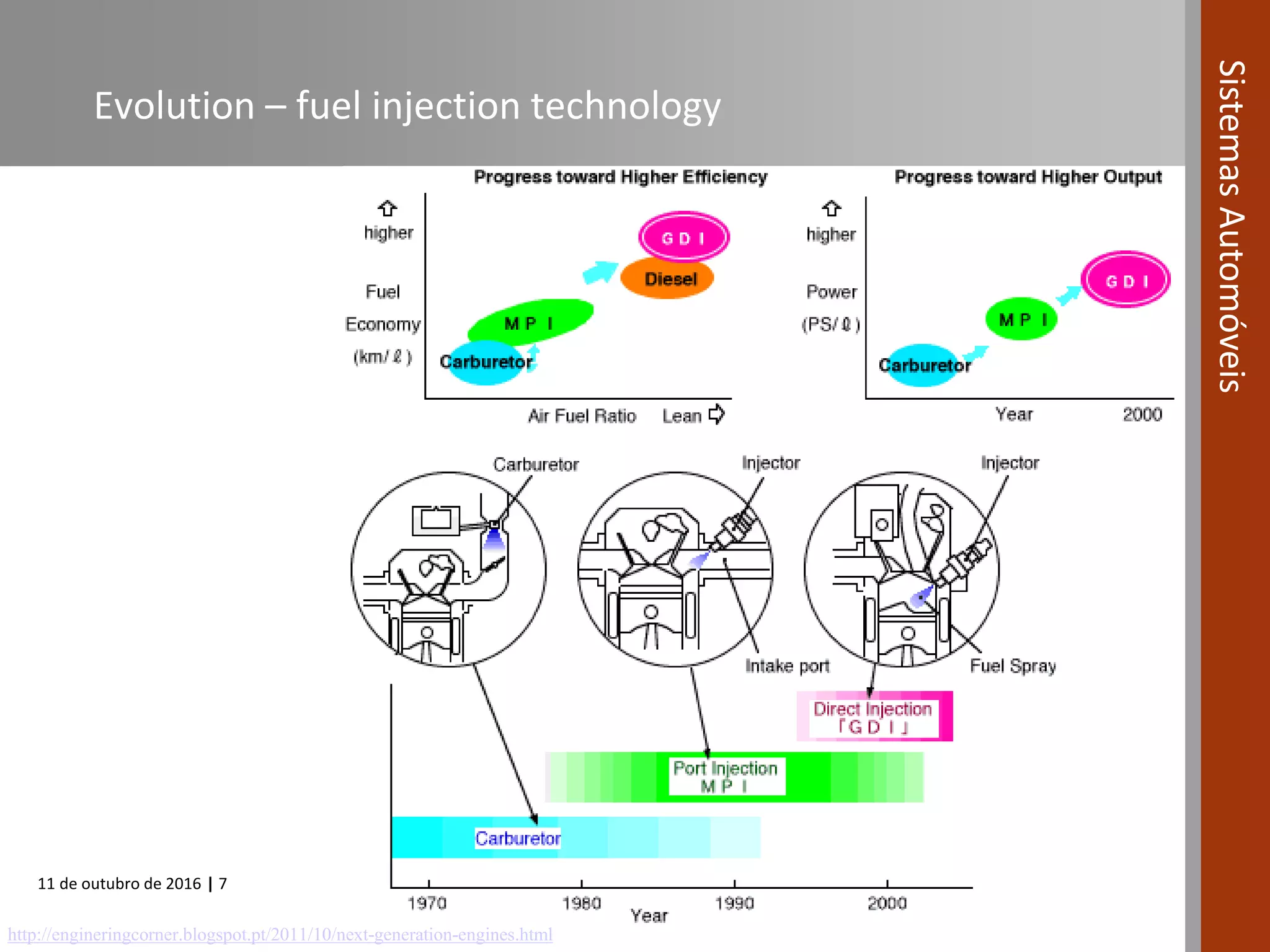
Evolution – fuel injection technology
http://engineringcorner.blogspot.pt/2011/10/next-generation-engines.html
11 de outubro de 2016 | 8
SistemasAutomóveis
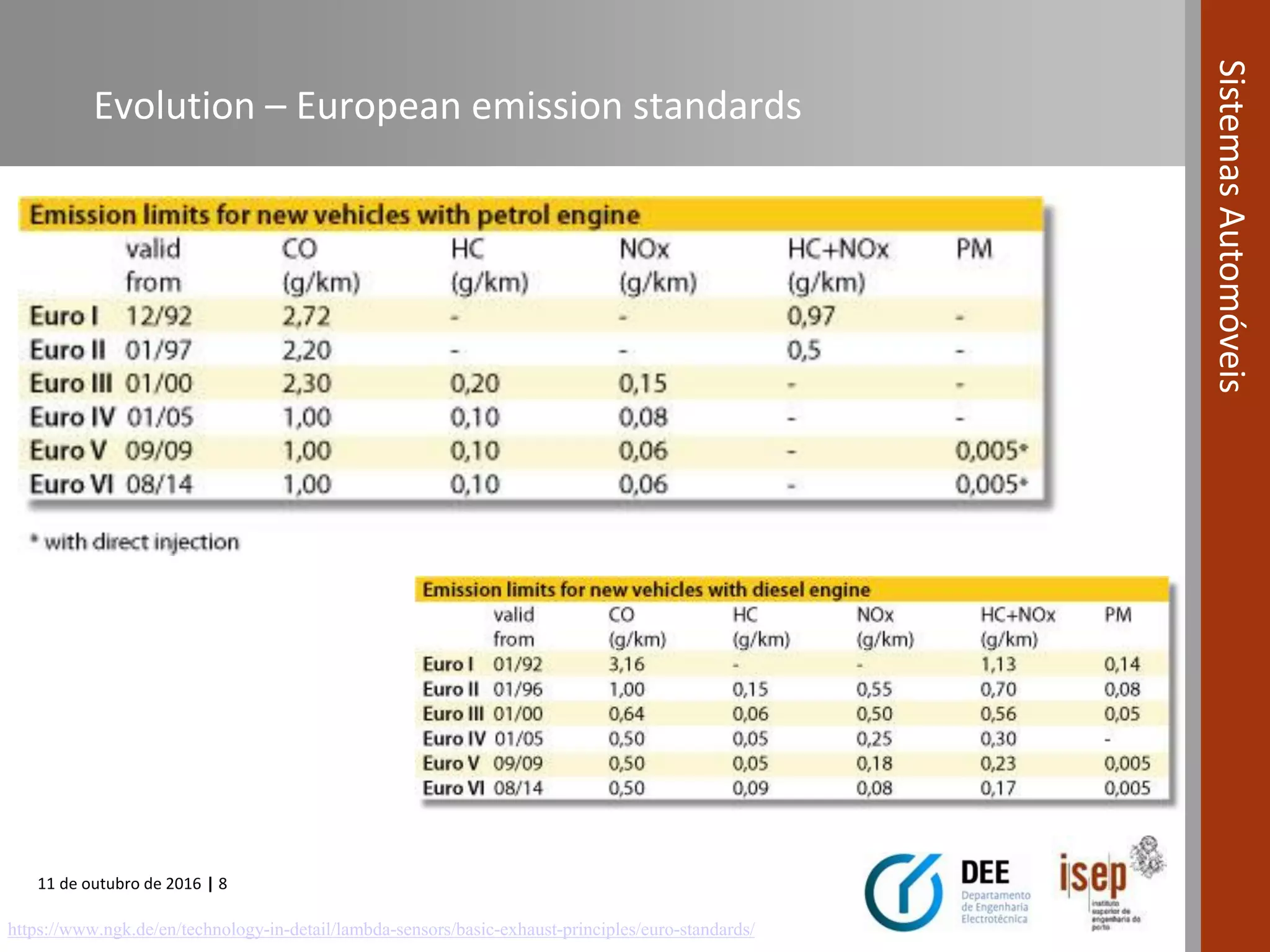
Evolution – European emission standards
https://www.ngk.de/en/technology-in-detail/lambda-sensors/basic-exhaust-principles/euro-standards/
11 de outubro de 2016 | 9
SistemasAutomóveis
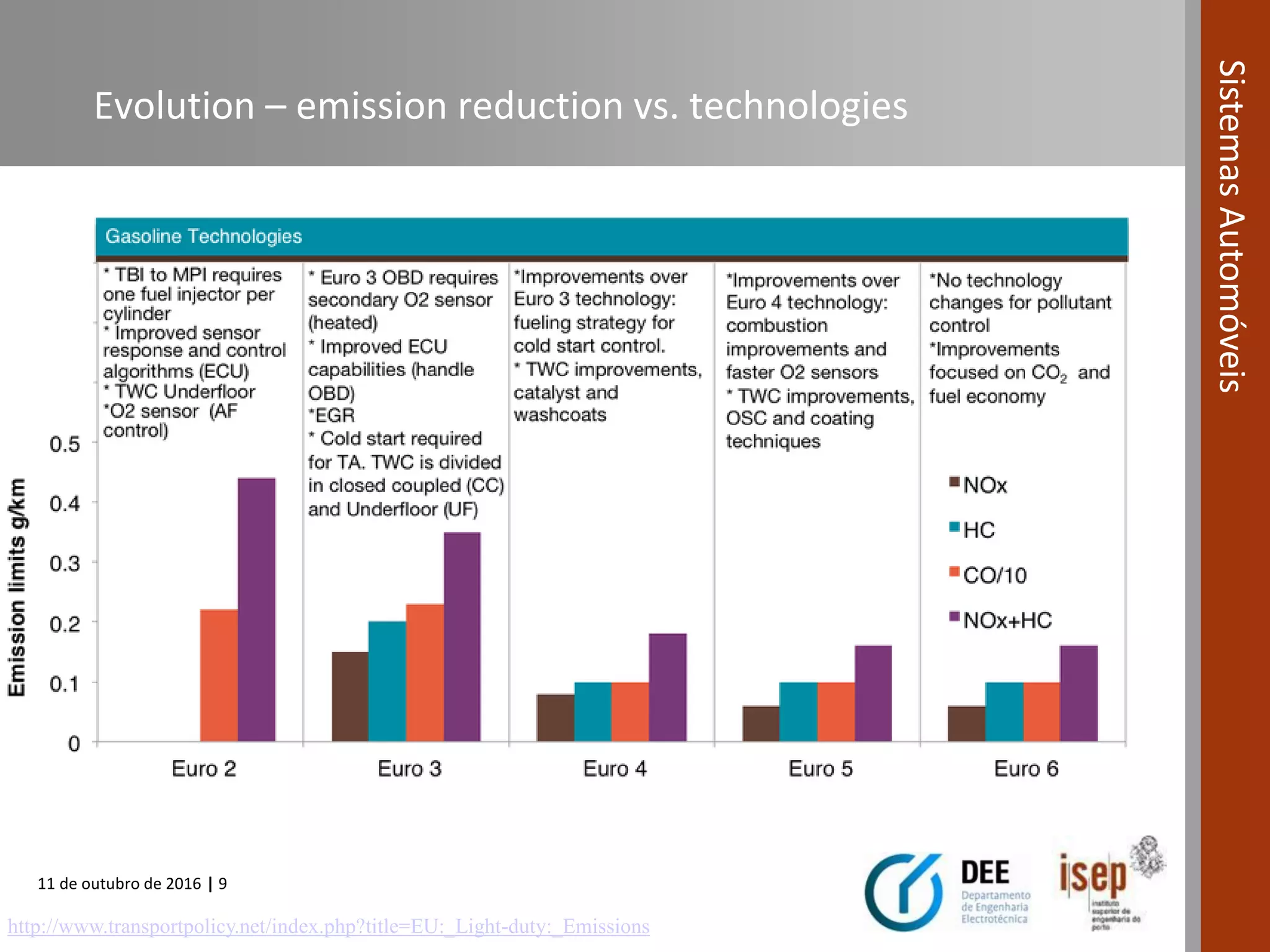
Evolution – emission reduction vs. technologies
http://www.transportpolicy.net/index.php?title=EU:_Light-duty:_Emissions
11 de outubro de 2016 | 10
SistemasAutomóveis
Carburetor-based fuel systems
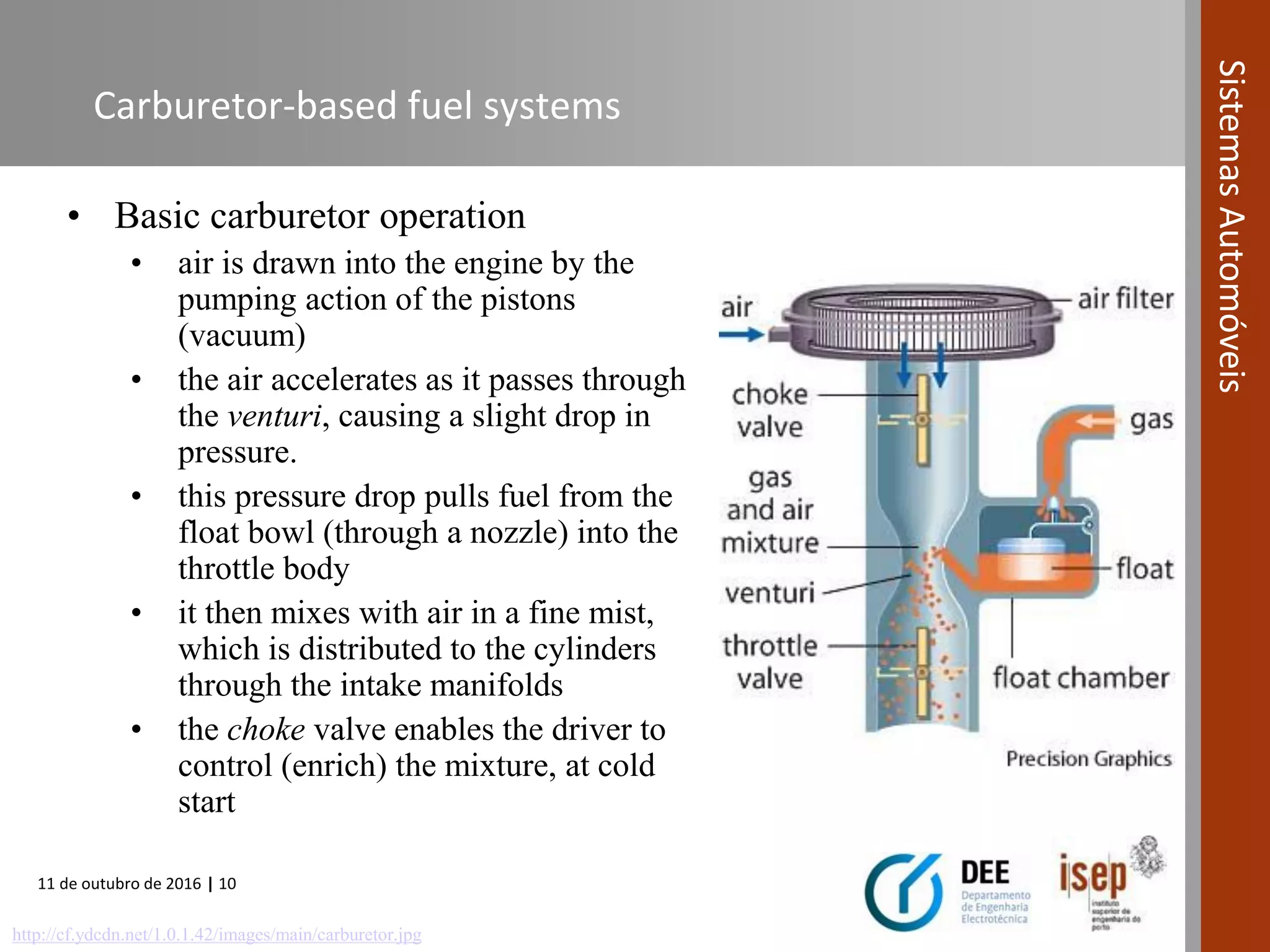
• Basic carburetor operation
• air is drawn into the engine by the
pumping action of the pistons
(vacuum)
• the air accelerates as it passes through
the venturi, causing a slight drop in
pressure.
• this pressure drop pulls fuel from the
float bowl (through a nozzle) into the
throttle body
• it then mixes with air in a fine mist,
which is distributed to the cylinders
through the intake manifolds
• the choke valve enables the driver to
control (enrich) the mixture, at cold
start
http://cf.ydcdn.net/1.0.1.42/images/main/carburetor.jpg
11 de outubro de 2016 | 11
SistemasAutomóveis
Carburetor-based fuel systems
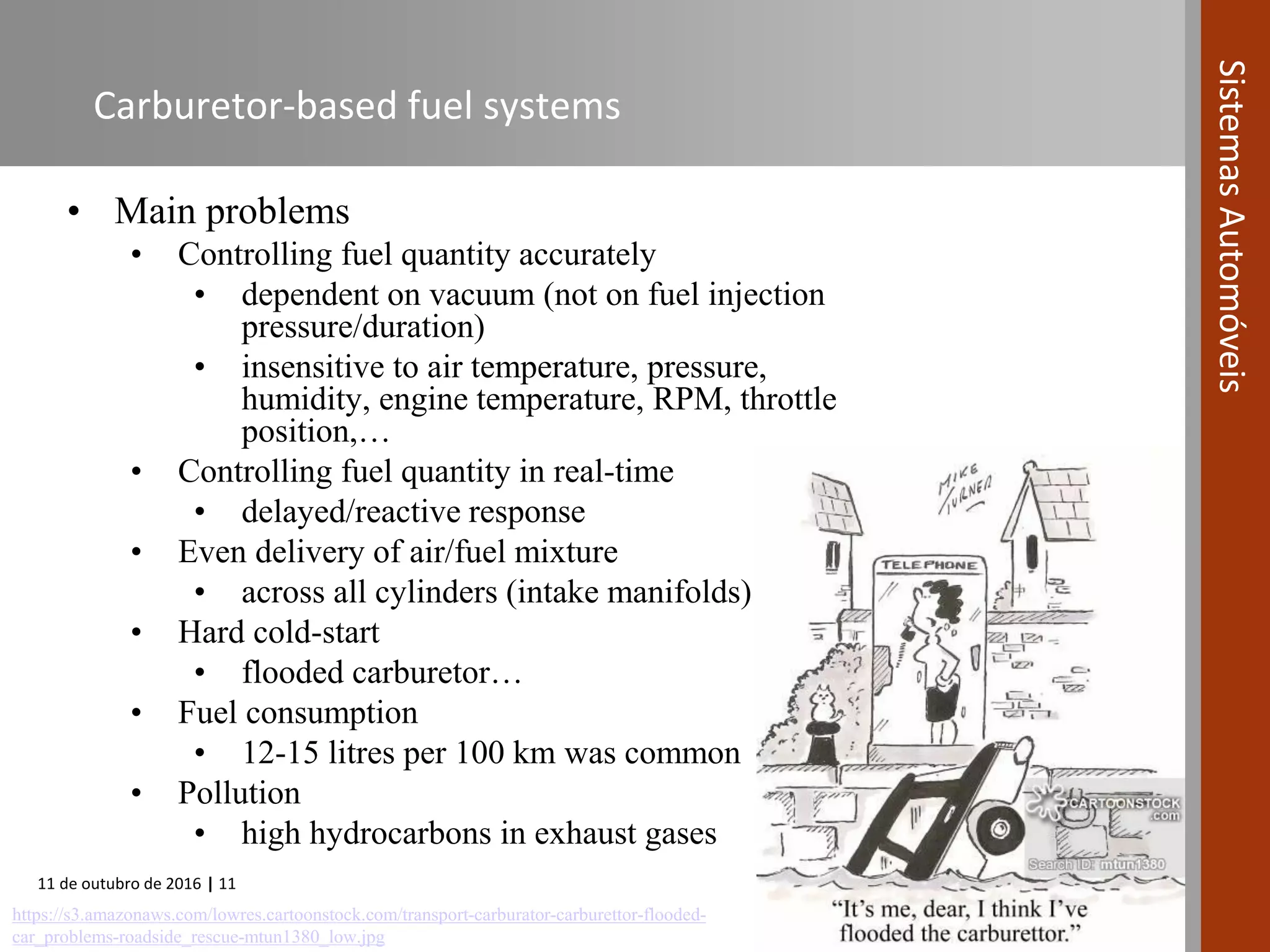
• Main problems
• Controlling fuel quantity accurately
• dependent on vacuum (not on fuel injection
pressure/duration)
• insensitive to air temperature, pressure,
humidity, engine temperature, RPM, throttle
position,…
• Controlling fuel quantity in real-time
• delayed/reactive response
• Even delivery of air/fuel mixture
• across all cylinders (intake manifolds)
• Hard cold-start
• flooded carburetor…
• Fuel consumption
• 12-15 litres per 100 km was common
• Pollution
• high hydrocarbons in exhaust gases
https://s3.amazonaws.com/lowres.cartoonstock.com/transport-carburator-carburettor-flooded-
car_problems-roadside_rescue-mtun1380_low.jpg
11 de outubro de 2016 | 12
SistemasAutomóveis
Electronic fuel injection (EFI) systems
• EFI emerged due to
• stringent exhaust emission regulations
• Increasing fossil fuel cost
• evolution of analog/digital electronics
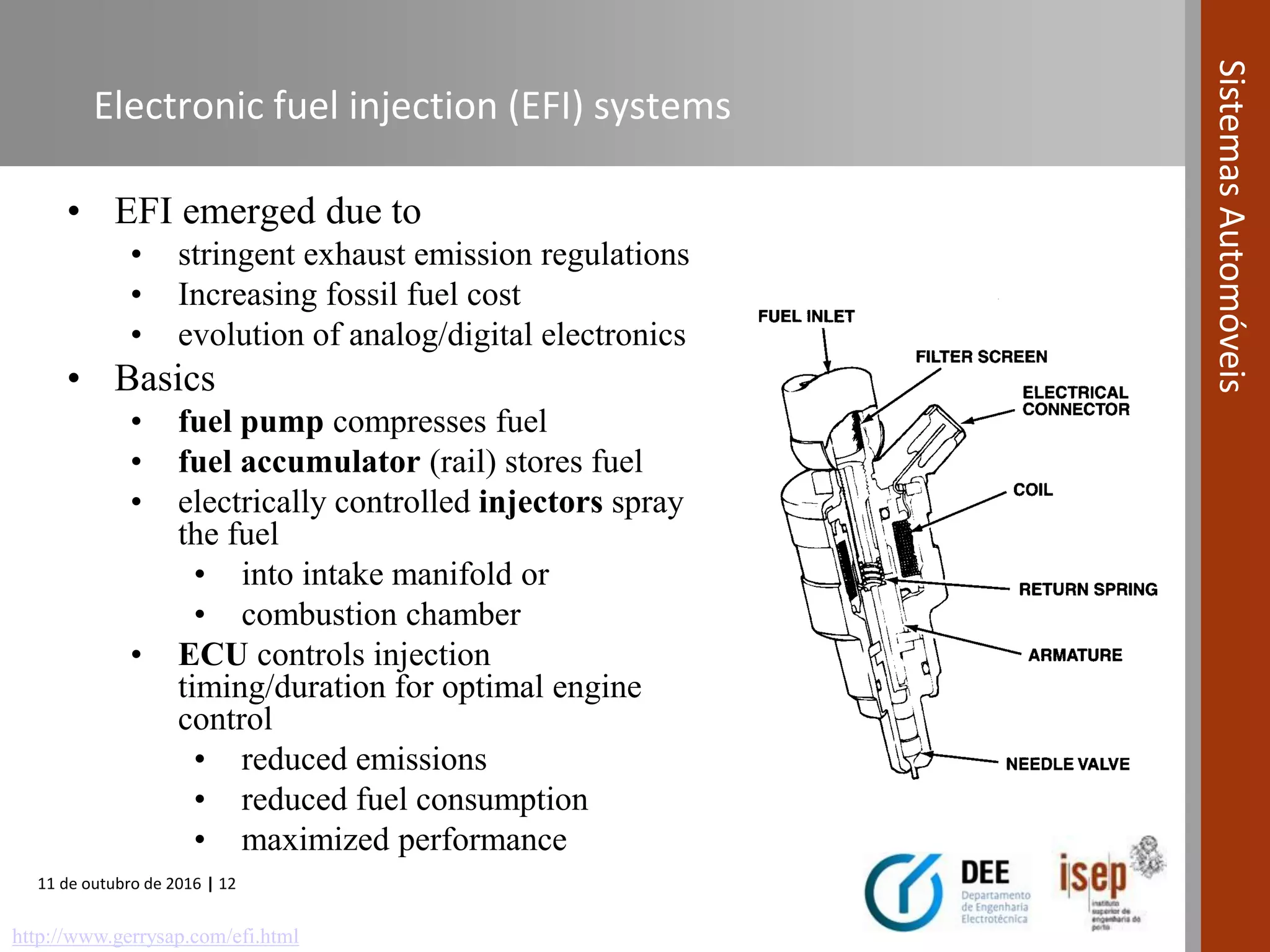
• Basics
• fuel pump compresses fuel
• fuel accumulator (rail) stores fuel
• electrically controlled injectors spray
the fuel
• into intake manifold or
• combustion chamber
• ECU controls injection
timing/duration for optimal engine
control
• reduced emissions
• reduced fuel consumption
• maximized performance
http://www.gerrysap.com/efi.html
11 de outubro de 2016 | 13
SistemasAutomóveis
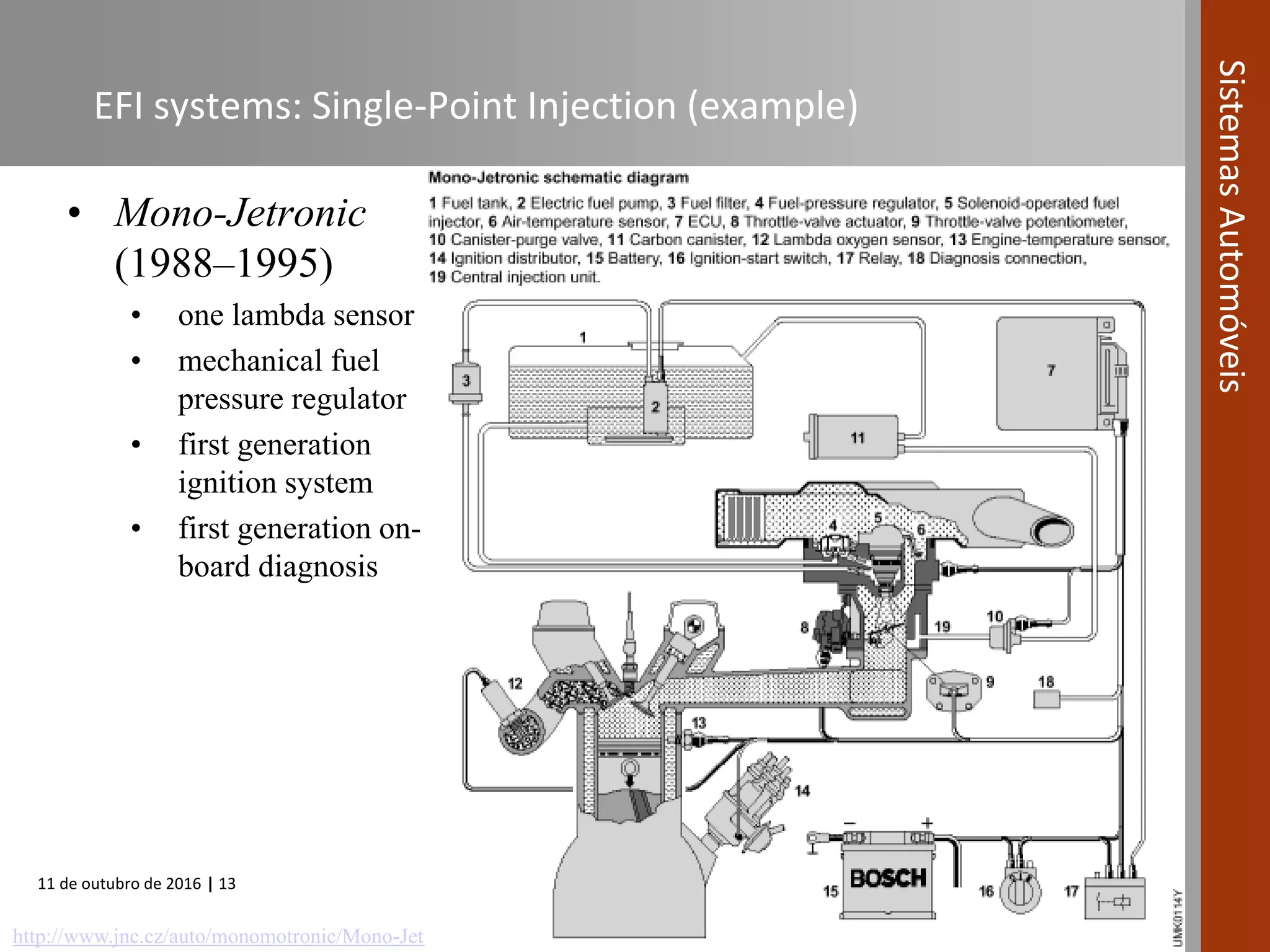
EFI systems: Single-Point Injection (example)
• Mono-Jetronic
(1988–1995)
• one lambda sensor
• mechanical fuel
pressure regulator
• first generation
ignition system
• first generation on-
board diagnosis
http://www.jnc.cz/auto/monomotronic/Mono-Jetronic_blo ck_diagram.gif
11 de outubro de 2016 | 14
SistemasAutomóveis
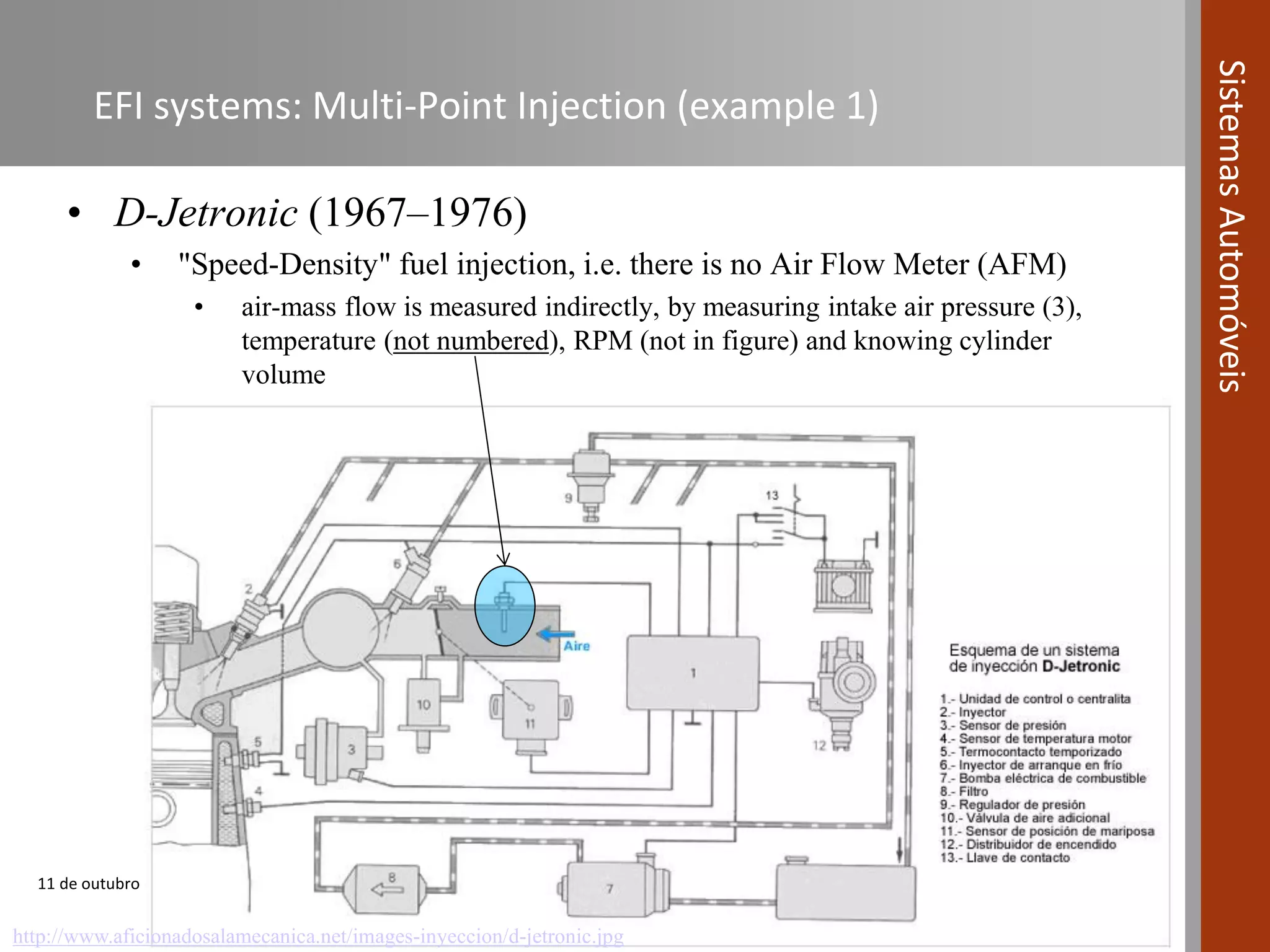
EFI systems: Multi-Point Injection (example 1)
• D-Jetronic (1967–1976)
• "Speed-Density" fuel injection, i.e. there is no Air Flow Meter (AFM)
• air-mass flow is measured indirectly, by measuring intake air pressure (3),
temperature (not numbered), RPM (not in figure) and knowing cylinder
volume
http://www.aficionadosalamecanica.net/images-inyeccion/d-jetronic.jpg
11 de outubro de 2016 | 15
SistemasAutomóveis
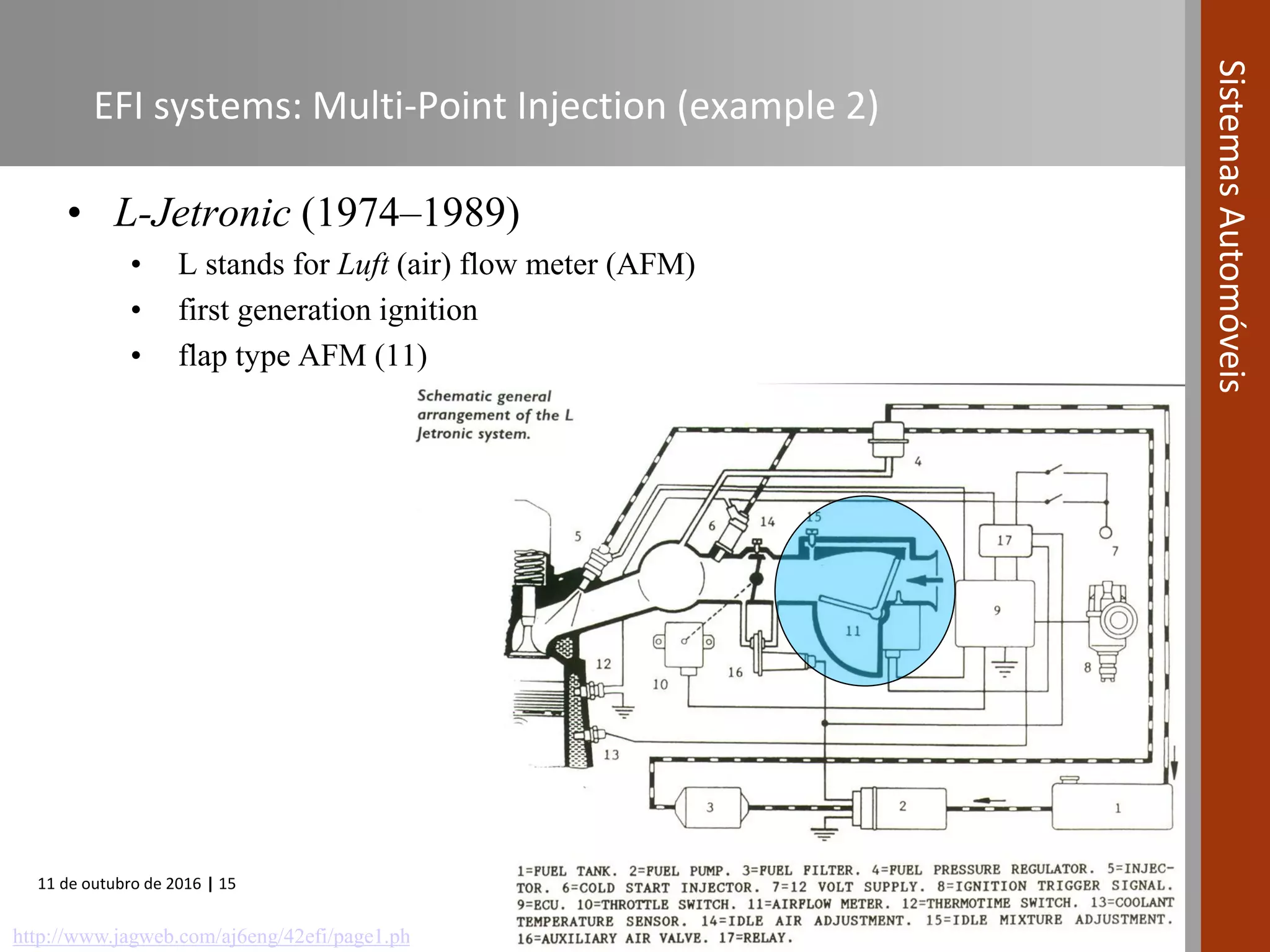
EFI systems: Multi-Point Injection (example 2)
• L-Jetronic (1974–1989)
• L stands for Luft (air) flow meter (AFM)
• first generation ignition
• flap type AFM (11)
http://www.jagweb.com/aj6eng/42efi/page1.php
11 de outubro de 2016 | 16
SistemasAutomóveis
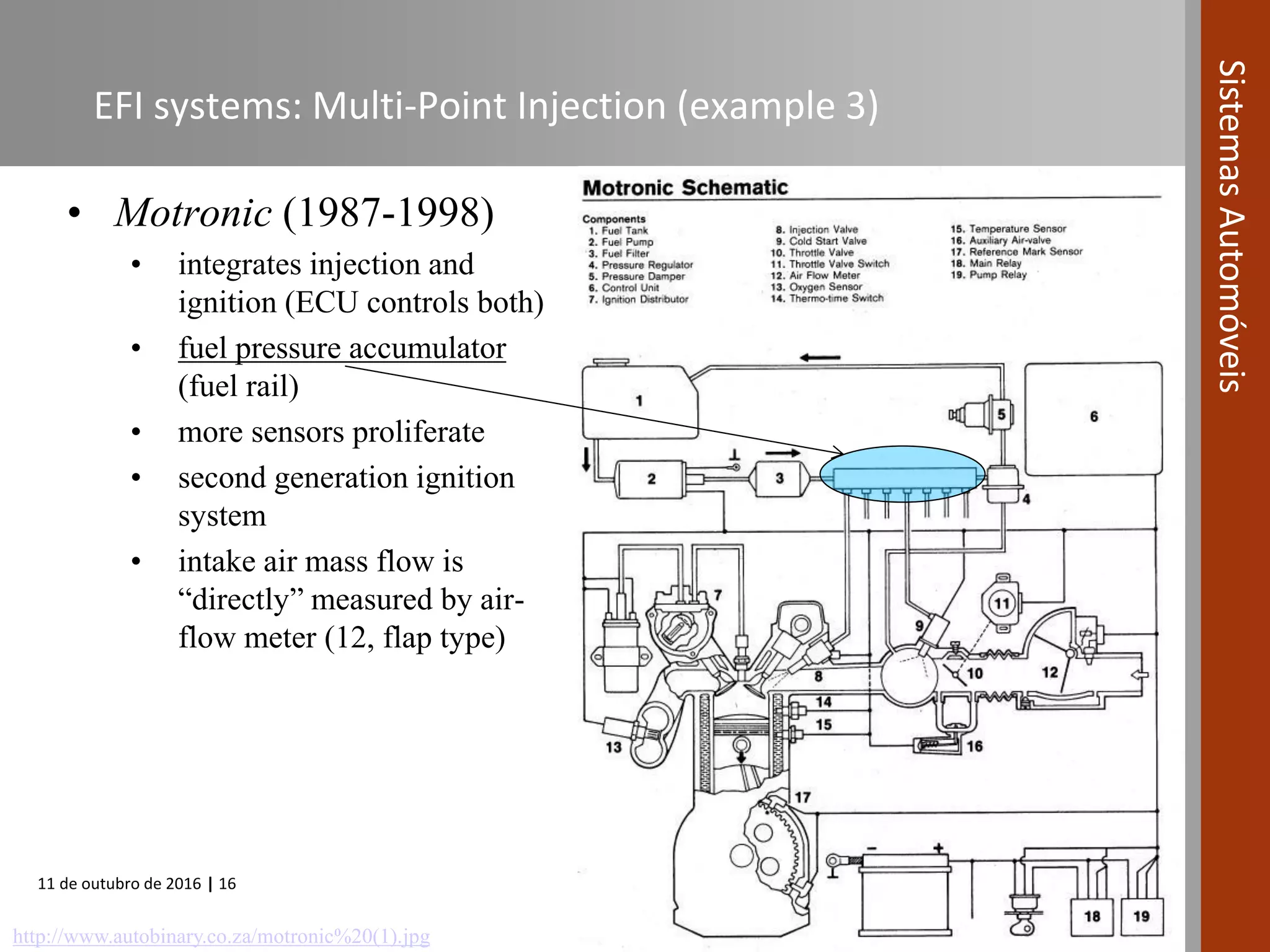
EFI systems: Multi-Point Injection (example 3)
• Motronic (1987-1998)
• integrates injection and
ignition (ECU controls both)
• fuel pressure accumulator
(fuel rail)
• more sensors proliferate
• second generation ignition
system
• intake air mass flow is
“directly” measured by air-
flow meter (12, flap type)
http://www.autobinary.co.za/motronic%20(1).jpg
11 de outubro de 2016 | 17
SistemasAutomóveis
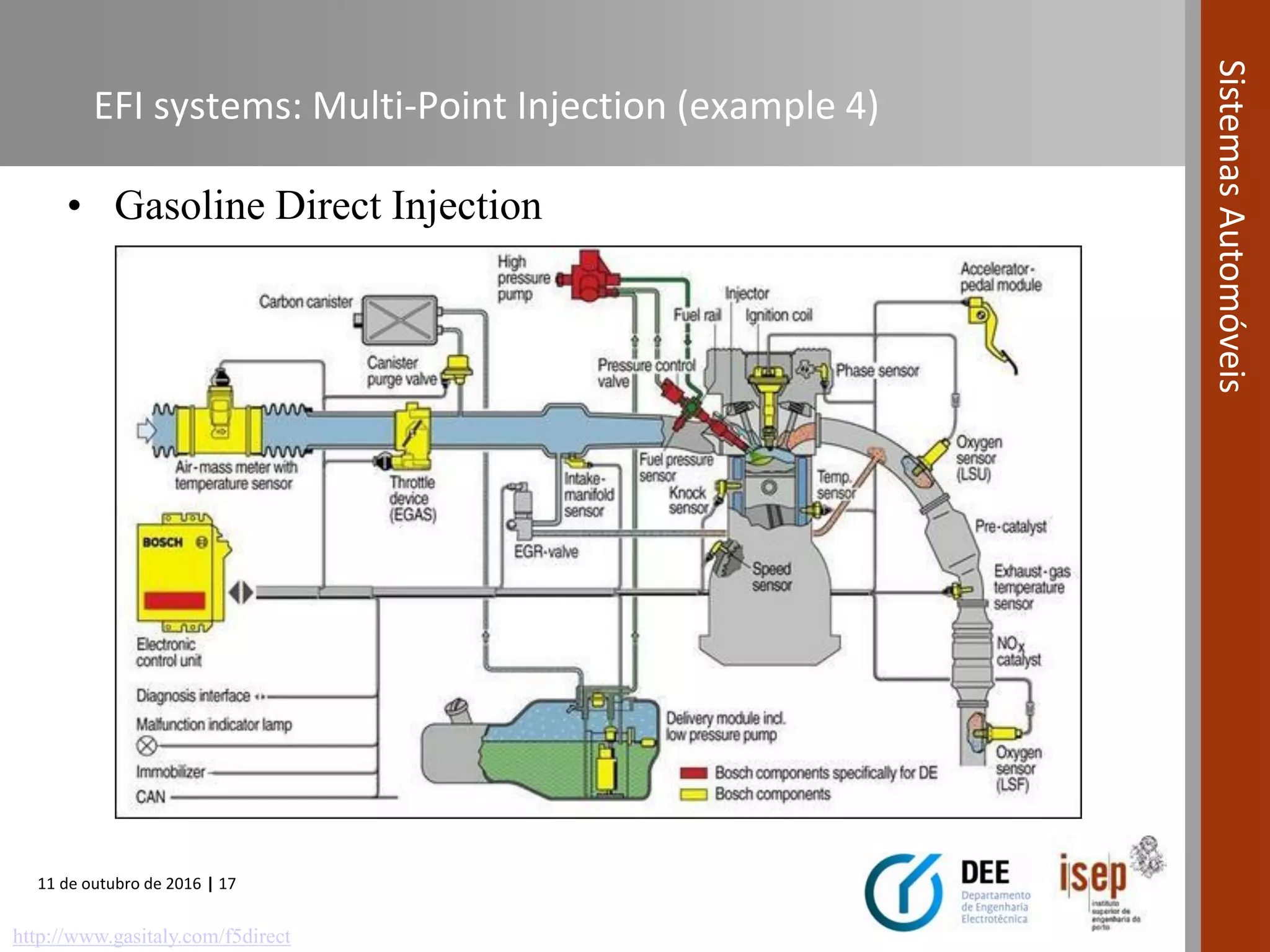
EFI systems: Multi-Point Injection (example 4)
• Gasoline Direct Injection
http://www.gasitaly.com/f5direct
11 de outubro de 2016 | 18
SistemasAutomóveis
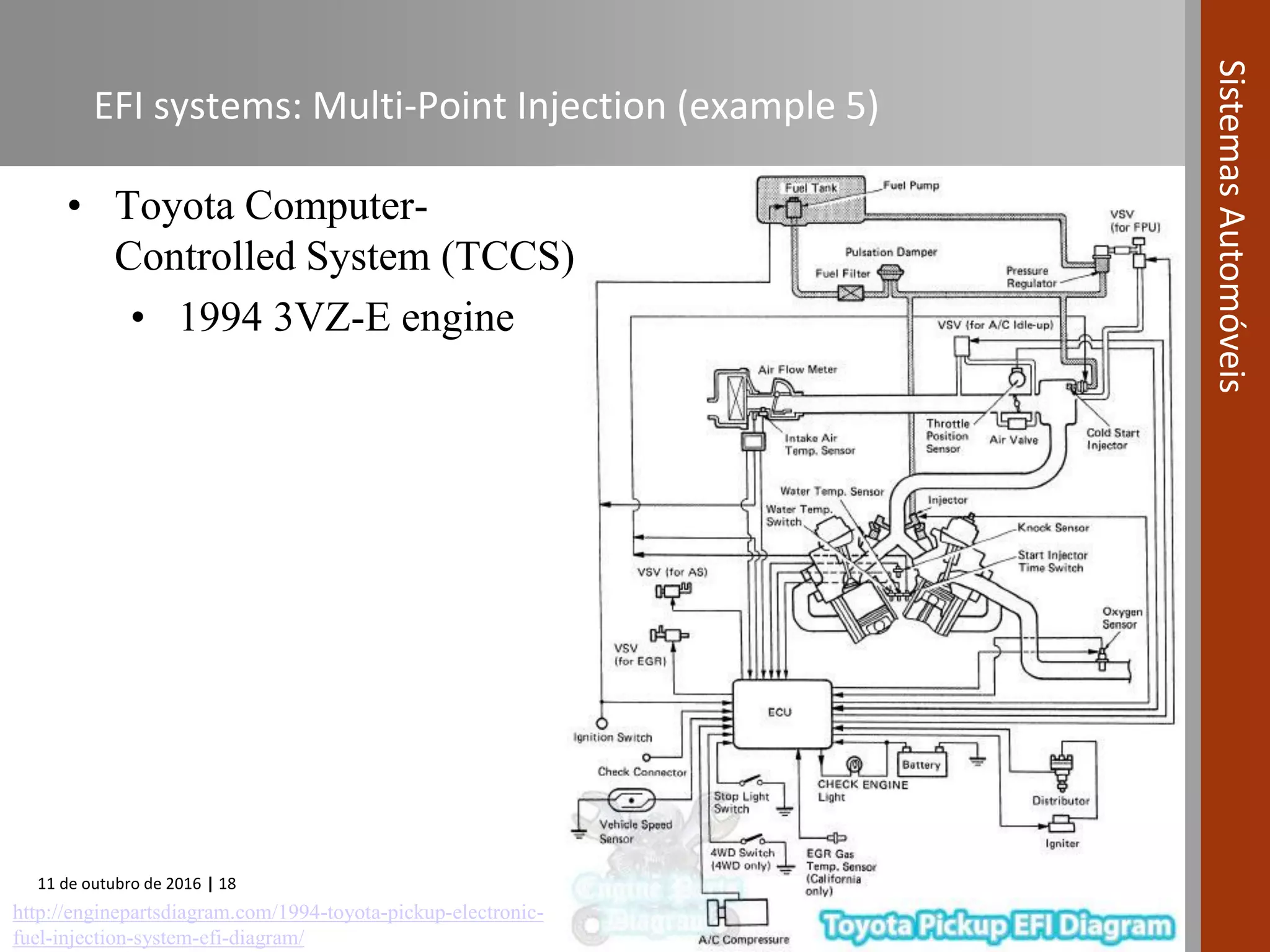
EFI systems: Multi-Point Injection (example 5)
• Toyota Computer-
Controlled System (TCCS)
• 1994 3VZ-E engine
http://enginepartsdiagram.com/1994-toyota-pickup-electronic-
fuel-injection-system-efi-diagram/
11 de outubro de 2016 | 19
SistemasAutomóveis
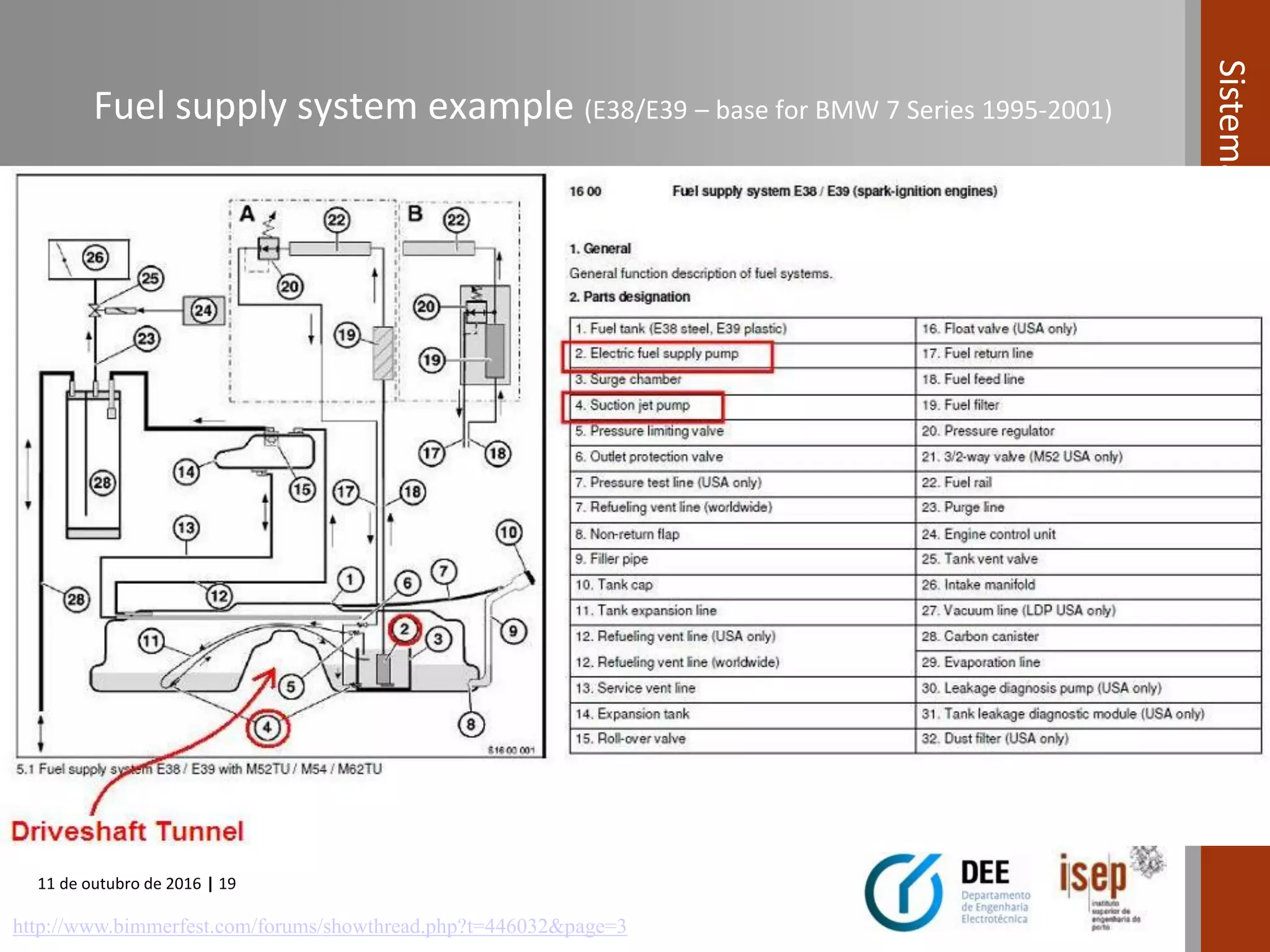
Fuel supply system example (E38/E39 – base for BMW 7 Series 1995-2001)
http://www.bimmerfest.com/forums/showthread.php?t=446032&page=3
11 de outubro de 2016 | 20
SistemasAutomóveis
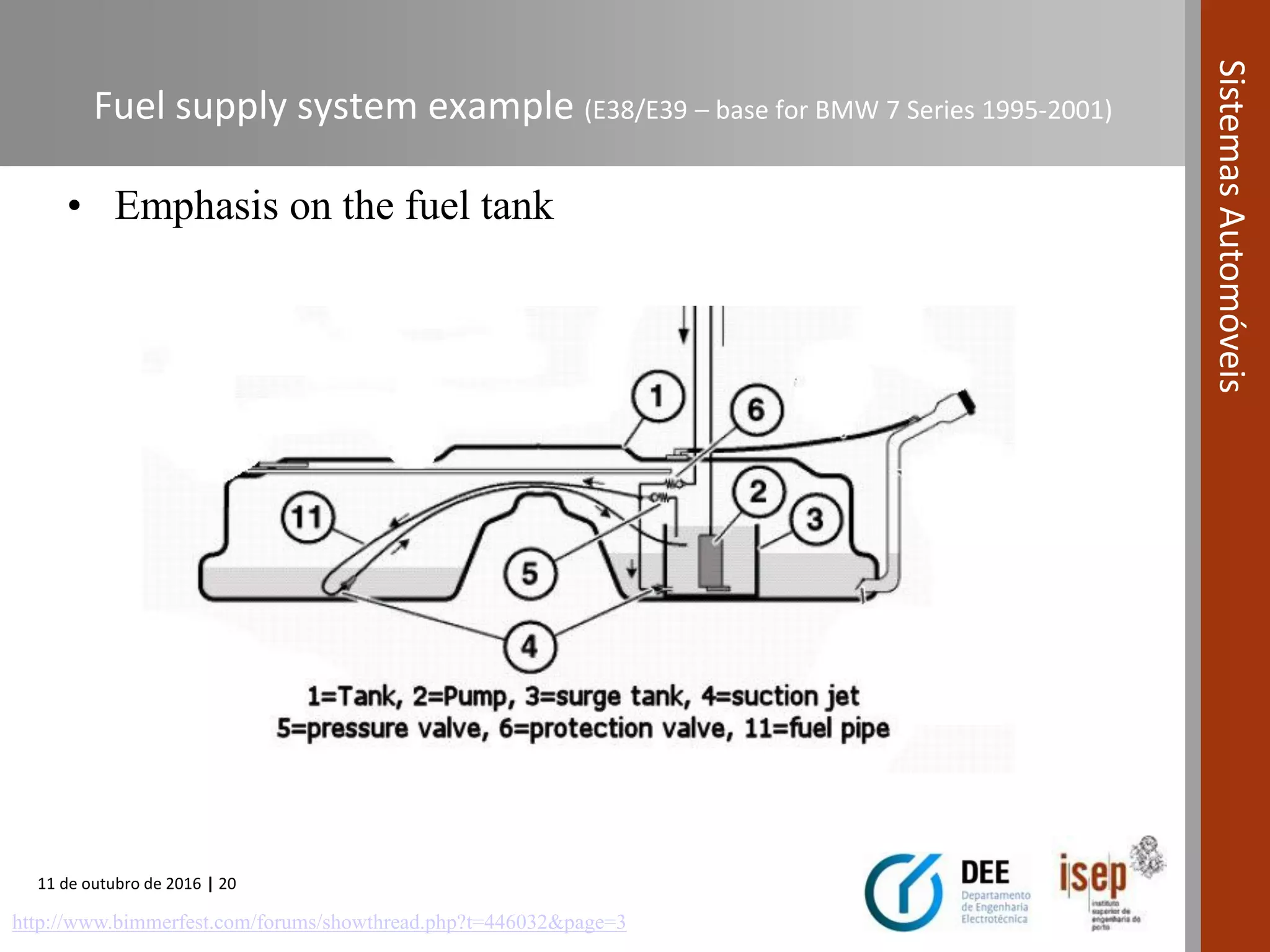
Fuel supply system example (E38/E39 – base for BMW 7 Series 1995-2001)
http://www.bimmerfest.com/forums/showthread.php?t=446032&page=3
• Emphasis on the fuel tank
11 de outubro de 2016 | 21
SistemasAutomóveis
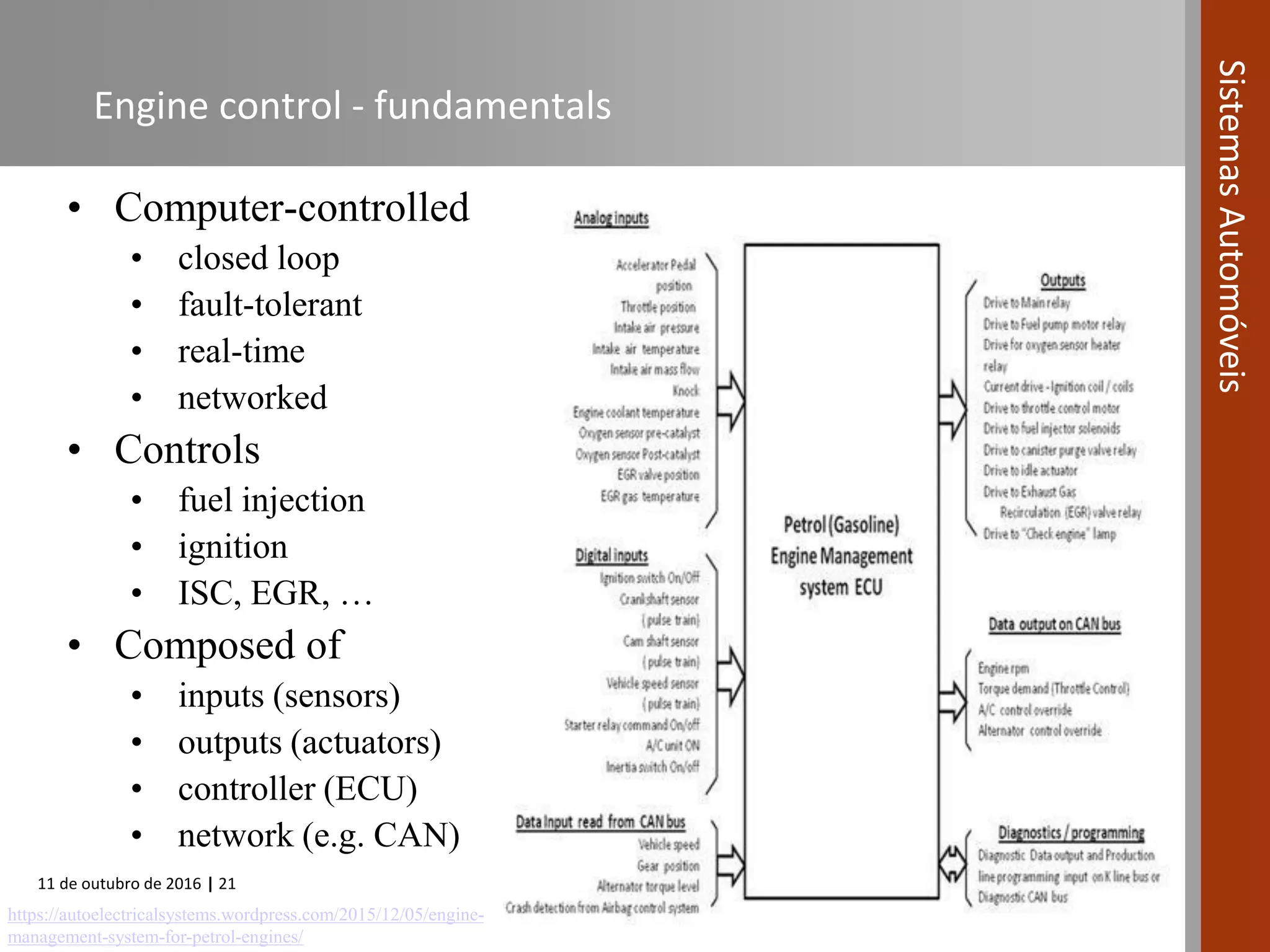
Engine control - fundamentals
• Computer-controlled
• closed loop
• fault-tolerant
• real-time
• networked
• Controls
• fuel injection
• ignition
• ISC, EGR, …
• Composed of
• inputs (sensors)
• outputs (actuators)
• controller (ECU)
• network (e.g. CAN)
https://autoelectricalsystems.wordpress.com/2015/12/05/engine-
management-system-for-petrol-engines/
11 de outubro de 2016 | 22
SistemasAutomóveis
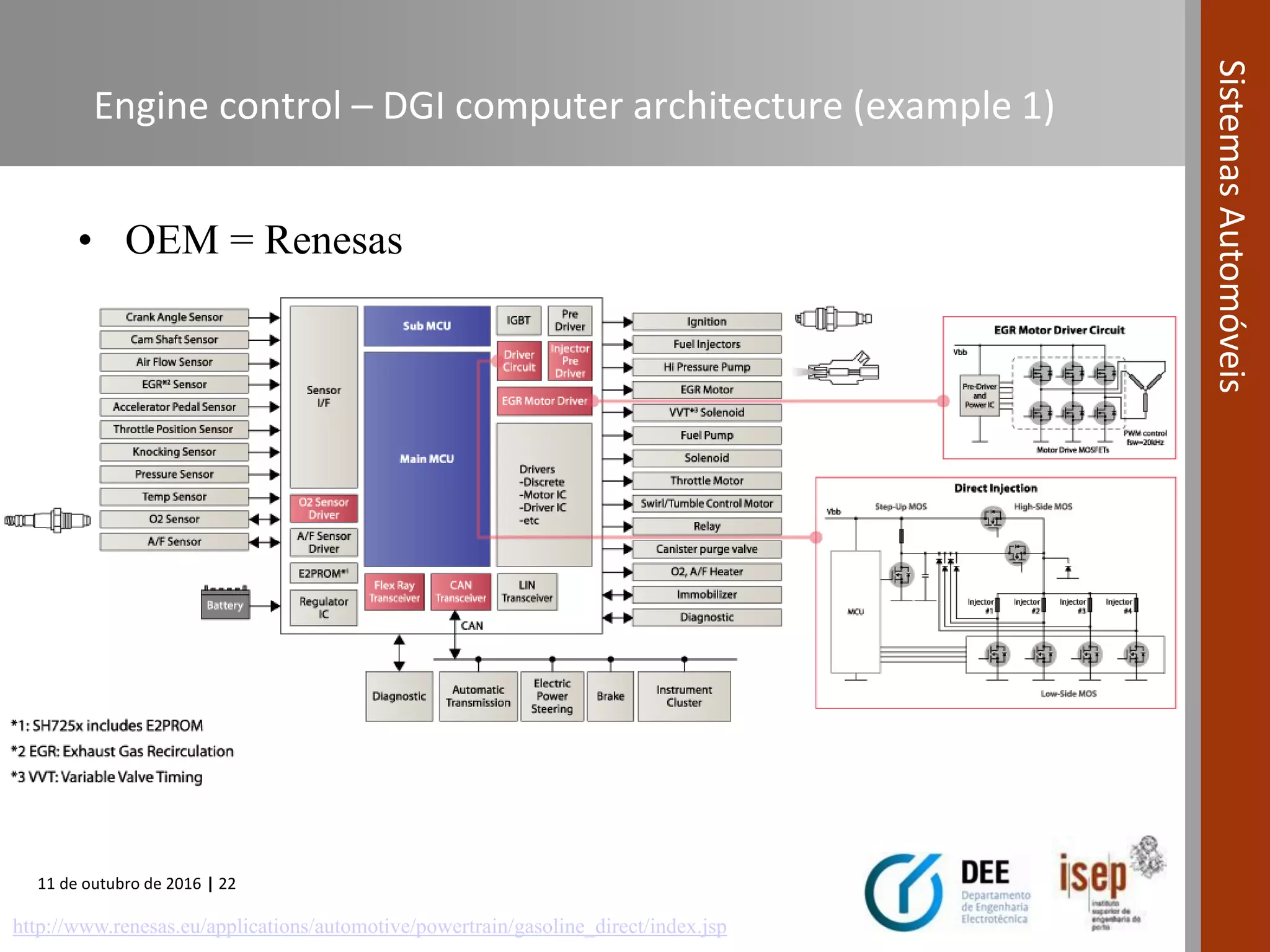
Engine control – DGI computer architecture (example 1)
• OEM = Renesas
http://www.renesas.eu/applications/automotive/powertrain/gasoline_direct/index.jsp
11 de outubro de 2016 | 23
SistemasAutomóveis
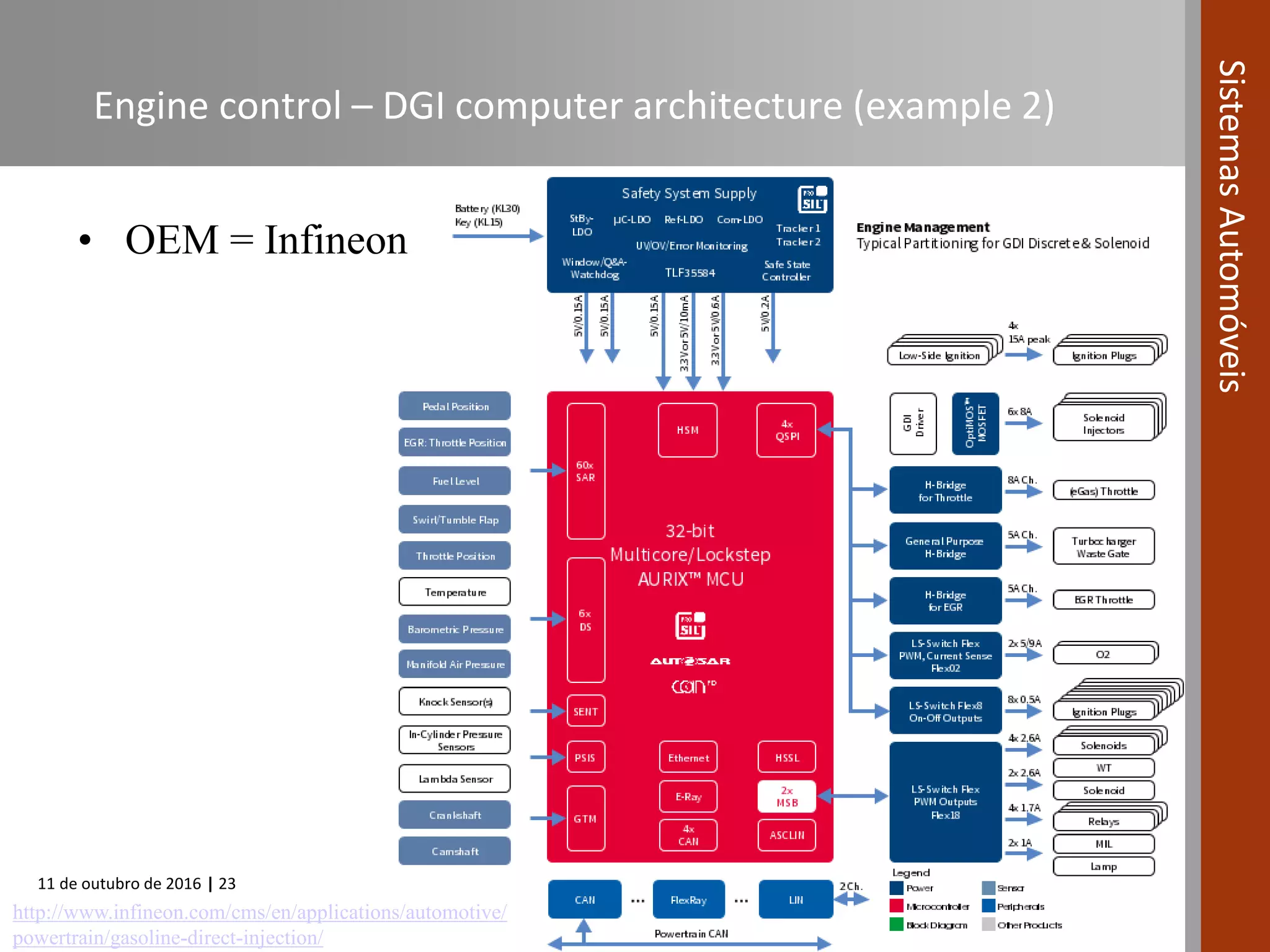
Engine control – DGI computer architecture (example 2)
• OEM = Infineon
http://www.infineon.com/cms/en/applications/automotive/
powertrain/gasoline-direct-injection/
11 de outubro de 2016 | 24
SistemasAutomóveis
Outline
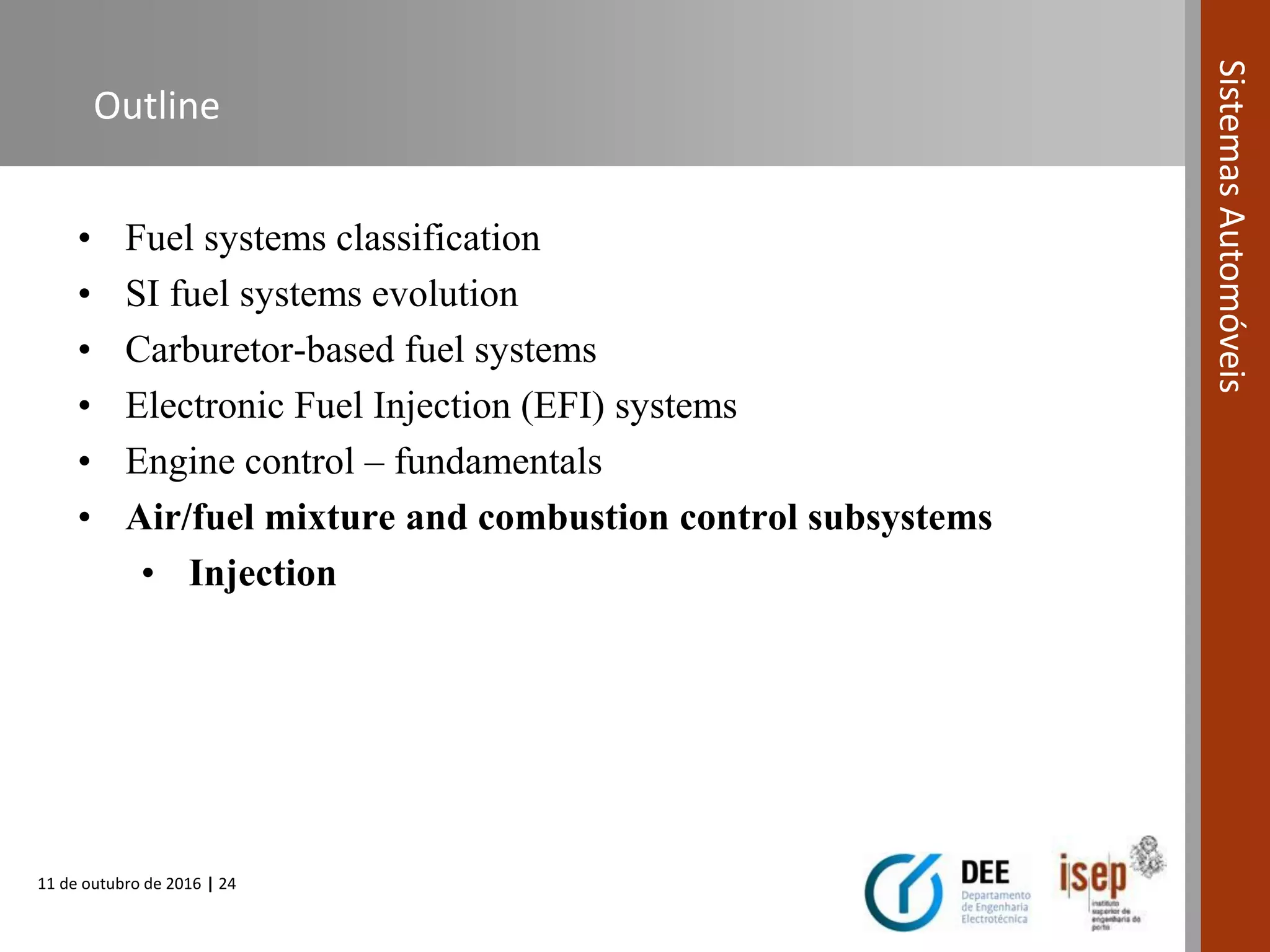
• Fuel systems classification
• SI fuel systems evolution
• Carburetor-based fuel systems
• Electronic Fuel Injection (EFI) systems
• Engine control – fundamentals
• Air/fuel mixture and combustion control subsystems
• Injection
11 de outubro de 2016 | 25
SistemasAutomóveis
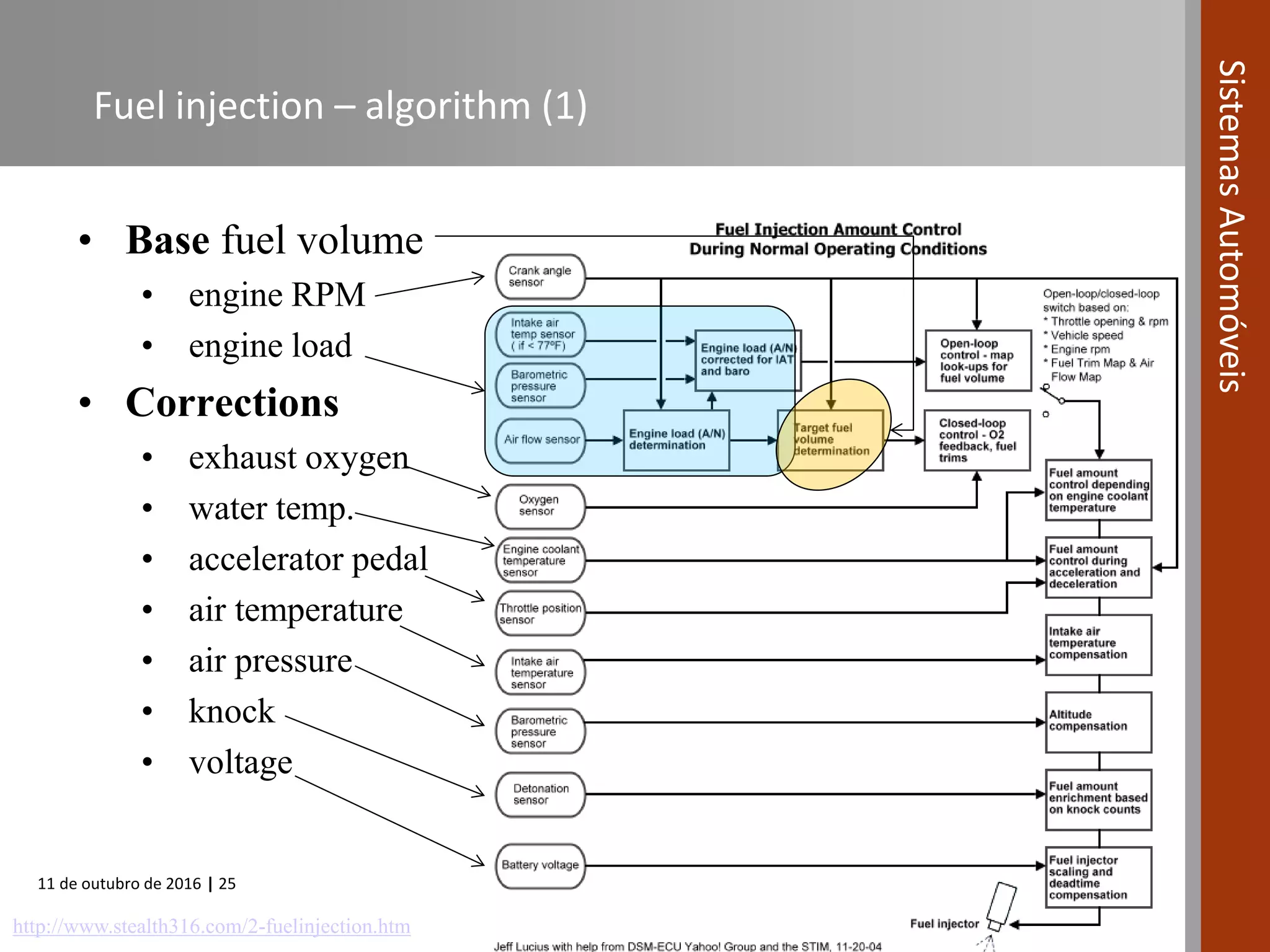
Fuel injection – algorithm (1)
• Base fuel volume
• engine RPM
• engine load
• Corrections
• exhaust oxygen
• water temp.
• accelerator pedal
• air temperature
• air pressure
• knock
• voltage
http://www.stealth316.com/2-fuelinjection.htm
11 de outubro de 2016 | 26
SistemasAutomóveis
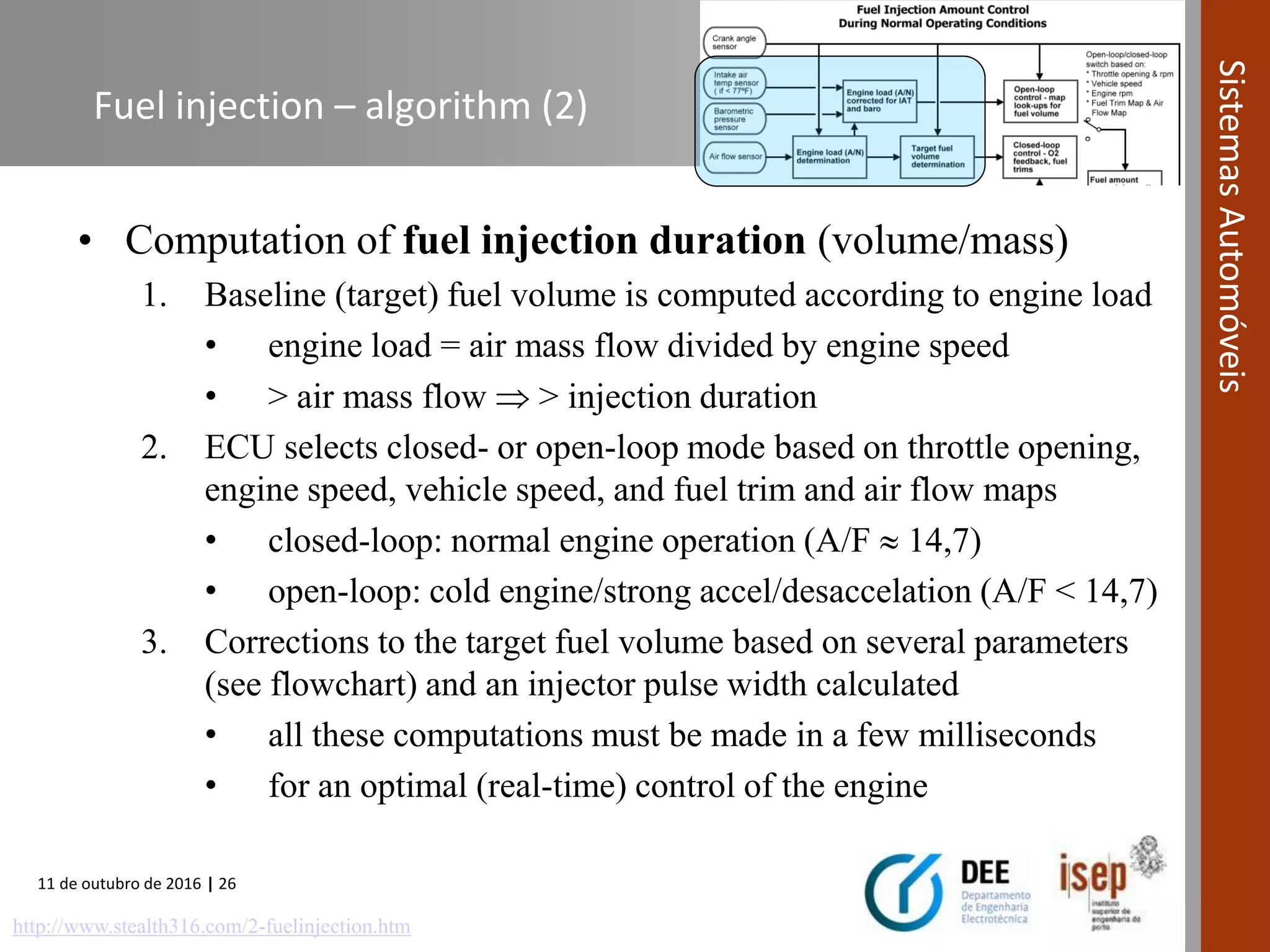
Fuel injection – algorithm (2)
• Computation of fuel injection duration (volume/mass)
1. Baseline (target) fuel volume is computed according to engine load
• engine load = air mass flow divided by engine speed
• > air mass flow  > injection duration
2. ECU selects closed- or open-loop mode based on throttle opening,
engine speed, vehicle speed, and fuel trim and air flow maps
• closed-loop: normal engine operation (A/F  14,7)
• open-loop: cold engine/strong accel/desaccelation (A/F < 14,7)
3. Corrections to the target fuel volume based on several parameters
(see flowchart) and an injector pulse width calculated
• all these computations must be made in a few milliseconds
• for an optimal (real-time) control of the engine
http://www.stealth316.com/2-fuelinjection.htm
11 de outubro de 2016 | 27
SistemasAutomóveis
Fuel injection – algorithm (3)
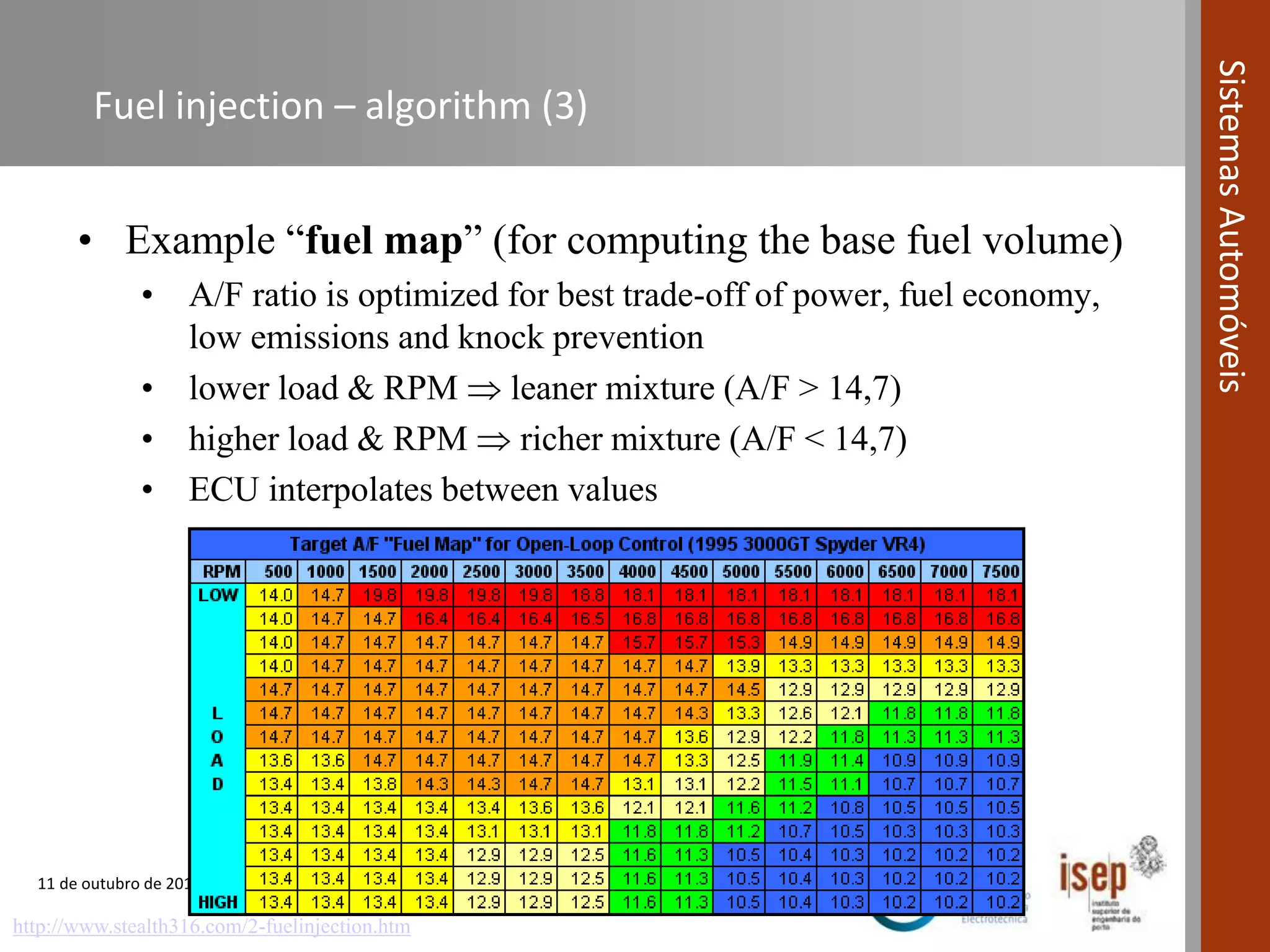
• Example “fuel map” (for computing the base fuel volume)
• A/F ratio is optimized for best trade-off of power, fuel economy,
low emissions and knock prevention
• lower load & RPM  leaner mixture (A/F > 14,7)
• higher load & RPM  richer mixture (A/F < 14,7)
• ECU interpolates between values
http://www.stealth316.com/2-fuelinjection.htm
11 de outubro de 2016 | 28
SistemasAutomóveis
Fuel injection – algorithm (4)
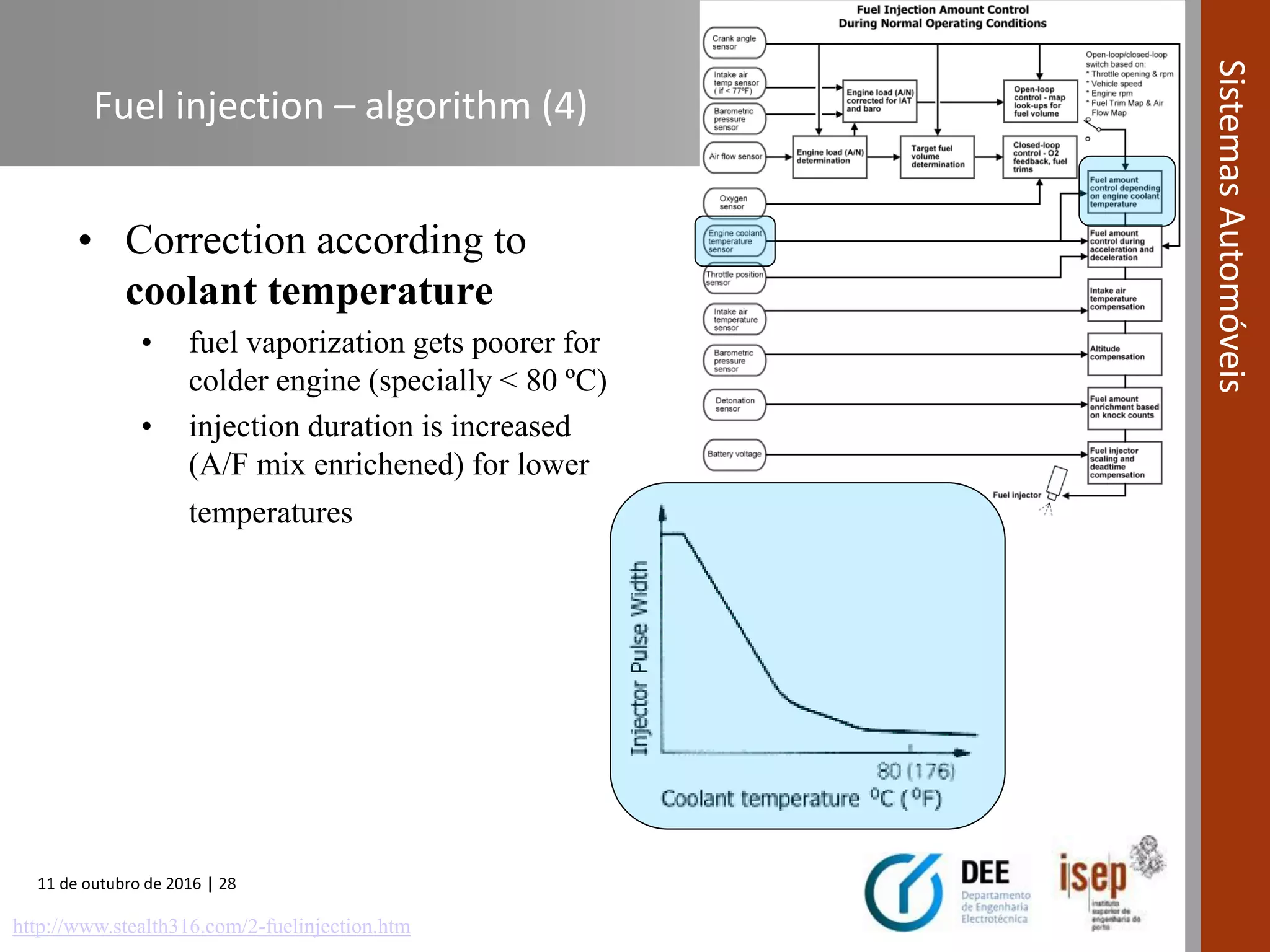
• Correction according to
coolant temperature
• fuel vaporization gets poorer for
colder engine (specially < 80 ºC)
• injection duration is increased
(A/F mix enrichened) for lower
temperatures
http://www.stealth316.com/2-fuelinjection.htm
11 de outubro de 2016 | 29
SistemasAutomóveis
Fuel injection – algorithm (5)
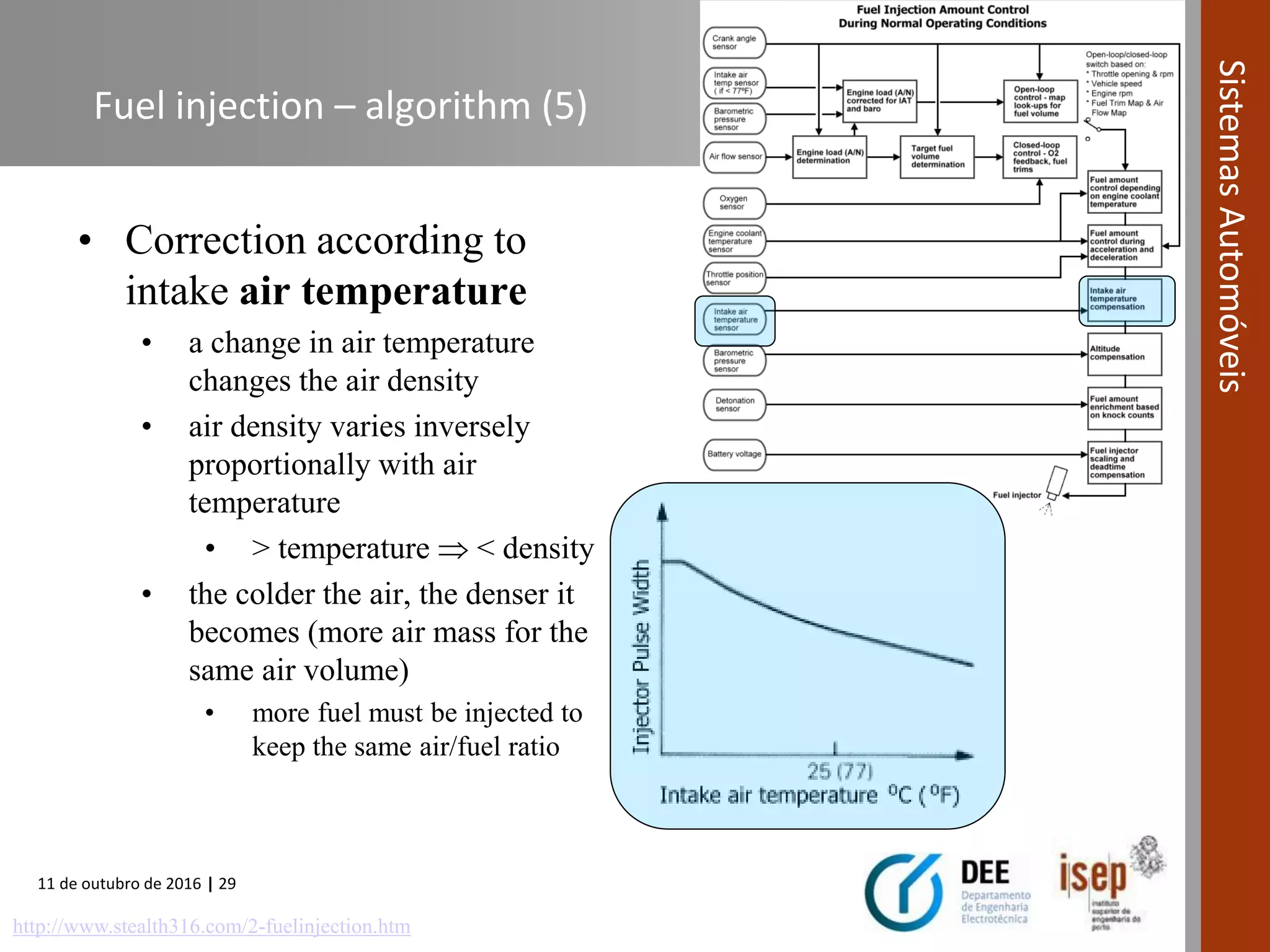
• Correction according to
intake air temperature
• a change in air temperature
changes the air density
• air density varies inversely
proportionally with air
temperature
• > temperature  < density
• the colder the air, the denser it
becomes (more air mass for the
same air volume)
• more fuel must be injected to
keep the same air/fuel ratio
http://www.stealth316.com/2-fuelinjection.htm
11 de outubro de 2016 | 30
SistemasAutomóveis
Fuel injection – algorithm (6)
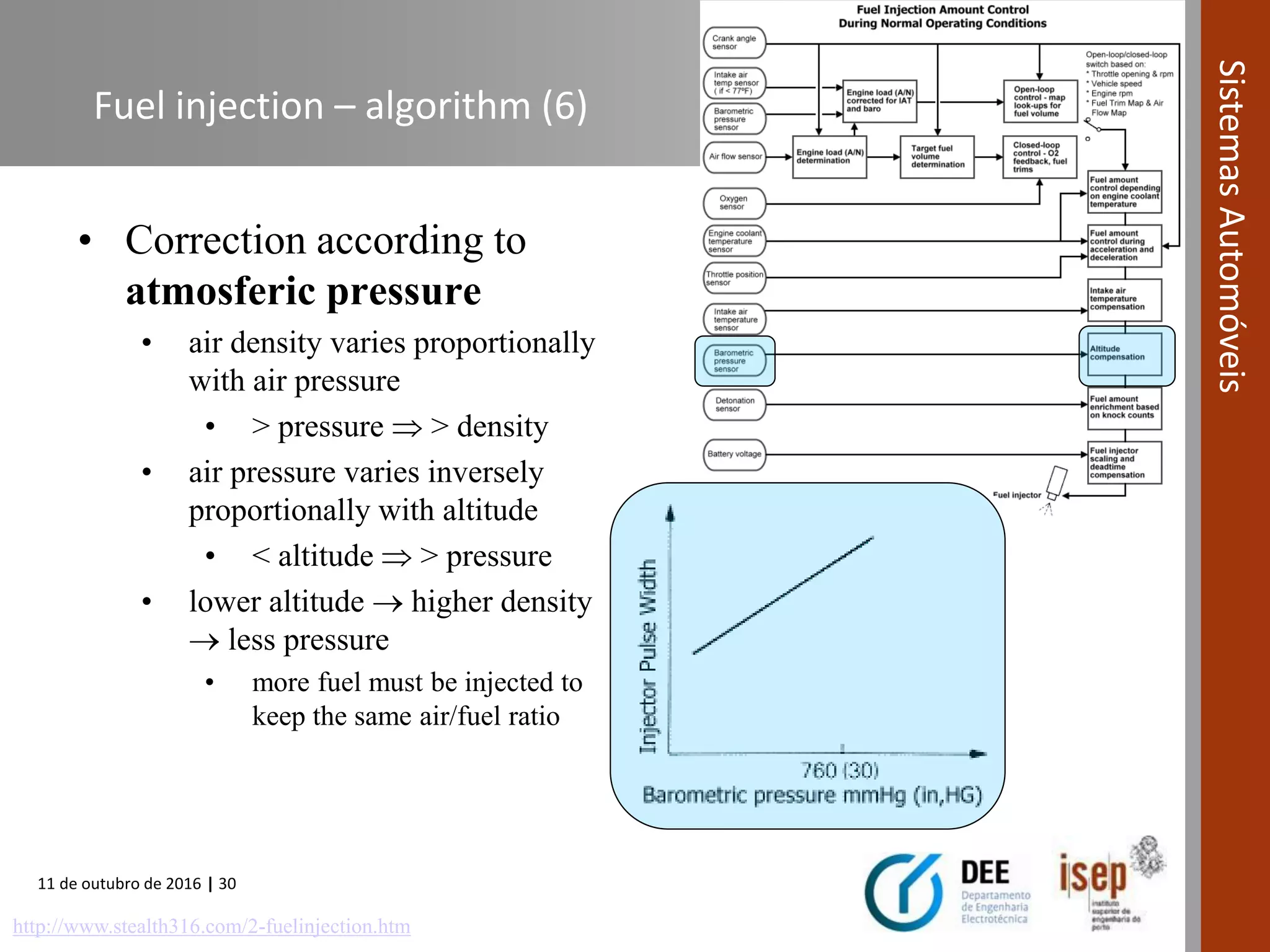
• Correction according to
atmosferic pressure
• air density varies proportionally
with air pressure
• > pressure  > density
• air pressure varies inversely
proportionally with altitude
• < altitude  > pressure
• lower altitude  higher density
 less pressure
• more fuel must be injected to
keep the same air/fuel ratio
http://www.stealth316.com/2-fuelinjection.htm
11 de outubro de 2016 | 31
SistemasAutomóveis
Fuel injection – algorithm (7)
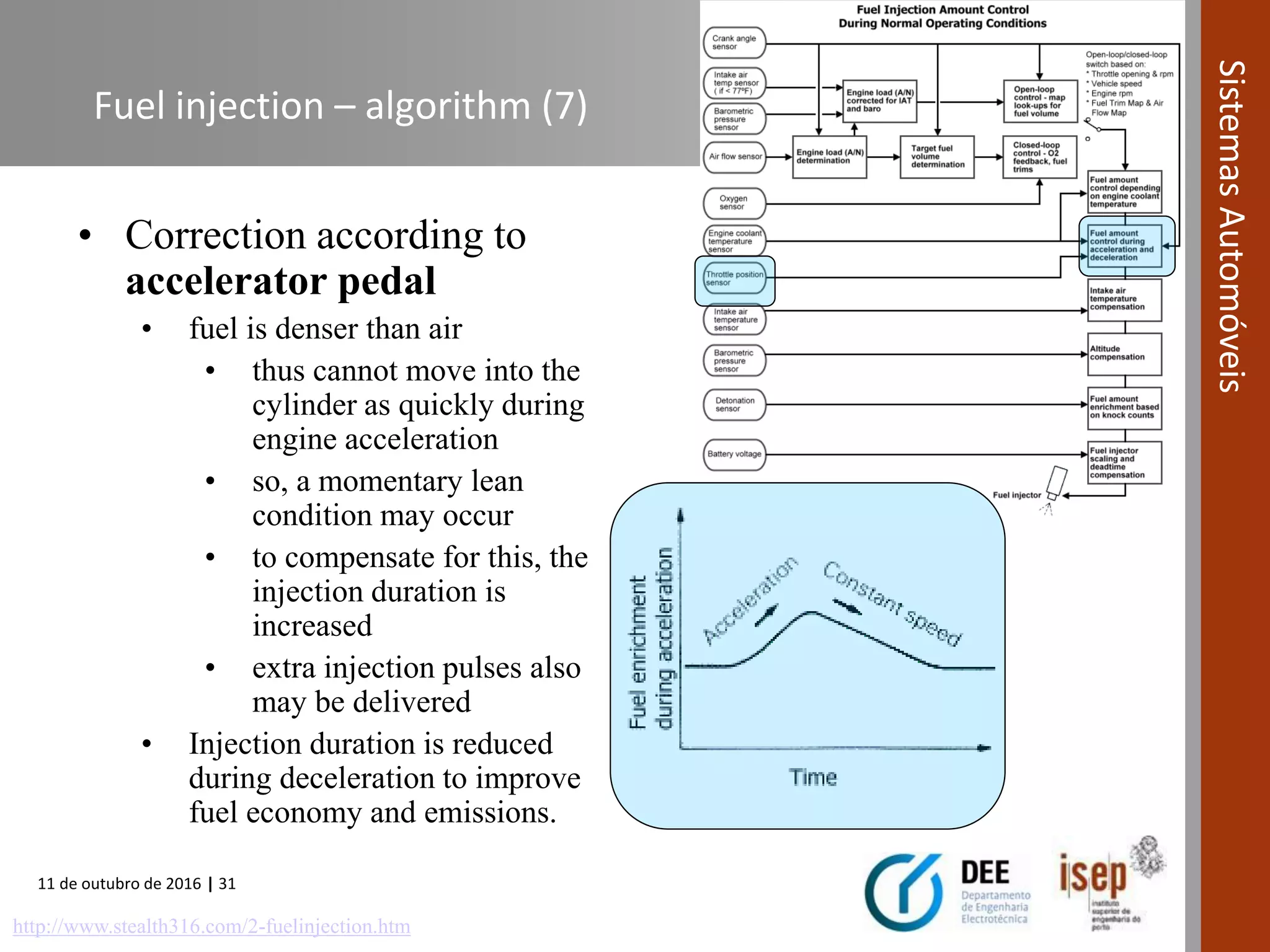
• Correction according to
accelerator pedal
• fuel is denser than air
• thus cannot move into the
cylinder as quickly during
engine acceleration
• so, a momentary lean
condition may occur
• to compensate for this, the
injection duration is
increased
• extra injection pulses also
may be delivered
• Injection duration is reduced
during deceleration to improve
fuel economy and emissions.
http://www.stealth316.com/2-fuelinjection.htm
11 de outubro de 2016 | 32
SistemasAutomóveis
Fuel injection – algorithm (8)
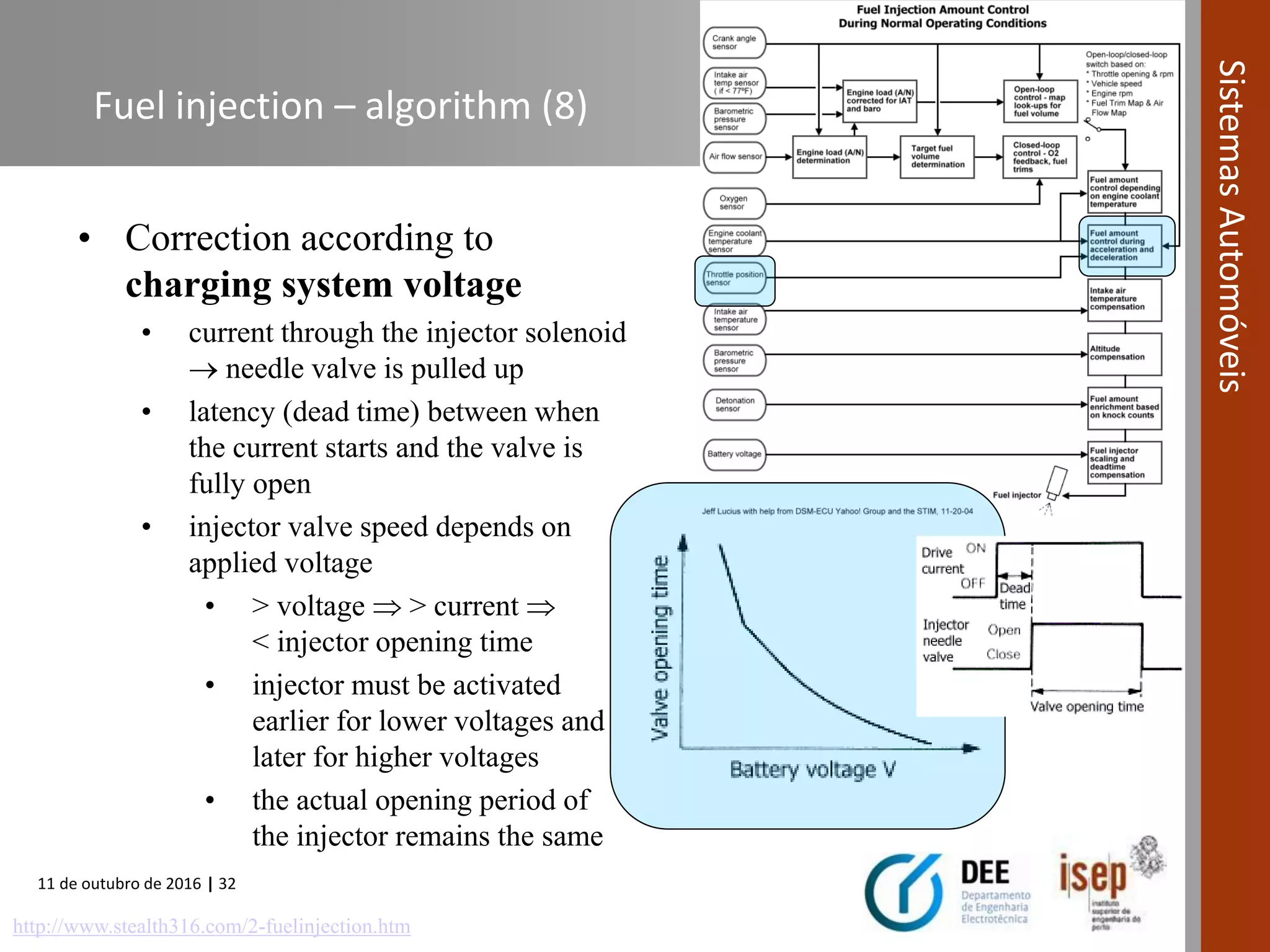
• Correction according to
charging system voltage
• current through the injector solenoid
 needle valve is pulled up
• latency (dead time) between when
the current starts and the valve is
fully open
• injector valve speed depends on
applied voltage
• > voltage  > current 
< injector opening time
• injector must be activated
earlier for lower voltages and
later for higher voltages
• the actual opening period of
the injector remains the same
http://www.stealth316.com/2-fuelinjection.htm
11 de outubro de 2016 | 33
SistemasAutomóveis
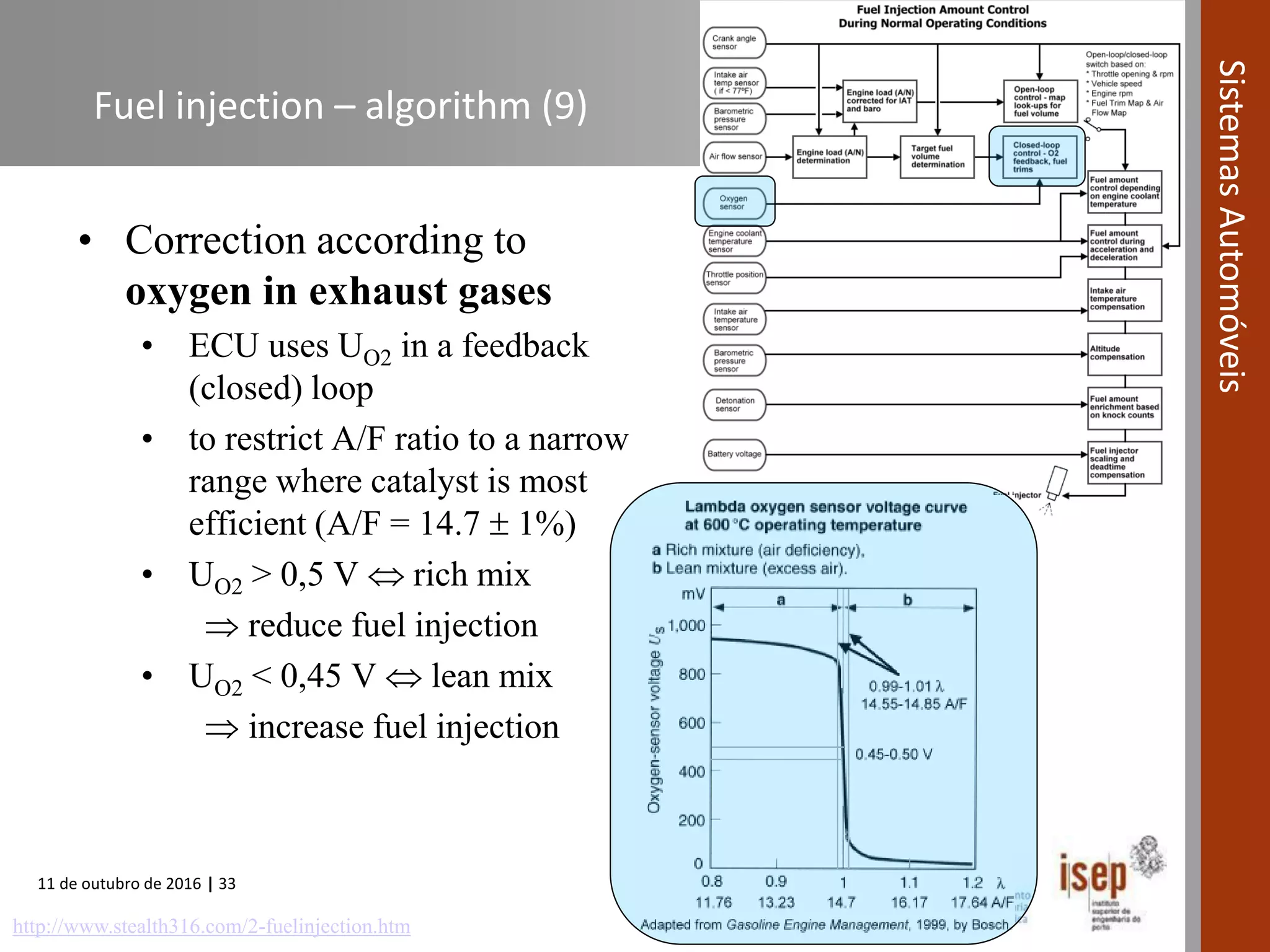
Fuel injection – algorithm (9)
• Correction according to
oxygen in exhaust gases
• ECU uses UO2 in a feedback
(closed) loop
• to restrict A/F ratio to a narrow
range where catalyst is most
efficient (A/F = 14.7  1%)
• UO2 > 0,5 V  rich mix
 reduce fuel injection
• UO2 < 0,45 V  lean mix
 increase fuel injection
http://www.stealth316.com/2-fuelinjection.htm
11 de outubro de 2016 | 34
SistemasAutomóveis
Outline
• Fuel systems classification
• SI fuel systems evolution
• Carburetor-based fuel systems
• Electronic Fuel Injection (EFI) systems
• Engine control – fundamentals
• Air/fuel mixture and combustion control subsystems
• Injection, idle speed and throttle position
11 de outubro de 2016 | 35
SistemasAutomóveis
Idle speed and throttle control
• Idle (or idling) state
• an ICE is considered to be “idle” if the two following conditions apply
• the throttle pedal/grip is not depressed
• the engine is uncoupled to the drivetrain
(either in neutral or with the clutch activated)
• Idle speed
• is the rotational speed of the crankshaft at idle state
• usually measured in revolutions (rotations) per minute (RPM)
• Idle Speed Control (ISC) (aka Idle Air Control (IAC))
• idle speed must be optimized so that
1. the engine runs smoothly (without vibrations)
2. the engine generates enough power to operate ancillary devices
• alternator, A/C, water/oil pumps, power steering
3. fuel consumption is minimized (lowest RPM)
11 de outubro de 2016 | 36
SistemasAutomóveis
Idle speed and throttle control
• Typical idle RPM:
• passenger-car = 600 – 1,000
• buses/trucks = 500 – 600
• motorcycles = 1000-1500
• Idle Speed Control can be
• purely mechanical
• as in carburetor-based fuel systems
• ECU-based, through the control of either
• bypass ISC valve (in the intake manifold)
• inputting air upstream and outputting air downstream the
throttle valve
• throttle valve
• Electronic Throttle Control (ETC), Throttle Actuator
Control (TAC) or Throttle-By-Wire
11 de outubro de 2016 | 37
SistemasAutomóveis
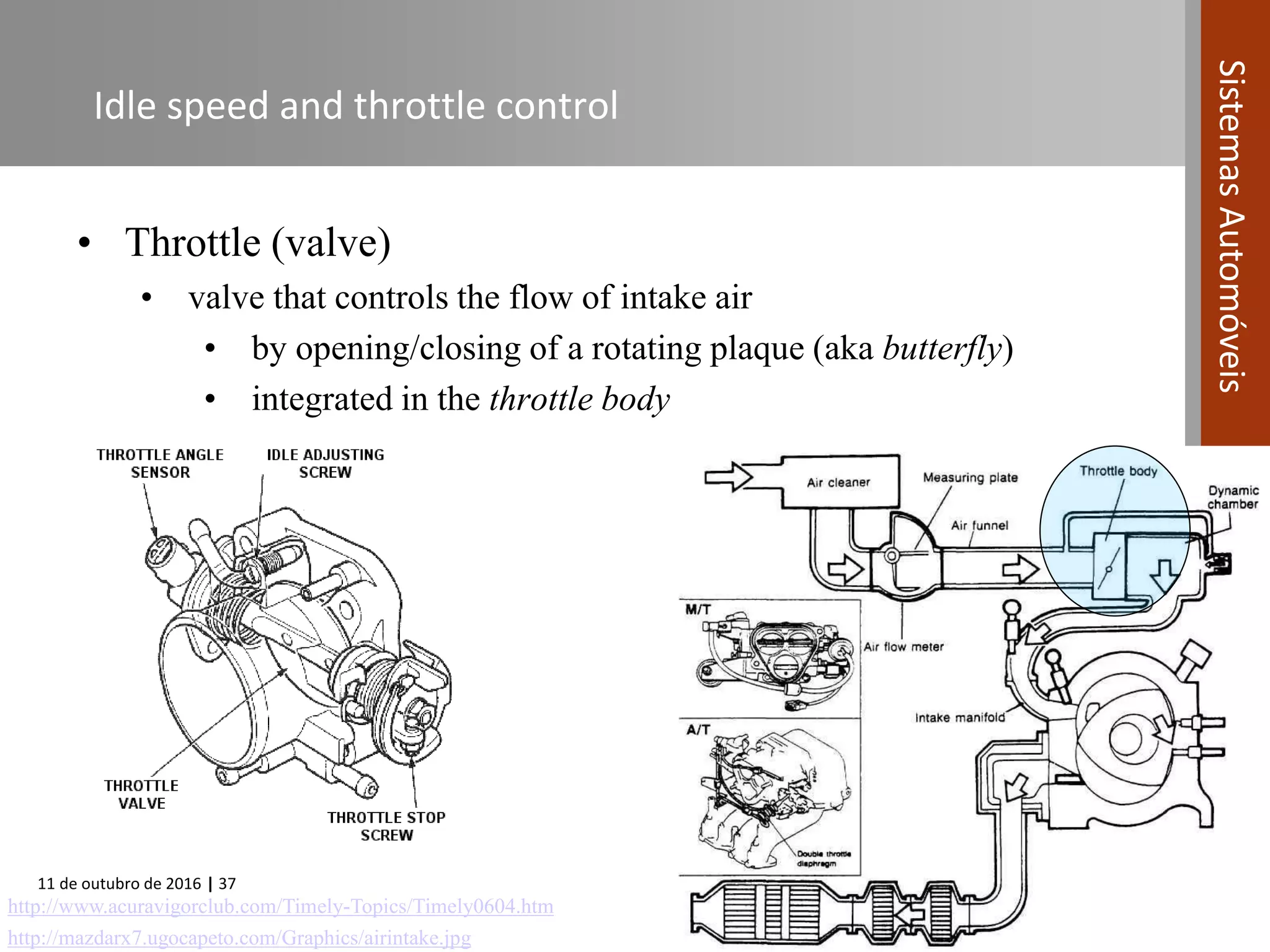
Idle speed and throttle control
• Throttle (valve)
• valve that controls the flow of intake air
• by opening/closing of a rotating plaque (aka butterfly)
• integrated in the throttle body
http://mazdarx7.ugocapeto.com/Graphics/airintake.jpg
http://www.acuravigorclub.com/Timely-Topics/Timely0604.htm
11 de outubro de 2016 | 38
SistemasAutomóveis
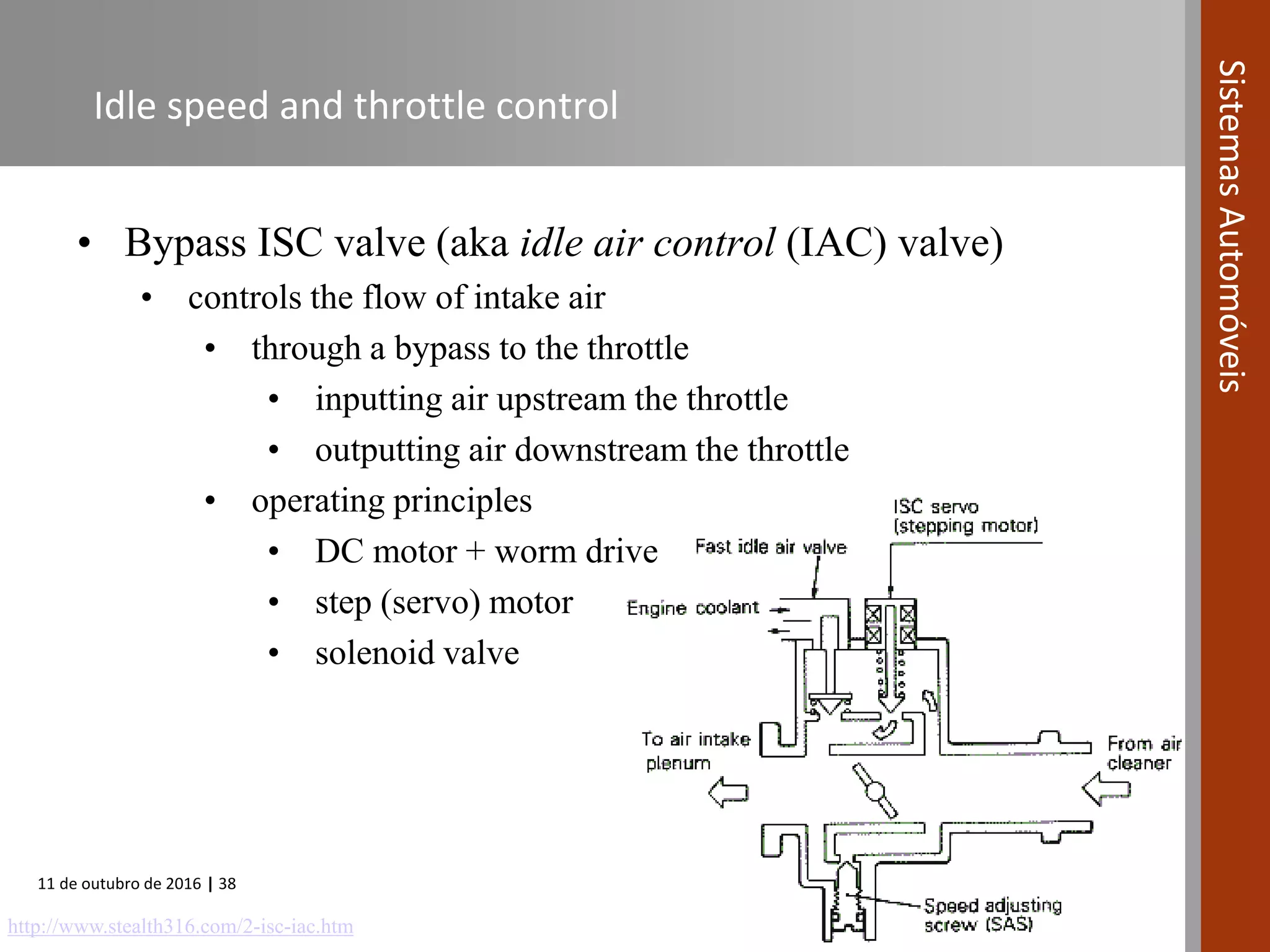
Idle speed and throttle control
• Bypass ISC valve (aka idle air control (IAC) valve)
• controls the flow of intake air
• through a bypass to the throttle
• inputting air upstream the throttle
• outputting air downstream the throttle
• operating principles
• DC motor + worm drive
• step (servo) motor
• solenoid valve
http://www.stealth316.com/2-isc-iac.htm
11 de outubro de 2016 | 39
SistemasAutomóveis
Idle speed and throttle control
• Throttle (valve)
• its actuation can be
• purely mechanically-controlled (driven by a cable or rod)
• ECU-controlled (throttle-by-wire)
http://www.croberts.com/Throttle-control-
system-defects.htm
11 de outubro de 2016 | 40
SistemasAutomóveis
Idle speed and throttle control
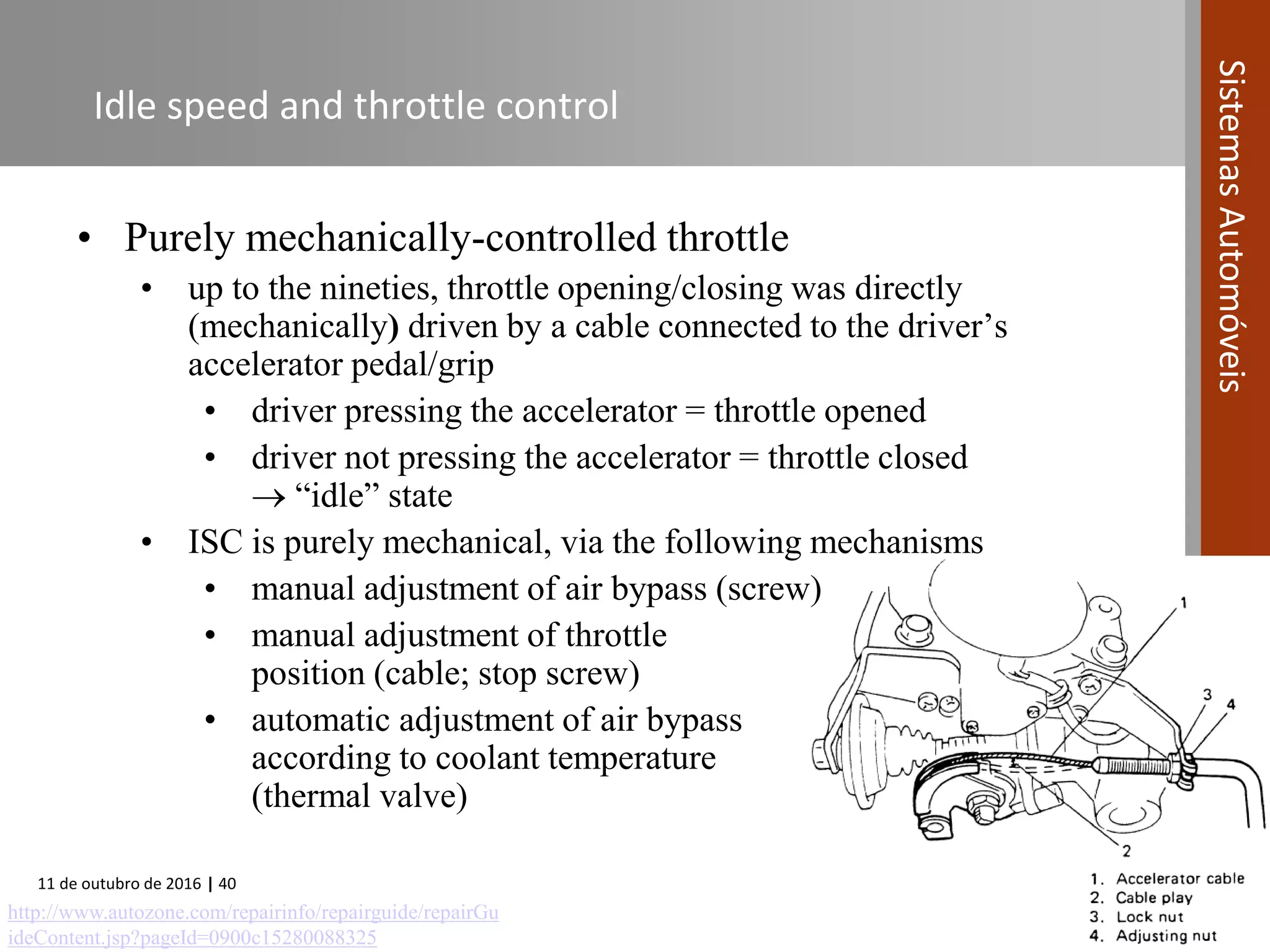
• Purely mechanically-controlled throttle
• up to the nineties, throttle opening/closing was directly
(mechanically) driven by a cable connected to the driver’s
accelerator pedal/grip
• driver pressing the accelerator = throttle opened
• driver not pressing the accelerator = throttle closed
 “idle” state
• ISC is purely mechanical, via the following mechanisms
• manual adjustment of air bypass (screw)
• manual adjustment of throttle
position (cable; stop screw)
• automatic adjustment of air bypass
according to coolant temperature
(thermal valve)
http://www.autozone.com/repairinfo/repairguide/repairGu
ideContent.jsp?pageId=0900c15280088325
11 de outubro de 2016 | 41
SistemasAutomóveis
Idle speed and throttle control
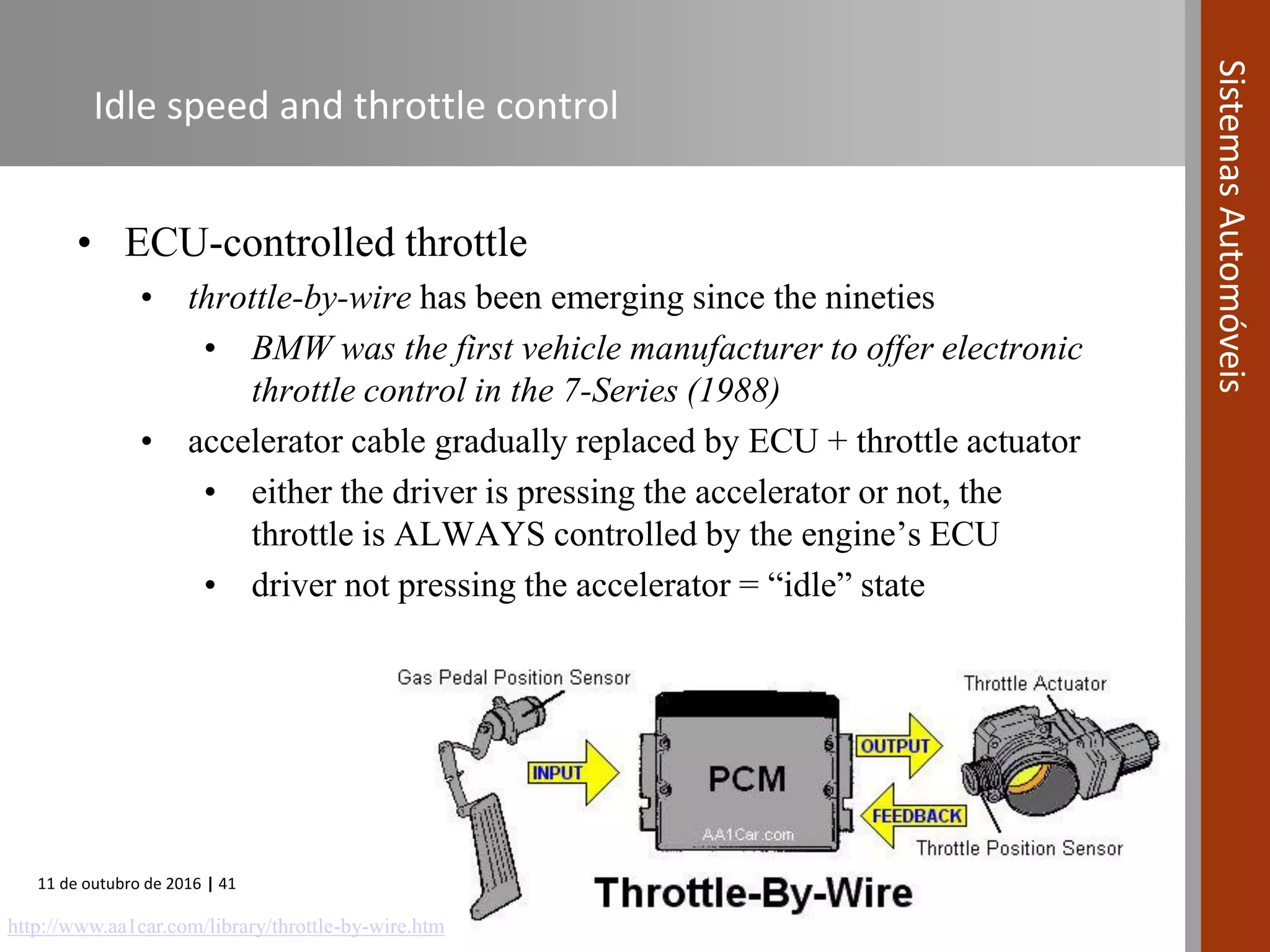
• ECU-controlled throttle
• throttle-by-wire has been emerging since the nineties
• BMW was the first vehicle manufacturer to offer electronic
throttle control in the 7-Series (1988)
• accelerator cable gradually replaced by ECU + throttle actuator
• either the driver is pressing the accelerator or not, the
throttle is ALWAYS controlled by the engine’s ECU
• driver not pressing the accelerator = “idle” state
http://www.aa1car.com/library/throttle-by-wire.htm
11 de outubro de 2016 | 42
SistemasAutomóveis
Outline
• Fuel systems classification
• SI fuel systems evolution
• Carburetor-based fuel systems
• Electronic Fuel Injection (EFI) systems
• Engine control – fundamentals
• Air/fuel mixture and combustion control subsystems
• Injection, idle speed and throttle position, fuel
pump/pressure
11 de outubro de 2016 | 43
SistemasAutomóveis
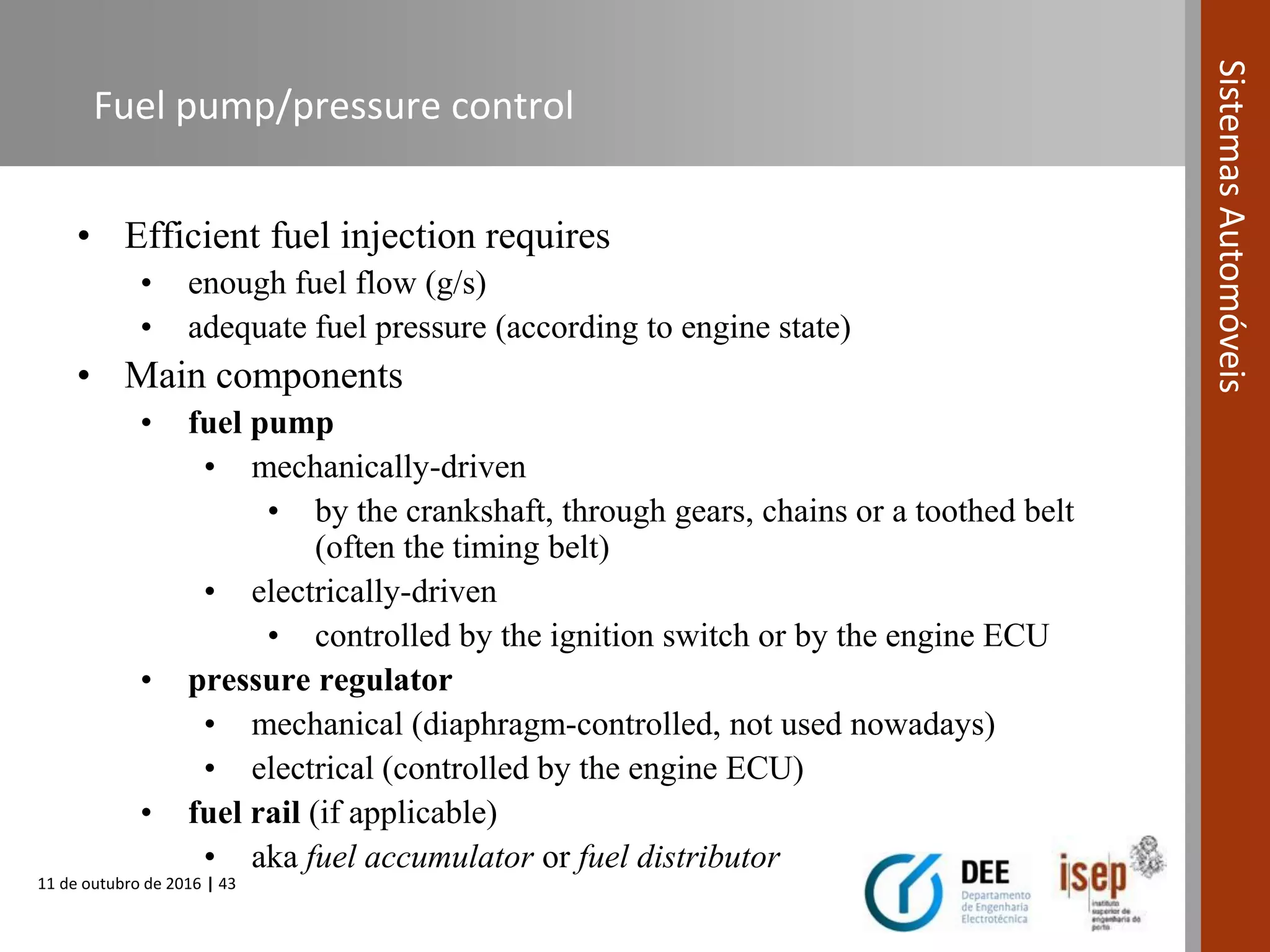
Fuel pump/pressure control
• Efficient fuel injection requires
• enough fuel flow (g/s)
• adequate fuel pressure (according to engine state)
• Main components
• fuel pump
• mechanically-driven
• by the crankshaft, through gears, chains or a toothed belt
(often the timing belt)
• electrically-driven
• controlled by the ignition switch or by the engine ECU
• pressure regulator
• mechanical (diaphragm-controlled, not used nowadays)
• electrical (controlled by the engine ECU)
• fuel rail (if applicable)
• aka fuel accumulator or fuel distributor
11 de outubro de 2016 | 44
SistemasAutomóveis
Fuel pump/pressure control
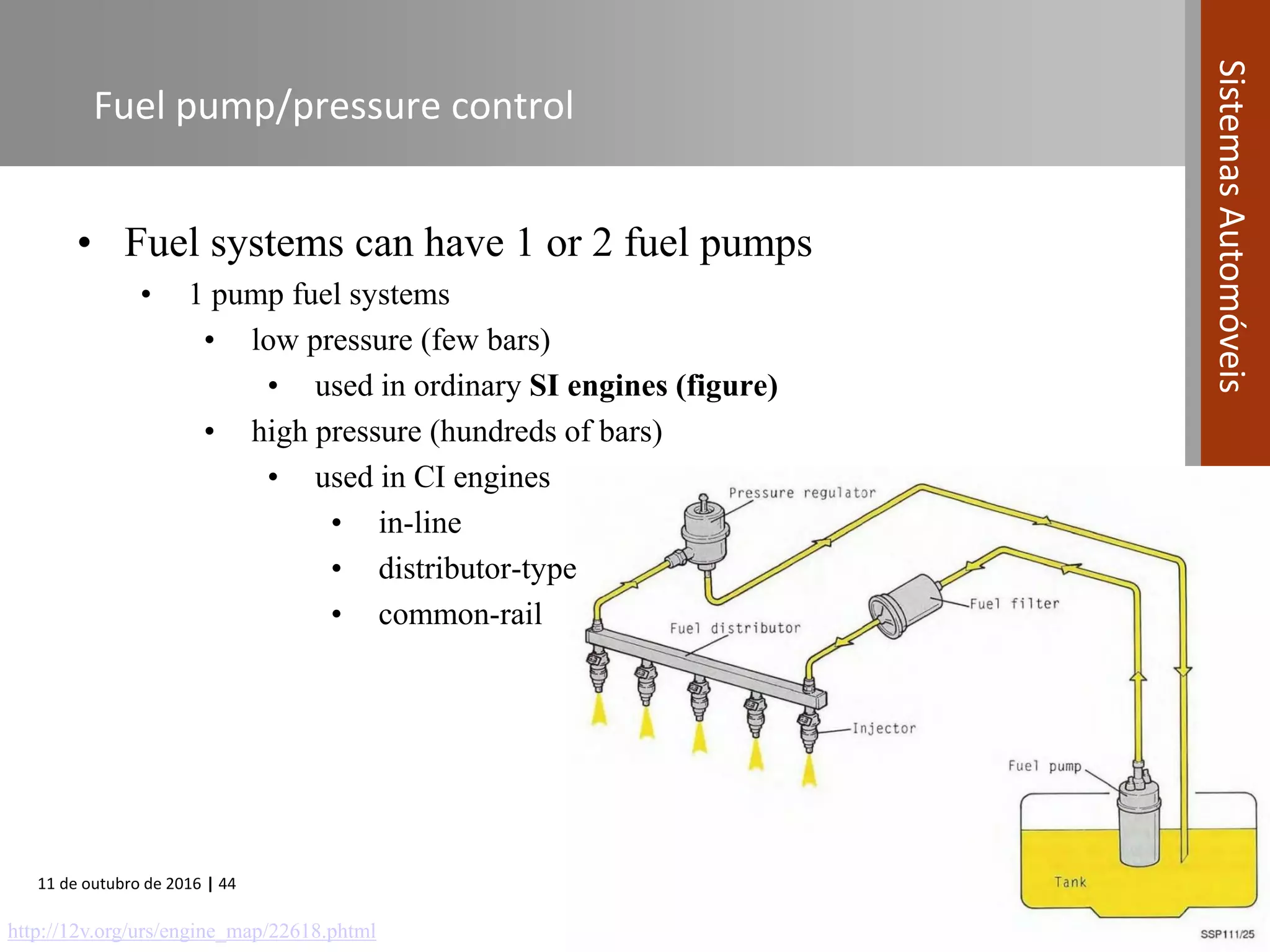
• Fuel systems can have 1 or 2 fuel pumps
• 1 pump fuel systems
• low pressure (few bars)
• used in ordinary SI engines (figure)
• high pressure (hundreds of bars)
• used in CI engines
• in-line
• distributor-type
• common-rail
http://12v.org/urs/engine_map/22618.phtml
11 de outubro de 2016 | 45
SistemasAutomóveis
Fuel pump/pressure control
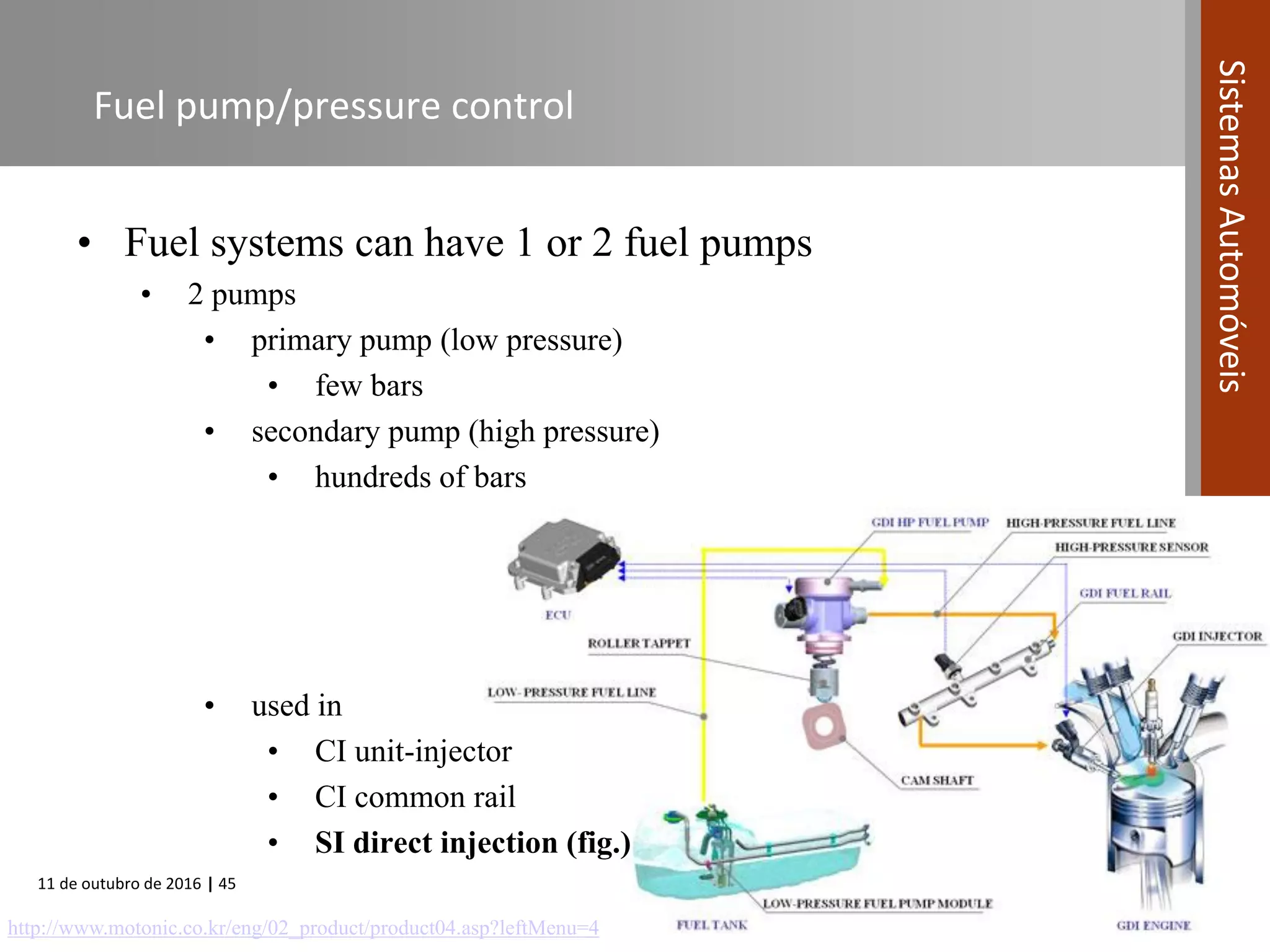
• Fuel systems can have 1 or 2 fuel pumps
• 2 pumps
• primary pump (low pressure)
• few bars
• secondary pump (high pressure)
• hundreds of bars
• used in
• CI unit-injector
• CI common rail
• SI direct injection (fig.)
http://www.motonic.co.kr/eng/02_product/product04.asp?leftMenu=4
11 de outubro de 2016 | 46
SistemasAutomóveis
Fuel pump/pressure control
• Pressure regulators are crucial for optimizing fuel
injection, and can be
• purely mechanically-controlled
• diaphragm-controlled, not used nowadays
• guarantees a “constant” pressure differential between the
fuel pressure in the accumulator and the air depression in
the intake manifold
• electrically-controlled
• controlled by the engine ECU
• enables an optimized control of the fuel pressure in the fuel
accumulator, according to engine/load conditions
11 de outubro de 2016 | 47
SistemasAutomóveis
Fuel pump/pressure control
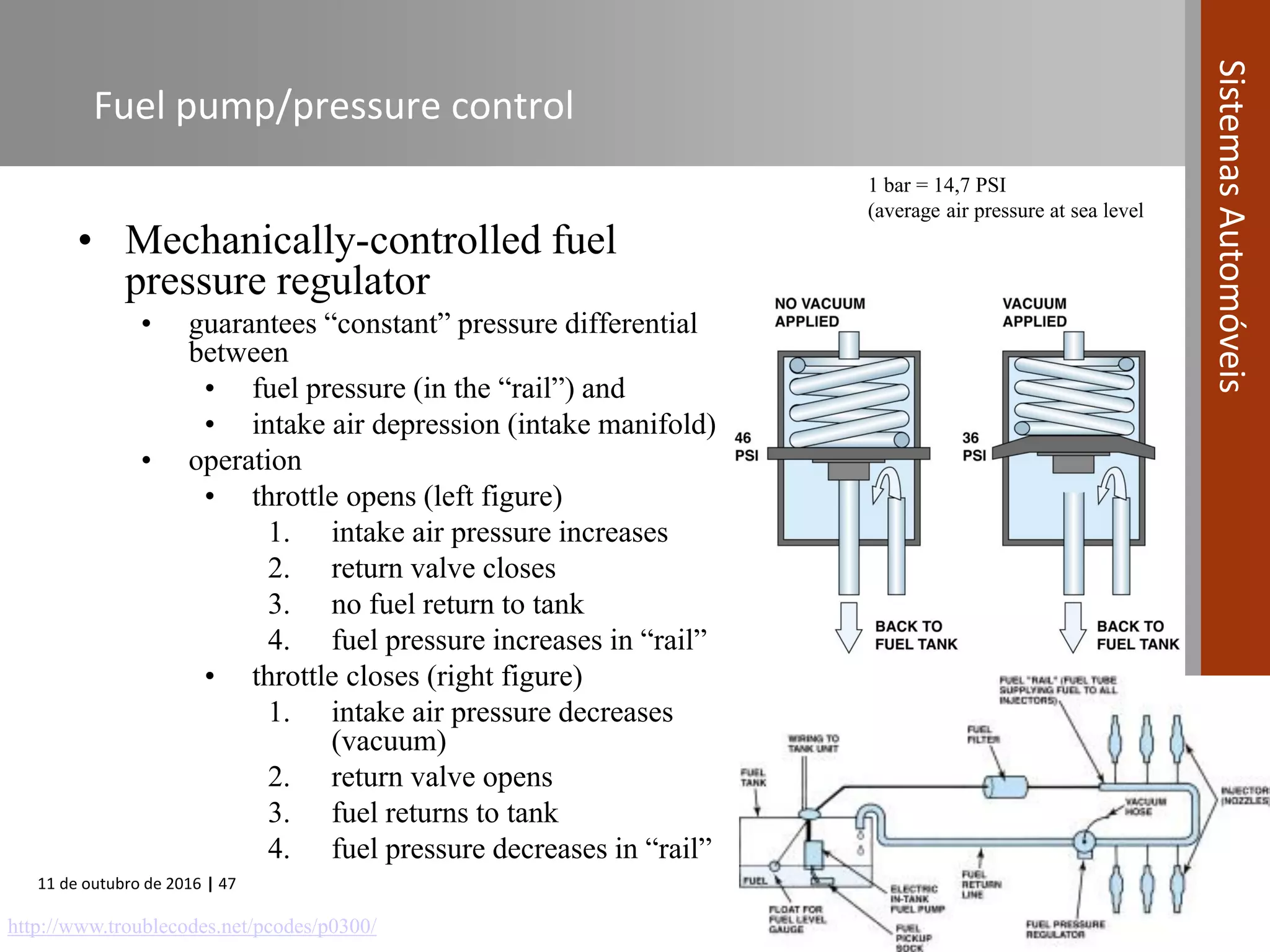
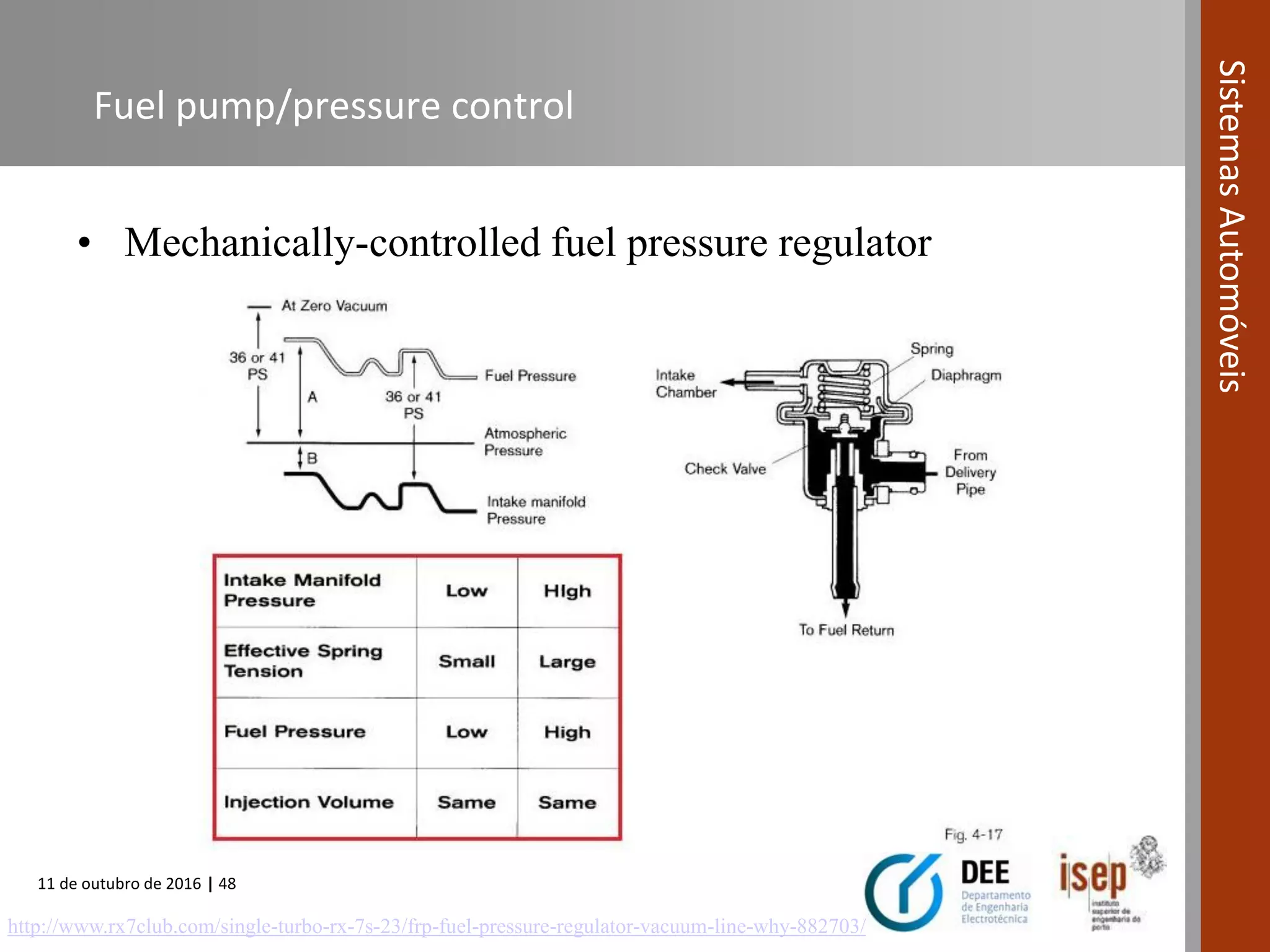
• Mechanically-controlled fuel
pressure regulator
• guarantees “constant” pressure differential
between
• fuel pressure (in the “rail”) and
• intake air depression (intake manifold)
• operation
• throttle opens (left figure)
1. intake air pressure increases
2. return valve closes
3. no fuel return to tank
4. fuel pressure increases in “rail”
• throttle closes (right figure)
1. intake air pressure decreases
(vacuum)
2. return valve opens
3. fuel returns to tank
4. fuel pressure decreases in “rail”
http://www.troublecodes.net/pcodes/p0300/
1 bar = 14,7 PSI
(average air pressure at sea level
11 de outubro de 2016 | 48
SistemasAutomóveis
Fuel pump/pressure control
• Mechanically-controlled fuel pressure regulator
http://www.rx7club.com/single-turbo-rx-7s-23/frp-fuel-pressure-regulator-vacuum-line-why-882703/
11 de outubro de 2016 | 49
SistemasAutomóveis
Fuel pump/pressure control
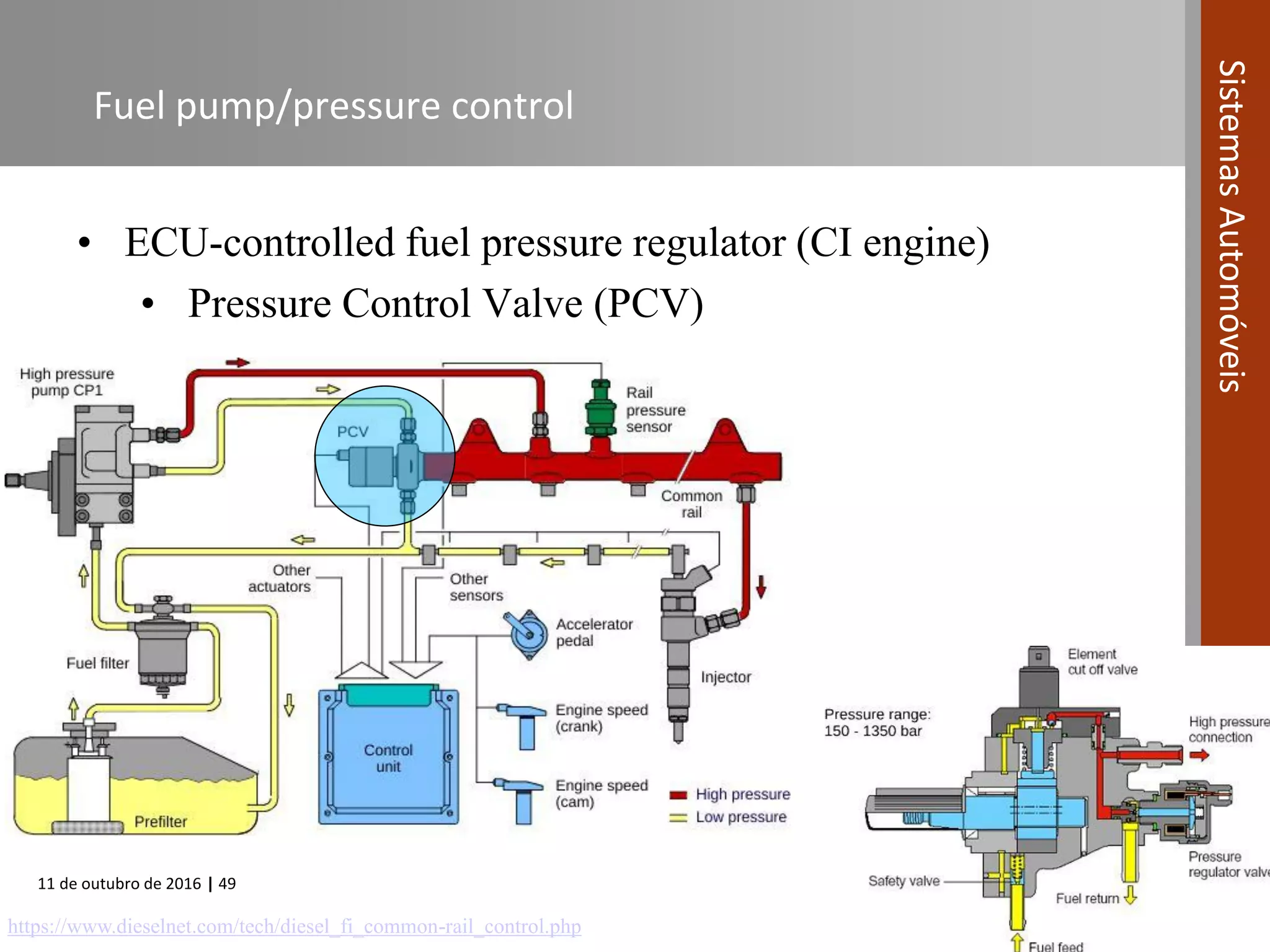
• ECU-controlled fuel pressure regulator (CI engine)
• Pressure Control Valve (PCV)
https://www.dieselnet.com/tech/diesel_fi_common-rail_control.php
11 de outubro de 2016 | 50
SistemasAutomóveis
Fuel pump/pressure control
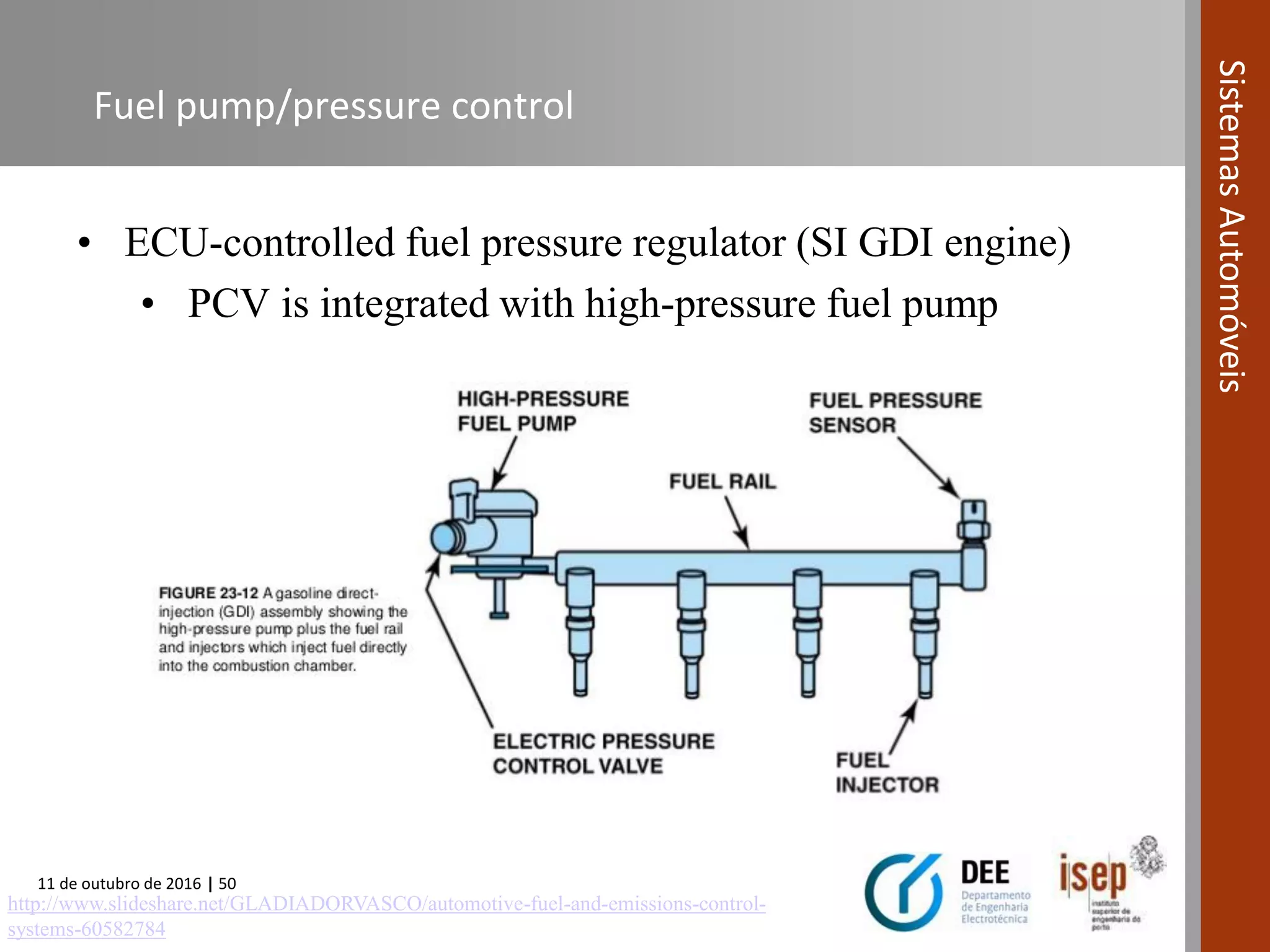
• ECU-controlled fuel pressure regulator (SI GDI engine)
• PCV is integrated with high-pressure fuel pump
http://www.slideshare.net/GLADIADORVASCO/automotive-fuel-and-emissions-control-
systems-60582784
11 de outubro de 2016 | 51
SistemasAutomóveis
Ignition
• (ignition will be addressed in a separated module)
https://autoelectricalsystems.wordpress.com/2015/12/05/engine-
management-system-for-petrol-engines/
11 de outubro de 2016 | 52
SistemasAutomóveis
Outline
• Fuel systems classification
• SI fuel systems evolution
• Carburetor-based fuel systems
• Electronic Fuel Injection (EFI) systems
• Engine control – fundamentals
• Air/fuel mixture and combustion control subsystems
• Injection, idle speed and throttle position, fuel pump/pressure,
ignition, supercharging (forced air induction)
11 de outubro de 2016 | 53
SistemasAutomóveis
Supercharging
• Supercharging = forced air induction
• compress intake air  increase air mass (flow)
• power output is increased for a given displacement and engine
speed
• Types
• mechanically-driven –supercharger
• directly driven by crankshaft (belt)
• exhaust-gas-driven – turbocharger
• driven by exhaust gases (turbine)
• hybrid (mechanically-driven) – twin-charger
• supercharger + turbocharger
• hybrid (electrically-driven) – electric supercharger
• electric motor/generator supporting the turbo/supercharger
11 de outubro de 2016 | 54
SistemasAutomóveis
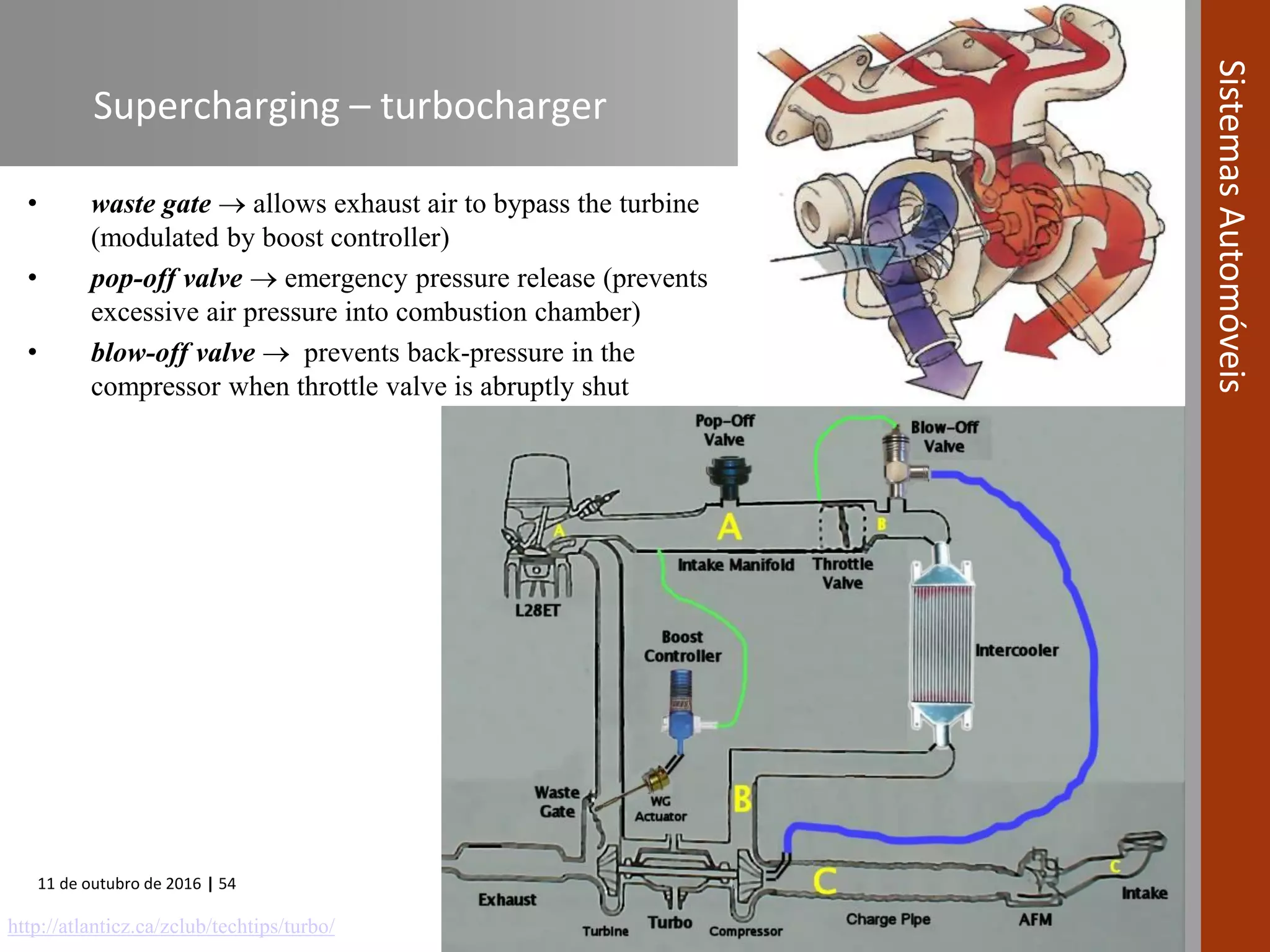
Supercharging – turbocharger
• waste gate  allows exhaust air to bypass the turbine
(modulated by boost controller)
• pop-off valve  emergency pressure release (prevents
excessive air pressure into combustion chamber)
• blow-off valve  prevents back-pressure in the
compressor when throttle valve is abruptly shut
http://atlanticz.ca/zclub/techtips/turbo/
11 de outubro de 2016 | 55
SistemasAutomóveis
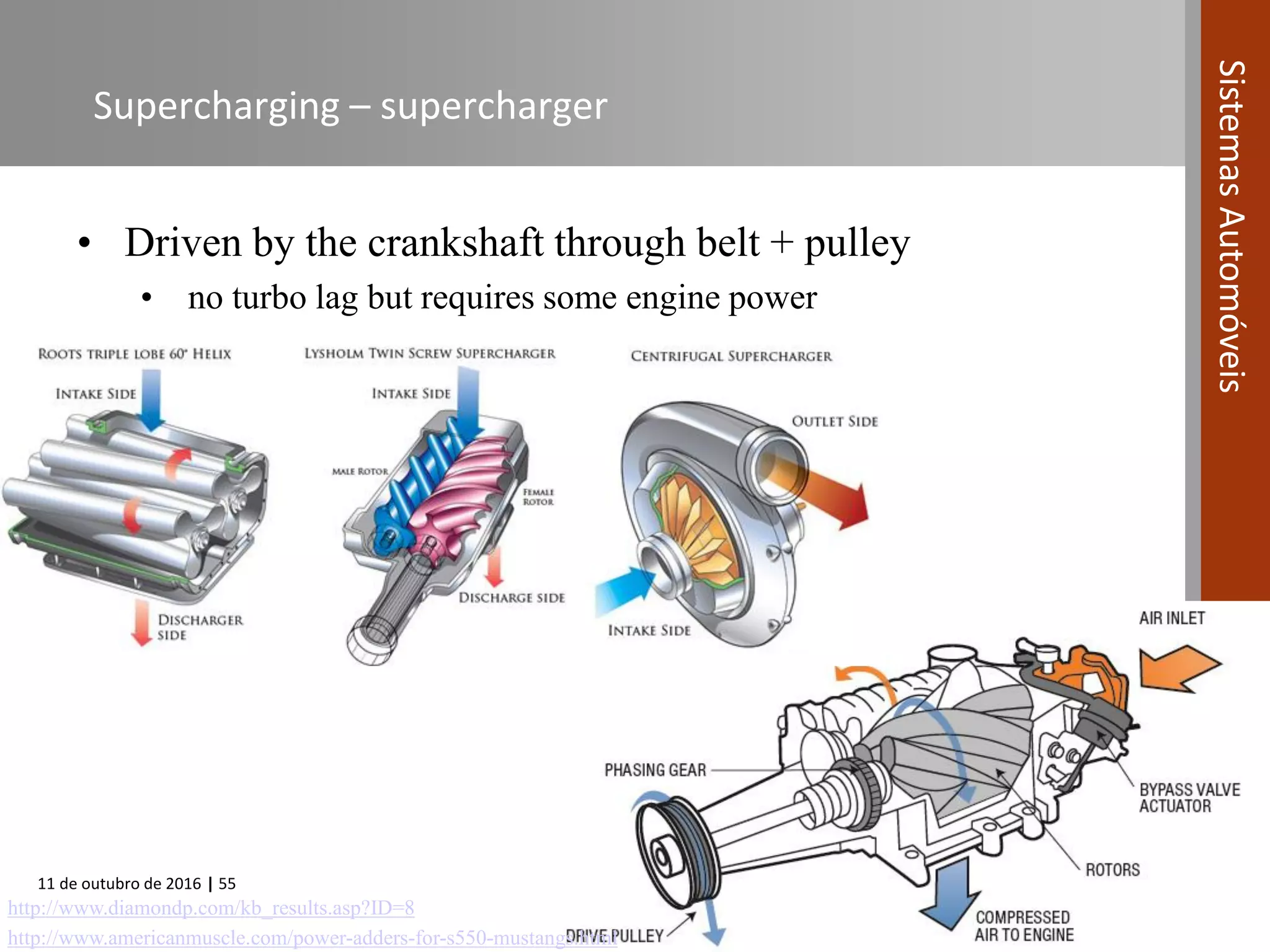
Supercharging – supercharger
http://www.diamondp.com/kb_results.asp?ID=8
• Driven by the crankshaft through belt + pulley
• no turbo lag but requires some engine power
http://www.americanmuscle.com/power-adders-for-s550-mustangs.html
11 de outubro de 2016 | 56
SistemasAutomóveis
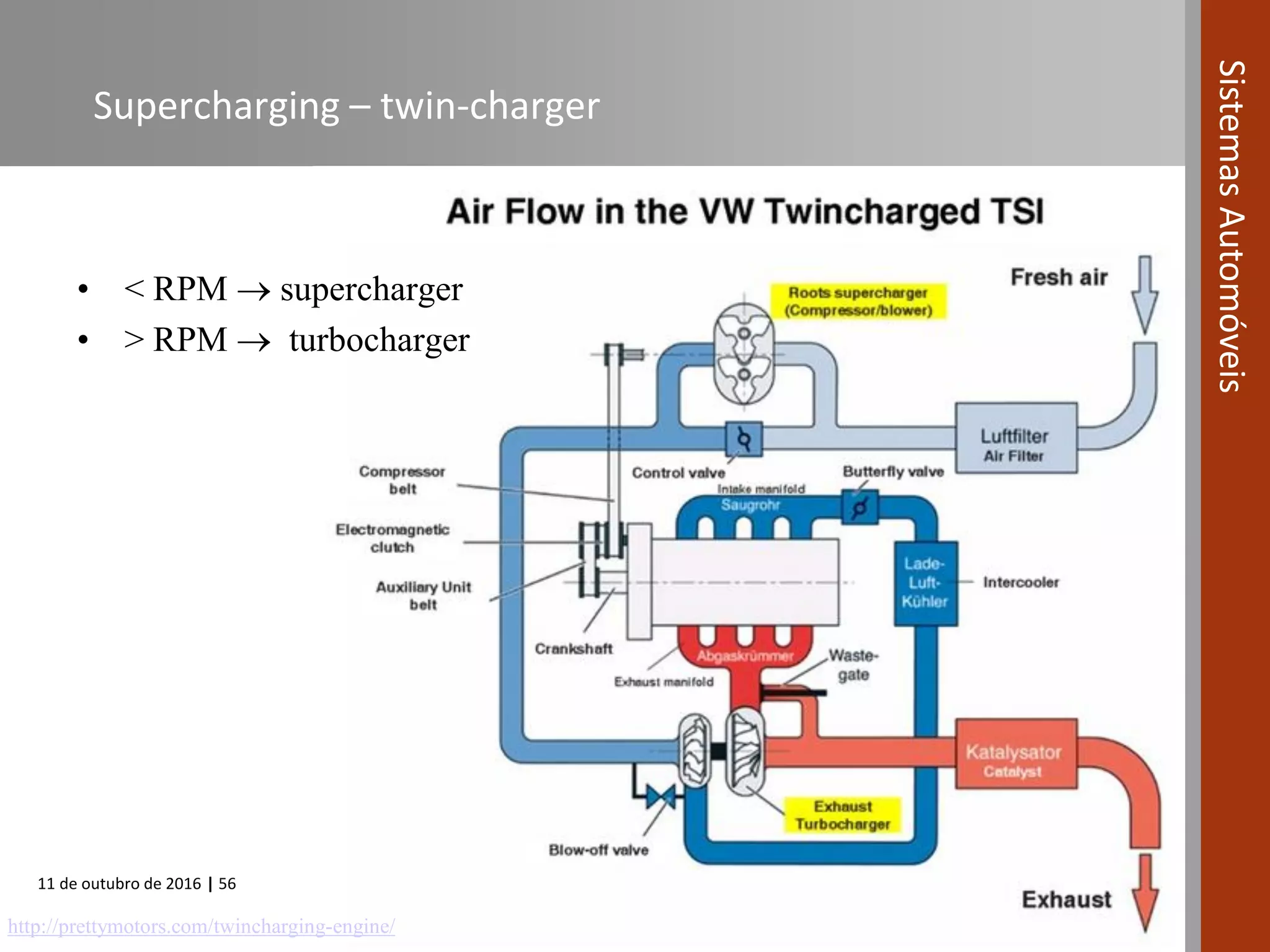
Supercharging – twin-charger
• < RPM  supercharger
• > RPM  turbocharger
http://prettymotors.com/twincharging-engine/
11 de outubro de 2016 | 57
SistemasAutomóveis
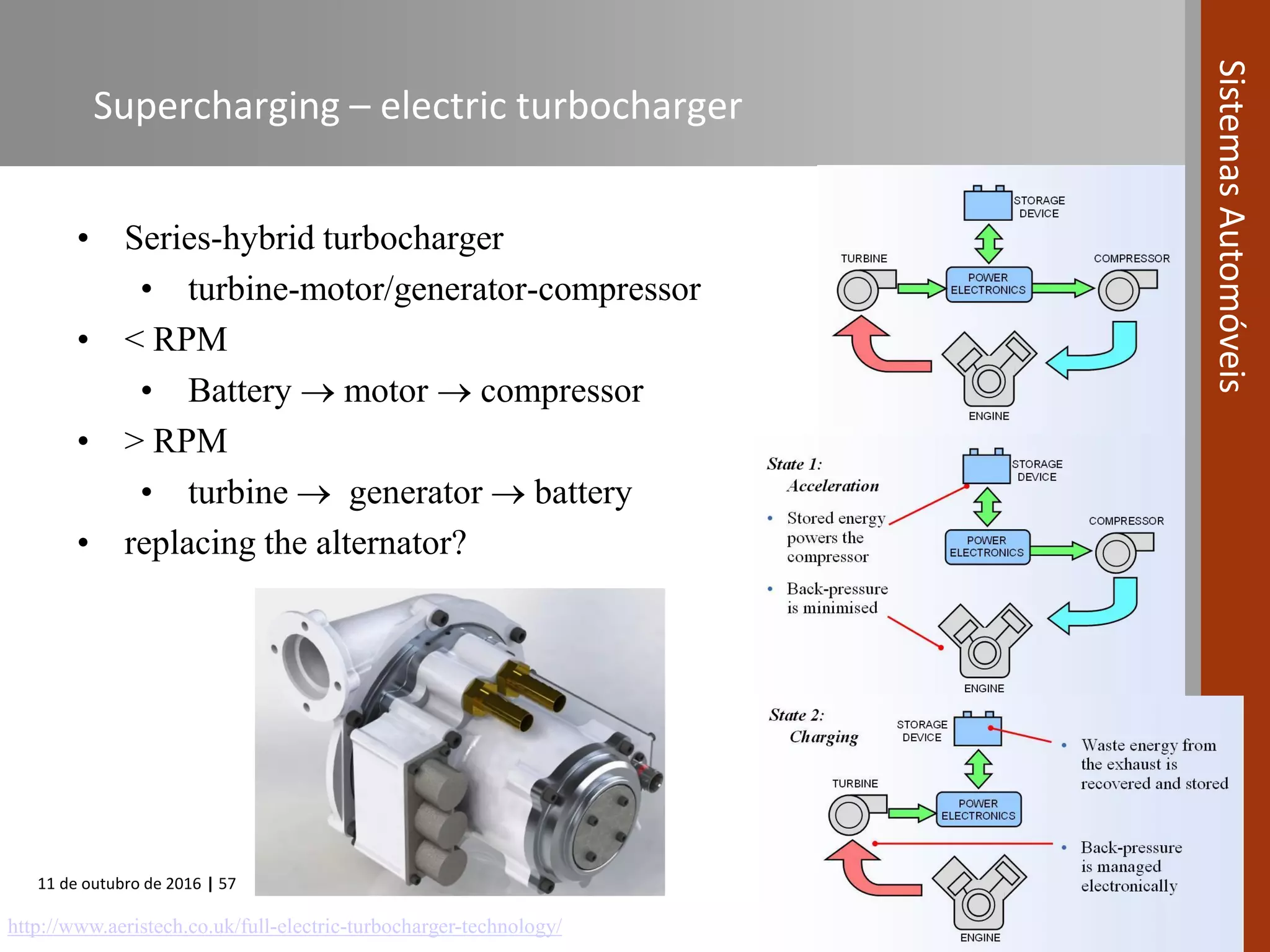
Supercharging – electric turbocharger
• Series-hybrid turbocharger
• turbine-motor/generator-compressor
• < RPM
• Battery  motor  compressor
• > RPM
• turbine  generator  battery
• replacing the alternator?
http://www.aeristech.co.uk/full-electric-turbocharger-technology/
11 de outubro de 2016 | 58
SistemasAutomóveis
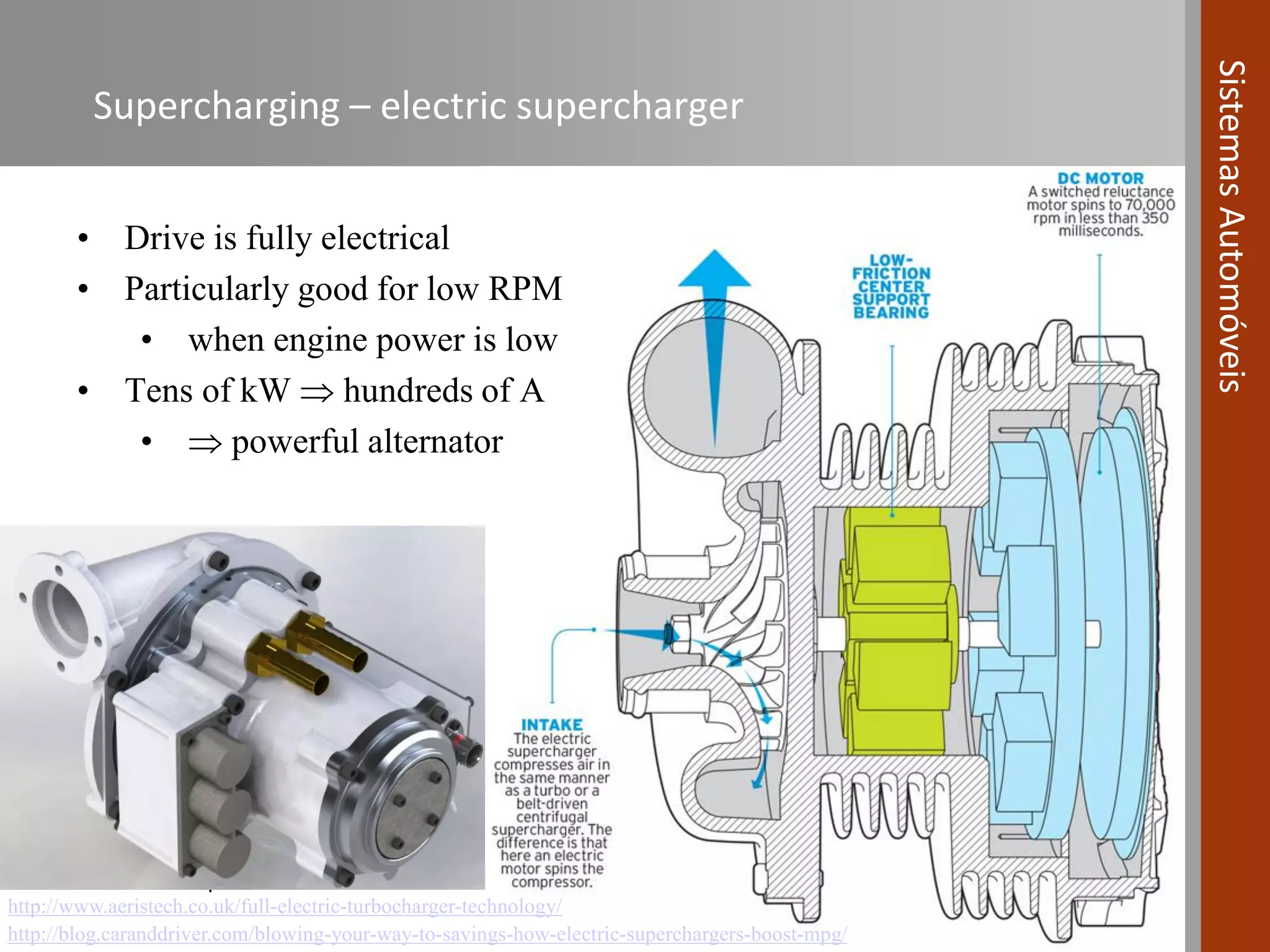
Supercharging – electric supercharger
• Drive is fully electrical
• Particularly good for low RPM
• when engine power is low
• Tens of kW  hundreds of A
•  powerful alternator
http://www.aeristech.co.uk/full-electric-turbocharger-technology/
http://blog.caranddriver.com/blowing-your-way-to-savings-how-electric-superchargers-boost-mpg/
11 de outubro de 2016 | 59
SistemasAutomóveis
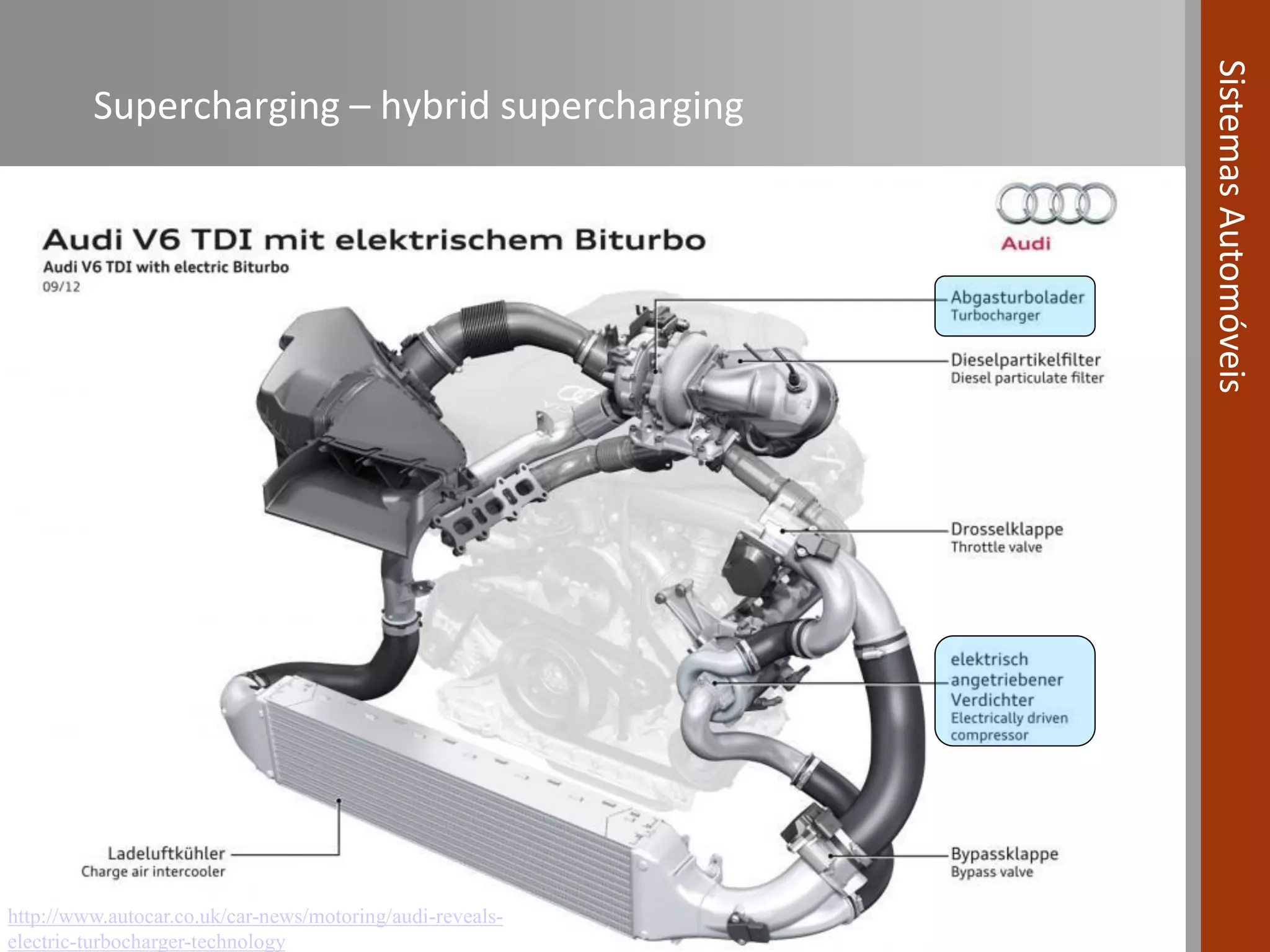
Supercharging – hybrid supercharging
• < RPM  supercharger
• > RPM  turbocharger
http://www.autocar.co.uk/car-news/motoring/audi-reveals-
electric-turbocharger-technology
11 de outubro de 2016 | 60
SistemasAutomóveis
Outline
• Objective of fuel systems
• Classification of fuel systems
• Evolution – technology, regulations
• Carburetor-based fuel systems
• Electronic Fuel Injection (EFI) systems
• Engine control – fundamentals
• Air/fuel mixture and combustion control subsystems
• Injection, idle speed and throttle position, fuel pump/pressure,
ignition, supercharging
• Exhaust subsystem
• exhaust, EGR, oxygen sensors heating
11 de outubro de 2016 | 61
SistemasAutomóveis
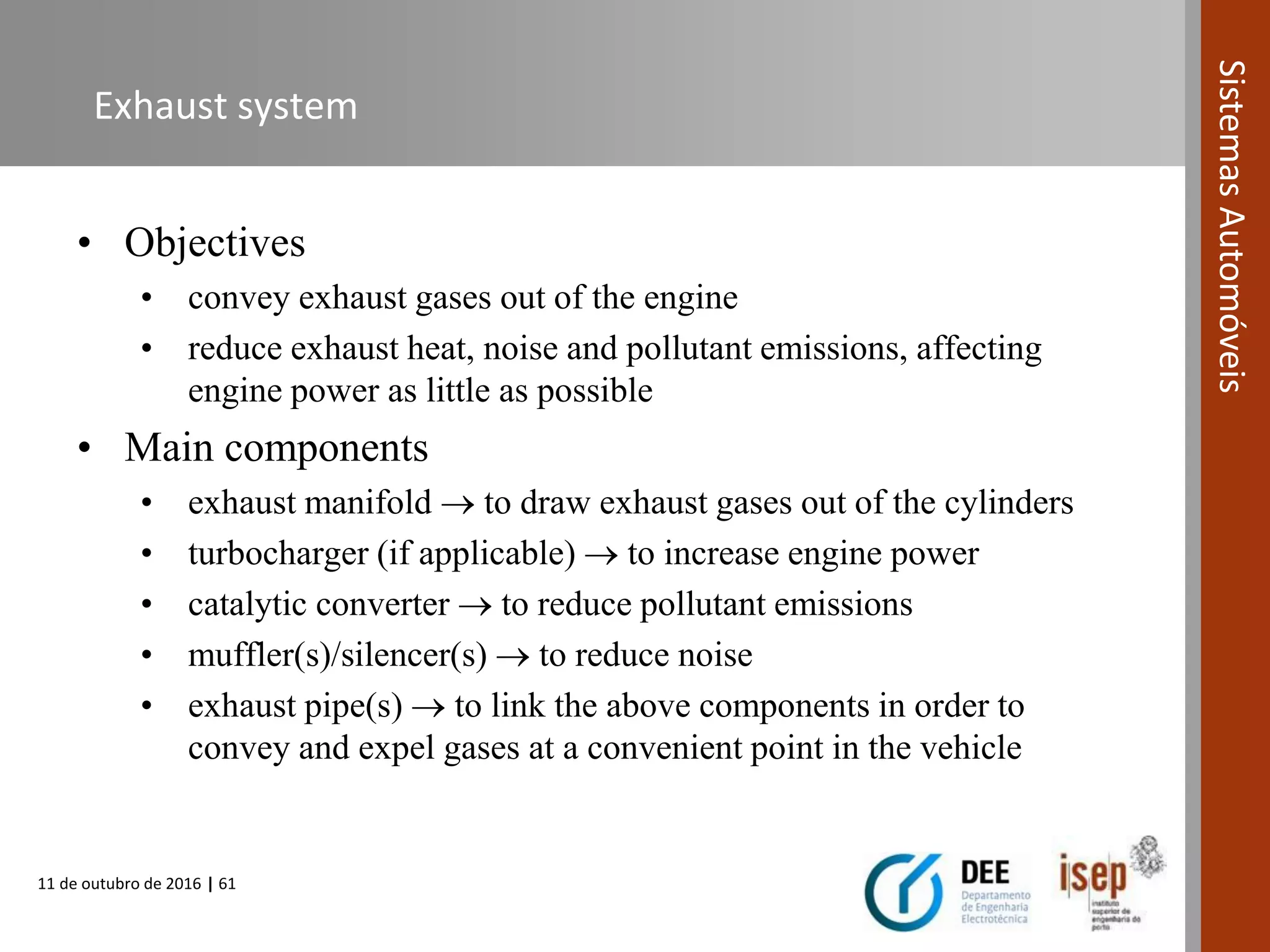
Exhaust system
• Objectives
• convey exhaust gases out of the engine
• reduce exhaust heat, noise and pollutant emissions, affecting
engine power as little as possible
• Main components
• exhaust manifold  to draw exhaust gases out of the cylinders
• turbocharger (if applicable)  to increase engine power
• catalytic converter  to reduce pollutant emissions
• muffler(s)/silencer(s)  to reduce noise
• exhaust pipe(s)  to link the above components in order to
convey and expel gases at a convenient point in the vehicle
11 de outubro de 2016 | 62
SistemasAutomóveis
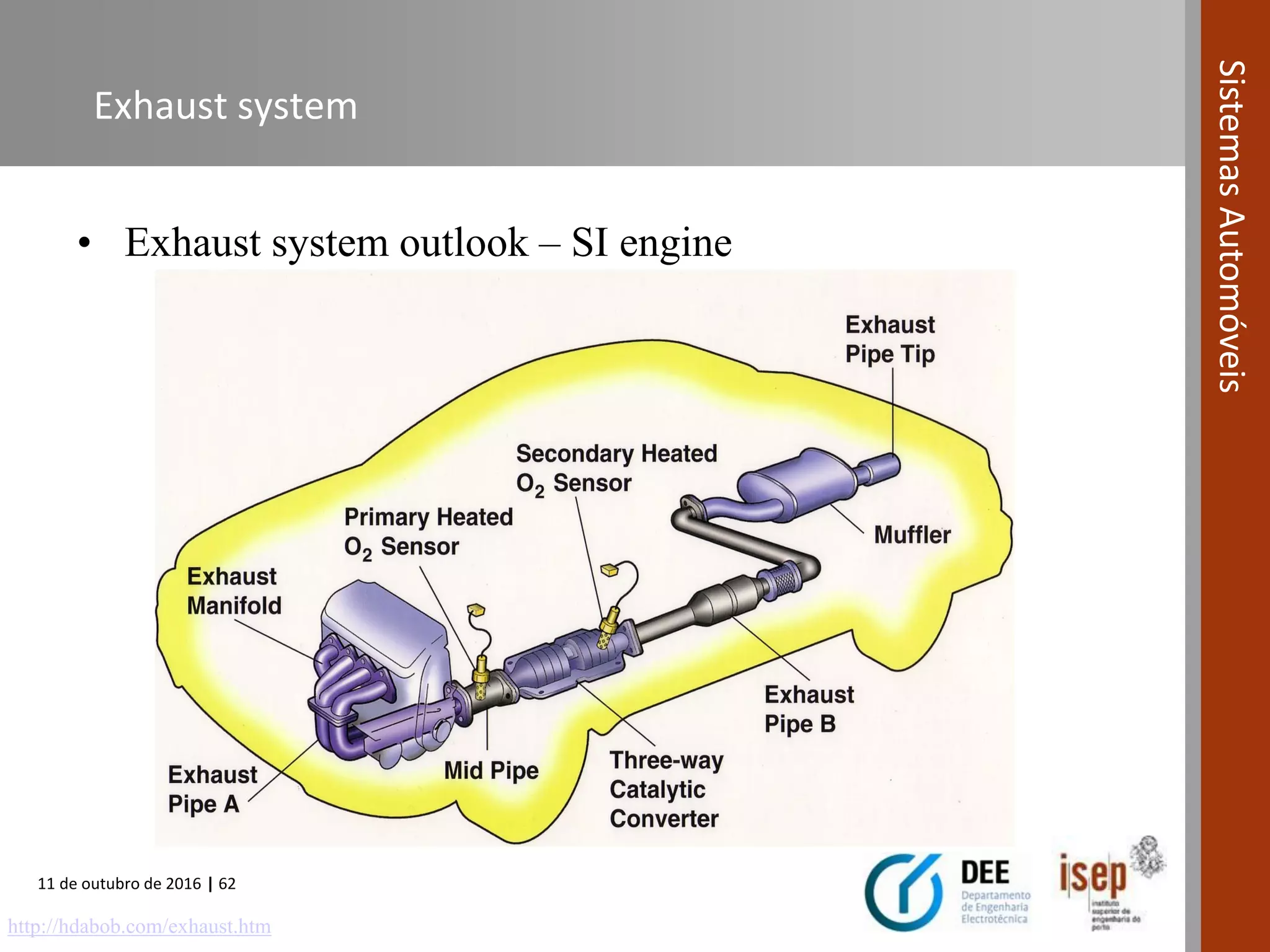
Exhaust system
• Exhaust system outlook – SI engine
http://hdabob.com/exhaust.htm
11 de outubro de 2016 | 63
SistemasAutomóveis
Exhaust gas recirculation (EGR)
• recirculates part of the exhaust gases into the intake
• 5-15% in SI engines
• up to 50% in CI engines
• EGR aim is to meet emissions standards
• most ICE (SI and CI) must have EGR
• some modern ICE do not need EGR
• e.g. use selective catalytic reduction (SCR) to reduce NOx
11 de outubro de 2016 | 64
SistemasAutomóveis
Exhaust gas recirculation (EGR)
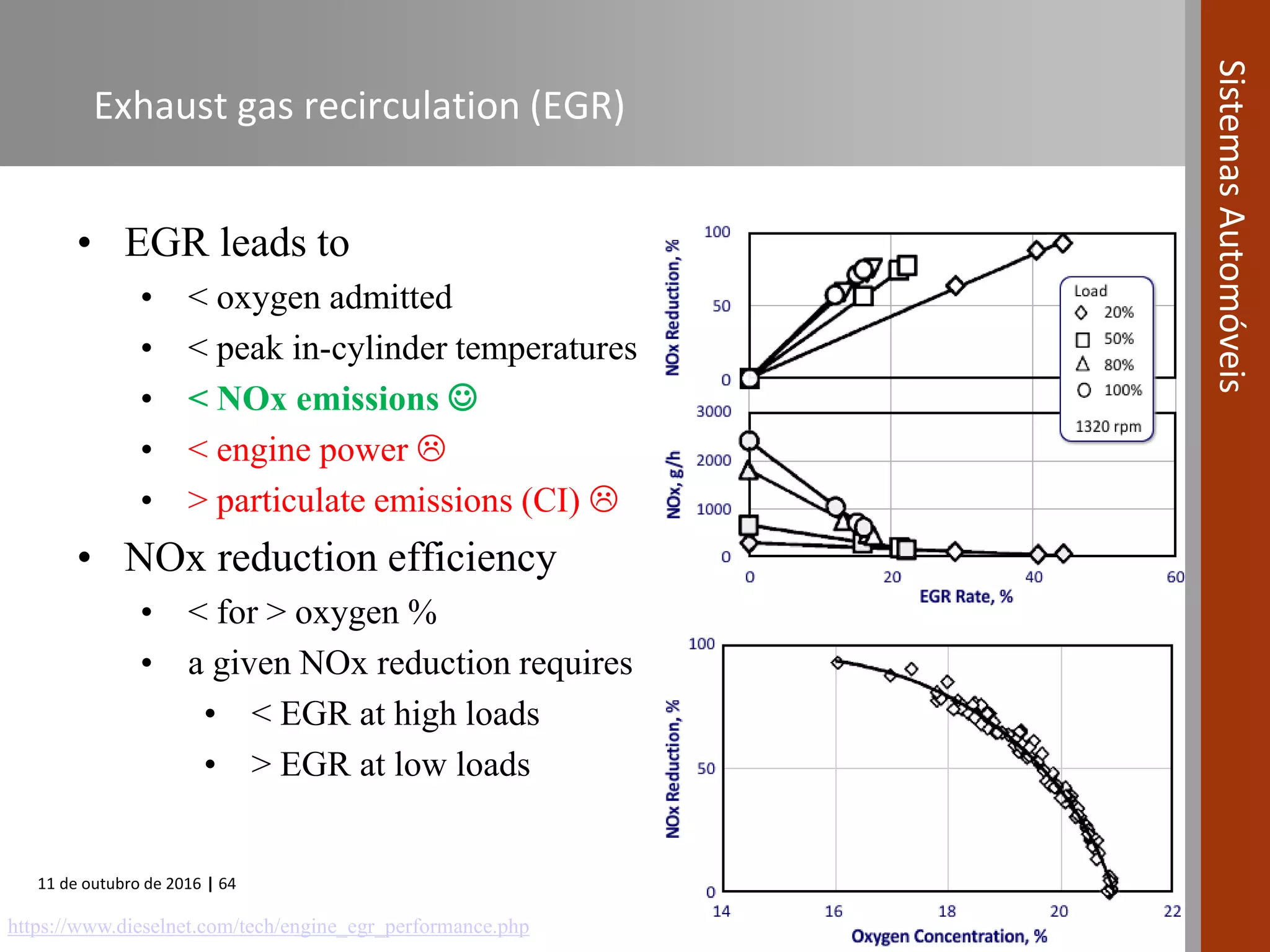
• EGR leads to
• < oxygen admitted
• < peak in-cylinder temperatures
• < NOx emissions 
• < engine power 
• > particulate emissions (CI) 
• NOx reduction efficiency
• < for > oxygen %
• a given NOx reduction requires
• < EGR at high loads
• > EGR at low loads
https://www.dieselnet.com/tech/engine_egr_performance.php
11 de outubro de 2016 | 65
SistemasAutomóveis
Exhaust gas recirculation (EGR)
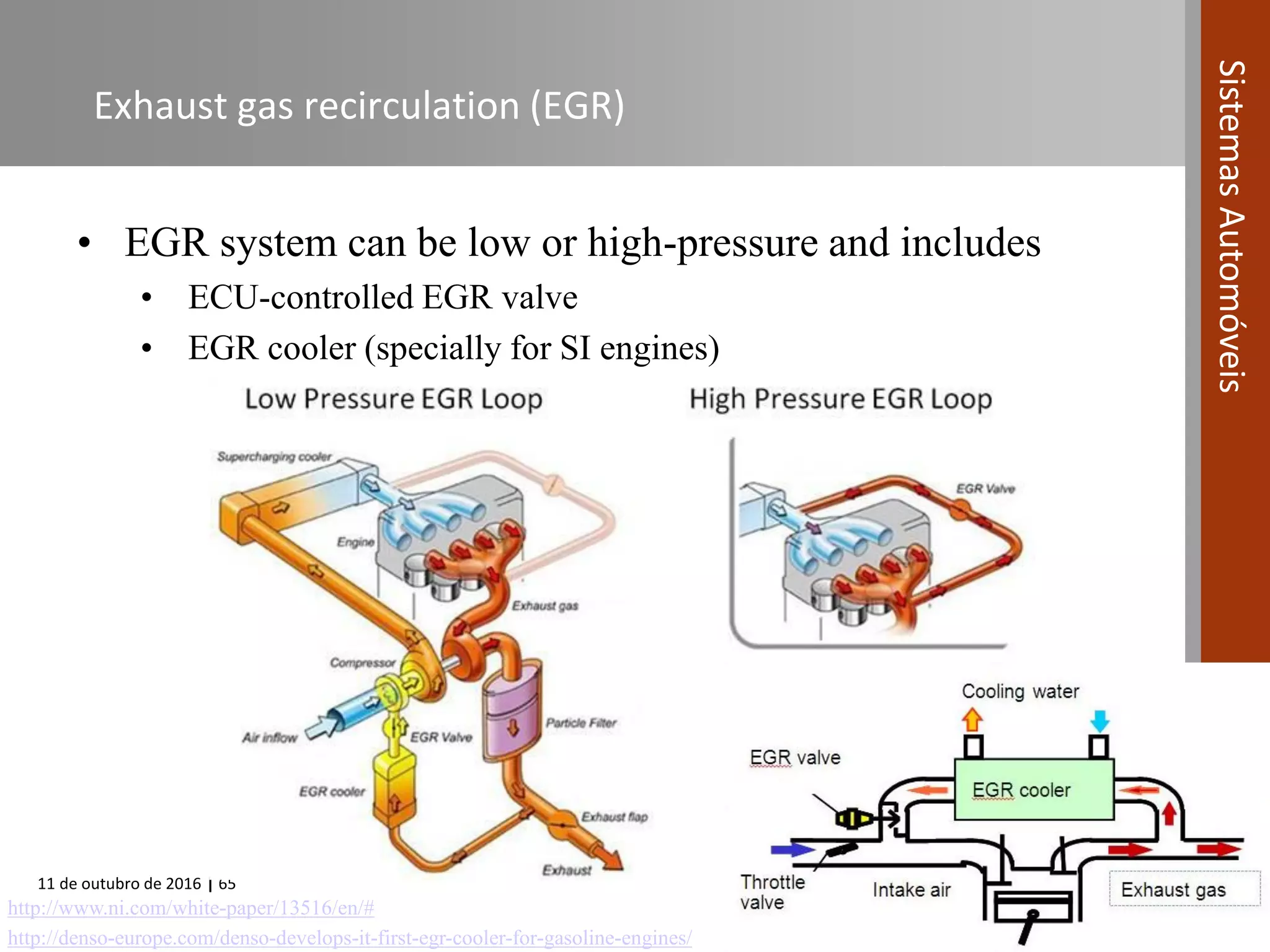
• EGR system can be low or high-pressure and includes
• ECU-controlled EGR valve
• EGR cooler (specially for SI engines)
http://denso-europe.com/denso-develops-it-first-egr-cooler-for-gasoline-engines/
http://www.ni.com/white-paper/13516/en/#
11 de outubro de 2016 | 66
SistemasAutomóveis
Outline
• Objective of fuel systems
• Classification of fuel systems
• Evolution – technology, regulations
• Carburetor-based fuel systems
• Electronic Fuel Injection (EFI) systems
• Engine control – fundamentals
• Air/fuel mixture and combustion control subsystems
• Injection, idle speed and throttle position, fuel pump/pressure, ignition,
supercharging
• Exhaust subsystem
• exhaust, EGR, oxygen sensors heating
• Other subsystems controlled by the engine ECU
• Radiator fan, Variable valves timing control, A/C compressor control,
OBD/Check engine lamp
• Sensors
• Actuators
11 de outubro de 2016 | 67
SistemasAutomóveis
Engine control - sensors
• (sensors will be addressed in a separated module)
• IG/STA switch, neutral switch, A/C switch
• THW, THA, MAP, TPS
• Air Flow Meter
• Knock, RPM,
• Crankshaft/cam shaft position
• Fuel pressure/temperature
• Oxygen sensors (pre/post catalyzer)
• Alternator output voltage
11 de outubro de 2016 | 68
SistemasAutomóveis
Engine control - actuators
• (actuators will be addressed in a separated module)
• Fuel pump
• Radiator fan
• igniters
• Injectors
• Throttle control
• ISC
• EGR control
• Fuel pressure regulator
• OBD/Check engine lamp
• Oxygen sensors heating
• Variable valves timing control
• A/C compressor control

Automotive Systems course (Module 03) - Fuel Systems in Spark Ignition Internal Combustion Engines

  • 1.
    11 de outubrode 2016 | 1 SistemasAutomóveis Fuel systems – SI engines Mário Alves (mjf@isep.ipp.pt)
  • 2.
    11 de outubrode 2016 | 2 SistemasAutomóveis Outline • Objective of fuel systems • Classification of fuel systems • Evolution – technology, regulations • Carburetor-based fuel systems • Electronic Fuel Injection (EFI) systems • Engine control – fundamentals • Air/fuel mixture and combustion control subsystems • Injection, idle speed and throttle position, fuel pump/pressure, ignition, supercharging • Exhaust subsystem • exhaust, EGR, oxygen sensors heating • Other subsystems controlled by the engine ECU • Radiator fan, Variable valves timing control, A/C compressor control, OBD/Check engine lamp • Sensors • Actuators
  • 3.
    11 de outubrode 2016 | 3 SistemasAutomóveis • Main objective is to deliver fuel into the cylinders • at proper timings (optimizing power) • in correct amounts (for optimal A/F ratio, function of load, RPM, engine temperature,…) • in the right form (fuel atomization, for full combustion and lower emissions)
  • 4.
    11 de outubrode 2016 | 4 SistemasAutomóveis Classification of fuel systems (CI and SI) Operating principle ICE type single or multiple injectors direct/indirect injection technology Mechanical SI (single point) indirect Carburetor Diesel (multi-point) direct or indirect Injection Pump (in-line or rotary), few hundred bars Electronic SI SPI indirect in the throttle body, few bars MPI indirect Fuel rail, few bars direct Fuel rail, tens of bars Diesel (multi-point) direct Fuel-rail or pump/unit- injection, hundreds to thousands of bars
  • 5.
    11 de outubrode 2016 | 5 SistemasAutomóveis Classification of fuel systems • Fuel system types • “Mechanical” (increasingly electronically assisted) • SI – mostly used until the dawn of “electronics” (< 1960) • materialized by the “Carburetor” • CI – still in use, but gradually changing to “common rail” • materialized by the “Injection Pump” (in the figure) http://what-when-how.com/automobile/distributor-type-injection-pump-automobile/
  • 6.
    11 de outubrode 2016 | 6 SistemasAutomóveis Classification of fuel systems • Fuel system types • “Electronic” (ECU-based) • Single-Point Injection (SPI) – Figure a) • Aka “throttle-body injection” • mostly used in low-cost small-sized SI engines • Multi-Point Injection (MPI) • Indirect (external) – Figure b) • SI: injection is done upstream (the intake valves) • Diesel: injection is done in a pre-chamber • Direct (internal) – Figure c) • pressure accumulator/common-rail systems (SI + most Diesel) • pump/unit-injector systems (few Diesel) http://www.intechopen.com/books/advances-in-internal-combustion-engines-and-fuel- technologies/combustion-process-in-the-spark-ignition-engine-with-dual-injection-system
  • 7.
    11 de outubrode 2016 | 7 SistemasAutomóveis Evolution – fuel injection technology http://engineringcorner.blogspot.pt/2011/10/next-generation-engines.html
  • 8.
    11 de outubrode 2016 | 8 SistemasAutomóveis Evolution – European emission standards https://www.ngk.de/en/technology-in-detail/lambda-sensors/basic-exhaust-principles/euro-standards/
  • 9.
    11 de outubrode 2016 | 9 SistemasAutomóveis Evolution – emission reduction vs. technologies http://www.transportpolicy.net/index.php?title=EU:_Light-duty:_Emissions
  • 10.
    11 de outubrode 2016 | 10 SistemasAutomóveis Carburetor-based fuel systems • Basic carburetor operation • air is drawn into the engine by the pumping action of the pistons (vacuum) • the air accelerates as it passes through the venturi, causing a slight drop in pressure. • this pressure drop pulls fuel from the float bowl (through a nozzle) into the throttle body • it then mixes with air in a fine mist, which is distributed to the cylinders through the intake manifolds • the choke valve enables the driver to control (enrich) the mixture, at cold start http://cf.ydcdn.net/1.0.1.42/images/main/carburetor.jpg
  • 11.
    11 de outubrode 2016 | 11 SistemasAutomóveis Carburetor-based fuel systems • Main problems • Controlling fuel quantity accurately • dependent on vacuum (not on fuel injection pressure/duration) • insensitive to air temperature, pressure, humidity, engine temperature, RPM, throttle position,… • Controlling fuel quantity in real-time • delayed/reactive response • Even delivery of air/fuel mixture • across all cylinders (intake manifolds) • Hard cold-start • flooded carburetor… • Fuel consumption • 12-15 litres per 100 km was common • Pollution • high hydrocarbons in exhaust gases https://s3.amazonaws.com/lowres.cartoonstock.com/transport-carburator-carburettor-flooded- car_problems-roadside_rescue-mtun1380_low.jpg
  • 12.
    11 de outubrode 2016 | 12 SistemasAutomóveis Electronic fuel injection (EFI) systems • EFI emerged due to • stringent exhaust emission regulations • Increasing fossil fuel cost • evolution of analog/digital electronics • Basics • fuel pump compresses fuel • fuel accumulator (rail) stores fuel • electrically controlled injectors spray the fuel • into intake manifold or • combustion chamber • ECU controls injection timing/duration for optimal engine control • reduced emissions • reduced fuel consumption • maximized performance http://www.gerrysap.com/efi.html
  • 13.
    11 de outubrode 2016 | 13 SistemasAutomóveis EFI systems: Single-Point Injection (example) • Mono-Jetronic (1988–1995) • one lambda sensor • mechanical fuel pressure regulator • first generation ignition system • first generation on- board diagnosis http://www.jnc.cz/auto/monomotronic/Mono-Jetronic_blo ck_diagram.gif
  • 14.
    11 de outubrode 2016 | 14 SistemasAutomóveis EFI systems: Multi-Point Injection (example 1) • D-Jetronic (1967–1976) • "Speed-Density" fuel injection, i.e. there is no Air Flow Meter (AFM) • air-mass flow is measured indirectly, by measuring intake air pressure (3), temperature (not numbered), RPM (not in figure) and knowing cylinder volume http://www.aficionadosalamecanica.net/images-inyeccion/d-jetronic.jpg
  • 15.
    11 de outubrode 2016 | 15 SistemasAutomóveis EFI systems: Multi-Point Injection (example 2) • L-Jetronic (1974–1989) • L stands for Luft (air) flow meter (AFM) • first generation ignition • flap type AFM (11) http://www.jagweb.com/aj6eng/42efi/page1.php
  • 16.
    11 de outubrode 2016 | 16 SistemasAutomóveis EFI systems: Multi-Point Injection (example 3) • Motronic (1987-1998) • integrates injection and ignition (ECU controls both) • fuel pressure accumulator (fuel rail) • more sensors proliferate • second generation ignition system • intake air mass flow is “directly” measured by air- flow meter (12, flap type) http://www.autobinary.co.za/motronic%20(1).jpg
  • 17.
    11 de outubrode 2016 | 17 SistemasAutomóveis EFI systems: Multi-Point Injection (example 4) • Gasoline Direct Injection http://www.gasitaly.com/f5direct
  • 18.
    11 de outubrode 2016 | 18 SistemasAutomóveis EFI systems: Multi-Point Injection (example 5) • Toyota Computer- Controlled System (TCCS) • 1994 3VZ-E engine http://enginepartsdiagram.com/1994-toyota-pickup-electronic- fuel-injection-system-efi-diagram/
  • 19.
    11 de outubrode 2016 | 19 SistemasAutomóveis Fuel supply system example (E38/E39 – base for BMW 7 Series 1995-2001) http://www.bimmerfest.com/forums/showthread.php?t=446032&page=3
  • 20.
    11 de outubrode 2016 | 20 SistemasAutomóveis Fuel supply system example (E38/E39 – base for BMW 7 Series 1995-2001) http://www.bimmerfest.com/forums/showthread.php?t=446032&page=3 • Emphasis on the fuel tank
  • 21.
    11 de outubrode 2016 | 21 SistemasAutomóveis Engine control - fundamentals • Computer-controlled • closed loop • fault-tolerant • real-time • networked • Controls • fuel injection • ignition • ISC, EGR, … • Composed of • inputs (sensors) • outputs (actuators) • controller (ECU) • network (e.g. CAN) https://autoelectricalsystems.wordpress.com/2015/12/05/engine- management-system-for-petrol-engines/
  • 22.
    11 de outubrode 2016 | 22 SistemasAutomóveis Engine control – DGI computer architecture (example 1) • OEM = Renesas http://www.renesas.eu/applications/automotive/powertrain/gasoline_direct/index.jsp
  • 23.
    11 de outubrode 2016 | 23 SistemasAutomóveis Engine control – DGI computer architecture (example 2) • OEM = Infineon http://www.infineon.com/cms/en/applications/automotive/ powertrain/gasoline-direct-injection/
  • 24.
    11 de outubrode 2016 | 24 SistemasAutomóveis Outline • Fuel systems classification • SI fuel systems evolution • Carburetor-based fuel systems • Electronic Fuel Injection (EFI) systems • Engine control – fundamentals • Air/fuel mixture and combustion control subsystems • Injection
  • 25.
    11 de outubrode 2016 | 25 SistemasAutomóveis Fuel injection – algorithm (1) • Base fuel volume • engine RPM • engine load • Corrections • exhaust oxygen • water temp. • accelerator pedal • air temperature • air pressure • knock • voltage http://www.stealth316.com/2-fuelinjection.htm
  • 26.
    11 de outubrode 2016 | 26 SistemasAutomóveis Fuel injection – algorithm (2) • Computation of fuel injection duration (volume/mass) 1. Baseline (target) fuel volume is computed according to engine load • engine load = air mass flow divided by engine speed • > air mass flow  > injection duration 2. ECU selects closed- or open-loop mode based on throttle opening, engine speed, vehicle speed, and fuel trim and air flow maps • closed-loop: normal engine operation (A/F  14,7) • open-loop: cold engine/strong accel/desaccelation (A/F < 14,7) 3. Corrections to the target fuel volume based on several parameters (see flowchart) and an injector pulse width calculated • all these computations must be made in a few milliseconds • for an optimal (real-time) control of the engine http://www.stealth316.com/2-fuelinjection.htm
  • 27.
    11 de outubrode 2016 | 27 SistemasAutomóveis Fuel injection – algorithm (3) • Example “fuel map” (for computing the base fuel volume) • A/F ratio is optimized for best trade-off of power, fuel economy, low emissions and knock prevention • lower load & RPM  leaner mixture (A/F > 14,7) • higher load & RPM  richer mixture (A/F < 14,7) • ECU interpolates between values http://www.stealth316.com/2-fuelinjection.htm
  • 28.
    11 de outubrode 2016 | 28 SistemasAutomóveis Fuel injection – algorithm (4) • Correction according to coolant temperature • fuel vaporization gets poorer for colder engine (specially < 80 ºC) • injection duration is increased (A/F mix enrichened) for lower temperatures http://www.stealth316.com/2-fuelinjection.htm
  • 29.
    11 de outubrode 2016 | 29 SistemasAutomóveis Fuel injection – algorithm (5) • Correction according to intake air temperature • a change in air temperature changes the air density • air density varies inversely proportionally with air temperature • > temperature  < density • the colder the air, the denser it becomes (more air mass for the same air volume) • more fuel must be injected to keep the same air/fuel ratio http://www.stealth316.com/2-fuelinjection.htm
  • 30.
    11 de outubrode 2016 | 30 SistemasAutomóveis Fuel injection – algorithm (6) • Correction according to atmosferic pressure • air density varies proportionally with air pressure • > pressure  > density • air pressure varies inversely proportionally with altitude • < altitude  > pressure • lower altitude  higher density  less pressure • more fuel must be injected to keep the same air/fuel ratio http://www.stealth316.com/2-fuelinjection.htm
  • 31.
    11 de outubrode 2016 | 31 SistemasAutomóveis Fuel injection – algorithm (7) • Correction according to accelerator pedal • fuel is denser than air • thus cannot move into the cylinder as quickly during engine acceleration • so, a momentary lean condition may occur • to compensate for this, the injection duration is increased • extra injection pulses also may be delivered • Injection duration is reduced during deceleration to improve fuel economy and emissions. http://www.stealth316.com/2-fuelinjection.htm
  • 32.
    11 de outubrode 2016 | 32 SistemasAutomóveis Fuel injection – algorithm (8) • Correction according to charging system voltage • current through the injector solenoid  needle valve is pulled up • latency (dead time) between when the current starts and the valve is fully open • injector valve speed depends on applied voltage • > voltage  > current  < injector opening time • injector must be activated earlier for lower voltages and later for higher voltages • the actual opening period of the injector remains the same http://www.stealth316.com/2-fuelinjection.htm
  • 33.
    11 de outubrode 2016 | 33 SistemasAutomóveis Fuel injection – algorithm (9) • Correction according to oxygen in exhaust gases • ECU uses UO2 in a feedback (closed) loop • to restrict A/F ratio to a narrow range where catalyst is most efficient (A/F = 14.7  1%) • UO2 > 0,5 V  rich mix  reduce fuel injection • UO2 < 0,45 V  lean mix  increase fuel injection http://www.stealth316.com/2-fuelinjection.htm
  • 34.
    11 de outubrode 2016 | 34 SistemasAutomóveis Outline • Fuel systems classification • SI fuel systems evolution • Carburetor-based fuel systems • Electronic Fuel Injection (EFI) systems • Engine control – fundamentals • Air/fuel mixture and combustion control subsystems • Injection, idle speed and throttle position
  • 35.
    11 de outubrode 2016 | 35 SistemasAutomóveis Idle speed and throttle control • Idle (or idling) state • an ICE is considered to be “idle” if the two following conditions apply • the throttle pedal/grip is not depressed • the engine is uncoupled to the drivetrain (either in neutral or with the clutch activated) • Idle speed • is the rotational speed of the crankshaft at idle state • usually measured in revolutions (rotations) per minute (RPM) • Idle Speed Control (ISC) (aka Idle Air Control (IAC)) • idle speed must be optimized so that 1. the engine runs smoothly (without vibrations) 2. the engine generates enough power to operate ancillary devices • alternator, A/C, water/oil pumps, power steering 3. fuel consumption is minimized (lowest RPM)
  • 36.
    11 de outubrode 2016 | 36 SistemasAutomóveis Idle speed and throttle control • Typical idle RPM: • passenger-car = 600 – 1,000 • buses/trucks = 500 – 600 • motorcycles = 1000-1500 • Idle Speed Control can be • purely mechanical • as in carburetor-based fuel systems • ECU-based, through the control of either • bypass ISC valve (in the intake manifold) • inputting air upstream and outputting air downstream the throttle valve • throttle valve • Electronic Throttle Control (ETC), Throttle Actuator Control (TAC) or Throttle-By-Wire
  • 37.
    11 de outubrode 2016 | 37 SistemasAutomóveis Idle speed and throttle control • Throttle (valve) • valve that controls the flow of intake air • by opening/closing of a rotating plaque (aka butterfly) • integrated in the throttle body http://mazdarx7.ugocapeto.com/Graphics/airintake.jpg http://www.acuravigorclub.com/Timely-Topics/Timely0604.htm
  • 38.
    11 de outubrode 2016 | 38 SistemasAutomóveis Idle speed and throttle control • Bypass ISC valve (aka idle air control (IAC) valve) • controls the flow of intake air • through a bypass to the throttle • inputting air upstream the throttle • outputting air downstream the throttle • operating principles • DC motor + worm drive • step (servo) motor • solenoid valve http://www.stealth316.com/2-isc-iac.htm
  • 39.
    11 de outubrode 2016 | 39 SistemasAutomóveis Idle speed and throttle control • Throttle (valve) • its actuation can be • purely mechanically-controlled (driven by a cable or rod) • ECU-controlled (throttle-by-wire) http://www.croberts.com/Throttle-control- system-defects.htm
  • 40.
    11 de outubrode 2016 | 40 SistemasAutomóveis Idle speed and throttle control • Purely mechanically-controlled throttle • up to the nineties, throttle opening/closing was directly (mechanically) driven by a cable connected to the driver’s accelerator pedal/grip • driver pressing the accelerator = throttle opened • driver not pressing the accelerator = throttle closed  “idle” state • ISC is purely mechanical, via the following mechanisms • manual adjustment of air bypass (screw) • manual adjustment of throttle position (cable; stop screw) • automatic adjustment of air bypass according to coolant temperature (thermal valve) http://www.autozone.com/repairinfo/repairguide/repairGu ideContent.jsp?pageId=0900c15280088325
  • 41.
    11 de outubrode 2016 | 41 SistemasAutomóveis Idle speed and throttle control • ECU-controlled throttle • throttle-by-wire has been emerging since the nineties • BMW was the first vehicle manufacturer to offer electronic throttle control in the 7-Series (1988) • accelerator cable gradually replaced by ECU + throttle actuator • either the driver is pressing the accelerator or not, the throttle is ALWAYS controlled by the engine’s ECU • driver not pressing the accelerator = “idle” state http://www.aa1car.com/library/throttle-by-wire.htm
  • 42.
    11 de outubrode 2016 | 42 SistemasAutomóveis Outline • Fuel systems classification • SI fuel systems evolution • Carburetor-based fuel systems • Electronic Fuel Injection (EFI) systems • Engine control – fundamentals • Air/fuel mixture and combustion control subsystems • Injection, idle speed and throttle position, fuel pump/pressure
  • 43.
    11 de outubrode 2016 | 43 SistemasAutomóveis Fuel pump/pressure control • Efficient fuel injection requires • enough fuel flow (g/s) • adequate fuel pressure (according to engine state) • Main components • fuel pump • mechanically-driven • by the crankshaft, through gears, chains or a toothed belt (often the timing belt) • electrically-driven • controlled by the ignition switch or by the engine ECU • pressure regulator • mechanical (diaphragm-controlled, not used nowadays) • electrical (controlled by the engine ECU) • fuel rail (if applicable) • aka fuel accumulator or fuel distributor
  • 44.
    11 de outubrode 2016 | 44 SistemasAutomóveis Fuel pump/pressure control • Fuel systems can have 1 or 2 fuel pumps • 1 pump fuel systems • low pressure (few bars) • used in ordinary SI engines (figure) • high pressure (hundreds of bars) • used in CI engines • in-line • distributor-type • common-rail http://12v.org/urs/engine_map/22618.phtml
  • 45.
    11 de outubrode 2016 | 45 SistemasAutomóveis Fuel pump/pressure control • Fuel systems can have 1 or 2 fuel pumps • 2 pumps • primary pump (low pressure) • few bars • secondary pump (high pressure) • hundreds of bars • used in • CI unit-injector • CI common rail • SI direct injection (fig.) http://www.motonic.co.kr/eng/02_product/product04.asp?leftMenu=4
  • 46.
    11 de outubrode 2016 | 46 SistemasAutomóveis Fuel pump/pressure control • Pressure regulators are crucial for optimizing fuel injection, and can be • purely mechanically-controlled • diaphragm-controlled, not used nowadays • guarantees a “constant” pressure differential between the fuel pressure in the accumulator and the air depression in the intake manifold • electrically-controlled • controlled by the engine ECU • enables an optimized control of the fuel pressure in the fuel accumulator, according to engine/load conditions
  • 47.
    11 de outubrode 2016 | 47 SistemasAutomóveis Fuel pump/pressure control • Mechanically-controlled fuel pressure regulator • guarantees “constant” pressure differential between • fuel pressure (in the “rail”) and • intake air depression (intake manifold) • operation • throttle opens (left figure) 1. intake air pressure increases 2. return valve closes 3. no fuel return to tank 4. fuel pressure increases in “rail” • throttle closes (right figure) 1. intake air pressure decreases (vacuum) 2. return valve opens 3. fuel returns to tank 4. fuel pressure decreases in “rail” http://www.troublecodes.net/pcodes/p0300/ 1 bar = 14,7 PSI (average air pressure at sea level
  • 48.
    11 de outubrode 2016 | 48 SistemasAutomóveis Fuel pump/pressure control • Mechanically-controlled fuel pressure regulator http://www.rx7club.com/single-turbo-rx-7s-23/frp-fuel-pressure-regulator-vacuum-line-why-882703/
  • 49.
    11 de outubrode 2016 | 49 SistemasAutomóveis Fuel pump/pressure control • ECU-controlled fuel pressure regulator (CI engine) • Pressure Control Valve (PCV) https://www.dieselnet.com/tech/diesel_fi_common-rail_control.php
  • 50.
    11 de outubrode 2016 | 50 SistemasAutomóveis Fuel pump/pressure control • ECU-controlled fuel pressure regulator (SI GDI engine) • PCV is integrated with high-pressure fuel pump http://www.slideshare.net/GLADIADORVASCO/automotive-fuel-and-emissions-control- systems-60582784
  • 51.
    11 de outubrode 2016 | 51 SistemasAutomóveis Ignition • (ignition will be addressed in a separated module) https://autoelectricalsystems.wordpress.com/2015/12/05/engine- management-system-for-petrol-engines/
  • 52.
    11 de outubrode 2016 | 52 SistemasAutomóveis Outline • Fuel systems classification • SI fuel systems evolution • Carburetor-based fuel systems • Electronic Fuel Injection (EFI) systems • Engine control – fundamentals • Air/fuel mixture and combustion control subsystems • Injection, idle speed and throttle position, fuel pump/pressure, ignition, supercharging (forced air induction)
  • 53.
    11 de outubrode 2016 | 53 SistemasAutomóveis Supercharging • Supercharging = forced air induction • compress intake air  increase air mass (flow) • power output is increased for a given displacement and engine speed • Types • mechanically-driven –supercharger • directly driven by crankshaft (belt) • exhaust-gas-driven – turbocharger • driven by exhaust gases (turbine) • hybrid (mechanically-driven) – twin-charger • supercharger + turbocharger • hybrid (electrically-driven) – electric supercharger • electric motor/generator supporting the turbo/supercharger
  • 54.
    11 de outubrode 2016 | 54 SistemasAutomóveis Supercharging – turbocharger • waste gate  allows exhaust air to bypass the turbine (modulated by boost controller) • pop-off valve  emergency pressure release (prevents excessive air pressure into combustion chamber) • blow-off valve  prevents back-pressure in the compressor when throttle valve is abruptly shut http://atlanticz.ca/zclub/techtips/turbo/
  • 55.
    11 de outubrode 2016 | 55 SistemasAutomóveis Supercharging – supercharger http://www.diamondp.com/kb_results.asp?ID=8 • Driven by the crankshaft through belt + pulley • no turbo lag but requires some engine power http://www.americanmuscle.com/power-adders-for-s550-mustangs.html
  • 56.
    11 de outubrode 2016 | 56 SistemasAutomóveis Supercharging – twin-charger • < RPM  supercharger • > RPM  turbocharger http://prettymotors.com/twincharging-engine/
  • 57.
    11 de outubrode 2016 | 57 SistemasAutomóveis Supercharging – electric turbocharger • Series-hybrid turbocharger • turbine-motor/generator-compressor • < RPM • Battery  motor  compressor • > RPM • turbine  generator  battery • replacing the alternator? http://www.aeristech.co.uk/full-electric-turbocharger-technology/
  • 58.
    11 de outubrode 2016 | 58 SistemasAutomóveis Supercharging – electric supercharger • Drive is fully electrical • Particularly good for low RPM • when engine power is low • Tens of kW  hundreds of A •  powerful alternator http://www.aeristech.co.uk/full-electric-turbocharger-technology/ http://blog.caranddriver.com/blowing-your-way-to-savings-how-electric-superchargers-boost-mpg/
  • 59.
    11 de outubrode 2016 | 59 SistemasAutomóveis Supercharging – hybrid supercharging • < RPM  supercharger • > RPM  turbocharger http://www.autocar.co.uk/car-news/motoring/audi-reveals- electric-turbocharger-technology
  • 60.
    11 de outubrode 2016 | 60 SistemasAutomóveis Outline • Objective of fuel systems • Classification of fuel systems • Evolution – technology, regulations • Carburetor-based fuel systems • Electronic Fuel Injection (EFI) systems • Engine control – fundamentals • Air/fuel mixture and combustion control subsystems • Injection, idle speed and throttle position, fuel pump/pressure, ignition, supercharging • Exhaust subsystem • exhaust, EGR, oxygen sensors heating
  • 61.
    11 de outubrode 2016 | 61 SistemasAutomóveis Exhaust system • Objectives • convey exhaust gases out of the engine • reduce exhaust heat, noise and pollutant emissions, affecting engine power as little as possible • Main components • exhaust manifold  to draw exhaust gases out of the cylinders • turbocharger (if applicable)  to increase engine power • catalytic converter  to reduce pollutant emissions • muffler(s)/silencer(s)  to reduce noise • exhaust pipe(s)  to link the above components in order to convey and expel gases at a convenient point in the vehicle
  • 62.
    11 de outubrode 2016 | 62 SistemasAutomóveis Exhaust system • Exhaust system outlook – SI engine http://hdabob.com/exhaust.htm
  • 63.
    11 de outubrode 2016 | 63 SistemasAutomóveis Exhaust gas recirculation (EGR) • recirculates part of the exhaust gases into the intake • 5-15% in SI engines • up to 50% in CI engines • EGR aim is to meet emissions standards • most ICE (SI and CI) must have EGR • some modern ICE do not need EGR • e.g. use selective catalytic reduction (SCR) to reduce NOx
  • 64.
    11 de outubrode 2016 | 64 SistemasAutomóveis Exhaust gas recirculation (EGR) • EGR leads to • < oxygen admitted • < peak in-cylinder temperatures • < NOx emissions  • < engine power  • > particulate emissions (CI)  • NOx reduction efficiency • < for > oxygen % • a given NOx reduction requires • < EGR at high loads • > EGR at low loads https://www.dieselnet.com/tech/engine_egr_performance.php
  • 65.
    11 de outubrode 2016 | 65 SistemasAutomóveis Exhaust gas recirculation (EGR) • EGR system can be low or high-pressure and includes • ECU-controlled EGR valve • EGR cooler (specially for SI engines) http://denso-europe.com/denso-develops-it-first-egr-cooler-for-gasoline-engines/ http://www.ni.com/white-paper/13516/en/#
  • 66.
    11 de outubrode 2016 | 66 SistemasAutomóveis Outline • Objective of fuel systems • Classification of fuel systems • Evolution – technology, regulations • Carburetor-based fuel systems • Electronic Fuel Injection (EFI) systems • Engine control – fundamentals • Air/fuel mixture and combustion control subsystems • Injection, idle speed and throttle position, fuel pump/pressure, ignition, supercharging • Exhaust subsystem • exhaust, EGR, oxygen sensors heating • Other subsystems controlled by the engine ECU • Radiator fan, Variable valves timing control, A/C compressor control, OBD/Check engine lamp • Sensors • Actuators
  • 67.
    11 de outubrode 2016 | 67 SistemasAutomóveis Engine control - sensors • (sensors will be addressed in a separated module) • IG/STA switch, neutral switch, A/C switch • THW, THA, MAP, TPS • Air Flow Meter • Knock, RPM, • Crankshaft/cam shaft position • Fuel pressure/temperature • Oxygen sensors (pre/post catalyzer) • Alternator output voltage
  • 68.
    11 de outubrode 2016 | 68 SistemasAutomóveis Engine control - actuators • (actuators will be addressed in a separated module) • Fuel pump • Radiator fan • igniters • Injectors • Throttle control • ISC • EGR control • Fuel pressure regulator • OBD/Check engine lamp • Oxygen sensors heating • Variable valves timing control • A/C compressor control