
CHEMOTAXONOMY
Prepared By-
Dr. Sangeeta Das
Assistant Professor
Department of Botany
Bahona College, Jorhat, Assam, India.
What is Chemotaxonomy?
Chemotaxonomy = Chemo + Taxonomy.
Phytochemical substances of taxonomic significance.
The classification of plants on the basis of chemical
contents is called chemotaxonomy or chemical taxonomy.
 These chemical constituents of plants differ from species
to species and are restricted to certain taxa.
Where Found ?
Among most studied families from the
chemotaxonomic point of view are:
Malvaceae,
Ranunculaceae,
Magnoliaceae,
Polygonaceae, and
Solanaceae.
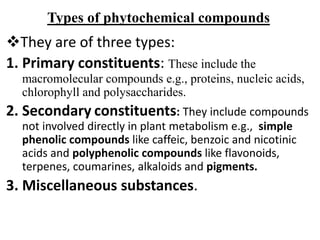
Types of phytochemical compounds
They are of three types:
1. Primary constituents: These include the
macromolecular compounds e.g., proteins, nucleic acids,
chlorophyll and polysaccharides.
2. Secondary constituents: They include compounds
not involved directly in plant metabolism e.g., simple
phenolic compounds like caffeic, benzoic and nicotinic
acids and polyphenolic compounds like flavonoids,
terpenes, coumarines, alkaloids and pigments.
3. Miscellaneous substances.
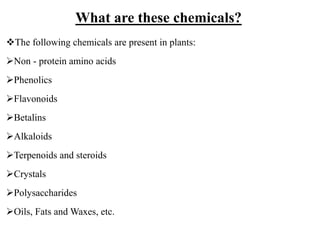
What are these chemicals?
The following chemicals are present in plants:
Non - protein amino acids
Phenolics
Flavonoids
Betalins
Alkaloids
Terpenoids and steroids
Crystals
Polysaccharides
Oils, Fats and Waxes, etc.
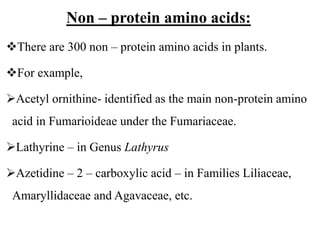
Non – protein amino acids:
There are 300 non – protein amino acids in plants.
For example,
Acetyl ornithine- identified as the main non-protein amino
acid in Fumarioideae under the Fumariaceae.
Lathyrine – in Genus Lathyrus
Azetidine – 2 – carboxylic acid – in Families Liliaceae,
Amaryllidaceae and Agavaceae, etc.
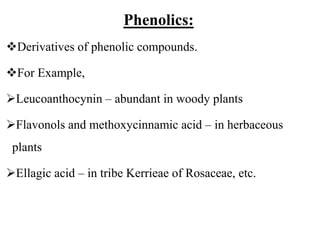
Phenolics:
Derivatives of phenolic compounds.
For Example,
Leucoanthocynin – abundant in woody plants
Flavonols and methoxycinnamic acid – in herbaceous
plants
Ellagic acid – in tribe Kerrieae of Rosaceae, etc.
Flavonoids:
Flavonoids are present in leaves, flowers and fruits.
Flavonoids are further classified into various types:
Flavones — e.g. apigenin, levtolin
Flavanones — e.g. naringenin
Iso-flavones — e.g. orobol
Iso-flavonoids — e.g. ferreirin, etc .
Flavonoids:
Hegnauer revealed that, the two families-
Umbelliferae and Araliaceae by are closely related.
Analysis of flavonoids of leaf of Liliaceae,
Juncaceae, Cyperaceae and Poaceae by Williams
suggest that all these families have arisen from
Liliaceous ancestors.
Betalins:
Betalins are derivatives of phenols serving as pigments.
They differ from flavonoids and other phenolic compounds in that they
contain nitrogen in them.
They are found in ten families of angiosperms
For example,
The systematic position of the family Cactaceae under Centrospermae. It
was placed in the order of its own i.e., the Cactales or Opuntiales. But, the
presence of betalin in the Cactaceae establishes its position in the
Centrospermae.
The genus Gisekia, based on morphological similarities was traditionally
placed under Molluginaceae. But, since it contains betalains Takhtaja has
recently transferred this genus to Phytolaccaceae.
Alkaloids:
 Alkaloids are nitrogen containing compounds with a
heterocyclic ring.
There are about 5000 alkaloids in angiosperms
For ex.
Isoquinoline – in Papaveraceae
Lupin – in Fabaceae
Tropane – in Solanaceae, etc.
Alkaloids:
Lupin alkaloids have been found in three tribes under the subfamily
Lotoideae of the Fabaceae suggesting that these tribes may have
originated from a common ancestral stock.
Distribution of alkaloid has proved useful in the taxonomy of the
Fabaceae.
The presence of isoquinoline alkaloids in the families Fumariaceae
and Papaveraccae indicates very close relationship between the two
families.
Alkaloids are useful in taxonomic studies in Papaver and Argemone
(Papaveraceae), Veratrum (Liliaceae), as well as in Lycopodium,
Lupinus and Caryophyllales (Jones and Luchsinger).
Terpenoids and steroids:
Terpenoids are unsaturated hydrocarbons derived from
isoprenes. Eg. Carotenoids, iridoids
Steroids are saturated hydrocarbons with four rings in their
structure. For ex., their distribution has proved helpful in
the taxonomy of the genera of tribe Veratreae of family
Liliaceae. According to Kupchan, these genera contain the
steroid veratum.
Crystals:
Some plants have raphide crystals in different parts of
their body.
For Example,
Presence and absence of raphides are used in the grouping
of plants in the family Rubiaceae.
Calcium oxalate crystals are present in the ovary walls of
the members of Asteraceae, etc.
Polysaccharides
They offer the greatest hope for taxonomic evidence because of their
complexity and diversity.
For example,
MacLeod and McCorquodale studied the water-soluble
polysaccharides in the seeds of 22 grass species. They found lesser or
greater amounts of 0-glucosan was present in all the Festuceae, but
Festuca and Lolium are distinctive in having an unusual
trisaccharide.
Amyloid was detected in 16 families of the Dicotyledons and none
of the Monocotyledons by Kooiman in a test involving over 2,500
species.
Oils, Fats and Waxes:
Lipids are found in all parts of plants but are dominant in
the storage organs, seeds and fruits.
Waxes occur in the cuticular layers of plants.
For example,
Ximenyric acid is found in the Olacaceae and Santalaceae.
Petroselinic acid is almost completely restricted to the
Umbelliferae.
Erucic acid is restricted to Cruciferae.
Immunological reactions:
These type of reactions are studied in Serotaxonomy where the
storage protein or pollen protein is injected from the plant body
to a test animal usually mouse or rabbit called the test animal.
The test animal produces antiserum against that protein which
is mixed with the plant extract to detect the precipitate formed
by antigen – antibody reaction.
The nature and amount of precipitate indicate the relationship
of the protein to the plant.
High rate of precipitation indicates closeness of the plants.
Immunological reactions:
Closeness of Delphinium to Aconitumis was confirmed by
such serological studies.
The genus Hydrastatis placed in Berneridaceae is found to
be more related to Ranunculaceae
Serological method is also useful in the classification of
the members of Fabaceae, Bromus, Potato, etc.
Chemotaxonomy-Plant Taxonomy

Chemotaxonomy-Plant Taxonomy

  • 1.
    CHEMOTAXONOMY Prepared By- Dr. SangeetaDas Assistant Professor Department of Botany Bahona College, Jorhat, Assam, India.
  • 2.
    What is Chemotaxonomy? Chemotaxonomy= Chemo + Taxonomy. Phytochemical substances of taxonomic significance. The classification of plants on the basis of chemical contents is called chemotaxonomy or chemical taxonomy.  These chemical constituents of plants differ from species to species and are restricted to certain taxa.
  • 3.
    Where Found ? Amongmost studied families from the chemotaxonomic point of view are: Malvaceae, Ranunculaceae, Magnoliaceae, Polygonaceae, and Solanaceae.
  • 4.
    Types of phytochemicalcompounds They are of three types: 1. Primary constituents: These include the macromolecular compounds e.g., proteins, nucleic acids, chlorophyll and polysaccharides. 2. Secondary constituents: They include compounds not involved directly in plant metabolism e.g., simple phenolic compounds like caffeic, benzoic and nicotinic acids and polyphenolic compounds like flavonoids, terpenes, coumarines, alkaloids and pigments. 3. Miscellaneous substances.
  • 5.
    What are thesechemicals? The following chemicals are present in plants: Non - protein amino acids Phenolics Flavonoids Betalins Alkaloids Terpenoids and steroids Crystals Polysaccharides Oils, Fats and Waxes, etc.
  • 6.
    Non – proteinamino acids: There are 300 non – protein amino acids in plants. For example, Acetyl ornithine- identified as the main non-protein amino acid in Fumarioideae under the Fumariaceae. Lathyrine – in Genus Lathyrus Azetidine – 2 – carboxylic acid – in Families Liliaceae, Amaryllidaceae and Agavaceae, etc.
  • 7.
    Phenolics: Derivatives of phenoliccompounds. For Example, Leucoanthocynin – abundant in woody plants Flavonols and methoxycinnamic acid – in herbaceous plants Ellagic acid – in tribe Kerrieae of Rosaceae, etc.
  • 8.
    Flavonoids: Flavonoids are presentin leaves, flowers and fruits. Flavonoids are further classified into various types: Flavones — e.g. apigenin, levtolin Flavanones — e.g. naringenin Iso-flavones — e.g. orobol Iso-flavonoids — e.g. ferreirin, etc .
  • 9.
    Flavonoids: Hegnauer revealed that,the two families- Umbelliferae and Araliaceae by are closely related. Analysis of flavonoids of leaf of Liliaceae, Juncaceae, Cyperaceae and Poaceae by Williams suggest that all these families have arisen from Liliaceous ancestors.
  • 10.
    Betalins: Betalins are derivativesof phenols serving as pigments. They differ from flavonoids and other phenolic compounds in that they contain nitrogen in them. They are found in ten families of angiosperms For example, The systematic position of the family Cactaceae under Centrospermae. It was placed in the order of its own i.e., the Cactales or Opuntiales. But, the presence of betalin in the Cactaceae establishes its position in the Centrospermae. The genus Gisekia, based on morphological similarities was traditionally placed under Molluginaceae. But, since it contains betalains Takhtaja has recently transferred this genus to Phytolaccaceae.
  • 11.
    Alkaloids:  Alkaloids arenitrogen containing compounds with a heterocyclic ring. There are about 5000 alkaloids in angiosperms For ex. Isoquinoline – in Papaveraceae Lupin – in Fabaceae Tropane – in Solanaceae, etc.
  • 12.
    Alkaloids: Lupin alkaloids havebeen found in three tribes under the subfamily Lotoideae of the Fabaceae suggesting that these tribes may have originated from a common ancestral stock. Distribution of alkaloid has proved useful in the taxonomy of the Fabaceae. The presence of isoquinoline alkaloids in the families Fumariaceae and Papaveraccae indicates very close relationship between the two families. Alkaloids are useful in taxonomic studies in Papaver and Argemone (Papaveraceae), Veratrum (Liliaceae), as well as in Lycopodium, Lupinus and Caryophyllales (Jones and Luchsinger).
  • 13.
    Terpenoids and steroids: Terpenoidsare unsaturated hydrocarbons derived from isoprenes. Eg. Carotenoids, iridoids Steroids are saturated hydrocarbons with four rings in their structure. For ex., their distribution has proved helpful in the taxonomy of the genera of tribe Veratreae of family Liliaceae. According to Kupchan, these genera contain the steroid veratum.
  • 14.
    Crystals: Some plants haveraphide crystals in different parts of their body. For Example, Presence and absence of raphides are used in the grouping of plants in the family Rubiaceae. Calcium oxalate crystals are present in the ovary walls of the members of Asteraceae, etc.
  • 15.
    Polysaccharides They offer thegreatest hope for taxonomic evidence because of their complexity and diversity. For example, MacLeod and McCorquodale studied the water-soluble polysaccharides in the seeds of 22 grass species. They found lesser or greater amounts of 0-glucosan was present in all the Festuceae, but Festuca and Lolium are distinctive in having an unusual trisaccharide. Amyloid was detected in 16 families of the Dicotyledons and none of the Monocotyledons by Kooiman in a test involving over 2,500 species.
  • 16.
    Oils, Fats andWaxes: Lipids are found in all parts of plants but are dominant in the storage organs, seeds and fruits. Waxes occur in the cuticular layers of plants. For example, Ximenyric acid is found in the Olacaceae and Santalaceae. Petroselinic acid is almost completely restricted to the Umbelliferae. Erucic acid is restricted to Cruciferae.
  • 17.
    Immunological reactions: These typeof reactions are studied in Serotaxonomy where the storage protein or pollen protein is injected from the plant body to a test animal usually mouse or rabbit called the test animal. The test animal produces antiserum against that protein which is mixed with the plant extract to detect the precipitate formed by antigen – antibody reaction. The nature and amount of precipitate indicate the relationship of the protein to the plant. High rate of precipitation indicates closeness of the plants.
  • 18.
    Immunological reactions: Closeness ofDelphinium to Aconitumis was confirmed by such serological studies. The genus Hydrastatis placed in Berneridaceae is found to be more related to Ranunculaceae Serological method is also useful in the classification of the members of Fabaceae, Bromus, Potato, etc.