This presentation offers a brief idea about the cultivation, processing, storage and marketing of medicinal plants for the health care practices in sustainable health. The role of different factors has been assessed for the same.
Presented By:
Dr. NandadulalSannigrahi, Associate Professor,
Department of Botany,
Nistarini College, Purulia (W.B)
INDIA, 723101
2.
Traditional medicineis “the knowledge, skills and practices based on the
theories, beliefs and experiences indigenous to different cultures, used in
the maintenance of health and in the prevention, diagnosis, improvement or
treatment of physical and mental illness”
There are many different systems of traditional medicine, and the
philosophy and practices of each are influenced by the prevailing
conditions, environment, and geographic area within which it first evolved
(WHO 2005), however, a common philosophy is a holistic approach to life,
equilibrium of the mind, body, and the environment, and an emphasis on
health rather than on disease.
Generally, the focus is on the overall condition of the individual, rather
than on the particular ailment or disease from which the patient is
suffering, and the use of herbs is a core part of all systems of traditional
medicine.
The importance of medicinal plants and derivatives is growing rapidly with
human progress in pharmaceutical fields.
3.
These plantsare a potential source of bio-molecules that play a major role
in modern medicine in the treatment of diseases like cancer, diabetes and
hypertension among others.
The demand for medicinal herbs is increasing thanks in part to a reputation
for fewer side effects. They are also considered to be a cost-effective
means of developing new and breakthrough drugs.
The medicinal plants seldom possess serious side effects,
The bioactive compounds extracted from medicinal plants are
economically viable and easy accessible by the common people,
Herbal industry has become the most booming industry nowadays,
The herbal plants have enough scope to address the sustainable health for
the forthcoming decades.
4.
Cultivation ofmedicinal herbs needs the following points to remember
Selection of place – The selection of place is very important as the different
edaphic factors like altitude, climate, soil, slopes of the earth surface play a
very crucial role for the qualitative and quantitative products from the
herbal plants.
Selection of Variety- Different types of varieties are important for the
quantity of the bioactive compounds extracted from them.
Harvesting of crops- Crop harvesting and time of harvesting are very
important to ensure the yields from, the herbs.
Processing- Processing comprises a number of practices like drying and
others play a very crucial role in this regard/
Storage- Dry or wet storage along with other issues are to be addressed
properly to ensure the quality for the future correspondences.
Marketing and utilization- The marketing and utilization protocols also
play a significant role in this regard.
Uses following the recommended protocols,
5.
Cultivation ofherbal plants need the following factors and their
consideration before the ground operation.
Climate-
Temperature,
pH of the soil,
Slope of the area,
The plant is known to grow under varying soil and climatic conditions. It
grows exceptionally well in poorly drained soils and waterlogged areas
under sub-tropical conditions. The plants grow faster at high temperatures
(33-400 C) and humidity (65-80%) and should be cultivated as summer-
rainy season crop.
6.
Altitude isa very important factor in cultivation of medicinal plants. Tea,
cinchona and eucalyptus are cultivated favorably at an altitude of 1,000–
2,000 meters. Cinnamon and cardamom are grown at a height of 500–1000
meters, while senna can be cultivated at sea level. The following are the
examples of medicinal and aromatic plants indicating the altitude for their
successful cultivation.
Temperature: Temperature is a crucial factor controlling the growth,
metabolism and there by the yield of secondary metabolites of plants. Even
though each species has become adapted to its own natural environment,
they are able to exist in a considerable range of temperature. Many plants
will grow better in temperate regions during summer, but they lack in
resistance to withstand frost in winter.
For the proper development of plant, rainfall is required in proper
measurements. Xerophytes plants like aloes do not require irrigation or
rainfall. The effects of rainfall on plants must be considered in relation to
the annual rainfall throughout the year with the water holding properties of
the soil. Variable results have been reported for the production of
constituents under different
7.
conditions ofrainfall. Excessive rainfall could cause a reduction in the
secondary metabolites due to leaching of water soluble substances from the
plants.
Day Length and Day Light It has been proved that even the length of the
day has an effect over the metabolites production. The plants that are kept
in long day conditions may contain more or less amount of constituents
when compared to the plants kept in short day. For example peppermint
has produced menthone, menthol and traces of menthofuran in long day
conditions and only menthofuran in short day condition.
The developments of plants vary much in both the amount and intensity of
the light they require.
The wild grown plants would meet the required conditions and so they
grow but during cultivation we have to fulfill the requirements of plants.
The day light was found to increase the amount of alkaloids in belladonna,
stramonium, cinchona, etc. Even the type of radiation too has an effect over
the development and metabolites of plants.
8.
Each andevery plant species have its own soil and nutritive requirements.
The three important basic characteristics of soils are their physical,
chemical and microbiological properties. Soil provides mechanical support,
water and essential foods for the development of plants. Soil consists of air,
water, mineral matters and organic matters. Variations in particle size result
in different soils ranging from clay, sand and gravel. Particle size
influences the water holding capacity of soil. The type and amount of
minerals plays a vital role in plant cultivation. Calcium favors the growth
of certain plants whereas with some plants it does not produce any effects.
The plants are able to determine their own soil pH range for their growth;
microbes should be taken in to consideration which grows well in certain
pH. Nitrogen containing soil has a great momentum in raising the
production of alkaloids in some plants.
Soil Fertility It is the capacity of soil to provide nutrients in adequate
amounts and in balanced proportion to plants. If cropping is done without
fortification of soil with plant nutrients, soil fertility gets lost. It is also
diminished through leaching and erosion. Soil fertility can be maintained
by addition of animal manures, nitrogen-fixing bacteria or by application of
chemical fertilizers. The latter is time saving and surest of all above
techniques.
9.
Fertilizers andManures Plant also needs food for their growth and
development. What plants need basically for their growth are the carbon
dioxide, sun-rays, water and mineral matter from the soil. Thus, it is seen
that with limited number of chemical elements, plants build up fruits,
grains, fibers, etc. and synthesize fixed and volatile oils, glycosides,
alkaloids, sugar and many more chemicals.
(a) Chemical fertilizers Animals are in need of vitamins, plants are in need
of sixteen nutrient elements for synthesizing various com-pounds. Some of
them are known as primary nutrients like nitrogen, phosphorus and
potassium. Magnesium, calcium and sulphur are required in small
quantities and hence, they are known as secondary nutrients. Trace
elements like copper, manganese, iron, boron, molybdenum, zinc are also
necessary for plant growths are known as micronutrients. Carbon,
hydrogen, oxygen and chlorine are provided from water and air. Every
element has to perform some specific function in growth and development
of plants. Its deficiency is also characterized by certain symptoms.
10.
(b) ManuresFarm yard manure (FYM/compost), castor seed cake, poultry
manures, neem and karanj seed cakes vermin compost, etc. are manures.
Oil-cake and compost normally consists of 3–6% of nitrogen, 2%
phosphates and 1–1.5% potash. They are made easily available to plants.
Bone meal, fish meal, biogas slurry, blood meal and press mud are the
other forms of organic fertilizers.
(c) Bio-fertilizers Inadequate supply, high costs and undesirable effects if
used successively are the demerits of fertilizers or manures and hence the
cultivator has to opt for some other type of fertilizer. Bio-fertilizers are the
most suitable forms that can be tried.
These consist of different types of micro organisms or lower organisms
which fix the atmospheric nitrogen in soil and plant can use them for their
day to day use. Thus they are symbiotic. Rhizobium, Azotobactor,
Azosperillium, Bijericcia, Blue-green algae, Azolla, etc. are the examples
of biofertilizers.
11.
Land preparation:
The field should be ploughed thoroughly and made free of weeds. The
land should be irrigated a day before planting for successful establishment
of plant cuttings. The preparation of land is also accompanied with the uses
of different ingredients to ensure desire fertility.
Transplanting:
Plant cuttings about 4-5 cm long, each containing a few leaves, nodes and
roots are ideal planting materials. These can be obtained by cutting mother
plants into small pieces with roots. The cutting are transplanted in wet soil
at spacing of 40 cm x 40 cm.
Flood irrigation is provided immediately after planting. Ideally, the plants
should be transplanted in March-June and allowed to grow and proliferate
through hot and humid months of monsoon till September after which
harvesting should be done.
The plants can also be maintained in a perennial state with two harvests in
a year, the first one in June and the other one after monsoon, in October.
12.
Irrigation:
Irrigationimmediately after transplanting is essential for the successful
survival of the plants. Subsequently, the fields are irrigated by flooding as
per requirement usually every 7-8 days. There is no need for irrigation
during the monsoon. Weeding: Initially hand weeding is required every 5-
20 days. Later as the plant proliferate and forms a dense mat of vegetation,
weeding may be required sporadically.
Harvesting/ Post harvesting:
The plants should be harvested between October-November, after that there
is loss of plant biomass and bacoside yield. The plant can be ideally
harvested by rationing so that the upper portions of the stem 4-5 cm from
the base are removed and the rest left for subsequent regeneration. The
plants can be dried in a conventional manner by spreading on the ground
under shade at room temperature. Alternatively, they can be treated at 800
C in oven for 30 minutes immediately after harvest for a two-fold more
retention of
13.
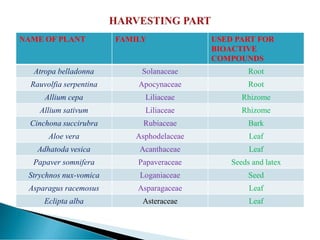
NAME OF PLANTFAMILY USED PART FOR
BIOACTIVE
COMPOUNDS
Atropa belladonna Solanaceae Root
Rauvolfia serpentina Apocynaceae Root
Allium cepa Liliaceae Rhizome
Allium sativum Liliaceae Rhizome
Cinchona succirubra Rubiaceae Bark
Aloe vera Asphodelaceae Leaf
Adhatoda vesica Acanthaceae Leaf
Papaver somnifera Papaveraceae Seeds and latex
Strychnos nux-vomica Loganiaceae Seed
Asparagus racemosus Asparagaceae Leaf
Eclipta alba Asteraceae Leaf
14.
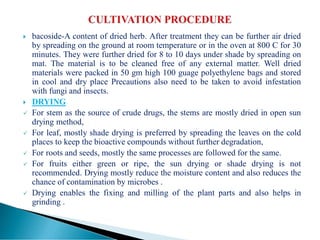
bacoside-A contentof dried herb. After treatment they can be further air dried
by spreading on the ground at room temperature or in the oven at 800 C for 30
minutes. They were further dried for 8 to 10 days under shade by spreading on
mat. The material is to be cleaned free of any external matter. Well dried
materials were packed in 50 gm high 100 guage polyethylene bags and stored
in cool and dry place Precautions also need to be taken to avoid infestation
with fungi and insects.
DRYING
For stem as the source of crude drugs, the stems are mostly dried in open sun
drying method,
For leaf, mostly shade drying is preferred by spreading the leaves on the cold
places to keep the bioactive compounds without further degradation,
For roots and seeds, mostly the same processes are followed for the same.
For fruits either green or ripe, the sun drying or shade drying is not
recommended. Drying mostly reduce the moisture content and also reduces the
chance of contamination by microbes .
Drying enables the fixing and milling of the plant parts and also helps in
grinding .
15.
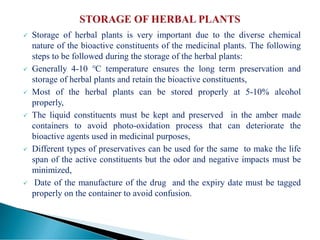
Storage ofherbal plants is very important due to the diverse chemical
nature of the bioactive constituents of the medicinal plants. The following
steps to be followed during the storage of the herbal plants:
Generally 4-10 ℃ temperature ensures the long term preservation and
storage of herbal plants and retain the bioactive constituents,
Most of the herbal plants can be stored properly at 5-10% alcohol
properly,
The liquid constituents must be kept and preserved in the amber made
containers to avoid photo-oxidation process that can deteriorate the
bioactive agents used in medicinal purposes,
Different types of preservatives can be used for the same to make the life
span of the active constituents but the odor and negative impacts must be
minimized,
Date of the manufacture of the drug and the expiry date must be tagged
properly on the container to avoid confusion.
16.
Marketing medicinalplants involves various strategies to increase
awareness and demand for these natural remedies. This includes utilizing
digital platforms like social media, creating educational content, and
participating in trade shows.
Furthermore, focusing on the health-promoting aspects of medicinal plants
and emphasizing their natural origins can attract consumers.
In developed countries. More than 80% people depends on the herbal
plants to address their health needs.
The main commercial organizations for this marketing as follows:
Himalaya Drug Company-India
Schwab -Germany,
Arkopharman- France
Nutraceuticals International Corporation-USA,
Besides these, there are number of organizations doing the same.
17.
Digital Marketing:
Social Media: Leverage platforms like X-account and Facebook to
showcase medicinal plants and their benefits, engage with followers, and
run targeted advertising campaigns.
Educational Content: Create informative blogs, articles, and videos about
the properties, uses, and benefits of different medicinal plants.
Newsletter Marketing: Build an email list and send out regular updates,
promotions, and valuable information about medicinal plants.
Traditional Marketing:
Trade Shows: Participate in trade shows and conferences to connect with
industry professionals, distributors, and potential customers.
Retail Partnerships: Collaborate with pharmacies, health food stores, and
other retailers to expand distribution channel.
Transparency of ingredients through quality control, sustainability,
regulatory compliance along with the identification of target users are very
important in marketing strategies.
18.
References:
DifferentWebPages for reference and content,
A textbook of Botany (Vol : II) Bhattacharya, Hait & Ghosh.
Manual of Ethnobotany- S.K.Jain
NIH
Other open sources powered with AI.
Disclaimer:
This presentation has been made and designed as the free open source of
study materials intended for the academic fraternity. The presenter does
not claim any kind of financial interest for this work. It is completely free
for use.