BIODIVERSITY AND level of biodiversity
Dr. N. Sannigrahi,
Associate Professor,
Department of Botany,
Nistarini college, Purulia
D.B. Road, Purulia,
INDIA (W.B)
BIODIVERSITY
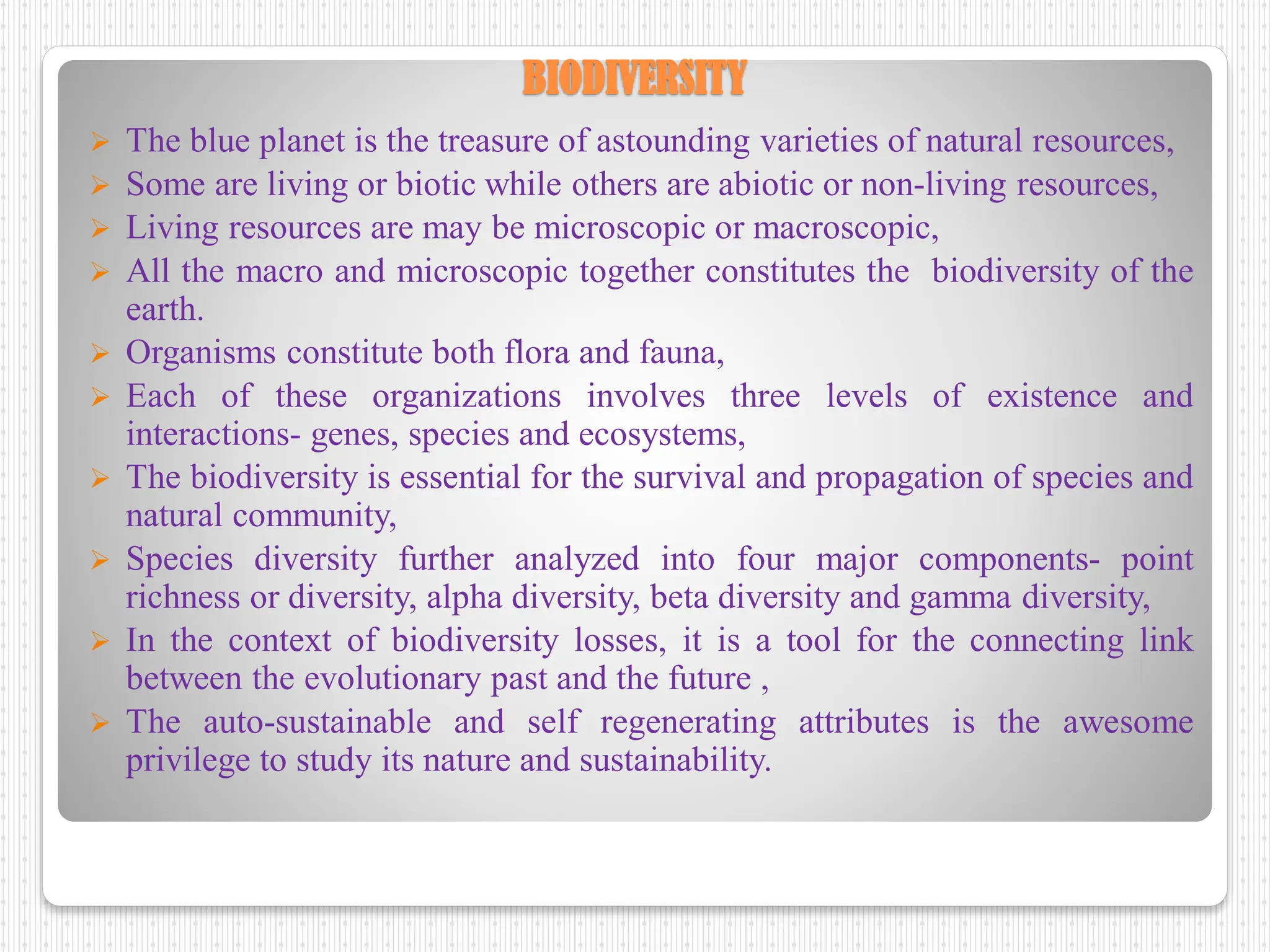
 The blue planet is the treasure of astounding varieties of natural resources,
 Some are living or biotic while others are abiotic or non-living resources,
 Living resources are may be microscopic or macroscopic,
 All the macro and microscopic together constitutes the biodiversity of the
earth.
 Organisms constitute both flora and fauna,
 Each of these organizations involves three levels of existence and
interactions- genes, species and ecosystems,
 The biodiversity is essential for the survival and propagation of species and
natural community,
 Species diversity further analyzed into four major components- point
richness or diversity, alpha diversity, beta diversity and gamma diversity,
 In the context of biodiversity losses, it is a tool for the connecting link
between the evolutionary past and the future ,
 The auto-sustainable and self regenerating attributes is the awesome
privilege to study its nature and sustainability.
BIODIVERSITY
Biodiversity?
 Biological diversity or Biodiversity is the foundation and life supporting
pillars of humans on the earth,
 “The reliability among living organisms from all sources including
interalia, terrestrial, marine and other ecosystems and the ecological
complexes of which they are part; includes diversity within species,
between species and ecosystem” (CBD).
 “the totality of genes, species and ecosystems of a region” is the
biodiversity of the place.
 The term “Biodiversity” was used by wildlife scientist and conservationist
Raymond E. Dasmann in 1958 in a book “ A different kind of Country”
advocating conservation,
 It is “ the sum of earth species including all their interactions and variations
within their biotic and abiotic environment in both space and time”. (Terry
Erawin, 1991),
 Biodiversity is “ the complete array of organisms biologically mediated
processes , originally derived structures out there on the globe”
 (Jerry Franklin)
Biodiversity?
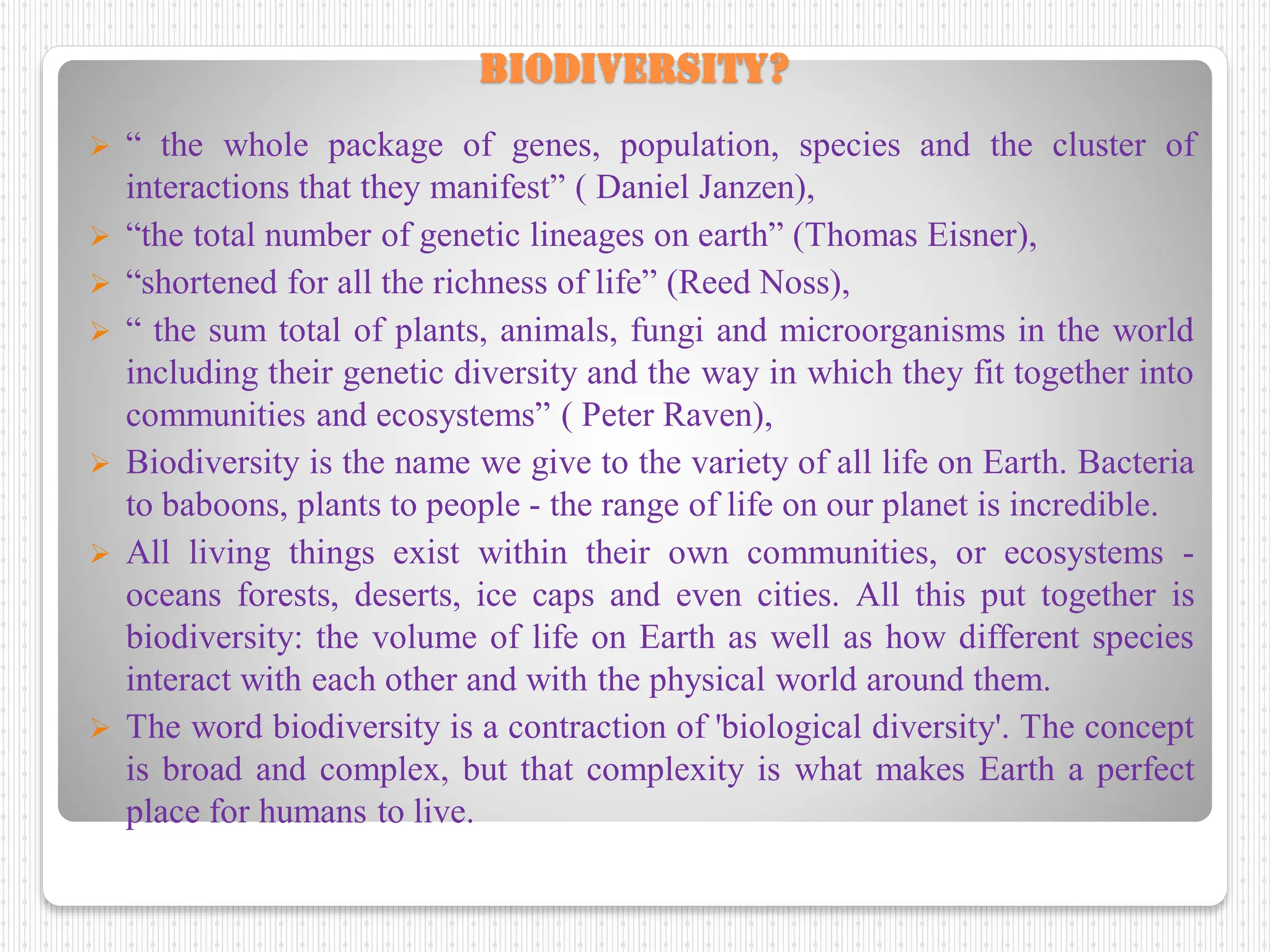
 “ the whole package of genes, population, species and the cluster of
interactions that they manifest” ( Daniel Janzen),
 “the total number of genetic lineages on earth” (Thomas Eisner),
 “shortened for all the richness of life” (Reed Noss),
 “ the sum total of plants, animals, fungi and microorganisms in the world
including their genetic diversity and the way in which they fit together into
communities and ecosystems” ( Peter Raven),
 Biodiversity is the name we give to the variety of all life on Earth. Bacteria
to baboons, plants to people - the range of life on our planet is incredible.
 All living things exist within their own communities, or ecosystems -
oceans forests, deserts, ice caps and even cities. All this put together is
biodiversity: the volume of life on Earth as well as how different species
interact with each other and with the physical world around them.
 The word biodiversity is a contraction of 'biological diversity'. The concept
is broad and complex, but that complexity is what makes Earth a perfect
place for humans to live.
GENETIC DIVERSITY
 The levels of biodiversity is an important context as per its organiasation point
of view,
 The internationally recognized and mostly discussed three kind of biodiversity
as stated below- Genetic diversity, Species Diversity and ecosystem Diversity
 Each one is represented basically by variety and variability of species including
the interactions of ecosystem and its components
 GENETIC DIVERSITY
 Genetic diversity is the variety of genes within a species.
 Genetic diversity can be measured at various levels, such as population,
species, community, and biome. E.g. Due to habitat fragmentation genetic
diversity of Indian tigers has been reduced.
 Genetic diversity is important as it serves as foundation for evolution and
adaptation.
 Greater genetic diversity within a species or population enhances the ability
of some individuals to adapt to environmental changes.
 Lesser genetic diversity results in uniformity, which poses a long-term
problem, as it’s unlikely that any individual within the population could
adapt to changing conditions.
SPECIES DIVERSITY
 Species diversity refers to the variety of species found within a habitat or a
region.
 This is the number of different species that are represented in a given
community,
 The effective number of species refers to the number of equally abundant
species needed to obtain the same mean proportional species abundance as that
observed in the dataset of interest where all the species may not be equally
abundant,
 Species diversity consists of three components- species richness, taxonomic or
phylogenetic diversity and species evenness,
 Some habitats, such as rainforests and coral reefs, have high species diversity.
 For Example, a good climate with good physical geography supports better
species diversity.
 There are two levels of species diversity:
I. Regional Diversity of whole nations or parts of continents within which
many different communities exist,
II. Local Diversity in a given nation where different communities exist at
different latitudes.
ECOSYSTEM DIVERSITY
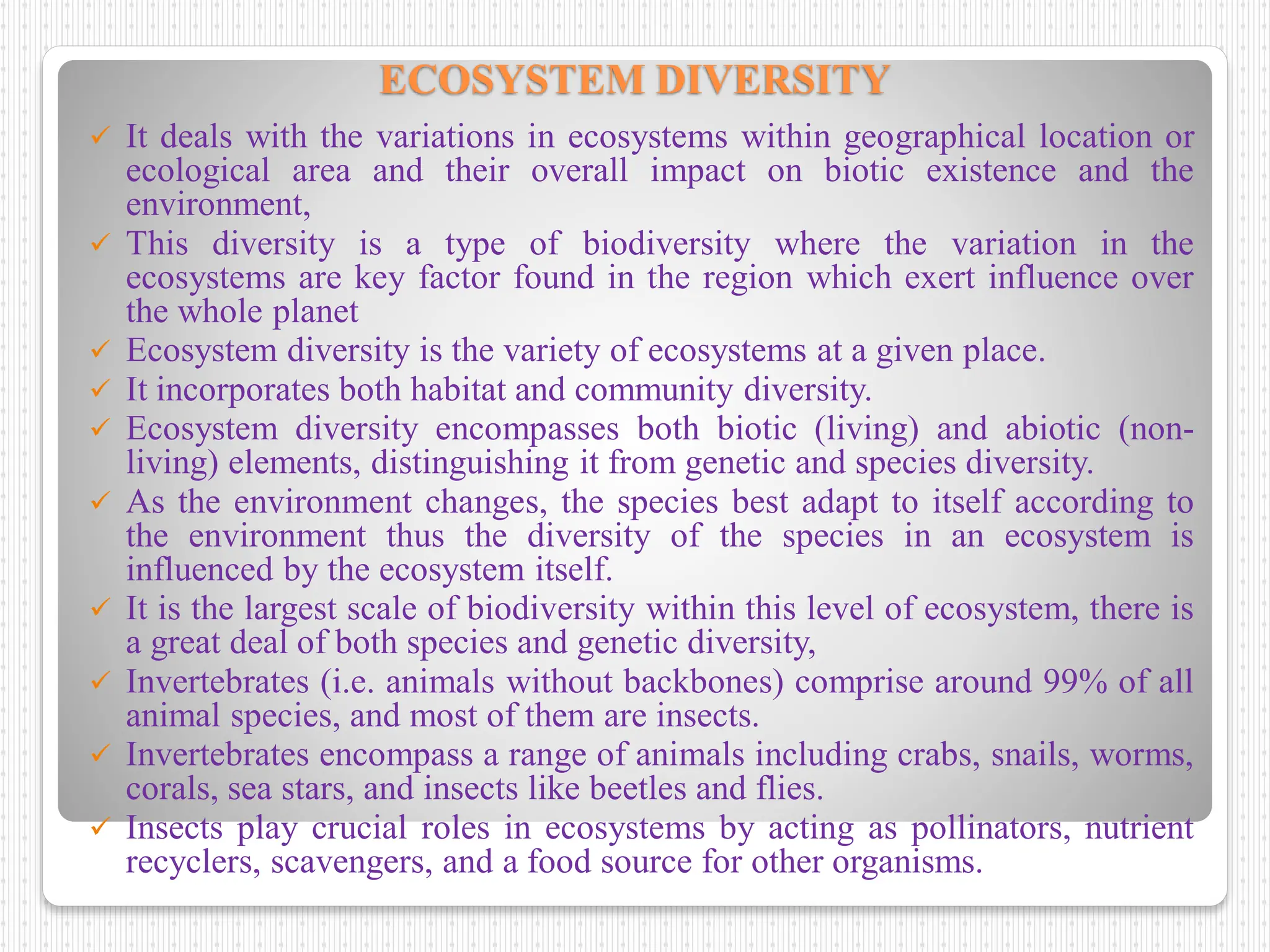
 It deals with the variations in ecosystems within geographical location or
ecological area and their overall impact on biotic existence and the
environment,
 This diversity is a type of biodiversity where the variation in the
ecosystems are key factor found in the region which exert influence over
the whole planet
 Ecosystem diversity is the variety of ecosystems at a given place.
 It incorporates both habitat and community diversity.
 Ecosystem diversity encompasses both biotic (living) and abiotic (non-
living) elements, distinguishing it from genetic and species diversity.
 As the environment changes, the species best adapt to itself according to
the environment thus the diversity of the species in an ecosystem is
influenced by the ecosystem itself.
 It is the largest scale of biodiversity within this level of ecosystem, there is
a great deal of both species and genetic diversity,
 Invertebrates (i.e. animals without backbones) comprise around 99% of all
animal species, and most of them are insects.
 Invertebrates encompass a range of animals including crabs, snails, worms,
corals, sea stars, and insects like beetles and flies.
 Insects play crucial roles in ecosystems by acting as pollinators, nutrient
recyclers, scavengers, and a food source for other organisms.
DIVERSITY OF PLANTS, ANIMALS & MICROBES
GROUP NUMBER DESCRIBED ESTIMATED TOTAL
SPECIES
Viruses 5000 About 50000
Bacteria 4,000 400,000- 3 million
Fungi 70,000 1-1.5 million
Protozoan 40,000 100,000-200,000
Algae 40,000 200,000- 10 million
Flowering plants 250,000 300,000-500,000
Vertebrates 45,000 50,000
Roundworms 15,000 50,000- 1 million
Mollusks 70,000 200,0000
Crustaceans 40,000 150,000
Spiders and mites 75,000 750,000- 10 million
Insects 950,000 8-100 million
MOLECULAR DIVERSITY
 Biodiversity involves diversity of species, genetics and habitats,
 Besides these three factors, another source of biodiversity is molecular
diversity, the molecular diversity s the key components without which the
origin of new species cannot be taken into account in the passage of
evolution,
 It is distinct from genetics although the both are ultimately involved with
the magic molecule of DNA along with other semantides,
 It occurs within one individual , between the individuals of the same
species,
 Molecular biodiversity refers to the diversity within and among organisms
at the molecular level, encompassing variations in DNA, RNA, and
proteins.
 It provides insights into evolution, species identification, and the discovery
of hidden biodiversity, such as cryptic species.
 Technologies like DNA bar coding and high-throughput sequencing are
crucial tools for studying molecular diversity, which has important
applications in conservation planning, ecology, and understanding the
effects of climate change.
ALPHA, BETAAND GAMMA DIVERSITY
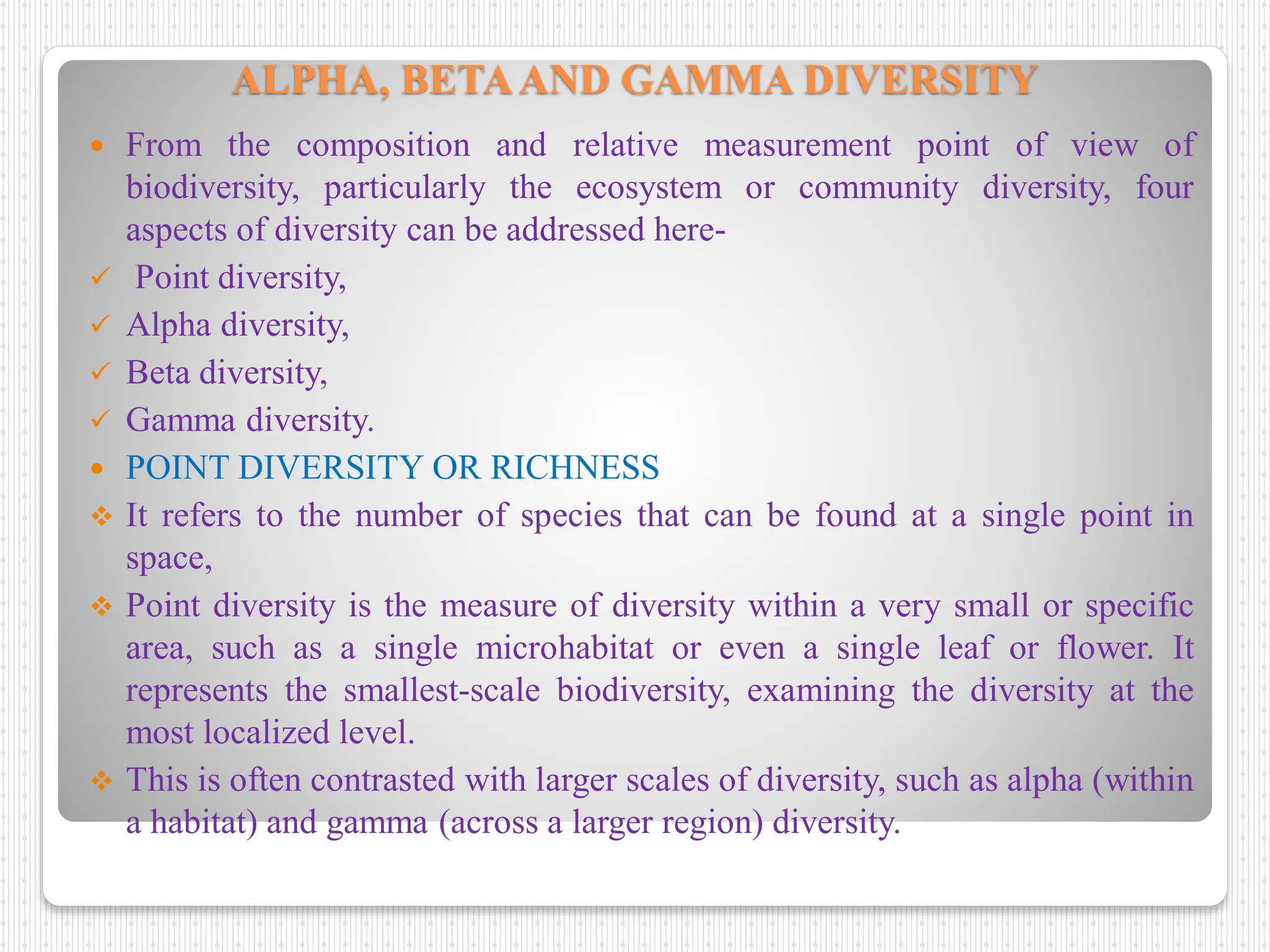
 From the composition and relative measurement point of view of
biodiversity, particularly the ecosystem or community diversity, four
aspects of diversity can be addressed here-
 Point diversity,
 Alpha diversity,
 Beta diversity,
 Gamma diversity.
 POINT DIVERSITY OR RICHNESS
 It refers to the number of species that can be found at a single point in
space,
 Point diversity is the measure of diversity within a very small or specific
area, such as a single microhabitat or even a single leaf or flower. It
represents the smallest-scale biodiversity, examining the diversity at the
most localized level.
 This is often contrasted with larger scales of diversity, such as alpha (within
a habitat) and gamma (across a larger region) diversity.
ALPHA DIVERSITY
 The total number of species in a single community is described as alpha
diversity,
 It comes general concept of species richness,
 When we casually speak of diversity of an area, more often than it refers to
alpha diversity,
 BETA DIVERSITY
 It refers to the degree to which species composition changes along an
environmental gradient,
 Beta diversity is said to high , as ad when the species composition of moss
communities , as an example , changes at successively higher elevations of
mountain slope , but low when same species occupy the whole mountain
side,
 It compares between the two communities or ecosystems,
GAMMA DIVERSITY
 It is a larger scale and looks to compare the species diversity between the
two separate entities that are often divided by a clear geographical barrier
like river or mountain.
 GAMMA DIVERSITY
 It relates to larger geographical scale,
 In fact, it may be defined as “ The rate at which the additional species are
encountered as geographical replacements within a habitat type in different
localities”.
 Interestingly, the plant communities of Amazon Rain forests may be cited
for exhibiting high levels of diversity at the alpha, beta and gamma
diversity,
 It is studied at a very large scale- a biome-where species diversity is
compared between the different ecosystems,
 It could be range over entire slope of mountain, or the entire littoral zone of
seashore,
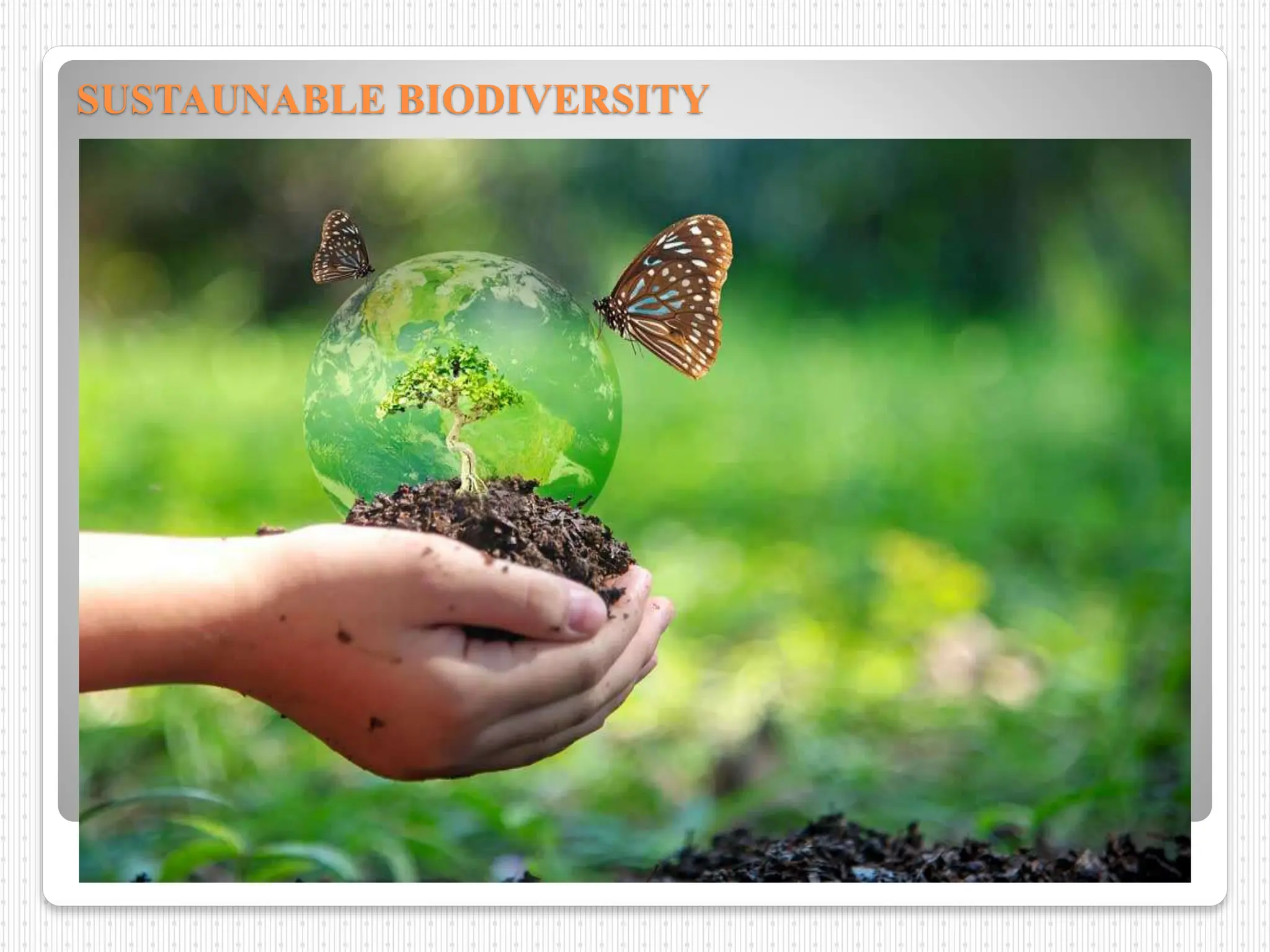
SUSTAUNABLE BIODIVERSITY
Thanks for your visit
 ACKNOWLEDGEMENTS:
a. Google for images,
b. Different websites for enriching the course content,
c. Science Direct pages,
d. Plant Taxonomy & Biodiversity- N.D. Paria
e. A textbook of Botany- Vol III – Hait, Bhattacharya & Ghosh.
DISCLAIMER:
This presentation has been designed to address the academic fraternity
without any financial interest. This is absolutely free to use . The
author does not claim any kind of financial benefits from this content.

BIODIVERSITY AND IT's DIFFERENT TYPES ALONG WITH IMPORTANCE

  • 1.
    BIODIVERSITY AND levelof biodiversity Dr. N. Sannigrahi, Associate Professor, Department of Botany, Nistarini college, Purulia D.B. Road, Purulia, INDIA (W.B)
  • 2.
    BIODIVERSITY  The blueplanet is the treasure of astounding varieties of natural resources,  Some are living or biotic while others are abiotic or non-living resources,  Living resources are may be microscopic or macroscopic,  All the macro and microscopic together constitutes the biodiversity of the earth.  Organisms constitute both flora and fauna,  Each of these organizations involves three levels of existence and interactions- genes, species and ecosystems,  The biodiversity is essential for the survival and propagation of species and natural community,  Species diversity further analyzed into four major components- point richness or diversity, alpha diversity, beta diversity and gamma diversity,  In the context of biodiversity losses, it is a tool for the connecting link between the evolutionary past and the future ,  The auto-sustainable and self regenerating attributes is the awesome privilege to study its nature and sustainability.
  • 3.
  • 4.
    Biodiversity?  Biological diversityor Biodiversity is the foundation and life supporting pillars of humans on the earth,  “The reliability among living organisms from all sources including interalia, terrestrial, marine and other ecosystems and the ecological complexes of which they are part; includes diversity within species, between species and ecosystem” (CBD).  “the totality of genes, species and ecosystems of a region” is the biodiversity of the place.  The term “Biodiversity” was used by wildlife scientist and conservationist Raymond E. Dasmann in 1958 in a book “ A different kind of Country” advocating conservation,  It is “ the sum of earth species including all their interactions and variations within their biotic and abiotic environment in both space and time”. (Terry Erawin, 1991),  Biodiversity is “ the complete array of organisms biologically mediated processes , originally derived structures out there on the globe”  (Jerry Franklin)
  • 5.
    Biodiversity?  “ thewhole package of genes, population, species and the cluster of interactions that they manifest” ( Daniel Janzen),  “the total number of genetic lineages on earth” (Thomas Eisner),  “shortened for all the richness of life” (Reed Noss),  “ the sum total of plants, animals, fungi and microorganisms in the world including their genetic diversity and the way in which they fit together into communities and ecosystems” ( Peter Raven),  Biodiversity is the name we give to the variety of all life on Earth. Bacteria to baboons, plants to people - the range of life on our planet is incredible.  All living things exist within their own communities, or ecosystems - oceans forests, deserts, ice caps and even cities. All this put together is biodiversity: the volume of life on Earth as well as how different species interact with each other and with the physical world around them.  The word biodiversity is a contraction of 'biological diversity'. The concept is broad and complex, but that complexity is what makes Earth a perfect place for humans to live.
  • 6.
    GENETIC DIVERSITY  Thelevels of biodiversity is an important context as per its organiasation point of view,  The internationally recognized and mostly discussed three kind of biodiversity as stated below- Genetic diversity, Species Diversity and ecosystem Diversity  Each one is represented basically by variety and variability of species including the interactions of ecosystem and its components  GENETIC DIVERSITY  Genetic diversity is the variety of genes within a species.  Genetic diversity can be measured at various levels, such as population, species, community, and biome. E.g. Due to habitat fragmentation genetic diversity of Indian tigers has been reduced.  Genetic diversity is important as it serves as foundation for evolution and adaptation.  Greater genetic diversity within a species or population enhances the ability of some individuals to adapt to environmental changes.  Lesser genetic diversity results in uniformity, which poses a long-term problem, as it’s unlikely that any individual within the population could adapt to changing conditions.
  • 7.
    SPECIES DIVERSITY  Speciesdiversity refers to the variety of species found within a habitat or a region.  This is the number of different species that are represented in a given community,  The effective number of species refers to the number of equally abundant species needed to obtain the same mean proportional species abundance as that observed in the dataset of interest where all the species may not be equally abundant,  Species diversity consists of three components- species richness, taxonomic or phylogenetic diversity and species evenness,  Some habitats, such as rainforests and coral reefs, have high species diversity.  For Example, a good climate with good physical geography supports better species diversity.  There are two levels of species diversity: I. Regional Diversity of whole nations or parts of continents within which many different communities exist, II. Local Diversity in a given nation where different communities exist at different latitudes.
  • 8.
    ECOSYSTEM DIVERSITY  Itdeals with the variations in ecosystems within geographical location or ecological area and their overall impact on biotic existence and the environment,  This diversity is a type of biodiversity where the variation in the ecosystems are key factor found in the region which exert influence over the whole planet  Ecosystem diversity is the variety of ecosystems at a given place.  It incorporates both habitat and community diversity.  Ecosystem diversity encompasses both biotic (living) and abiotic (non- living) elements, distinguishing it from genetic and species diversity.  As the environment changes, the species best adapt to itself according to the environment thus the diversity of the species in an ecosystem is influenced by the ecosystem itself.  It is the largest scale of biodiversity within this level of ecosystem, there is a great deal of both species and genetic diversity,  Invertebrates (i.e. animals without backbones) comprise around 99% of all animal species, and most of them are insects.  Invertebrates encompass a range of animals including crabs, snails, worms, corals, sea stars, and insects like beetles and flies.  Insects play crucial roles in ecosystems by acting as pollinators, nutrient recyclers, scavengers, and a food source for other organisms.
  • 9.
    DIVERSITY OF PLANTS,ANIMALS & MICROBES GROUP NUMBER DESCRIBED ESTIMATED TOTAL SPECIES Viruses 5000 About 50000 Bacteria 4,000 400,000- 3 million Fungi 70,000 1-1.5 million Protozoan 40,000 100,000-200,000 Algae 40,000 200,000- 10 million Flowering plants 250,000 300,000-500,000 Vertebrates 45,000 50,000 Roundworms 15,000 50,000- 1 million Mollusks 70,000 200,0000 Crustaceans 40,000 150,000 Spiders and mites 75,000 750,000- 10 million Insects 950,000 8-100 million
  • 10.
    MOLECULAR DIVERSITY  Biodiversityinvolves diversity of species, genetics and habitats,  Besides these three factors, another source of biodiversity is molecular diversity, the molecular diversity s the key components without which the origin of new species cannot be taken into account in the passage of evolution,  It is distinct from genetics although the both are ultimately involved with the magic molecule of DNA along with other semantides,  It occurs within one individual , between the individuals of the same species,  Molecular biodiversity refers to the diversity within and among organisms at the molecular level, encompassing variations in DNA, RNA, and proteins.  It provides insights into evolution, species identification, and the discovery of hidden biodiversity, such as cryptic species.  Technologies like DNA bar coding and high-throughput sequencing are crucial tools for studying molecular diversity, which has important applications in conservation planning, ecology, and understanding the effects of climate change.
  • 11.
  • 12.
    ALPHA, BETAAND GAMMADIVERSITY  From the composition and relative measurement point of view of biodiversity, particularly the ecosystem or community diversity, four aspects of diversity can be addressed here-  Point diversity,  Alpha diversity,  Beta diversity,  Gamma diversity.  POINT DIVERSITY OR RICHNESS  It refers to the number of species that can be found at a single point in space,  Point diversity is the measure of diversity within a very small or specific area, such as a single microhabitat or even a single leaf or flower. It represents the smallest-scale biodiversity, examining the diversity at the most localized level.  This is often contrasted with larger scales of diversity, such as alpha (within a habitat) and gamma (across a larger region) diversity.
  • 13.
    ALPHA DIVERSITY  Thetotal number of species in a single community is described as alpha diversity,  It comes general concept of species richness,  When we casually speak of diversity of an area, more often than it refers to alpha diversity,  BETA DIVERSITY  It refers to the degree to which species composition changes along an environmental gradient,  Beta diversity is said to high , as ad when the species composition of moss communities , as an example , changes at successively higher elevations of mountain slope , but low when same species occupy the whole mountain side,  It compares between the two communities or ecosystems,
  • 14.
    GAMMA DIVERSITY  Itis a larger scale and looks to compare the species diversity between the two separate entities that are often divided by a clear geographical barrier like river or mountain.  GAMMA DIVERSITY  It relates to larger geographical scale,  In fact, it may be defined as “ The rate at which the additional species are encountered as geographical replacements within a habitat type in different localities”.  Interestingly, the plant communities of Amazon Rain forests may be cited for exhibiting high levels of diversity at the alpha, beta and gamma diversity,  It is studied at a very large scale- a biome-where species diversity is compared between the different ecosystems,  It could be range over entire slope of mountain, or the entire littoral zone of seashore,
  • 15.
  • 16.
    Thanks for yourvisit  ACKNOWLEDGEMENTS: a. Google for images, b. Different websites for enriching the course content, c. Science Direct pages, d. Plant Taxonomy & Biodiversity- N.D. Paria e. A textbook of Botany- Vol III – Hait, Bhattacharya & Ghosh. DISCLAIMER: This presentation has been designed to address the academic fraternity without any financial interest. This is absolutely free to use . The author does not claim any kind of financial benefits from this content.