

BENTHAM AND HOOKER
SYSTEM OF PLANT
CLASSIFICATION
PRESENTER
RASHMI M G
1st YEAR MSc. BOTANY
Maharani’s science college
for women
Mysore
Introduction
TAXONOMY is basically concerned with the classification of
organisms or plants on the basis of similarities and differences.
Classification is the placement or arrangement of groups of
plants with a particular circumscription by rank and position
according to artificial criteria, phenetic similarities or
phylogenetic relationships
Types of classifications
Natural
Artificial
Mechanical
Phylogenetic system
Natural system of classification
In natural system of classification, all the
characters are considered and plants are arranged
according to various levels of their affinities. It
uses overall similarities in grouping taxa a
concept initiated by M. Adanson
These systems explains the natural situation of
plants as such
BENTHAM AND HOOKER’S SYSTEM OF
CLASSIFICATION is the best example for
natural system of plant classification
Bentham & Hooker
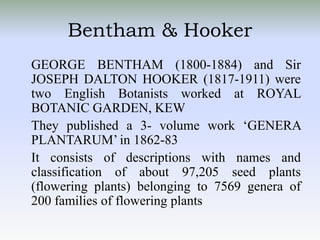
GEORGE BENTHAM (1800-1884) and Sir
JOSEPH DALTON HOOKER (1817-1911) were
two English Botanists worked at ROYAL
BOTANIC GARDEN, KEW
They published a 3- volume work ‘GENERA
PLANTARUM’ in 1862-83
It consists of descriptions with names and
classification of about 97,205 seed plants
(flowering plants) belonging to 7569 genera of
200 families of flowering plants
GEORGE BENTHAM & JOSEPH
DALTON HOOKER
GEORGE BENTHAM JOSEPH DALTON HOOKER
3 VOLUMED WORK -
GENERA PLANTARUM
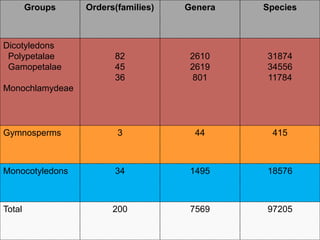
Groups Orders(families) Genera Species
Dicotyledons
Polypetalae
Gamopetalae
Monochlamydeae
82
45
36
2610
2619
801
31874
34556
11784
Gymnosperms 3 44 415
Monocotyledons 34 1495 18576
Total 200 7569 97205
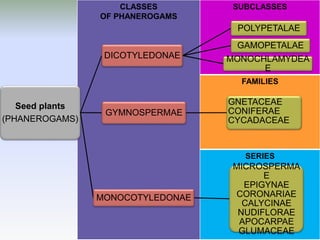
CLASSES
OF PHANEROGAMS
SERIES
FAMILIES
SUBCLASSES
Seed plants
(PHANEROGAMS)
DICOTYLEDONAE
POLYPETALAE
GAMOPETALAE
MONOCHLAMYDEA
E
GYMNOSPERMAE
GNETACEAE
CONIFERAE
CYCADACEAE
MONOCOTYLEDONAE
MICROSPERMA
E
EPIGYNAE
CORONARIAE
CALYCINAE
NUDIFLORAE
APOCARPAE
GLUMACEAE
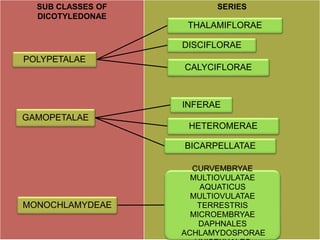
SERIES
SUB CLASSES OF
DICOTYLEDONAE
POLYPETALAE
THALAMIFLORAE
DISCIFLORAE
CALYCIFLORAE
GAMOPETALAE
INFERAE
HETEROMERAE
BICARPELLATAE
MONOCHLAMYDEAE
CURVEMBRYAE
MULTIOVULATAE
AQUATICUS
MULTIOVULATAE
TERRESTRIS
MICROEMBRYAE
DAPHNALES
ACHLAMYDOSPORAE
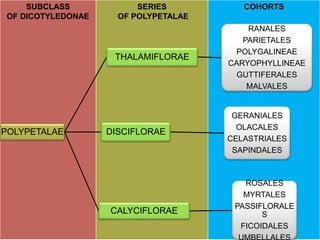
SUBCLASS
OF DICOTYLEDONAE
SERIES
OF POLYPETALAE
COHORTS
POLYPETALAE
THALAMIFLORAE
RANALES
PARIETALES
POLYGALINEAE
CARYOPHYLLINEAE
GUTTIFERALES
MALVALES
DISCIFLORAE
GERANIALES
OLACALES
CELASTRIALES
SAPINDALES
CALYCIFLORAE
ROSALES
MYRTALES
PASSIFLORALE
S
FICOIDALES
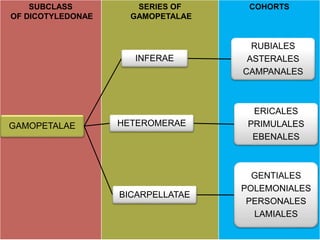
COHORTS
SERIES OF
GAMOPETALAE
SUBCLASS
OF DICOTYLEDONAE
GAMOPETALAE
INFERAE
RUBIALES
ASTERALES
CAMPANALES
HETEROMERAE
ERICALES
PRIMULALES
EBENALES
BICARPELLATAE
GENTIALES
POLEMONIALES
PERSONALES
LAMIALES
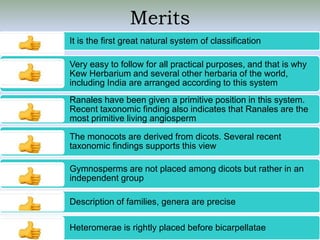
Merits
It is the first great natural system of classification
Very easy to follow for all practical purposes, and that is why
Kew Herbarium and several other herbaria of the world,
including India are arranged according to this system
Ranales have been given a primitive position in this system.
Recent taxonomic finding also indicates that Ranales are the
most primitive living angiosperm
The monocots are derived from dicots. Several recent
taxonomic findings supports this view
Gymnosperms are not placed among dicots but rather in an
independent group
Description of families, genera are precise
Heteromerae is rightly placed before bicarpellatae
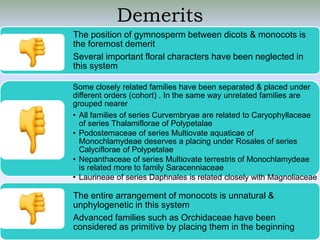
Demerits
The position of gymnosperm between dicots & monocots is
the foremost demerit
Several important floral characters have been neglected in
this system
Some closely related families have been separated & placed under
different orders (cohort) . In the same way unrelated families are
grouped nearer
• All families of series Curvembryae are related to Caryophyllaceae
of series Thalamiflorae of Polypetalae
• Podostemaceae of series Multiovate aquaticae of
Monochlamydeae deserves a placing under Rosales of series
Calyciflorae of Polypetalae
• Nepanthaceae of series Multiovate terrestris of Monochlamydeae
is related more to family Saracenniaceae
• Laurineae of series Daphnales is related closely with Magnoliaceae
of Ranales
The entire arrangement of monocots is unnatural &
unphylogenetic in this system
Advanced families such as Orchidaceae have been
considered as primitive by placing them in the beginning
Conclusion
Bentham and Hooker system of plant classification is
the best example of natural system of classification
Their contribution to the field of taxonomy and plant
systematics is enormous
Their classification is of practical importance even
today
The 3 volume work ‘Genera Plantarum’ published by
them It consists of descriptions with names and
classification of about 97,205 seed plants (flowering
plants) belonging to 7569 genera of 200 families of
flowering plants.
Reference
• PLANT SYSTEMATICS – THEORY AND
PRACTICE by GURCHARAN SINGH, 3rd
edition, CBS publishers & distributors Pvt
Ltd , P no. 308-311
• PLANT TAXONOMY by O P SHARMA,
2nd edition , Mc Graw Hill education, P No.
24-27
• https://www.google.com/imghp?hl=en
BENTHAM AND HOOKER SYSTEM OF CLASSIFICATION.pptx

BENTHAM AND HOOKER SYSTEM OF CLASSIFICATION.pptx