ENDEMISM; BRIEF DESCRIPTION OF MAJOR TERRESTRIAL BIOMES (ONE EACH
FROM TROPICAL, TEMPERATE & TUNDRA
Dr. N. Sannigrahi,
Associate Professor,
Department of Botany,
Nistarini college, Purulia
D.B. Road, Purulia,
INDIA (W.B)
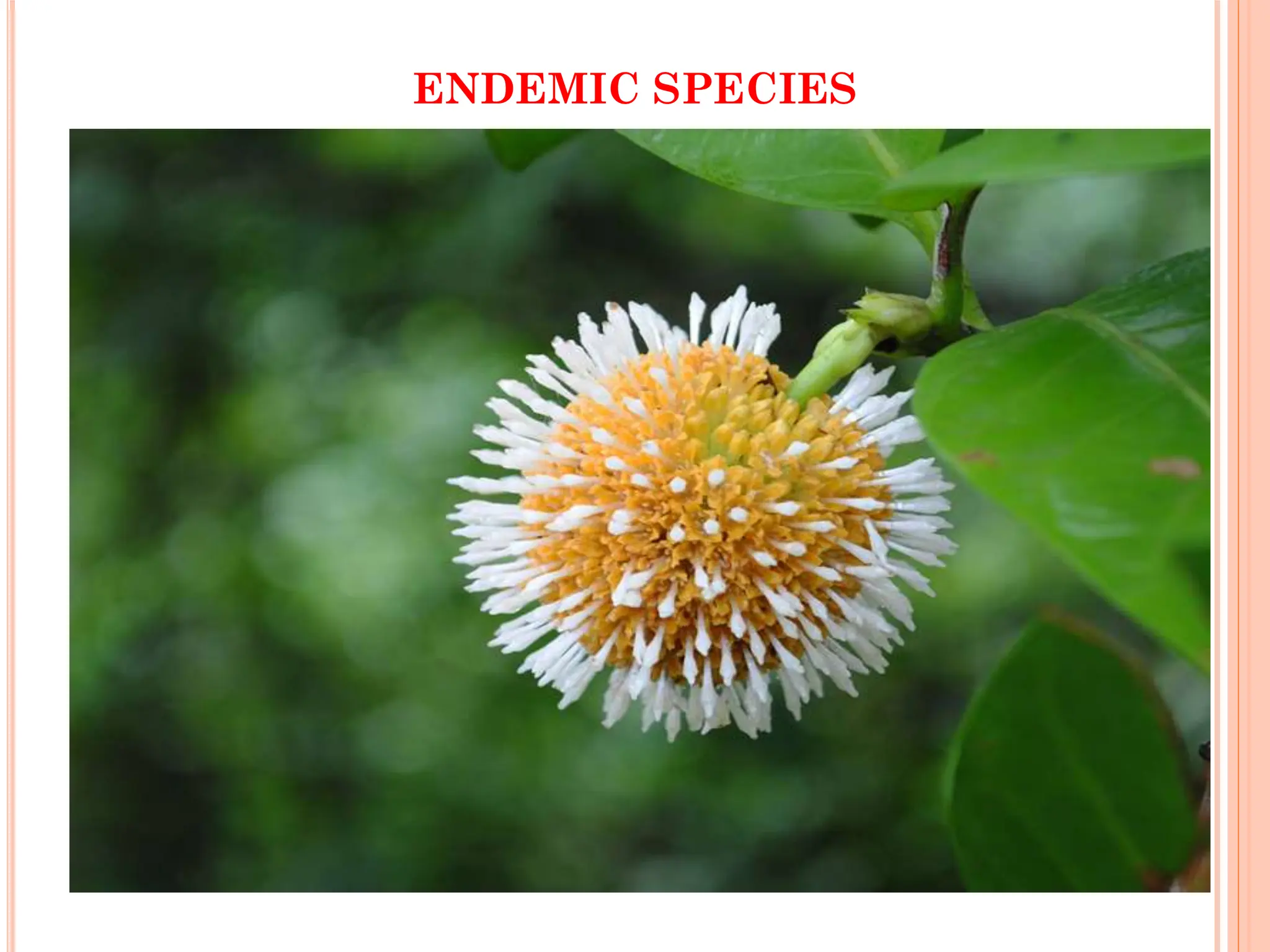
ENDEMIC SPECIES
ENDEMISM- INTRODUCTION
 The phenomenon of the confinement of species usually to single restricted
area,
 It is applied normally to area where there is a considerable restriction of
distriution of species,
 In biogeography, the term is exclusively used as equivalent to indigenous or
native,
 The extreme opposite of an endemic species is the cosmopolitan distribution
having global or widespread distribution,
 According to Juan J Morrone, a species may be endemic to any particular
geographic region regardless of size,
 Endemics are not necessarily rare but some common where they occur,
 All rare species are not endemic ,
 Two types of endemism- Paleoendemism and Neoendemism ,
 Endemism is the science of the distribution of taxa to a restricted
geographical area.
PALEOENDEMISM
 Paleobiology is the domain for the untold biotic heritage as remnants of the
ancient past in the form of fossils, excavation can speak a lot,
 According to Ridley ( 1922), endemic species once had the far extended
distribution but now exist as the survivals of the larger group occurring in
the past,
 These are known as epibiotics that remain confined as relics of the past in
an isolated area,
 Due to lack of effective dispersal ability, species cannot overcome the
barrier and consequently become restricted to their place of natural
occurrences,
 Some example like Ginkgo biloba, Glyptosteroboides restricted to China but
as far as fossil records are concerned, found in north temperate zone,
 Seqoiadendron giganteum formerly widely distributed but now found in
Nevada of USA. These are relics and endemics,
 This is popularly known as the theory of epibiotics.
NEOENDEMISM
 On the basis of age and area hypothesis, Willis states that the occurrence of
diverse species and genera in a particular area is proportional to the age in
the evolution.
 A small area having definite plant groups where they are endemic indicates
their relative recent age .
 Willis suggests that all endemic species occupying small area are to be
regarded as younger species but this view has been criticized by D.
Chjatterjee (1939) on the basis of the fact that they may be correct for a
large number of species but certainly not for all.
 Some examples of neoendemism includes Gentiana, Impatiens, Primula,
Rhodendron etc which are arise through natural crossing and mutation.
 Regarding the above concepts, Chatterjee proposed “ both schools are
correct in their views but from the evidence of large number of new forms,
it is likely that the later view has more supporters”.
 Richardson( 1978) suggested endemics of intermediate nature between the
above two types , known as holoendemics .
OTHER TYPES OF ENDEMISM
 Based on cytotaxonomic criteria, Faverger and Contandriopoulis ( 1961),
three different types of neoendemics have been stated- Schizoendemics,
Patroendemics and Apoendemics.
 Schizoendemics- obtained from or having given to a relatively widespread
taxon with same chromosome count as the parent taxon.
 Patroendemics- involve restricted diploids which have given rise to more
widespread polyploids.
 Apoendemics- the restricted polyploids which have arisen from more
widespread diploids.
 In addition to these, Pseudoendemics are also considered which have
recently evolved from a mutation.
 Myers and de Grave ( 2000) further attempted to redefine the concept of
endemism. In their view, everything is endemic , even cosmopolitan species
are endemic . Thus, the subdivisions of neoendemics and paleoendemics are
without merit regarding the study of distributions because those concepts
consider that an endemic has distributions limited to one place.
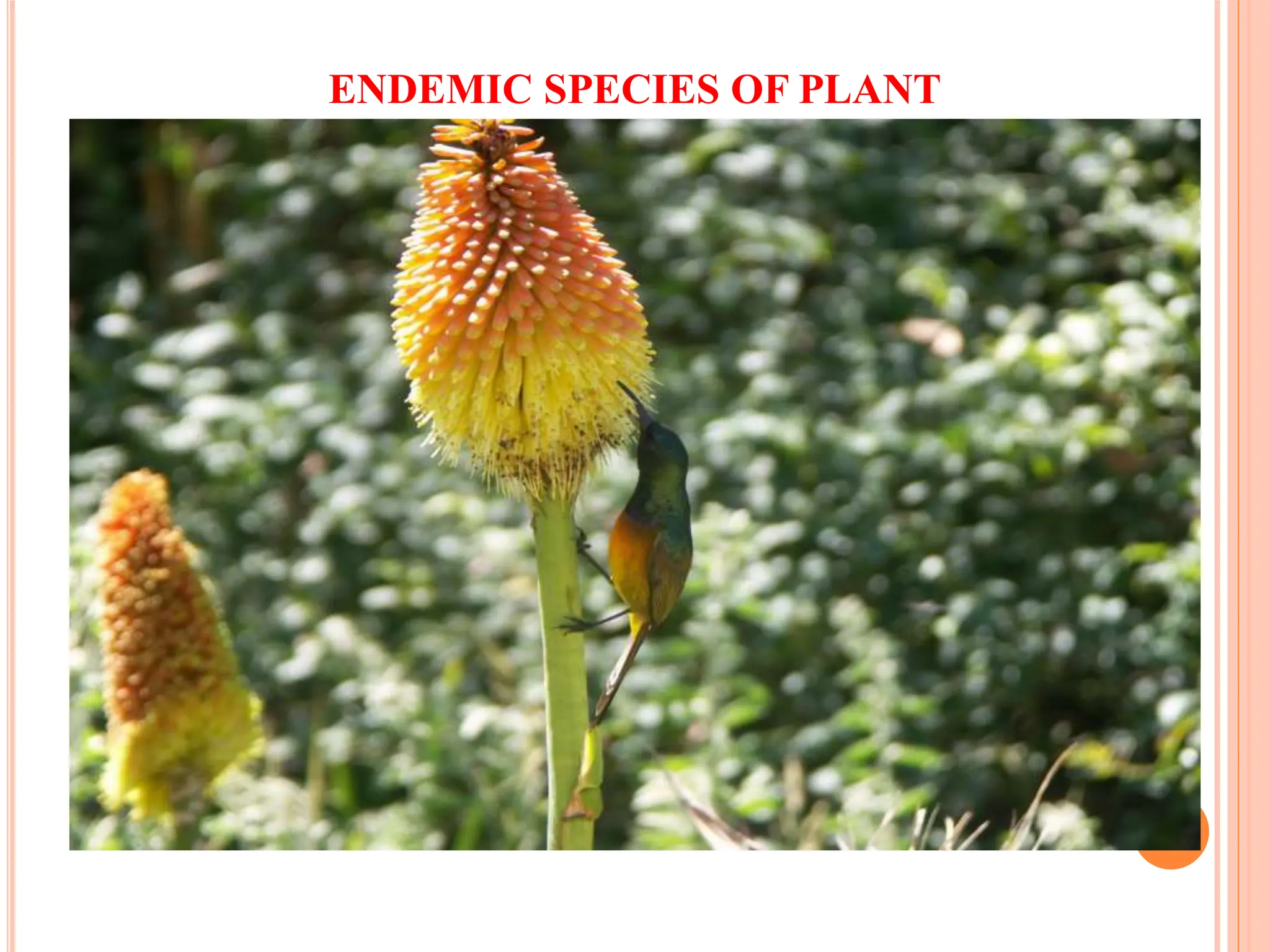
ENDEMIC SPECIES OF PLANT
OTHER TYPES OF ENDEMISM
 They proposed four different categories-
 Holoendemics, Euryendemics, Steoendemics , Rhoendemics.
 In their scheme, cryptoendemics and euendemics is further subdivision of
rhoendemics,
 Stenoendemics is known as local endemics , that have reduced distribution
and are synonymous with the word, endemics.
 In the traditional sense, euroendemics have larger distribution.
 A rhoendemic has distinct distribution.
 In a cryptoendemic , the disjunct distribution was due to extinction of the
intervening populations.
 Traditionally, none of Myers and de Grave’s categories would be considered
endemics except stenoendemics.
 Thus, different approaches are found to have types of concept to explore
the endemism in broad sense.
ISLAND ENDEMISM
 There are some special type of endemism found to occur restricted to
isolated land from the main landmass that build up the concept of Island
endemism.
 Galapagos, Juan Fernandez and Hawaii belong to this domain.
 The Galapagos Islands being volcanic archipelago in the pacific ocean and
the province of Ecuador has many endemic species but few endemic genera
and many endemic species are comparatively closely allied to continental
America type.
 Juan Fernandez islands are situated in the south pacific ocean near to
Chile and represent a small flora but this is peculiar. In its endemics,
including numerous genera and even one family.
 The Hawaiian islands contain flora much larger than those of the other
groups, 90% of species being confined to archipelago.
 There are so many endemic genera although the number of species is much
of these flora is very different.
FACTORS OF ENDEMISM
 Various events caused by drifting of continents, dispersal and extinction
along with other geological instability may be possible causal factors,
 Ecological factors play a very pivotal role in this regard . Endemic species
are likely to develop on geographically and biologically isolated areas like
islands and remote island groups.
 The most common cause of isolation represent lofty mountainous chains ,
deserts, vast stretches of marshes along with other restricted boundaries and
they render some possible factors of endemism.
 The stability of a region’s climate and habitat through time may also
contribute to high rates of endemism , especially paleoendemics . Acting as
refuges for species during times of climate change specially like ice age.
 In many cases, biological factors like poor dispersal rate can cause a
particular group of organisms to have speciation rates and thus play a
crucial role in the content of endemism.
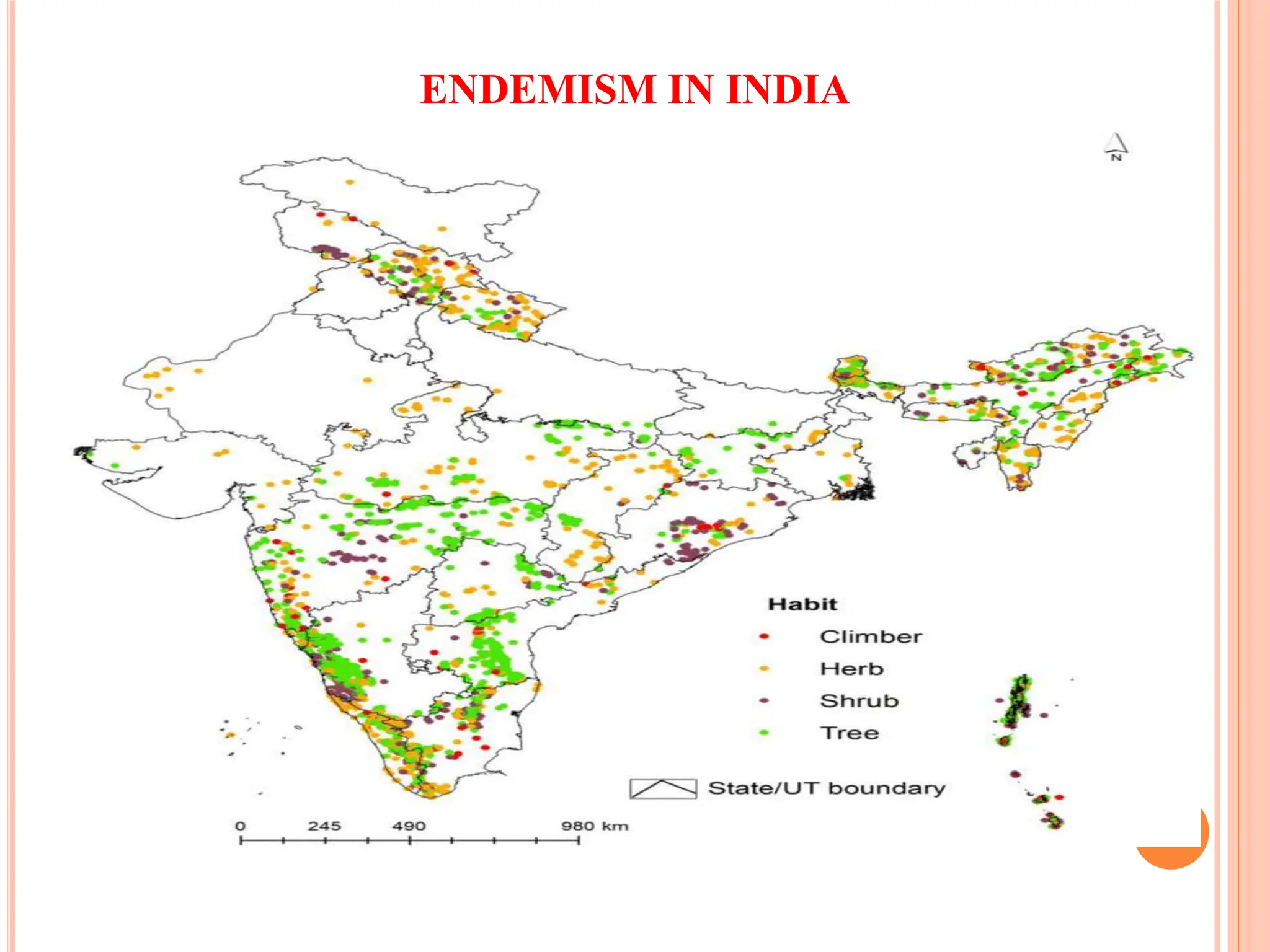
ENDEMISM IN INDIA
 The floristic composition and ecological consideration in the context of India is
very important,
 The British India was a land of diversity due to natural and physical barriers,
 This enables the difficulty of the migration of species to spread freely from
north to south direction,
 According to Hooker(1904), the flora of India is a mixture of flora of the
surrounding areas like Malaya, Orient, Africa, Tibet, China and Japan,
 But Chatterjee though his critical analysis came to the conclusion “ India has
flora of its own” because it is not only rich in endemic flora but also a number
of endemic species,
 According to chatterjee(1939), the total number of Dicotyledons in India is
11124 of which 61.5% of plants are endemic in British India,
 The highest number of endemic genera is found in the families like
Acanthaceae, Asclepidaceae, Balsaminaceae, Compositae, Euphorbiaceae,
Gentaniaceae, Papillionaceae, Primulaceae, Rosaceae, Rubiaceae etc.
 Chatterjee divided Indiainto10 Phytogeographical regions-Western Himalaya,
central Himalaya, Eastern Himalaya, Indus plain, Gangetic plane, Deccan,
Malabar, Andaman and Nicober islands
ENDEMISM IN INDIA
TERRISTRIAL BIOMES
 Biomes are large-scale environments that are distinguished by characteristic
temperature ranges and amounts of precipitation. These two variables affect
the types of vegetation and animal life that can exist in those areas. Because
each biome is defined by climate, the same biome can occur in
geographically distinct areas with similar climate.
 There are eight major terrestrial biomes:
i. Tropical rainforests,
ii. Savannas,
iii. Subtropical deserts,
iv. Chaparral,
v. Temperate grasslands,
vi. Temperate forests,
vii. Boreal forests,
viii. and Arctic tundra
TROPICAL RAIN FORESTS
 Tropical Rain Forests are the most biodiverse terrestrial biome. This
biodiversity is under extraordinary threat primarily through logging and
deforestation for agriculture.
 Tropical rainforests have also been described as nature’s pharmacy because
of the potential for new drugs that is largely hidden in the chemicals
produced by the huge diversity of plants, animals, and other organisms.
 The vegetation is characterized by plants with spreading roots and broad
leaves that fall off throughout the year, unlike the trees of deciduous forests
that lose their leaves in one season.
 The temperature and sunlight profiles of tropical rainforests are stable in
comparison to other terrestrial biomes, with average temperatures ranging
from 20oC to 34oC (68oF to 93oF).
 Month-to-month temperatures are relatively constant in tropical rainforests,
in contrast to forests farther from the equator. This lack of temperature
seasonality leads to year-round plant growth rather than just seasonal
growth.
 In contrast to other ecosystems, a consistent daily amount of sunlight (11–
12 hours per day year-round) provides more solar radiation and therefore
more opportunity for primary productivity.
TROPICAL RAIN FORESTS
 The annual rainfall in tropical rainforests ranges from 125 to 660 cm (50–
200 in) with considerable seasonal variation.
 Tropical rainforests have wet months in which there can be more than 30
cm (11–12 in) of precipitation, as well as dry months in which there are
fewer than 10 cm (3.5 in) of rainfall.
 However, the driest month of a tropical rainforest can still exceed the annual
rainfall of some other biomes, such as deserts.
 Tropical rainforests have high net primary productivity because the annual
temperatures and precipitation values support rapid plant growth. However,
the high amounts of rainfall leaches nutrients from the soils of these forests.
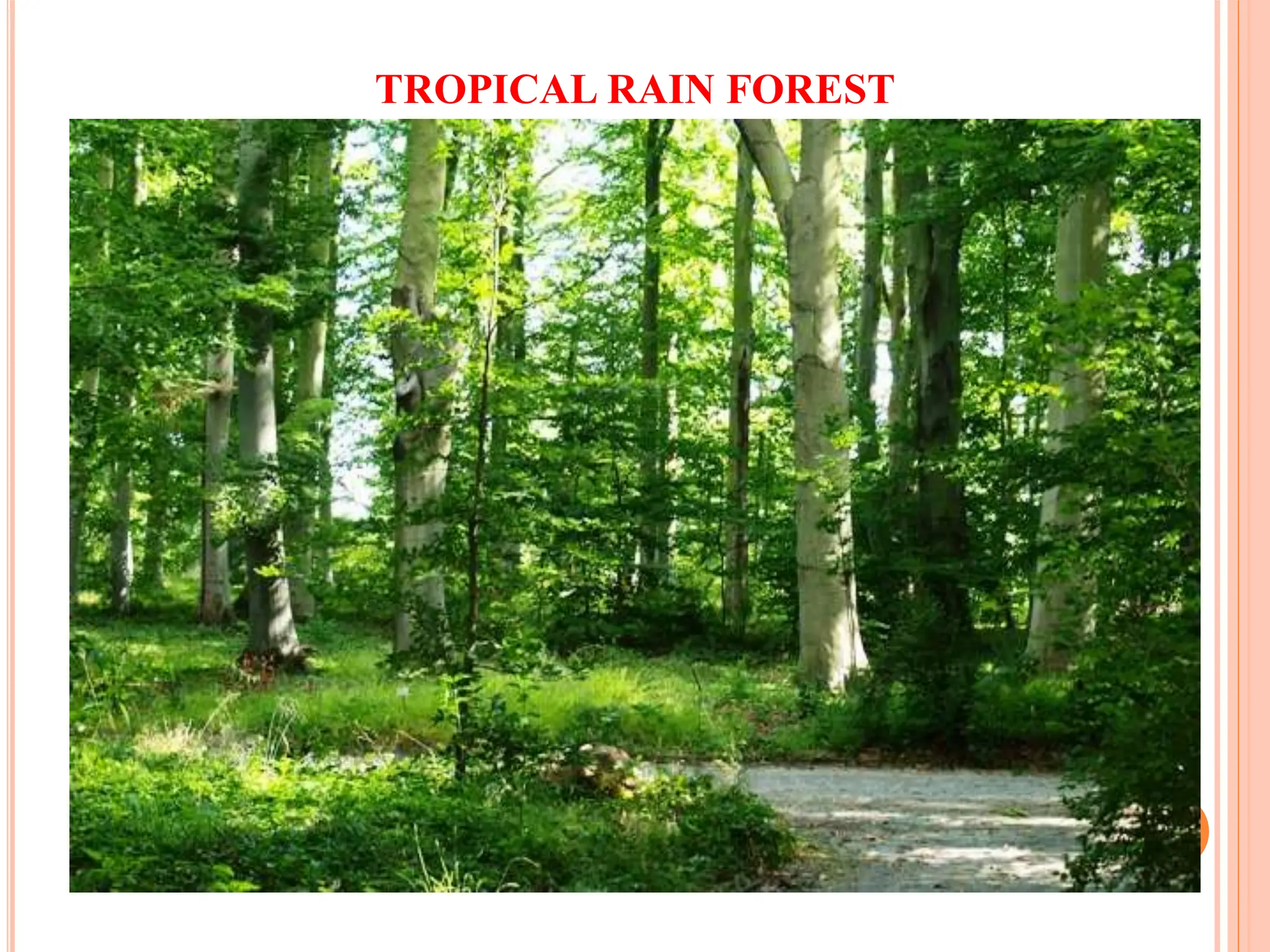
 Tropical rainforests are characterized by vertical layering of vegetation and
the formation of distinct habitats for animals within each layer. On the forest
floor is a sparse layer of plants and decaying plant matter.
 Above that is an understory of short, shrubby foliage. A layer of trees rises
above this understory and is topped by a closed upper canopy—the
uppermost overhead layer of branches and leaves. Some additional trees
emerge through this closed upper canopy.
TROPICAL RAIN FOREST
TROPICAL RAIN FORESTS
 These layers provide diverse and complex habitats for the variety of plants,
animals, and other organisms. Many species of animals use the variety of
plants and the complex structure of the tropical wet forests for food and
shelter. Some organisms live several meters above ground, rarely
descending to the forest floor.
 The tropical forest biome is estimated to contain over half of the terrestrial
species on Earth. Approximately 170,000 of the 250,000 described species
of vascular plants occur in tropical biomes. As many as 1,209 butterfly
species have been documented in 55 square kilometers of the Tambopata
Reserve in southeastern Peru, compared to 380 butterfly species in Europe .
 The tropical forest biome is composed of several different sub-biomes,
including evergreen rainforest, seasonal deciduous forest, tropical cloud
forest, and mangrove forest. These sub-biomes develop due to changes in
seasonal patterns of rainfall, elevation and/or substrate.
TEMPERATE BIOMES
 The climate of the mid latitudes is much more variable than the tropics. As
the Earth orbits the Sun, the seasons alternate back and forth between the
northern and southern hemisphere and plants must cope with sometimes
extreme seasonal changes in temperature and moisture. In general, the
temperate biomes of the mid latitudes have less species diversity than their
tropical counterparts.
 While the climate of the tropics is dominated by the ITCZ and subtropical
High pressure centers, the mid latitude zones are dominated by the
movements of air masses.
 Also, ocean currents moving in opposite directions on opposite sides of
continents and mountain ranges can produce distinctly different climate and
vegetation zones between east and west coasts. Look at North America in
the map below, for example. The vegetation zones clearly vary more in an
east-west direction than in the north-south direction, as was the case in the
tropics.
TEMPERATE BIOMES
TEMPERATE BIOMES
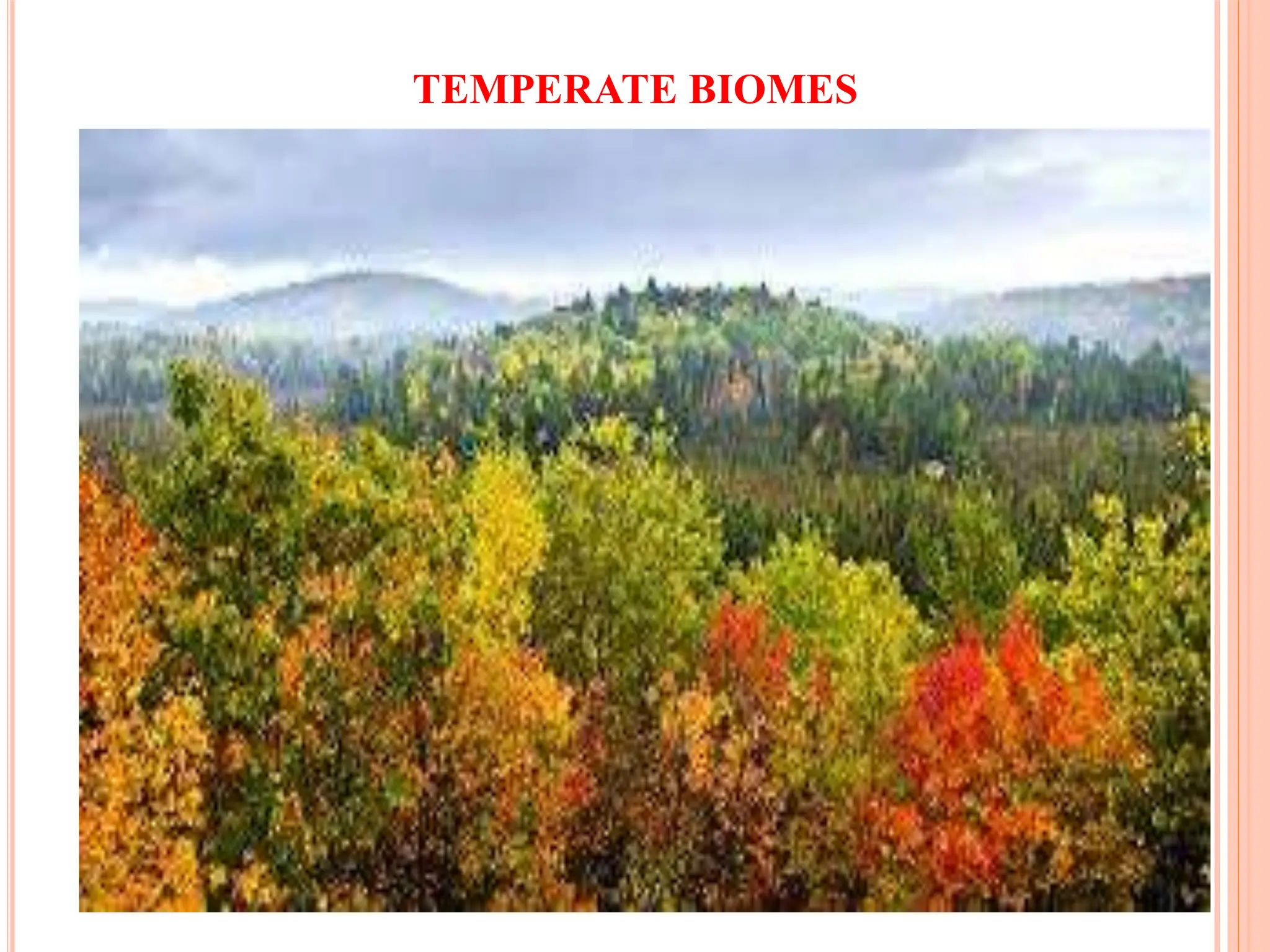
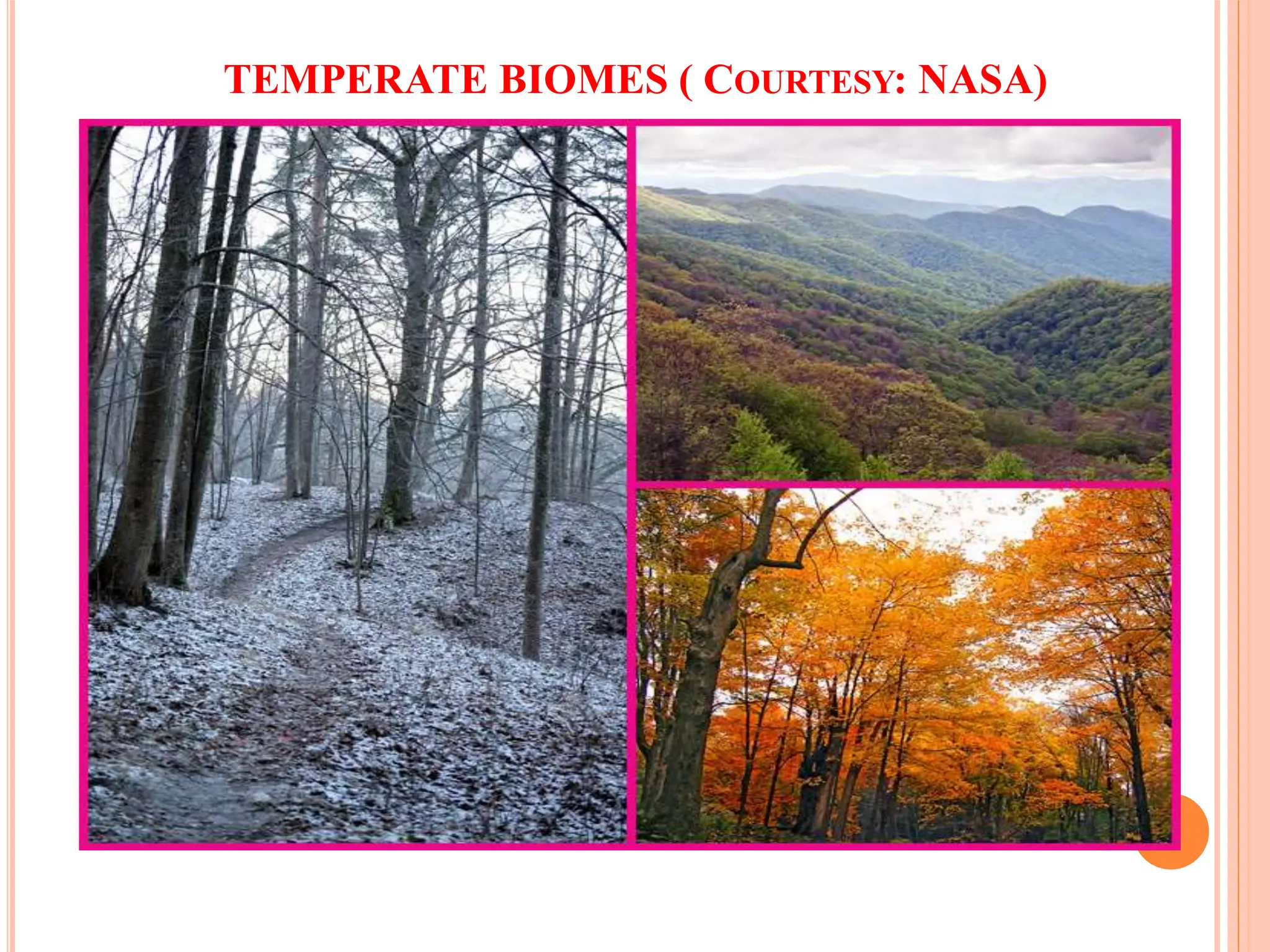
 Temperate deciduous forest dominates large tracts of the Eurasian and North
American continents. Deciduous means that the trees lose their leaves
during the cold, or sometimes dry, season. In colder climates, this helps
prevent frost damage as trees "harden" their tissues for the coming winter.
Broadleaf trees, like oak, elm, hemlock, maple, and beech, dominate these
forests. They cover most of the eastern portions of North America and Asia,
as well as most of Europe south of Scandinavia.
 The wet western coasts of North and South America and most of New
Zealand and Tasmania support temperate evergreen forest. These are
dominated by coniferous species, such as redwood and fir, but also
containing many broadleaf species.
 The climate of these areas is fairly stable year-round as onshore winds bring
plenty of rain to the windward slopes of coastal mountain ranges and keep
temperatures cool in summer and relatively warm in winter.
 It remains something of a mystery in biogeography why broadleaf forests
dominate the eastern part of North America, while at the same latitudes,
conifers dominate the west coast.
TEMPERATE BIOMES ( COURTESY: NASA)
TEMPERATE BIOMES
 Mediterranean biome, also called chaparral in California and maquis in
Europe, occurs on the fringes of the Mediterranean Sea and in small patches
on the west coasts of North and South America, Western Australia, and the
southern tip of Africa. These areas have unusual climates with wet winters
and long, dry summers (that's why Europeans head to the Med for their
summer vacations). Other places in the world receive most of their rainfall
in summer. Mediterranean biome consists of tough grasses, cacti and
scattered, short trees like olive and scrub oak that are well adapted to
drought and frequent fire. Many species, in fact, require wildfire to initiate
seed germination.
 Moderate temperatures, seasonal variations, precipitation distribution round
the year, richness of soil due to leaf litter composition, and other
environmental factors play a very significant role in this regard to make it
homeland of a wide number of flora and fauna.
 The Temperate biome plays a significant role in the biodiversity privilege of
the world.
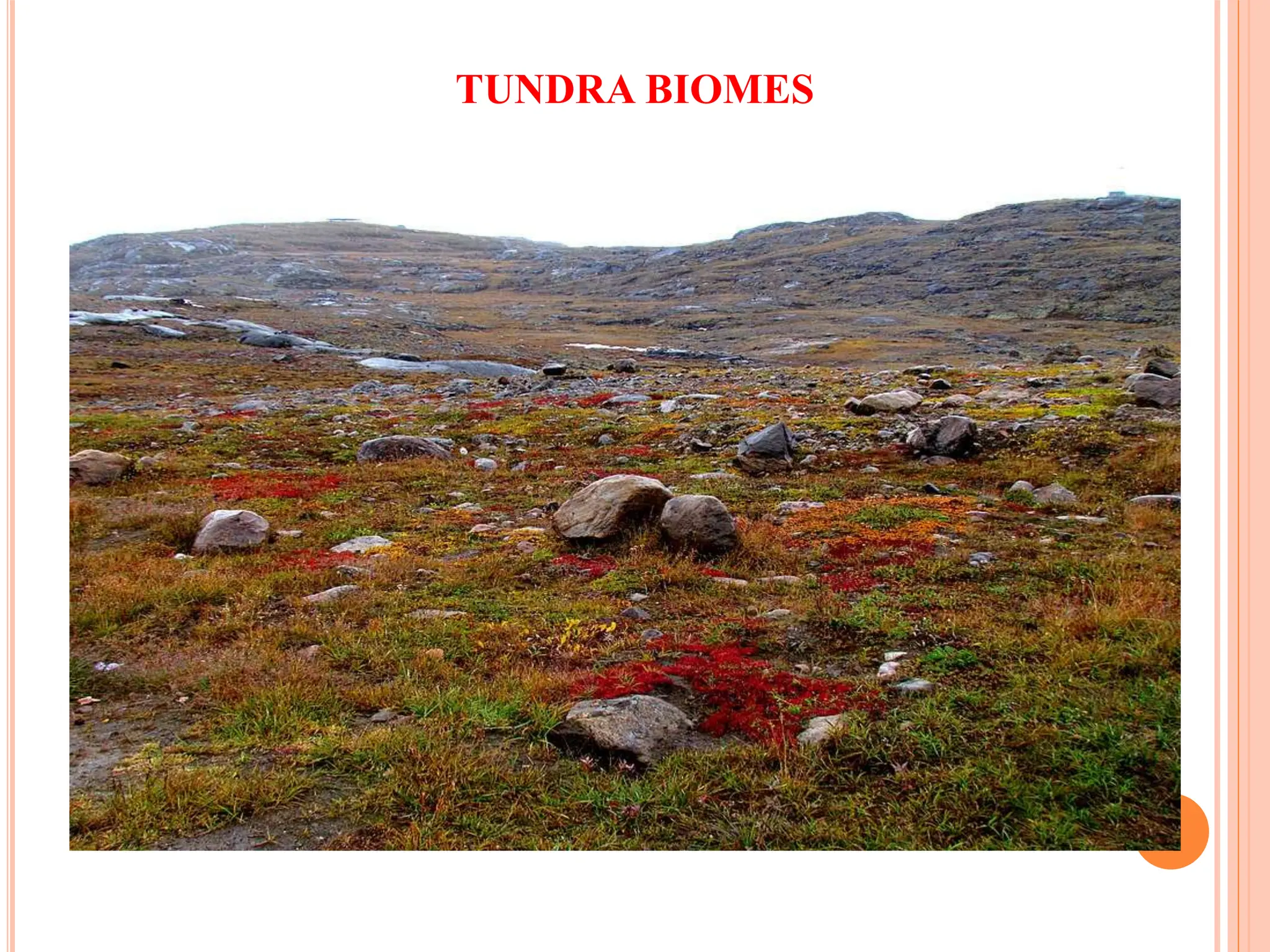
TUNDRA BIOMES
 Tundra is the coldest of all the biomes. Tundra comes from the Finnish word
tunturi, meaning treeless plain. It is noted for its frost-molded landscapes,
extremely low temperatures, little precipitation, poor nutrients, and short
growing seasons. Dead organic material functions as a nutrient pool. The two
major nutrients are nitrogen and phosphorus. Nitrogen is created by biological
fixation, and phosphorus is created by precipitation.
 The Tundra biome is characterized by the following features-
 Extremely cold climate- Temperature always in very chilling stage, minus
range, less than 0,
 Low biotic diversity- least biodiversity due to cold and chilling condition,
 Simple vegetation structure- vegetation is mostly simple without diversity of
species,
 Limitation of drainage- drainage is scanty,
 Short season of growth and reproduction- growth and reproduction enjoy a short
interval,
 Energy and nutrients in the form of dead organic material- organic compounds
are energy and nutrient sources
 Large population oscillations
TUNDRA BIOMES
 The ecosystem, which is devoid of trees and covered with snow for most of
the year is called the tundra ecosystem. These types of ecosystems are
mainly found in cold climates and in those regions with limited or scarce
rainfall. Polar regions are some examples of the tundra ecosystem.
 Arctic and Alpines are two types of tundra ecosystems. Compared to the
alpine tundra, the arctic tundra is colder.
 This type of ecosystem is found at lower altitudes and is characterized by
severe cold environmental conditions, which are similar to deserts.
 In these regions, the soil is frozen throughout the year and during the
summer season, the snow-covered land melts and produces shallow ponds.
Small plants with flowers and different types of lichens can be rarely found,
as these regions are habitually treeless and always covered by snow.
TUNDRA BIOMES
ARCTIC TUNDRA
 Arctic tundra is located in the northern hemisphere, encircling the north pole
and extending south to the coniferous forests of the taiga. The arctic is known
for its cold, desert-like conditions. The growing season ranges from 50 to 60
days.
 The average winter temperature is -34° C (-30° F), but the average summer
temperature is 3-12° C (37-54° F) which enables this biome to sustain life.
Rainfall may vary in different regions of the arctic.
 Yearly precipitation, including melting snow, is 15 to 25 cm (6 to 10 inches).
 Soil is formed slowly. A layer of permanently frozen subsoil called permafrost
exists, consisting mostly of gravel and finer material. When water saturates the
upper surface, bogs and ponds may form, providing moisture for plants.
 There are no deep root systems in the vegetation of the arctic tundra, however,
there are still a wide variety of plants that are able to resist the cold climate.
 There are about 1,700 kinds of plants in the arctic and subarctic, and these
include:
 low shrubs, sedges, reindeer mosses, liverworts, and grasses,
 400 varieties of flowers,
 crustose and foliose lichen.
ARCTIC TUNDRA
 All of the plants are adapted to sweeping winds and disturbances of the soil.
Plants are short and group together to resist the cold temperatures and are
protected by the snow during the winter.
 They can carry out photosynthesis at low temperatures and low light
intensities. The growing seasons are short and most plants reproduce by
budding and division rather than sexually by flowering.
 The fauna in the arctic is also diverse type and the following type of flora is
found to occur in this biome as listed below:
 Herbivorous mammals: lemmings, voles, caribou, arctic hares and squirrels.
 Carnivorous mammals: arctic foxes, wolves, and polar bears.
 Migratory birds: ravens, snow buntings, falcons, loons, sandpipers, terns,
snow birds, and various species of gulls
 Insects: mosquitoes, flies, moths, grasshoppers, black flies and arctic
bumble bees,
 Fish: cod, flatfish, salmon, and trout.
ALPINE TUNDRA
 Alpine tundra is located on mountains throughout the world at high altitude
where trees cannot grow. The growing season is approximately 180 days.
The nighttime temperature is usually below freezing. Unlike the arctic
tundra, the soil in the alpine is well drained. The plants are very similar to
those of the arctic ones and include:
 tussock grasses, dwarf trees, small-leafed shrubs, and heaths
 Animals living in the alpine tundra are also well adapted:
 Mammals: pikas, marmots, mountain goats, sheep, elk,
 Birds: grouse like birds.
 Insects: springtails, beetles, grasshoppers, butterflies.
 Thus, the Tudra biome is really a treeless biome due to most harsh climate
that has been made the biome least fertile in comparison to tropical or
temperate biomes.
THANK YOU FOR YOUR VISIT
 ACKNOWLEDGEMENTS:
a. Google for images,
b. Different websites for enriching the course content,
c. Science Direct pages,
d. Plant Taxonomy & Biodiversity- N.D. Paria
e. A textbook of Botany- Vol III – Hait, Bhattacharya & Ghosh.
f. National Geographic society,
g. Panda.org,
DISCLAIMER:
This presentation has been designed to address the academic fraternity
without any financial interest. This is absolutely free to use . The author
does not claim any kind of financial benefits from this content.

Endemism- Causes, Factors, Type and Different Biomes

  • 1.
    ENDEMISM; BRIEF DESCRIPTIONOF MAJOR TERRESTRIAL BIOMES (ONE EACH FROM TROPICAL, TEMPERATE & TUNDRA Dr. N. Sannigrahi, Associate Professor, Department of Botany, Nistarini college, Purulia D.B. Road, Purulia, INDIA (W.B)
  • 2.
  • 3.
    ENDEMISM- INTRODUCTION  Thephenomenon of the confinement of species usually to single restricted area,  It is applied normally to area where there is a considerable restriction of distriution of species,  In biogeography, the term is exclusively used as equivalent to indigenous or native,  The extreme opposite of an endemic species is the cosmopolitan distribution having global or widespread distribution,  According to Juan J Morrone, a species may be endemic to any particular geographic region regardless of size,  Endemics are not necessarily rare but some common where they occur,  All rare species are not endemic ,  Two types of endemism- Paleoendemism and Neoendemism ,  Endemism is the science of the distribution of taxa to a restricted geographical area.
  • 4.
    PALEOENDEMISM  Paleobiology isthe domain for the untold biotic heritage as remnants of the ancient past in the form of fossils, excavation can speak a lot,  According to Ridley ( 1922), endemic species once had the far extended distribution but now exist as the survivals of the larger group occurring in the past,  These are known as epibiotics that remain confined as relics of the past in an isolated area,  Due to lack of effective dispersal ability, species cannot overcome the barrier and consequently become restricted to their place of natural occurrences,  Some example like Ginkgo biloba, Glyptosteroboides restricted to China but as far as fossil records are concerned, found in north temperate zone,  Seqoiadendron giganteum formerly widely distributed but now found in Nevada of USA. These are relics and endemics,  This is popularly known as the theory of epibiotics.
  • 5.
    NEOENDEMISM  On thebasis of age and area hypothesis, Willis states that the occurrence of diverse species and genera in a particular area is proportional to the age in the evolution.  A small area having definite plant groups where they are endemic indicates their relative recent age .  Willis suggests that all endemic species occupying small area are to be regarded as younger species but this view has been criticized by D. Chjatterjee (1939) on the basis of the fact that they may be correct for a large number of species but certainly not for all.  Some examples of neoendemism includes Gentiana, Impatiens, Primula, Rhodendron etc which are arise through natural crossing and mutation.  Regarding the above concepts, Chatterjee proposed “ both schools are correct in their views but from the evidence of large number of new forms, it is likely that the later view has more supporters”.  Richardson( 1978) suggested endemics of intermediate nature between the above two types , known as holoendemics .
  • 6.
    OTHER TYPES OFENDEMISM  Based on cytotaxonomic criteria, Faverger and Contandriopoulis ( 1961), three different types of neoendemics have been stated- Schizoendemics, Patroendemics and Apoendemics.  Schizoendemics- obtained from or having given to a relatively widespread taxon with same chromosome count as the parent taxon.  Patroendemics- involve restricted diploids which have given rise to more widespread polyploids.  Apoendemics- the restricted polyploids which have arisen from more widespread diploids.  In addition to these, Pseudoendemics are also considered which have recently evolved from a mutation.  Myers and de Grave ( 2000) further attempted to redefine the concept of endemism. In their view, everything is endemic , even cosmopolitan species are endemic . Thus, the subdivisions of neoendemics and paleoendemics are without merit regarding the study of distributions because those concepts consider that an endemic has distributions limited to one place.
  • 7.
  • 8.
    OTHER TYPES OFENDEMISM  They proposed four different categories-  Holoendemics, Euryendemics, Steoendemics , Rhoendemics.  In their scheme, cryptoendemics and euendemics is further subdivision of rhoendemics,  Stenoendemics is known as local endemics , that have reduced distribution and are synonymous with the word, endemics.  In the traditional sense, euroendemics have larger distribution.  A rhoendemic has distinct distribution.  In a cryptoendemic , the disjunct distribution was due to extinction of the intervening populations.  Traditionally, none of Myers and de Grave’s categories would be considered endemics except stenoendemics.  Thus, different approaches are found to have types of concept to explore the endemism in broad sense.
  • 9.
    ISLAND ENDEMISM  Thereare some special type of endemism found to occur restricted to isolated land from the main landmass that build up the concept of Island endemism.  Galapagos, Juan Fernandez and Hawaii belong to this domain.  The Galapagos Islands being volcanic archipelago in the pacific ocean and the province of Ecuador has many endemic species but few endemic genera and many endemic species are comparatively closely allied to continental America type.  Juan Fernandez islands are situated in the south pacific ocean near to Chile and represent a small flora but this is peculiar. In its endemics, including numerous genera and even one family.  The Hawaiian islands contain flora much larger than those of the other groups, 90% of species being confined to archipelago.  There are so many endemic genera although the number of species is much of these flora is very different.
  • 10.
    FACTORS OF ENDEMISM Various events caused by drifting of continents, dispersal and extinction along with other geological instability may be possible causal factors,  Ecological factors play a very pivotal role in this regard . Endemic species are likely to develop on geographically and biologically isolated areas like islands and remote island groups.  The most common cause of isolation represent lofty mountainous chains , deserts, vast stretches of marshes along with other restricted boundaries and they render some possible factors of endemism.  The stability of a region’s climate and habitat through time may also contribute to high rates of endemism , especially paleoendemics . Acting as refuges for species during times of climate change specially like ice age.  In many cases, biological factors like poor dispersal rate can cause a particular group of organisms to have speciation rates and thus play a crucial role in the content of endemism.
  • 11.
    ENDEMISM IN INDIA The floristic composition and ecological consideration in the context of India is very important,  The British India was a land of diversity due to natural and physical barriers,  This enables the difficulty of the migration of species to spread freely from north to south direction,  According to Hooker(1904), the flora of India is a mixture of flora of the surrounding areas like Malaya, Orient, Africa, Tibet, China and Japan,  But Chatterjee though his critical analysis came to the conclusion “ India has flora of its own” because it is not only rich in endemic flora but also a number of endemic species,  According to chatterjee(1939), the total number of Dicotyledons in India is 11124 of which 61.5% of plants are endemic in British India,  The highest number of endemic genera is found in the families like Acanthaceae, Asclepidaceae, Balsaminaceae, Compositae, Euphorbiaceae, Gentaniaceae, Papillionaceae, Primulaceae, Rosaceae, Rubiaceae etc.  Chatterjee divided Indiainto10 Phytogeographical regions-Western Himalaya, central Himalaya, Eastern Himalaya, Indus plain, Gangetic plane, Deccan, Malabar, Andaman and Nicober islands
  • 12.
  • 13.
    TERRISTRIAL BIOMES  Biomesare large-scale environments that are distinguished by characteristic temperature ranges and amounts of precipitation. These two variables affect the types of vegetation and animal life that can exist in those areas. Because each biome is defined by climate, the same biome can occur in geographically distinct areas with similar climate.  There are eight major terrestrial biomes: i. Tropical rainforests, ii. Savannas, iii. Subtropical deserts, iv. Chaparral, v. Temperate grasslands, vi. Temperate forests, vii. Boreal forests, viii. and Arctic tundra
  • 14.
    TROPICAL RAIN FORESTS Tropical Rain Forests are the most biodiverse terrestrial biome. This biodiversity is under extraordinary threat primarily through logging and deforestation for agriculture.  Tropical rainforests have also been described as nature’s pharmacy because of the potential for new drugs that is largely hidden in the chemicals produced by the huge diversity of plants, animals, and other organisms.  The vegetation is characterized by plants with spreading roots and broad leaves that fall off throughout the year, unlike the trees of deciduous forests that lose their leaves in one season.  The temperature and sunlight profiles of tropical rainforests are stable in comparison to other terrestrial biomes, with average temperatures ranging from 20oC to 34oC (68oF to 93oF).  Month-to-month temperatures are relatively constant in tropical rainforests, in contrast to forests farther from the equator. This lack of temperature seasonality leads to year-round plant growth rather than just seasonal growth.  In contrast to other ecosystems, a consistent daily amount of sunlight (11– 12 hours per day year-round) provides more solar radiation and therefore more opportunity for primary productivity.
  • 15.
    TROPICAL RAIN FORESTS The annual rainfall in tropical rainforests ranges from 125 to 660 cm (50– 200 in) with considerable seasonal variation.  Tropical rainforests have wet months in which there can be more than 30 cm (11–12 in) of precipitation, as well as dry months in which there are fewer than 10 cm (3.5 in) of rainfall.  However, the driest month of a tropical rainforest can still exceed the annual rainfall of some other biomes, such as deserts.  Tropical rainforests have high net primary productivity because the annual temperatures and precipitation values support rapid plant growth. However, the high amounts of rainfall leaches nutrients from the soils of these forests.  Tropical rainforests are characterized by vertical layering of vegetation and the formation of distinct habitats for animals within each layer. On the forest floor is a sparse layer of plants and decaying plant matter.  Above that is an understory of short, shrubby foliage. A layer of trees rises above this understory and is topped by a closed upper canopy—the uppermost overhead layer of branches and leaves. Some additional trees emerge through this closed upper canopy.
  • 16.
  • 17.
    TROPICAL RAIN FORESTS These layers provide diverse and complex habitats for the variety of plants, animals, and other organisms. Many species of animals use the variety of plants and the complex structure of the tropical wet forests for food and shelter. Some organisms live several meters above ground, rarely descending to the forest floor.  The tropical forest biome is estimated to contain over half of the terrestrial species on Earth. Approximately 170,000 of the 250,000 described species of vascular plants occur in tropical biomes. As many as 1,209 butterfly species have been documented in 55 square kilometers of the Tambopata Reserve in southeastern Peru, compared to 380 butterfly species in Europe .  The tropical forest biome is composed of several different sub-biomes, including evergreen rainforest, seasonal deciduous forest, tropical cloud forest, and mangrove forest. These sub-biomes develop due to changes in seasonal patterns of rainfall, elevation and/or substrate.
  • 18.
    TEMPERATE BIOMES  Theclimate of the mid latitudes is much more variable than the tropics. As the Earth orbits the Sun, the seasons alternate back and forth between the northern and southern hemisphere and plants must cope with sometimes extreme seasonal changes in temperature and moisture. In general, the temperate biomes of the mid latitudes have less species diversity than their tropical counterparts.  While the climate of the tropics is dominated by the ITCZ and subtropical High pressure centers, the mid latitude zones are dominated by the movements of air masses.  Also, ocean currents moving in opposite directions on opposite sides of continents and mountain ranges can produce distinctly different climate and vegetation zones between east and west coasts. Look at North America in the map below, for example. The vegetation zones clearly vary more in an east-west direction than in the north-south direction, as was the case in the tropics.
  • 19.
  • 20.
    TEMPERATE BIOMES  Temperatedeciduous forest dominates large tracts of the Eurasian and North American continents. Deciduous means that the trees lose their leaves during the cold, or sometimes dry, season. In colder climates, this helps prevent frost damage as trees "harden" their tissues for the coming winter. Broadleaf trees, like oak, elm, hemlock, maple, and beech, dominate these forests. They cover most of the eastern portions of North America and Asia, as well as most of Europe south of Scandinavia.  The wet western coasts of North and South America and most of New Zealand and Tasmania support temperate evergreen forest. These are dominated by coniferous species, such as redwood and fir, but also containing many broadleaf species.  The climate of these areas is fairly stable year-round as onshore winds bring plenty of rain to the windward slopes of coastal mountain ranges and keep temperatures cool in summer and relatively warm in winter.  It remains something of a mystery in biogeography why broadleaf forests dominate the eastern part of North America, while at the same latitudes, conifers dominate the west coast.
  • 21.
    TEMPERATE BIOMES (COURTESY: NASA)
  • 22.
    TEMPERATE BIOMES  Mediterraneanbiome, also called chaparral in California and maquis in Europe, occurs on the fringes of the Mediterranean Sea and in small patches on the west coasts of North and South America, Western Australia, and the southern tip of Africa. These areas have unusual climates with wet winters and long, dry summers (that's why Europeans head to the Med for their summer vacations). Other places in the world receive most of their rainfall in summer. Mediterranean biome consists of tough grasses, cacti and scattered, short trees like olive and scrub oak that are well adapted to drought and frequent fire. Many species, in fact, require wildfire to initiate seed germination.  Moderate temperatures, seasonal variations, precipitation distribution round the year, richness of soil due to leaf litter composition, and other environmental factors play a very significant role in this regard to make it homeland of a wide number of flora and fauna.  The Temperate biome plays a significant role in the biodiversity privilege of the world.
  • 23.
    TUNDRA BIOMES  Tundrais the coldest of all the biomes. Tundra comes from the Finnish word tunturi, meaning treeless plain. It is noted for its frost-molded landscapes, extremely low temperatures, little precipitation, poor nutrients, and short growing seasons. Dead organic material functions as a nutrient pool. The two major nutrients are nitrogen and phosphorus. Nitrogen is created by biological fixation, and phosphorus is created by precipitation.  The Tundra biome is characterized by the following features-  Extremely cold climate- Temperature always in very chilling stage, minus range, less than 0,  Low biotic diversity- least biodiversity due to cold and chilling condition,  Simple vegetation structure- vegetation is mostly simple without diversity of species,  Limitation of drainage- drainage is scanty,  Short season of growth and reproduction- growth and reproduction enjoy a short interval,  Energy and nutrients in the form of dead organic material- organic compounds are energy and nutrient sources  Large population oscillations
  • 24.
    TUNDRA BIOMES  Theecosystem, which is devoid of trees and covered with snow for most of the year is called the tundra ecosystem. These types of ecosystems are mainly found in cold climates and in those regions with limited or scarce rainfall. Polar regions are some examples of the tundra ecosystem.  Arctic and Alpines are two types of tundra ecosystems. Compared to the alpine tundra, the arctic tundra is colder.  This type of ecosystem is found at lower altitudes and is characterized by severe cold environmental conditions, which are similar to deserts.  In these regions, the soil is frozen throughout the year and during the summer season, the snow-covered land melts and produces shallow ponds. Small plants with flowers and different types of lichens can be rarely found, as these regions are habitually treeless and always covered by snow.
  • 25.
  • 26.
    ARCTIC TUNDRA  Arctictundra is located in the northern hemisphere, encircling the north pole and extending south to the coniferous forests of the taiga. The arctic is known for its cold, desert-like conditions. The growing season ranges from 50 to 60 days.  The average winter temperature is -34° C (-30° F), but the average summer temperature is 3-12° C (37-54° F) which enables this biome to sustain life. Rainfall may vary in different regions of the arctic.  Yearly precipitation, including melting snow, is 15 to 25 cm (6 to 10 inches).  Soil is formed slowly. A layer of permanently frozen subsoil called permafrost exists, consisting mostly of gravel and finer material. When water saturates the upper surface, bogs and ponds may form, providing moisture for plants.  There are no deep root systems in the vegetation of the arctic tundra, however, there are still a wide variety of plants that are able to resist the cold climate.  There are about 1,700 kinds of plants in the arctic and subarctic, and these include:  low shrubs, sedges, reindeer mosses, liverworts, and grasses,  400 varieties of flowers,  crustose and foliose lichen.
  • 27.
    ARCTIC TUNDRA  Allof the plants are adapted to sweeping winds and disturbances of the soil. Plants are short and group together to resist the cold temperatures and are protected by the snow during the winter.  They can carry out photosynthesis at low temperatures and low light intensities. The growing seasons are short and most plants reproduce by budding and division rather than sexually by flowering.  The fauna in the arctic is also diverse type and the following type of flora is found to occur in this biome as listed below:  Herbivorous mammals: lemmings, voles, caribou, arctic hares and squirrels.  Carnivorous mammals: arctic foxes, wolves, and polar bears.  Migratory birds: ravens, snow buntings, falcons, loons, sandpipers, terns, snow birds, and various species of gulls  Insects: mosquitoes, flies, moths, grasshoppers, black flies and arctic bumble bees,  Fish: cod, flatfish, salmon, and trout.
  • 28.
    ALPINE TUNDRA  Alpinetundra is located on mountains throughout the world at high altitude where trees cannot grow. The growing season is approximately 180 days. The nighttime temperature is usually below freezing. Unlike the arctic tundra, the soil in the alpine is well drained. The plants are very similar to those of the arctic ones and include:  tussock grasses, dwarf trees, small-leafed shrubs, and heaths  Animals living in the alpine tundra are also well adapted:  Mammals: pikas, marmots, mountain goats, sheep, elk,  Birds: grouse like birds.  Insects: springtails, beetles, grasshoppers, butterflies.  Thus, the Tudra biome is really a treeless biome due to most harsh climate that has been made the biome least fertile in comparison to tropical or temperate biomes.
  • 29.
    THANK YOU FORYOUR VISIT  ACKNOWLEDGEMENTS: a. Google for images, b. Different websites for enriching the course content, c. Science Direct pages, d. Plant Taxonomy & Biodiversity- N.D. Paria e. A textbook of Botany- Vol III – Hait, Bhattacharya & Ghosh. f. National Geographic society, g. Panda.org, DISCLAIMER: This presentation has been designed to address the academic fraternity without any financial interest. This is absolutely free to use . The author does not claim any kind of financial benefits from this content.