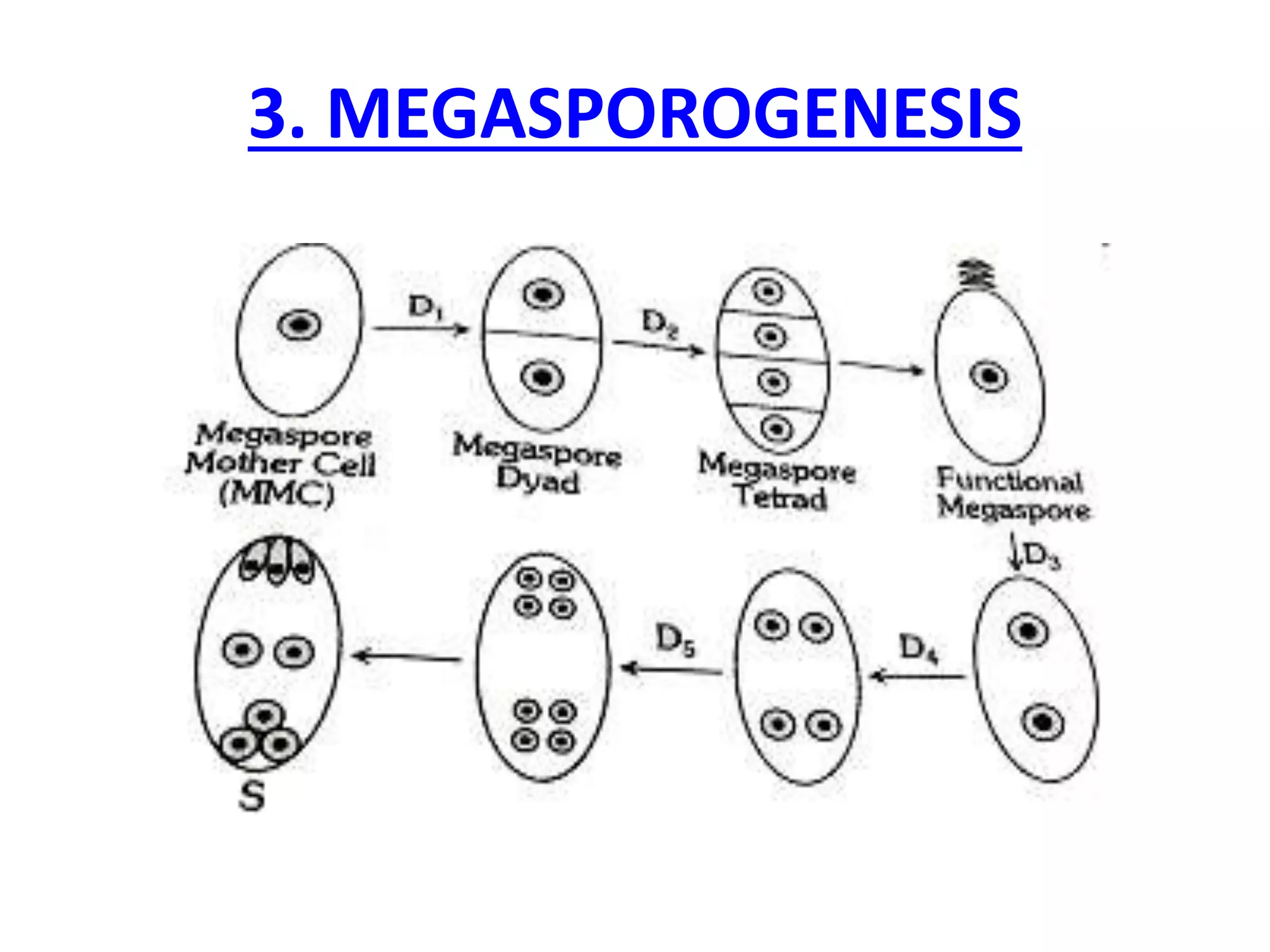

3. MEGASPOROGENESIS
• Megasporogenesis is the formation of megaspores
in the megasporangium.
• Megasporangium, or macrosporangium, is the
sporangium in which megaspores, (macrospores or
female spores) are produced by the division of
sporogenous cells.
• Together with its protective integuments,
megasporangium forms the ovule.
• Thus, ovule is an integumented megasporangium.
• Ovule is a small oval structure.
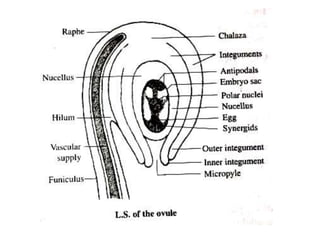
• It is attached to the placenta on the inner wall of
the ovary by means of a short and slender stalk,
called funiculus or funicle.
• The point of attachment of the funicle to the body
proper of the ovule is called hilum.
• In some cases, the funicle continues beyond the
hilum along the surface of the ovule as a ridge,
called raphe.
• A mature ovule consists of a central mass of
tissue, called Nucellus.
• It is almost completely enclosed by one or two
protective integuments, leaving a small opening
at the apical end, called micropyle.
• Micropyle is the major passage for the entry of
pollen tube into the ovule.
• The basal part of the ovule, where nucellus,
integuments and funicle meet and merge
together, is called chalaza.
• Lying embedded in the nucellus at the micropylar
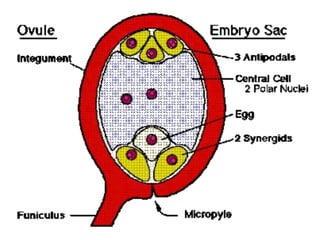
end is a large oval cell, called embryo sac.
• It represents the female gametophyte.
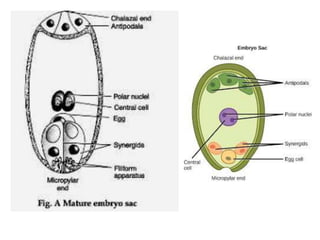
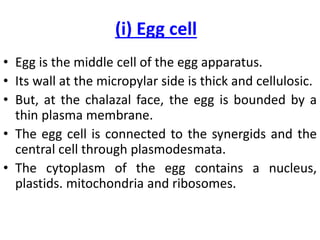
• Typically, an embryo sac contains eight haploid
nuclei, three at the micropylar end, and three at the
chalazal end, and two in the centre.
• The chalazal nuclei organize to form antipodal cells,
the micropylar nuclei organize to form the egg
apparatus, and the central ones become the polar
nuclei.
• The egg apparatus consists of an egg, or female
gamete, and two synergids.
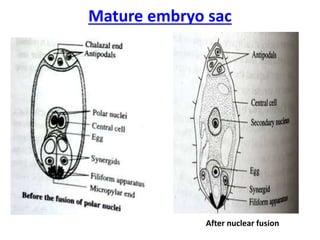
• In some cases, before fertilization, the polar nuclei
fuse together forming diploid secondary nucleus.
Types of ovules
• Based on the number of integuments, three main kinds of
ovules can be recognized, ategmic, unitegmic and bitegmic.
• Ategmic ovules have no integument (e.g.,Olax, Liriosma),
unitegmic ovules have a single integument (e.g.,
Gamopetalae) and bitegmic ovules have two integuments
(e.g., Polypetalae, Monocots).
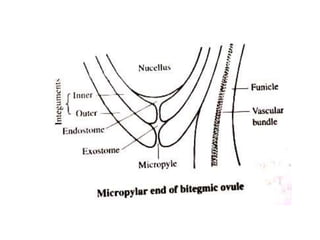
• In bitegmic ovules, micropyle is formed most usually by the
inner integument sometimes by both the integuments, and
very rarely by the outer integument.
• When formed by both the integuments, the micropylar canal
encloses two tiny spaces namely exostome and endostome.
• Exostome is seen between the outer and inner integuments,
and endostome in between the inner integument and the
nucellus.
Classification of ovules
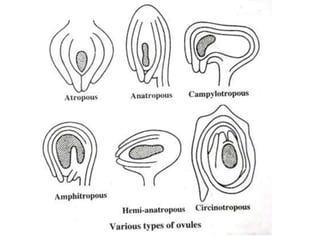
• Based on the position of micropyle in relation to the
funiculus, ovules are classified into six types, namely
orthotropous, (atropous) anatropous, campylotropous,
amphitropous, hemianatropous and circinotropous.
1. Orthotropous (atropous) ovule
• Mature ovule is straight and upright from the placental
surface.
• Micropyle, body, chalaza and funiculus are in straight
line and above the hilum. e.g., members of the
angiosperm families.
• Polygonaceae and Piperaceae.
2. Anatropous (inverted) ovule
• The ovule in which the body bends at 180 degree
and gets inverted in such away that micropyle and
hilum come close to the funicle.
• The funicle is elongated and it lies parallel to the
micropyle and the body of the ovule.
• This is the commonest type of angiosperm ovule
and is found in Sympetalae, Malvaceae,
Compositae, Cucurbitaceae, Solanaceae, etc.
3. Campylotropous ovule
• This is the type of ovule in which
(i) the body is slightly curved and place right angles to
the funiculus
(ii) micropyle and chalaza are not in straight line
(iii)micropyle lies close to the funicle and
(iv) funicle is at right angles to the chalaza.
• e.g., members of Leguminosae, Cruciferae,
Capparidaceae, Fabaceae, etc.
4. Amphitropous ovule
• The ovule is horse-shoe-shaped.
• The curvature of the body of the ovule is much
greater than in campylotropous type and it
extends to nucellus and embryo sac.
• The embryo sac is U-shaped. The basal half of
the ovule resembles the orthotropous type and
the terminal half resembles the anatropous type.
• e.g., members of Alisamaceae, Loganiaceae and
Butomaceae.
5. Hemi-anatropous (hemitropous) ovule
• The body of the ovule is half inverted (ovule has
rotated at 90°) and it lies at right angle to the
funicle.
• Micropyle, nucellus, embryo sac and chalaza are in
straight line.
• Micropyle is not found near the hilum.
• e.g., members of Ranunculaceae and Primulaceae.
6. Circinotropous ovule
• This is the ovule in which the funicle is very long and it
forms a complete ring around the body of the ovule.
• This type of ovule is formed due to unilateral growth.
• Initially, it is orthotropous. Then, unilateral growth
takes place and the ovule gets inverted and becomes
anatropous.
• The curvature continues till the ovule takes a complete
360° turn and the micropyle again faces upwards.
• e.g., Plumbaginaceae, Cactaceae.
Development of ovule
• Ovule develops from the inner surface of the ovary which is
lined with a special ring of tissue, called placenta.
• On the surface of the placenta, the ovule primordium arises
as a small mass of homogeneous tissue.
• It grows rapidly and assumes a conical shape, with a rounded
tip which is the future nucellus.
• It increases in size by repeated division and projects out.
• Simultaneously, the integument primordia originate close to
the base of the nucellar tissue and grow upwards forming the
integuments.
• The integuments develop faster and completely cover the
nucellus, except in the micropylar region.
Megasporogenesis
• Megasporogenesis is the formation of megaspores in
megasporangium.
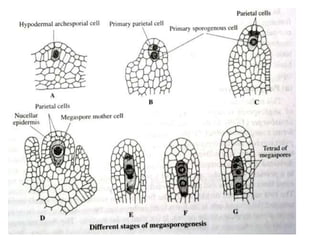
• It begins with the differentiation and development of a
single cell in the hypodermal region.
• This cell becomes distinct by its large size, prominent
nucleus, and dense cytoplasm.
• It is called the archesporial cell or archesporial initial.
• Its further development varies with the type of the
ovule.
• Three types of development can be recognized, namely
crassinucellate type, pseudo-crassinucellate type and
tenuinucellate type.
(a) Crassinucellate type
• In crassinucellate type of megasporogenesis, the
hypodermal archesporeal undergoes periclinal division,
forming an outer primary parietal cell (PPC) and a
inner primary sporogenous cell (PSC).
• The PPC may remain undivided, or it may undergo
periclinal and anticlinal divisions forming a mass of cells
which will push the PSC deep into the nucellar tissue.
• Thus, the PSC becomes sub-hypodermal and it behaves
as the megaspore mother cell or megasporophyte,
• e.g., Myriophyllum intermedium.
(b) Pseudo-crassinucellate type
• This is similar to the crassinucellate type. In it, the
archesporal cell divid periclinally, forming PPC and
PSC.
• PSC becomes sub-hypodermal due to cello sion in
nucellar epidermis, and not by the divisions of PPC.
• In this case also, PSC behaves as the megaspore
mother cell.
• e.g., Nigella damascena
(c) Tenuinucellate type
• In this type, the archesporial cell directly
functions as the megaspore mother without
undergoing division.
• e.g., Elytraria acaulis.
Development of megaspore mother cell
• The diploid megaspore mother cell is the last cell of the
sporophytic generation.
• It undergoes meiosis, forming four haploid megaspores.
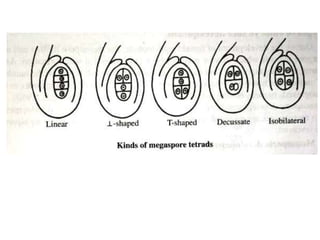
• These form a megaspore tetrad.
• In most cases, this tetrad is linear.
• In others, it can be T-shaped, 1-shaped, decussate, or rarely
tetrahedral of the four megaspores of a tetrad, the one lying
towards the chalazal end survives as the functional megaspore and
it represents the first cell of the female gametophyte or embryo
sac.
• The remaining ones degenerate and are consumed by the
functional megaspore.
• Callose deposition occurs around the functional megaspore
isolating it from other cells.
Types of embryo sacs development
• During the development of female gametophyte, the
megaspore mother cell undergoes meiosis which may
or may not be accompanied by wall formation.
• As a result, four megaspores or four megaspore nuclei
are formed.
• Based on the number of megaspores involved in
embryo sac formation, three types of development can
be recognized, namely monosporic, bisporic and
tetrasporic (Maheswari, 1950).
• In monosporic development, only one megaspore is
involved; in bisporic development two megaspores are
involved; in tetrasporic development, all the four
megaspores are involved.
(i) Monosporic development
• In monosporic development, the megaspore mother
cell undergoes meiosis, first forming a dyad and then a
tetrad of megaspores.
• Out of the four megaspores, only one takes part in the
formation of female gametophyte.
• All the nuclei, present in monosporic embryo sacs, are
genetically identical because all of them are the mitotic
products of one and the same functional megaspore
nucleus.
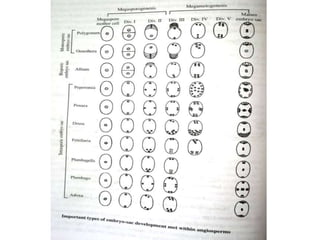
• There are two basic types of monosporic development,
namely Polygonum type and Oenothera type.
(a) Polygonum type
• This is the commonest type of monosporic development
found in more than 80% of angiosperm families.
• It was first observed in Polygonum divaricatum by
Strasburger (1879).
• In this case, the megaspore mother cell undergoes meiosis
and forms a megaspore tetrad.
• Of these, the chalazal megaspore (4th one from the
micropyle) survives and the remaining ones degenerate.
• The surviving functional megaspore undergoes three
successive nuclear divisions, forming eight haploid nuclei.
• Nuclear divisions are not accompanied by wall formation.
• The first nuclear division results in a primary
micropylar nucleus and a primary chalazal nucleus.
• These are separated from each other and pushed
towards opposite poles by a large central vacuole
The two nuclei then divide twice.
• The first division results in a 4-nucleate embro sac,
and the second one in an 8-nucleate embryo sac.
• Now, one nucleus from each polar group migrates
to the centre.
• It is called polar nucleus.
• The three micropylar nuclei then organize to form a
three-celled egg apparatus and the three chalazal
nuclei organize into three antipodal cells.
• The egg apparatus consists of an egg cell and two flask-
shaped synergids or helpers.
• The two central polar nuclei now fuse together and
form a diploid fusion nucleus (definitive or secondary
nucleus).
• Thus, a polygonum type of embryo sac or female
gametophyte is an initially 8-nucleated and finally 7-
celled structure.
• Initially, it has eight haploid nuclei, and finally six
haploid nuclei and a diploid nucleus.
• A fully formed embryo sac, together with nucellus and
integuments, constitutes the mature ovule.
(b) Oenothera type
• This type of monosporic development was first observed in
Oenothera lamarckiana (evening primrose) by Hofmeister
(1849).
• In this case, the embryo sac is derived from the micropylar
megaspore. I
• t is 4-nucelate, composed of 3-celled egg apparatus and one
polar nucleus, antipodal cells are absent.
• In this case, the megaspore nucleus divides meiotically,
forming four haploid nuclei.
• Of these three nuclei organize into an egg apparatus and the
remaining one functions as a polar nucleus.
• Antipodals are absent.
• e.g., Family Onagraceae.
(ii) Bisporic development
• In bisporic development, the megaspore mother cell
undergoes the first meiotic division and forms a dyad.
• One member of the dyad soon degenerates, and the other
one undergoes the second division.
• This results in two haploid megaspore nuclei which undergo
megagametogenesis.
• They divide twice and form eight haploid nuclei which
organize into a 7-celled embryo exactly as in Polygonum type.
• During this, three nuclei form the micropylar egg apparatus,
three form the chalazal antipodals, and the remaining two
function as polar nuclei.
• The polar nuclei later on fuse together and form a
diploid secondary nucleus.
• Based on the behaviour of the dyad, two types of
bisporic development can be recognized, namely
Allium type and Endymion type.
• In the former, the egg apparatus develops from
the chalazal cell of the dyad (e.g.. Allium
fistulosum), whereas in the latter it develops from
the micropylar cell of the dyad (e.g., Endymion,
hispanicus - formerly called Scillax hispanicus)
Allium type
• This type of embryo sac was described by
Strasburger (1879) in Allium fistulosum.
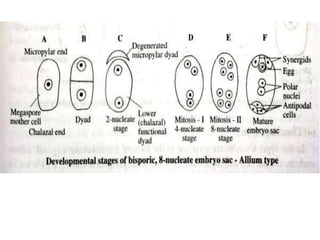
• It develops from the chalazal cell of the dyad.
• The two nuclei of the chalazal dyad undergo two
repeated mitosis to form 8 nuclei, which are
organized into the embryo sac.
• This type of embryo sac is found in several
monocot families, such as Liliaceae,
Amarillidaceae and Orchidaceae.
(iii) Tetrasporic development
• In tetrasporic development, the meiotic division of the megaspore
mother cell is not accompanied by wall formation and cytokinesis.
• So, it results in a coenocytic cell with four haploid nuclei, called
coenomegaspore.
• All its nuclei take part in the formation of embryo sac.
• The process is much more complex than monosporic and bisporic
development and it varies greatly with different species.
• Tetrasporic embryo-sac development is further classified, based on
the arrangement of haploid nuclei in the coenomegaspore, the
number of post-meiotic divisions of the nuclei, the presence or
absence of nuclear fusion before the final organization of the
embryo sac, and the final organization of the embryo sac.
• There are two major types of tetrasporic development, namely
those without nuclear fusion and those with nuclear fusion.
(a) Tetrasporic development without
nuclear fusion
• There are five types of tetrasporic development
which does not involve nuclear fusion. They are
• Adoxa type,
• Plumbago type,
• Penaea type,
• Drusa type and
• Peperomia type.
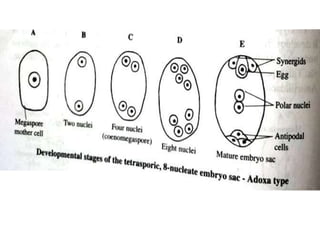
(i) Adoxa type
• The four nuclei undergo mitosis forming an eight-
nucleate embryo sac.
• These eight nuclei are organised into three-celled
egg apparatus, two-nucleate central cell and three-
celled antipodals (i.e., 3+2+3 arrangement).
• It was reported by Jonsson (1880) from Adoxa
moschatellina.
(ii) Plumbago type
• In this type, 8 nuclei are arranged in the form of a
uninucleate egg cell, a four nucleate central cell and
three nuclei are cut off as peripheral cells. (i.e.,
1+4+3)
• It is found in Plumbago campensis.
(iii) Penaea type
• Here, four nuclei undergo two mitotic divisions,
resulting sixteen nuclei Which are arranged in an
unusual manner - a three-celled egg apparatus at
the micropylar end, a three-celled group at the
chalazal end, two lateral groups of three cells each,
and a central group of four cells functioning as
polars (i.e., 3+3+3+3+4).
• It was reported from three genera of the family
Penaeaceae - Penaea, Brachysiphon and
Sarcocolla.
(iv) Drusa type
• In this type, just as in Penaea type, sixteen nuclei
are formed.
• They are arranged in a three-celled egg apparatus,
two polar nuclei and eleven-celled antipodals (i.e., 3
+ 2 + 11).
• It was reported from Drusa oppositifolia.
(v) Peperomia type
• This type also has sixteen nuclei which are
arranged in the form of a two-celled egg
apparatus, six peripheral cells and a central
cell having eight polar nuclei (2 + 6 + 8).
• It was reported from Peperomia pellucida.
(b) Tetrasporic development with
nuclear fusion
• In this case, out of the four nuclei formed, three
fuse to form a triploid nucleus at the chalazal end of
the coenomegaspore, whereas the fourth nucleus
remains free in the micropylar end. This type shows
two variations, namely
• Fritillaria type and Plumbagella type
(i) Fritillaria type
• In this type, both the haploid and triploid nuclei
undergo two divisions giving rise to four nuclei at
each pole.
• The eight-nucleate embryo sac has a three-celled
haploid egg apparatus, three-celled triploid
antipodals and a central cell with two polar nuclei -
one haploid and the other one triploid (i.e., 3+3+2).
• Such embryo sacs are found in various species of
Lilium.
(ii) Plumbagella type
• The two nuclei (one haploid and the other triploid)
divide to form four nuclei i.e., two haploid and two
triploid nuclei.
• These four nuclei are arranged in two groups of two
each.
• One group, present at the micropylar end, consists of
one haploid egg and one haploid upper polar nucleus.
• The other group at the chalazal end consists of one
triploid antipodal cell and one triploid lower polar
nucleus.
• Thus, the polar nucleus comprises one haploid and one
triploid set.
• This type was reported from Plumbagella micrantha.
Structure of mature embryo sac
• Mature embryo sac is ellipsoidal, with tapering ends
and a thick and multilayered pecto-cellulosic wall all
around.
• The wall is devoid of plasmodesmata, and is
occasionally covered by a thin layer of cutin.
• The embryo sac is mostly a 7-celled structure, with
a 3-celled egg apparatus at the micropylar end, 3
antipodal cells at the chalazal end and a central
cell.
• The central cell is initially binucleate.
• But, later on the two nuclei fuse to form a diploid
secondary nucleus.
Egg apparatus
• Egg apparatus is present at the micropylar end
of the embryo sac.
• It consist of a middle egg cell, flanked usually
by two synergids .
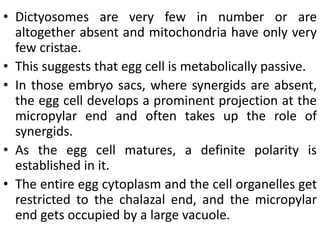
(i) Egg cell
• Egg is the middle cell of the egg apparatus.
• Its wall at the micropylar side is thick and cellulosic.
• But, at the chalazal face, the egg is bounded by a
thin plasma membrane.
• The egg cell is connected to the synergids and the
central cell through plasmodesmata.
• The cytoplasm of the egg contains a nucleus,
plastids. mitochondria and ribosomes.
• Dictyosomes are very few in number or are
altogether absent and mitochondria have only very
few cristae.
• This suggests that egg cell is metabolically passive.
• In those embryo sacs, where synergids are absent,
the egg cell develops a prominent projection at the
micropylar end and often takes up the role of
synergids.
• As the egg cell matures, a definite polarity is
established in it.
• The entire egg cytoplasm and the cell organelles get
restricted to the chalazal end, and the micropylar
end gets occupied by a large vacuole.
Mature embryo sac
After nuclear fusion
(ii) Synergids
• Synergids, also known as helpers, are elongated structures
which partly enclose the egg at the micropylar end of the
embryo sac.
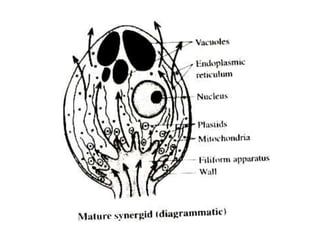
• In general, they have a nucleus, large numbers of ER,
ribosomes, mitochondria and dictyosomes, a filiform
apparatus and hooks on the micropylar side, and vacuoles on
the chalazal side.
• The abundance of ER, mitochondria, ribosomes and
dictyosomes suggests that synergids are metabolically very
active.
• Electron microscopic studies have revealed that synergids are
devoid of cell wall on the chalazal side.
• Filiform apparatus consists of finger-like processes,
composed of a central core of polysaccharide
microfibrils, enclosed by a nonfibrillar sheath.
• It resembles transfer cells, and is concerned with
the absorption of nutrients from nucellus, and the
distance-transport of metabolites.
• Plasmodesmata may be present between synergids,
central cell and egg.
• In some angiosperms, in addition to
plasmodesmata, some membrane-bound vesicular
structures also extend between synergids and
central cell.
• These probably act as channels for the transport of
metabolic products and other materials.
• The polarity of synergids is opposite to that of egg.
• In them, nucleus, most of the cytoplasm and the
majority of cell organelles are present in the micropylar
two-third of the cell, whereas the chalazal one-third is
highly vacuolated.
• Synergids are short-lived.
• One of them degenerates before the pollen tube enters
the embryo sac, whereas the other one, known as
persistent synergid, degenerates after the pollen tube
has discharged the male gametes into the embryo sac.
• In some plants, such as Sedum, Cotula, etc., haustorial
appendages may arise from synergids.
The major roles of synergids are the
following:
(i) Synergids secrete chemotaxically active
substances and thereby direct the growth of
pollen tube.
(ii) The filiform apparatus of synergids helps in the
absorption and conduction of nutrients from
nucellus to the female gametophyte.
(iii)In some families, such as Asteraceae and
Santaceae, synergids function as haustoria.
(iv)The degenerating synergids may form the site for
the discharge of the contents of the pollen tube.
Antipodals
• These are the cells lying at the chalazal end of the
embryo sac. Their number ranges from one to many.
• In the typical Polygonum type of embryo sac, there are
three antipodals.
• Occasionally, they may undergo division and increase in
number
• In Zea mays, there are 20 antipodals, and in Sosa
paniculaia there are as many as 300.
• Generally, antipodals will have definite cell wall.
• But in many families, such as Orchidaceae and
Sapotaceae, cell wall formation does not occur.
• The cytoplasm of antipodals contains many
mitochondria, plastids, ribosomes and
dictyosomes.
• Antipodals do not undergo any special change
and usually degenerate before or immediately
after fertilization.
• They are believed to be nutritive in function.
• Certain substances, produced by antipodals,
control the growth and development of
endosperm.
• In some cases, such as Argemone and
Haplopappus, antipodal cells form haustoria.
Central cell
• Central cell is the largest cell of the embryo sac.
• It lies in the centre of the embryo sac and it forms
the endosperm.
• Hence, it is often described as endosperm mother
cell.
• Initially, it contains the polar nuclei which fuse
together before fertilization to form the diploid
secondary nucleus.
• This causes double fertilization.
• In Santalum, Comandra, etc., a haustorium may
arise from the central cell.
• There is considerable variation in the number of
polar nuclei in the central cell.
• In most cases, there are two polar nuclei. But, in the
four-nucleate Oenothera type or embryo sac, there
is only one polar nucleus, and in the Penaea and
Plumbago types of embryo sacs, there are 3 or 4
polar nuclei.
• The cytoplasm of the central cell contains numerous
mitochondria, plastics, ribosomes and dictyosomes.
• It is continuous with the cytoplasm of egg cell, sync
and antipodals through plasmodesmata.
• However, the central cell has no connection with
the cells of the nucellus.
Megasporogenesis

Megasporogenesis

  • 1.
  • 2.
    • Megasporogenesis isthe formation of megaspores in the megasporangium. • Megasporangium, or macrosporangium, is the sporangium in which megaspores, (macrospores or female spores) are produced by the division of sporogenous cells. • Together with its protective integuments, megasporangium forms the ovule. • Thus, ovule is an integumented megasporangium.
  • 3.
    • Ovule isa small oval structure. • It is attached to the placenta on the inner wall of the ovary by means of a short and slender stalk, called funiculus or funicle. • The point of attachment of the funicle to the body proper of the ovule is called hilum. • In some cases, the funicle continues beyond the hilum along the surface of the ovule as a ridge, called raphe.
  • 4.
    • A matureovule consists of a central mass of tissue, called Nucellus. • It is almost completely enclosed by one or two protective integuments, leaving a small opening at the apical end, called micropyle. • Micropyle is the major passage for the entry of pollen tube into the ovule. • The basal part of the ovule, where nucellus, integuments and funicle meet and merge together, is called chalaza.
  • 5.
    • Lying embeddedin the nucellus at the micropylar end is a large oval cell, called embryo sac. • It represents the female gametophyte. • Typically, an embryo sac contains eight haploid nuclei, three at the micropylar end, and three at the chalazal end, and two in the centre. • The chalazal nuclei organize to form antipodal cells, the micropylar nuclei organize to form the egg apparatus, and the central ones become the polar nuclei. • The egg apparatus consists of an egg, or female gamete, and two synergids. • In some cases, before fertilization, the polar nuclei fuse together forming diploid secondary nucleus.
  • 8.
    Types of ovules •Based on the number of integuments, three main kinds of ovules can be recognized, ategmic, unitegmic and bitegmic. • Ategmic ovules have no integument (e.g.,Olax, Liriosma), unitegmic ovules have a single integument (e.g., Gamopetalae) and bitegmic ovules have two integuments (e.g., Polypetalae, Monocots). • In bitegmic ovules, micropyle is formed most usually by the inner integument sometimes by both the integuments, and very rarely by the outer integument. • When formed by both the integuments, the micropylar canal encloses two tiny spaces namely exostome and endostome. • Exostome is seen between the outer and inner integuments, and endostome in between the inner integument and the nucellus.
  • 9.
    Classification of ovules •Based on the position of micropyle in relation to the funiculus, ovules are classified into six types, namely orthotropous, (atropous) anatropous, campylotropous, amphitropous, hemianatropous and circinotropous. 1. Orthotropous (atropous) ovule • Mature ovule is straight and upright from the placental surface. • Micropyle, body, chalaza and funiculus are in straight line and above the hilum. e.g., members of the angiosperm families. • Polygonaceae and Piperaceae.
  • 10.
    2. Anatropous (inverted)ovule • The ovule in which the body bends at 180 degree and gets inverted in such away that micropyle and hilum come close to the funicle. • The funicle is elongated and it lies parallel to the micropyle and the body of the ovule. • This is the commonest type of angiosperm ovule and is found in Sympetalae, Malvaceae, Compositae, Cucurbitaceae, Solanaceae, etc.
  • 11.
    3. Campylotropous ovule •This is the type of ovule in which (i) the body is slightly curved and place right angles to the funiculus (ii) micropyle and chalaza are not in straight line (iii)micropyle lies close to the funicle and (iv) funicle is at right angles to the chalaza. • e.g., members of Leguminosae, Cruciferae, Capparidaceae, Fabaceae, etc.
  • 12.
    4. Amphitropous ovule •The ovule is horse-shoe-shaped. • The curvature of the body of the ovule is much greater than in campylotropous type and it extends to nucellus and embryo sac. • The embryo sac is U-shaped. The basal half of the ovule resembles the orthotropous type and the terminal half resembles the anatropous type. • e.g., members of Alisamaceae, Loganiaceae and Butomaceae.
  • 13.
    5. Hemi-anatropous (hemitropous)ovule • The body of the ovule is half inverted (ovule has rotated at 90°) and it lies at right angle to the funicle. • Micropyle, nucellus, embryo sac and chalaza are in straight line. • Micropyle is not found near the hilum. • e.g., members of Ranunculaceae and Primulaceae.
  • 14.
    6. Circinotropous ovule •This is the ovule in which the funicle is very long and it forms a complete ring around the body of the ovule. • This type of ovule is formed due to unilateral growth. • Initially, it is orthotropous. Then, unilateral growth takes place and the ovule gets inverted and becomes anatropous. • The curvature continues till the ovule takes a complete 360° turn and the micropyle again faces upwards. • e.g., Plumbaginaceae, Cactaceae.
  • 16.
    Development of ovule •Ovule develops from the inner surface of the ovary which is lined with a special ring of tissue, called placenta. • On the surface of the placenta, the ovule primordium arises as a small mass of homogeneous tissue. • It grows rapidly and assumes a conical shape, with a rounded tip which is the future nucellus. • It increases in size by repeated division and projects out. • Simultaneously, the integument primordia originate close to the base of the nucellar tissue and grow upwards forming the integuments. • The integuments develop faster and completely cover the nucellus, except in the micropylar region.
  • 17.
    Megasporogenesis • Megasporogenesis isthe formation of megaspores in megasporangium. • It begins with the differentiation and development of a single cell in the hypodermal region. • This cell becomes distinct by its large size, prominent nucleus, and dense cytoplasm. • It is called the archesporial cell or archesporial initial. • Its further development varies with the type of the ovule. • Three types of development can be recognized, namely crassinucellate type, pseudo-crassinucellate type and tenuinucellate type.
  • 18.
    (a) Crassinucellate type •In crassinucellate type of megasporogenesis, the hypodermal archesporeal undergoes periclinal division, forming an outer primary parietal cell (PPC) and a inner primary sporogenous cell (PSC). • The PPC may remain undivided, or it may undergo periclinal and anticlinal divisions forming a mass of cells which will push the PSC deep into the nucellar tissue. • Thus, the PSC becomes sub-hypodermal and it behaves as the megaspore mother cell or megasporophyte, • e.g., Myriophyllum intermedium.
  • 20.
    (b) Pseudo-crassinucellate type •This is similar to the crassinucellate type. In it, the archesporal cell divid periclinally, forming PPC and PSC. • PSC becomes sub-hypodermal due to cello sion in nucellar epidermis, and not by the divisions of PPC. • In this case also, PSC behaves as the megaspore mother cell. • e.g., Nigella damascena
  • 21.
    (c) Tenuinucellate type •In this type, the archesporial cell directly functions as the megaspore mother without undergoing division. • e.g., Elytraria acaulis.
  • 22.
    Development of megasporemother cell • The diploid megaspore mother cell is the last cell of the sporophytic generation. • It undergoes meiosis, forming four haploid megaspores. • These form a megaspore tetrad. • In most cases, this tetrad is linear. • In others, it can be T-shaped, 1-shaped, decussate, or rarely tetrahedral of the four megaspores of a tetrad, the one lying towards the chalazal end survives as the functional megaspore and it represents the first cell of the female gametophyte or embryo sac. • The remaining ones degenerate and are consumed by the functional megaspore. • Callose deposition occurs around the functional megaspore isolating it from other cells.
  • 25.
    Types of embryosacs development • During the development of female gametophyte, the megaspore mother cell undergoes meiosis which may or may not be accompanied by wall formation. • As a result, four megaspores or four megaspore nuclei are formed. • Based on the number of megaspores involved in embryo sac formation, three types of development can be recognized, namely monosporic, bisporic and tetrasporic (Maheswari, 1950). • In monosporic development, only one megaspore is involved; in bisporic development two megaspores are involved; in tetrasporic development, all the four megaspores are involved.
  • 26.
    (i) Monosporic development •In monosporic development, the megaspore mother cell undergoes meiosis, first forming a dyad and then a tetrad of megaspores. • Out of the four megaspores, only one takes part in the formation of female gametophyte. • All the nuclei, present in monosporic embryo sacs, are genetically identical because all of them are the mitotic products of one and the same functional megaspore nucleus. • There are two basic types of monosporic development, namely Polygonum type and Oenothera type.
  • 27.
    (a) Polygonum type •This is the commonest type of monosporic development found in more than 80% of angiosperm families. • It was first observed in Polygonum divaricatum by Strasburger (1879). • In this case, the megaspore mother cell undergoes meiosis and forms a megaspore tetrad. • Of these, the chalazal megaspore (4th one from the micropyle) survives and the remaining ones degenerate. • The surviving functional megaspore undergoes three successive nuclear divisions, forming eight haploid nuclei. • Nuclear divisions are not accompanied by wall formation.
  • 28.
    • The firstnuclear division results in a primary micropylar nucleus and a primary chalazal nucleus. • These are separated from each other and pushed towards opposite poles by a large central vacuole The two nuclei then divide twice. • The first division results in a 4-nucleate embro sac, and the second one in an 8-nucleate embryo sac. • Now, one nucleus from each polar group migrates to the centre. • It is called polar nucleus. • The three micropylar nuclei then organize to form a three-celled egg apparatus and the three chalazal nuclei organize into three antipodal cells.
  • 29.
    • The eggapparatus consists of an egg cell and two flask- shaped synergids or helpers. • The two central polar nuclei now fuse together and form a diploid fusion nucleus (definitive or secondary nucleus). • Thus, a polygonum type of embryo sac or female gametophyte is an initially 8-nucleated and finally 7- celled structure. • Initially, it has eight haploid nuclei, and finally six haploid nuclei and a diploid nucleus. • A fully formed embryo sac, together with nucellus and integuments, constitutes the mature ovule.
  • 31.
    (b) Oenothera type •This type of monosporic development was first observed in Oenothera lamarckiana (evening primrose) by Hofmeister (1849). • In this case, the embryo sac is derived from the micropylar megaspore. I • t is 4-nucelate, composed of 3-celled egg apparatus and one polar nucleus, antipodal cells are absent. • In this case, the megaspore nucleus divides meiotically, forming four haploid nuclei. • Of these three nuclei organize into an egg apparatus and the remaining one functions as a polar nucleus. • Antipodals are absent. • e.g., Family Onagraceae.
  • 33.
    (ii) Bisporic development •In bisporic development, the megaspore mother cell undergoes the first meiotic division and forms a dyad. • One member of the dyad soon degenerates, and the other one undergoes the second division. • This results in two haploid megaspore nuclei which undergo megagametogenesis. • They divide twice and form eight haploid nuclei which organize into a 7-celled embryo exactly as in Polygonum type. • During this, three nuclei form the micropylar egg apparatus, three form the chalazal antipodals, and the remaining two function as polar nuclei.
  • 34.
    • The polarnuclei later on fuse together and form a diploid secondary nucleus. • Based on the behaviour of the dyad, two types of bisporic development can be recognized, namely Allium type and Endymion type. • In the former, the egg apparatus develops from the chalazal cell of the dyad (e.g.. Allium fistulosum), whereas in the latter it develops from the micropylar cell of the dyad (e.g., Endymion, hispanicus - formerly called Scillax hispanicus)
  • 35.
    Allium type • Thistype of embryo sac was described by Strasburger (1879) in Allium fistulosum. • It develops from the chalazal cell of the dyad. • The two nuclei of the chalazal dyad undergo two repeated mitosis to form 8 nuclei, which are organized into the embryo sac. • This type of embryo sac is found in several monocot families, such as Liliaceae, Amarillidaceae and Orchidaceae.
  • 37.
    (iii) Tetrasporic development •In tetrasporic development, the meiotic division of the megaspore mother cell is not accompanied by wall formation and cytokinesis. • So, it results in a coenocytic cell with four haploid nuclei, called coenomegaspore. • All its nuclei take part in the formation of embryo sac. • The process is much more complex than monosporic and bisporic development and it varies greatly with different species. • Tetrasporic embryo-sac development is further classified, based on the arrangement of haploid nuclei in the coenomegaspore, the number of post-meiotic divisions of the nuclei, the presence or absence of nuclear fusion before the final organization of the embryo sac, and the final organization of the embryo sac. • There are two major types of tetrasporic development, namely those without nuclear fusion and those with nuclear fusion.
  • 38.
    (a) Tetrasporic developmentwithout nuclear fusion • There are five types of tetrasporic development which does not involve nuclear fusion. They are • Adoxa type, • Plumbago type, • Penaea type, • Drusa type and • Peperomia type.
  • 39.
    (i) Adoxa type •The four nuclei undergo mitosis forming an eight- nucleate embryo sac. • These eight nuclei are organised into three-celled egg apparatus, two-nucleate central cell and three- celled antipodals (i.e., 3+2+3 arrangement). • It was reported by Jonsson (1880) from Adoxa moschatellina.
  • 41.
    (ii) Plumbago type •In this type, 8 nuclei are arranged in the form of a uninucleate egg cell, a four nucleate central cell and three nuclei are cut off as peripheral cells. (i.e., 1+4+3) • It is found in Plumbago campensis.
  • 42.
    (iii) Penaea type •Here, four nuclei undergo two mitotic divisions, resulting sixteen nuclei Which are arranged in an unusual manner - a three-celled egg apparatus at the micropylar end, a three-celled group at the chalazal end, two lateral groups of three cells each, and a central group of four cells functioning as polars (i.e., 3+3+3+3+4). • It was reported from three genera of the family Penaeaceae - Penaea, Brachysiphon and Sarcocolla.
  • 43.
    (iv) Drusa type •In this type, just as in Penaea type, sixteen nuclei are formed. • They are arranged in a three-celled egg apparatus, two polar nuclei and eleven-celled antipodals (i.e., 3 + 2 + 11). • It was reported from Drusa oppositifolia.
  • 44.
    (v) Peperomia type •This type also has sixteen nuclei which are arranged in the form of a two-celled egg apparatus, six peripheral cells and a central cell having eight polar nuclei (2 + 6 + 8). • It was reported from Peperomia pellucida.
  • 45.
    (b) Tetrasporic developmentwith nuclear fusion • In this case, out of the four nuclei formed, three fuse to form a triploid nucleus at the chalazal end of the coenomegaspore, whereas the fourth nucleus remains free in the micropylar end. This type shows two variations, namely • Fritillaria type and Plumbagella type
  • 46.
    (i) Fritillaria type •In this type, both the haploid and triploid nuclei undergo two divisions giving rise to four nuclei at each pole. • The eight-nucleate embryo sac has a three-celled haploid egg apparatus, three-celled triploid antipodals and a central cell with two polar nuclei - one haploid and the other one triploid (i.e., 3+3+2). • Such embryo sacs are found in various species of Lilium.
  • 47.
    (ii) Plumbagella type •The two nuclei (one haploid and the other triploid) divide to form four nuclei i.e., two haploid and two triploid nuclei. • These four nuclei are arranged in two groups of two each. • One group, present at the micropylar end, consists of one haploid egg and one haploid upper polar nucleus. • The other group at the chalazal end consists of one triploid antipodal cell and one triploid lower polar nucleus. • Thus, the polar nucleus comprises one haploid and one triploid set. • This type was reported from Plumbagella micrantha.
  • 48.
    Structure of matureembryo sac • Mature embryo sac is ellipsoidal, with tapering ends and a thick and multilayered pecto-cellulosic wall all around. • The wall is devoid of plasmodesmata, and is occasionally covered by a thin layer of cutin. • The embryo sac is mostly a 7-celled structure, with a 3-celled egg apparatus at the micropylar end, 3 antipodal cells at the chalazal end and a central cell. • The central cell is initially binucleate. • But, later on the two nuclei fuse to form a diploid secondary nucleus.
  • 49.
    Egg apparatus • Eggapparatus is present at the micropylar end of the embryo sac. • It consist of a middle egg cell, flanked usually by two synergids .
  • 51.
    (i) Egg cell •Egg is the middle cell of the egg apparatus. • Its wall at the micropylar side is thick and cellulosic. • But, at the chalazal face, the egg is bounded by a thin plasma membrane. • The egg cell is connected to the synergids and the central cell through plasmodesmata. • The cytoplasm of the egg contains a nucleus, plastids. mitochondria and ribosomes.
  • 52.
    • Dictyosomes arevery few in number or are altogether absent and mitochondria have only very few cristae. • This suggests that egg cell is metabolically passive. • In those embryo sacs, where synergids are absent, the egg cell develops a prominent projection at the micropylar end and often takes up the role of synergids. • As the egg cell matures, a definite polarity is established in it. • The entire egg cytoplasm and the cell organelles get restricted to the chalazal end, and the micropylar end gets occupied by a large vacuole.
  • 53.
  • 54.
    (ii) Synergids • Synergids,also known as helpers, are elongated structures which partly enclose the egg at the micropylar end of the embryo sac. • In general, they have a nucleus, large numbers of ER, ribosomes, mitochondria and dictyosomes, a filiform apparatus and hooks on the micropylar side, and vacuoles on the chalazal side. • The abundance of ER, mitochondria, ribosomes and dictyosomes suggests that synergids are metabolically very active. • Electron microscopic studies have revealed that synergids are devoid of cell wall on the chalazal side.
  • 56.
    • Filiform apparatusconsists of finger-like processes, composed of a central core of polysaccharide microfibrils, enclosed by a nonfibrillar sheath. • It resembles transfer cells, and is concerned with the absorption of nutrients from nucellus, and the distance-transport of metabolites. • Plasmodesmata may be present between synergids, central cell and egg. • In some angiosperms, in addition to plasmodesmata, some membrane-bound vesicular structures also extend between synergids and central cell. • These probably act as channels for the transport of metabolic products and other materials.
  • 57.
    • The polarityof synergids is opposite to that of egg. • In them, nucleus, most of the cytoplasm and the majority of cell organelles are present in the micropylar two-third of the cell, whereas the chalazal one-third is highly vacuolated. • Synergids are short-lived. • One of them degenerates before the pollen tube enters the embryo sac, whereas the other one, known as persistent synergid, degenerates after the pollen tube has discharged the male gametes into the embryo sac. • In some plants, such as Sedum, Cotula, etc., haustorial appendages may arise from synergids.
  • 59.
    The major rolesof synergids are the following: (i) Synergids secrete chemotaxically active substances and thereby direct the growth of pollen tube. (ii) The filiform apparatus of synergids helps in the absorption and conduction of nutrients from nucellus to the female gametophyte. (iii)In some families, such as Asteraceae and Santaceae, synergids function as haustoria. (iv)The degenerating synergids may form the site for the discharge of the contents of the pollen tube.
  • 60.
    Antipodals • These arethe cells lying at the chalazal end of the embryo sac. Their number ranges from one to many. • In the typical Polygonum type of embryo sac, there are three antipodals. • Occasionally, they may undergo division and increase in number • In Zea mays, there are 20 antipodals, and in Sosa paniculaia there are as many as 300. • Generally, antipodals will have definite cell wall. • But in many families, such as Orchidaceae and Sapotaceae, cell wall formation does not occur.
  • 62.
    • The cytoplasmof antipodals contains many mitochondria, plastids, ribosomes and dictyosomes. • Antipodals do not undergo any special change and usually degenerate before or immediately after fertilization. • They are believed to be nutritive in function. • Certain substances, produced by antipodals, control the growth and development of endosperm. • In some cases, such as Argemone and Haplopappus, antipodal cells form haustoria.
  • 63.
    Central cell • Centralcell is the largest cell of the embryo sac. • It lies in the centre of the embryo sac and it forms the endosperm. • Hence, it is often described as endosperm mother cell. • Initially, it contains the polar nuclei which fuse together before fertilization to form the diploid secondary nucleus. • This causes double fertilization. • In Santalum, Comandra, etc., a haustorium may arise from the central cell.
  • 65.
    • There isconsiderable variation in the number of polar nuclei in the central cell. • In most cases, there are two polar nuclei. But, in the four-nucleate Oenothera type or embryo sac, there is only one polar nucleus, and in the Penaea and Plumbago types of embryo sacs, there are 3 or 4 polar nuclei. • The cytoplasm of the central cell contains numerous mitochondria, plastics, ribosomes and dictyosomes. • It is continuous with the cytoplasm of egg cell, sync and antipodals through plasmodesmata. • However, the central cell has no connection with the cells of the nucellus.