Dr. Jatinder S. Luthra
Annual Regional Orthopaedic symposium Nizwa
Ideal TKR
• Components ideally aligned in CAS plane
• With the femoral component matched to the
tibial in rotation
• With a joint line at the appropriate level
• With balanced soft tissue
• In flexion andextension
• With the patella tracking in the correct plane.
Annual Regional Orthopaedic symposium Nizwa
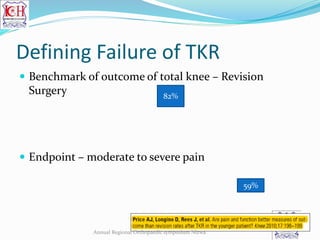
Defining Failure of TKR
 Benchmark of outcome of total knee – Revision
Surgery
 Endpoint – moderate to severe pain
82%
59%
Annual Regional Orthopaedic symposium Nizwa
Defining Failure of TKR
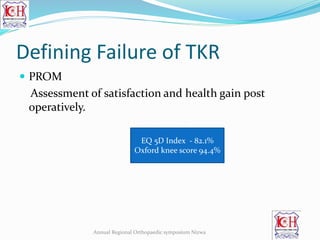
 PROM
Assessment of satisfaction and health gain post
operatively.
EQ 5D Index - 82.1%
Oxford knee score 94.4%
Annual Regional Orthopaedic symposium Nizwa
Defining Failure of TKR
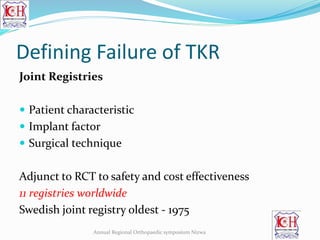
Joint Registries
 Patient characteristic
 Implant factor
 Surgical technique
Adjunct to RCT to safety and cost effectiveness
11 registries worldwide
Swedish joint registry oldest - 1975
Annual Regional Orthopaedic symposium Nizwa
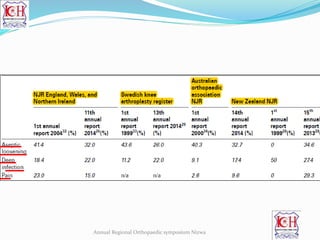
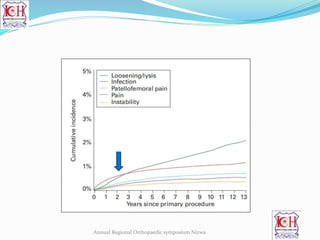
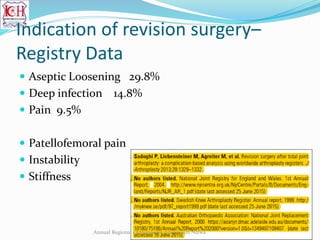
Indication of revision surgery–
Registry Data
 Aseptic Loosening 29.8%
 Deep infection 14.8%
 Pain 9.5%
 Patellofemoral pain
 Instability
 Stiffness
Annual Regional Orthopaedic symposium Nizwa
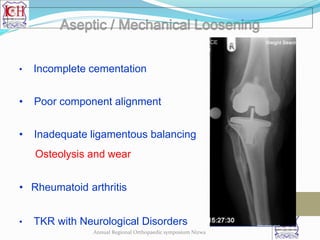
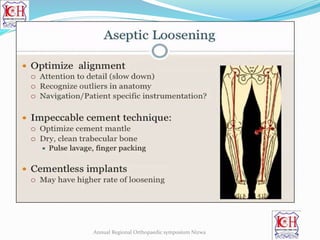
• Incomplete cementation
• Poor component alignment
• Inadequate ligamentous balancing
Osteolysis and wear
• Rheumatoid arthritis
• TKR with Neurological Disorders
Annual Regional Orthopaedic symposium Nizwa
Patellar loosening
Annual Regional Orthopaedic symposium Nizwa
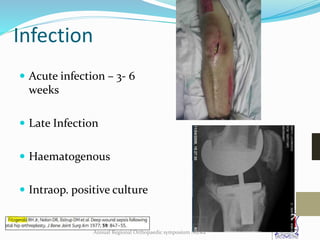
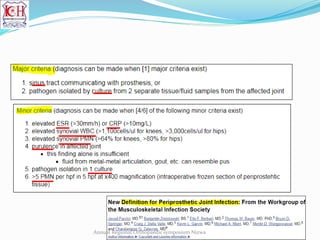
Infection
 Acute infection – 3- 6
weeks
 Late Infection
 Haematogenous
 Intraop. positive culture
Annual Regional Orthopaedic symposium Nizwa
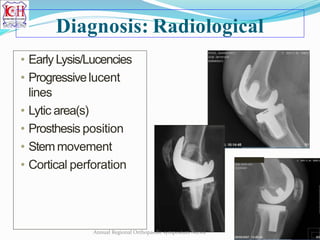
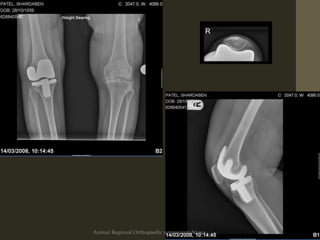
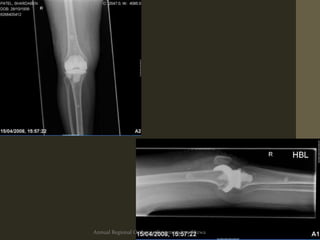
Diagnosis: Radiological
• Early Lysis/Lucencies
• Progressivelucent
lines
• Lytic area(s)
• Prosthesis position
• Stem movement
• Cortical perforation
Annual Regional Orthopaedic symposium Nizwa
Laboratory Parameters
ESR peak 5-7 daysafter operation,
pre-operative levels in 3months.
studiesshowedthat the ESRcanremain elevated for as
longasoneyear.
An ESR>30 mm per hour has asensitivity 82%,
for infectionspecificity of 85%
PPvalue of 58%
NPvalue of95%.
Moreschini O,GreggiG,GiordanoMC,NocenteM, Margheretini F.
Postoperative physiopathological analysis of inflammatory parameters in
patients undergoing hip or kneearthroplasty.
Int JTissueReact2001;23:151-4.
Annual Regional Orthopaedic symposium Nizwa
CRP
level is abetter indicator
early peak 2-3 daysafter surgery,
usually normal - 3 wksafter operation.
CRPvalue>10 mg/l
for infection
96%sensitivity
92%specificity
74%PPV
99%NPV
GreidanusNV,Masri BA,GarbuzDS,et al. Useof erythrocyte sedimentation rate
and C-reactive protein level to diagnose infection before revision total knee
arthroplasty: a prospective evaluation. JBoneJointSurg[Am] 2007;89-A:1409-16.Annual Regional Orthopaedic symposium Nizwa
Interleukin 6 (IL-6)
elevated (> 10 pg/mL )
peri-prosthetic infection, higher predictivevalue
Interleukin-6 levels
peak - first 6 to 12hours
baseline- 48 to 72 hours.
Acombination of CRPandIL-6hasrecentlybeenshown
to provide excellent sensitivityin the assessmentof
infection after TKR.
Bottner F,ErrenM, WegnerA, Winkelmann K,et al.
Interleukin-6, procalcitonin and TNFalpha: markers of peri-
prosthetic infection following total joint replacement. JBoneJoint
Surg[Br] 2007;89-B:94-9.
Annual Regional Orthopaedic symposium Nizwa
Alpha Defensin
Leucocyte esterase
Annual Regional Orthopaedic symposium Nizwa
Ideally the pain should be largelyrelieved
in most of thecases
by 3 months postoperatively.
Bakeret al, JBoneJointSurg [Br]2007;89-B:893-900
Study involving more than 8000 patients reported that 19.8%had
persistent pain one year after operation.
Avisualanaloguescale(VAS)ishelpfulindocumenting.
Pain
Annual Regional Orthopaedic symposium Nizwa
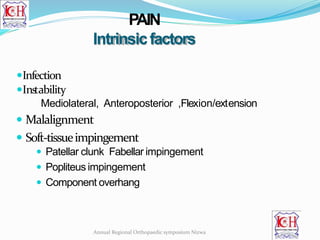
PAIN
Intrinsicfactors
Infection
Instability
Mediolateral, Anteroposterior ,Flexion/extension
 Malalignment
 Soft-tissueimpingement
 Patellar clunk Fabellar impingement
 Popliteus impingement
 Component overhang
Annual Regional Orthopaedic symposium Nizwa
Intrinsic factors
Arthrofibrosis
Wear, osteolysisandasepticloosening
Extensormechanism problems
- Patellar maltracking
- Extensor mechanism disruption
- Unresurfaced patella
- Undersized patellar button with lateral
facet impingement
- Oversized patellar button with overstuffing
of patellofemoral joint
- Patella baja +alta
Recurrent haemarthrosis
Annual Regional Orthopaedic symposium Nizwa
PAIN - Extrinsicfactors
- Hippathology
-Neurological
-Vascular- DVT
-Pesanserinus bursitis
-Stressfracture andperi-prosthetic fracture
-Tendinopathy(patellar/quadricep)
-Heterotopic ossification
-Psychologicaldisorder
-Others
• Paget’sdisease
• Pigmentedvillonodular synovitis
• Rheumatoid arthritis
• Footandankle pathology
Annual Regional Orthopaedic symposium Nizwa
Painwith full flexion
• Impingement between posterior femoral osteophyte andtibial
component
• Overstuffing of the flexionspace.
Painassociatedwith stair climbingor descent
• Dysfunction of the extensormechanism.
• Patellar maltracking or subluxation
Restpain andcontinuouspostoperative pain that never
improves
• Infectionor CRPS.
Pain- Characteristics
Annual Regional Orthopaedic symposium Nizwa
Earlypost-operative pain
 Acute Infection
 Instability
 Inadequate balancing of the soft tissues
Pain- Characteristics
Annual Regional Orthopaedic symposium Nizwa
Delayedonset
 Loosening of a component,
 Wear of the polyethylene
 Late Ligamentous instability
 Late haematogenous infection
 Stress fracture.
Pain- Characteristics
Annual Regional Orthopaedic symposium Nizwa
Neuroma
• Injury of the infrapatellar branch of the saphenous nerve
Complex Regional Pain Syndrome
• Uncommon cause
• Cutaneous hypersensitivity is common,
• Swelling and stiffness
• .
Ritter MA: Postoperative pain after total kneearthroplasty. JArthroplasty 1997;12:337-
339.
Annual Regional Orthopaedic symposium Nizwa
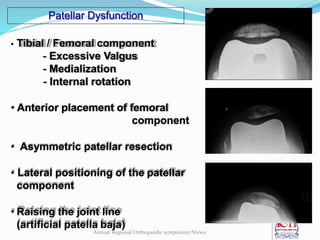
Patellar Dysfunction
• Tibial / Femoral component
- Excessive Valgus
- Medialization
- Internal rotation
• Anterior placement of femoral
component
• Asymmetric patellar resection
• Lateral positioning of the patellar
component
• Raising the joint line
(artificial patella baja)
Annual Regional Orthopaedic symposium Nizwa
Quadriceps tendonrupture
• Quadriceps turndown
• Over-resection of patella with damage to the
quadriceps tendon.
• Manipulation or an extensive lateral release.
Annual Regional Orthopaedic symposium Nizwa
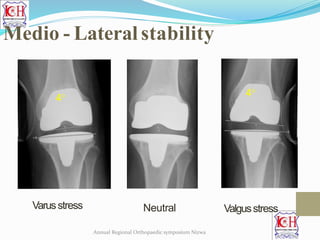
44
Varusstress ValgusstressNeutral
Medio - Lateral stability
Annual Regional Orthopaedic symposium Nizwa
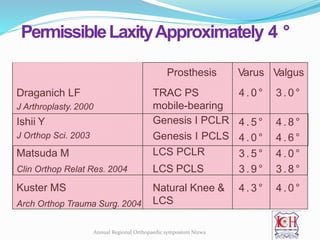
Draganich LF
J Arthroplasty. 2000
Ishii Y
J Orthop Sci. 2003
Matsuda M
Clin Orthop Relat Res. 2004
Kuster MS
Arch Orthop Trauma Surg. 2004
Prosthesis
TRAC PS
mobile-bearing
Genesis I PCLR
Genesis I PCLS
LCS PCLR
LCS PCLS
Natural Knee &
LCS
Varus
4. 0 °
4. 5 °
4. 0 °
3. 5 °
3. 9 °
4. 3 °
Valgus
3. 0 °
4. 8 °
4. 6 °
4. 0 °
3. 8 °
4. 0 °
PermissibleLaxityApproximately 4 °
Annual Regional Orthopaedic symposium Nizwa
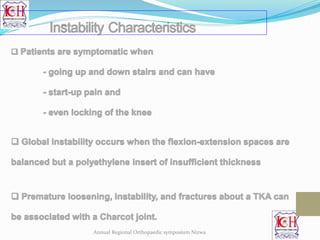
 Early post-operative period
• Uncorrected pre-operative ligamentous imbalance
• Improper intra-operative ligamentous balancing
• Mismatch of the flexion-extension gap
• Iatrogenic injury to the ligaments during surgery
• Pre-existing neuromuscular pathology
 Late instability
• Malalignment leading to progressive stretching of ligaments
• Wear of polyethylene
• Loosening of the component and collapse
Parratte S, Pagnano MW. Instability after total knee arthroplasty. J Bone
JointSurg [Am] 2008;90-A:184-94.Annual Regional Orthopaedic symposium Nizwa
Annual Regional Orthopaedic symposium Nizwa
Average knee motion required
 Climbing stairs normally 83°;
 Sitting, 93°;
 Tying a shoe, 106°;
 Lifting an object, 117°.
 ROM of <90°
 Pain or functional disability
Postoperative Stiffness
Laubenthal KN, Smidt GL, Kettelkamp DB:Aquantitative analysis of knee motion
during activities of daily living. Phys Ther 1972;52:34-43.
Annual Regional Orthopaedic symposium Nizwa
FFD > 15 Deg.
ROM < 90 deg.
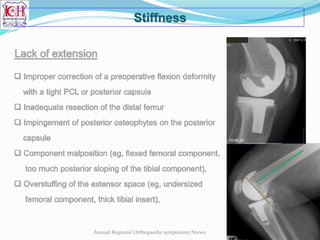
Stiffness
Annual Regional Orthopaedic symposium Nizwa
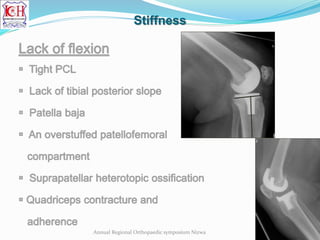
Stiffness
Annual Regional Orthopaedic symposium Nizwa
Stiffness - Characteristics
Annual Regional Orthopaedic symposium Nizwa
Harwin SF. Patellofemoral complications in symmetrical total knee arthroplasty. J Arthropla 1998;13:753-62
Chalidis BE, Tsiridis E, Tragas AA, Stavrou Z, Giannoudis PV. Management of periprostheticpatellar
fractures: a systemic review of literature. Injury2007;38:714-24.
Chalidis BE, Tsiridis E, Tragas AA, Stavrou Z, Giannoudis PV. Management of periprosthetic patellar
fractures: a systemic review of literature. Injury2007;38:714-24.
Annual Regional Orthopaedic symposium Nizwa
Pain
Annual Regional Orthopaedic symposium Nizwa
Thank
You
Annual Regional Orthopaedic symposium Nizwa

Why do total knees fail

  • 1.
    Dr. Jatinder S.Luthra Annual Regional Orthopaedic symposium Nizwa
  • 2.
    Ideal TKR • Componentsideally aligned in CAS plane • With the femoral component matched to the tibial in rotation • With a joint line at the appropriate level • With balanced soft tissue • In flexion andextension • With the patella tracking in the correct plane. Annual Regional Orthopaedic symposium Nizwa
  • 3.
    Defining Failure ofTKR  Benchmark of outcome of total knee – Revision Surgery  Endpoint – moderate to severe pain 82% 59% Annual Regional Orthopaedic symposium Nizwa
  • 4.
    Defining Failure ofTKR  PROM Assessment of satisfaction and health gain post operatively. EQ 5D Index - 82.1% Oxford knee score 94.4% Annual Regional Orthopaedic symposium Nizwa
  • 5.
    Defining Failure ofTKR Joint Registries  Patient characteristic  Implant factor  Surgical technique Adjunct to RCT to safety and cost effectiveness 11 registries worldwide Swedish joint registry oldest - 1975 Annual Regional Orthopaedic symposium Nizwa
  • 6.
  • 7.
  • 8.
  • 9.
    Indication of revisionsurgery– Registry Data  Aseptic Loosening 29.8%  Deep infection 14.8%  Pain 9.5%  Patellofemoral pain  Instability  Stiffness Annual Regional Orthopaedic symposium Nizwa
  • 10.
    • Incomplete cementation •Poor component alignment • Inadequate ligamentous balancing Osteolysis and wear • Rheumatoid arthritis • TKR with Neurological Disorders Annual Regional Orthopaedic symposium Nizwa
  • 11.
  • 12.
    Patellar loosening Annual RegionalOrthopaedic symposium Nizwa
  • 13.
    Infection  Acute infection– 3- 6 weeks  Late Infection  Haematogenous  Intraop. positive culture Annual Regional Orthopaedic symposium Nizwa
  • 14.
    Diagnosis: Radiological • EarlyLysis/Lucencies • Progressivelucent lines • Lytic area(s) • Prosthesis position • Stem movement • Cortical perforation Annual Regional Orthopaedic symposium Nizwa
  • 15.
    Laboratory Parameters ESR peak5-7 daysafter operation, pre-operative levels in 3months. studiesshowedthat the ESRcanremain elevated for as longasoneyear. An ESR>30 mm per hour has asensitivity 82%, for infectionspecificity of 85% PPvalue of 58% NPvalue of95%. Moreschini O,GreggiG,GiordanoMC,NocenteM, Margheretini F. Postoperative physiopathological analysis of inflammatory parameters in patients undergoing hip or kneearthroplasty. Int JTissueReact2001;23:151-4. Annual Regional Orthopaedic symposium Nizwa
  • 16.
    CRP level is abetterindicator early peak 2-3 daysafter surgery, usually normal - 3 wksafter operation. CRPvalue>10 mg/l for infection 96%sensitivity 92%specificity 74%PPV 99%NPV GreidanusNV,Masri BA,GarbuzDS,et al. Useof erythrocyte sedimentation rate and C-reactive protein level to diagnose infection before revision total knee arthroplasty: a prospective evaluation. JBoneJointSurg[Am] 2007;89-A:1409-16.Annual Regional Orthopaedic symposium Nizwa
  • 17.
    Interleukin 6 (IL-6) elevated(> 10 pg/mL ) peri-prosthetic infection, higher predictivevalue Interleukin-6 levels peak - first 6 to 12hours baseline- 48 to 72 hours. Acombination of CRPandIL-6hasrecentlybeenshown to provide excellent sensitivityin the assessmentof infection after TKR. Bottner F,ErrenM, WegnerA, Winkelmann K,et al. Interleukin-6, procalcitonin and TNFalpha: markers of peri- prosthetic infection following total joint replacement. JBoneJoint Surg[Br] 2007;89-B:94-9. Annual Regional Orthopaedic symposium Nizwa Alpha Defensin Leucocyte esterase
  • 18.
  • 19.
  • 20.
  • 21.
    Ideally the painshould be largelyrelieved in most of thecases by 3 months postoperatively. Bakeret al, JBoneJointSurg [Br]2007;89-B:893-900 Study involving more than 8000 patients reported that 19.8%had persistent pain one year after operation. Avisualanaloguescale(VAS)ishelpfulindocumenting. Pain Annual Regional Orthopaedic symposium Nizwa
  • 22.
    PAIN Intrinsicfactors Infection Instability Mediolateral, Anteroposterior ,Flexion/extension Malalignment  Soft-tissueimpingement  Patellar clunk Fabellar impingement  Popliteus impingement  Component overhang Annual Regional Orthopaedic symposium Nizwa
  • 23.
    Intrinsic factors Arthrofibrosis Wear, osteolysisandasepticloosening Extensormechanismproblems - Patellar maltracking - Extensor mechanism disruption - Unresurfaced patella - Undersized patellar button with lateral facet impingement - Oversized patellar button with overstuffing of patellofemoral joint - Patella baja +alta Recurrent haemarthrosis Annual Regional Orthopaedic symposium Nizwa
  • 24.
    PAIN - Extrinsicfactors -Hippathology -Neurological -Vascular- DVT -Pesanserinus bursitis -Stressfracture andperi-prosthetic fracture -Tendinopathy(patellar/quadricep) -Heterotopic ossification -Psychologicaldisorder -Others • Paget’sdisease • Pigmentedvillonodular synovitis • Rheumatoid arthritis • Footandankle pathology Annual Regional Orthopaedic symposium Nizwa
  • 25.
  • 26.
    Painwith full flexion •Impingement between posterior femoral osteophyte andtibial component • Overstuffing of the flexionspace. Painassociatedwith stair climbingor descent • Dysfunction of the extensormechanism. • Patellar maltracking or subluxation Restpain andcontinuouspostoperative pain that never improves • Infectionor CRPS. Pain- Characteristics Annual Regional Orthopaedic symposium Nizwa
  • 27.
    Earlypost-operative pain  AcuteInfection  Instability  Inadequate balancing of the soft tissues Pain- Characteristics Annual Regional Orthopaedic symposium Nizwa
  • 28.
    Delayedonset  Loosening ofa component,  Wear of the polyethylene  Late Ligamentous instability  Late haematogenous infection  Stress fracture. Pain- Characteristics Annual Regional Orthopaedic symposium Nizwa
  • 29.
    Neuroma • Injury ofthe infrapatellar branch of the saphenous nerve Complex Regional Pain Syndrome • Uncommon cause • Cutaneous hypersensitivity is common, • Swelling and stiffness • . Ritter MA: Postoperative pain after total kneearthroplasty. JArthroplasty 1997;12:337- 339. Annual Regional Orthopaedic symposium Nizwa
  • 30.
    Patellar Dysfunction • Tibial/ Femoral component - Excessive Valgus - Medialization - Internal rotation • Anterior placement of femoral component • Asymmetric patellar resection • Lateral positioning of the patellar component • Raising the joint line (artificial patella baja) Annual Regional Orthopaedic symposium Nizwa
  • 31.
    Quadriceps tendonrupture • Quadricepsturndown • Over-resection of patella with damage to the quadriceps tendon. • Manipulation or an extensive lateral release. Annual Regional Orthopaedic symposium Nizwa
  • 32.
    44 Varusstress ValgusstressNeutral Medio -Lateral stability Annual Regional Orthopaedic symposium Nizwa
  • 33.
    Draganich LF J Arthroplasty.2000 Ishii Y J Orthop Sci. 2003 Matsuda M Clin Orthop Relat Res. 2004 Kuster MS Arch Orthop Trauma Surg. 2004 Prosthesis TRAC PS mobile-bearing Genesis I PCLR Genesis I PCLS LCS PCLR LCS PCLS Natural Knee & LCS Varus 4. 0 ° 4. 5 ° 4. 0 ° 3. 5 ° 3. 9 ° 4. 3 ° Valgus 3. 0 ° 4. 8 ° 4. 6 ° 4. 0 ° 3. 8 ° 4. 0 ° PermissibleLaxityApproximately 4 ° Annual Regional Orthopaedic symposium Nizwa
  • 34.
     Early post-operativeperiod • Uncorrected pre-operative ligamentous imbalance • Improper intra-operative ligamentous balancing • Mismatch of the flexion-extension gap • Iatrogenic injury to the ligaments during surgery • Pre-existing neuromuscular pathology  Late instability • Malalignment leading to progressive stretching of ligaments • Wear of polyethylene • Loosening of the component and collapse Parratte S, Pagnano MW. Instability after total knee arthroplasty. J Bone JointSurg [Am] 2008;90-A:184-94.Annual Regional Orthopaedic symposium Nizwa
  • 35.
  • 36.
    Average knee motionrequired  Climbing stairs normally 83°;  Sitting, 93°;  Tying a shoe, 106°;  Lifting an object, 117°.  ROM of <90°  Pain or functional disability Postoperative Stiffness Laubenthal KN, Smidt GL, Kettelkamp DB:Aquantitative analysis of knee motion during activities of daily living. Phys Ther 1972;52:34-43. Annual Regional Orthopaedic symposium Nizwa FFD > 15 Deg. ROM < 90 deg.
  • 37.
  • 38.
  • 39.
    Stiffness - Characteristics AnnualRegional Orthopaedic symposium Nizwa
  • 40.
    Harwin SF. Patellofemoralcomplications in symmetrical total knee arthroplasty. J Arthropla 1998;13:753-62 Chalidis BE, Tsiridis E, Tragas AA, Stavrou Z, Giannoudis PV. Management of periprostheticpatellar fractures: a systemic review of literature. Injury2007;38:714-24. Chalidis BE, Tsiridis E, Tragas AA, Stavrou Z, Giannoudis PV. Management of periprosthetic patellar fractures: a systemic review of literature. Injury2007;38:714-24. Annual Regional Orthopaedic symposium Nizwa
  • 41.
    Annual Regional Orthopaedicsymposium Nizwa Pain
  • 42.
  • 43.
  • 44.
  • 45.