DUAL MOBILITY CUPS – KHOULA
EXPERIENCE
Dr. Jatinder S. Luthra MS, DNB, MRCS
Dr. Amur Riyami
Dr. Mohamad Kasim Allami FRCS , FRCS ( Trauma & Ortho)
• THR – 1.5 million
worldwide
• One of most succesful
procedure
Rate of THR grow by 174%
by 2030
The Burden of Hip Osteoarthritis in The United States : epidemiologi and
economic consideration
NHO et al JAAOS 2013
THR – Dislocation
• Cumulative risk of
dislocation increases
with time
Posterolateral approach
> 70 years
Head Diameter
Female Sex
The cumulative long –term risk of dislocation after primary Charnley total hip
arthroplasty
Berry et al JBJS 2004
Surgical
Factors
Implant
Factors
Patient
Factors
Impingement
Jump Distance
Reduction
Dual Mobility - Concept
• Gilles Bosquet and Raoul Lambart - 1975
Based on
• Low friction arthroplasty ( Charnley)
• Low dislocation rate – Large Femoral Head
(Mackee Farrar)
• Larger femoral head reduced dislocation
- Better head neck ratio – better movement
- Greater translocation is required before
dislocation
• 3 components & 3 joints
• - Acetabular socket
(cemented / cementless)
• Poly Liner
• Metal / Ceramic head
• Liner is free in acetabular
component
• Small Joint – Poly liner &
head
• Large joint – Poly liner metal
cup
Recruitment Phenomenon
Indications
• > 65 yrs
• Prior Hip Surgery
• Neuromuscular disease
• Cognitive Dysfunction
• ASA > 3
• Revision THR
Khoula Experience
• Early results
• Mar 2011 – Till Date
• Total 47 cases
• Male – 18
• Female – 29
• Age range from – 23 yrs to 91
yrs –
• Mean age 61 yrs
• Patients < 40 yrs – 5
• Patients > 40 Yrs - 42
• Multisurgeon study
Patients - 47
Male - 18
Female - 29
Total Case - 47
Primary
THR
Revision
THR
22 27
Total Cases 47
Primary
THR 22
Revision
THR 25
Primary THR
12
7
2
1
Primary THR 22
OA
# Neck femur
# Acetabulum
Sickler
Osteoarthritis - 12
# Neck Femur – 7
# Acetabulum – 2
Sickler - 1
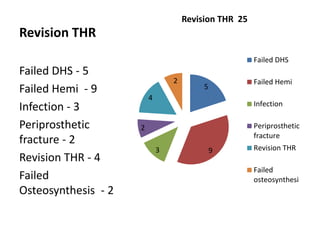
Revision THR
5
93
2
4
2
Revision THR 25
Failed DHS
Failed Hemi
Infection
Periprosthetic
fracture
Revision THR
Failed
osteosynthesi
Failed DHS - 5
Failed Hemi - 9
Infection - 3
Periprosthetic
fracture - 2
Revision THR - 4
Failed
Osteosynthesis - 2
• Posterior approach
• Avantage Privelege Cup system ( Biomet)
• Patients with high risk of post op dislocation
Acetabular Size
Size 44 - 25
Size 46 – 10
Size 48 – 5
Size 50 - 4
Size 52 - 3
25
10
5
4
3
0
5
10
15
20
25
30
44 46 48 50 52
Acetabular Sizes
Acetabular
Sizes
Femoral Sizes
8
26
10
2
1
0
5
10
15
20
25
30
7 9 11 13 15
AxisTitle
Axis Title
Femoral sizes
Femoral sizes
Size 7 - 8
Size 9 - 26
Size 11 - 10
Size 13 - 2
Size 15 - 1
0
5
10
15
20
25
30
35
40
No Of Cases
No Of Cases
Cemented – 36
(76%)
Uncemented - 2
(4%)
Hybrid – 9 ( 19%)
Fluoroscopic evaluation
• 7 pt agreed in follow up to undergo
fluoroscopic evaluation
• No impingement at extremes of movement
Fluoroscopic evaluation
Complications
• Deep infection – 1
• Dislocation – 1
• Mortality – 1
• Intraop Fracture - 2
Results
• Follow up range from 4mths to 42mths
• Good early Results in high risk cases in Omani
population
• Dislocation - 2% ( Revision THR)
Radiological Evaluation
• No reported cases of osteolysis
• No signs of aseptic loosening
• Fluoroscopy demonstrates – no impingement
Dual mobility cup - Sickler
Dual mobility cup – Failed
Osteosynthesis
Dual mobility cup - # Neck Femur
Dual mobility cup – Failed DHS
Dual mobility cup – Failed Hemi
Dual mobility cup - Arthritis
Dual mobility cup – Post Infection
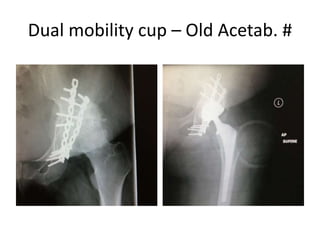
Dual mobility cup – Old Acetab. #
Dual mobility cup – Revision THR
Intraprosthetic dislocation
Concern about early Intraprosthetic Dislocation in Dual Mobility Implants
Marc et Al JBJS Case Connector 2013
Femoral head dislodgement complicating use of a Dual Mobility Prosthesis for
recurrent Instability
Banzhof et al Journal of Arthroplasty 2010
Severe Metallosis owing to intraprosthetic dislocation in a failed Dual – mobility
cup Primary Total Hip Arthroplasty
Mohammad et al Journal of Arthroplasty 2011
Dual mobility cups in primary THR
• 10 years follow up survivorship – 94% – 97%
• Dislocation rate 0%-1%
• Causes of failure – Aseptic loosening
• Excessive PE wear
Study Hips Survivorship Years
Aubriot ,
1993
100 97% 5
Farizon 1998 135 95.4% 10
Leclerc, 1999 153 96% 10
Philippot,
2004
106 94.6% 10
Philippot,
2006
100 95% 10
Dislocation in Primary THR – Dual
Mobility Cup
Study No of Cases No of Dislocation
Philippot, 2004 106 0
Aubriot, 1993 110 1
Vanel, 2003 127 1
Bejui- Hughes, 2006 167 0
Philippot, 2006 70 0
Dual Mobility cup in Revision THR
• Dislocation after conventional THR –
dislocation 5% to 30 %
 Muscular insufficiency
 Bone loss Aggressive capsulectomy
 Difficulty in implant positioning
Dislocation in Revision THR – Dual
Mobility Cup
Study No Of Revision THR No of Dislocation
Aubriot, 1995 13 0
Beguin, 2002 42 0
SFHG, 2006 403 8
Guyen, 2009 54 3
Dual mobility in fracture neck femur
• Mean Dislocation rate - 10 % ( conventional
THR)
• Tarasevicius et al compared dislocation rates
for DM cup and conventional cups
At 1 year 14 % dislocation in conventional gp
and no dislocation in DM gp
Dual mobility in tumor resection
• Bone loss & soft tissue compromise – high
dislocation rate
• Philippeau et al – 9 % dislocation in 71 pt with
Tumor resection
• Can be further reduced by reattaching
abductors and avoid gluteus max resection
Dual mobility cup in spastic disorder
• Dislocation rate – 14 %
• Sanders et al – 10 hips – no dislocation – 3 yrs
Summary
• Excellent implant for Thr in high risk patients
in middle east population
• Constrained liners are not needed
• Elderly pt with fracture neck femur – Dual
mobility cup is treatment of choice
THANK YOU

Dual mobility cups (6)

  • 1.
    DUAL MOBILITY CUPS– KHOULA EXPERIENCE Dr. Jatinder S. Luthra MS, DNB, MRCS Dr. Amur Riyami Dr. Mohamad Kasim Allami FRCS , FRCS ( Trauma & Ortho)
  • 2.
    • THR –1.5 million worldwide • One of most succesful procedure
  • 3.
    Rate of THRgrow by 174% by 2030 The Burden of Hip Osteoarthritis in The United States : epidemiologi and economic consideration NHO et al JAAOS 2013
  • 4.
    THR – Dislocation •Cumulative risk of dislocation increases with time Posterolateral approach > 70 years Head Diameter Female Sex The cumulative long –term risk of dislocation after primary Charnley total hip arthroplasty Berry et al JBJS 2004
  • 5.
  • 6.
    Dual Mobility -Concept • Gilles Bosquet and Raoul Lambart - 1975 Based on • Low friction arthroplasty ( Charnley) • Low dislocation rate – Large Femoral Head (Mackee Farrar)
  • 7.
    • Larger femoralhead reduced dislocation - Better head neck ratio – better movement - Greater translocation is required before dislocation
  • 8.
    • 3 components& 3 joints • - Acetabular socket (cemented / cementless) • Poly Liner • Metal / Ceramic head • Liner is free in acetabular component
  • 9.
    • Small Joint– Poly liner & head • Large joint – Poly liner metal cup Recruitment Phenomenon
  • 10.
    Indications • > 65yrs • Prior Hip Surgery • Neuromuscular disease • Cognitive Dysfunction • ASA > 3 • Revision THR
  • 11.
    Khoula Experience • Earlyresults • Mar 2011 – Till Date
  • 12.
    • Total 47cases • Male – 18 • Female – 29 • Age range from – 23 yrs to 91 yrs – • Mean age 61 yrs • Patients < 40 yrs – 5 • Patients > 40 Yrs - 42 • Multisurgeon study Patients - 47 Male - 18 Female - 29
  • 13.
    Total Case -47 Primary THR Revision THR 22 27 Total Cases 47 Primary THR 22 Revision THR 25
  • 14.
    Primary THR 12 7 2 1 Primary THR22 OA # Neck femur # Acetabulum Sickler Osteoarthritis - 12 # Neck Femur – 7 # Acetabulum – 2 Sickler - 1
  • 15.
    Revision THR 5 93 2 4 2 Revision THR25 Failed DHS Failed Hemi Infection Periprosthetic fracture Revision THR Failed osteosynthesi Failed DHS - 5 Failed Hemi - 9 Infection - 3 Periprosthetic fracture - 2 Revision THR - 4 Failed Osteosynthesis - 2
  • 16.
    • Posterior approach •Avantage Privelege Cup system ( Biomet) • Patients with high risk of post op dislocation
  • 17.
    Acetabular Size Size 44- 25 Size 46 – 10 Size 48 – 5 Size 50 - 4 Size 52 - 3 25 10 5 4 3 0 5 10 15 20 25 30 44 46 48 50 52 Acetabular Sizes Acetabular Sizes
  • 18.
    Femoral Sizes 8 26 10 2 1 0 5 10 15 20 25 30 7 911 13 15 AxisTitle Axis Title Femoral sizes Femoral sizes Size 7 - 8 Size 9 - 26 Size 11 - 10 Size 13 - 2 Size 15 - 1
  • 19.
    0 5 10 15 20 25 30 35 40 No Of Cases NoOf Cases Cemented – 36 (76%) Uncemented - 2 (4%) Hybrid – 9 ( 19%)
  • 20.
    Fluoroscopic evaluation • 7pt agreed in follow up to undergo fluoroscopic evaluation • No impingement at extremes of movement
  • 21.
  • 22.
    Complications • Deep infection– 1 • Dislocation – 1 • Mortality – 1 • Intraop Fracture - 2
  • 23.
    Results • Follow uprange from 4mths to 42mths • Good early Results in high risk cases in Omani population • Dislocation - 2% ( Revision THR)
  • 24.
    Radiological Evaluation • Noreported cases of osteolysis • No signs of aseptic loosening • Fluoroscopy demonstrates – no impingement
  • 25.
  • 26.
    Dual mobility cup– Failed Osteosynthesis
  • 27.
    Dual mobility cup- # Neck Femur
  • 28.
    Dual mobility cup– Failed DHS
  • 29.
    Dual mobility cup– Failed Hemi
  • 30.
    Dual mobility cup- Arthritis
  • 31.
    Dual mobility cup– Post Infection
  • 32.
    Dual mobility cup– Old Acetab. #
  • 33.
    Dual mobility cup– Revision THR
  • 34.
    Intraprosthetic dislocation Concern aboutearly Intraprosthetic Dislocation in Dual Mobility Implants Marc et Al JBJS Case Connector 2013 Femoral head dislodgement complicating use of a Dual Mobility Prosthesis for recurrent Instability Banzhof et al Journal of Arthroplasty 2010 Severe Metallosis owing to intraprosthetic dislocation in a failed Dual – mobility cup Primary Total Hip Arthroplasty Mohammad et al Journal of Arthroplasty 2011
  • 35.
    Dual mobility cupsin primary THR • 10 years follow up survivorship – 94% – 97% • Dislocation rate 0%-1% • Causes of failure – Aseptic loosening • Excessive PE wear
  • 36.
    Study Hips SurvivorshipYears Aubriot , 1993 100 97% 5 Farizon 1998 135 95.4% 10 Leclerc, 1999 153 96% 10 Philippot, 2004 106 94.6% 10 Philippot, 2006 100 95% 10
  • 37.
    Dislocation in PrimaryTHR – Dual Mobility Cup Study No of Cases No of Dislocation Philippot, 2004 106 0 Aubriot, 1993 110 1 Vanel, 2003 127 1 Bejui- Hughes, 2006 167 0 Philippot, 2006 70 0
  • 38.
    Dual Mobility cupin Revision THR • Dislocation after conventional THR – dislocation 5% to 30 %  Muscular insufficiency  Bone loss Aggressive capsulectomy  Difficulty in implant positioning
  • 39.
    Dislocation in RevisionTHR – Dual Mobility Cup Study No Of Revision THR No of Dislocation Aubriot, 1995 13 0 Beguin, 2002 42 0 SFHG, 2006 403 8 Guyen, 2009 54 3
  • 40.
    Dual mobility infracture neck femur • Mean Dislocation rate - 10 % ( conventional THR) • Tarasevicius et al compared dislocation rates for DM cup and conventional cups At 1 year 14 % dislocation in conventional gp and no dislocation in DM gp
  • 41.
    Dual mobility intumor resection • Bone loss & soft tissue compromise – high dislocation rate • Philippeau et al – 9 % dislocation in 71 pt with Tumor resection • Can be further reduced by reattaching abductors and avoid gluteus max resection
  • 42.
    Dual mobility cupin spastic disorder • Dislocation rate – 14 % • Sanders et al – 10 hips – no dislocation – 3 yrs
  • 43.
    Summary • Excellent implantfor Thr in high risk patients in middle east population • Constrained liners are not needed • Elderly pt with fracture neck femur – Dual mobility cup is treatment of choice
  • 44.

Editor's Notes

  • #36 The use of a dual-articulation acetabular cup system to prevent dislocation after primary total hip arthroplasty: analysis of 384 cases at a mean follow-up of 15 years.Philippot R, Camilleri JP, Boyer B, Adam P, Farizon F Int Orthop. 2009 Aug; 33(4):927-32. Unconstrained tripolar hip implants: effect on hip stability.Guyen O, Chen QS, Bejui-Hugues J, Berry DJ, An KN Clin Orthop Relat Res. 2007 Feb; 455():202-8. Results with a cementless alumina-coated cup with dual mobility. A twelve-year follow-up study.Farizon F, de Lavison R, Azoulai JJ, Bousquet G Int Orthop. 1998; 22(4):219-24. The dual mobility socket concept: experience with 668 cases.Vielpeau C, Lebel B, Ardouin L, Burdin G, Lautridou C Int Orthop. 2011 Feb; 35(2):225-30.
  • #41 Dual mobility cups hip arthroplasty as a treatment for displaced fracture of the femoral neck in the elderly. A prospective, systematic, multicenter study with specific focus on postoperative dislocation.Adam P, Philippe R, Ehlinger M, Roche O, Bonnomet F, Molé D, Fessy MH, French Society of Orthopaedic Surgery and Traumatology (SoFCOT) Orthop Traumatol Surg Res. 2012 May; 98(3):296-300. Dual mobility cup reduces dislocation rate after arthroplasty for femoral neck fracture.Tarasevicius S, Busevicius M, Robertsson O, Wingstrand H BMC Musculoskelet Disord. 2010 Aug 6; 11():175. [PubMed] [Ref list]
  • #43 Constrained total hip arthroplasty in a paediatric patient with cerebral palsy and painful dislocation of the hip. A case report.Blake SM, Kitson J, Howell JR, Gie GA, Cox PJ J Bone Joint Surg Br. 2006 May; 88(5):655-7. Total hip arthroplasty in patients with cerebral palsy.Weber M, Cabanela ME Orthopedics. 1999 Apr; 22(4):425-7.