ZAP 70 ADA ADA PNP PNP
“ Pure” T Cell Disorders “ Pure” B Cell Disorders Severe Combined Immunodeficiency (SCID) Combined Immunodeficiencies Phagocyte Deficiencies Complement Deficiencies
B Cell: recurrent sinopulmonary and GI infections beginning after 3-4 mo. T Cell and Severe Combined Immunodeficiency (SCID): opportunistic infections beginning early in infancy (thrush, diarrhea, failure to thrive); Milder forms termed Combined Immunodeficiency (CID) Phagocyte deficiencies: deep tissue infections with high-grade bacterial pathogens Complement: some infections, primarily with encapsulated organisms and  Neisseriae
“ Pure” T Cell Deficiencies: DiGeorge syndrome T cell receptor deficiencies Zap 70 deficiency
Conotruncal cardiac malformation Hypoparathyroidism Thymic hypoplasia leading to variable immunodeficiency Other features: Characteristic facies Deletion in 22q11 in > 80% Affected gene(s) is a transcription factor in the T-box family called  Tbx1
 
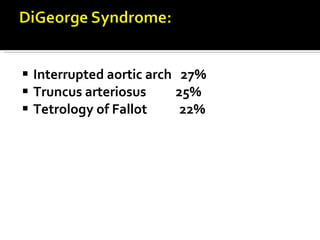
Interrupted aortic arch  27% Truncus arteriosus  25% Tetrology of Fallot  22%
 
 
X-linked SCID (  c  deficiency) Jak3 kinase deficiency Adenosine deaminase deficiency Purine nucleoside phosphorylase deficiency Bare lymphocyte syndrome RAG1 and RAG2 deficiency
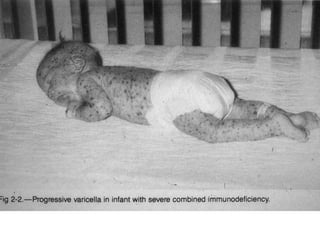
Failure to thrive Onset of infections in the neonatal period Opportunistic infections Chronic or recurrent thrush Chronic rashes Chronic or recurrent diarrhea Paucity of lymphoid tissue
Hypogammaglobulinemia Absence of antibody responses to immunizations Absent mitogen responses Low or absent T cells Often low or absent B cells
Bone marrow transplantation, preferably from a histocompatible sibling Gene therapy
Most common form of SCID (40%) Very low T cells and NK cells with low to normal numbers of B cells Responsible gene:   c  – the common subunit of receptors for IL-2, IL-4, IL-7, IL-9, and IL-15
 
Bruton’s (X-linked) Agammaglobulinemia Autosomal Recessive Hyper-IgM Syndrome B Cell Receptor Deficiencies Common Variable Immunodeficiency (CVID) Selective IgA Deficiency IgG Subclass Deficiency
IgA deficiency frequently coexists with IgG subclass deficiency, especially IgG2 and IgG4 Linkage to Class III region of HLA 50% incidence of IgA-D in children of patients with CVID Occasionally IgA deficient patients have been noted to progress to CVID
Panhypogammaglobulinemia, usually with lymphadenopathy and splenomegaly Absence of clear abnormalities in T and B cell subsets Chronic/recurrent respiratory infections, & diarrhea, especially due to  Giardia Tendency to develop autoimmunity and lymphoid malignancies Linkage to HLA Class III Region in 2/3 of patients One gene identified: ICOS (B7h) (activation antigen on T cells)
Chronic/recurrent upper respiratory infections, especially sinusitis Tendency to develop respiratory and gastrointestinal allergies and autoimmunity
Wiskott-Aldrich Syndrome: thrombocytopenia, eczema, immunodeficiency Ataxia-Telangiectasia: DNA repair disorder X-linked Hyper-IgM Syndrome: inability to make other Ig isotypes X-linked Lymphoproliferative Disorder: immunodeficiency following EBV infection Hyper-IgE with Infections: markedly elevated IgE with deep-seated bacterial infections Chronic Mucocutaneous Candidiasis: chronic superficial fungal infections Genes identified
Chronic granulomatous disease (CGD) Leukocyte adhesion deficiency (LAD I) Chediak-Higashi syndrome IL-12/IFN   pathway deficiencies Chronic or cyclic neutropenia
Inability of phagocytes to generate hydrogen peroxide due to mutations in one of four proteins comprising the NADPH oxidase Severe tissue infections with catalase positive organisms, esp.  Staph aureus, Serratia marcescens,  mycobacteria, and fungi such as  Aspergillus
Nitroblue tetrazolium (NBT) test or, more recently, flow cytometric tests using fluorescent dyes such as dihydrorhodamine (DHR)
Prophylaxis with antibiotics (bactrim and itraconazole) and gamma interferon Bone marrow transplant with HLA identical sibling Gene therapy (?)
 
Patient Mother Father DHR Flow Cytometric Assay
CGD patient with  skin infections due to  Serratia  marcescens
Severe tissue infections due to absence of adhesion molecules (  -integrins CD11/CD18) on leukocytes Inability to make pus due to entrapment of phagocytes within the vasculature Lethal within the first decade of life without bone marrow transplant
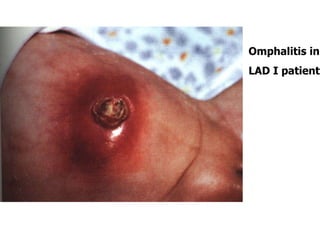
Omphalitis in  LAD I patient
Abnormal large granules in a variety of cells leading to: hypopigmentation/partial albinism severe immunodeficiency neurologic abnormalities mild bleeding tendencies Defective gene: CHS1 located on 1q42-43,  protein product involved in granule trafficking
 
IL-12 receptor IL-12 IFN  R1 and IFN  R2 STAT-1 Pattern of infections: overwhelming infection with intracellular pathogens, esp. atypical mycobacteria
 
 
Rule I:  In any inherited deficiency of a component of the classical pathway, total hemolytic activity (CH50) will be close to zero Rule II: In any inherited deficiency of a component of the alternate pathway, total hemolytic activity (AH50) will be close to zero
 

Primary immunodeficiencies

  • 1.
  • 2.
    ZAP 70 ADAADA PNP PNP
  • 3.
    “ Pure” TCell Disorders “ Pure” B Cell Disorders Severe Combined Immunodeficiency (SCID) Combined Immunodeficiencies Phagocyte Deficiencies Complement Deficiencies
  • 4.
    B Cell: recurrentsinopulmonary and GI infections beginning after 3-4 mo. T Cell and Severe Combined Immunodeficiency (SCID): opportunistic infections beginning early in infancy (thrush, diarrhea, failure to thrive); Milder forms termed Combined Immunodeficiency (CID) Phagocyte deficiencies: deep tissue infections with high-grade bacterial pathogens Complement: some infections, primarily with encapsulated organisms and Neisseriae
  • 5.
    “ Pure” TCell Deficiencies: DiGeorge syndrome T cell receptor deficiencies Zap 70 deficiency
  • 6.
    Conotruncal cardiac malformationHypoparathyroidism Thymic hypoplasia leading to variable immunodeficiency Other features: Characteristic facies Deletion in 22q11 in > 80% Affected gene(s) is a transcription factor in the T-box family called Tbx1
  • 7.
  • 8.
    Interrupted aortic arch 27% Truncus arteriosus 25% Tetrology of Fallot 22%
  • 9.
  • 10.
  • 11.
    X-linked SCID ( c deficiency) Jak3 kinase deficiency Adenosine deaminase deficiency Purine nucleoside phosphorylase deficiency Bare lymphocyte syndrome RAG1 and RAG2 deficiency
  • 12.
    Failure to thriveOnset of infections in the neonatal period Opportunistic infections Chronic or recurrent thrush Chronic rashes Chronic or recurrent diarrhea Paucity of lymphoid tissue
  • 13.
    Hypogammaglobulinemia Absence ofantibody responses to immunizations Absent mitogen responses Low or absent T cells Often low or absent B cells
  • 14.
    Bone marrow transplantation,preferably from a histocompatible sibling Gene therapy
  • 15.
    Most common formof SCID (40%) Very low T cells and NK cells with low to normal numbers of B cells Responsible gene:  c – the common subunit of receptors for IL-2, IL-4, IL-7, IL-9, and IL-15
  • 16.
  • 17.
    Bruton’s (X-linked) AgammaglobulinemiaAutosomal Recessive Hyper-IgM Syndrome B Cell Receptor Deficiencies Common Variable Immunodeficiency (CVID) Selective IgA Deficiency IgG Subclass Deficiency
  • 18.
    IgA deficiency frequentlycoexists with IgG subclass deficiency, especially IgG2 and IgG4 Linkage to Class III region of HLA 50% incidence of IgA-D in children of patients with CVID Occasionally IgA deficient patients have been noted to progress to CVID
  • 19.
    Panhypogammaglobulinemia, usually withlymphadenopathy and splenomegaly Absence of clear abnormalities in T and B cell subsets Chronic/recurrent respiratory infections, & diarrhea, especially due to Giardia Tendency to develop autoimmunity and lymphoid malignancies Linkage to HLA Class III Region in 2/3 of patients One gene identified: ICOS (B7h) (activation antigen on T cells)
  • 20.
    Chronic/recurrent upper respiratoryinfections, especially sinusitis Tendency to develop respiratory and gastrointestinal allergies and autoimmunity
  • 21.
    Wiskott-Aldrich Syndrome: thrombocytopenia,eczema, immunodeficiency Ataxia-Telangiectasia: DNA repair disorder X-linked Hyper-IgM Syndrome: inability to make other Ig isotypes X-linked Lymphoproliferative Disorder: immunodeficiency following EBV infection Hyper-IgE with Infections: markedly elevated IgE with deep-seated bacterial infections Chronic Mucocutaneous Candidiasis: chronic superficial fungal infections Genes identified
  • 22.
    Chronic granulomatous disease(CGD) Leukocyte adhesion deficiency (LAD I) Chediak-Higashi syndrome IL-12/IFN  pathway deficiencies Chronic or cyclic neutropenia
  • 23.
    Inability of phagocytesto generate hydrogen peroxide due to mutations in one of four proteins comprising the NADPH oxidase Severe tissue infections with catalase positive organisms, esp. Staph aureus, Serratia marcescens, mycobacteria, and fungi such as Aspergillus
  • 24.
    Nitroblue tetrazolium (NBT)test or, more recently, flow cytometric tests using fluorescent dyes such as dihydrorhodamine (DHR)
  • 25.
    Prophylaxis with antibiotics(bactrim and itraconazole) and gamma interferon Bone marrow transplant with HLA identical sibling Gene therapy (?)
  • 26.
  • 27.
    Patient Mother FatherDHR Flow Cytometric Assay
  • 28.
    CGD patient with skin infections due to Serratia marcescens
  • 29.
    Severe tissue infectionsdue to absence of adhesion molecules (  -integrins CD11/CD18) on leukocytes Inability to make pus due to entrapment of phagocytes within the vasculature Lethal within the first decade of life without bone marrow transplant
  • 30.
    Omphalitis in LAD I patient
  • 31.
    Abnormal large granulesin a variety of cells leading to: hypopigmentation/partial albinism severe immunodeficiency neurologic abnormalities mild bleeding tendencies Defective gene: CHS1 located on 1q42-43, protein product involved in granule trafficking
  • 32.
  • 33.
    IL-12 receptor IL-12IFN  R1 and IFN  R2 STAT-1 Pattern of infections: overwhelming infection with intracellular pathogens, esp. atypical mycobacteria
  • 34.
  • 35.
  • 36.
    Rule I: In any inherited deficiency of a component of the classical pathway, total hemolytic activity (CH50) will be close to zero Rule II: In any inherited deficiency of a component of the alternate pathway, total hemolytic activity (AH50) will be close to zero
  • 37.