

Neoplasia Aetiology
Aetiology
Introduction Development and progression of malignancies is a  multi-step process  involving number of  genetic changes  over a  period of time  as a result of continuous exposure to chemical physical viral or any other carcinogenic agent.
Risk factors  for a cancer Age Genetic factors. Geographical  Racial factors Environmental factors.
The possible causative agents of carcinogenesis   Chemical carcinogens Physical carcinogens Viruses  Hereditary factors Hormones Cancers associated with chronic diseases
Physical agents Ionizing radiation: UV radiation
What happens when exposed Radiation causes its effect by transferring energy to the substance through which it passes Result may be: Ionization Change in the energy state of the electrons or charged molecules.
Physical agents Ionizing radiation: X rays ,   ,    and    rays  These agents injure the cells through which it pass by dislodging ions from water and other molecules–  Formation of free radicals. React with DNA nucleic acids, proteins,and other molecules. DNA damages may be;  Point mutation (Changes in single bases)  Breaks in the DNA double strand (wrong reunion)
Lethal doses - Immediate cell death  Sub lethal doses - Permanent damage in DNA.    Malignant transformation. Effect of the radiation on different tissues depends on the  Nature of the tissues (Bone)  Type of radiation (Determined the    depth of penetration)
Evidence to show effects of ionized radiation Nuclear weapons testing; Radio strontium Hiroshima and Nagasaki (1945) - leukaemias &  other cancers  Dial painters (Osteosarcomas).  Radiologists
UV light: Farmers with fair skin who have no melanin protection. (Solar keratosis) lip cancers, Squamous cell carcinomas Basel cell carcinomas Malignant melanomas Mechanism;   Dimmer formation between bases      E.g.:Thymidine bases in the DNA.  (Dimer causes mutation in DNA replication) Xeroderma Pigmentosum:   Lack of enzyme involved in the repair mechanism of damaged DNA.
Hormones Relationship between neoplasia and hormones is complex.
Animal experiments to show hormonal involvement in carcinogenesis: Mice: High cancer strains  oestregen  Breast cancers  Low cancer strains  oestregen  Hyperplasia  Mice or rats.   Two  ovaries were removed and one implanted in the spleen to stop the feed back inhibition of pituitary.  (result is occasional ovarian tumours) Mice or rats Low I, diet and thiouracil  Reduce thyroxin formation  (no feed back effect) Result is thyroid hyperplasia/ademoma/carcinomas
However evidence of hormonal involvement in human tumours are rare. But association of  hormones in tumours in man have been shown Granular  cell  OESTROGEN   tumour of  the ovary   Endometrial  Endometrial    hyperplasia  Carcinoma Artificial sex  Oestrogen   Enlargement of  change  Breast    Carcinoma  Hyperplasia
Hormone dependency  ;   Even though the role of  hormones in the aetiology of tumours is not clear, it is clear that hormones are important in maintaining of some tumours.  Administration  Progress the growth  Deprival  Regress the tumour   eg; prostate  30% Breast tumours, are hormone dependent  Later hormonal dependent  Independent.
Hereditary predisposition ; Cancer of the breast Cancer families Hereditary diseases;  Polyposis coli: Autosomal dominant Retinoblastoma Xeroderma pigmentation
Virus and cancer Ellerman and Band (1908)  Chicken Cell free extract   Erythroid  leukaemia
Rous (1911) Chicken  Cell free extract   Sarcoma    of sarcoma   Bittner(1936): Foster mothers from cancer free strains     New bone mice with cancer susceptible strains  New bone mice from cancer free strains   Foster mothers from cancer strains
Both RNA and DNA viruses have been shown to be capable of causing cancers in various vertebrate species including man. Integrate there genetic material into the DNA of the host cell.
EBV: Africans Burkitt’s lymphomas Nasopharyngeal carcinomas. 98% of the tumour cells show EBV genom  High antibody levels in the serum.  Human papilloma virus. Type 5.6,11 papillomas  Type 16 & 18 involved in cervical carcinomas. Hepatitis B: Hepatocellular carcinoma.
CHEMICAL CARCINOGENESIS Epidemiological evidence shows that there is a large number of chemicals with carcinogenic properties  Eg Industrial cancers (Occupational cancers);  Result of prolong  exposure to chemical carcinogens. Scrotal cancers - Chimney sweepers  (Percival Pott in 1775) Skin cancers - Tar workers  Bladder cancers - Aniline die workers (1895) Liver angiosarcomas - PVC factory workers Lung cancers - Asbestos workers
Experimental evidence for chemical carcinogens 1917 (Yamagiwa and Itchikawa)  Coal tar application in rabbit skins   Polycyclic hydrocarbons ;  Dibenzanthracene    Methyl cholanthrene Benzpyrene (carcinogens) It has been shown that most of the Poly cyclic hydrocarbons, Aromatic amines Nitrosamines, aflatoxins are carcinogenic.    mineral oils/fuels, atmosphere of  industrialized cities
Action of chemical carcinogens Direct acting carcinogens: Need no activation Electrophilic form Weak carcinogens  Procarcinogens: Poly cyclic hydrocarbons,    Aromatic amines    Nitrosamines,  Aflatoxins
How do chemical carcinogens including poly cyclic hydocarbons act.   Procarcinogens   Ultimate   carcinogens (Carcinogen compo)  ( Ultimate   carcinogens ) Positively charged  Negatively charged  electrophilic reactants  proteins &  N acids  ++++   - - - -  (Elec dense)  Insertion of a reactant between bases of the DNA  leads to alter the base pair (mutations).   Hydroxylation
Benzidine and derivatives ;   Used in Laboratories (Occult blood) /Industries   Induce bladder cancers   Dimethylaminoazobenzene (Butter yellow);   Induced liver cancers (Hepatomas ) Asbestos (silicates);   Malignant Mesotheliomas of the pleura    Bronchial carcinomas PVC (v c monomer);   Haemangiosarcoma in the liver   Habits;  Betel/smoking(Oral/Lung)
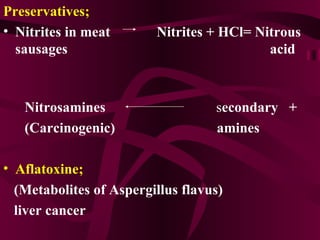
Preservatives; Nitrites in meat   Nitrites + HCl=   Nitrous  sausages      acid   Nitrosamines   s econdary  + (Carcinogenic)   amines  Aflatoxine; (Metabolites of Aspergillus flavus)  liver cancer
Bladder cancer in rubber industry workers   Liver  -naphtylamine   1 hydroxy 2 naphtylamine    Conjugate with        Glucuronic Acid Doges/ humans secretion of Glucuronidase in the bladder   Glucuronide Excrete in urine   The example of remote carcinogenesis
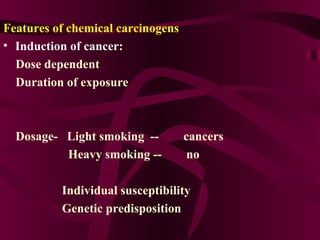
Features of chemical carcinogens Induction of cancer: Dose dependent  Duration of exposure Dosage-  Light smoking  --  cancers  Heavy smoking --  no  Individual susceptibility  Genetic predisposition
Chemical carcinogenesis involves two  distinct but sequential effects on cells.   Initiation  Promotion
Initiation and promotion;   Skin of mice:   (Compete Carcinogen) Methylcholanthrene   long time   Cancer Croton oil (Promoter/co-carcinogens)
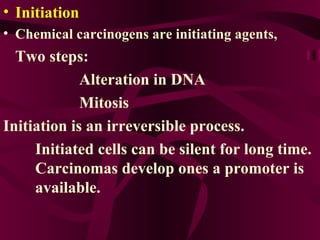
Initiation  Chemical carcinogens are initiating agents,  Two steps:  Alteration in DNA Mitosis  Initiation is an irreversible process. Initiated cells can be silent for long time.  Carcinomas develop ones a promoter is  available.
Promotion: The steps involved in this is not known. Selective proliferation of initiated cells. Nonspecific  Slow acting.  Reversible at least at the beginning .

Cancer 111

  • 1.
  • 2.
  • 3.
    Introduction Development andprogression of malignancies is a multi-step process involving number of genetic changes over a period of time as a result of continuous exposure to chemical physical viral or any other carcinogenic agent.
  • 4.
    Risk factors for a cancer Age Genetic factors. Geographical Racial factors Environmental factors.
  • 5.
    The possible causativeagents of carcinogenesis Chemical carcinogens Physical carcinogens Viruses Hereditary factors Hormones Cancers associated with chronic diseases
  • 6.
    Physical agents Ionizingradiation: UV radiation
  • 7.
    What happens whenexposed Radiation causes its effect by transferring energy to the substance through which it passes Result may be: Ionization Change in the energy state of the electrons or charged molecules.
  • 8.
    Physical agents Ionizingradiation: X rays ,  ,  and  rays These agents injure the cells through which it pass by dislodging ions from water and other molecules– Formation of free radicals. React with DNA nucleic acids, proteins,and other molecules. DNA damages may be; Point mutation (Changes in single bases) Breaks in the DNA double strand (wrong reunion)
  • 9.
    Lethal doses -Immediate cell death Sub lethal doses - Permanent damage in DNA. Malignant transformation. Effect of the radiation on different tissues depends on the Nature of the tissues (Bone) Type of radiation (Determined the depth of penetration)
  • 10.
    Evidence to showeffects of ionized radiation Nuclear weapons testing; Radio strontium Hiroshima and Nagasaki (1945) - leukaemias & other cancers Dial painters (Osteosarcomas). Radiologists
  • 11.
    UV light: Farmerswith fair skin who have no melanin protection. (Solar keratosis) lip cancers, Squamous cell carcinomas Basel cell carcinomas Malignant melanomas Mechanism; Dimmer formation between bases E.g.:Thymidine bases in the DNA. (Dimer causes mutation in DNA replication) Xeroderma Pigmentosum: Lack of enzyme involved in the repair mechanism of damaged DNA.
  • 12.
    Hormones Relationship betweenneoplasia and hormones is complex.
  • 13.
    Animal experiments toshow hormonal involvement in carcinogenesis: Mice: High cancer strains oestregen Breast cancers Low cancer strains oestregen Hyperplasia Mice or rats. Two ovaries were removed and one implanted in the spleen to stop the feed back inhibition of pituitary. (result is occasional ovarian tumours) Mice or rats Low I, diet and thiouracil Reduce thyroxin formation (no feed back effect) Result is thyroid hyperplasia/ademoma/carcinomas
  • 14.
    However evidence ofhormonal involvement in human tumours are rare. But association of hormones in tumours in man have been shown Granular cell OESTROGEN tumour of the ovary Endometrial Endometrial hyperplasia Carcinoma Artificial sex Oestrogen Enlargement of change Breast Carcinoma Hyperplasia
  • 15.
    Hormone dependency ; Even though the role of hormones in the aetiology of tumours is not clear, it is clear that hormones are important in maintaining of some tumours. Administration Progress the growth Deprival Regress the tumour eg; prostate 30% Breast tumours, are hormone dependent Later hormonal dependent Independent.
  • 16.
    Hereditary predisposition ;Cancer of the breast Cancer families Hereditary diseases; Polyposis coli: Autosomal dominant Retinoblastoma Xeroderma pigmentation
  • 17.
    Virus and cancerEllerman and Band (1908) Chicken Cell free extract Erythroid leukaemia
  • 18.
    Rous (1911) Chicken Cell free extract Sarcoma of sarcoma Bittner(1936): Foster mothers from cancer free strains New bone mice with cancer susceptible strains New bone mice from cancer free strains Foster mothers from cancer strains
  • 19.
    Both RNA andDNA viruses have been shown to be capable of causing cancers in various vertebrate species including man. Integrate there genetic material into the DNA of the host cell.
  • 20.
    EBV: Africans Burkitt’slymphomas Nasopharyngeal carcinomas. 98% of the tumour cells show EBV genom High antibody levels in the serum. Human papilloma virus. Type 5.6,11 papillomas Type 16 & 18 involved in cervical carcinomas. Hepatitis B: Hepatocellular carcinoma.
  • 21.
    CHEMICAL CARCINOGENESIS Epidemiologicalevidence shows that there is a large number of chemicals with carcinogenic properties Eg Industrial cancers (Occupational cancers); Result of prolong exposure to chemical carcinogens. Scrotal cancers - Chimney sweepers (Percival Pott in 1775) Skin cancers - Tar workers Bladder cancers - Aniline die workers (1895) Liver angiosarcomas - PVC factory workers Lung cancers - Asbestos workers
  • 22.
    Experimental evidence forchemical carcinogens 1917 (Yamagiwa and Itchikawa) Coal tar application in rabbit skins Polycyclic hydrocarbons ; Dibenzanthracene Methyl cholanthrene Benzpyrene (carcinogens) It has been shown that most of the Poly cyclic hydrocarbons, Aromatic amines Nitrosamines, aflatoxins are carcinogenic. mineral oils/fuels, atmosphere of industrialized cities
  • 23.
    Action of chemicalcarcinogens Direct acting carcinogens: Need no activation Electrophilic form Weak carcinogens Procarcinogens: Poly cyclic hydrocarbons, Aromatic amines Nitrosamines, Aflatoxins
  • 24.
    How do chemicalcarcinogens including poly cyclic hydocarbons act. Procarcinogens Ultimate carcinogens (Carcinogen compo) ( Ultimate carcinogens ) Positively charged Negatively charged electrophilic reactants proteins & N acids ++++ - - - - (Elec dense) Insertion of a reactant between bases of the DNA leads to alter the base pair (mutations). Hydroxylation
  • 25.
    Benzidine and derivatives; Used in Laboratories (Occult blood) /Industries Induce bladder cancers Dimethylaminoazobenzene (Butter yellow); Induced liver cancers (Hepatomas ) Asbestos (silicates); Malignant Mesotheliomas of the pleura Bronchial carcinomas PVC (v c monomer); Haemangiosarcoma in the liver Habits; Betel/smoking(Oral/Lung)
  • 26.
    Preservatives; Nitrites inmeat Nitrites + HCl= Nitrous sausages acid Nitrosamines s econdary + (Carcinogenic) amines Aflatoxine; (Metabolites of Aspergillus flavus) liver cancer
  • 27.
    Bladder cancer inrubber industry workers Liver  -naphtylamine 1 hydroxy 2 naphtylamine Conjugate with Glucuronic Acid Doges/ humans secretion of Glucuronidase in the bladder Glucuronide Excrete in urine The example of remote carcinogenesis
  • 28.
    Features of chemicalcarcinogens Induction of cancer: Dose dependent Duration of exposure Dosage- Light smoking -- cancers Heavy smoking -- no Individual susceptibility Genetic predisposition
  • 29.
    Chemical carcinogenesis involvestwo distinct but sequential effects on cells. Initiation Promotion
  • 30.
    Initiation and promotion; Skin of mice: (Compete Carcinogen) Methylcholanthrene long time Cancer Croton oil (Promoter/co-carcinogens)
  • 31.
    Initiation Chemicalcarcinogens are initiating agents, Two steps: Alteration in DNA Mitosis Initiation is an irreversible process. Initiated cells can be silent for long time. Carcinomas develop ones a promoter is available.
  • 32.
    Promotion: The stepsinvolved in this is not known. Selective proliferation of initiated cells. Nonspecific Slow acting. Reversible at least at the beginning .