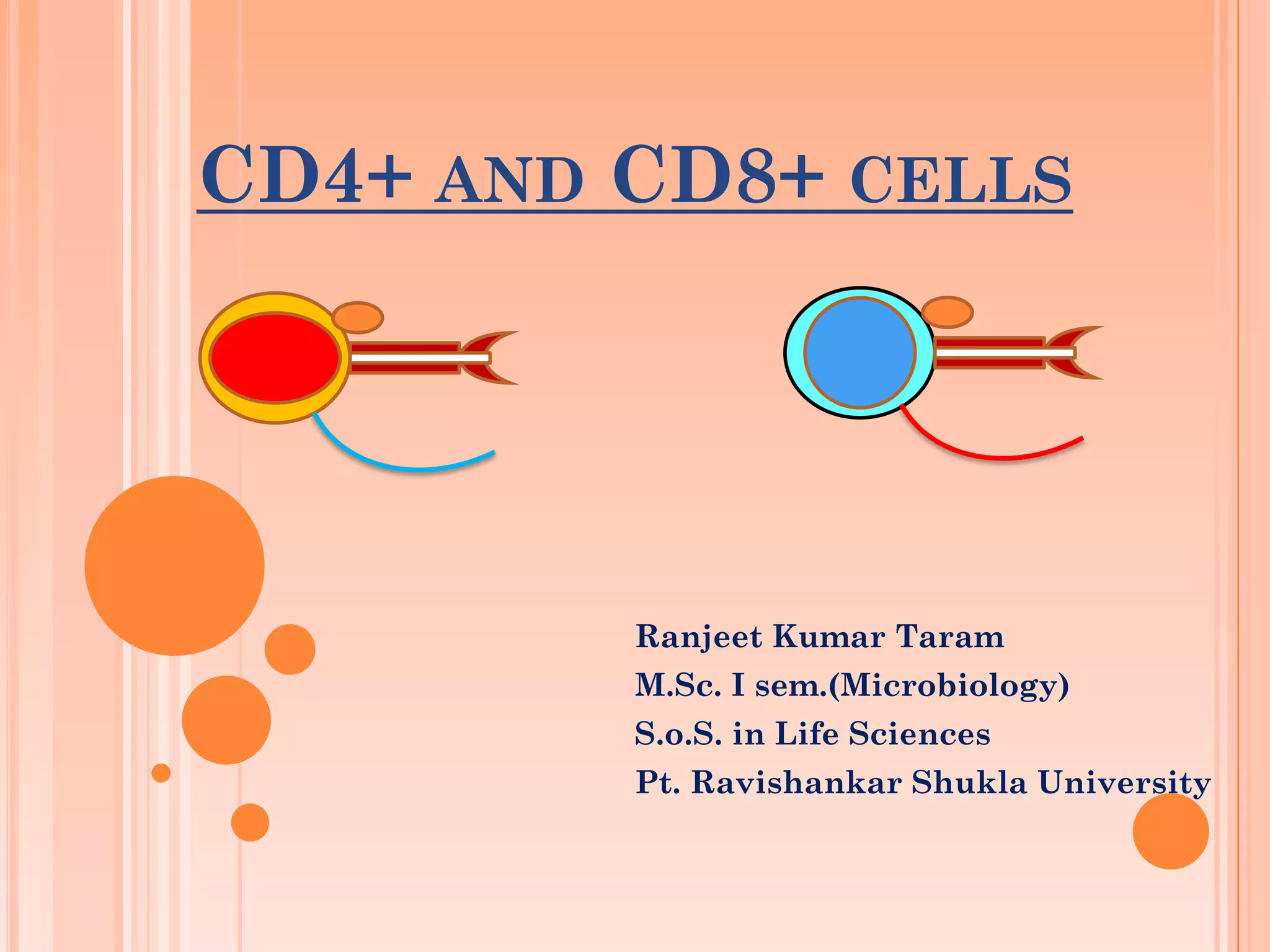
CD4+ AND CD8+ CELLS
Ranjeet Kumar Taram
M.Sc. I sem.(Microbiology)
S.o.S. in Life Sciences
Pt. Ravishankar Shukla University
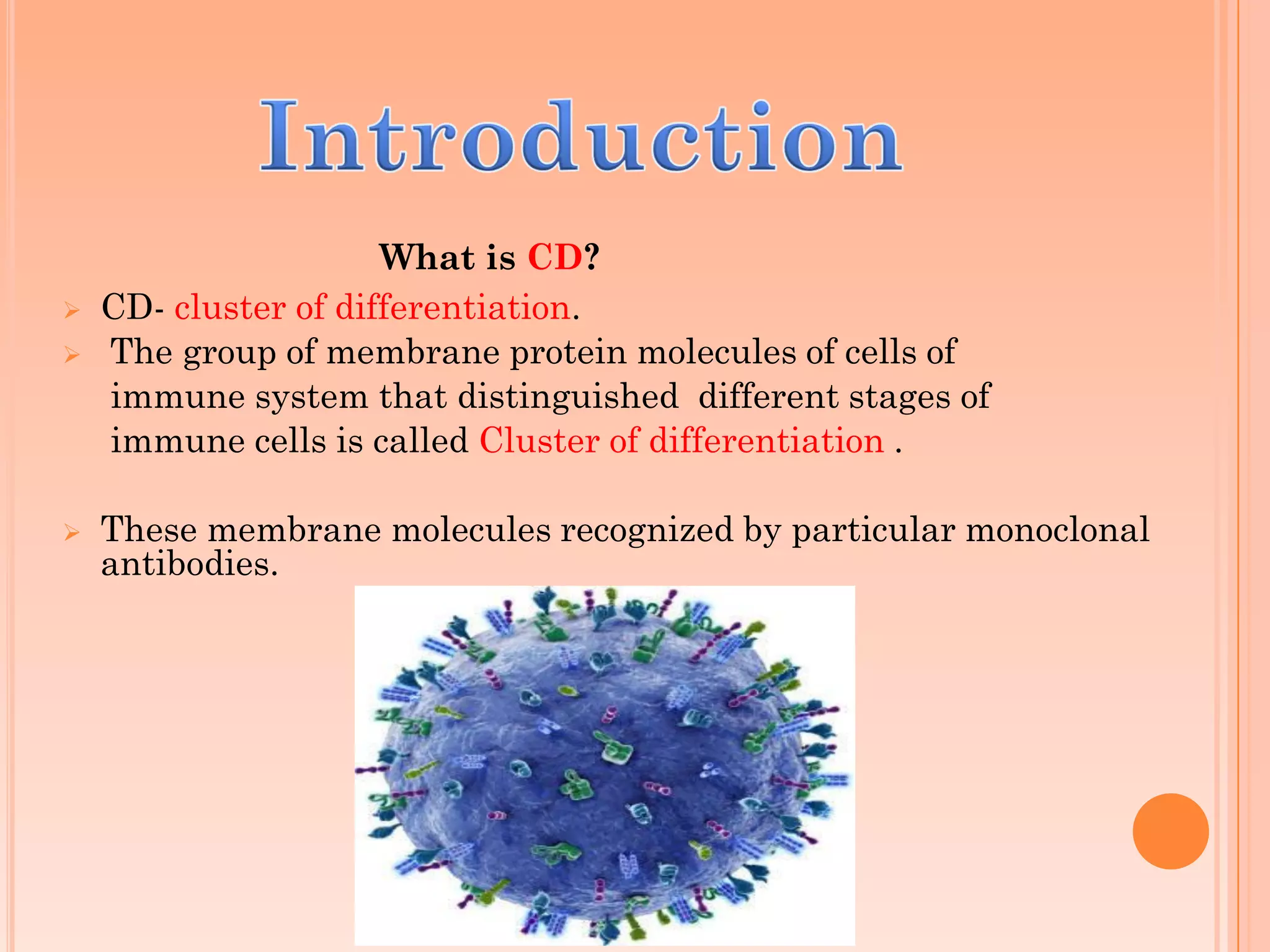
 CD- cluster of differentiation.
 The group of membrane protein molecules of cells of
immune system that distinguished different stages of
immune cells is called Cluster of differentiation .
 These membrane molecules recognized by particular monoclonal
antibodies.
What is CD?
 The CD nomenclature was proposed and
established in the 1st international workshop and
conference on Human Leukocyte
Differentiation Antigens (HLDA) which was
held in Paris in 1982. This system was intended
for the classification of the many monoclonal
antibodies generated by different laboratories
around the against epitopes on the surface
molecules of Leukocytes.
 The number reflect the order in which the cell
surface marker was discovered. At present CD
marker range CD1 to CD371 .
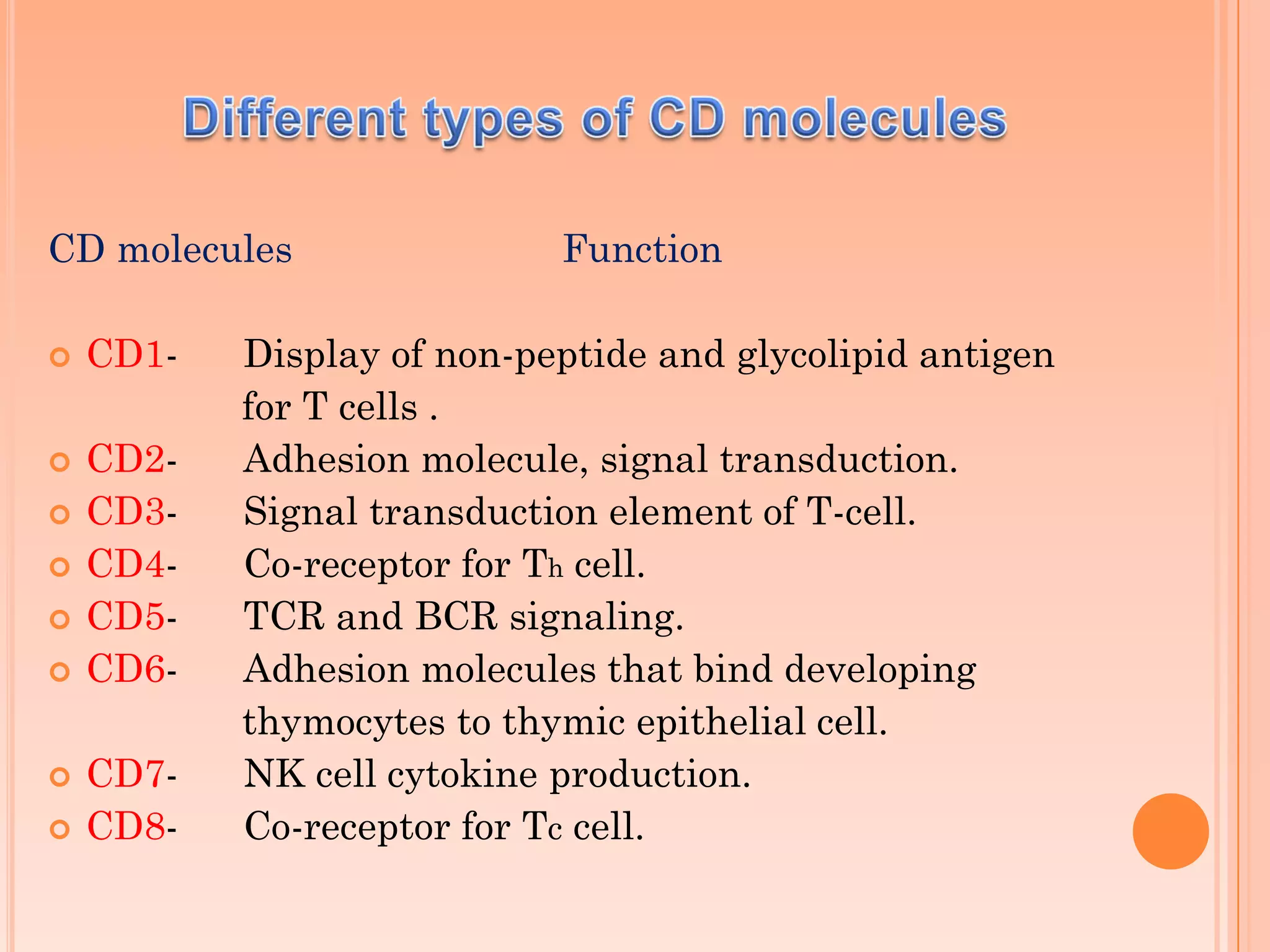
CD molecules Function
 CD1- Display of non-peptide and glycolipid antigen
for T cells .
 CD2- Adhesion molecule, signal transduction.
 CD3- Signal transduction element of T-cell.
 CD4- Co-receptor for Th cell.
 CD5- TCR and BCR signaling.
 CD6- Adhesion molecules that bind developing
thymocytes to thymic epithelial cell.
 CD7- NK cell cytokine production.
 CD8- Co-receptor for Tc cell.
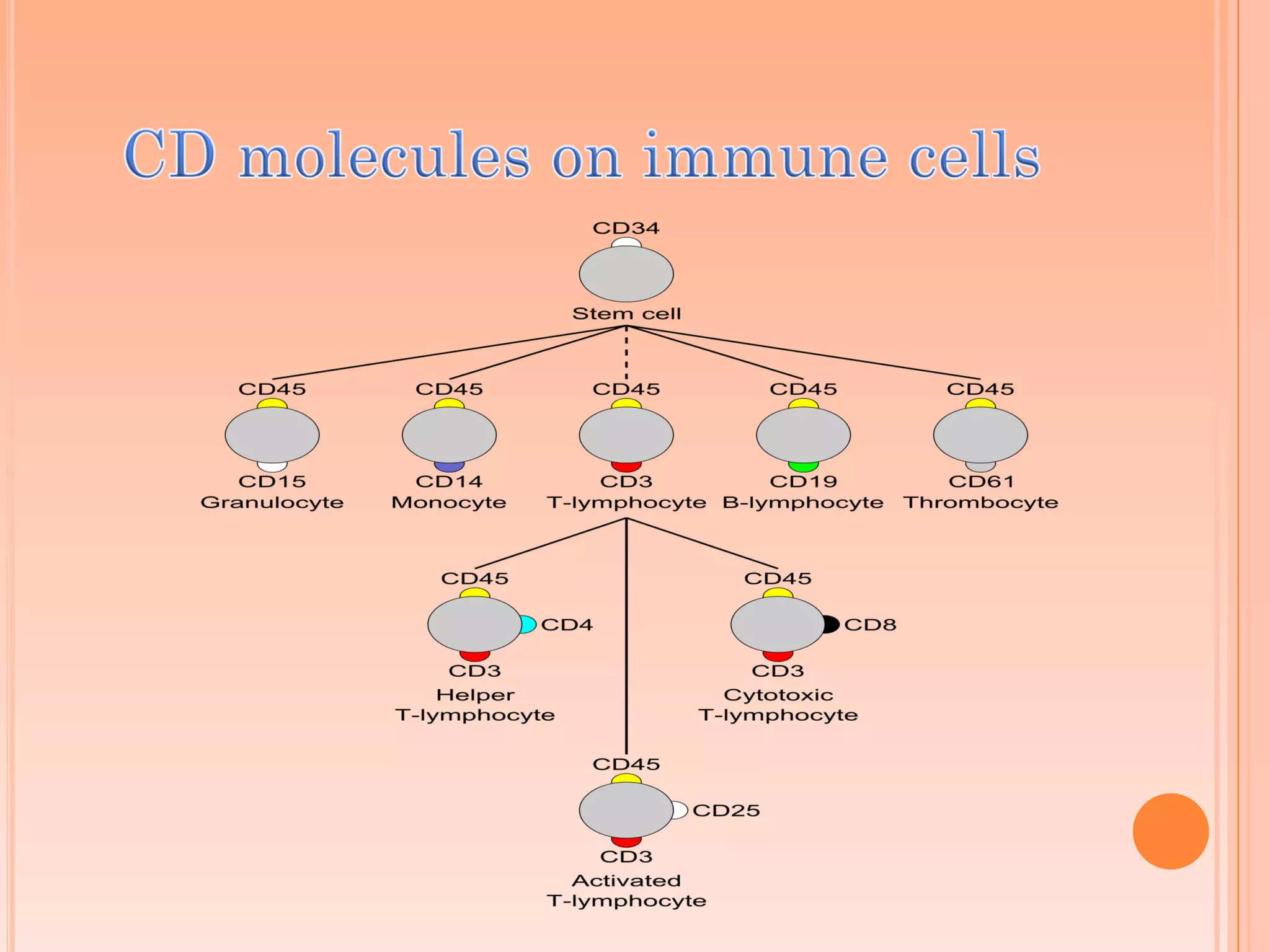
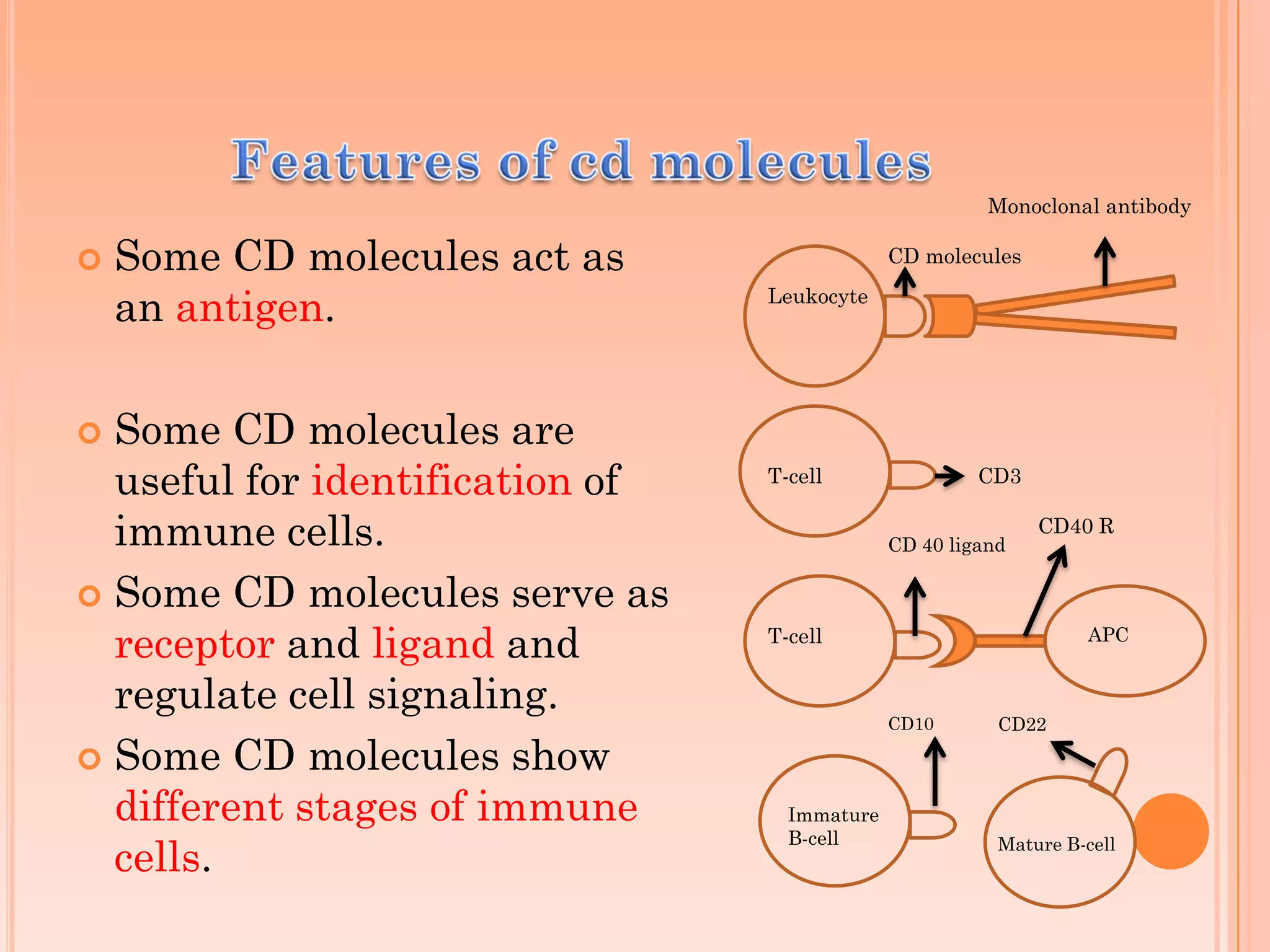
 Some CD molecules act as
an antigen.
 Some CD molecules are
useful for identification of
immune cells.
 Some CD molecules serve as
receptor and ligand and
regulate cell signaling.
 Some CD molecules show
different stages of immune
cells.
Monoclonal antibody
Leukocyte
CD molecules
T-cell CD3
T-cell
CD 40 ligand
CD40 R
APC
Immature
B-cell
CD10
Mature B-cell
CD22
 CD4 – A transmembrane glycoprotein molecules that
serve as a co-receptor on MHC class II restricted T cell.
 CD8- A transmembrane glycoprotein molecules that
serve as a co-receptor on MHC class I restricted T cell.
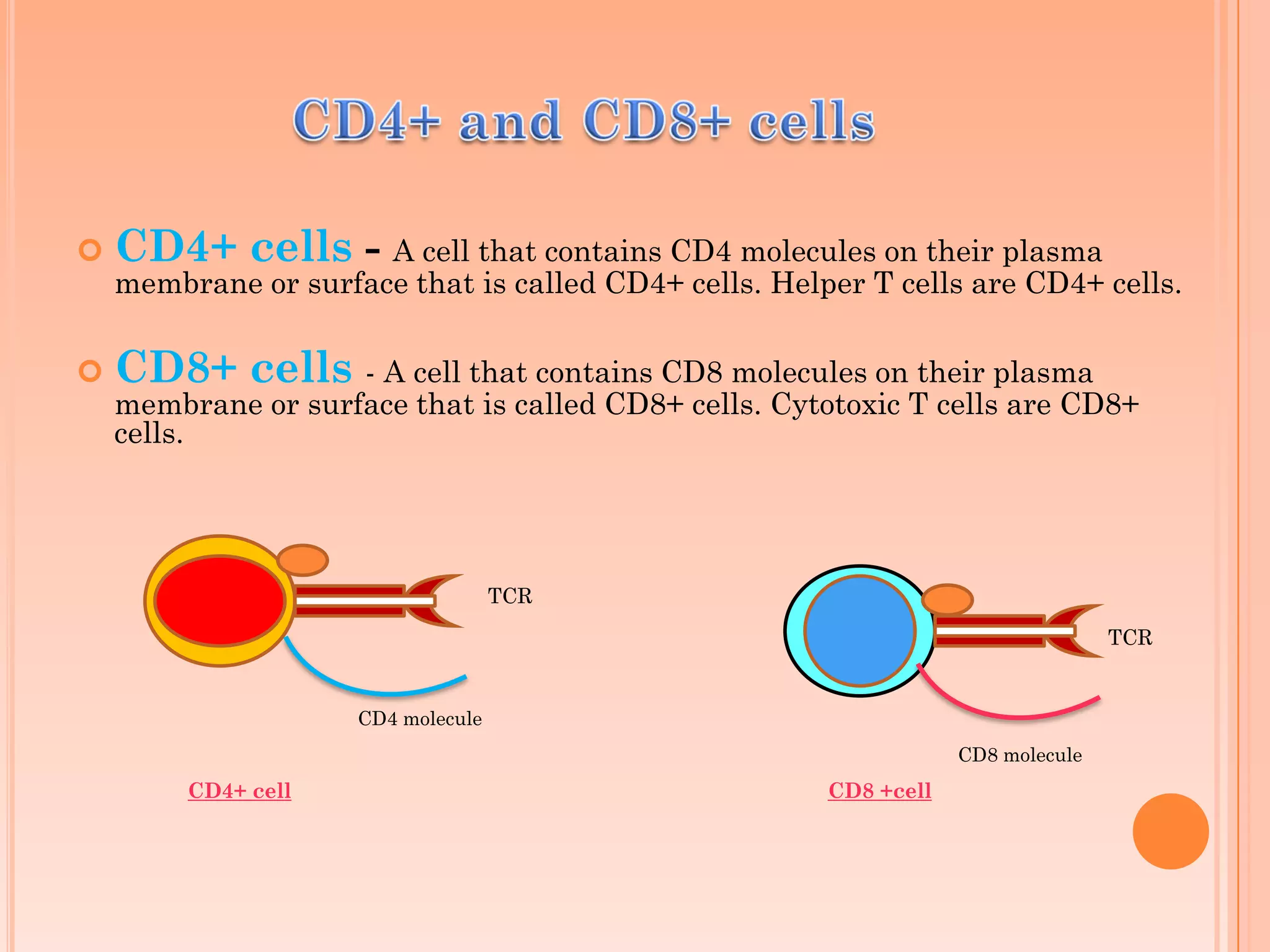
 CD4+ cells - A cell that contains CD4 molecules on their plasma
membrane or surface that is called CD4+ cells. Helper T cells are CD4+ cells.
 CD8+ cells - A cell that contains CD8 molecules on their plasma
membrane or surface that is called CD8+ cells. Cytotoxic T cells are CD8+
cells.
TCR
TCR
CD4+ cell CD8 +cell
CD4 molecule
CD8 molecule
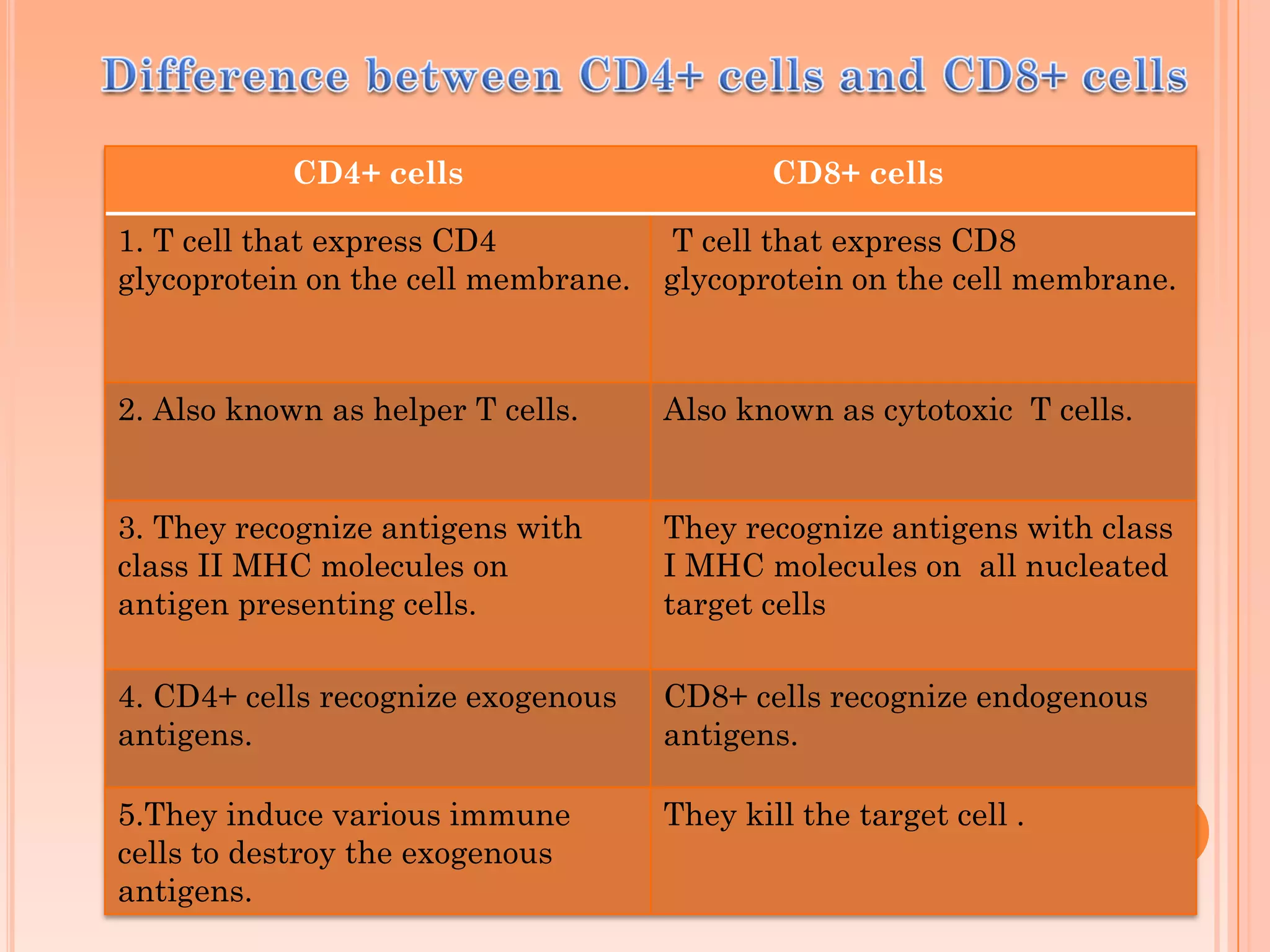
CD4+ cells CD8+ cells
1. T cell that express CD4
glycoprotein on the cell membrane.
T cell that express CD8
glycoprotein on the cell membrane.
2. Also known as helper T cells. Also known as cytotoxic T cells.
3. They recognize antigens with
class II MHC molecules on
antigen presenting cells.
They recognize antigens with class
I MHC molecules on all nucleated
target cells
4. CD4+ cells recognize exogenous
antigens.
CD8+ cells recognize endogenous
antigens.
5.They induce various immune
cells to destroy the exogenous
antigens.
They kill the target cell .
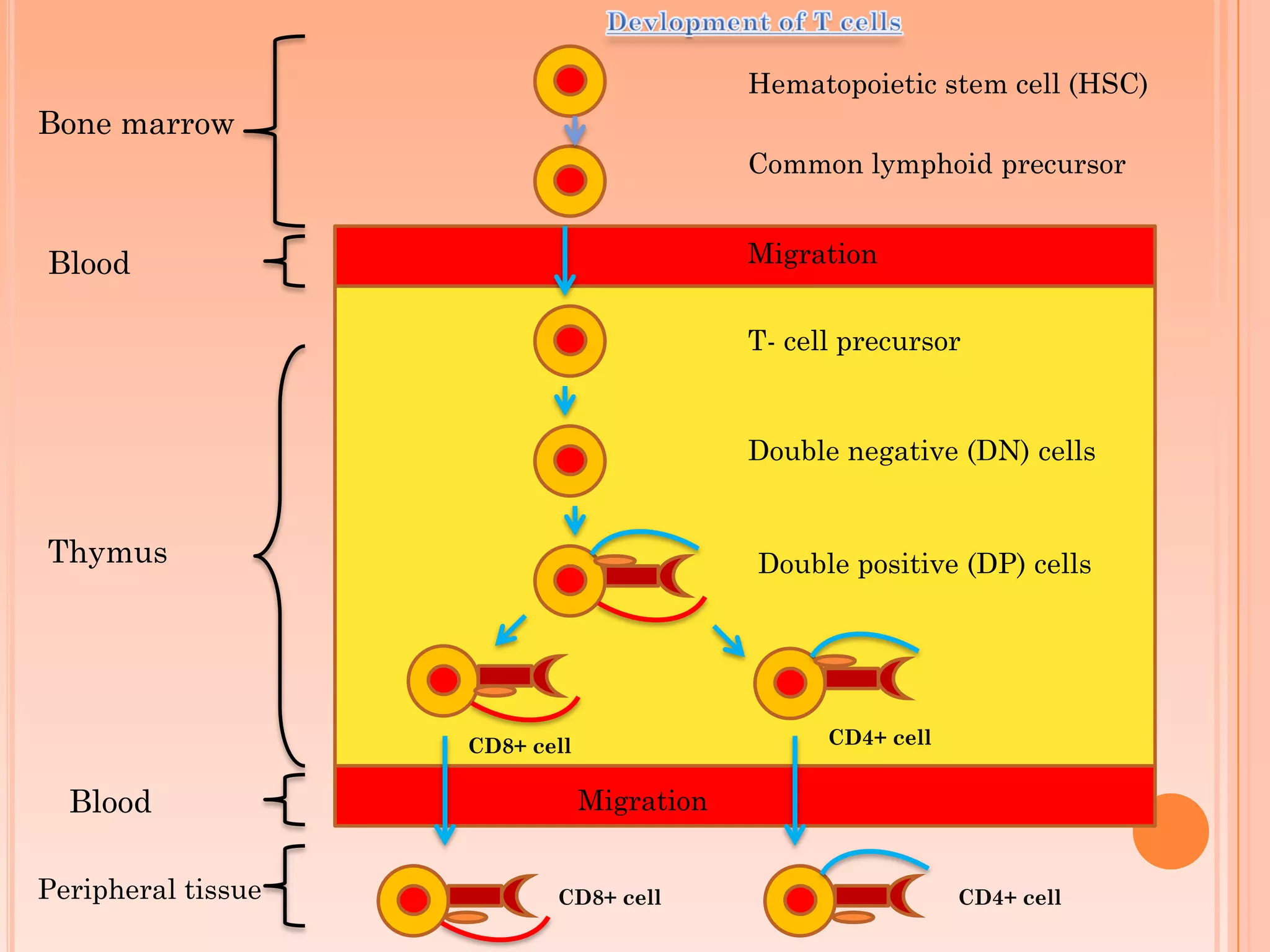
Hematopoietic stem cell (HSC)
Common lymphoid precursor
Bone marrow
T- cell precursor
Double negative (DN) cells
Double positive (DP) cells
Blood
Blood
Thymus
Migration
Migration
CD8+ cell
CD8+ cell
CD4+ cell
CD4+ cellPeripheral tissue
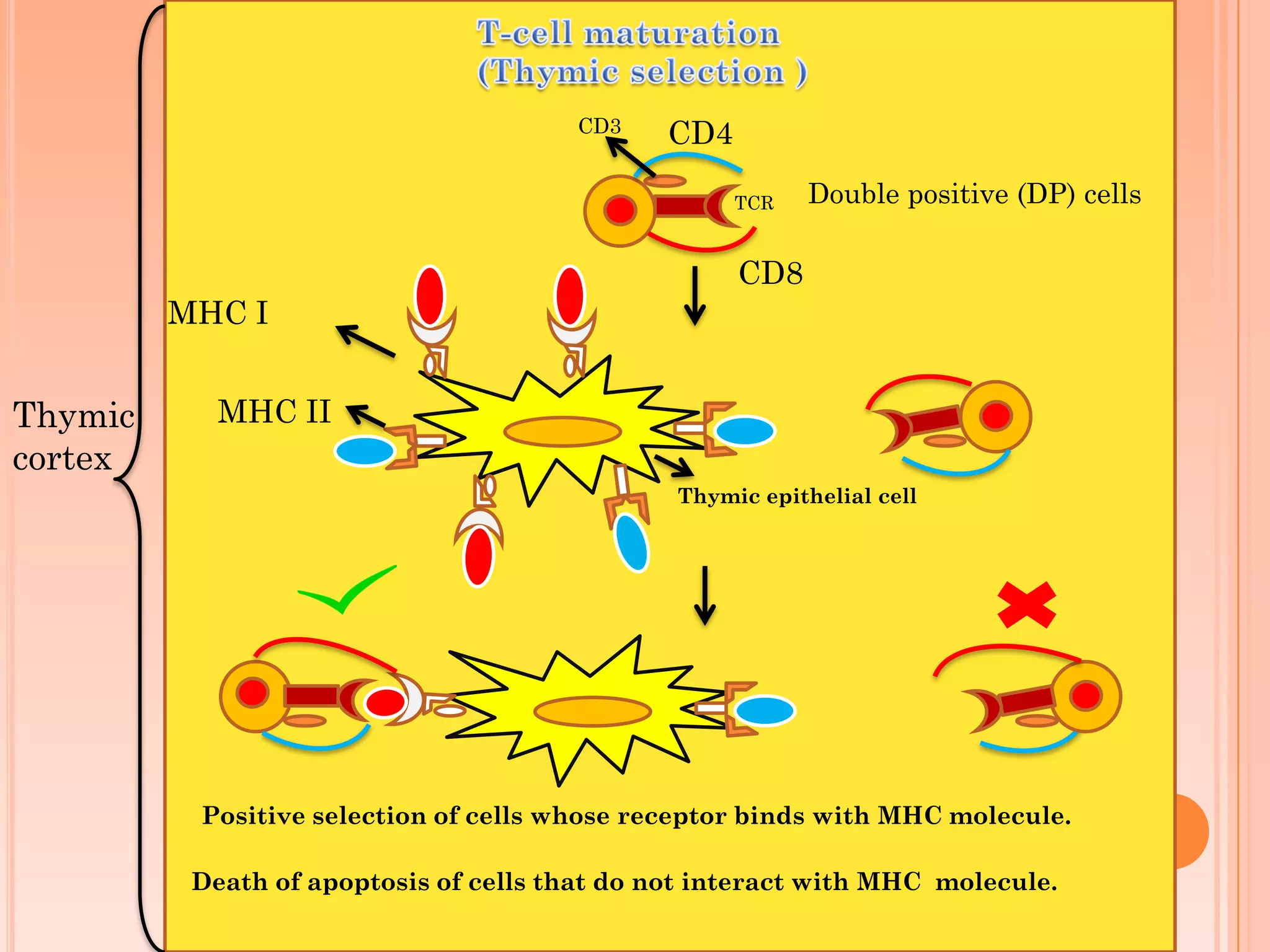
Double positive (DP) cells
CD8
CD4
TCR
CD3
MHC I
MHC II
Death of apoptosis of cells that do not interact with MHC molecule.
Thymic
cortex
Thymic epithelial cell
Positive selection of cells whose receptor binds with MHC molecule.
Negative selection and death of cells with high affinity receptors
for self MHC or self MHC + self antigen. Negative selection
ensures self – tolerance.
Thymic
cortex
Mature CD4+ and CD8+ cells
Dendritic cells/Macrophages
Naive T - cell
APC / Target cells
Memory cells Effectors cells
G1
s
G2
M
TCR
CD4/ CD8
CD28 CD80/CD86
MHC I / MHCII
IL-2
IL-2R
CD3
CD28
CD80/CD86
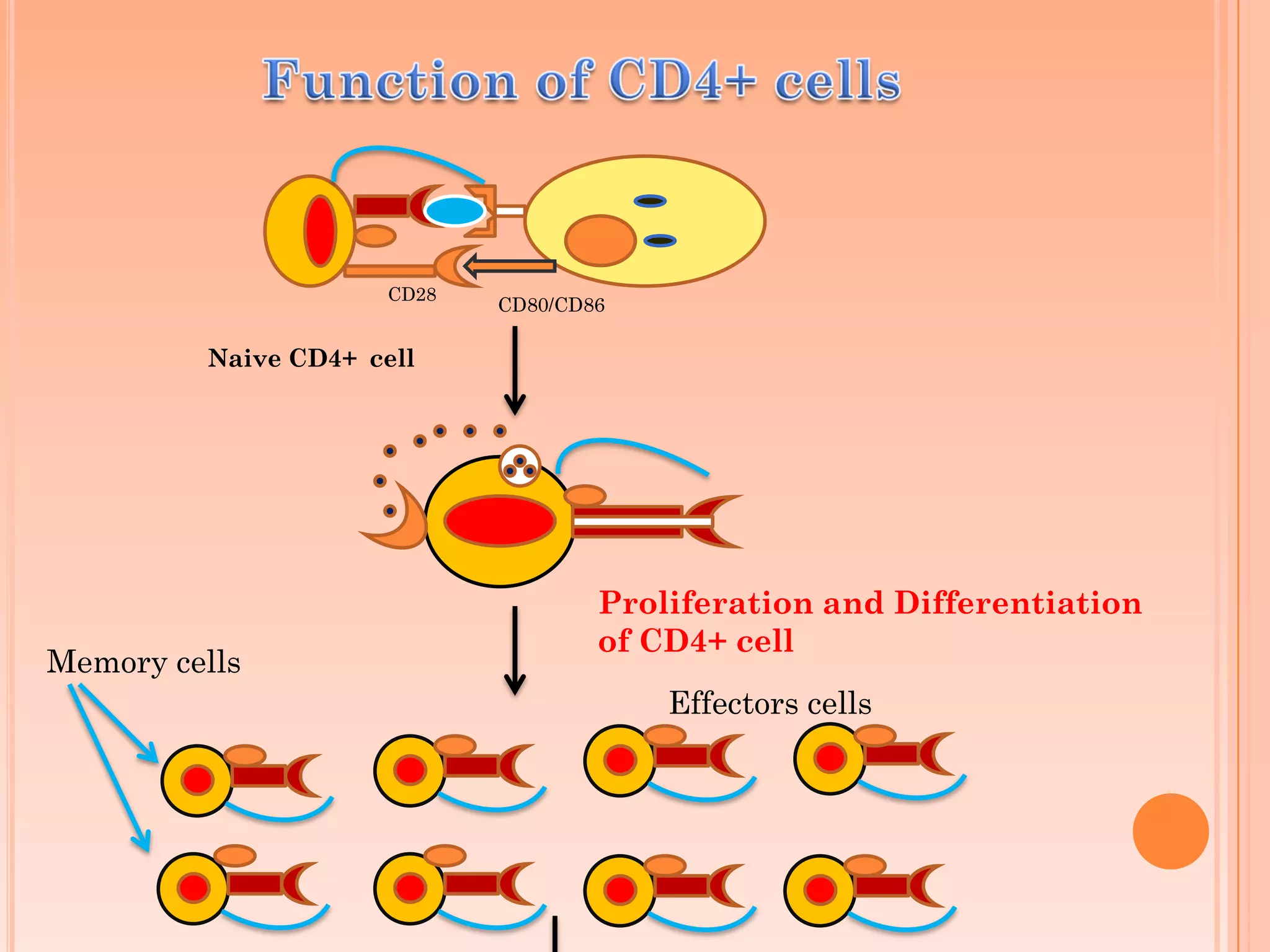
Naive CD4+ cell
Memory cells
Effectors cells
Proliferation and Differentiation
of CD4+ cell
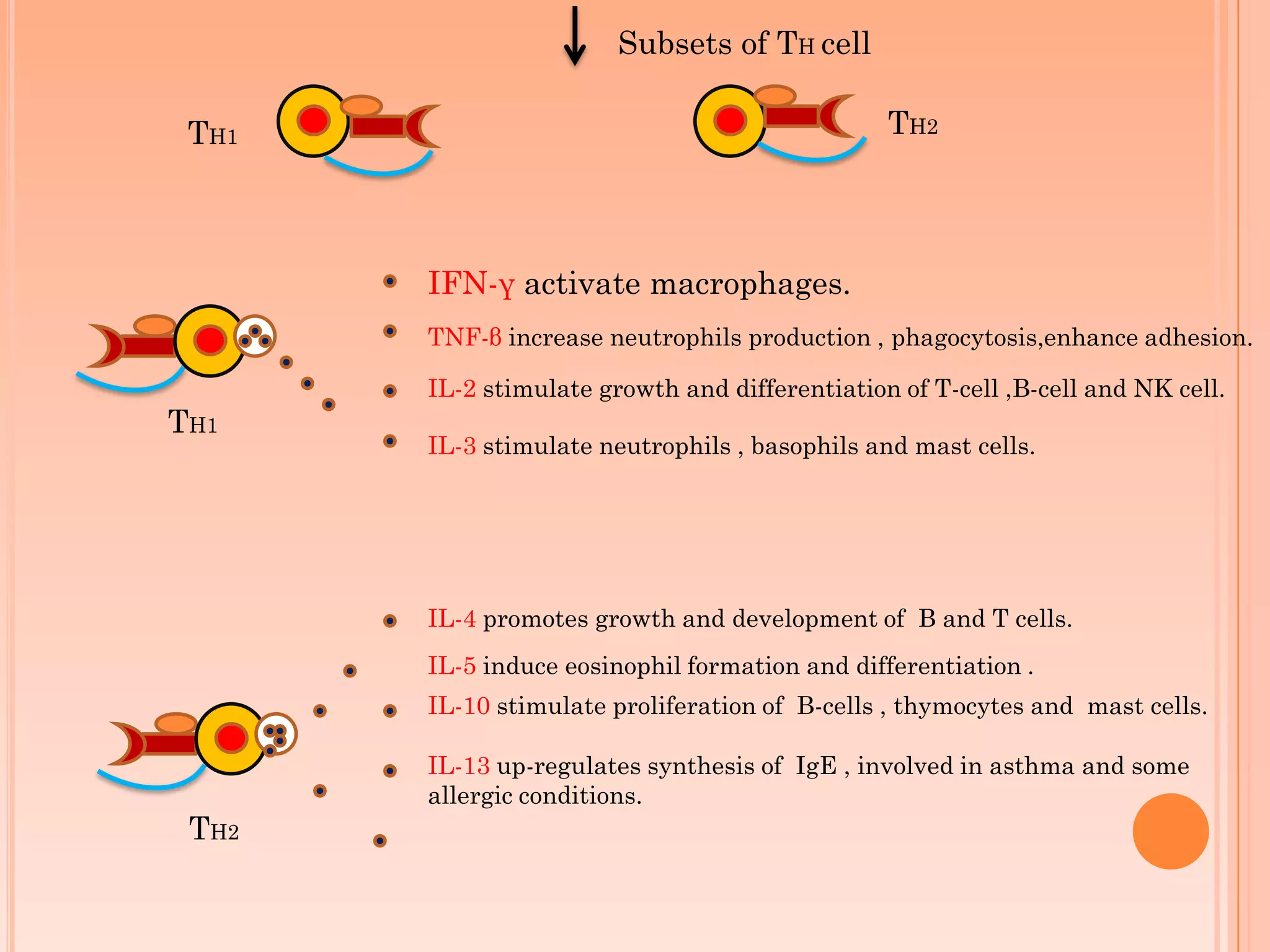
Subsets of TH cell
TH1 TH2
IFN-γ activate macrophages.
TNF-β increase neutrophils production , phagocytosis,enhance adhesion.
IL-2 stimulate growth and differentiation of T-cell ,B-cell and NK cell.
IL-3 stimulate neutrophils , basophils and mast cells.
TH1
IL-4 promotes growth and development of B and T cells.
IL-5 induce eosinophil formation and differentiation .
IL-10 stimulate proliferation of B-cells , thymocytes and mast cells.
IL-13 up-regulates synthesis of IgE , involved in asthma and some
allergic conditions.
TH2
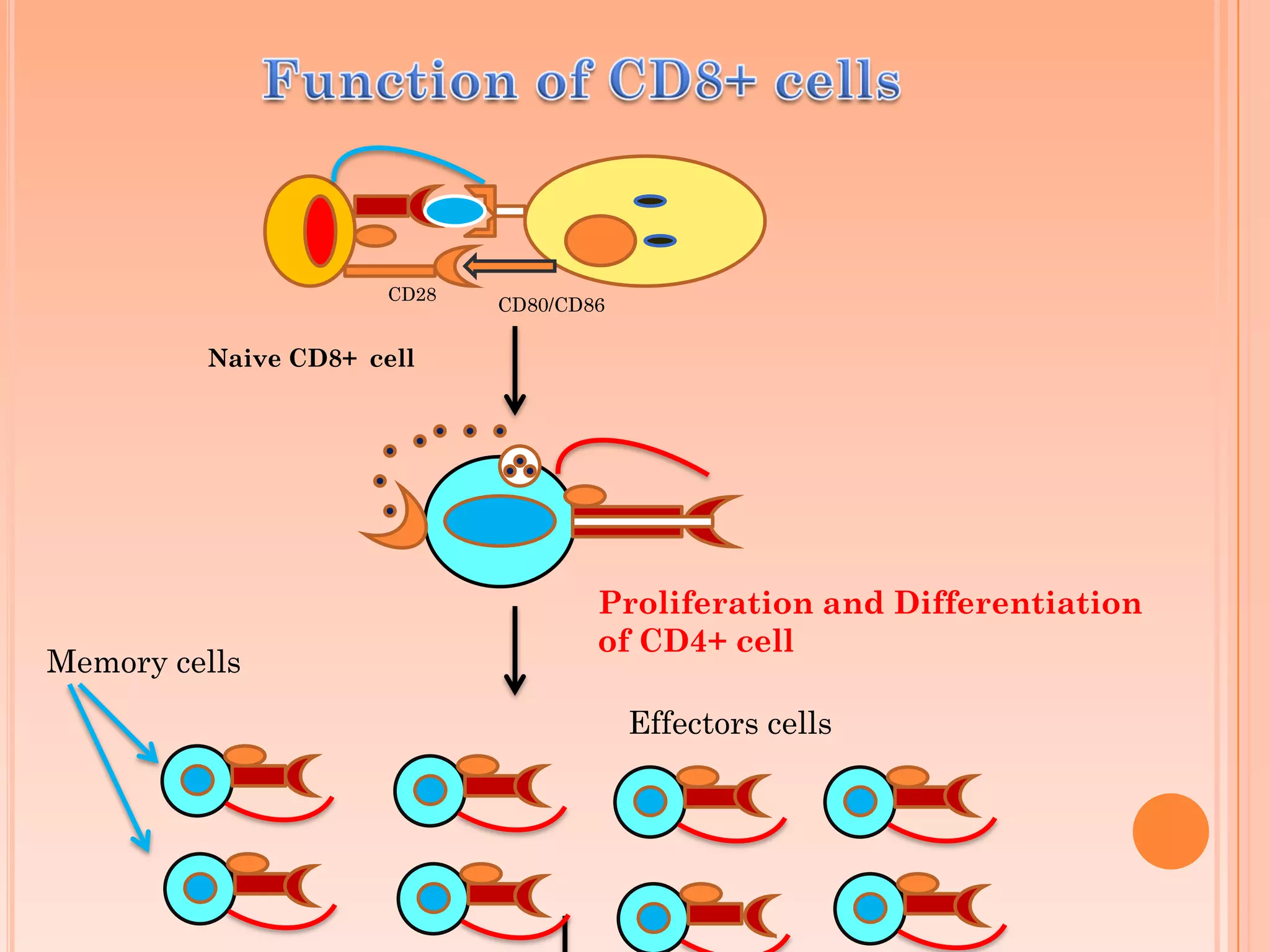
CD28
CD80/CD86
Naive CD8+ cell
Memory cells
Effectors cells
Proliferation and Differentiation
of CD4+ cell
CTL secrete pore forming protein perforin and several serine protease called
granzymes.
Perforin make pores on the surface of target cell .Once granzymes enter the
cytoplasm of the target cell ,it initiates a cascade of reactions that result in the
fragmentation of the target- cell DNA into oligomers of 200 bp; this type of DNA
fragmentation is typical of apoptosis.
 A normal CD4/CD8 ratio is 2:1.
 In normal body:-
CD4 lymphocyte > 400 cells/mm³
CD8 lymphocyte - 200-800 cells/mm³
 If someone has HIV his CD4 cell count may be low.
 If our CD4/CD8 ratio is less than 1,we may have
HIV
Bone marrow problems
Anemia
Chronic disease
Only CD4/CD8 ratio is not enough for diagnosis of HIV . Health
adviser may also suggest other tests to help diagnose HIV these
include:-
HIV Test
Complete blood count
 Kindt, Goldsby. "Osborne." Kuby IMMUNOLOGY
Sixth Edition, FREMMAN (2007).
 http://myelomacinderella.net/2013/04/clusters-of-
differentiation-cd-or-immunophenotyping/
Cd4 and cd8 cells by RK

Cd4 and cd8 cells by RK

  • 1.
    CD4+ AND CD8+CELLS Ranjeet Kumar Taram M.Sc. I sem.(Microbiology) S.o.S. in Life Sciences Pt. Ravishankar Shukla University
  • 2.
     CD- clusterof differentiation.  The group of membrane protein molecules of cells of immune system that distinguished different stages of immune cells is called Cluster of differentiation .  These membrane molecules recognized by particular monoclonal antibodies. What is CD?
  • 4.
     The CDnomenclature was proposed and established in the 1st international workshop and conference on Human Leukocyte Differentiation Antigens (HLDA) which was held in Paris in 1982. This system was intended for the classification of the many monoclonal antibodies generated by different laboratories around the against epitopes on the surface molecules of Leukocytes.  The number reflect the order in which the cell surface marker was discovered. At present CD marker range CD1 to CD371 .
  • 5.
    CD molecules Function CD1- Display of non-peptide and glycolipid antigen for T cells .  CD2- Adhesion molecule, signal transduction.  CD3- Signal transduction element of T-cell.  CD4- Co-receptor for Th cell.  CD5- TCR and BCR signaling.  CD6- Adhesion molecules that bind developing thymocytes to thymic epithelial cell.  CD7- NK cell cytokine production.  CD8- Co-receptor for Tc cell.
  • 6.
     Some CDmolecules act as an antigen.  Some CD molecules are useful for identification of immune cells.  Some CD molecules serve as receptor and ligand and regulate cell signaling.  Some CD molecules show different stages of immune cells. Monoclonal antibody Leukocyte CD molecules T-cell CD3 T-cell CD 40 ligand CD40 R APC Immature B-cell CD10 Mature B-cell CD22
  • 7.
     CD4 –A transmembrane glycoprotein molecules that serve as a co-receptor on MHC class II restricted T cell.  CD8- A transmembrane glycoprotein molecules that serve as a co-receptor on MHC class I restricted T cell.
  • 8.
     CD4+ cells- A cell that contains CD4 molecules on their plasma membrane or surface that is called CD4+ cells. Helper T cells are CD4+ cells.  CD8+ cells - A cell that contains CD8 molecules on their plasma membrane or surface that is called CD8+ cells. Cytotoxic T cells are CD8+ cells. TCR TCR CD4+ cell CD8 +cell CD4 molecule CD8 molecule
  • 9.
    CD4+ cells CD8+cells 1. T cell that express CD4 glycoprotein on the cell membrane. T cell that express CD8 glycoprotein on the cell membrane. 2. Also known as helper T cells. Also known as cytotoxic T cells. 3. They recognize antigens with class II MHC molecules on antigen presenting cells. They recognize antigens with class I MHC molecules on all nucleated target cells 4. CD4+ cells recognize exogenous antigens. CD8+ cells recognize endogenous antigens. 5.They induce various immune cells to destroy the exogenous antigens. They kill the target cell .
  • 11.
    Hematopoietic stem cell(HSC) Common lymphoid precursor Bone marrow T- cell precursor Double negative (DN) cells Double positive (DP) cells Blood Blood Thymus Migration Migration CD8+ cell CD8+ cell CD4+ cell CD4+ cellPeripheral tissue
  • 12.
    Double positive (DP)cells CD8 CD4 TCR CD3 MHC I MHC II Death of apoptosis of cells that do not interact with MHC molecule. Thymic cortex Thymic epithelial cell Positive selection of cells whose receptor binds with MHC molecule.
  • 13.
    Negative selection anddeath of cells with high affinity receptors for self MHC or self MHC + self antigen. Negative selection ensures self – tolerance. Thymic cortex Mature CD4+ and CD8+ cells Dendritic cells/Macrophages
  • 14.
    Naive T -cell APC / Target cells Memory cells Effectors cells G1 s G2 M TCR CD4/ CD8 CD28 CD80/CD86 MHC I / MHCII IL-2 IL-2R CD3
  • 15.
    CD28 CD80/CD86 Naive CD4+ cell Memorycells Effectors cells Proliferation and Differentiation of CD4+ cell
  • 16.
    Subsets of THcell TH1 TH2 IFN-γ activate macrophages. TNF-β increase neutrophils production , phagocytosis,enhance adhesion. IL-2 stimulate growth and differentiation of T-cell ,B-cell and NK cell. IL-3 stimulate neutrophils , basophils and mast cells. TH1 IL-4 promotes growth and development of B and T cells. IL-5 induce eosinophil formation and differentiation . IL-10 stimulate proliferation of B-cells , thymocytes and mast cells. IL-13 up-regulates synthesis of IgE , involved in asthma and some allergic conditions. TH2
  • 17.
    CD28 CD80/CD86 Naive CD8+ cell Memorycells Effectors cells Proliferation and Differentiation of CD4+ cell
  • 18.
    CTL secrete poreforming protein perforin and several serine protease called granzymes. Perforin make pores on the surface of target cell .Once granzymes enter the cytoplasm of the target cell ,it initiates a cascade of reactions that result in the fragmentation of the target- cell DNA into oligomers of 200 bp; this type of DNA fragmentation is typical of apoptosis.
  • 20.
     A normalCD4/CD8 ratio is 2:1.  In normal body:- CD4 lymphocyte > 400 cells/mm³ CD8 lymphocyte - 200-800 cells/mm³  If someone has HIV his CD4 cell count may be low.  If our CD4/CD8 ratio is less than 1,we may have HIV Bone marrow problems Anemia Chronic disease Only CD4/CD8 ratio is not enough for diagnosis of HIV . Health adviser may also suggest other tests to help diagnose HIV these include:- HIV Test Complete blood count
  • 21.
     Kindt, Goldsby."Osborne." Kuby IMMUNOLOGY Sixth Edition, FREMMAN (2007).  http://myelomacinderella.net/2013/04/clusters-of- differentiation-cd-or-immunophenotyping/