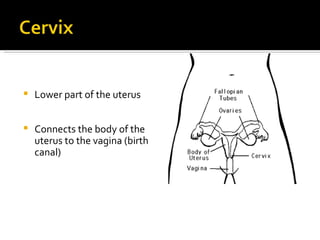
Lower part of the uterus Connects the body of the uterus to the vagina (birth canal)
Begins in the lining of the cervix Cells change from normal to pre-cancer (dysplasia) and then to cancer
Squamous cell Carcinomas Cancer of flat epithelial cell 80% to 90% Adenocarcinomas  Cancer arising from glandular epithelium 10% - 20% Mixed carcinoma   Features both types
10,520   new cases in the U.S. this year  3,900  will die 50%  are diagnosed between ages 35 and 55. 20%  at the age of 65 or over. Rarely occurs in women younger than 20 Noninvasive is four times more common 74%  decrease in deaths between 1955 and 1992 in the U.S. Death rate continuous to decline by  2%  a year
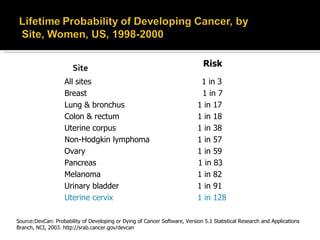
Site Risk All sites   1 in 3 Breast   1 in 7 Lung & bronchus     1 in 17 Colon & rectum   1 in 18 Uterine corpus   1 in 38 Non-Hodgkin lymphoma   1 in 57 Ovary   1 in 59 Pancreas   1 in 83  Melanoma    1 in 82 Urinary bladder   1 in 91 Uterine cervix   1 in 128  Source:DevCan: Probability of Developing or Dying of Cancer Software, Version 5.1 Statistical Research and Applications Branch, NCI, 2003. http://srab.cancer.gov/devcan
Vaginal bleeding Menstrual bleeding is longer and heavier than usual Bleeding after menopause or increased vaginal discharge Bleeding following intercourse or pelvic exam Pain during intercourse
Human papillomavirus infection (HPV) – Primary factor HPV 16, HPV 18, HPV 31, HPV 33, HPV 45 50% are caused by HPV 16 AND 18 Sexual behavior Smoking HIV infection Chlamydia infection Diet Oral contraceptives Multiple pregnancies Low socioeconomic status Diethylstilbestrol (DES) Family history
Avoiding the risk factors   Especially HPV Help for low-income women (NBCCEDP) Having the Pap Test 3 years after first vaginal intercourse or by age 21. Have test annually
Cervical Cytology (Pap Test) Cells are removed from the cervix and examined under the microscope. Can detect epithelial cell abnormalities Atypical squamous cells Squamous intraepithelial lesions Squamous cell carcinoma (likely to be invasive)
Additional testing Colposcopy Cervix is viewed through a colposcope and the surface of the cervix can be seen close and clear. Cervical Biopsies Colposcopic biopsy  – removal of small section of the abnormal area of the surface. Endocervical curettage  – removing some tissue lining from the endocervical canal. Cone biopsy   – cone-shaped piece of tissue is removed from the cervix
FIGO System  (International Federation Of Gynecology and Obstetrics) Has five stages – 0 to 4 Stage 0  Carcinoma in situ Stage 1  Invaded cervix, but has not spread. Stage 2  Has spread to nearby areas, not leaving pelvic area. Stage 3  Cancer has spread to the lower part of the vagina. Stage 4  Cancer has spread to nearby organs; metastasis.
5-year survival rate is 92% for earliest stage  71% for all stages combined
Surgery Preinvasive cervical cancer Cryosurgery Laser surgery Conization Invasive cervical cancer Simple hysterectomy Removal of the body of the uterus and cervix. Radical hysterectomy and pelvic lymph node dissection Removal of entire uterus, surrounding tissue, upper part of the vagina, and lymph nodes from the cervix. Radiation Chemotherapy
HPV test HPV vaccine Radical trachelectomy procedure Other clinical trials

Cervical cancer

  • 1.
  • 2.
    Lower part ofthe uterus Connects the body of the uterus to the vagina (birth canal)
  • 3.
    Begins in thelining of the cervix Cells change from normal to pre-cancer (dysplasia) and then to cancer
  • 4.
    Squamous cell CarcinomasCancer of flat epithelial cell 80% to 90% Adenocarcinomas Cancer arising from glandular epithelium 10% - 20% Mixed carcinoma Features both types
  • 5.
    10,520 new cases in the U.S. this year 3,900 will die 50% are diagnosed between ages 35 and 55. 20% at the age of 65 or over. Rarely occurs in women younger than 20 Noninvasive is four times more common 74% decrease in deaths between 1955 and 1992 in the U.S. Death rate continuous to decline by 2% a year
  • 6.
    Site Risk Allsites 1 in 3 Breast 1 in 7 Lung & bronchus 1 in 17 Colon & rectum 1 in 18 Uterine corpus 1 in 38 Non-Hodgkin lymphoma 1 in 57 Ovary 1 in 59 Pancreas 1 in 83 Melanoma 1 in 82 Urinary bladder 1 in 91 Uterine cervix 1 in 128 Source:DevCan: Probability of Developing or Dying of Cancer Software, Version 5.1 Statistical Research and Applications Branch, NCI, 2003. http://srab.cancer.gov/devcan
  • 7.
    Vaginal bleeding Menstrualbleeding is longer and heavier than usual Bleeding after menopause or increased vaginal discharge Bleeding following intercourse or pelvic exam Pain during intercourse
  • 8.
    Human papillomavirus infection(HPV) – Primary factor HPV 16, HPV 18, HPV 31, HPV 33, HPV 45 50% are caused by HPV 16 AND 18 Sexual behavior Smoking HIV infection Chlamydia infection Diet Oral contraceptives Multiple pregnancies Low socioeconomic status Diethylstilbestrol (DES) Family history
  • 9.
    Avoiding the riskfactors Especially HPV Help for low-income women (NBCCEDP) Having the Pap Test 3 years after first vaginal intercourse or by age 21. Have test annually
  • 10.
    Cervical Cytology (PapTest) Cells are removed from the cervix and examined under the microscope. Can detect epithelial cell abnormalities Atypical squamous cells Squamous intraepithelial lesions Squamous cell carcinoma (likely to be invasive)
  • 11.
    Additional testing ColposcopyCervix is viewed through a colposcope and the surface of the cervix can be seen close and clear. Cervical Biopsies Colposcopic biopsy – removal of small section of the abnormal area of the surface. Endocervical curettage – removing some tissue lining from the endocervical canal. Cone biopsy – cone-shaped piece of tissue is removed from the cervix
  • 12.
    FIGO System (International Federation Of Gynecology and Obstetrics) Has five stages – 0 to 4 Stage 0 Carcinoma in situ Stage 1 Invaded cervix, but has not spread. Stage 2 Has spread to nearby areas, not leaving pelvic area. Stage 3 Cancer has spread to the lower part of the vagina. Stage 4 Cancer has spread to nearby organs; metastasis.
  • 13.
    5-year survival rateis 92% for earliest stage 71% for all stages combined
  • 14.
    Surgery Preinvasive cervicalcancer Cryosurgery Laser surgery Conization Invasive cervical cancer Simple hysterectomy Removal of the body of the uterus and cervix. Radical hysterectomy and pelvic lymph node dissection Removal of entire uterus, surrounding tissue, upper part of the vagina, and lymph nodes from the cervix. Radiation Chemotherapy
  • 15.
    HPV test HPVvaccine Radical trachelectomy procedure Other clinical trials