Shobhita Katiyar
JULY 20, 2016
PID : distribution
Distribution of identified PIDs in ESID registry database
B cell development
Surface receptors on developing B cell
CD 19, CD21 and CD 81
Clinical cytometry society,2008
B cell development
J Clin Immunol 2015
B cell immunodeficiency: Warning signs
Question: Which is the most common antibody
produced in the body?
• IgG
• IgM
• IgA
• IgE
• IgD
Question: Which is the most common antibody
in circulation in the body?
• IgG
• IgM
• IgA
• IgE
• IgD
Agammaglobulinemias
Agammaglobulinemias
 First recognized human immune deficiency
 Discovered in 1952 by Colonel Ogden Bruton
 Case report : 8-year-old boy, recurrent infections over a 4-year period
- Majority of infections: pneumococcus
- Bruton attempted to vaccinate → no γ globulin was production
- Treated with monthly intramuscular injections of human γ globulin
with significant clinical improvement
- No family history
 Subsequent cases revealed a similar clinical phenotype with an X-
linked pedigree
Agammaglobulinemia.Pediatrics,1952, Clin Exp Immunol,2000.
Introduction
Epidemiology
 Incidence
Unknown because general population screening for the disorder is not done
(1/3 new mutation)
 Prevalence
1/10,000 in the general population
Variable (1/379,000 in USA, 1/100,000 in Norway)
Clinical and Molecular Allergy ,2008
Pathophysiology
 Cause : mutations in the human BTK gene – halts B cell development
 In 1993, two groups of investigators independently/simultaneously
discovered mutated gene in XLA.
European group called atk gene→ ammaglobulinemia tyrosine kinase
American group called bpk gene → B-cell pro-genitor kinase
 A compromise was reached with the term;
‘Btk (Bruton's tyrosine kinase)’ in honor of Dr. Bruton
Immunological Reviews 2005
Cell 1993
Btk in B cell signaling
Btk gene & protein
 Contains 19 exons → 37 kb of DNA
 Intracellular signal transduction molecule
- Member of Tec family ; 75 kDa cytoplasmic tyrosine kinase
National Library of Medicine,2012
 BTK protein consists of 5 functional domains
- Pleckstrin Homology (PH) domain
- Tec homology (TH) domain
- Src homology 3 (SH3) domain
- Src homology 2 (SH2) domain
- Catalytic kinase (SH1) domain
 Mutations in all domains of the BTK gene have been shown to cause
XLA.
protein-protein interactions
Catalytic activity
Journal of Hematology and Oncology, 2013
Question: Which cell population will you gate for
analyzing Btk expression in a suspected patient?
Btk expression in hematopoietic cells
Btk Mutation
 >600 different mutations in the BTK gene have been found
 90% : Single base pair substitution & insertion or deletion < 5 bp
 No clear correlation has been found between mutation location and
clinical phenotype.
 55% of males have no family history of XLA
- De novo causing mutation : 15%-20%
- Mother is a carrier of a disease-causing mutation : 80%-85%
 Female carriers of XLA can be identified by the presence of either;
- non-random X chromosome inactivation in their B cells or
- mutated gene (if known in the family)
National Library of Medicine,2012.
Clinical Manifestations
The Indian Journal of Pediatrics,2016
Diagnosis
 Family history
 Clinical manifestations
 Intermittent neutropenia can occur at the onset of an acute infection
 Low serum IgG, IgM and IgA level
 Peripheral blood CD19 B-cell counts < 2%
 Laboratory investigation by
 Prenatal diagnosis: detection of the mutated gene in chorionic villus
or amniocentesis samples
 Confirmation by demonstrating;
- absence of BTK protein in monocytes (flowcytometry)
- detection of a mutation in BTK in DNA (sequence analysis)
Flowcytometry
Btk expression in monocytes
Treatment
 Early diagnosis and treatment would improve the survival
 Intravenous immunoglobulin (IVIG) and antibiotic prophylaxis are
conventional treatments → increased survival rate
 Genetic counselling, carrier detection, and prenatal diagnosis
 Gene therapy
Blood, 2004
CVID
 Term coined in 1971 by WHO committee to separate less well
defined antibody deficiency syndrome from others
 Causes of CVID: largely obscure; no universally accepted definition
• A group of antibody deficiencies that lack a more specific genetic or
phenotypic classification
• Patients with antibody deficiency (no secondary causes for it)
lacking uniform genetic defect and clinical features
Epidemiology
 Prevalence 1 in 25,000 to 1 in 50,000
 Most patients are diagnosed between the ages of 20 and 40 years,
approximately 20% are under the age of 20
 Affects both sexes equally, boys > girls in children
Blood,2012
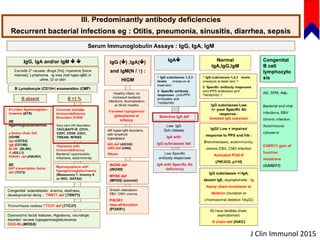
CVID: Diagnostic Criteria
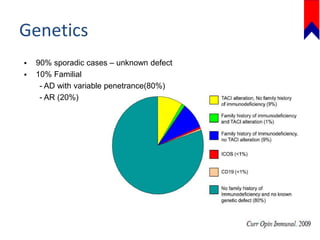
Genetics
 90% sporadic cases – unknown defect
 10% Familial
- AD with variable penetrance(80%)
- AR (20%)
CVID: genetic defects
Arthritis Research & Therapy 2012
British journal of Hematology,2009
Clinical manifestations
Blood,2008
Autoimmunity in CVID
 Others include
 Neutropenia
 Pernicious anaemia
 Anticardiolipin Ab
 Antiphospholipid syndrome
 Diabetes mellitus
 Juvenile Idiopathic Arthritis
 Uveitis
 Multiple sclerosis
 Systemic lupus erythematosus
 Autoimmune thyroid disease
 Lichen planus
 Vasculitis
 Vililago
American Society of Hematology,2012
• Q: An 8 year old boy p/w lower limb predominant arthritis of 4
m duration. It was not controlled with NSAIDs alone and was
started on SSZ f/b Mtx in combination for it.
• Again, there was incomplete response and he also developed
bloody diarrhoea 2 months later. He was investigated for
possible PID with autoimmunity. No family history.
• Hb = 8gm%, TLC = 14000, N90 L6, Plt = 3.3 Lac
• STP = 5.6 gm, Alb. = 3.2 gm,  IgG, A and M
• Imp: Panhypogamamglobulinemia
• Diagnosis & next step?
Treatment
 Primary treatment is antibody replacement: IVIG or SCIG
 IVIG: 400 – 600 mg/Kg q3-4 weeks
 SCIG: 100 – 150 mg/Kg/week
 Ch. Lung Disease and IBD: Higher doses
 Trough levels: 7gm/L
 Infection prevention: Antibiotic prophylaxis
 Autoimmune phenomena: Steroids, IS, Rtx
 Severe hematological changes (chronic transfusion need, leukopenia,
Thrombocytopenia) & secondary malignancies - Stem cell transplantation
Introduction
 IgA: first described in serum in 1953; Selective IgA deficiency: first reported
in 1964
 Incidence – Caucacians > Asians
 No well defined genetic susceptibility → AD, AR and sporadic
 Most abundant Ab isotype produced in body
 Subclasses: IgA 1 and IgA 2 → locus α1 and α2 on chromosome 14
 Circulating IgA : monomeric
- predominantly IgA 1
- Produced in BM from plasma cell
 Secretory IgA : dimeric
- predominantly IgA 2
- Produced locally in the mucosal tissue
Definition
Selective IgA Deficiency
 Male / Female > 4 yrs. of age
 Serum IgA < 7 mg/dL
 Normal serum IgG and IgM
 Other causes of hypogammaglobulinemia have been excluded
 Normal IgG antibody response response to vaccination
Partial IgA Deficiency
 Serum IgA > 7 mg/dL but 2 SD below for normal of that age
Ig A
 Most abundant Ab isotype produced in body
 Subclasses: IgA 1 and IgA 2 → locus α1 and α2 on chromosome 14
 Exists in monomeric and dimeric forms
 Circulating IgA : monomeric
- predominantly IgA 1
- Produced in BM from plasma cell
 Secretory IgA : dimeric
- predominantly IgA 2
- Produced locally in the mucosal tissue
Pathogenesis
 Primary defect: block in differentiation of B cells → IgA secreting
plasma cell (? At the level of stem cells)
 α heavy chain deletions: chromosome 14
 Abnormalities in cytokine network: IL-4,6,7,10,21 and TGF-β
 Mutations reported : TACI, APRIL,TNFRSF13B
 Disease association with MHC haplotype 8.1(HLA A1,B8,DR3 and
DQ2) → ↑ risk of developing disease
Lancet, 1985
Clinical Manifestations
 Wide spectrum of manifestations:
 Most patients asymptomatic → 90-95%
 Symptomatic patients: Mucosal infections (RS & GI)
 Reccurrent sinopulmonary infections
Haemophilus influenzae
Streptococcus pneumoniae
 Gastrointestinal infections/disorders
Giardia lamblia
Malabsorption
Celiac disease
Ulcerative colitis
Nodular lymphoid hyperplasia
 Allergic disorder
 Autoimmune conditions (Commonest after infections)
Idiopathic thrombocytopenic purpura
Hemolytic anemia
Juvenile rheumatoid arthritis
Thyroiditis
Systemic lupus erthematosus
 Malignancies
Clinical Manifestations
Treatment
 Asymptomatic patients: none
 Mainstay treatment : treatment of associated diseases
 IgG subclass deficiency/antibody deficiency → IVIG,SCIG with
product containing minimal IgA
 Prevent anaphylactic reaction secondary to blood transfusion
 Recurrent respiratory infections : antibiotics
 Observation: Patients may progress to develop CVID.
Take Home Message
• Humoral immunodeficiencies : commonest PIDs
Exclude 2o causes of Ab deficiency
• Clinical features:
Symptomatic after 1 year of age
Encapsulated bacterial infections (Resp. & GI)
• Improving prognosis:
Suspect PID!!
Timely treatment and prophylaxis of infections

Humoral Immunodeficiencies

  • 1.
  • 2.
    PID : distribution Distributionof identified PIDs in ESID registry database
  • 3.
  • 4.
    Surface receptors ondeveloping B cell
  • 5.
    CD 19, CD21and CD 81
  • 6.
  • 7.
  • 8.
  • 9.
    Question: Which isthe most common antibody produced in the body? • IgG • IgM • IgA • IgE • IgD
  • 10.
    Question: Which isthe most common antibody in circulation in the body? • IgG • IgM • IgA • IgE • IgD
  • 11.
  • 12.
  • 14.
     First recognizedhuman immune deficiency  Discovered in 1952 by Colonel Ogden Bruton  Case report : 8-year-old boy, recurrent infections over a 4-year period - Majority of infections: pneumococcus - Bruton attempted to vaccinate → no γ globulin was production - Treated with monthly intramuscular injections of human γ globulin with significant clinical improvement - No family history  Subsequent cases revealed a similar clinical phenotype with an X- linked pedigree Agammaglobulinemia.Pediatrics,1952, Clin Exp Immunol,2000. Introduction
  • 15.
    Epidemiology  Incidence Unknown becausegeneral population screening for the disorder is not done (1/3 new mutation)  Prevalence 1/10,000 in the general population Variable (1/379,000 in USA, 1/100,000 in Norway) Clinical and Molecular Allergy ,2008
  • 16.
    Pathophysiology  Cause :mutations in the human BTK gene – halts B cell development  In 1993, two groups of investigators independently/simultaneously discovered mutated gene in XLA. European group called atk gene→ ammaglobulinemia tyrosine kinase American group called bpk gene → B-cell pro-genitor kinase  A compromise was reached with the term; ‘Btk (Bruton's tyrosine kinase)’ in honor of Dr. Bruton Immunological Reviews 2005 Cell 1993
  • 17.
    Btk in Bcell signaling
  • 18.
    Btk gene &protein  Contains 19 exons → 37 kb of DNA  Intracellular signal transduction molecule - Member of Tec family ; 75 kDa cytoplasmic tyrosine kinase National Library of Medicine,2012
  • 19.
     BTK proteinconsists of 5 functional domains - Pleckstrin Homology (PH) domain - Tec homology (TH) domain - Src homology 3 (SH3) domain - Src homology 2 (SH2) domain - Catalytic kinase (SH1) domain  Mutations in all domains of the BTK gene have been shown to cause XLA. protein-protein interactions Catalytic activity Journal of Hematology and Oncology, 2013
  • 20.
    Question: Which cellpopulation will you gate for analyzing Btk expression in a suspected patient?
  • 21.
    Btk expression inhematopoietic cells
  • 22.
    Btk Mutation  >600different mutations in the BTK gene have been found  90% : Single base pair substitution & insertion or deletion < 5 bp  No clear correlation has been found between mutation location and clinical phenotype.  55% of males have no family history of XLA - De novo causing mutation : 15%-20% - Mother is a carrier of a disease-causing mutation : 80%-85%  Female carriers of XLA can be identified by the presence of either; - non-random X chromosome inactivation in their B cells or - mutated gene (if known in the family) National Library of Medicine,2012.
  • 23.
    Clinical Manifestations The IndianJournal of Pediatrics,2016
  • 24.
    Diagnosis  Family history Clinical manifestations  Intermittent neutropenia can occur at the onset of an acute infection  Low serum IgG, IgM and IgA level  Peripheral blood CD19 B-cell counts < 2%  Laboratory investigation by  Prenatal diagnosis: detection of the mutated gene in chorionic villus or amniocentesis samples  Confirmation by demonstrating; - absence of BTK protein in monocytes (flowcytometry) - detection of a mutation in BTK in DNA (sequence analysis)
  • 25.
  • 26.
    Treatment  Early diagnosisand treatment would improve the survival  Intravenous immunoglobulin (IVIG) and antibiotic prophylaxis are conventional treatments → increased survival rate  Genetic counselling, carrier detection, and prenatal diagnosis  Gene therapy
  • 27.
  • 29.
    CVID  Term coinedin 1971 by WHO committee to separate less well defined antibody deficiency syndrome from others  Causes of CVID: largely obscure; no universally accepted definition • A group of antibody deficiencies that lack a more specific genetic or phenotypic classification • Patients with antibody deficiency (no secondary causes for it) lacking uniform genetic defect and clinical features
  • 30.
    Epidemiology  Prevalence 1in 25,000 to 1 in 50,000  Most patients are diagnosed between the ages of 20 and 40 years, approximately 20% are under the age of 20  Affects both sexes equally, boys > girls in children Blood,2012
  • 31.
  • 35.
    Genetics  90% sporadiccases – unknown defect  10% Familial - AD with variable penetrance(80%) - AR (20%)
  • 36.
    CVID: genetic defects ArthritisResearch & Therapy 2012
  • 37.
    British journal ofHematology,2009 Clinical manifestations
  • 38.
  • 39.
    Autoimmunity in CVID Others include  Neutropenia  Pernicious anaemia  Anticardiolipin Ab  Antiphospholipid syndrome  Diabetes mellitus  Juvenile Idiopathic Arthritis  Uveitis  Multiple sclerosis  Systemic lupus erythematosus  Autoimmune thyroid disease  Lichen planus  Vasculitis  Vililago American Society of Hematology,2012
  • 40.
    • Q: An8 year old boy p/w lower limb predominant arthritis of 4 m duration. It was not controlled with NSAIDs alone and was started on SSZ f/b Mtx in combination for it. • Again, there was incomplete response and he also developed bloody diarrhoea 2 months later. He was investigated for possible PID with autoimmunity. No family history. • Hb = 8gm%, TLC = 14000, N90 L6, Plt = 3.3 Lac • STP = 5.6 gm, Alb. = 3.2 gm,  IgG, A and M • Imp: Panhypogamamglobulinemia • Diagnosis & next step?
  • 41.
    Treatment  Primary treatmentis antibody replacement: IVIG or SCIG  IVIG: 400 – 600 mg/Kg q3-4 weeks  SCIG: 100 – 150 mg/Kg/week  Ch. Lung Disease and IBD: Higher doses  Trough levels: 7gm/L  Infection prevention: Antibiotic prophylaxis  Autoimmune phenomena: Steroids, IS, Rtx  Severe hematological changes (chronic transfusion need, leukopenia, Thrombocytopenia) & secondary malignancies - Stem cell transplantation
  • 43.
    Introduction  IgA: firstdescribed in serum in 1953; Selective IgA deficiency: first reported in 1964  Incidence – Caucacians > Asians  No well defined genetic susceptibility → AD, AR and sporadic  Most abundant Ab isotype produced in body  Subclasses: IgA 1 and IgA 2 → locus α1 and α2 on chromosome 14  Circulating IgA : monomeric - predominantly IgA 1 - Produced in BM from plasma cell  Secretory IgA : dimeric - predominantly IgA 2 - Produced locally in the mucosal tissue
  • 44.
    Definition Selective IgA Deficiency Male / Female > 4 yrs. of age  Serum IgA < 7 mg/dL  Normal serum IgG and IgM  Other causes of hypogammaglobulinemia have been excluded  Normal IgG antibody response response to vaccination Partial IgA Deficiency  Serum IgA > 7 mg/dL but 2 SD below for normal of that age
  • 45.
    Ig A  Mostabundant Ab isotype produced in body  Subclasses: IgA 1 and IgA 2 → locus α1 and α2 on chromosome 14  Exists in monomeric and dimeric forms  Circulating IgA : monomeric - predominantly IgA 1 - Produced in BM from plasma cell  Secretory IgA : dimeric - predominantly IgA 2 - Produced locally in the mucosal tissue
  • 46.
    Pathogenesis  Primary defect:block in differentiation of B cells → IgA secreting plasma cell (? At the level of stem cells)  α heavy chain deletions: chromosome 14  Abnormalities in cytokine network: IL-4,6,7,10,21 and TGF-β  Mutations reported : TACI, APRIL,TNFRSF13B  Disease association with MHC haplotype 8.1(HLA A1,B8,DR3 and DQ2) → ↑ risk of developing disease
  • 47.
  • 48.
    Clinical Manifestations  Widespectrum of manifestations:  Most patients asymptomatic → 90-95%  Symptomatic patients: Mucosal infections (RS & GI)  Reccurrent sinopulmonary infections Haemophilus influenzae Streptococcus pneumoniae  Gastrointestinal infections/disorders Giardia lamblia Malabsorption Celiac disease Ulcerative colitis Nodular lymphoid hyperplasia
  • 49.
     Allergic disorder Autoimmune conditions (Commonest after infections) Idiopathic thrombocytopenic purpura Hemolytic anemia Juvenile rheumatoid arthritis Thyroiditis Systemic lupus erthematosus  Malignancies Clinical Manifestations
  • 50.
    Treatment  Asymptomatic patients:none  Mainstay treatment : treatment of associated diseases  IgG subclass deficiency/antibody deficiency → IVIG,SCIG with product containing minimal IgA  Prevent anaphylactic reaction secondary to blood transfusion  Recurrent respiratory infections : antibiotics  Observation: Patients may progress to develop CVID.
  • 51.
    Take Home Message •Humoral immunodeficiencies : commonest PIDs Exclude 2o causes of Ab deficiency • Clinical features: Symptomatic after 1 year of age Encapsulated bacterial infections (Resp. & GI) • Improving prognosis: Suspect PID!! Timely treatment and prophylaxis of infections

Editor's Notes

  • #7 CD19 & CD21 – B cell coreceptor – required for amplification of signaling CD24 – cell adhesion molecule CD27 – binds to CD70 and plays a role in B cell activation and Ig production CD38 – Cell Activation marker
  • #20 659 AA residues
  • #24 BTK was found to be already expressed in very early stages of B cell differentiation, even prior to immunoglobulin (Ig) heavy (H) or light (L) chain gene rearrangements The loss of btk expression coincides with the loss of cell division capacity and of several membrane B cell antigens, such as sIg, CD19, CD20, CD22, CD24, CD40 and CD72 In very early stages of B cell development the btk gene product may be present in an inactive form which is activated, e.g. by phosphorylation, in the pre-B cell stage through interactions with other B-lineage signalling molecules. BTK protein is absent in most patients with XLA
  • #44 TACI: Trans memebrane activator and calcium modulating cyclophilin ligand interactor(TACI) ICOS: Inducible T cell co-stimulator
  • #47 o
  • #52 ITP:immune thrombocytopenia AIHA: Autoimmune hemolytic anemia RA:rhematoid arthritis
  • #57 Threshold age of 4 years is used to avaoid premature diagnosis of IgA deficiency which may be transient in younger children due to delayed ontogeny of IgA system after birth
  • #58 constant heavy region is encoded by A1 A2 genes on chromosome 14 Both subclasses can form diamers
  • #59 IF1H1 =Interferon induced with helicase C domain 1 protein CLEC 16 A =C-type lectin domain family 16