PRESSURE SWING ADSORPTION
CONTENT
 Introduction
 Process
 Adsorbents
 Applications
 Advancement in PSA
INTRODUCTION
 Pressure swing adsorption is a widely used technology for the purification of gases.
This regeneration process is accomplished by reducing the pressure. At the
moderate pressures found in compressed air systems, such as 100 pounds per
square inch, an adsorbent can support a certain amount of moisture. When that
pressure is dropped to ambient air pressure, the adsorbent can only support a
smaller amount of moisture. By swinging the pressure from high to low, it is
possible to adsorb large quantities of moisture at the higher pressure, and then
release that moisture at the low pressure. This technique is called pressure swing
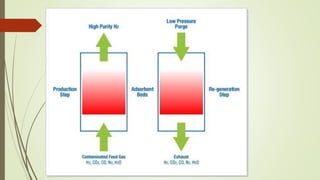
adsorption. By alternating between two adsorbent filled vessels, one vessel being
on line and removing moisture at high pressure, and the other off line releasing the
trapped moisture at low pressure, it is possible to thoroughly dry a gas.
PROCESS
 Pressure swing adsorption processes rely on the fact that under high pressure,
gases tend to be attracted to solid surfaces, or "adsorbed". The higher the pressure,
the more gas is adsorbed; when the pressure is reduced, the gas is released, or
desorbed. PSA processes can be used to separate gases in a mixture because
different gases tend to be attracted to different solid surfaces more or less
strongly. If a gas mixture such as air, for example, is passed under pressure through
a vessel containing an adsorbent bed of zeolite that attracts nitrogen more
strongly than it does oxygen, part or all of the nitrogen will stay in the bed, and the
gas coming out of the vessel will be enriched in oxygen. When the bed reaches the
end of its capacity to adsorb nitrogen, it can be regenerated by reducing the
pressure, thereby releasing the adsorbed nitrogen. It is then ready for another cycle
of producing oxygen-enriched air.
PROCESS
 This is the process used in medical oxygen concentrators used by emphysema
patients and others who require oxygen-enriched air to breathe.
 Using two adsorbent vessels allows near-continuous production of the target gas.
It also permits so-called pressure equalization, where the gas leaving the vessel
being depressurized is used to partially pressurize the second vessel. This results in
significant energy savings, and is common industrial practice.
ADSORBENTS
 Aside from their ability to discriminate between different gases, adsorbents for PSA
systems are usually very porous materials chosen because of their large specific
surface areas. Typical adsorbents are activated carbon, silica gel, alumina and
zeolite. Though the gas adsorbed on these surfaces may consist of a layer only one
or at most a few molecules thick, surface areas of several hundred square meters
per gram enable the adsorption of a significant portion of the adsorbent's weight
in gas. In addition to their selectivity for different gases, zeolites and some types of
activated carbon called carbon molecular sieves may utilize their molecular sieve
characteristics to exclude some gas molecules from their structure based on the
size of the molecules, thereby restricting the ability of the larger molecules to be
adsorbed.
APPLICATIONS
 Aside from its use to supply medical oxygen, or as a substitute for bulk cryogenic
or compressed-cylinder storage, which is the primary oxygen source for any
hospital, PSA has numerous other uses.
 One of the primary applications of PSA is in the removal of carbon dioxide (CO2) as
the final step in the large-scale commercial synthesis of hydrogen (H2) for use in oil
refineries and in the production of ammonia (NH3).
 Refineries often use PSA technology in the removal of hydrogen sulfide (H2S) from
hydrogen feed and recycle streams of hydro treating and hydrocracking units.
 Another application of PSA is the separation of carbon dioxide from biogas to
increase the methane (CH4) ratio. Through PSA the biogas can be upgraded to a
quality similar to natural gas.
APPLICATIONS
 PSA is also used in
 Hypoxic air fire prevention systems to produce air with a low oxygen content.
 On purpose propylene plants via propane dehydrogenation. They consist of a selective
medium for the preferred adsorption of methane and ethane over hydrogen.
 Industrial Nitrogen generator units which employ the PSA technique produce high
purity nitrogen gas (up to 99.9995%) from a supply of compressed air. But such PSA are
more fitted to supply intermediate ranges of purity and flows. Capacities of such units
are given in Nm³/h, normal cubic meters per hour, one Nm³/h being equivalent to 1000
liters per hour under any of several standard conditions of temperature, pressure, and
humidity.
 for nitrogen : from 100 Nm³/h at 99,9 % purity, to 9000 Nm³/h at 97% purity ;
 for oxygen : up to 1500 Nm³/h with a purity between 88% and 93%
ADVANCEMENT IN PSA
 Research is currently underway for PSA to capture CO2 in large quantities from
coal-fired power plants prior to geosequestration, in order to reduce greenhouse
gas production from these plants.
 PSA has also been discussed as a future alternative to the non-regenerable sorbent
technology used in space suit Primary Life Support Systems, in order to save
weight and extend the operating time of the suit.

Pressure swing adsorption

  • 1.
  • 2.
    CONTENT  Introduction  Process Adsorbents  Applications  Advancement in PSA
  • 3.
    INTRODUCTION  Pressure swingadsorption is a widely used technology for the purification of gases. This regeneration process is accomplished by reducing the pressure. At the moderate pressures found in compressed air systems, such as 100 pounds per square inch, an adsorbent can support a certain amount of moisture. When that pressure is dropped to ambient air pressure, the adsorbent can only support a smaller amount of moisture. By swinging the pressure from high to low, it is possible to adsorb large quantities of moisture at the higher pressure, and then release that moisture at the low pressure. This technique is called pressure swing adsorption. By alternating between two adsorbent filled vessels, one vessel being on line and removing moisture at high pressure, and the other off line releasing the trapped moisture at low pressure, it is possible to thoroughly dry a gas.
  • 5.
    PROCESS  Pressure swingadsorption processes rely on the fact that under high pressure, gases tend to be attracted to solid surfaces, or "adsorbed". The higher the pressure, the more gas is adsorbed; when the pressure is reduced, the gas is released, or desorbed. PSA processes can be used to separate gases in a mixture because different gases tend to be attracted to different solid surfaces more or less strongly. If a gas mixture such as air, for example, is passed under pressure through a vessel containing an adsorbent bed of zeolite that attracts nitrogen more strongly than it does oxygen, part or all of the nitrogen will stay in the bed, and the gas coming out of the vessel will be enriched in oxygen. When the bed reaches the end of its capacity to adsorb nitrogen, it can be regenerated by reducing the pressure, thereby releasing the adsorbed nitrogen. It is then ready for another cycle of producing oxygen-enriched air.
  • 6.
    PROCESS  This isthe process used in medical oxygen concentrators used by emphysema patients and others who require oxygen-enriched air to breathe.  Using two adsorbent vessels allows near-continuous production of the target gas. It also permits so-called pressure equalization, where the gas leaving the vessel being depressurized is used to partially pressurize the second vessel. This results in significant energy savings, and is common industrial practice.
  • 7.
    ADSORBENTS  Aside fromtheir ability to discriminate between different gases, adsorbents for PSA systems are usually very porous materials chosen because of their large specific surface areas. Typical adsorbents are activated carbon, silica gel, alumina and zeolite. Though the gas adsorbed on these surfaces may consist of a layer only one or at most a few molecules thick, surface areas of several hundred square meters per gram enable the adsorption of a significant portion of the adsorbent's weight in gas. In addition to their selectivity for different gases, zeolites and some types of activated carbon called carbon molecular sieves may utilize their molecular sieve characteristics to exclude some gas molecules from their structure based on the size of the molecules, thereby restricting the ability of the larger molecules to be adsorbed.
  • 8.
    APPLICATIONS  Aside fromits use to supply medical oxygen, or as a substitute for bulk cryogenic or compressed-cylinder storage, which is the primary oxygen source for any hospital, PSA has numerous other uses.  One of the primary applications of PSA is in the removal of carbon dioxide (CO2) as the final step in the large-scale commercial synthesis of hydrogen (H2) for use in oil refineries and in the production of ammonia (NH3).  Refineries often use PSA technology in the removal of hydrogen sulfide (H2S) from hydrogen feed and recycle streams of hydro treating and hydrocracking units.  Another application of PSA is the separation of carbon dioxide from biogas to increase the methane (CH4) ratio. Through PSA the biogas can be upgraded to a quality similar to natural gas.
  • 9.
    APPLICATIONS  PSA isalso used in  Hypoxic air fire prevention systems to produce air with a low oxygen content.  On purpose propylene plants via propane dehydrogenation. They consist of a selective medium for the preferred adsorption of methane and ethane over hydrogen.  Industrial Nitrogen generator units which employ the PSA technique produce high purity nitrogen gas (up to 99.9995%) from a supply of compressed air. But such PSA are more fitted to supply intermediate ranges of purity and flows. Capacities of such units are given in Nm³/h, normal cubic meters per hour, one Nm³/h being equivalent to 1000 liters per hour under any of several standard conditions of temperature, pressure, and humidity.  for nitrogen : from 100 Nm³/h at 99,9 % purity, to 9000 Nm³/h at 97% purity ;  for oxygen : up to 1500 Nm³/h with a purity between 88% and 93%
  • 10.
    ADVANCEMENT IN PSA Research is currently underway for PSA to capture CO2 in large quantities from coal-fired power plants prior to geosequestration, in order to reduce greenhouse gas production from these plants.  PSA has also been discussed as a future alternative to the non-regenerable sorbent technology used in space suit Primary Life Support Systems, in order to save weight and extend the operating time of the suit.