Pigments Are Insoluble, Fine Particle Size Materials
Which Confer On A Paint Its Color And Opacity.
The Pigments Are Used In Paint Formulation To Carry
Out One Or More Of The Following Tasks:
I. To Provide Color,
Ii. To Hide Substrates And Obliterate Previous Colors ,
Iii. To Improve The Strength Of The Paint Film,
Iv. To Improve The Adhesion Of The Paint Film,
V. To Reduce Gloss,
Vi. To Reduce Cost,
PIGMENTS
 Pigments serve three main functions: the optical function of
providing colour, opacity and gloss; a protective function with regards to
the surface underneath the paint and with regards to the binder which
can be destroyed by UV; and a reinforcing function for the paint itself in
that they help the binder to stick. Pigments are composed of tiny solid
particles less than 1μm in diameter, a size that enables them to refract
light (light has wavelengths between 0.4μm and 0.7μm).
 For the pigment to be effective it has to be evenly dispersed throughout
the solvent3 and in contact with the solvent. Surrounding pigment
particles is a layer of moist air and, in some cases, other gases. To bring
the pigment into contact with the solvent this layer has to be displaced,
and this displacement is known as wetting. If a pigment is not properly
wetted in a paint it may result in colour streakiness in the finished
paints, thus solvents and pigments must be chosen that result in a well
wetted pigment. Wetting and dispersing agents are used to improve the
wetting properties of the resin/solvent system.
CONSTITUENTS OF PIGMENTS
 All pigments should be insoluble in the medium in
which they are used, chemically inert, free of soluble
Salts and unaffected by normal temperatures.
 It should be easily wetted for proper dispersion,
Nontoxic, non-corrosive and have low oil-absorption
characteristics.
 They should be durable and fast to light as possible.
In general the following properties of the pigments
are important in selecting a pigment for any
particular product.
a) Hiding power
b) Tinting strength
c) Refractive index
d) Light fastness
e) Bleeding Characteristics
f) Particle size and shape
HIDING POWER
 Hiding Power is the ability of paint to completely
obliterate any underlying color and usually expressed as
the number of square meters of a surface covered by one
liter of paint.
 The pigments used must prevent light from passing
through the film to the previous colored layer and back
to the eye of an observer.
 Hiding power depends upon the wavelength and the total
amount of light that a pigment will absorb, on its
refractive index and also on particle size and shape.
TENTING STRENGTH
 Tenting Strength is the amount of a colored pigment required to
tint (color) a given weight of a white pigment to produce a given
shade.
 Tinting strengths are always relative to a standard sample of the
pigment under test, and for two samples of the same pigment, the
tinting strength is a measure of the difference in particle size and
distribution.
 Comparative tinting strengths of white pigments in a standard blue
pigment show that the tinting strength of rutile titanium pigment
exceeds that of all other listed pigments.
 The tinting strength of a pigment is independent of its hiding
power. Relatively transparent pigments can have a high tinting
strength
REFRACTIVE INDEX
 When light falls on a pigmented paint film, part
is reflected back whilst some enters the film.
 The light, which is reflected back, interacts with
the pigment on the way back through the film.
 The black and strongly colored pigments absorb
the light to obliterate any surface, whereas the
white pigments confer opacity solely by
scattering of light.
LIGHT FASTNESS
 Light fastness of a paint is its ability to resist
deterioration under the action of sunlight and
industrial fumes.
 Pigment stability during exposure to sunlight and
environment is of considerable importance. Many
pigments fade or darken or change shade badly in the
light.
 This is because the ultra-violet rays in the sunlight
are sufficiently energetic to break certain chemical
bonds and thus change molecules.
BLEEDING CHARACTERISTICS
 Some pigments (organic type) are soluble in
aromatic solvents and slightly soluble in alcohols
and other aliphatic solvents.
 This solvent solubility results in the phenomenon
of bleeding, whereby organic pigments in paint
films can be solubilized.
 The bleeding results in discoloration of paint
films.
DIFFERENCE BETWEEN DYE & PIGMENTS
 The materials used to impart color may either be pigments
or dyestuffs.
 The difference between pigments and dyes is their relative
solubility in the liquid media (solvent + binder) in which
they are dispersed.
 Dyes are soluble, while pigments are insoluble. This
solubility or insolubility is the reason a surface colored
with an insoluble pigment is opaque with their good light
fastness.
 A dye, on the other hand, may impart an intense color to
the surface but remain transparent and generally their light
fastness is fairly poor.
 Pigments, which can be organic or inorganic in
origin, have been classified in a variety of ways,
such as: color, natural or synthetic, and by chemical
types.
 Extenders are solid materials insoluble in the paint
medium but which impart little or no opacity or color
to the film into which they are incorporated.
 Extenders are incorporated into paints to modify the
flow properties, gloss, surface topography and the
mechanical and permeability characteristics of the
film.
THE CLASSIFICATION OF PIGMENTS
1. By Their Origin: Pigments can be classified by their
origin as natural, synthetic, or inorganic. Natural pigments
are produced by living organisms such as plants, animals,
fungi, and microorganisms. Synthetic pigments are
obtained from laboratories. Natural and synthetic pigments
are organic compounds. Inorganic pigments can be found
in nature or reproduced by synthesis.29
2. By the Chemical Structure of the Chromophore :
pigments can be classified by taking into account the
chromophore chemical structure. Chromophores with
conjugated systems: carotenoids, anthocyanins, betalains,
caramel, synthetic pigments, and lakes. Metal-coordinated
porphyrins: myoglobin, chlorophyll, and their derivatives.
3. By the Structural Characteristics of the Natural Pigments
:Moreover, natural pigments can be classified by their structural
characteristics as Tetrapyrrole derivatives: chlorophylls and heme
colors. Isoprenoid derivatives: carotenoids and iridoids. N-
heterocyclic compounds different from tetrapyrroles: purines,
pterins, flavins, phenazines, phenoxazines, and betalains.
Benzopyran derivatives (oxygenated heterocyclic compounds):
anthocyanins and other flavonoid pigments. Quinones:
benzoquinone, naphthoquinone, anthraquinone. Melanins.
4. As Food Additives :By considering the pigments as food
additives, their classification by the FDA is150,162,510
Certifiable. These are manmade and subdivided as synthetic
pigments and lakes.
Exempt from certification. This group includes pigments
derived from natural sources such as vegetables, minerals, or
animals, and manmade counterparts of natural derivatives.
ORGANIC PIGMENTS
 The organic coloring materials, which are insoluble
in the pure form, are known as toner pigments and
those, which require a base, are referred to as lakes.
 Compared with inorganic pigments, organic
pigments in general are brighter in color, more
transparent (lower hiding power), considerably
greater in tinting strength, and poorer in heat and
light-fastness.
 A large number of organic pigments are available in
the market.
RED PIGMENTS
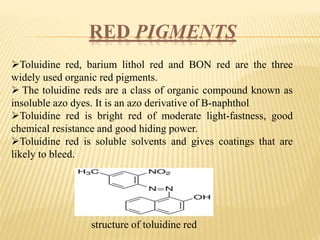
Toluidine red, barium lithol red and BON red are the three
widely used organic red pigments.
 The toluidine reds are a class of organic compound known as
insoluble azo dyes. It is an azo derivative of B-naphthol
Toluidine red is bright red of moderate light-fastness, good
chemical resistance and good hiding power.
Toluidine red is soluble solvents and gives coatings that are
likely to bleed.
structure of toluidine red
Barium lithol red is bright red in color and is suitable for interior
use only due to its relatively poor lightfastness and poor chemical
resistance.
structure of Barium lithol red
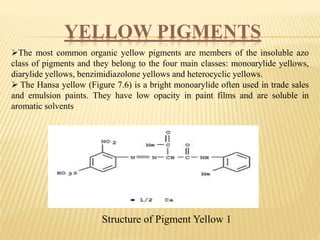
YELLOW PIGMENTS
Structure of Pigment Yellow 1
The most common organic yellow pigments are members of the insoluble azo
class of pigments and they belong to the four main classes: monoarylide yellows,
diarylide yellows, benzimidiazolone yellows and heterocyclic yellows.
 The Hansa yellow (Figure 7.6) is a bright monoarylide often used in trade sales
and emulsion paints. They have low opacity in paint films and are soluble in
aromatic solvents
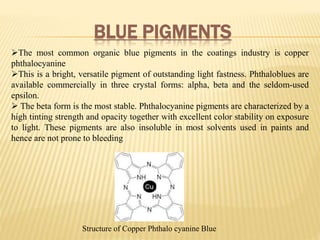
BLUE PIGMENTS
Structure of Copper Phthalo cyanine Blue
The most common organic blue pigments in the coatings industry is copper
phthalocyanine
This is a bright, versatile pigment of outstanding light fastness. Phthaloblues are
available commercially in three crystal forms: alpha, beta and the seldom-used
epsilon.
 The beta form is the most stable. Phthalocyanine pigments are characterized by a
high tinting strength and opacity together with excellent color stability on exposure
to light. These pigments are also insoluble in most solvents used in paints and
hence are not prone to bleeding
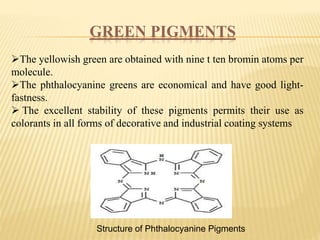
GREEN PIGMENTS
Structure of Phthalocyanine Pigments
The yellowish green are obtained with nine t ten bromin atoms per
molecule.
The phthalocyanine greens are economical and have good light-
fastness.
 The excellent stability of these pigments permits their use as
colorants in all forms of decorative and industrial coating systems
CLASSIFICATION OF INORGANIC PIGMENTS
 White pigment : 1)Titanium dioxide
2)Zinc oxide
3)Antimony oxide
4)White lead
5)Lead sulfate
 Colored Pigemts :1)Iron oxide
2)Red lead
3)Cadmium red
4)Lead silicochromate
5)Lead chromates
6)Zinc chromates
7)Cadmium yellow
8)Calcium plumbate
9)Chromium oxide
10) Prussian blue
11 )Ultramarine blue
 Metallic : 1)aluminium
2)Zinc
3)lead
 Extenders :1)Blanc fixe
2)Paris white
3)Barytes whiting
4)China clay
5)Mica
6)Talc
1)WHITE PIGMENTS
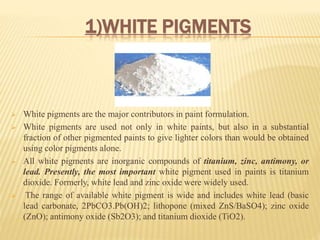
 White pigments are the major contributors in paint formulation.
 White pigments are used not only in white paints, but also in a substantial
fraction of other pigmented paints to give lighter colors than would be obtained
using color pigments alone.
 All white pigments are inorganic compounds of titanium, zinc, antimony, or
lead. Presently, the most important white pigment used in paints is titanium
dioxide. Formerly, white lead and zinc oxide were widely used.
 The range of available white pigment is wide and includes white lead (basic
lead carbonate, 2PbCO3.Pb(OH)2; lithopone (mixed ZnS/BaSO4); zinc oxide
(ZnO); antimony oxide (Sb2O3); and titanium dioxide (TiO2).
 Due to high toxicity of lead salts and because of this restriction
and also easy availability of titanium dioxide pigments, usage
of white lead dropped rapidly and is no longer permitted as a
constituent of most paints.
 Lithopone is a mixed zinc sulfide-barium sulfate pigment
available in two types; one containing 30 % zinc sulfide and
one containing 60 % zinc sulfide.
 Coprecipitation is achieved by reacting an aqueous solution of
zinc sulfate with barium sulfide. The barium sulfide solution is
prepared by reducing barite ore (BaSO4) with carbon.
B aSO4 + 4C B aS + 4C O
Z nSO 4 + B aS  B aSO 4 + Z n S
 After TiO2, zinc sulfide is the strongest white pigment due to
its brilliant white color, extremely fine texture and relative
cheaper cost.
TITANIUM DIOXIDE PIGMENT
 Titanium dioxide, also known as titanium(IV) oxide or titania, is the
naturally occurring oxide of titanium, chemical formula TiO 2. When used as
a pigment, it is called titanium white, Pigment White 6 (PW6), or CI 77891.
Generally it is sourced from ilmenite, rutile and anatase. It has a wide range of
applications, from paint to sunscreen to food colouring. When used as a food
colouring, it has E number E171
Manufacture process of Titanium dioxide
2)COLORED PIGMENTS
 Color pigments can be divided into inorganic and
organic products.
 The inorganic pigments are chemically inert, very
light-fast products based on oxides and sulfides of
the elements iron and chromium in particular, and of
zinc, molybdenum and cadmium to a smaller level.
 The color pigments may be either of natural or
synthetic origin. Synthetically produced pigments are
preferred by the paint formulators, since only they
fulfill for today’s requirements for color consistency
and uniformity.
 Color pigments can be divided into inorganic and
organicproducts.
 The inorganic pigments are chemically inert, very
light-fast products based on oxides and sulfides of
the elements iron and chromium in particular, and of
zinc, molybdenum and cadmium to a smaller level.
 The most important organic color pigments include
azo compounds, carbonyl colorants and
phthalocyanius, as well as their salts and metal
complexes.
RED PIGMENTS
 Red iron oxide (Fe2O3) is an inorganic pigment of either
natural or synthetic origin.
 Synthetic pigment is made by heating iron sulfate with
quicklime in a furnace.
 Indian red is a naturally occurring mineral whose ferric oxide
content may vary from 80 to 95%, the remainder being clay and
silica.
 It is made by grinding hematite and floating off the fines for
use.
 Red lead (Pb3O4) is a brilliant red-orange colored synthetic
inorganic pigment used mainly as a protective priming coat for
steel work rather than a coloring pigment in paints.
YELLOW AND ORANGE PIGMENTS
 Yellow Iron Oxide, FeO(OH), lead chromates, PbCrO4,
zinc chromates, ZnCrO4 and cadmium yellow, CdS belong
to standard pigments among the yellow pigments.
 Yellow iron oxides are of both natural and synthetic origin.
 The synthetic iron oxides are available in a wider range of
shades than the naturally occurring varieties.
 Yellow iron oxides give opaque films with good hiding and
high exterior durability; chemical and solvent resistance is
excellent.
BLUE AND GREEN PIGMENTS
 Ultramarine blue is a complex sodium aluminum silicate
and sulfide, made by calcining an intimate mixture of
sodium carbonate, china clay, sulfur and silica together
with some organic resinous material such as rosin.
 The color of the pigment is attributed to the presence of
sulfur.
 Ultramarine is widely used as bluing in laundering to
neutralize the yellowish tone in cotton and linen fabrics.
 Prussian blue, KFe(Fe(CN)6), is an intense reddish shade
blue pigment with fairly good properties. It is used as a
coloring pigment in many types of paint systems and is
also used in the production of lead chrome greens.
3)METALLIC PIGMENTS
 Black iron oxide, Fe3O4, is a synthetic inorganic
pigment, produced by oxidation of iron (II)
hydroxide obtained from the action of alkali on iron
(II) sulfate solution.
 Metallic pigments are used on the surfaces for luster
and brilliance finishes which are normally not
produced by conventional pigments.
 For many applications, a metallic effect is highly
desirable and can be achieved by adding aluminum,
zinc, bronze, stainless steel or pearlescent pigments.
ALUMINUM POWDER
 Aluminum powder is available in two forms: Leafing
grade and non-leafing grade. Both grades are manufactured
from pure aluminum (99.3-99.7% purity) and the particle
is lamellar in shape (0.1-2 μm in thickness and 0.5-200 μm
in diameter).
 In the milling process stearic acid is used to give the
leafing grade having a bright silvery appearance.
 The non-leafing grade aluminum types are manufactured
using oleic acid. The non-leafing grade is primarily used in
automotive topcoats where they impart an aesthetically
pleasing sparkle to the finish.
ZINC DUST
 There are two forms of zinc, namely powder and
dust. Only the zinc dust is used in coatings.
 Zinc dust is prepared by distilling zinc oxide, ZnO,
in the presence of carbon.
 Zinc dust primers provide a high degree of corrosion
protection to the steel substrate due to the tendency
of the metallic zinc to corrode preferentially to steel
4)EXTENDER PIGMENTS
 Extenders or extender pigments are white inorganic minerals that are
relatively deficient in both color and opacity and are commonly to
replace the more expensive prime pigments.
 These pigments are also referred to as inert pigments because of their
optically inert behavior in surface coatings.
 The extenders commonly used by the surface coatings industry
include, for the most part, the following: Calcite (Whiting), Silica,
Kaolin (Clay), Talc and Barytes.
 Calcite and whitings (refractive index: 1.5-1.7) are naturally
occurring calcium carbonate deposits. The lowest cost grades are
ground limestone or the mixed calcium magnesium carbonate ore,
dolomite.
 Calcium carbonate is the most widely used of the
extender pigments. It is used throughout the range of
water and solvent based paints for both interior and
exterior application.
 In some applications, the reactivity of calcium
carbonate with acids makes carbonate pigments
undesirable, especially in exterior applications.
 Silica (SiO2) (refractive index: 1.48) is mined from
deposits of diatomaceous soft chalk-like rock
(keiselghur).
REFERENCES
• http://faculty.kfupm.edu.sa/CHEM/belali/CHEM%2
0456/Chapter%207/CHAPTER%207_PAINTS,%20
PIGMENTS,%20AND%20INDUSTRIAL%20
• http://www.freedoniagroup.com/brochure/22xx/2232
smwe.pdf
• http://nzic.org.nz/ChemProcesses/polymers/10D.pdf
• https://mail.google.com/mail/u/0/?pli=1#inbox/14cf5
9ec65254863?projector=1
• Google images
Pigments

Pigments

  • 2.
    Pigments Are Insoluble,Fine Particle Size Materials Which Confer On A Paint Its Color And Opacity. The Pigments Are Used In Paint Formulation To Carry Out One Or More Of The Following Tasks: I. To Provide Color, Ii. To Hide Substrates And Obliterate Previous Colors , Iii. To Improve The Strength Of The Paint Film, Iv. To Improve The Adhesion Of The Paint Film, V. To Reduce Gloss, Vi. To Reduce Cost, PIGMENTS
  • 3.
     Pigments servethree main functions: the optical function of providing colour, opacity and gloss; a protective function with regards to the surface underneath the paint and with regards to the binder which can be destroyed by UV; and a reinforcing function for the paint itself in that they help the binder to stick. Pigments are composed of tiny solid particles less than 1μm in diameter, a size that enables them to refract light (light has wavelengths between 0.4μm and 0.7μm).  For the pigment to be effective it has to be evenly dispersed throughout the solvent3 and in contact with the solvent. Surrounding pigment particles is a layer of moist air and, in some cases, other gases. To bring the pigment into contact with the solvent this layer has to be displaced, and this displacement is known as wetting. If a pigment is not properly wetted in a paint it may result in colour streakiness in the finished paints, thus solvents and pigments must be chosen that result in a well wetted pigment. Wetting and dispersing agents are used to improve the wetting properties of the resin/solvent system.
  • 4.
    CONSTITUENTS OF PIGMENTS All pigments should be insoluble in the medium in which they are used, chemically inert, free of soluble Salts and unaffected by normal temperatures.  It should be easily wetted for proper dispersion, Nontoxic, non-corrosive and have low oil-absorption characteristics.  They should be durable and fast to light as possible.
  • 5.
    In general thefollowing properties of the pigments are important in selecting a pigment for any particular product. a) Hiding power b) Tinting strength c) Refractive index d) Light fastness e) Bleeding Characteristics f) Particle size and shape
  • 6.
    HIDING POWER  HidingPower is the ability of paint to completely obliterate any underlying color and usually expressed as the number of square meters of a surface covered by one liter of paint.  The pigments used must prevent light from passing through the film to the previous colored layer and back to the eye of an observer.  Hiding power depends upon the wavelength and the total amount of light that a pigment will absorb, on its refractive index and also on particle size and shape.
  • 7.
    TENTING STRENGTH  TentingStrength is the amount of a colored pigment required to tint (color) a given weight of a white pigment to produce a given shade.  Tinting strengths are always relative to a standard sample of the pigment under test, and for two samples of the same pigment, the tinting strength is a measure of the difference in particle size and distribution.  Comparative tinting strengths of white pigments in a standard blue pigment show that the tinting strength of rutile titanium pigment exceeds that of all other listed pigments.  The tinting strength of a pigment is independent of its hiding power. Relatively transparent pigments can have a high tinting strength
  • 8.
    REFRACTIVE INDEX  Whenlight falls on a pigmented paint film, part is reflected back whilst some enters the film.  The light, which is reflected back, interacts with the pigment on the way back through the film.  The black and strongly colored pigments absorb the light to obliterate any surface, whereas the white pigments confer opacity solely by scattering of light.
  • 9.
    LIGHT FASTNESS  Lightfastness of a paint is its ability to resist deterioration under the action of sunlight and industrial fumes.  Pigment stability during exposure to sunlight and environment is of considerable importance. Many pigments fade or darken or change shade badly in the light.  This is because the ultra-violet rays in the sunlight are sufficiently energetic to break certain chemical bonds and thus change molecules.
  • 10.
    BLEEDING CHARACTERISTICS  Somepigments (organic type) are soluble in aromatic solvents and slightly soluble in alcohols and other aliphatic solvents.  This solvent solubility results in the phenomenon of bleeding, whereby organic pigments in paint films can be solubilized.  The bleeding results in discoloration of paint films.
  • 11.
    DIFFERENCE BETWEEN DYE& PIGMENTS  The materials used to impart color may either be pigments or dyestuffs.  The difference between pigments and dyes is their relative solubility in the liquid media (solvent + binder) in which they are dispersed.  Dyes are soluble, while pigments are insoluble. This solubility or insolubility is the reason a surface colored with an insoluble pigment is opaque with their good light fastness.  A dye, on the other hand, may impart an intense color to the surface but remain transparent and generally their light fastness is fairly poor.
  • 12.
     Pigments, whichcan be organic or inorganic in origin, have been classified in a variety of ways, such as: color, natural or synthetic, and by chemical types.  Extenders are solid materials insoluble in the paint medium but which impart little or no opacity or color to the film into which they are incorporated.  Extenders are incorporated into paints to modify the flow properties, gloss, surface topography and the mechanical and permeability characteristics of the film.
  • 13.
    THE CLASSIFICATION OFPIGMENTS 1. By Their Origin: Pigments can be classified by their origin as natural, synthetic, or inorganic. Natural pigments are produced by living organisms such as plants, animals, fungi, and microorganisms. Synthetic pigments are obtained from laboratories. Natural and synthetic pigments are organic compounds. Inorganic pigments can be found in nature or reproduced by synthesis.29 2. By the Chemical Structure of the Chromophore : pigments can be classified by taking into account the chromophore chemical structure. Chromophores with conjugated systems: carotenoids, anthocyanins, betalains, caramel, synthetic pigments, and lakes. Metal-coordinated porphyrins: myoglobin, chlorophyll, and their derivatives.
  • 14.
    3. By theStructural Characteristics of the Natural Pigments :Moreover, natural pigments can be classified by their structural characteristics as Tetrapyrrole derivatives: chlorophylls and heme colors. Isoprenoid derivatives: carotenoids and iridoids. N- heterocyclic compounds different from tetrapyrroles: purines, pterins, flavins, phenazines, phenoxazines, and betalains. Benzopyran derivatives (oxygenated heterocyclic compounds): anthocyanins and other flavonoid pigments. Quinones: benzoquinone, naphthoquinone, anthraquinone. Melanins. 4. As Food Additives :By considering the pigments as food additives, their classification by the FDA is150,162,510 Certifiable. These are manmade and subdivided as synthetic pigments and lakes. Exempt from certification. This group includes pigments derived from natural sources such as vegetables, minerals, or animals, and manmade counterparts of natural derivatives.
  • 15.
    ORGANIC PIGMENTS  Theorganic coloring materials, which are insoluble in the pure form, are known as toner pigments and those, which require a base, are referred to as lakes.  Compared with inorganic pigments, organic pigments in general are brighter in color, more transparent (lower hiding power), considerably greater in tinting strength, and poorer in heat and light-fastness.  A large number of organic pigments are available in the market.
  • 16.
    RED PIGMENTS Toluidine red,barium lithol red and BON red are the three widely used organic red pigments.  The toluidine reds are a class of organic compound known as insoluble azo dyes. It is an azo derivative of B-naphthol Toluidine red is bright red of moderate light-fastness, good chemical resistance and good hiding power. Toluidine red is soluble solvents and gives coatings that are likely to bleed. structure of toluidine red
  • 17.
    Barium lithol redis bright red in color and is suitable for interior use only due to its relatively poor lightfastness and poor chemical resistance. structure of Barium lithol red
  • 18.
    YELLOW PIGMENTS Structure ofPigment Yellow 1 The most common organic yellow pigments are members of the insoluble azo class of pigments and they belong to the four main classes: monoarylide yellows, diarylide yellows, benzimidiazolone yellows and heterocyclic yellows.  The Hansa yellow (Figure 7.6) is a bright monoarylide often used in trade sales and emulsion paints. They have low opacity in paint films and are soluble in aromatic solvents
  • 19.
    BLUE PIGMENTS Structure ofCopper Phthalo cyanine Blue The most common organic blue pigments in the coatings industry is copper phthalocyanine This is a bright, versatile pigment of outstanding light fastness. Phthaloblues are available commercially in three crystal forms: alpha, beta and the seldom-used epsilon.  The beta form is the most stable. Phthalocyanine pigments are characterized by a high tinting strength and opacity together with excellent color stability on exposure to light. These pigments are also insoluble in most solvents used in paints and hence are not prone to bleeding
  • 20.
    GREEN PIGMENTS Structure ofPhthalocyanine Pigments The yellowish green are obtained with nine t ten bromin atoms per molecule. The phthalocyanine greens are economical and have good light- fastness.  The excellent stability of these pigments permits their use as colorants in all forms of decorative and industrial coating systems
  • 21.
    CLASSIFICATION OF INORGANICPIGMENTS  White pigment : 1)Titanium dioxide 2)Zinc oxide 3)Antimony oxide 4)White lead 5)Lead sulfate  Colored Pigemts :1)Iron oxide 2)Red lead 3)Cadmium red 4)Lead silicochromate 5)Lead chromates 6)Zinc chromates 7)Cadmium yellow 8)Calcium plumbate 9)Chromium oxide 10) Prussian blue 11 )Ultramarine blue
  • 22.
     Metallic :1)aluminium 2)Zinc 3)lead  Extenders :1)Blanc fixe 2)Paris white 3)Barytes whiting 4)China clay 5)Mica 6)Talc
  • 23.
    1)WHITE PIGMENTS  Whitepigments are the major contributors in paint formulation.  White pigments are used not only in white paints, but also in a substantial fraction of other pigmented paints to give lighter colors than would be obtained using color pigments alone.  All white pigments are inorganic compounds of titanium, zinc, antimony, or lead. Presently, the most important white pigment used in paints is titanium dioxide. Formerly, white lead and zinc oxide were widely used.  The range of available white pigment is wide and includes white lead (basic lead carbonate, 2PbCO3.Pb(OH)2; lithopone (mixed ZnS/BaSO4); zinc oxide (ZnO); antimony oxide (Sb2O3); and titanium dioxide (TiO2).
  • 24.
     Due tohigh toxicity of lead salts and because of this restriction and also easy availability of titanium dioxide pigments, usage of white lead dropped rapidly and is no longer permitted as a constituent of most paints.  Lithopone is a mixed zinc sulfide-barium sulfate pigment available in two types; one containing 30 % zinc sulfide and one containing 60 % zinc sulfide.  Coprecipitation is achieved by reacting an aqueous solution of zinc sulfate with barium sulfide. The barium sulfide solution is prepared by reducing barite ore (BaSO4) with carbon. B aSO4 + 4C B aS + 4C O Z nSO 4 + B aS  B aSO 4 + Z n S  After TiO2, zinc sulfide is the strongest white pigment due to its brilliant white color, extremely fine texture and relative cheaper cost.
  • 25.
    TITANIUM DIOXIDE PIGMENT Titanium dioxide, also known as titanium(IV) oxide or titania, is the naturally occurring oxide of titanium, chemical formula TiO 2. When used as a pigment, it is called titanium white, Pigment White 6 (PW6), or CI 77891. Generally it is sourced from ilmenite, rutile and anatase. It has a wide range of applications, from paint to sunscreen to food colouring. When used as a food colouring, it has E number E171 Manufacture process of Titanium dioxide
  • 26.
    2)COLORED PIGMENTS  Colorpigments can be divided into inorganic and organic products.  The inorganic pigments are chemically inert, very light-fast products based on oxides and sulfides of the elements iron and chromium in particular, and of zinc, molybdenum and cadmium to a smaller level.  The color pigments may be either of natural or synthetic origin. Synthetically produced pigments are preferred by the paint formulators, since only they fulfill for today’s requirements for color consistency and uniformity.
  • 27.
     Color pigmentscan be divided into inorganic and organicproducts.  The inorganic pigments are chemically inert, very light-fast products based on oxides and sulfides of the elements iron and chromium in particular, and of zinc, molybdenum and cadmium to a smaller level.  The most important organic color pigments include azo compounds, carbonyl colorants and phthalocyanius, as well as their salts and metal complexes.
  • 28.
    RED PIGMENTS  Rediron oxide (Fe2O3) is an inorganic pigment of either natural or synthetic origin.  Synthetic pigment is made by heating iron sulfate with quicklime in a furnace.  Indian red is a naturally occurring mineral whose ferric oxide content may vary from 80 to 95%, the remainder being clay and silica.  It is made by grinding hematite and floating off the fines for use.  Red lead (Pb3O4) is a brilliant red-orange colored synthetic inorganic pigment used mainly as a protective priming coat for steel work rather than a coloring pigment in paints.
  • 29.
    YELLOW AND ORANGEPIGMENTS  Yellow Iron Oxide, FeO(OH), lead chromates, PbCrO4, zinc chromates, ZnCrO4 and cadmium yellow, CdS belong to standard pigments among the yellow pigments.  Yellow iron oxides are of both natural and synthetic origin.  The synthetic iron oxides are available in a wider range of shades than the naturally occurring varieties.  Yellow iron oxides give opaque films with good hiding and high exterior durability; chemical and solvent resistance is excellent.
  • 30.
    BLUE AND GREENPIGMENTS  Ultramarine blue is a complex sodium aluminum silicate and sulfide, made by calcining an intimate mixture of sodium carbonate, china clay, sulfur and silica together with some organic resinous material such as rosin.  The color of the pigment is attributed to the presence of sulfur.  Ultramarine is widely used as bluing in laundering to neutralize the yellowish tone in cotton and linen fabrics.  Prussian blue, KFe(Fe(CN)6), is an intense reddish shade blue pigment with fairly good properties. It is used as a coloring pigment in many types of paint systems and is also used in the production of lead chrome greens.
  • 31.
    3)METALLIC PIGMENTS  Blackiron oxide, Fe3O4, is a synthetic inorganic pigment, produced by oxidation of iron (II) hydroxide obtained from the action of alkali on iron (II) sulfate solution.  Metallic pigments are used on the surfaces for luster and brilliance finishes which are normally not produced by conventional pigments.  For many applications, a metallic effect is highly desirable and can be achieved by adding aluminum, zinc, bronze, stainless steel or pearlescent pigments.
  • 32.
    ALUMINUM POWDER  Aluminumpowder is available in two forms: Leafing grade and non-leafing grade. Both grades are manufactured from pure aluminum (99.3-99.7% purity) and the particle is lamellar in shape (0.1-2 μm in thickness and 0.5-200 μm in diameter).  In the milling process stearic acid is used to give the leafing grade having a bright silvery appearance.  The non-leafing grade aluminum types are manufactured using oleic acid. The non-leafing grade is primarily used in automotive topcoats where they impart an aesthetically pleasing sparkle to the finish.
  • 33.
    ZINC DUST  Thereare two forms of zinc, namely powder and dust. Only the zinc dust is used in coatings.  Zinc dust is prepared by distilling zinc oxide, ZnO, in the presence of carbon.  Zinc dust primers provide a high degree of corrosion protection to the steel substrate due to the tendency of the metallic zinc to corrode preferentially to steel
  • 34.
    4)EXTENDER PIGMENTS  Extendersor extender pigments are white inorganic minerals that are relatively deficient in both color and opacity and are commonly to replace the more expensive prime pigments.  These pigments are also referred to as inert pigments because of their optically inert behavior in surface coatings.  The extenders commonly used by the surface coatings industry include, for the most part, the following: Calcite (Whiting), Silica, Kaolin (Clay), Talc and Barytes.  Calcite and whitings (refractive index: 1.5-1.7) are naturally occurring calcium carbonate deposits. The lowest cost grades are ground limestone or the mixed calcium magnesium carbonate ore, dolomite.
  • 35.
     Calcium carbonateis the most widely used of the extender pigments. It is used throughout the range of water and solvent based paints for both interior and exterior application.  In some applications, the reactivity of calcium carbonate with acids makes carbonate pigments undesirable, especially in exterior applications.  Silica (SiO2) (refractive index: 1.48) is mined from deposits of diatomaceous soft chalk-like rock (keiselghur).
  • 36.
    REFERENCES • http://faculty.kfupm.edu.sa/CHEM/belali/CHEM%2 0456/Chapter%207/CHAPTER%207_PAINTS,%20 PIGMENTS,%20AND%20INDUSTRIAL%20 • http://www.freedoniagroup.com/brochure/22xx/2232 smwe.pdf •http://nzic.org.nz/ChemProcesses/polymers/10D.pdf • https://mail.google.com/mail/u/0/?pli=1#inbox/14cf5 9ec65254863?projector=1 • Google images